RC Chakraborty, www.myreaders.info
Hybrid Systems – Integration of NN, GA and FS : Course Lecture 41 – 42, notes, slides
www.myreaders.info/ , RC Chakraborty, e-mail [email protected] , Aug. 10, 2010 http://www.myreaders.info/html/soft_computing.html
Hybrid Systems
Integration of Neural Network, Fuzzy Logic & Genetic Algorithm
Soft Computing
www.myreaders.info
Return to Website
Hybrid systems, topic : Integration of neural networks, fuzzy logic and genetic algorithms; Hybrid systems - sequential, auxiliar, and embedded; Neuro-Fuzzy hybrid - integration of NN and FL; Neuro- Genetic hybrids - integration of GAs and NNs ; Fuzzy-Genetic hybrids - integration of FL and GAs. Genetic Algorithms Based Back Propagation Networks : hybridization of BPN and GAs;
Genetic algorithms based techniques for determining weights in a BPN - coding, weight extraction, fitness function algorithm, reproduction of offspring, selection of parent chromosomes, convergence. Fuzzy back propagation networks : LR-type fuzzy numbers, operations on LR-type fuzzy numbers; Fuzzy neuron;
Architecture of fuzzy BP. Fuzzy associative memories : example of FAM Model of washing machine - variables, operations, representation, defuzzification. Simplified fuzzy ARTMAP : supervised ARTMAP system, comparing ARTMAP with back- propagation networks.
RC Chakraborty, www.myreaders.info
Hybrid Systems
Integration of Neural Network, Fuzzy Logic & Genetic Algorithm
Soft Computing
Topics
(Lectures 41, 42 2 hours) Slides
1. Integration of Neural Networks, Fuzzy Logic and Genetic Algorithms Hybrid systems : Sequential, Auxiliar, Embedded; Neuro-Fuzzy Hybrid : Integration of NN and FL; Neuro-Genetic Hybrids : Integration of GAs and NNs ; Fuzzy-Genetic Hybrids : Integration of FL and GAs; Typical Hybrid systems.
03-13
2. Genetic Algorithms Based Back Propagation Networks
Hybridization of BPN and GAs; GA based techniques for determining weights in a BPN : Coding, Weight extraction, Fitness function algorithm, Reproduction of offspring, Selection of parent chromosomes, Convergence.
14-25
3. Fuzzy Back Propagation Networks
LR-type Fuzzy numbers; Operations on LR-type Fuzzy Numbers; Fuzzy Neuron; Architecture of Fuzzy BP.
26-32
4. Fuzzy Associative Memories
Example : FAM Model of Washing Machine - Variables, Operations, Representation, Defuzzification.
33-37
5. Simplified Fuzzy ARTMAP
Supervised ARTMAP system, Comparing ARTMAP with Back-Propagation Networks.
38-40
6. References 41
02
RC Chakraborty, www.myreaders.info
Hybrid Systems
Integration of NN FL GA
What is Hybridization ?
• Hybrid systems employ more than one technology to solve a problem.
• Hybridization of technologies can have pitfalls and therefore need to be done with care.
• If one technology can solve a problem then a hybrid technology ought to be used only if its application results in a better solution.
• Hybrid systems have been classified as :
− Sequential hybrid system: the technologies are used in pipelining fashion;
− Auxiliary hybrid system: the one technology calls the other technology as subroutine;
− Embedded hybrid system : the technologies participating appear to be fused totally.
• Hybridization of fuzzy logic, neural networks, genetic algorithms has led to creation of a perspective scientific trend known as soft computing.
− Neural networks mimic our ability to adapt to circumstances and learn from past experience,
− Fuzzy logic addresses the imprecision or vagueness in input and output,
− Genetic algorithms are inspired by biological evolution, can systemize random search and reach to optimum characteristics.
• Each of these technologies have provided efficient solution to wide range of problems belonging to different domains. However, each of these technologies has advantages and disadvantages. It is therefore appropriate that Hybridization of these three technologies are done so as to over come the weakness of one with the strength of other.
03
RC Chakraborty, www.myreaders.info
SC – Hybrid Systems - Introduction 1. Introduction :
Hybridization - Integration of NN , FL , and GA
Fuzzy logic, Neural networks and Genetic algorithms are soft computing methods which are inspired by biological computational processes and nature's problem solving strategies.
Neural Networks (NNs) are highly simplified model of human nervous system which mimic our ability to adapt to circumstances and learn from past experience. Neural Networks systems are represented by different architectures like single and multilayer feed forward network. The networks offers back proposition generalization, associative memory and adaptive resonance theory.
Fuzzy logic addresses the imprecision or vagueness in input and output description of the system. The sets have no crisp boundaries and provide a gradual transition among the members and non-members of the set elements.
Genetic algorithms are inspired by biological evolution, can systemize random search and reach to optimum characteristics.
Each of these technologies have provided efficient solution to wide range of problems belonging to different domains. However, each of these technologies suffer from advantages and disadvantages.
It is therefore appropriate that Hybridization of these three technologies are done so as to over come the weakness of one with the strength of other.
04
RC Chakraborty, www.myreaders.info
SC – Hybrid Systems - Introduction 1.1 Hybrid Systems
Hybrid systems employ more than one technology to solve a problem.
Hybridization of technologies can have pitfalls and therefore need to be done with care. If one technology can solve a problem then a hybrid technology ought to be used only if its application results in a better solution. Hybrid systems have been classified as Sequential , Auxiliary and Embedded.
In Sequential hybrid system, the technologies are used in pipelining fashion.
In Auxiliary hybrid system, one technology calls the other technology as subroutine.
In Embedded hybrid system, the technologies participating appear to be fused totally.
05
RC Chakraborty, www.myreaders.info
SC – Hybrid Systems - Introduction
• Sequential Hybrid System
In Sequential hybrid system, the technologies are used in pipelining fashion. Thus, one technology's output becomes another technology's input and it goes on. However, this is one of the weakest form of hybridization since an integrated combination of technologies is not present.
Example: A Genetic algorithm preprocessor obtains the optimal parameters for different instances of a problem and hands over the preprocessed data to a neural network for further processing.
06
RC Chakraborty, www.myreaders.info
SC – Hybrid Systems - Introduction
• Auxiliary Hybrid System
In Auxiliary hybrid system, one technology calls the other technology as subroutine to process or manipulate information needed. The second technology processes the information provided by the first and hands it over for further use. This type of hybridization is better than the sequential hybrids.
Example : A neuron-genetic system in which a neural network employs a genetic algorithm to optimize its structural parameters that defines its architecture.
07
RC Chakraborty, www.myreaders.info
SC – Hybrid Systems - Introduction
• Embedded Hybrid System
In Embedded hybrid system, the technologies participating are integrated in such a manner that they appear intertwined. The fusion is so complete that it would appear that no technology can be used without the others for solving the problem.
Example : A NN-FL hybrid system may have an NN which receives fuzzy inputs, processes it and extracts fuzzy outputs as well.
08
RC Chakraborty, www.myreaders.info
SC – Hybrid Systems - Introduction 1.2 Neural Networks, Fuzzy Logic, and Genetic Algorithms Hybrids
Neural Networks, Fuzzy Logic, and Genetic Algorithms are three distinct technologies.
Each of these technologies has advantages and disadvantages. It is therefore appropriate that hybridization of these three technologies are done so as to over come the weakness of one with the strength of other.
09
RC Chakraborty, www.myreaders.info
SC – Hybrid Systems - Introduction
• Neuro-Fuzzy Hybrid
Neural Networks and Fuzzy logic represents two distinct methodologies to deal with uncertainty. Each of these has its own merits and demerits.
Neural Networks :
− Merits : Neural Networks, can model complex nonlinear relationships and are appropriately suited for classification phenomenon into predetermined classes.
− Demerits : Neural Network's output, precision is often limited to least squares errors; the training time required is quite large; the training data has to be chosen over entire range where the variables are expected to change.
Fuzzy logic :
− Merits : Fuzzy logic system, addresses the imprecision of inputs and outputs defined by fuzzy sets and allow greater flexibility in formulating detail system description.
Integration of NN and FL, called Neuro-Fuzzy systems, have the potential to extend the capabilities of the systems beyond either of these two technologies applied individually. The integrated systems have turned out to be useful in :
− accomplishing mathematical relationships among many variables in a complex dynamic process,
− performing mapping with some degree of imprecision, and
− controlling nonlinear systems to an extent not possible with conventional linear control systems.
There are two ways to do hybridization :
− One, is to provide NNs with fuzzy capabilities, there by increasing the network's expressiveness and flexibility to adapt to uncertain environments.
− Second, is to apply neuronal learning capabilities to fuzzy systems so that the fuzzy systems become more adaptive to changing environments. This method is called NN driven fuzzy reasoning.
10
RC Chakraborty, www.myreaders.info
SC – Hybrid Systems - Introduction
• Neuro-Genetic Hybrids
The Neural Networks and Genetic Algorithms represents two distinct methodologies.
Neural Networks : can learn various tasks from examples, classify phenomena and model nonlinear relationships.
Genetic Algorithms : have offered themselves as potential candidates for the optimization of parameters of NN.
Integration of GAs and NNs has turned out to be useful.
− Genetically evolved nets have reported comparable results against their conventional counterparts.
− The gradient descent learning algorithms have reported difficulties in leaning the topology of the networks whose weights they optimize.
− GA based algorithms have provided encouraging results especially with regard to face recognition, animal control, and others.
− Genetic algorithms encode the parameters of NNs as a string of properties of the network, i.e. chromosomes. A large population of chromosomes representing many possible parameters sets, for the given NN, is generated.
− GA-NN is also known as GANN have the ability to locate the neighborhood of the optimal solution quicker than other conventional search strategies.
− The drawbacks of GANN algorithms are : large amount of memory required to handle and manipulate chromosomes for a given network;
the question is whether this problem scales as the size of the networks become large.
11
RC Chakraborty, www.myreaders.info
SC – Hybrid Systems - Introduction
• Fuzzy-Genetic Hybrids
Fuzzy systems have been integrated with GAs.
The fuzzy systems like NNs (feed forward) are universal approximator in the sense that they exhibit the capability to approximate general nonlinear functions to any desired degree of accuracy.
The adjustments of system parameters called for in the process, so that the system output matches the training data, have been tackled using GAs. Several parameters which a fuzzy system is involved with like input/output variables and the membership function that define the fuzzy systems, have been optimized using GAs.
12
RC Chakraborty, www.myreaders.info
SC – Hybrid Systems - Introduction 1.3 Typical Hybrid Systems
The Systems considered are listed below.
1. Genetic algorithm based back propagation network (Neuro Genetic Hybrid)
2. Fuzzy back propagation network
(Neuro – Fuzzy Hybrid with Multilayer Feed forward Network as the host architecture)
3. Simplified Fuzzy ARTMAP
(Neuro – Fuzzy Hybrid with Recurrent Network as the host architecture) 4. Fuzzy Associative Memory
( Neuro – Fuzzy Hybrid with single layer Feed forward architecture) 5. Fuzzy logic controlled Genetic algorithm
(Fuzzy – Genetic Hybrid)
13
RC Chakraborty, www.myreaders.info
SC – Hybrid Systems – GA based BPN 2. Genetic Algorithm (GA) based Back Propagation Network (BPN)
Neural networks (NNs) are the adaptive system that changes its structure based on external or internal information that flows through the network.
Neural network solve problems by self-learning and self-organizing.
Back Propagation Network (BPN) is a method of training multi-layer neural networks. Here learning occurs during this training phase.
The steps involved are:
− The pattern of activation arriving at the output layer is compared with the correct output pattern to calculate an error signal.
− The error signal is then back-propagated from output to input for adjusting the weights in each layer of the BPN.
− The Back-Propagation searches on the error surface using gradient descent method to minimize error E = 1/2 Σ ( T j – O j )2 where T j is target output and O j is the calculated output by the network.
Limitations of BPN :
− BPN can recognize patterns similar to those they have learnt, but do not have the ability to recognize new patterns.
− BPN must be sufficiently trained to extract enough general features applicable to both seen and unseen; over training to network may have undesired effects.
14
RC Chakraborty, www.myreaders.info
SC – Hybrid Systems – GA based BPN [ continued from previous slide ]
Genetic Algorithms (GAs) are adaptive search and optimization algorithms, mimic the principles of nature.
− GAs are different form traditional search and
− Optimization exhibit simplicity, ease of operation, minimal requirements, and global perspective.
Hybridization of BPN and GAs
− The BPN determines its weight based on gradient search technique and therefore it may encounter a local minima problem.
− GAs do not guarantee to find global optimum solution, but are good in finding quickly good acceptable solution.
− Therefore, hybridization of BPN and GAs are expected to provide many advantages compare to what they alone can.
The GA based techniques for determining weights in a BPN are explained next.
15
RC Chakraborty, www.myreaders.info
SC – Hybrid Systems – GA based BPN 2.1 GA based techniques for determining weights in a BPN
Genetic algorithms work with population of individual strings.
The steps involved in GAs are:
− each individual string represent a possible solution of the problem considered,
− each individual string is assigned a fitness value,
− high fit individuals participate in reproduction, yields new strings as offspring and they share some features with each parents,
− low fit individuals are kept out from reproduction and so die,
− a whole new population of possible solutions to the problem is generated by selecting high fit individuals from current generation,
− this new generation contains characteristics which are better than their ancestors,
− processing this way after many generation, the entire population inherits the best and fit solution.
However, before a GA is executed :
− a suitable coding for the problem is devised,
− a fitness function is formulated,
− parents have to be selected for reproduction and crossover to generate offspring.
All these aspects of GAs for determining weights of BPN are illustrated in next few slides.
16
RC Chakraborty, www.myreaders.info
SC – Hybrid Systems – GA based BPN
• Coding
Assume a BPN configuration ℓ - m – n where
− ℓ is input , m is hidden and n is output neurons.
− number of weights to be determined are (ℓ + n) m.
− each weight (gene) is a real number.
− assume number of digits (gene length) in weight are d .
− a string S represents weight matrices of input-hidden and the hidden- output layers in a linear form arranged as row-major or column-major selected.
− population size is the randomly generated initial population of p chromosomes.
Example :
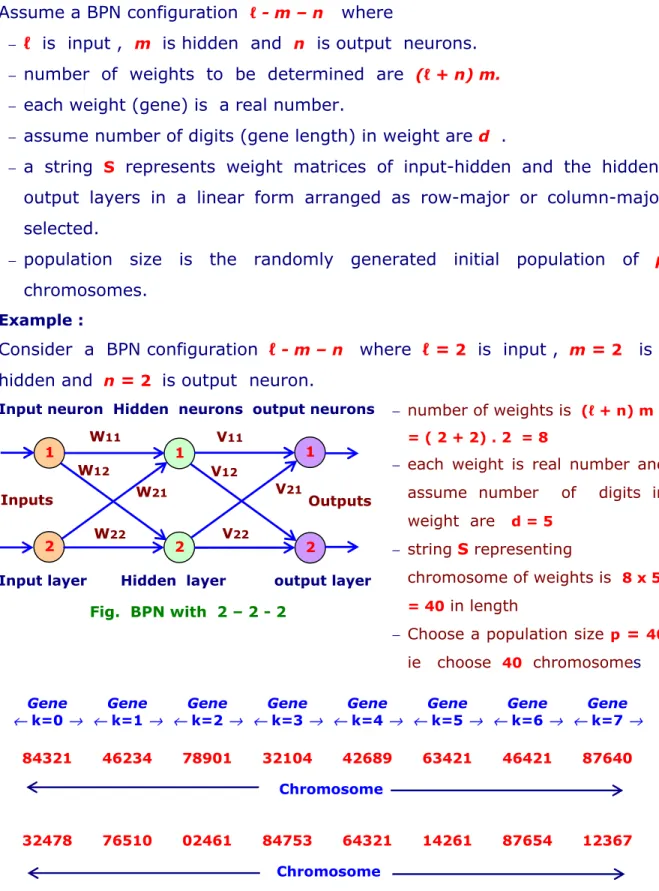
Consider a BPN configuration ℓ - m – n where ℓ = 2 is input , m = 2 is hidden and n = 2 is output neuron.
Input neuron Hidden neurons output neurons
Input layer Hidden layer output layer Fig. BPN with 2 – 2 - 2
− number of weights is (ℓ + n) m
= ( 2 + 2) . 2 = 8
− each weight is real number and assume number of digits in weight are d = 5
− string S representing
chromosome of weights is 8 x 5
= 40 in length
− Choose a population size p = 40 ie choose 40 chromosomes
Gene
← k=0 → Gene
← k=1 → Gene
← k=2 → Gene
← k=3 → Gene
← k=4 → Gene
← k=5 → Gene
← k=6 → Gene
← k=7 → 84321 46234 78901 32104 42689 63421 46421 87640
Chromosome
32478 76510 02461 84753 64321 14261 87654 12367 Chromosome
Fig. Some randomly generated chromosome made of 8 genes representing 8 weights for BPN
17
1
2
1 1
2 2
W11
Inputs
W12
W21
W22
V11
V22
V12
V21
Outputs
RC Chakraborty, www.myreaders.info
SC – Hybrid Systems – GA based BPN
• Weight Extraction
Extract weights from each chromosomes, later to determine the fitness values.
Let x1 , x2 , . . . . x d , . . . . x L represent a chromosome and Let xkd+1 , xkd+2 , . . x(k + 1)d represent kth gene (k ≥ 0) in the chromosomes.
The actual weightwk is given by
xkd+2 10d-2 + xkd +3 10d-3 + . . . + x(k + 1)d , if 5 ≤ xkd +1 ≤ 9 10d-2
wk =
xkd +2 10d-2 + xkd +3 10d-3 + . . . + x(k + 1)d , if 0 ≤ xkd +1 < 5 10d-2
Example : [Ref Fig. BPN previous slide]
The Chromosomes are stated in the Fig. The weights extracted from all the eight genes are :
■ Gene 0 : 84321 ,
Here we have, k = 0 , d = 5 , and xkd +1 is x1 such that 5 ≤ x1 = 8 ≤ 9. Hence, the weight extracted is
4 x 10³ + 3 x 10² + 2 x 10 + 1 103
■ Gene 1 : 46234 ,
Here we have, k = 1 , d = 5 , and xkd +1 is x6 such that 0 ≤ x6 = 4 ≤ 5. Hence, the weight extracted is
6 x 10³ + 2 x 10² + 3 x 10 + 4 103
■ Similarly for the remaining genes Gene 2 : 78901 yields W2 = + 8.901 Gene 3 : 32104 yields W3 = − 2.104 Gene 4 : 42689 yields W4 = − 2.689 Gene 5 : 63421 yields W5 = + 3.421 Gene 6 : 46421 yields W6 = − 6.421 Gene 7 : 87640 yields W7 = + 7.640
18
+
W0 = + = +4.321
W1 = − = − 6.234
RC Chakraborty, www.myreaders.info
SC – Hybrid Systems – GA based BPN
• Fitness Function :
A fitness is devised for each problem.
Example :
The matrix on the right, represents a set of input I and output T for problem P to be solved.
Generate initial population P0 of size p = 40.
(I11 , I21) (T11 , T21) (I12 , I22) (T12 , T22) (I13 , I23) (T13 , T23)
Let C01 , C01 , . . . , C040 represent the 40 chromosomes.
Let , , . . . . be the weight sets extracted, using the Eq.
in the previous slides, from each of the chromosome C0i , i = 1, 2, . . . , 40 . Let , , be the calculated outputs of BPN.
Compute root mean square error : E 1 = (T11 – O11)2 + (T21 – O21)2 , E 2 = (T12 – O12)2 + (T22 – O22)2 E3 = (T13 – O13)2 + (T23 – O23)2 The root mean square of error is E = [(E1 + E2 + E3) / 3 ] 1/2 Compute Fitness F1 :
The fitness F1 for the chromosome C01 is given by F1 = 1 / E .
Similarly, find the fitness F2 for the chromosome C02 and so on the fitness Fn for the chromosome C0n
19
w02
w01 w040
o 02
o01 o 03
RC Chakraborty, www.myreaders.info
SC – Hybrid Systems – GA based BPN [ continued from previous slide fitness fuction]
Algorithm {
Let ( , ) , i = 1 , 2 , . . . , N represents the input-output pairs of the problem to be solved by BPN with configuration ℓ - m – n ; where = (I1i , I2i , , . . . , Iℓ i ) and
= (T1i , T2i , , . . . , Tn i )
For each chromosome C i , i = 1 , 2 , . . . , p belonging to current the population P i whose size is p
{
Extract weights form C i using Eq. 2.1 in previous slide;
Keeping as a fixed weight, train the BPN for the N input instances;
Calculate error E i for each of the input instances using the formula below E i = ( T j i – O j i )2 where is the output vector calculated by BPN;
Find the root mean square E of the errors E i , i = 1 , 2 , . . . , N i.e. E = ( ( E i ) / N ) 1/2
Calculate the Fitness value F i for each of the individual string of the population as Fi = 1 / E
}
Output Fi for each C i , i = 1 , 2 , . . . , p ; }
20
Ii Ti
I Ti
wi
wi
Σ
j O i
Σ
iRC Chakraborty, www.myreaders.info
SC – Hybrid Systems – GA based BPN [ continued from previous slide - Fitness Function ]
Thus the Fitness values Fi for all chromosomes in the initial population are computed. The population size is p = 40, so F i , i = 1 , 2 , . . , 40 are computed.
A schematic for the computation of fitness values is illustrated below.
Fig. Computation of Fitness values for the population
21
C01
C02
---- ----
C040
Fi =1/E ---
--- w01
w02
W040 Fitness
Values Initial
Population of
Chromosomes Extracted weight sets
Training BPN
Extract Input Output
Error E weights
weights
Compute Fitness
RC Chakraborty, www.myreaders.info
SC – Hybrid Systems – GA based BPN
• Reproduction of Offspring
Before the parent chromosomes reproduce offspring :
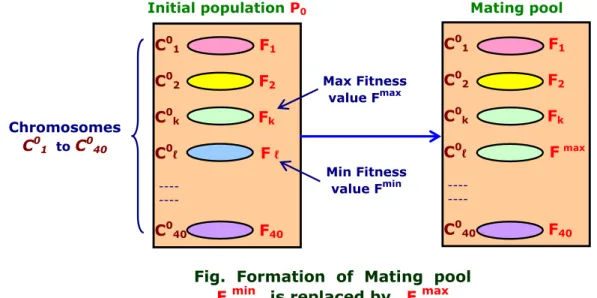
First, form a mating pool by excluding that chromosome C ℓ with least fitness F min and then replacing it with a duplicate copy of C k with highest fitness F max ;
i.e., the best fit individuals have multiple copies while worst fit individuals die off.
Having formed the mating pool, select parent pair at random.
Chromosomes of respective pairs are combined using crossover operator. Fig. below shows :
− two parent chromosomes Pa and Pb,
− the two point crossover,
− exchange of gene segments by the parent pairs, and
− the offspring Oa and Ob are produced.
Pa Pb
Oa Ob
Fig. Two – point crossover operator
22
Parent
Chromosomes
Offspring
A B
B A
Crossover
Point 1 Crossover
Point 1 Crossover
Point 1 Crossover
Point 1
RC Chakraborty, www.myreaders.info
SC – Hybrid Systems – GA based BPN [ continued from previous slide - Reproduction ]
Example :
− Consider the initial population of chromosomes P0 generated, with their fitness value Fi , where i = 1 , 2 , . . , 40 ,
− Let F max = Fk be maximum and F min = Fℓ be minimum fitness value for 1 ≤ ℓ , k ≤ 40 where ℓ≠ k
− Replace all chromosomes having fitness value F min with copies of chromosomes having fitness value F max
Fig. below illustrates the Initial population of chromosomes and the formation of the mating pool.
Initial population P0 Mating pool
Fig. Formation of Mating pool F min is replaced by F max
23
C01 F1
C02 F2
C0k Fk
C0ℓ F ℓ ----
----
C040 F40
C01 F1
C02 F2
C0k Fk
C0ℓ Fmax
---- ----
C040 F40
Max Fitness value Fmax
Min Fitness value Fmin Chromosomes
C01 to C040
RC Chakraborty, www.myreaders.info
SC – Hybrid Systems – GA based BPN
• Selection of Parent Chromosomes
The previous slide illustrated Reproduction of the Offspring.
Here, sample "Selection Of Parents" for the "Two Points Crossover" operator to produce Offspring Chromosomes are illustrated.
Fig. Random Selection of Parent Chromosomes
The Crossover Points of the Chromosomes are randomly chosen for each parent pairs as shown in the Fig. below.
Fig. Randomly chosen Crossover points of Parent Chromosomes The Genes are exchanged for Mutation as shown in the Fig. below.
Fig. New population P1 after application of two point Crossover operator
Thus new population P1 is created comprising 40 Chromosomes which are the Offspring of the earlier population generation P0 .
24
Chromosomes - Mating Pool
Selected Parent Pairs
C11 C12 C1k C1ℓ C140
Chromosomes -Mating Pool
Crossover points
Selected Parent Pairs
C11 C12 C1k C1ℓ C140
Chromosomes -Mating Pool
C11 C12 C1k C1ℓ C140
New Population P1
C11 C12 C1k C1ℓ C140
RC Chakraborty, www.myreaders.info
SC – Hybrid Systems – GA based BPN
• Convergence
For any problem, if GA is correctly implemented, the population evolves over successive generations with fitness value increasing towards the global optimum.
Convergence is the progression towards increasing uniformity.
A population is said to have converged when 95% of the individuals constituting the population share the same fitness value.
Example :
Let a population P1 undergoes the process of selection, reproduction, and crossover.
− the fitness values for the chromosomes in P1 are computed.
− the best individuals replicated and the reproduction carried out using two-point crossover operators form the next generation P2 of the chromosomes.
− the process of generation proceeds until at one stage 95% of the chromosomes in the population Pi converge to the same fitness value.
− at that stage, the weights extracted from the population Pi are the final weights to be used by BPN.
25
RC Chakraborty, www.myreaders.info
SC – Hybrid Systems – Fuzzy BPN 3. Fuzzy Back Propagation Network
Neural Networks and Fuzzy logic (NN-FL) represents two distinct methodologies and the integration of NN and FL is called Neuro-Fuzzy systems.
Back Propagation Network (BPN) is a method of training multi-layer neural networks where learning occurs during this training phase.
Fuzzy Back Propagation Network (Fuzzy-BPN) is a hybrid architecture. It is, Hybridization of BPN by incorporating fuzzy logic.
Fuzzy-BPN architecture, maps fuzzy inputs to crisp outputs. Here, the Neurons uses LR-type fuzzy numbers.
The Fuzzy-Neuron structure, the architecture of fuzzy BP, its learning mechanism and algorithms are illustrated in next few slides.
26
RC Chakraborty, www.myreaders.info
SC – Hybrid Systems – Fuzzy BPN 3.1 LR-type Fuzzy Numbers
The LR-type fuzzy number are special type of representation of fuzzy numbers. They introduce functions called L and R.
• Definition
A fuzzy member is of L-R type if and only if
where L is a left reference R is a right reference,
m , is called mean of is a real number, α , β are left and right spreads respectively.
µ is the membership function of fuzzy member The functions L and R are defined as follows:
LR-type fuzzy number can be represented as (m, α, β)LR shown below.
1 Member ship deg
00 α m, β x
Fig. A triangular fuzzy number (m, α, β).
Note : If α and β are both zero, then L-R type function indicates a crisp value. The choice of L and R functions is specific to problem.
27
L for x ≤ m , α > 0 =
R for x ≤ m , β > 0 µ (x)
M ~
m – x α
m – x β
L = max ( 0 , 1 - )
R = max ( 0 , 1 - )
m – x α
m – x α m – x
α
m – x α
µ (x) M ~
M ~
M~ M~
M ~
M~
RC Chakraborty, www.myreaders.info
SC – Hybrid Systems – Fuzzy BPN
• Operations on LR-type Fuzzy Numbers
Let = (m, α , β) LR and = (n, γ , δ) LR be two L R-type fuzzy numbers. The basic operations are
■ Addition
(m, α , β) LR (n, γ , δ) LR = (m + n, α + γ , β + δ ) LR
■ Substraction
(m, α , β) LR (n, γ , δ) LR = (m - n, α + δ , β + γ ) LR
■ Multiplicaion
(m, α , β) LR (n, γ , δ) LR = (mn , mγ + nα , mδ + nβ) LR for m≥0 , n≥0
(m, α , β) LR (n, γ , δ) LR = (mn , mα - mδ , nβ - mγ) RLfor m<0 , n≥0 (m, α , β) LR (n, γ , δ) LR = (mn , - nβ - mδ , -nα - mγ) LRfor m<0 , n<0
■ Scalar Multiplicaion λ*(m, α , β) LR = (λm, λα , λβ) LR , ∀λ ≥0 , λ ∈ R
λ*(m, α , β) LR = (λm, -λα , -λβ) RL , ∀λ <0 , λ ∈ R
28
M ~
N~