http://go.warwick.ac.uk/lib-publications
Original citation:
Crawford, Gregory S., Tosini, Nicola and Waehrer, Keith (2011) Endogenous product choice : a progress report. Working Paper. Coventry: Department of Economics, University of Warwick. (Warwick economics research paper series (TWERPS). Permanent WRAP url:
http://wrap.warwick.ac.uk/44431
Copyright and reuse:
The Warwick Research Archive Portal (WRAP) makes the work of researchers of the University of Warwick available open access under the following conditions. Copyright © and all moral rights to the version of the paper presented here belong to the individual author(s) and/or other copyright owners. To the extent reasonable and practicable the material made available in WRAP has been checked for eligibility before being made available.
Copies of full items can be used for personal research or study, educational, or not-for-profit purposes without prior permission or charge. Provided that the authors, title and full bibliographic details are credited, a hyperlink and/or URL is given for the original metadata page and the content is not changed in any way.
A note on versions:
The version presented here is a working paper or pre-print that may be later published elsewhere. If a published version is known of, the above WRAP url will contain details on finding it.
Endogenous Product Choice : A Progress Report
Gregory S. Crawford
No 979
WARWICK ECONOMIC RESEARCH PAPERS
Endogenous Product Choice: A Progress Report
∗Gregory S. Crawford Dept. of Economics University of Warwick
This draft: January 23, 2012
Abstract
Empirical models of differentiated product demand are widely used by both aca-demics and practitioners. While these methods treat carefully the potential endogene-ity of price, until recently they have assumed the number and characteristics of the products offered by firms are exogenous. This paper presents a progress report on an ongoing research agenda to address this issue. First, it summarizes how the appropriate choice of “orthogonal” instruments can yield consistent estimates of own and cross-price elasticities in the presence of endogenous product characteristics. Second, it summarizes how to measure “quality markups” and the welfare consequences of endogenous prod-uct quality in U.S. cable television markets. Related papers and extensions to consider multiple product characteristics and dynamics are also discussed.
∗
1
Introduction
Empirical models of differentiated product demand based on the seminal contributions of Berry (1994) and Berry, Levinsohn and Pakes (1995) (hereafter BLP) are widely used by both academics and practitioners. Berry (1994) introduced methods allowing IV or GMM estimation of demand systems nonlinear in the econometric error using widely available aggregate data on prices, market shares, and products’ characteristics across locations or time. This, in turn, opened the door to the specification and estimation of demand models with more flexible econometric specifications than those offered by Logit or Nested Logit models.
BLP popularized parameterizing substitution patterns as a function of products’ observed charac-teristics and the resulting random-coefficients logit (RCL) model is now widely perceived to be the best available option for estimating differentiated product demand systems. Academic applications include the estimation of own- and cross-price elasticities to analyze pricing or to simulate the effects of mergers (Berry et al. (1995), Nevo (2000)), estimating the effects of taxes and quotas (Berry, Levinsohn and Pakes (1999), Griffith, Nesheim and O’Connell (2010)), and measuring the welfare effects of new goods (Petrin (2003)).1
Econometric estimation of differentiated product demand models for evaluating the unilateral effects of horizontal mergers (including merger simulation) is also now regularly being used by competition and regulation policymakers (DG Comp (2011)).
While this literature treats carefully the potential endogeneity of price, its vast majority assumes the number and characteristics of the products offered by firms are exogenous.2
Indeed, product characteristics are frequently used as instruments for price. While characteristic exogeneity may be reasonable in some settings, as when product choice decisions required fixed investments or commitment on the part of firms, it is likely to be violated in many others. This can have both econometric and economic consequences. Econometrically, endogenous product characteristics im-ply inconsistency not only for the parameters on the endogenous characteristics, but for all the parameters in the model. Economically, endogenous product characteristics introduce the possibil-ity that market power can influence the offered set and characteristics of products, with associated welfare effects on top of the familiar price effects.
This paper summarizes an ongoing research agenda analyzing consequence of endogenous product characteristics. I first consider settings where the principle focus of the analysis is obtaining the own-and/or cross-price elasticities of demand. This is relevant for issues of optimal pricing for a given set of products or evaluating the short-run price effects of mergers.3
In this setting, ongoing research in Ackerberg, Crawford and Hahn (2011) demonstrates how the careful choice of instruments for prices that areorthogonal to potentially endogenous product characteristics can yield consistent estimates of these own- and cross-price elasticities, despite the presence of the endogenous characteristics.
I then consider settings where the choice of characteristics themselves is of interest. Focusing for
1
That is, exogenously provided new goods!
2
See, e.g., Nevo (2001, p320) and the papers cited there.
3
simplicity on an economic environment with a single endogenous characteristic (“quality”), ongoing research in Crawford, Shcherbakov and Shum (2011) endogenizes both the numbers of products and their qualities for U.S. cable television systems. It introduces the concept of a “quality markup” analogous to a price markup and describes how to measure the welfare effects of market power over quality, both in an absolute sense and relative to the conventional effects of market power over price. In two concluding sections, I survey related work in this area and discuss fruitful extensions of the methods applied to date, including allowing for multiple endogenous product characteristics and product choice dynamics.
2
Benchmark Demand Models
I introduce two benchmark demand models to motivate the ideas in this paper: a Logit model and a Random Coefficients Logit (RCL) model.
2.1 A Logit Demand Model
To fix ideas, consider first a simple Logit version of the canonical differentiated product demand model with a single product characteristic:
uijn=αpjn+βqjn+ξjn+ijn
=δjn+ijn
(1)
where uijn is the utility to individual i from consuming productj in market n,pjn is the price of
that product,qjnis its observed quality,ξjnis a demand error commonly assumed to be unobserved
quality of the product,ijn is the idiosyncratic taste of individualifor that product, and{α, β}are
parameters to be estimated.4
The second line in (1) aggregates all the elements that are common across individuals into a “mean utility” term,δjn. Assumingijnis distributed as a Type I Extreme
Value yields the conventional Logit market share for j inn:
sjn=
exp(δjn)
P
r∈Jnexp(δrn)
(2)
where Jn indexes the set of products offered in market n, including the outside option, denoted
j= 0. The estimating equation for this model is given by
log(sjn
s0n
) =δjn
=αpjn+βqjn+ξjn
(3)
wheres0n is the market share of the outside good (whose utility has been normalized to zero).
4
2.2 A Random Coefficients Logit (RCL) Demand Model
As discussed above, one of the innovations of Berry and BLP is the ability to consider richer demand specifications like those in a RCL demand model. We extend Equation (1) above by introducing a random coefficient on observed quality:
uijn=αpjn+βiqjn+ξjn+ijn
=δjn+µiqjn+ijn
(4)
where βi = β+µi and µi ∼ dF(µi|σµ2) ≡N(0, σ
2
µ).
5
Market shares now require integrating over the distribution of µi:
sjn(δn, qn;σ
2
µ) =
Z
exp(δjn+µiqjn)
P
r∈Jnexp(δrn+µiqrn)
dF(µi|σ
2
µ)
= Z
sijn(δn, qn;µi)dF(µi|σ
2
µ)
(5)
where sijn(δn, qn;µi) is the market share for a consumer with random tastes for quality, µi. The
estimating equation for this model is given by
δjn(sn, qn;σ
2
µ) =αpjn+βqjn+ξjn (6)
where sn is the set of market shares for all Jn products in market n (similarly for qn) and δjn is
the mean utility obtained by “inverting” the market share equations in (5) for j = 1, . . . , Jn as
described in Berry (1994).
3
Estimating Price Elasticities with Endogenous Product
Char-acteristics
This section summarizes results from Ackerberg, Crawford, and Hahn (2011) (hereafter ACH) to describe how to consistently estimate the price elasticities from models (1)-(3) and (4)-(6) in the presence of a potentially endogenous product characteristic, qjn.6 These price elasticities may be
of primary importance to an econometric analysis, with any quality elasticity being of secondary importance.7
For the Logit model in (1), the own- and cross-price elasticities depend only on observed data ({sn, pn}) and the price parameter,α.8 For the RCL model in (4), ACH show that, similarly, these
5
The normality assumption is for convenience. Any distribution known up to a fixed parameter vector would yield equivalent results.
6
In what follows, I summarize results for the simple Logit model to motivate the basic intuition of ACH’s approach. As discussed there, this approach may be extended to include other exogenous covariates, multiple endogenous characteristics, and non-parametric analysis.
7
For example, a key element of interest in the evaluation of unilateral competitive effects of a proposed merger is the “diversion ratio,” the share of units lost from the sales of one good that go to another good in response to a price change. It is given by the negative of the ratio of the cross-price to the own-price elasticity (Shapiro (1996)).
8
elasticities depend only on observed data ({sn, pn, qn}) and the “price (and nonlinear) parameters,”
α and σ2
µ.
The essence of ACH is to show that in fact these “price parameters” can be consistently estimated in the presence of a potentially endogenous product characteristic, qjn. The intuition comes from
a very simple econometric result. Suppose for the sake of illustration that in equation (3),pjn was
exogenous but qjn was not. In this case, it is well known that the OLS estimator forboth α and β
is generally inconsistent: endogeneity bias in any one variable is typically “transmitted” to all the parameter estimates.
Are there any conditions under which we could consistently estimateαin this example? To explore this possibility, partition the econometric error into a portion correlated with the endogenous qjn
and a portion which is not:
ξjn=qjnρ+ξjn∗
ρ= Eqjnqjn0
−1
E[qjnξjn]
(7)
where ρ is the population regression coefficient whenξjn is regressed on qjn. By the properties of
linear projection, E[qjnξjn∗ ] = 0 in (7). Using the decomposition in (7), we can rewrite Equation
(3) as
log(sjn
s0n
) =αpjn+ (β+ρ)qjn+ξjn∗ (8)
This will yield consistent estimates of α and (β+ρ), but neverβ alone, wheneverpjn and qjn are
uncorrelated with ξjn∗ . By construction, qjn is uncorrelated with ξjn∗ . pjn will be as well when
0 = Epjnξjn∗
=E[pjnξjn]−E[pjnqjn]ρ
(9)
E[pjnξjn] = 0 by assumption in this motivating example. E[pjnqjn]ρ = 0 whenever pjn and
qjn are uncorrelated (or orthogonal).9 The essence of this example is that any bias induced by
the endogeneity of qjn is not transmitted to the price parameter as long as price and quality are
uncorrelated.
ACH show that there is an IV analog to this simple and well-known OLS result. Suppose now
pjn and qjn are both endogenous. Further suppose one has an instrumental variable, zjn, that is
correlated with price and uncorrelated with ξjn. Call such an instrument a “price instrument.”
ACH observe, like in the derivation above, that IV estimation of Equation (8) usingzjnand qjnas
instruments yields consistent estimates of α and (β+ρ), but neverβ alone, wheneverzjn andqjn
are uncorrelated with ξ∗
jn. From (7) above, we know qjn is uncorrelated with ξjn∗ . zjn will be as
well when
0 =Ezjnξjn∗
=E[zjnξjn]−E[zjnqjn]ρ
(10)
9
E[zjnξjn] = 0 holds by the assumption that zjn is an appropriate instrument. E[zjnqjn]ρ = 0
whenever zjn andqjn are orthogonal. Thus consistent estimates of the “price parameter,”α, may
be obtained if one can identify and select “Orthogonal Instruments,” i.e. instruments for price that are uncorrelated with a (potentially) endogenous characteristic.
In the balance of the paper, ACH demonstrate that this idea has several useful extensions and applications. They show that the same logic demonstrated for the Logit model also applies for the RCL model (though in this case at least two orthogonal instruments are needed), that there is a non-parametric analog to these simple linear results, and that the result can be used to assess the econometric bias induced by potentially endogenous characteristics. They also apply the idea in an application estimating the demand for U.S. cable television services. In their application, they demonstrate that when faced with a selection of possible instruments for price in a simple Logit demand model, the only one that is orthogonal to the quality of offered cable services also yields the smallest estimation bias and the most plausible price elasticities.
4
The Welfare Effects of Endogenous Quality Choice
When one is solely interested in the own- and cross-price elasticities arising from a demand model, the analysis summarized above demonstrates that consistent estimation of those is possible in the presence of endogenous product characteristics if one can identify Orthogonal Instruments, instruments for price that are orthogonal to the included endogenous product characteristics. While a useful result, the analysis also demonstrates the inability to consistently estimate own- and cross-quality elasticities, nor make positive or normative statements about the welfare effects of endogenous quality choice. That these are of independent interest demands other methods to address them.
This section summarizes results from Crawford, Shcherbakov, and Shum (2011) (hereafter CSS) that implement an empirical model based on BLP that endogenizes both prices and quality and yields interesting insights into the relative importance for consumer welfare of market power over price versus market power over quality in the study of cable television markets in the U.S.10
Models of price and quality choice under single-product monopoly date back at least to Spence (1975). He compares prices and qualities chosen by a single-product monopolist with those offered by a social planner and finds the now-familiar result that a monopolist selects quality to equate the change in the willingness-to-pay (WTP) for the marginal consumer with the change in the marginal cost for a marginal increment in quality. The social planner, on the other hand, equates the change in the WTP for the average consumer with this change in marginal cost.11
Whether the social planner or monopolist offers more or less quality depends on two key features of preferences and the monopolist’s and social planner’s optimal quantities: (1) whether high- or low-WTP consumers
10
The model estimated by CSS differs slightly in its specification of the econometric error of (4) above. To ease the discussion of both papers summarized here, I present it based on on the specification above.
11
value more increases in quality and (2) the extent of quantity restriction in monopoly.12
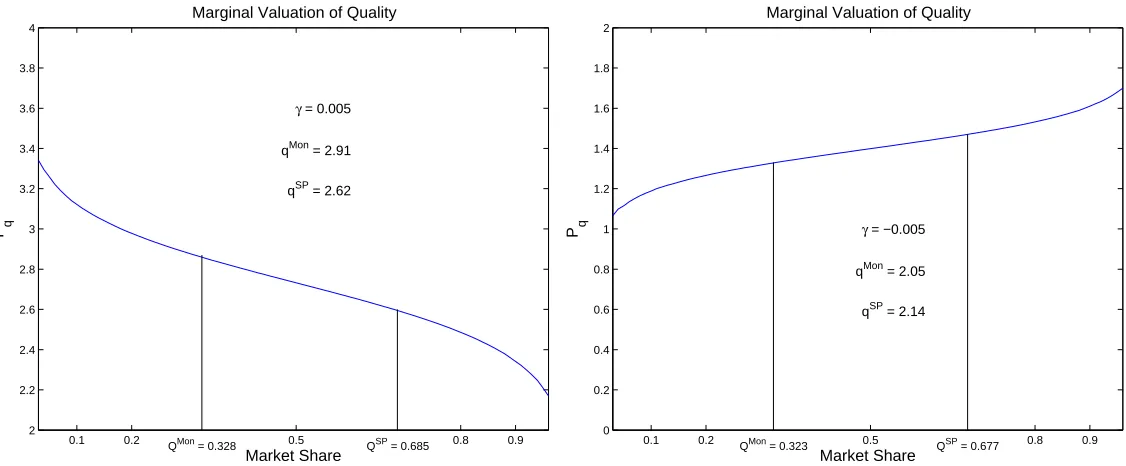
Figure 1: Optimal quality choice when the change in WTP decreases vs. increases with quantity
0.1 0.2 0.5 0.8 0.9
2 2.2 2.4 2.6 2.8 3 3.2 3.4 3.6 3.8 4
QMon = 0.328 QSP = 0.685
P q
Marginal Valuation of Quality
Market Share
γ = 0.005
qMon = 2.91
qSP = 2.62
0.1 0.2 0.5 0.8 0.9
0 0.2 0.4 0.6 0.8 1 1.2 1.4 1.6 1.8 2
QMon = 0.323 QSP = 0.677
P q
Marginal Valuation of Quality
Market Share
γ = −0.005
qMon = 2.05
qSP = 2.14
Notes: Reported is the difference in WTP across the demand curve due to a unit increase in quality for a
single-product logit model given by log( sjn
1−s0n) =α0+αppjn+αqqjn+γpjnqjn. In this setting, positive values ofγ(as in
the left panel) mean increasing product quality makes demand curves steeper, while negative values ofγ(as in the right panel) mean increasing quality makes demand curves flatter.
Figure 1 demonstrates these effects in a simple Logit specification with a price-quality interac-tion term, γpjnqjn.13 Positive values for γ mean increments to quality make the demand curve
progressively steeper. In this case, described in the left panel of Figure 1, MVQ increases more for high-WTP consumers, the monopolist restricts quantities considerably (QM on << QSP), and the monopolist over-provides quality. In the second panel, MVQ increases more for low-WTP consumers and the monopolist still substantially restricts quantities, but he now under-provides quality. Which of the two occurs in practice is, of course, an empirical question.
Models of price and quality choice undermulti-product monopoly typically rely on principal-agent models of optimal nonlinear pricing.14
Under standard assumptions – a single dimension of het-erogeneity and preferences exhibiting single-crossing – the optimal price-quality schedule exhibits features common from screening models: qualities to the highest type maximize social surplus (“no distortion at the top”) and qualities for other types are distorted downwards (“quality degrada-tion”). Furthermore, the monopolist’s optimum involves a marginal-inframarginal tradeoff:
lower-12
For a Logit model, the monopolist chooses the optimal quality as there is no heterogeneity: the monopolist’s marginal consumer has the same preferences as the social planner’s average.
13
See the notes to the figure for details.
14
ing quality to any type at the margin reduces profits (as that type’s WTP for quality is generally greater than the monopolist’s marginal costs), but allows the monopolist to increase prices for all types choosing higher qualities (because they are all less tempted to switch to the first type’s now-lower quality).
The paper in the theory literature most relevant to applying these insights in empirical settings is Rochet and Stole (2002). They analyze the optimal price-quality schedule for a multiproduct monopolist based on the classical screening model of Mussa and Rosen (1978), but add “random participation”: the utility to each household for the purchase of any of the quality-differentiated goods depends on the a random-to-the-monopolist error,i0n:
uijn=tiqjn−pjn−i0n (11)
where ti represents individual i’s (money-metric) willingness-to-pay for quality variant, qjn,pjn is
the price of that option, and i0n, the random participation term, enters the utility to each good,
j, due to the standard normalization of utility of the outside good to 0.15
The similarities between Equations (4) and (11) were not lost on the latter authors (c.f., Rochet and Stole (2002, p.280)) and the empirical framework used by CSS builds on that foundation. They begin with a specification of preferences similar to that in Equations (4)-(6) above,16
but add in a supply-side that leverages the insights of the nonlinear pricing literature.
They assume costs are constant in quantity and involve fixed costs for offering products:
C(qn, Qn) =
X
j∈Jn
mcjn(qjn, Wjn, ω1jn, ω2jn)Qjn+FJnn (12)
where Qjn =Mnsjn(δn, qn;σµ2) is the quantity sold for product j in market n (for known market
sizeMn),Wjn≡ {W1jn, W2jn}are cost shifters, andFJnn are the fixed costs of offeringJnservices.
Marginal costs are given by
mcjn(qjn, Wjn, ω1jn, ω2jn) =c0+W1jnγ1+ (c1+W2jnγ2+ω2jn)qjn+ (c2/2)q 2
jn+ω1jn (13)
where ω1jn captures shocks to marginal quantity costs,ω2jncaptures shocks to the marginal cost
of quality, andW1jn,W2jn are (quantity, quality) cost shifters. As they endogenize the choices of
prices and qualities, there are two econometric errors per product, theω, on the supply side. The balance of the supply side follows naturally. Profits are maximized with respect to both prices and qualities and are given by
Πn=
X
j∈Jn
(pjn−mcjn)Mnsjn(δn, qn;σ
2
µ)−FJnn (14)
15
Rochet and Stole (2002) find that the optimal price-quality schedule with random participation is bounded between the Mussa-Rosen schedule and the first best and that one can get efficiency at the bottom as well as the top (but not the middle).
16
Yielding a system of 2∗Jn first-order-conditions in each market:
[pjn] : Z
sijn(δn, qn;µi)dF(µi;σ
2
µ) + X
r∈Jn
(prn−mcrn) Z ∂s
irn(δn, qn;µi) ∂pjn
dF(µi;σ
2
µ) = 0 (15)
[qjn] :−
∂mcjn(qjn, Wjn, ω1jn, ω2jn) ∂qjn
Z
sijn(δ, q;µi)dF(µi;σ
2
µ)+ X
r∈Jn
(prn−mcrn) Z
∂sirn(δ, qn;µi) ∂qjn
dF(µi;σ
2
µ) = 0.
(16)
Demand can be estimated separately or jointly with the supply side. Solving for the econometric error on the demand side, ξjn, follows a mild generalization of the Berry inversion described for
Equation (6). Solving (15) for the econometric errors on the supply side, ω1jn, ω2jn, is feasible
under standard regularity conditions and is done numerically. For a fixed number of products, estimation proceeds using GMM with cost shifters instrumenting for pjn and qjn on the demand
side and demand shifters instrumenting for prices, quality, and (quantity and quality) markups in supply. CSS also endogenize the number of products offered in each market.
Quality Markups A primary advantage of endogenizing both prices and qualities is that CSS can measure the welfare consequences of market power over offered qualities. To help do so, they introduce the concept of a “quality markup”. Much as a price markup,p−mc, measures the difference between the marginal social benefit of an additional unit of quantity (p) with its marginal social cost (mc), a quality markup measures the difference between the marginal social benefit of an additional unit of quality with its marginal social cost.
The total social benefit of any price and quality combination is the sum of profit, given above in (14), and consumers surplus, given by
CSn=−
1 α Z log Jn X j=0
exp(δjn(sn, qn;σ
2
µ) +µiqjn)
dF(µi|σ
2
µ) (17)
with partial derivatives
∂CSn
∂pjn
=−
Z
sijn(δn, qn;µi)dF(µi|σ
2
µ)
∂CSn
∂qjn
=−
Z β+µ
i
α sijn(δn, qn;µi)dF(µi|σ
2
µ)
(18)
The quality markup is then
Quality Markup =M Bq−M Cq
= ∂Πn
∂qjn
+∂CSn
∂qjn
− ∂C(qn, Qn)
∂qn
(19)
whereM Bqis the marginal social benefit from a change in quality, M Cqis the marginal social cost
from such a change, the first two terms in the last line measure M Bq and are given in equations
There are both similarities and differences between quality and price markups. Both measure the social losses due to market power at the margin and both are (usually) non-zero for a monopolist, but zero for the social planner. Because a monopolist can over-provide quality, however, quality markups can be negative.
The quality markup is useful for quantifying the consequences of market power over quality at the margin. CSS also describe how to measure the consequences of market power over quality for inframarginal consumers as well as the relative importance of market power over price and market power over quality for consumer and social welfare.
Application CSS demonstrate the power of this approach in an application to measure the wel-fare effects of endogenous quality choice in the market for U.S. cable television services.17
This setting is attractive as it fits well the key assumptions underlying the framework. In particular, while cable television systems typically offer multiple products, these products are bundles of tele-vision networks such that higher-quality bundles include all the teletele-vision networks in lower quality bundles and (possibly many) more. A single dimension to product quality is therefore reasonable in this setting.18
Furthermore, the model above is a monopoly model of (unregulated) price and quality choice. Before 2000, when regulatory reform leveled the playing field for satellite competi-tors, the vast majority of U.S. cable systems were unregulated multiproduct monopolists.19
After 2000, satellite providers grew in importance, but priced nationally, leaving local cable systems monopolists on their residual demand curve.
In preliminary results, they find modest quality degradation relative to efficient levels for a social planner offering the same number of products and estimated quality markups substantially less than comparable price-cost markups. Despite this, they show that the total welfare effects of market power over quality can be of comparable magnitude to the welfare effects of market power over price.
5
Related Literature
Ackerberg, Crawford, and Hahn (2011) and Crawford, Shcherbakov, and Shum (2011) contribute to a small but growing literature that allows for endogenous product choices by firms.20
This literature can roughly be divided into three branches. The first, earliest, branch searched for reduced-form evidence that the product characteristics offered by firms either were influenced by market power (McManus (2007)) or responded to plausibly exogenous changes in it (Berry and Waldfogel (2001),
17
The CSS approach differs from related work by Chu (2010) by endogenizing the number of products offered by systems, introducing quality markups, and measuring the relative welfare effects of market power over quality versus market power over price.
18
In practice, CSS use an cost-weighted number of total channels as their quality measure.
19
An exception applied for the lowest quality product in some markets where local cable franchise authorities were permitted, if they so chose, to regulate cable prices. Crawford and Shum (2007) show this tended to increase the offered quality of such services (but not necessarily reduce their price).
20
Sweeting (2010)).21
Subsequent research has tried to address the consequences of endogenous product choice by follow-ing a structural approach: specifyfollow-ing models of demand and supply that allow firms not only to choose prices but also whether and/or what types of products to offer. The two remaining branches of the existing literature differ in the relative weight they put on the “whether” versus “what type” aspects of that decision. In markets where the types of products a firm can offer are discrete, the decision to offer a product or not is conceptually and methodologically similar to the decision to enter a market. Papers in the former literature therefore add profitability conditions familiar from entry models to the standard (demand + pricing) framework to recover the fixed costs of such product introductions. Examples in this vein include Draganska, Mazzeo and Seim (2009), Eizenberg (2011), Nosko (2010), and Sweeting (2011).22
In other settings, the set of products cannot easily be changed (or cannot easily be modeled) and the analysis focuses on the continuous choice of one or more product characteristics. Examples of this type of analysis include Gandhi, Froeb, Tschantz and Werden (2008), Chu (2010), Fan (2010), and Byrne (2011).23
CSS combines both of these approaches, endogenizing both the number of products offered and their characteristics.
With a small but growing sample of papers, is there any consensus about the importance of en-dogenous product choice? With respect to the first branch of the literature, the answer to this is affirmative. There is clear evidence that firms respond to changes in market power by changing product positioning, albeit the magnitudes of these effects are modest.24
What then of welfare effects? How important is it to endogenize the products offered or their charac-teristics to understand the welfare consequences of changes in economic environments? The answers here are mixed. Papers endogenizing product choice using entry methods tend to find relatively
21
McManus (2007) finds evidence of quality distortion for “low-quality” products at speciality coffee shops along the lines predicted by nonlinear pricing models. Berry and Waldfogel (2001) and Sweeting (2010) both examine the consequences of relaxed ownership limits in U.S. radio markets on product variety offered by firms. The former finds evidence of increased numbers of offered formats and formats per station in response to increased concentration in local radio markets while the latter finds, within formats, that commonly owned stations position their playlists to differentiate themselves more from each other and closer to competitors.
22
Draganska et al. (2009) analyzes the optimal choice of pricing and product assortment within premium vanilla ice creams, Eizenberg (2011) analyzes the optimal pricing and Central Processing Unit (CPU) configurations of PC manufacturers, Nosko (2010) analyzes the consequences of market power on product line and pricing decisions by PC chip makers, and Sweeting (2011) analyzes the optimal format choice of radio stations. The last is further discussed below as it offers the only dynamic model in this literature.
23
Gandhi et al. (2008) offer a numerical analysis of product re-positioning after merger (with fixed numbers of products), Chu (2010) analyzes the price and quality responses of U.S. cable television systems (for their pre-existing products) in response to satellite entry, Fan (2010) predicts how newspapers would change prices to advertisers and multiple continuous quality attributes if challenged mergers had instead been approved, and Byrne (2011) analyzes the price and quality effects of merger in Canadian cable television markets.
24
modest effects, albeit that could be a function of the specific settings being analyzed.25
Papers allowing continuous characteristic responses, on the other hand, sometimes find larger effects.26
Overall, no clear patterns have emerged. Further research, both in other settings and connecting the variation in reported results with the underlying characteristics of the markets under study, would be welcome.
6
Conclusions
This paper presents a progress report on an ongoing research agenda to analyze endogenous product choices by firms. It summarizes results developed in Ackerberg, Crawford, and Hahn (2011) that describe how to consistently estimate price elasticities in the presence of potentially endogenous product characteristics and results developed in Crawford, Shcherbakov, and Shum (2011) that endogenize the quality of products offered by U.S. cable television systems and measure the welfare consequences of market power over quality. It also surveys related work in this area.
Understanding the consequences for profitability and welfare of endogenous firm product choices is of first-order importance for both business strategy and public policy. The settings in which models of endogenous product characteristics have been applied is still small and there remains no consensus of the importance of these effects.
From a modelling perspective, endogenizing the discrete decision to offer a product, its continuous characteristics, or both, is likely to be important. Most of the literature has analyzed pricing and characteristic choice in single-characteristic settings. While a reasonable starting point, extending these approaches to accommodate multiple endogenous characteristics (as in Fan (2010)) poses computational hurdles but is critical to estimating realistic models of competitive interaction in most product markets. So, too, are considering the dynamic effects of product choice. While markets differ, in many settings offering new products and/or changing their characteristics is reasonably considered the outcome of a dynamic process, yet only Sweeting (2011) in the literature has taken such an approach. There is much more work to be done.
25
Based on their results, Draganska et al. (2009) simulate the effect of a merger between the two largest ice cream manufacturers and find that incorporating endogenous product choice into the analysis reduces consumer surplus due to decreased variety, but increases consumer surplus due to lower prices at the new varieties. The difference in consumer surplus allowing or not endogenous varieties is slight. Eizenberg (2011) assess the welfare consequences of computer makers being required to offer PC configurations using the oldest chips in the market and finds that the consumer welfare benefits of such a policy was 0.8%. The added fixed costs to firms from the policy meant the bounds on the estimated total surplus included zero, however. Sweeting (2011) finds the introduction of a 10% royalty rate on music revenues would yield a long-run reduction in the number of radio stations offering musical formats of 11% and reductions in audience listening of 5.9%.
26
References
Ackerberg, D., Gregory S. Crawford, and Jinyong Hahn, “Orthogonal Instruments: Es-timating Price Elasticities in the Presence of Endogenous Product Characteristics,” 2011. Working Paper, University of Warwick.
Berry, S., “Estimating Discrete Choice Models of Product Differentiation,” Rand Journal of Eco-nomics, 1994, 25(2), 242–262.
and J. Waldfogel, “Do Mergers Increase Product Variety? Evidence from Radio Broad-casting,”Quarterly Journal of Economics, 2001, 116(3), 1009–1025.
, J. Levinsohn, and A. Pakes, “Voluntary Export Restraints on Automobiles: Evaluating a Trade Policy,” American Economics Review, 1999, 89(3), 400–430.
Berry, Steven, James Levinsohn, and Ariel Pakes, “Automobile Prices in Market Equilib-rium,”Econometrica, 1995, 63(4), 841–890.
Byrne, David P., “Consolidation and Price Discrimination in the Cable Television Industry,” 2011. Working Paper, University of Melbourne.
Chu, Chenghuan Sean, “The Effects of Satellite Entry on Cable Television Prices and Product Quality,”Rand Journal of Economics, 2010, 41 (4), 730–764.
Crawford, G., A. Shcherbakov, and M. Shum, “The Welfare Effects of Endogenous Quality Choice: Evidence from Cable Television Markets,” 2011. mimeo, University of Warwick.
Crawford, Gregory S. and Matthew Shum, “Monopoly Quality Degradation in the Cable Television Industry,”The Journal of Law and Economics, 2007, 50(1), 181–219.
DG Comp, “Economic Evidence in Merger Analysis,” Technical
Re-port, Directory General for Competition February 2011. Available at
http://ec.europa.eu/competition/international/multilateral/2011_feb_economic_evidence.pdf.
DOJ/FTC, Horizontal Merger Guidelines, United States, 2010. Jointly authored
by U.S. Department of Justice and Federal Trade Commission. Available at
http://www.ftc.gov/os/2010/08/100819hmg.pdf.
Draganska, M., M. Mazzeo, and K. Seim, “Beyond Plain Vanilla: Modeling Joint Product Assortment and Pricing Decisions,”Quantitative Marketing and Economics, 2009,7, 105–146.
Eizenberg, A., “Upstream Innovation and Product Variety in the U.S. Home PC Market,” 2011. Working Paper, Hebrew University of Jerusalem.
Gandhi, Amit, Luke Froeb, Steven Tschantz, and Gregory J. Werden, “Post-Merger Product Repositioning,”Journal of Industrial Economics, 2008, 56(1), 49–67.
Griffith, Rachel, Lars Nesheim, and Martin O’Connell, “Sin taxes in differentiated product oligopoly: an application to the butter and margarine market,” 2010. CeMMAP Working Paper No. CWP37/10.
Maskin, Eric and John Riley, “Monopoly with Incomplete Information,” RAND Journal of Economics, 1984, 15(2), 171–196.
McManus, Brian, “Nonlinear Pricing in an Oligopoly Market: The Case of Specialty Coffee,”
Rand Journal of Economics, Summer 2007, 38, 512–532.
Mussa, M. and S. Rosen, “Monopoly and Product Quality,”Journal of Economic Theory, 1978,
18(2), 301–17.
Nevo, A., “Mergers with Differentiated Products: The Case of the Ready-To-Eat Cereal Industry,”
RAND Journal of Economics, 2000, 31(3), 395–421.
Nevo, Aviv, “Measuring Market Power in the Ready-To-Eat Cereal Industry,” Econometrica, 2001,69 (2), 307–342.
Nosko, C., “Competition and Quality Choice in the CPU Market,” 2010. Working Paper, Uni-versity of Chicago, Graduate School of Business.
Petrin, Amil, “Quantifying the Benefits of New Products: The Case of the Minivan,” Journal of Political Economy, 2003, 110(4), 705–729.
Rochet, Jean-Charles and Lars A. Stole, “Nonlinear Pricing with Random Participation,”
Review of Economic Studies, 2002, 69(1), 277–311.
Shapiro, Carl, “Mergers with Differentiated Products,”Antitrust, 1996, pp. 23–30.
Spence, A. M., “Monopoly, Quality, and Regulation,” Bell Journal of Economics, 1975, 6 (2), 417–29.
Sweeting, A., “The Effects of Merger on Product Positioning: Evidence from the Music Radio Industry,”Rand Journal of Economics, 2010, 41(2), 372–97.
, “Dynamic Product Positioning in Differentiated Product Markets: The Effect of Fees for Musical Performance Rights on the Commercial Radio Industry,” 2011. Working Paper, Duke University.
Tenn, S., Luke Froeb, and Steven Tschantz, “Mergers when firms compete by choosing both price and promotion,”International Journal of Industrial Organization, 2010, 28, 695–707.