external image and the internal corporate identity
when serving multiple market segments’
Master thesis
Faculty of behavioural, management and social sciences (BMS)
Abstract
In a continuously and rapidly changing environment, it is pivotal for companies to create a proper sustainable alignment between external image and internal identity. This alignment reflects a congruence between what customers observe in terms of image and the way organizational
members consider themselves in terms of identity. As companies are serving an increasing number of market segments, it is imaginable that within these segments, the image that exists about a company differs. Therefore, this research investigates how companies can overcome the challenges of aligning image and identity differences as a result from serving multiple market segments. Using semi-structured interviews, the existing identity and image of a young and growing b2b company was investigated. Hereby, customers and potential customers from different segments participated in order to find out differences between market segments. Ensuing from an open and axial coding process, results firstly indicate that there is an overall gap between image and identity concerning distinctiveness, symbolism, direct communication, word of mouth, corporate behaviour and intermediary communication in different market segments. The analysis also shows differences between segments that are mainly caused by variety in involvement and variety in the nature of the market segments. For this reason, one segment finds certain distinctive values more important than another segment. In conclusion, young b2b companies should find out which of the values they possess are perceived as most important in the different market segments they are operating in, in order to increase the effectiveness of communicating the desired image. We offer implications for b2b companies about how to deal with this variance in practice.
Keywords: corporate image, corporate identity, market segmentation
Carmen Hemel s1389300
10 February 2016
Master thesis – Business Administration First supervisor: Dr. R. Loohuis
1. Introduction
In a continuously and rapidly changing environment, companies have to keep finding new ways of communicating effectively with potential customers (Karaosmanoglu & Melewar, 2006). Companies also have to increasingly focus on distinctive manners to create competitive advantages. This is caused by several phenomena, such as a continuous increase in the number of companies around the world (Cornelissen & Harris, 2001), an increase in the number of (and the variety in) products and services that these companies offer (Proctor & Kitchen, 2002), new markets that are being created and served (Gardberg & Fombrun, 2002) and the fact that customers get more and more
sophisticated and are having more various demands (Proctor & Kitchen, 2002).
Several corporate studies claim that sustaining a consistent image over several years is a remedy against these changing environmental issues and that it is key in creating a favourable reputation and strategic and competitive advantages (Fombrun & Shanley, 1990; Kennedy, 1997; Einwiller & Will, 2002; Gray & Smeltzer, 1985). These studies indicate that a constant image creates an increase in sales, better relations with stakeholders, higher satisfaction within employees and more awareness and understanding of a company’s products and/or services within stakeholders.
In contrast, Collins and Porras (2002), argue that not the image of the company only is key in making companies perform well over a longer period of time, but rather its identity. They claim that ‘a cherished core ideology built upon the company’s main purpose and value is a major competency for companies’. Another recent study indicates that when a company consistently communicates their core ideology they can achieve advantageous public exposure (Melewar & Karaosmanoglu, 2006).
Others state that it is the alignment between identity and image that is key and consider communication as the prime medium for its maintenance (Gray and Balmer, 1998). By aligning corporate identity with image, companies can benefit from a better company performance through a favourable corporate image. This implies that companies need to prevent a discrepancy between what organizational members think they are (identity) and what outsiders, such as customers and stakeholders, think the organization is (image) (Gioia et al., 2000). Additionally, Bidin, Muhaimi and Bolong (2014) have concluded, the way the elements of corporate identity components are
strategized has a major influence on their branding strategy and eventually on the corporate image. Another relevant study of Nguyen (2006) indicates that companies should make concerted effort to manage their corporate image by closing the gap between the (internal) corporate identity and the (external) corporate image. This results in a better alignment between identity and image, which means that the company can articulate its position to its stakeholders more clearly.
companies succeed in communicating the correct way and branding effectively. Therefore, it would be wise to investigate the way companies take the differences between segments (or target groups) concerning the alignment between corporate identity and corporate image into account. For that reason, the following research question has been formulated:
RQ: “How can companies overcome the challenges of aligning external image and internal identity differences as a result from serving multiple market segments?”
The purpose of studying this subject is to find out what the current state of affairs is concerning how companies deal with the differences between their identity and their image for different segments in which they are operating. Moreover, the aim is to further develop the knowledge about how they can improve their strategy in overcoming these challenges.
In order to give an answer on the central research question, the following sub questions have evolved, which must be answered to be able to give a complete answer to the central research question:
SQ1: What gaps exist between the corporate identity and the image? SQ2: What differences in image exist between market segments?
SQ3: How should companies deal with aligning identity and image when serving different market segments?
Concerning the practical contribution of this study, it is stated before that companies can create major advantages if they are capable of communicating the correct corporate identity to the outside world. Since it is assumed that this is essential for companies to sustain, the aimed results of this study can be able to improve organizational practices concerning marketing and strategic
management. Because the amount of research in this field regarding the b2b market is quite limited, this study also has a theoretical contribution to business and marketing literature. Complementary, there is an extra practical contribution for the company for which the data is gathered during this study. This company will gain insights into the identity and image within their different market segments and will be able to make use of the practical implications given in this study.
This thesis first discusses the theoretical positioning of the subjects identity and image, followed by this research’ methodology. Thereafter, the results and the conclusions of the study are discussed.
2. Theoretical framework
2.1 Identity
Firstly, a lot of practitioners used to explain corporate identity as a graphic design paradigm (Carter, 1982; Chajet, 1989; Bernstein, 1986; Blauw, 1989). They claimed that corporate identity was equivalent with logos, a company’s house style and visual identification. Nowadays, the role of symbolism has also expended, as it is currently seen as a major element in communicating corporate strategy. As indicated by Olins (1978), visual identity can be classified into three main types (e.g. monolithic, endorsed and branded) which can be used to reflect an organization’s communication policies, branding and strategy. Secondly, several researchers favour the integrated communication paradigm, which argues that consistency in formal corporate communication is most important concerning corporate identity formation (Bernstein, 1986; Schultz, Tannenbaum and Lauterborn, 1994). Within this consistent formal communication, the depth and complexity of the
communication appears to be key in communicating effectively with stakeholders. As a third, the interdisciplinary paradigm explains that corporate identity is revealed through all behaviour,
communications and symbolisms to the internal and external public. Although the area of identity is still of multidisciplinary nature, it is increasingly acknowledged that a company’s identity refers to ‘an organization’s unique characteristics which are rooted in the behaviour of members of the
organization’ (van Riel & Balmer, 2007).
Several studies explain how managers can create the desired corporate identity by using the corporate identity mix (e.g. communications, symbolism and behaviour). Firstly, the visual
expressions of a company can be an effective way of differentiating, which makes symbolism a useful tool to represent the distinctive attributes of a company (Schmitt, Simonson & Marcus, 1995). Symbolism includes the name, logo and slogan of a company, but also involves company aesthetics (e.g. interior design, retail stores, architecture) and staff apparels (use of logos on the clothes of the employees) (Kennedy, 1977). Since these elements reflect the corporate identity, the way consumers will evaluate the identity will be partly defined by their attitude towards these elements. The second essential feature of the corporate identity mix is communication, which can also be used to display the distinctive qualities of a company. With corporate advertising and public relation activities, the identity of a company can be displayed to the outside world, besides the communication about individual products and services. Therefore, Karaosmanoglu and Melewar (2006) conclude that the more the consumer perceives that the marketing communication elements of a company reflects the company’s values (corporate identity) well, the more favourable image the consumer has about the company. The final element of the corporate identity mix is named behaviour, which consists of corporate behaviour and management communication (Van Riel, 1995). Corporate behaviour refers to the steps corporations take regarding environmental, ethical and recruitment issues.
Complementary, management communication indicates the extent to which managers have the ability to represent a company’s values and the way in which employees treat consumers. The study of Karaosmanoglu and Melewar (2006) indicates that these behavioural elements have a major influence on the corporate identity formation.
This approach of using the corporate identity mix has led to the following definition of corporate identity, which is used as a guideline concerning the conceptualization of corporate identity in this thesis:
2.2 Image
As Karaosmanoglu and Melewar (2006) state in their study, the most simple way to describe corporate image is the consumers’ perception of organizations’ identities. This explanation of the concept of image would indicate that as long as companies succeed in managing their corporate identity as indicated in the former paragraph, they also maintain a favourable image. This is because as explained in its definition, corporate identity is created by the strategically planned expressions of the corporate personality through behaviour and communication. Nevertheless, as Cornelissen (2000) argues in his study, corporate image is not only a product of controlled and strategically planned corporate communication, but also a product of noncompany controlled messages. This statement indicates that in order to understand how organizations build impressions of themselves, one should not solely be looking at the direct communication from the company, but also at the word-of-mouth of third parties and the emotions and feelings of individuals. In other words, it is argued that the external sources of communication can consist of interpersonal communication (e.g. word of mouth), intrapersonal communication (such as emotional attachment) and intermediary communication (such as governmental institutions) (Cornelissen, 2000). The reception of information through these intermediary sources as well as through one-to-one conversations and the person-specific psychological factors have an impact on the way consumers perceive the corporate image.
Much earlier research of Dowling (1986) has resulted in an image formation model which is still used in literature nowadays. In his model, the concept of image refers to impressions created at a
particular time at a particular level of abstraction. These levels of abstractions are based on the extent to which there exists a relation between the level of involvement of the consumer with the company and the degree of elaboration of the image of the company. In this conceptualization, the term involvement is explained as the capacity of the individual to process information and the level of motivation to do this. As Petty and Cacioppo (1986) argue in their study, a higher degree of involvement relates to a higher degree of elaboration of the image. Based on this assumption, Pruyn (1990) states that there exist three types of images based on the degree of elaboration. Firstly, an image can be a complex structured network or schema, in case of high elaboration. Secondly, image can be an evaluative attitude when there is a case of middle elaboration. Finally, image can be a global impression when there is a low elaboration. This line of thought is in agreement with the study of Poiesz (1989), who claims that image forming results from elaborative thinking. He also argues that if companies want to create a favourable image, they have to move from creating general impressions to articulated meaningful structures.
Thus, an image of a consumer can be described as a network of meanings that is stored in the memory and that can range from general impressions to elaborated evaluations. An image is influenced by the perception the receiver has of the corporate identity and by the reflections of interpretations of various attributes. As there are many different views on how to give a clear definition of corporate image (Gioia et al., 2000), this thesis uses a definition that is used by many marketing communication academics, as it is viewed from the perspective of the receiver:
2.3 The relation between image and identity
As many perspectives about corporate image imply, the creation of a corporate identity can have major influence on the corporate image. In agreement with Christensen and Askegaard (2001), corporate image is composed by the total sum of signs that stand for an organization’s identity. This implies that the image is formed by the consumer’s perception of the reflected identity. Therefore, it can be stated that corporate identity and corporate image are very closely related. In line with this assumption, the study of Birkigt and Stadler (1986) indicates that it is the responsibility of managers of a company to create equivalence between planned identity and desired image. In other words, it can be claimed that if a company wants to create the desired image among the outside world, it has to close the gap between the corporate identity and the image as much as possible. If there exists a significant gap between image and identity, managers did not successfully communicate the corporate personality and corporate behaviour. For this reason, the alignment of corporate image and corporate identity can form a major competency for companies.
As Karaosmanoglu and Melewar (2006) claim in their study, companies have to be aware of the fact that external communication cannot always be fully controlled by a company, which makes the alignment of identity and image an even more challenging aspect for the management. For instance, companies have to take into consideration that they cannot control which version of organizational information appears in the media and that the result of this information in the minds of consumers cannot be fully predicted. In addition, the attitude of consumers towards an organization is also influential. Karaosmanoglu and Melewar (2006) argue that when consumers have a positive attitude towards a company’s communication messages, they will more likely interpret the messages in a positive way, resulting in a more favourable image about that company.
Furthermore, as the study of Gioia and Thomas (1996) indicates, the perceptions of identity and image (especially desired future image) of managers of an organization are key to the sensemaking process. This process is explained as creating shared awareness and understanding out of different individual perspectives and varied interests. Bearing this study in mind, it can be stated that the sensemaking process is essential for organizations and that creating an in dept understanding of the alignment between image and identity is of high relevance.
Recapitulating, it is stated that it is important to define the most valuable aspects of corporate identity and communicate them with the target groups to create a favourable corporate image. This is because corporate image is inherently a product of the way the corporate identity is
2.4 Image and identity within multiple market segments
In modern society in which consumers are creating more various demands, it gets harder to place every individual into a homogenous market segment (Firat & Schult, 1997). For that reason, many organizations are maintaining an expanding number of market segments in which they are operating. Within these market segments, managers could use different marketing techniques, positioning and different communication messages to reach their potential customers. As Firat and Schult (1997) claim, within these segments, different images among consumers about the same company may exist. As an example, the car manufacturer Volkswagen tries to position their different models into different market segments. For instance, they manufacture models aimed at what they call ‘the normal people’ (‘people’s cars’) but they also push their brand into new luxury markets, aimed at high class consumers. It is reasonable that there exist different images about the brand Volkswagen within different segments, e.g. different type of consumers (Truong, Simmons, McColl & Kitchen, 2008). Especially within the b2b market, there is not much research within literature that describes how companies should deal with the alignment of image and identity within multiple market segments. Therefore, this thesis aims at creating more insight within this research topic.
3. Methodology
3.1 Research design
The aim of this study was to reveal how companies can overcome the challenges of aligning image and corporate identity when serving multiple market segments. For this reason, this study looked at differences in images of companies in different market segments and what this means for companies that have one identity. In order to reveal these differences in images, a qualitative and explorative research design using interviews was set up in a b2b case company. In order to be able to give an answer to the research question, first the current existing gaps between identity and image in the case company are investigated. Consequently, the differences in image between the following segments of the case company are studied: Agricultural, Government and Industrial. In order to do this, in-depth interviews were used. This method gave the opportunity to find out which keywords about the company were top-of-mind within participants. Furthermore, it also gave the opportunity for probing in order to reveal underlying assumptions of participants. Therefore, this method was found most appropriate for collecting data that could help answering the research question. After the interviews, the data that emerged in all segments was first analysed separately, after which a meta-analysis on all three segments was conducted to identify the main differences.
3.2 Selection
number of different b2b market segments and is active in a very rapidly expanding market.
3.3 Research context
The case company in this study is a relatively young b2b company which was founded in 2013. The company is nowadays situated in Enschede. It is a technology company which develops and delivers complete Machine to Machine and Internet of Things hardware and software solutions. All the solutions can be customized to match the demands of particular customers. In this research, all the segments in which the case company is operating are included, namely: Agricultural, Industrial and Governmental.
This company creates an interesting case for this study, because it is a young b2b company. As we can all mention keywords about companies such as Coca Cola, the theoretical contribution and novelty of this study is increased because it is interesting to find out more about the alignment between image and identity in multiple market segments for a young and growing company.
3.4 Participants (sample)
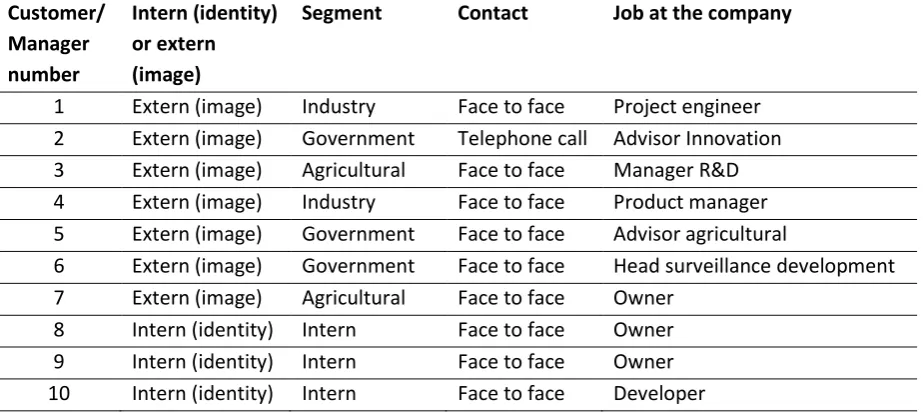
In order to reveal the identity of the b2b company, interviews are held among management and employees of the company. In order to determine the current image within different market segments of the company, customers and potential customers are interviewed. These customers were randomly selected but the condition that had to be met was that customers from different segments (target groups) had to be included to be able to expose possible differences between segments. These segments were Industry, Agricultural and Government. An overview of the features of the customers/prospects/management members interviewed can be seen below in table 1.
Customer/ Manager number
Intern (identity) or extern (image)
Segment Contact Job at the company
1 Extern (image) Industry Face to face Project engineer 2 Extern (image) Government Telephone call Advisor Innovation 3 Extern (image) Agricultural Face to face Manager R&D 4 Extern (image) Industry Face to face Product manager 5 Extern (image) Government Face to face Advisor agricultural
6 Extern (image) Government Face to face Head surveillance development 7 Extern (image) Agricultural Face to face Owner
8 Intern (identity) Intern Face to face Owner
9 Intern (identity) Intern Face to face Owner
[image:8.595.67.529.492.698.2]3.5 Procedure (data collection)
According to Cassell & Symon (2004), the preference during qualitative research should be given to the use of interviews. When using this method, participants are being less influenced by the opinion of others than when using for instance, focus groups. To be able to improve the sensemaking process within the case organization and to establish the real differences in image and identity for multiple market segments, in-depth interviews were found to be the correct method. Because of the explorative nature of this study, the interviews were semi-structured (a template for the interviews can be found in Appendix A). In the semi-structured interviews, questions were asked to managers to reveal the identity of the company, and to customers from different segments to reveal the existing image of the company. The questions in these interviews were based on the literature about corporate identity and image defined in the theoretical framework of this thesis. The Corporate Identity Mix of Stuart (1995) was used as a basis for questioning identity and the definition of Dowling (1986) structured the interviews with customers concerning image. Also, questions were asked to customers regarding whether or not they agreed on certain identity keywords that were mentioned by the managers of the company.
The reason for using semi-structured interviews was to find out the opinions including their background of participants on identity and image, without influencing participants in any way. As described by Spradley (1979), this type of semi-structured and open-ended interviews provides ‘thick’, descriptive data. The leading question throughout the interviews with the management was what they thought the identity of the company was. In interviews with customers, the leading question consisted of what participants thought the image of the company was. In the interviews, a technique called laddering (Downs & Adrian, 2004) was used to be able to gain more data about particular subjects. With this technique, the questions about the image of a company started at a general level, but each answer participants gave led to more specific probing about the underlying assumptions about the image.
Throughout the whole procedure of data collection, two central constructs applied, namely
corporate identity (internally) and corporate image (externally). Managers and employees of the case company were interviewed to measure the construct identity. In these interviews, questions
investigating the existing corporate identity were based on the literature in this thesis describing how to define a corporate identity. The topics where: the view of the identity overall, the distinctiveness of the company, symbolism used by the company (logo, house style etc), direct communication used by the company, word of mouth about the company, corporate behaviour of the company (how they handle ethical/environmental issues) and the intermediary communication that is done about the company.
Customers were interviewed to measure the construct image. Within these interviews, the aim was to discover what keywords first came up in the minds of customers when thinking about the image of the case company (words such as innovative, customer-friendly etc). Subsequently, customers were asked questions about the same topics as in the identity interviews. The aim of doing this was to find out where gaps exist between who managers think they are (identity) and how customers see them (image). For this reason, customers were asked if they thought the symbolism, direct
the constructs identity and image were analysed separately to find out differences between the two, after which the image of the multiple segments were compared. The latter was done using the data of interviews with customers (externally, data about image).
3.6 Analysis
In consultation with all participants, the interviews were recorded. After the semi-structured interviews were held, they were fully transcribed, which resulted in a set of documented raw data. To structure the data, literature suggests deploying an open coding process to explore which keywords can be used as codes (Strauss & Corbin, 1998). In this study, two types of open coding processes were used to analyse the data, namely in vivo coding and summarised coding. Keywords that are literally mentioned by the respondent were used as codes (in vivo coding) and the remaining parts of the interview were summarized into codes (summarized coding). Thereafter, the codes were translated from Dutch into English (visible in Appendix II). To specify the coding process, axial coding was used as a next step in the analysis. Here, all the codes are categorized, a process which is shown in Appendix III. Codes that were not useful enough for this study were also eliminated in this phase. In Appendix IV, one can find an overview of all categories that have emerged after analysing all the semi-structured interviews. The findings that have emerged after analysing the categorized data are discussed in the following section of this thesis.
4. Findings
All findings of the qualitative research are discussed in this section of the thesis. At first, the current gap between image and corporate identity of the case company is described. Secondly, the
differences in the gap between identity and image in the different target groups are defined.
4.1 Gap between corporate identity and image
As described in the methodology section, ten interviews were conducted to reveal differences between image and corporate identity for the case company. These differences were analysed based on the categories that emerged during the coding process. The most important question during all semi-structured interviews was: Could you give an as comprehensive as possible explanation of your view of the identity/image of the company? First, the data about the constructs identity and image was analysed separately. Afterwards, the differences between the two are reported. As a result, it appears that in some cases, the gap between identity and image is more obvious than in other cases.
4.1.1 Identity
View identity
At first, it can be stated that the managers and employees of the company want to make clear to the outside world that they have technical expertise and are specialists in their field. In addition, a very important aspect of their identity is that they are working in a highly customer-oriented way, as the following quotes illustrates:
“We are very customer-oriented, we always try to serve the customer and make sure that we unburden the customer. We want to build the exact solution the customer had in mind.”
The company builds from scratch specially for one customer and delivers an on-demand customized total solution of high quality. They also claim to be pragmatic and highly innovative. They consider efficiency and quality as important standards and have control of all aspects in-house. The
management also states that their company is flexible and professional and that they can offer their total-package solutions for a good price.
The management also explains that they are a young and growing business and that it is very important to build trust within customers. Furthermore, they claim to be the company for certain players in the market.
Distinctiveness
The management explains that in comparison with the competition, the company can easily adapt to the demands of the customers and that they have everything in-house. They do not ask the highest price for their solutions and have a high flexibility:
“I think we are very good in delivering customized work in a cost-efficient manner. Because we develop both hardware and software and we can deliver a complete platform that we build ourselves, we can create an on-demand, total package. This makes us flexible, which we see as a distinctiveness of our company.”
They also claim to have more knowledge concerning technical aspects, that they are conceptually stronger in their field than competitors and that others are more pragmatic. In addition, they mention the quality and complexity of their products and employees and the fact that competitors mostly do not work as customized as they do. Complementary, they claim that they are able to increase the customer’s efficiency and save costs.
Symbolism
The management explains that they have doubts about the symbolism supporting their image and identity. They think the logo may be a bit too playful but that it is easy to remember and it lingers. They are also aware of the fact they did not think extensively enough about how to effuse their identity through the used symbolism. Additionally, they state that the different names they are using can be a bit confusing and that this is a difficult issue.
Direct communication
that he does not consciously supports the wanted identity during direct communication and that he just focuses on being honest and building trust. Another manager clarifies that he thinks that showing their technical expertise in the direct communication is most important. One employee claims that in this field of expertise, involving the client using direct communication is essential and that theirs is professional because of their short lines and honesty.
Word of mouth
The management and the employee imagine that the word of mouth that is spread about the company is mostly supporting their wanted identity. They explain that certain customers get in contact with the company through other companies and that this word of mouth therefore has to be positive, otherwise customers would not get in touch with them this way.
Corporate behaviour
The management and the employee explain that they do not communicate much about ethical and environmental issues. The management claims that they operate quite aware of the environment in most cases, but that this is below the surface. The employee clarifies that the company does not build solutions because of environmental/ethical aspects but because of what the customer wants.
Intermediary communication
Members of the company claim that the intermediary communication that is done supports the wanted identity. Nevertheless, they are aware of the fact that not that much intermediary communication takes place:
“As far as intermediary communication about our company takes place, I think it supports our existing identity. For example, I know that the government published something about a system that we built and it appears as if they are very satisfied with the system and that it is very innovative. This supports our identity.”
4.1.2 Image
In interviews with current customers and potential customers, the existing image of the company was revealed.
View image
Overall, the analysis displayed that the existing image of the company among customers and potential customers is that it is a young business which has a lot of technical expertise and knowledge that is very useful in the field. The following quote illustrates that the technical knowledge is considered as a very important part of the image of the company:
“I think the company has a very positive image, it is a young and dynamic team which is working with the newest techniques to process data and to provide insight in data. I have learned that there are a lot of data processing companies but this one is always one step ahead of the rest. [...]. Members of the team are very enthusiastic, positive, creative, flexible and they really think along with customers.”
with customers. What is also mentioned a lot is that customers think the company has a very customer-oriented approach and that they are able to deliver on-demand and customized work. The image that does exist among customers is that it is a relatively small business and that they are still in the first growing phase of doing business. For example, one customer mentioned that this means there is ‘not much behind the company’ and that this can create a disadvantage when doing business with the company. Nevertheless, another customer mentions that if the case company finds out that they do not have particular knowledge in-house, they will search for it somewhere else in order to still deliver a total package.
Complementary, some customers mention the no-nonsense, honest and realistic approach of the company. They explain that the company is able to find out what the customer wants and is also able to deliver that specifically:
“I see the company as very involved, hard working and trustworthy. Their approach is very
no-nonsense and realistic. For me, they have a down-to-earth image. [...]. In conversations with members of the company, I notice that they are able to find out what elements a customer needs in order to create an efficient solution and that they also are able to deliver this.”
One of the customers claims that there is one element that decreases the professionalism of the company. He explains that the lack of project management and the fact there is not always enough structure lowers the professional image. He also mentions that in order to increase efficiency and professionalism they should hire more people, for example to structure project management.
Reason for choice for company/distinctiveness
When customers were asked to explain the most important reason why they have chosen to work with the company, the technical expertise the company has in-house was mentioned a lot. It is specified several times that the company can create things that not many other companies can create and that they are very well aware of all developments in the market:
“It became clear to us quite fast that the company could build solutions we cannot build ourselves and that not many other companies can build. We could never have figured out how to create the system they built for us, they have a very high quality technical expertise. [...] They also are very aware of all important changes in the field.”
Another distinctive feature that is mentioned is that members of the case company are able to translate the wishes of customers into practical solutions very fast and that they are willing to invest themselves if necessary.
Symbolism
Overall, the conclusion that can be drawn is that there does not exist a very intensive view on the symbolism of the company. During the interviews, a lot of laddering (a technique explained in section 3.5) was necessary in order to reveal more information about the view customers had on the
the logo and the name come across as a normal ICT or computer company and does not display the technical expertise as much as they should do. Another customer states that the website also does not show the sympathy the company possesses naturally. One customer mentions that the different names they use are confusing.
Direct communication
In general, it is very clear after the analysis that the opinions about the direct communication of the company are very positive. Keywords such as professional, sympathetic, satisfying, no-nonsense, pleasant, pro-active, enthusiastic and authentic are mentioned several times. It is also quoted many times that the direct communication supports a positive image.
Word of mouth
Within two out of the three segments, customers claim that they have received or spread word of mouth about the company. These customers got to know the company because of word of mouth or spread word of mouth themselves after working with the company. All these customers state that this word of mouth was supporting a positive image and in some cases this was the actual reason to get in contact with the company:
“I was told about the company by a former colleague of mine. That actually has been the reason for me to get in contact with the company, so the word of mouth I received was very positive and also had influence.”
Some customers explain that the fact that they are known in the market has convinced them to work with the company. Others claim that they would never recommend the company to others if they did not had a very positive view of the image of the company. So, it can be stated that the word of mouth that is spread about the company is very positive.
Corporate behaviour
Overall, it can be concluded that there does not exist an extensive view about the corporate
behaviour of the company. Within all segments, participants did not reveal much about this subject. The underlying reason for this could be that it is a very young company and that not much about the corporate behaviour is known within customers let alone at potential customers.
Intermediary communication
Among the participants measuring image, not many customers have an extensive view on the intermediary communication about the company. Some customers explain that they did read some articles in which the government published information concerning subsidies and their participation in ammonia reduction. These customers claim that this communication supported their view on the image of the company and that it confirmed professionalism.
4.1.3 The overall gaps
anymore but that they are a professional business with more technical expertise than the average competitor.
Another gap that can be mentioned about the overall image of the company is that customers focus more on the aspect of technical expertise than the company itself does. For all types of customers, the fact that the company is able to create things almost nobody else can create (yet) is the most distinctive value the company possesses. In comparison with the conversations with the
management, they also focus a lot on customizing and producing on-demand as their main
distinctiveness. However, in contrast, customers actually do not find this the main distinctive power of the company.
There exists a gap between the identity of the company and the symbolism that is used to display this identity. Both the management and some customers indicate that they have doubts about the extent to which the logo and names communicate the wanted identity.
A small gap is present between the image and identity concerning direct communication. All
customers and potential customers indicated that they surely thought the direct communication the company uses supports a very positive and professional, no-nonsense image. Although the members of the company also see this as core values, they are not fully aware of the fact that their direct communication is supporting this identity to a great extent.
4.2 Differences in gaps image and identity between target groups
An analysis of the codes and categories in this study revealed several differences between target groups concerning the gaps between image and identity. The most relevant differences are displayed below. Again, the following segments of the case company were analysed: Agricultural, Government and Industry. First, each segment was analysed separately, after which a meta-analysis was
conducted on all three segments to identify the main differences.
4.2.1 Involvement
In case of the segment government, the gap between image and identity concerning involvement is negligible. The members of the company are aware of the fact that most government customers are only buying the product and that there is a lower involvement because they are not developing together. Despite the fact that members of the company know that the involvement differs per case, in the segments agricultural and industry, customers also do not often mention a high involvement. Only one agricultural customer claims to have a high involvement and sees the company more as a partner than a supplier.
4.2.2 View image/identity
What also became clear in the interviews is that within the segment government, it is very important for customers that companies do not have a very slick and fake appearance. This seemed more important in the segment government than in other segments. The case company in this study succeeds in creating the image of a company that can be trusted and is down to earth and certainly not fake. This difference between segments can be caused by the fact that authorities are mostly less business-oriented and therefore differ in their opinion about this aspect in comparison with the other two segments. To strengthen this, companies from the segment government find it more positive that the company is small than the other segments do. Although they also indicate that because they are small, they can create very customized solution, the segments agricultural and industry also mention the risk that is involved when doing business with a very small company.
Furthermore, there are no major differences in the view of customers of the image of the company within the three different segments. All customers mention the fact that they think the company has technical expertise, is customer oriented, uses the newest techniques and delivers high quality. The only side mark concerning professionalism was made in the segment industry by one customer, who claims that the lack of project management and structure lowers the professional image of the company.
4.2.3 Distinctiveness
Another element which differs between the segments based on the interviews is the importance of price. As the members of the company all mention that part of the identity is that they can deliver against a competitive price, not many customers have mentioned this, except in the industrial segment. There, customers have indicated that the competitive price is one of the reasons of doing business with the case company. Customers from other segments have not mentioned the price aspect when discussing distinctiveness.
Customers from all segments clarify that the technical knowledge of the company is the main distinctive value of the company. Nevertheless, within the segment government the focus was also on honesty and keeping promises to a higher extent than in other segments.
4.2.4 Direct communication
Although all customers indicate that they overall think the direct communication supports the wanted image, there are some small differences between the segments. After analysis it becomes clear that for the segment government, authenticity and no-nonsense are very important assets that the case company possesses in their direct communication. In the segment agricultural, customers really appreciate the short lines the direct communication has and of which the members of the organization are very aware. Only in the segment industry, a remark was made concerning the professionalism of the direct communication with some employees of the company. The particular customer indicates that sometimes their communication is too technical and not concrete so that the customer does not get a clear view on the situation of a project. This results in a gap between the identity and image of the company.
4.2.5 Word of mouth
clarified that they have no view about whether or not word of mouth supports the image of the company. In the government sector, it is indicated by customers that the word of mouth they received or spread their selves supports the image of the company. This is in line with the findings of word of mouth in the agricultural segment. Here, it also becomes clear that the word of mouth is actually very important for the case company and that it can be of high influence.
4.2.6 Corporate behaviour
A minor but present difference between the segments can also be found concerning the corporate behaviour of the company. Although all companies indicate that they have no clear view on to what extent the corporate behaviour of the case company supports their image, only the customers in the segment government clarify that this is increasingly important. They also indicated that this element will have an increasing influence for authorities when choosing between certain companies to work with.
4.2.7 Intermediary communication
Despite the fact that most customers claim to have no view on intermediary communication about the case company, customers of the agricultural segment did have knowledge about the fact that some subsidies were assigned and that the company is also active in ammonia reduction. They indicate that these facts confirm or increase the professional image of the company.
4.3 The alignment of identity and different images
An important finding of this study concerns an assumption about how young b2b businesses can best succeed in aligning images in different segments with one identity. This study namely shows that in order to achieve this, companies should first invest some time and energy into finding out what core values that they posses (identity) are found most important in particular market segments. Once they have got a clear view of what key elements are perceived as most valuable in every segment in which they are operating, they can use this information in communicating identity issues to potential customers. By doing this, they are able to reduce the gaps between image and identity within every segment, without claiming to have characteristics they do not actually have.
5. Discussion
5.1 Conclusions
Firstly, it can be stated that for the case company, the main differences between identity and image exist in their distinctive values. In terms of identity, managers focus on customizing and producing on-demand more than customers do. In terms of image, the focus is laid on the technical expertise of the case company. Furthermore, the management of the company is not fully aware of the fact that their identity is supported to a great extent in their direct communication. This is confirmed by the view of the image customers have of the company.
Secondly, it can be concluded based on the findings in this study that a lot of differences in image formation within different segments is caused by a different level of involvement. In the literature it is assumed that when a customer or potential customer has a lower involvement, it is harder to create the desired image within this individual. With a higher involvement, it is also possible to create a more extensive view of a company (Petty & Cacioppo, 1986). Furthermore, the most important conclusion regarding the differences in image between market segments is that these differences are mostly caused by the nature of the segments. In this study, the segment government is less business-oriented and therefore places more value in a non-slick appearance of the company. Other segments did not indicate that they thought this is very important. This study also shows that one segment places more weight on the price of products than others. In addition, the segment government also indicates that they find corporate behaviour increasingly important. These findings are in line with the study of Gioia, Schultz and Corley (2000), who claim that the interpretation of values mean different things to different groups at different times.
In answering the central research question, it can be concluded that young b2b companies can overcome the challenges of aligning image and identity when serving multiple market segments by finding out which core values they posses are found most important in which market segments. These core values are than to be communicated more prominently to customers from that particular market segment. This conclusion is found during the analysis of the results after interviewing the customers from different market segments. It shows that these market segments differ in nature and that this causes them to find dissimilar values of companies most important.
By communicating those characteristics the company possesses to particular segments who find them most important more prominently, young b2b companies can succeed in reducing the gap between image and identity when serving multiple market segments. This way, they can profit from all the advantages that a proper alignment between image and identity offers as mentioned in the literature, although they are operating in multiple market segments.
5.2 Discussion
One of the most important theoretical contributions of this study concerns consistency in image. As stated in literature, many studies indicate that consistency in image results in major competitive advantages (Fombrun & Shanley, 1990; Kennedy, 1997; Einwiller & Will, 2002; Gray & Smeltzer, 1985). However, this current study shows that when young b2b companies are aligning image and identity, they have to take differences into account concerning the nature of market segments. This causes customers in certain segments to find particular company-image characteristics more important than those customers in other segments. Therefore, this study claims that for young b2b businesses, it is more efficient to communicate certain image characteristics depending on the segment. When doing this, the focus will be less on consistency in image, but more on
communicating the right image characteristics to the right market segment. Through this, young b2b companies can benefit from the advantages of aligning image in the eyes of customers and internal identity and thus enables serving multiple market segments effectively. Nevertheless, as this research clearly indicates, it is important that young b2b companies remain communicating their core ideology across segments, as this will result in a favourable image (Collins & Porras, 1996).
Another contribution of this study is the confirmation of the theory about the importance of
corporate identity, which also counts for young b2b companies (Collins & Porras, 2002). For example, managers of the case company are aware that they are a young, growing company, this is also the way customers see it. This is in line with literature, because the image customers have is formed by their perception of the identity the company reflects (Christensen & Askegaard, 2001). In contrast, this study also strongly displays the importance of the ‘customer’s perception’ part of this theory. For instance, the identity of the company describes a different major distinctive value than customers do. In this study, customers place the most value in the technical expertise the company possesses, while managers think their on-demand customization is the most important distinctive value. This indicates that the customer’s perceptions can have major influence on image formation.
In other words, this study confirms the importance of the identity a company reflects but more strongly, it displays that also in young b2b companies, the perception of customers of these identity characteristics influences image formation to a greater extent. This theoretical contribution is strengthened by the one mentioned above, explaining that customers from certain market segments find particular image characteristics more important than customers from other market segments. It displays that the perception of a customer is of major influence and that this may differ between market segments.
5.3 Practical implications
This study delivers some practical implications for managers in young b2b businesses. As a result of this study, it shows that in a young company, differences in image between the market segments are caused mostly by differences in the nature of the segments themselves. In most cases, young
companies did not put effort in communicating key characteristics and identity issues more prominently to certain market segments than others. Nevertheless, it seems that customers from different target groups sometimes think different about which value is important and which is not. This is what young companies have to take into account when communicating their image towards different market segments. They need to find out what distinctive values (besides their core
ideology) that the company possesses are most important in which target group in order to succeed in communicating their wanted image in the most effective manner. This can be done by conducting interviews (or just having face to face conversations) with existing customers or potential customers from different market segments to find out what they think the most important distinctive values of the company are. When the company has knowledge about what values are most important to what market segments, it can use these values in direct communication efforts to communicate
effectively.
In addition, the findings of this study indicate that a high involvement is key in creating the wanted image, also for young b2b companies. In order to be able to create an extensive view on the image of the company, customers need to be involved in order to interest them to obtain this elaborated view on the image of the company.
5.4 Limitations
One of the major limitations of this study is the generalizability. This limitation has several reasons. Firstly, this study was conducted at a relatively small and young business to business company. Although this ensures the novelty of the research because it creates a lot of new insights in the field of corporate identity and image, it is also hard to find out the in-depth, underlying assumptions about the image of the company that exists among customers and potential customers. This is strengthened by the fact that the case company creates products and solutions which have a high abstract level. Furthermore, because they are a young company, they have not done a great deal of communication efforts to form the wanted image in the outside world. As Gioia et al. (2000) claim in their study, in order to interrelate identity with image, members of the company must have
communicated their identity to internal and external parties to a certain extent. Because the small amount of communication effort of the case company so far, a lot of laddering had to be done in the interviews to eventually find out as much as possible about the current view on the company. Because of these reasons, it is hard to generalize the results of this study to all other existing companies in the world. Thus, the generalizability is restricted to young b2b companies.
References
Bernstein, D. (1986). Company image & reality, a critique of corporate communications. Holt, Rinehart and Winston, Eastbourne, UK.
Bidin, R., Muhaimi, A., & Bolong, J. (2014). Strategising corporate identity for the perception of corporate image in the selected government-linked companies (GLC’s) in Malaysia. Social and Behavioural Sciences, 155, 326 – 330.
Birkigt, K., & Stadler, M. M. (1986). Corporate identity, Grundlagen, Funktionen und Beispielen. Landsberg am Lech Verlaga, Moderne Industrie. (cited in Christensen & Askegaard, p. 306).
Blauw, E. (1989). Het corporate image, beeldvorming van de onderneming, één van de meest complexe managementvraagstukken. De Viergang, Amsterdam.
Carter, D. E. (1982). Designing corporate identity programs for small corporations. Art Direction Company, New York, NY.
Cassel, C. & Symon, G. (2004). Essential guide to qualitative methods in organizational research. California, Sage Publications.
Chajet, C. (1989). The making of a new corporate image. The Journal of Business Strategy, May/June, 18-20.
Christensen, L. T., & Askegaard, S. (2001). Corporate identity and corporate image revisited. European Journal of Marketing, 35(3/4), 292 – 315.
Collins, J.C., & Harris, P. (2002). Built to last: Successful habits of visionary companies. Random House, London.
Cornelissen, J. (2000). Corporate image: An audience centred model. Corporate Communications: An International Journal, 5(2), 119 – 125.
Cornelissen, J., & Harris, P. (2001). Corporate identity metaphor: Perspectives, problems and Prospects. Journal of Marketing Management, 17, 49 - 71 .
Downs, C.W., & Adrian, A.D. (2004). Assessing Organizational Communication: Strategic Communication Audits. The Guilford Press, New York, NY.
Dowling, G. R. (1986). Managing your corporate image. Individual Marketing Management, 15, 109 – 115.
Firat, A. F., & Schultz, C. J. (1997). From segmentation to fragmentation. Markets and marketing strategy in the postmodern era. European Journal of Marketing, 31(3/4), 183 – 207.
Fombrun, C., & Shanley, M. (1990). What is in a name? Reputation building and corporate strategy. Academy of Management Journal, 33(2), 233 – 258.
Gardberg, N. A., & Fombrun, C. J. (2002). The reputation quotient project: First steps towards a cross-nationality valid measure of corporate reputation. Corporate Reputation Review, 4(4), 296 – 302.
Gioia, D.A., Schultz, M., & Corley, K.G. (2000). Organizational identity, image and adaptive instability. The Academy of Management Review, 25(1), 63-81.
Gioia, D. A., & Thomas, J. B. (1996). Identity, image and issue interpretation: sensemaking during strategic change in academia. Administrative Science Quarterly, 41, 370 – 403.
Gray, E. R., & Balmer, J. M. T. (1998). Managing corporate image and corporate reputation. Long Range Planning, 31(5), 695- 702.
Gray, E. R., & Smeltzer, L.R., (1985). SRM Forum: Corporate image – an integral part of strategy. Sloan Management Review, 26(4), 73 – 78.
Karaosmanoglu, E., & Melewar, T. C. (2006). Corporate communications, identity and image: A research agenda. Journal of Brand Management, 14(1), 196-206.
Kennedy, S. (1977). Nurturing corporate images. European Journal of Marketing, 11(3), 120 – 164.
Melewar, T.C., & Karaosmanoglu, E. (2006). Seven dimensions of corporate identity: A categorisation from the practitioners’ perspectives. Journal of Marketing, 40(7/8), 846 – 869.
Nguyen, N. (2006). The collective impact of service workers and servicescape on the corporate image information. International Journal of Hospitality Management, 25(2), 227– 244.
Petty, R. E., & Cacioppo, J. T. (1986). Communication and persuasion: central and peripheral routes to attitude change. Springer Verlag, New York, NY.
Olins, W. (1978). The corporate personality: an inquiry into the nature of corporate identity. Thames and Hudson, London.
Poiesz, T. B. C. (1986). The image concept: its place in consumer psychology. Journal of Economic Psychology, 10, 457 – 72.
Pruyn, A.T.H. (1990). Imago: een analytische benadering van een begrip en de implicaties daarvan voor onderzoek. Handboek Corporate Commuication, Van Loghum Slaterus, Deventer.
Schultz, D., Tannenbaum, S. J., & Lauterborn, R.F. (1994). Integrated marketing communications: pulling it together and making it work. NTC Business Books, Chicago, IL.
Schmitt, B. H., Simonson, A., & Marcus, J. (1995). Managing corporate image and identity. Long Range Planning, 28(5), 82 – 92.
Spradley, J.P. (1979). The ethnographic interview. New York: Holt Rinehart and Winston.
Strauss, A., & Corbin, J. (1998). Basics of qualitative research: Procedures and techniques for developing grounded theory. Thousand Oaks, CA: Sage.
Stuart, H.J. (1995). Moments of truth: exploring the corporate identity/corporate image interface. PhD Thesis, University of New England. Armidale, Australia, p. 38.
Truong, Y., Simmons, G., McColl, R., & Kitchen, P. J. (2008). Status and conspicuousness, are they related? Strategic marketing implications for luxury brands. Journal of Strategic Marketing, 16(3), 189 – 203.
Van Riel, C. M. B. (1995). Principles of corporate communication. Prentice Hall, Hertfordshire/England.
Appendix I: Template interviews
A1. Interviews Identity (management of the company)
1. Could you give an as comprehensive as possible explanation of your view of the identity of the company?
2. What is, according to you, the distinctive power of the company?
3. To what extent do you think that customers are involved with the company?
4. To what extent do you think the company uses symbolism in the right manner to display the distinctive values of the company? With symbolism I mean the logo, house style and all over appearance of the company.
5. To what extent do you think that the company uses the correct direct communication to display the wanted identity?
6. To what extent do you think that the word-of-mouth that takes place supports the wanted corporate image?
7. To what extent do you think that the company has the correct corporate behaviour to support the wanted identity?
8. To what extent do you think that the intermediary communication that takes place about the company supports the right image?
A2. Interviews Image (customers and prospects)
1. Could you indicate if you have a high, middle or low involvement with the company? 2. Could you give an as comprehensive as possible explanation of the view you currently have
of the image of the company? You are free to mention all your impressions and beliefs. 3. Only for existing clients: What is the most important reason you are doing business with the
company? What are the biggest advantages for you when working with the company? 4. To what extent do you think the company uses the correct symbolism to display the wanted
identity?
5. To what extent do you think that the company uses the correct direct communication in order to display the wanted identity? How much influence did this information had on your imaging of the company?
6. To what extent did you receive information about the company through word-of-mouth in the last couple of years? What was the content of this information? How much influence did this information had on your imaging of the company?
7. To what extent do you think that the company has the correct corporate behaviour to support their wanted identity?
Appendix II: Open coding process
Appendix III: Axial coding process
Appendix IV: All categories per interview (identity and image)
*These appendices (Appendix II, III and IV) can be viewed on request.
The codes in the coding process were obtained from the interviews with customers and