i
2015
Karel Doorman: from project to product
An explorative case study
ii
Title
Karel Doorman: from project to product
Subtitle
An explorative case study
Author
R.M. Derksen (Rayke) – s0190810
Educational institution
University of Twente – Enschede, The Netherlands
Faculty Behavioural, Management and Social Sciences (BMS)
Master Industrial Engineering and Management – Production and Logistics Management
Company
Royal HaskoningDHV Business Line Buildings
Business Unit New strategic Initiatives
Supervisory committee Internal supervisors
Dr. P.C. Schuur Dr. J.T. Voordijk
External supervisor
Ir. B. Brink MBA
Contact details University of Twente
Faculty Behavioural, Management and Social Sciences Department IEBIS
P.O. Box 217 7500 AE Enschede The Netherlands 053 489 91 11
iii PREFACE
This report marks the end of seven years being a student at the University of Twente. Let me start with putting some emphasis on the phrase ‘being a student’. I could have written ‘of studying’ as well, but that would not do justice to what student life has contributed to my personal development. Being a student means so much more than attending lectures and taking exams. It was being a student with all the extracurricular activities that brought me to this point, the point at which I can confidently say: ‘I am ready for the next level in life.’ Of course being a student does include all those courses, lectures, assignments, and exams as well. All that knowledge enables me to act on professional level. Besides the interesting courses from my master programme Industrial Engineering & Management - Production- and Logistic management track, I fully grabbed the opportunities to explore the boarders of my discipline by taking several courses from other master programmes. I am very pleased by the opportunities that University of Twente and my master programme offered me in doing so.
This leads me to the core subject of this preface, my master assignment that has led to this thesis. During this master assignment I had the opportunity to explore the bounderies of my discipline as well. The past seven months were extremely valuable. I have learned a lot about the construction industry and its consulting- and engineering services. The word ‘bestek’ has a whole different meaning to me now. On the other hand, I hope that I have learned my collegues at Royal HaskoningDHV a lot about supply chain management, supplier
management, risk assessment, and business models.
Completing this thesis, however, was a bumby road. The Dutch expression: ‘het venijn zit in de staart’ (the sting is in the tail) does not apply to my bumpy road, I would rather say: ‘Alle begin is lastig’. Completing my research plan took a lot of time and rewriting. For that, I have to blame my internal supervisors. And with blame I of course mean thank. Peter en Hans, I enjoyed our discussions on-topic, as well as off-topic, very much. You guided me through the struggles I had with defining my research in a scientific way, and besides of the on topic discussions our meetings were just very entertaining. I remember Hans, literaly standing on Peter’s desk, pointing at a map of Rotterdam. Thank you both for your guidance and
support.
Although I never have cought my external supervisor,nor my otherNSI collegues standing on their desks, I had a very good time at Royal HaskoningDHV as well. The NSI meetings were very valuable, both for understanding the construction industry as for conducting my
research. Bart H., Hermen Jan, John, Bas, and Deena, thank you for your support. You were a valuable source of information and above all very supportive collegues.
iv
that you showed. You gave me a lot responsibilities regarding managing my own research project, but also in fully participating in NSI activities. For the latter, a special thanks should be adressed to John and Bart H. as well.
Besides these collegues, who I met several times per month, there were collegues from the Business Line that I saw on a regular basis at the Amersfoort office. You were very
welcoming and always showed interest in my research progress, as well as my weekends. Providing a list of names here would be tricky business, since I would feel very guilty if I would forget somebody. Nevertheless, a big thank you to you all, especially the ones that could be find on a regular basis at the beautiful ‘flex island’ surrounded at column 19. There is someone, although not located in Amersfoort, that should be named and thanked here for all her support. Sophie, there is no one that showed more interest and care than you did, although it was not always face-to-face, it was still very valuable to me.
And of course, thank you, Rowan, for our relaxing coffee breaks. I really enjoyed those, as well as I enjoyed organizing and hosting our hugely succesfull Intern drink. ‘Interns Drinking Together’!
Now that I have thanked all the people that were heavenly involved in my master assignment, there are people to thank that were very supportive and important in the background as well; Not only during my master assignment, but also in the seven years of being a student.
Let’s start with my beloved hockeyteam, Drienerlo Dames 1, you were an awsome source of distraction, but above that a lovely bunch of friends that contributed a lot to my personal development as well. A special thanks to Marije, Joannet, and Marit (I miss you, Miss USA). Without you I would have definitely consumed less alcohol, but I also would not enjoyed student life in Twente as much as I did now. You were always there for me, for having fun, but also being a listening ear. Thank you so much for that!
And then to all my fellow board members from Drienerlo, as well as the Bedrijvendagen, committee members, (study) friends, and roommates: we had so much fun, we organized awsome things, we learned a lot from eachother, we laughed, we ate, we drank, we shared our concerns; together. Together, to me, is the very valuable keyword in here. Thank you all!
When moving out as a 17 year-old, it was furthermore extremely comforting to know that you can allways rely on family. Visiting family and especially my grandparents (in the
v
become a success without your endless support. And let those things be the things from which I learned the most. Thom, I really hope that you feel that same support. You are a student now as well, and I just wish that you make the most of it, just like I did.
Dear Daan, you were there just from the very beginning of my life as a student, first as a valuable friend, a year later as the most supportive, sage, and caring boyfriend that I could wish for. Thank you for your encouragement at the moments that I needed it the most. Thank you for the lovely things we have done together. Thank you for just being you and being there. To very nice continuation of all of that in the next phase of our lives!
Dear reader, I may have to appologize for this extraordinairy long preface. However, none of the words could have been left unspoken. Let me warn you beforehand: you may recognize in the remainder of this report that I am not that short-spoken in general. Nevertheless, I thank you very much for showing interest in my work, and I hope you enjoy reading it afterall.
vi MANAGEMENT SUMMARY
This report is the end result of our research which was performed to complete the author’s master study Industrial Engineering and Management at the University of Twente. We conducted our research at Royal HaskoningDHV, business line Buildings, business unit NSI. The research is about changing projects into products.
The business unit NSI is founded to turn project into replicable products. We summarized the underlying logic in 2 drivers and 2 enablers. The drivers are changed customer demands and the need for higher profitability. Enablers for turning projects into products are the developments in projects of the Business Line Buildings that could possibly be reused and IT developments that support the reusability of project information.
If projects are turned in to products NSI knows that the value offered to the client and the revenue structure must change. NSI however needs insights on the effects of changing projects into products on the network of parties that contributes to the completion of project/product in terms of roles, but also risks. We performed a case study with the Karel Doorman Rotterdam project as subject to provide those insights. The Karel Doorman Rotterdam is a successful project of the business unit Hubs & Leisure in which an existing building is extended with an ultra light weight steel construction, which resulted in a 16 storey apartment complex on top of a shopping mall.
Our research question therefore is: If NSI turns the Karel Doorman project into a replicable product, what is the effect on the network that contributes to the realization of the building in terms of roles and risks and what are the business consequences of this effect?
From the literature study we performed we learned to place our research problem in the framework of business model literature. We now describe turning projects in to projects as a change in value proposition and earning logic. The network of contributing parties can be described as value network, in terms of business model literature. The literature study more gave us the foundations for a structured method that could describe and map value
proposition, earning logic, and value network in terms of roles and risks. We combined several methods that we found in literature to a method that we called Roles and Risks Breakdown structure (RRBS).
After that we applied this method on the Karel Doorman case. We described the relevant elements of the business model of the Karel Doorman Rotterdam project and a future Karel Doorman like product with the help of the experts of NSI. We indentified roles and risks for the Karel Doorman Rotterdam project and a Karel Doorman like product and we
vii
With the results of the case study we answered our research question. If the Karel Doorman project is turned into a replicable product the effect will be that the value network changes both in terms of roles and risk. The main change in terms of roles is the integration of 4 roles into 2 roles. One of those new roles becomes the largest role in the value network. This role,
the supplier of the Karel Doorman, is to be filled in by NSI. The role of project developer,
which was an important role during the project, is divided over the 2 new roles. The remainder of the roles stays the same when the project is turned into a product.
Our main conclusions regarding the risks in the value network are the decrease in the total amount of risk in the value network, especially when the product is replicated, and the shift of a lot of risks to supplier of the KD product, which is the role that NSI would fulfill. This is a much larger role than the role of designer of the construction, the usual role. Although the amount of major risks increases during the first Karel Doorman like product situation, the amount of major risks decreases when the product is replicated. Furthermore the largest risk NSI has to carry is less severe in the Karel Doorman like product situations compared to the Karel Doorman Rotterdam project situation.
The business consequences adhere to the larger role. NSI must adapt to this larger role in which they have to do activities that are outside their regular business activities, and therefore involves skills and capabilities that may not be present (yet). Since more risks are carried, another consequence is that NSI should put a lot effort in risk management. A very positive consequence of the larger role is that the portion of the network benefits should become larger as well.
Our conclusion is that the effects of turning a project into a product could be very beneficial for NSI and thus the company, if, and only if, NSI is able to adapt well to larger role in the product situation and the product is replicated several times. NSI should therefore focus on products that can be easily replicated several times, since the benefits increase and the risks decrease if a product is replicated several times.
Our recommendations for NSI include: replicating the RRBS in case of more information on the network of a future Karel Doorman like product, replicating the RRBS in other cases and for other value propositions and earning logics, storing risks that occurred, storing
information on the performance of other parties in the network, critically considering the launching customer, updating the risks categories in the RRBS when needed, using the RRBS to negotiate for a large share of the benefits that the value network should divide, and above all obtaining the right skills and capabilities that are needed for fulfilling the role of supplier of the Karel Doorman product.
viii
ix TABLE OF CONTENTS
Preface ... iii
Management Summary ... vi
Table of contents ...ix
List of Figures ...xi
List of Tables ... xiii
List of Abbreviations ... xiv
1 Introduction ... 1
1.1 Royal HaskoningDHV ... 1
1.2 Introduction to the problem... 3
1.3 Report outline ... 8
2 Research plan ... 11
2.1 Research Scope ... 11
2.2 Research objective & research questions ... 14
2.3 Research approach ... 15
2.4 Deliverables ... 16
3 Theoretical framework ... 17
3.1 A structured approach to obtain a suitable method ... 17
3.2 Theoretical context of the problem ... 19
3.3 Mapping (relevant parts of) the business model ... 25
3.4 Conclusions and summary ... 46
4 Suitable mapping methods ... 47
4.1 Method for NSI ... 47
4.2 Conclusions and summary ... 53
5 Explorative case study: The Karel Doorman case ... 55
x
5.2 (Re-)Constructing the business models ... 60
5.3 Analysis of the value networks in terms of roles and risks ... 73
5.4 Business consequences & Generalization of the results ... 85
5.5 Conclusions and Summary ... 87
6 Conclusions & Recommendations ... 91
6.1 Conclusions ... 91
6.2 Recommendations ... 94
6.3 Limitations & further reasearch ... 97
xi LIST OF FIGURES
Figure 1.1: Business line Buildings with its business units and advisory groups ... 3
Figure 1.2: Research, development and innovation strategy within Royal HaskoningDHV and within business line Buildings ... 5
Figure 1.3: Graphical overview of drivers and enablers ... 6
Figure 1.4: Chapter overview ... 9
Figure 2.1 a & b: The Karel Doorman in Rotterdam seen from different perspectives ... 12
Figure 2.2: Relationship between the sub questions ... 15
Figure 3.1: The business model canvas, source: (Osterwalder & Pigneur, Business model generation, 2009) ... 28
Figure 3.2: Relationship between the building blocks of the business model canvas (Fritscher & Pigneur, 2009) ... 28
Figure 3.3: Several methods to describe a business model (Burkhart, Schief, Vanderhaeghen, & Wolter, 2012) ... 30
Figure 3.4: Level 1 of the method which shows the Meta surroundings of a Business model(Burkhart, Schief, Vanderhaeghen, & Wolter, 2012) ... 31
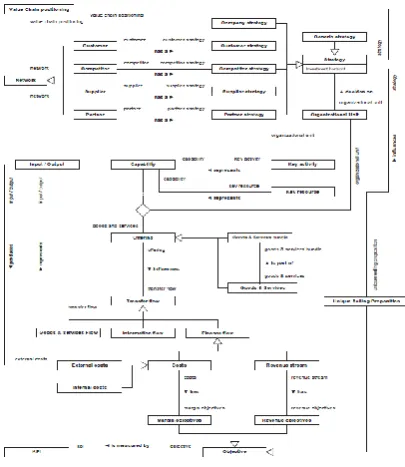
Figure 3.5: Level 2 to map the core business model ontology ... 31
Figure 3.6: RBS example based on the work of Chapman (1999) obtained from Hillson (2003) ... 41
Figure 4.1: Overview of our proposed method RRBS ... 52
Figure 5.1: Rotterdam indicated on the map of the Netherlands ... 57
Figure 5.2: The Lijnbaan in Rotterdam in 1964 ... 57
Figure 5.3: The NEMO museum upon the IJ-tunnel ... 58
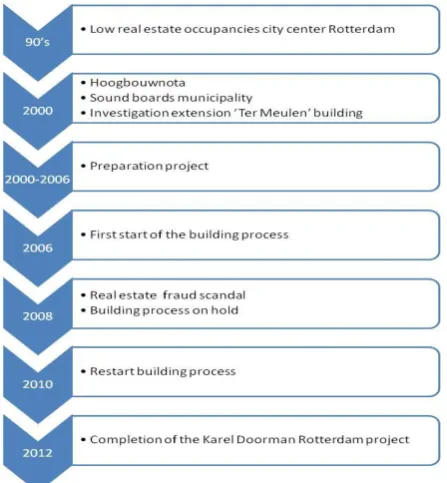
Figure 5.4: Important milestones in the Karel Doorman Rotterdam project ... 59
Figure 5.5: Risks with a risk score higher than or equal to 9 in the Karel Doorman Rotterdam project ... 77
Figure 5.6: Risks with a RPN higher than or equal to 25 in the Karel Doorman project. ... 77
xii
xiii LIST OF TABLES
Table 1.1: Focus regions of the business line Buildings ... 2
Table 3.1 Scoring table for methods found in literature ... 18
Table 3.2: Building blocks and corresponding questions of the Business model canvas ... 27
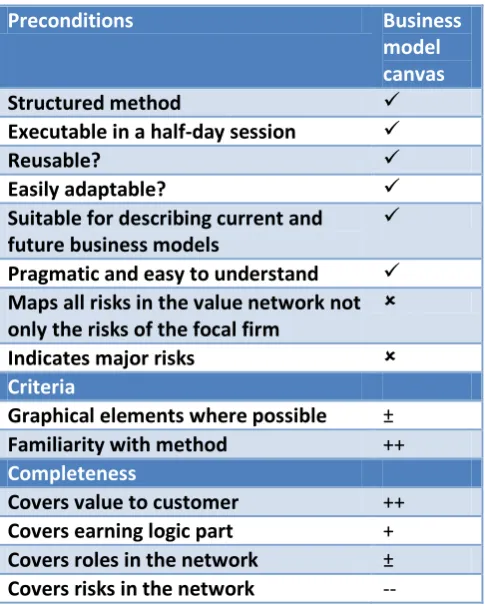
Table 3.3 Scores of the Business model canvas ... 29
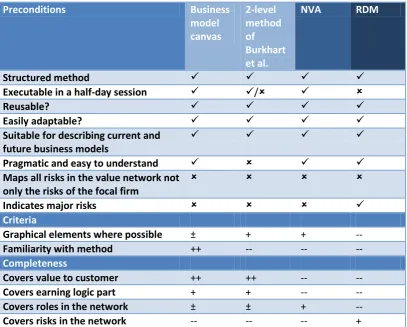
Table 3.4: Scores the 2-level method of Burkhart et al. ... 32
Table 3.5: Scores of the NVA ... 36
Table 3.6: Risk types and their descriptions adapted from Harland et al. (2003) ... 37
Table 3.7: Scores of the RDM ... 40
Table 3.8: Scores of the RBS ... 43
Table 3.9: Scores for RFMEA ... 45
Table 4.1: Scoring system ... 49
Table 4.2: scores of the RRBS on the preconditions and completeness ... 51
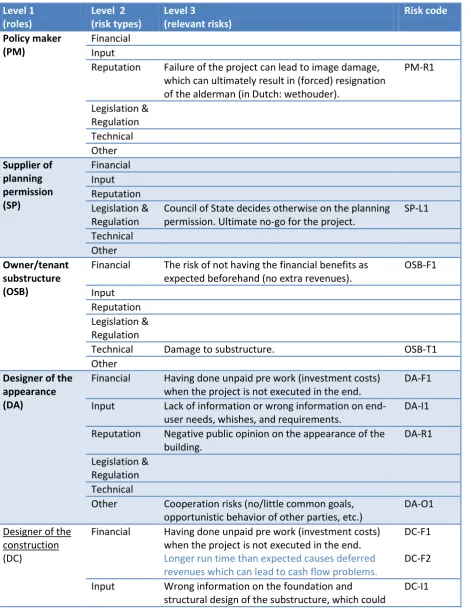
Table 5.1: RRBS for the Karel Doorman Rotterdam project ... 62
Table 5.2: RRBS for a Karel Doorman like product (1st and 5th-10th) ... 67
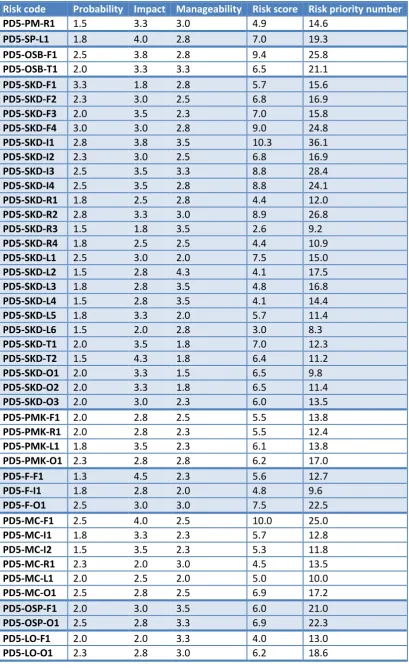
Table 5.3: Quantified risks for the Karel Doorman project, based on the risks in Table 5.1 ... 70
Table 5.4: Quantifying risks of a first Karel Doorman like product, based on the risks in Table 5.2 ... 71
Table 5.5: Quantified risks of a fifth-tenth Karel Doorman like product, based on the risks in Table 5.2. ... 72
Table 5.6: Aggregated risk score and aggregated RPN per role per situation and total risk score per situation ... 74
Table 5.7: Consequences of role integration in terms of aggregated risk ... 75
xiv LIST OF ABBREVIATIONS
AEC Architecture, Engineering and Construction (industry) AHP Analytical Hierarchy Process (risk assessment method) ASEA Australia and South East Asia (region)
BIM Business Information Model
BL Business Line
BM Business Model
BU Business Unit
B&U Burgerlijke- en utiliteitsbouw (Dutch) CAPEX Capital expenditure
DA Designer of the appearance of the building (role) DC Designer of the construction (role)
F Financer (role)
II Impact of risk I
KD Karel Doorman
LO Land owner (role) MC Main contractor (role)
MENAI Middle East, North Africa and India (region) MI Manageability of risk I
NSI Business Unit New Strategic Initiatives NVA Network Value Analysis
OA Other advisors (role)
OSB Owner of substructure (role) OSP Owner of superstructure (role)
P-I Probability-Impact method (risk assessment method) PI Probability of risk I
PjD Project developer (role) PM Policy Maker (role)
PMK Project manager with local market knowledge (role) PRM Project Risk Management
(R)FMEA (Risk) Failure Mode and Effects Analysis RBS Risk Breakdown Structure
RDM Risk Diagnosing Methodology
RPN Risk Priority Number (= probability * impact * detection) RRBS Risks and Roles Breakdown Structure
RS Risk Score (= probability * impact)
SKD Supplier of the Karel Doorman product (role) SP Supplier of planning permission (role)
1 1 INTRODUCTION
This report is written in the framework of completing my Master programme Industrial Engineering and Management (Production and Logistic Management track) at the University of Twente. This research on turning projects into products was conducted at Royal
HaskoningDHV. The aim of this first chapter is to introduce the reader to the company and the motivation for this research by introducing the problem. This chapter ends with section 1.3 which gives an overview of the outline of this research (and thus this report). We provided a List of Abbreviations on page xiv to support the reader in interpreting the abbreviations in the remainder of this report.
1.1 ROYAL HASKONINGDHV
Since this master assignment was conducted at Royal HaskoningDHV, this section provides some background information on the company and its organization structure.
According to the Annual Report 2014((Royal HaskoningDHV, 2014) ‘Royal HaskoningDHV is an independent, international engineering and project management consultancy with over 130 years of experience. Our professionals deliver services in the fields of aviation, buildings, energy, industry, infrastructure, maritime, mining, transport, urban and rural planning and water.’
In 1881 Royal Haskoning was founded (named ‘ingenieursbureau J. van Hasselt & De
Koning') by Johannes van Hasselt en Jacobus de Koning. International engineering consultant DHV was founded in 1917 by Dwars, Heederik en Verhey. In 2012 the two engineering consultants merged to Royal HaskoningDHV.
Royal HaskoningDHV has an average workforce of 7000 professionals spread over 100 offices in 34 countries. These professionals work for public and private clients in more than 130 countries. (Royal HaskoningDHV, 2014) Royal HaskoningDHV’s head office is located in Amersfoort, The Netherlands, from which the largest part of this research was conducted. Royal HaskoningDHV ‘focuses on delivering added value for its clients while at the same time addressing the challenges that societies worldwide are facing.’(Royal HaskoningDHV, n.d.) Therefore its guiding vision is ‘Enhancing Society together’.
Royal HaskoningDHV organizes its consulting and engineering activities in separate business lines. These business lines include:
Aviation Buildings
Industry, Energy and Mining Infrastructure
2 Rivers, Deltas and Coasts
Water Technology
Within these business lines multiple business units and advisory groups exist. Since this research was conducted at business line Buildings, the next sub section zooms in into business line Buildings.
1.1.1 BUSINESS LINE BUILDINGS
Business line Buildings focuses on creating sustainable buildings by using innovative
technologies and focuses on several regions. These regions include Europe, the sub Saharan region, the MENAI (Middle East, North Africa and India) region, South East Asia, Antarctica and Australia1 (ASEAN). Table 1.1 shows the amount of Buildings staff that is dedicated to a specific area and the market position (compared to its competitors) of Buildings in terms of turnover in (parts of) that region.The table shows that most staff is dedicated to Europe, which has lead to a leading market position. Moreover the ASEAN and Sub Saharan regions have a large amount of dedicated staff as well which gives the business line a noticeable market position in those regions as well.
Table 1.1: Focus regions of the business line Buildings
Europe region Middle East Northern Africa and India region (MENAI)
Sub Saharan region
Australia and South East Asia, Antarctica region (ASEAN)
# Staff 650 40 140 260
Market Position #1 in the Netherlands
Unknown #3 in South Africa #3 in Thailand
Most important to the business line is to deliver environments that fit the client’s needs. The business line is active in all stages of the building cycle which include initiative, design, development, management, and maintenance. The business line serves a broad line of markets, namely healthcare, arts & culture, education, corporate offices, research & development, mission critical facilities, transport hubs, commercial real estate, public & diplomatic, and sports & leisure. These markets are all characterized as complex markets. That complexity can be found in technological challenges or in the context of the market. Therefore elementary schools and housing are in general no part of the focus markets for the business line for example.
The business line Buildings aims for a global leading market position in three of its focus markets, namely: healthcare, research & development, and mission critical facilities.
1
Business Line buildings is not actively involved in Australia, but they are heavenly involved in South East Asian projects. Furthermore they are active in Antarctica. There are other Business Lines that are working in
3
According to Royal HaskoningDHV’s vision: ‘leading market positions are related to
profitability because of economies of scale – synergies drive effectiveness and efficiency – or because of market power. To stay ahead of the competition and hold these positions for the future, we continuously need to be recognised for our thought leadership and innovations’ (Royal HaskoningDHV).
All focus markets are divided amongst several so called global business units. Figure 1.1 provides an overview of the business units. The business units contain several local advisory groups which can be found underneath the name of the units.
Figure 1.1: Business line Buildings with its business units and advisory groups
This research is conducted for the Business unit New Strategic Initiatives (from here: NSI). This recently started (January 2015) Business unit aims to accelerate the development of new products and services, based on new revenue models. The goal of this development is to find opportunities for new projects with higher profitability then projects with traditional revenue models. The business unit works in close cooperation with the other business units to identify opportunities for such new products and services.
1.2 INTRODUCTION TO THE PROBLEM
This section aims to introduce the problem to the reader. We start with an explanation of the changes in the way of working of the business line Buildings and the underlying logic of these changes. After that the problem becomes clear.
1.2.1 A NEW WAY OF WORKING
The business line Buildings has decided that a separate business unit, named NSI, will try to work in new ways with higher profitability than the standard way of working, which is based on project-based activities.
4
to a focus on individual projects and decentralized decision making and financial control (Cox & Thompson, 1997) (Dubois & & Gadde, 2002).
The new Business Unit NSI will leave the site-specific project-based activities and instead provide clients with products and solutions. The other business units of BL Buildings will still work in the traditional project-based way. The other business units are closely involved to NSI. NSI has 4 shareholders, namely the other business units. They provide equity and share in the profit of NSI.
1.2.2 DRIVERS FOR PROVIDING PRODUCTS AND SOLUTIONS
The decision to provide clients with scalable products and solutions is based on several drivers.
Profitability
First of all, the AEC industry is under great pressure. The crisis had led to a drop in building activities. To survive in this market, a way of working that can lead to higher profitability than the traditional ways of working would be helpful. The business line Buildings expects that higher profits can be gained by selling scalable products and solutions compared to the traditional way of working that is project-based and payment is done per hour worked. The scalability could for example lead to cost reductions due to learning effects and reuse of knowledge. Solutions become increasing standardized: in general 80% the same and 20% client specific, whereas the AEC industry has a history of 100% unique solutions per client.
Changes in clients’ demands
Other important drivers are the changes in clients’ demands. Clients today are more and more focusing on their core businesses to live up to the dynamics of the globalized
competition and are therefore asking for integrated solutions with associated performance guarantees for their buildings.
Public clients are integrating their tenders as well. The maintaining and operating phase is for example included in those tenders in so called DBFMO contracts2. This seems to be a fair trend since a complex building will only benefit the client when this building is fully
operating and supporting its primary process in a correct way.
This also leads to the need for reduced throughput times in the realization of buildings, since a building does not provide value before completion. It becomes even worse when the
2
Design, Build, Finance, Maintain and Operate (DBFMO) contracts are a form of public private partnership that the government uses on building and infrastructure projects. In a DBFMO project, the government
5
building does not perform when it is first operated. In that case the high building costs are not compensated for. That is an important reason for clients to ask for performance
guarantees. A ‘proven’ product or solution instead of a new project might be very attractive to clients that need complex buildings.
The need for reduced throughput times is also fed by the IT developments in clients’ organizations. Due to rapid developments in IT the organizations of the clients have
developed rapidly as well. Therefore, the need for buildings that suit the clients’ organization has become urgent.
1.2.3 ENABLERS FOR PROVIDING SCALABLE PRODUCTS AND SOLUTIONS
Besides drivers, there are also enablers that make it possible to provide clients with products and solutions.
Development within projects
One of the drivers for providing products and solutions is the fact that a lot of interesting development is done within the current projects of the business line. This means that new ways of building, for example the use of a light weight steel construction, are developed during a project for a specific client. When the project has successfully ended, this new knowledge and techniques are stored in a project file, or even end up as tacit knowledge3 in project members’ heads, even if the new technique is potentially useful in other projects. Some projects are even reusable as whole and can be turned into a product.
Within the business line buildings the scalability and reuse of a project is seen as a form of innovation. Figure 1.2 provides an overview of the vision on research, development and innovation within business line Buildings.
Figure 1.2: Research, development and innovation strategy within Royal HaskoningDHV and within business line Buildings
3 Tacit knowledge (as opposed to formal, codified or explicit knowledge) is the kind of knowledge that is
6
Innovation is thus seen as successfully bringing developments to the market, which is exactly what NSI is doing. NSI collects promising project developments and investigates whether the development in that project would be replicable as a product.
IT supports reusability
An enabler which supports reusability of projects is IT development. In construction projects, a lot of information is stored nowadays in Building Information Models (BIM). These models support the reusability of projects. All useful information is stored in a systematic way and can be found at one (digital) location. Figure 1.3 is a graphical representation of the factors that are drivers for a change from projects to products (dark-blue) and the factors that are enablers for this change (green).
1.2.4 MOTIVATION & PROBLEM DESCRIPTION
This sub section starts with an explanation of the changed earning logic as a consequence of providing a product instead of a project. After that, we introduce the uncertainties that NSI faces regarding to movement in which projects are turned into products. These uncertainties are the motivation for this research and form the problem description of our research.
Foreseen changes in selling products instead of executing projects
First of all, NSI knows for sure that the value that they provide to the end customer will change if they sell a product instead of conducting projects. For example, in a project the
7
outcome is never known beforehand by the end customer, whereas the end customer knows the outcome when a product is delivered.
Furthermore, NSI is aware of the fact that the new way of working has a consequence on the way in which revenues are captured. Traditionally, Royal HaskoningDHV (and thus, the business units of the business line Buildings), is paid by its clients based on the hours worked. The traditional revenue formula can be expressed as: Revenue = Amount of hours worked * hourly rate. However, since NSI aims to deliver products, not projects (worked hours), this revenue formula is not applicable. Therefore, NSI has to work with other ways of capturing revenues. NSI has decided together with the general management team of Royal HaskoningDHV that the following revenue models are feasible:
1. Licensing
A client pays for the right to use the solution of NSI. This payment consists of a fixed sum that includes the license fee. In this case the profit for NSI= the fixed sum – development costs – proposal costs – the cost for working capital - legal costs for patents (if applicable).
NSI could for example sell the right to use a technical development from a Buildings’ project to a contractor that implements this development in one of its projects. Licensing is very common for software and music.
2. Products with performance guarantees (managing contractor)
Selling of a (physical) product including services and performance guarantees. The price of the product includes the services. The profit for NSI is the price of the product-costs for the sales network – development product-costs – proposal product-costs – product-costs for working capital
NSI could sell for example the result of a Buildings project as a product to a customer. The customer knows upfront what the product will look like and what is performance will be, since an example can be found at the end customer of the initial project.
3. Sweat equity
This is applicable when a product or solution is developed with partners outside Royal HaskoningDHV. In this case NSI brings in equity investments in kind (not in cash) and becomes one of the shareholders of the product. The profit for NSI is a percentage of the profit (or, hopefully not, loss) that the entity of all shareholders makes on selling products.
If NSI develops a solution or product together with other parties, they can set up a separate entity or contractual relationship in which NSI and its partners take part. They all become shareholder of this entity to a percentage that matches the initial investments in kind (hours spend on developing the solution or product).
8
The reason to choose from these three models is that these models are applicable to products, fit Royal HaskoningDHV’s business model, and the risk profile of these models is acceptable to the general management team of Royal HaskoningDHV. Another important fit is in the amount of pre investment needed. Royal HaskoningDHV does not have the capital to heavily invest upfront; they, however, have a lot of human capital available.
Problem description
NSI expects that offering a product to the client instead of a project combined with the choice for one of these revenue models has an impact on the network of parties with whom NSI (or Royal HaskoningDHV) creates value for the customer. Traditionally, a project is conducted together for example with financers, project developers, contractors, and
municipalities. All those parties take certain risks within the overall project. NSI expects that this network of parties will change in terms of roles and risks if NSI offers a product instead of a project (and thus hours). However NSI is not sure in what way these roles and risk change.
It is important to get insight in the roles and risks that will be present in a product situation; since this information is beneficial in deciding which role (and therefore which risks) NSI is willing to take itself. Furthermore it can be helpful in selecting the right parties to fulfill a role and therefore a certain risk. Our research aims to get insight in the roles and risks in the product situation. We translate the uncertainty regarding roles and risks in the network of parties that contributes to a future NSI product into a research objective and research questions in section 2.2. The problem on how to divide risk between several parties is an well-known problem in literature as well.
1.3 REPORT OUTLINE
In this section a short description of the remainder of this report is given.
The following chapter, Chapter 2, continues with the research plan to solve the problem of NSI. In this chapter we among others provide the scope of this research, research questions and the plan of approach. In Chapter 3 we present a theoretical framework that provides the information that is needed to come up with a solution for the problem of NSI. In Chapter 4 we elaborate on this theory by combining several theoretical sources into a useful mapping method that we need as we introduce in Chapter 2. In Chapter 5 we apply the knowledge that we obtained from theory to practice in the form of a case study on the Karel Doorman case which we introduce in Chapter 2 as well.
9
Figure 1.4: Chapter overview
Figure 1.4 graphically shows the outline of this report. 1.
Introduction
2. Research plan
3. Theoretical framework
4. Mapping method
5. Case study
6. Conclusions &
11 2 RESEARCH PLAN
In this chapter we provide a research plan to tackle the problem of NSI, which we introduced in section 1.2. This second chapter starts with section 2.1 in which we define the scope and context for this research. In this section we introduce the Karel Doorman case as well. In section 2.2 we formulate our main research question and its corresponding sub questions. Section 2.3 introduces the research approach and in the last section, section 2.4, we will present the deliverables of this research project.
2.1 RESEARCH SCOPE
The range of projects that NSI likes to turn into products is broad. The ideas vary from floating islands to temporary parking garages. Per idea, the revenue model, but especially the network of parties will vary as well. Furthermore, our time is limited, so we have to limit our research scope. In this section we secure the scope of our research and we introduce our research context, namely the context of the Karel Doorman, one of the projects that NSI wants to turn into a product. The Karel Doorman functions as the real life case that we use in the remainder of this research.
2.1.1 SCOPE
Due to the fact that limited time and resources are available for this research, combined with the broad range activities the business line Buildings (and thus NSI) is involved in, a scope must be defined for this research. To be as specific and as practically useful as possible this research is bounded by a representative case. We have chosen the Karel Doorman as the representative case since the Karel Doorman was a traditional project in which useful and replicable knowledge was developed. These are the kind of projects that NSI likes to turn into products. Furthermore all information on the history of the project, the
technological developments during the project, and the network of parties that contributed to the Karel Doorman project, is present within NSI.
Furthermore this research will solely focus on changes in roles and risks in the network of parties that contribute in completing the building. Other possible changes caused by a shift from project to product are left out of consideration.
2.1.2 THE RESEARCH CONTEXT
12
Karel Doorman building Rotterdam
The Karel Doorman is successful project of the business unit Hubs & Leisure which was completed in 2012. The Karel Doorman is a 16 storey apartment block with a car park that is built upon a monumental shopping center in the middle of the city center of Rotterdam. The technological developments in this project are described on the intranet of Royal HaskoningDHV (Royal HaskoningDHV, 2013) as follows: ‘the engineers turned this idea into an audacious but feasible project: urban densification carried by hidden strength. A unique combination of thorough investigation of the existing structure, a clever lightweight design (only 250kg/m2) and on-site research and development of sound insulation and vibrations resulted in high quality apartments for a reasonable price’.
Figure 2.1a and Figure 2.1 b give an impression of the Karel Doorman on top of the ‘Ter Meulen’ building, a monumental shopping center in the city center of Rotterdam. This project was a traditional project in which Royal HaskoningDHV (BU Hubs & Leisure) was paid in a traditional way as well, in other words, the engineering of the building was paid per hour worked.
Figure 2.1 a & b: The Karel Doorman in Rotterdam seen from different perspectives
The construction of the Karel Doorman has won several prizes and can thus be seen as very successful development within a project. Therefore NSI aims to upscale the concept of the Karel Doorman into a product that can be put on the market. The offer to the client is then a product with an anchored outcome instead of a project. To that end, another revenue model must be applied, since the traditional payment per hour worked is not applicable. More on the development and history of the original Karel Doorman project can be found in Chapter 5.
The AEC industry
Royal HaskoningDHV, and thus NSI, takes part in the Architecture, Engineering and
13
industry as follows: “The sector of the construction industry that provides the services on the architectural design, engineering design and construction services. It is a sector which is very active in the adoption of Information, Communication and Technology. This is also a sector which is very active in the international arena.”
Although the first part of this definition may sound evident, it provides some starting points for our literature study in Chapter 3, especially when another definition of the AEC industry is added. According to IMSCAD (IMSCAD global, n.d.) “The architecture, engineering and construction (AEC) industry consists of separate players who work together to bring a project to fruition. By integrating these seemingly separate entities into a single industry, architects, engineers and contractors can work more efficiently to achieve a common goal.”
Important starting points that can be deduced from these definitions are the facts that the sector is project driven, part of the larger construction industry and active in an international playfield. For our literature research that means that we can search for literature in an international context (and is therefore not limited to the Dutch situation only). Research areas that might be interesting for our research are project management literature from all kinds of project driven industries and literature that is focused on the AEC industry or the construction industry.
Sub sections of the construction industry
The Karel Doorman Rotterdam project can be defined as part of theresidential and non-residential construction sector (in Dutch: burgerlijke- en utiliteits bouw B&U). The Karel Doorman concept can be used for as well residential buildings as well as non-residential buildings. Although the original Karel Doorman building in Rotterdam is an example of a residential building, it is also possible to apply the Karel Doorman concept for office construction for example.
It is, however, certain that the concept always involves high-rise building. Typical characteristics for this sub section of the construction industry, the high rise sector, are (Wikipedia, 2015):
Design challenges for structural and geotechnical engineers, especially if the high rise building is build in a seismically active region or if the underlying soil has geotechnical challenges such as high compressibility
Design challenges with respect to fire safety
Studies are often required to ensure that pedestrianwind comfort and wind danger concerns are addressed. In order to allow less wind exposure, to transmit more daylight to the ground and to appear more slender, many high-rises have a design with setbacks
Apartment buildingshave technical and economic advantages in areas of high population density, and have become a distinctive feature of housing
14
contrast with low-riseand single-family houses, apartment blocks accommodate more inhabitants per unit of area of land and decrease the cost ofmunicipal infrastructure
For the remainder of this research we keep in mind, and limit ourselves to, this context. The last characteristic is for example an important one in the light of the value that is provided to the client.
2.2 RESEARCH OBJECTIVE & RESEARCH QUESTIONS
This section starts with describing the objective of this research based upon the problem description in subsection 1.2.4. We continue with the research question and sub questions.
2.2.1 RESEARCH OBJECTIVE
The objective of this research is to get insights in the future roles and risks that will be present in the network of parties that are needed to deliver the end product to the client, when the result of the Karel Doorman project is turned into a product.
2.2.2 MAIN RESEARCH QUESTION
The main question of this research project can be conducted from the research goal and is as follows:
If NSI turns the Karel Doorman project into a replicable product, what is the effect on the network that contributes to the realization of the building in terms of roles and risks and what are the business consequences of this effect?
2.2.3 SUB QUESTIONS
To answer this research question, an answer on several sub questions must be found. These sub questions include:
1. What is a suitable method to map the roles and risks in the network in a structured way?
2. What did the network in terms of roles and risks look like during the Karel Doorman project?
3. What roles and risks in the network of a future Karel Doorman product are expected? 4. What similarities and differences can we find if we compare the roles and risks of the
project network and the future product network? 5. What are the business consequences of these changes?
6. To what extent can we generalize the results of the Karel Doorman case?
15
Figure 2.2: Relationship between the sub questions
2.3 RESEARCH APPROACH
This section discusses the plan of approach for the research.
First of all we conduct a literature study. The aim of this literature review is twofold. We aim to place the problem of NSI in the light of a theoretical framework and to find suitable ways to map the roles and risks of a network of parties. If such a method does not exist yet, we must design a suitable method for NSI based on the available literature on roles and risks our selves.
To make sure that a method is useful for NSI, we define criteria and preconditions for a method. The literature review answers sub question 1. During the search for relevant literature we make use of scientific search engines such as Google scholar, Web of Science, and Scopus. We only make use of literature that we can obtain without charge.
When the mapping methods are clear, we start with an explorative case study, namely the case of turning the Karel Doorman project into a product. The focus subjects of this case study are the roles and risks in the network of parties that realized the Karel Doorman Rotterdam project and the roles and risks that NSI expects in realizing a Karel Doorman like product in the future. By applying the mapping methods from the first question, this
explorative case study answer sub questions 2 and 3. More explicitly we first reconstruct the roles and risks that were present during the Karel Doorman project and we then try to predict how a future Karel Doorman product looks like in terms of value to the clients, earning logic, and roles and risks in the network of parties that is involved in realizing in such a Karel Doorman product.
We apply the mapping methods on this case together with all the NSI members. All
16
professional, business development manager, business unit director, and strategic consultant. Furthermore we consult a risk expert of the business line Buildings to check whether our risk method complies with the vision on risk of the business line.
After the identification of the roles en risks for the Karel Doorman Rotterdam project and a future Karel Doorman like product, the NSI experts quantify the risks. In quantifying we assume that there are 3 situations.
The first situation is the Karel Doorman Rotterdam project. The experts quantify the risks that we identified for the Karel Doorman Rotterdam project. From now on we call this situation the Karel Doorman project, or in short: KD project.
The second situation is the situation in which the future Karel Doorman like product is delivered for the first time. The experts quantify the risks that we identified for the future Karel Doorman product as if it was the first time that this product is delivered. From now on we call this situation the 1st Karel Doorman product, or in short: 1st KD product.
The third situation is the situation in which the Karel Doorman like product is delivered for several times already. To make this more explicit we assume that it is the 5th-10th time that a future Karel Doorman like product is delivered. The experts quantify the risk that we identified for the future Karel Doorman product. From now on we call this situation: the 5th-10th Karel Doorman product, or in short: 5th-10th KD product. With adding this third situation we are able to say something about the effect of the replicating a product.
The next step is comparing the outcomes of sub question 2 and 3. By comparing and analyzing the results of these questions we provide an answer on sub question 4. The interpretation of these results then gives an answer on question 5 and 6.
When all sub questions are answered, the main question is answered as well.
2.4 DELIVERABLES
In this section we describe the deliverables that follow from our research.
This research has two clear deliverables. First of all we provide a method to construct and map three important variables, namely value for the client, revenue model, and most the
network of parties that are involved in delivering the end product. This network is described in terms of roles and risks.
17 3 THEORETICAL FRAMEWORK
In this chapter we present the results of our literature study that aims to place the problem of NSI in a theoretical context and to provide a basis for a structured method to map roles and risks in the network that is involved in the total completion of a building project for the end customer.
In section 3.1 we start with the purpose and demands for such a method. We use the demands to structure our further literature review. In section 3.2 we introduce business model theory as the theoretical context of the problem. Section 3.3 treats the several methods that we found in literature and indicates whether they fulfill the criteria we
established in section 3.1. This chapter concludes with our conclusions and a short summary.
3.1 A STRUCTURED APPROACH TO OBTAIN A SUITABLE METHOD
This section starts with introducing the purpose of the method that maps roles and risks in the network of parties that is involved in completing a building project for the end customer. After that we provide criteria and preconditions to ensure that the method we choose is suitable for NSI. We conclude with a framework that structures the remainder of this literature study.
3.1.1 PURPOSE OF THE METHOD
The purpose of the method is to provide a structured way in which the value that NSI offers to the client, the earning logic, and the network of parties in terms of roles and risk can be described and secured. We are especially interested to see which party caries what risks. Therefore the method must link identified risks to a certain role within the network. The structured and standardized way of working is helpful to compare different business models. In this research this comparison is made for a project which has already been executed and its corresponding product that will be developed in the future.
3.1.2 CRITERIA AND PRECONDITIONS TO FIND A METHOD THAT IS SUITABLE
To make sure that the method is suitable for NSI, the following preconditions and criteria are important to meet. These preconditions and criteria are approved (and seen as important) by the NSI BU Director.
The method is structured.
The method cannot be too time-consuming. Ideally, a half-day session is enough to execute the method.
The method contains graphical representations where possible.
18
changed parts. If two separate methods for the past and the future are used, the outcomes would not be comparable.
The method must be pragmatic and easy to understand for everyone in the company that may use the method in the future. A short description and a step by step
approach must be enough to work with the proposed method.
The method maps risks for all roles in the value network, not only the risks of the focal firm (NSI).
The method should indicate major risks.
The more familiar NSI already is with (part of a) method, the better.
The method must cover not only the network in terms of roles and risks, but also the value NSI offers to the client and the earning logic.
3.1.3 APPROACH FOR THE REMAINDER OF THIS LITERATURE STUDY
To structure our literature study we make use of the criteria and preconditions as provided in the former subsection. For every method that we find in literature we fill in a score on the preconditions, criteria and completeness. Table 3.1 shows the format that we use.
Table 3.1 Scoring table for methods found in literature
Preconditions Method
1
Method 2
Method …
Method N Structured method
Executable in a half-day session Reusable?
Easily adaptable?
Suitable for describing current and future business models
Pragmatic and easy to understand
Maps all risks in the value network not only the risks of the focal firm
Indicates major risks Criteria
Graphical elements where possible Familiarity with method
Completeness
Covers value to customer Covers earning logic part Covers roles in the network Covers risks in the network
19 3.2 THEORETICAL CONTEXT OF THE PROBLEM
To come up with suitable methods for mapping the customer value, revenue model and network in terms of roles and risk, we first place the problem of NSI in a theoretical context. This provides some direction in which we must search for suitable mapping methods. We introduce the business model concept which places the problem of NSI in a useful
theoretical context.
Within literature business models (BM) are a widespread and much mentioned way to describe the way in which companies do business. In the following subsections we investigate business models in depth.
These subsections aim to give insight in the current state of research on business models, try to give an overview of the status of several research areas that are linked to the concept of business models, but also to pinpoint existing research gaps. Most importantly we link our research problem to business model literature.
3.2.1 INTRODUCTION TO THE BUSINESS MODEL RESEARCH FIELD
The term business model was first mentioned in 1957 by Bellman et al. (1957). However, the concept of a business model did not get much attention until the end 1990’s when the commercial internet boom took place (Magretta, 2002). Therefore the research field of business models is considered to be a young one (Burkhart, Krumeich, Werth, & Loos, 2011). The growing usage of modern information and communication technology based on the Internet in that time led to drastic changes in the economy and the nature of competition. The competition of this ‘new economy’ became more global especially due to internet-based business activities. Business model became a buzzword, even in practice-oriented journals, and some emerging companies even thought that they neither needed a strategy nor any revenue resources as long as they had any Internet-based business model that would be considered as strategically well-placed (Magretta, 2002),(Teece, 2010), (Burkhart, Krumeich, Werth, & Loos, 2011). However, the dot-com hype could not last forever and the well known collapse of the dot-com bubble took place (Burkhart, Krumeich, Werth, & Loos, 2011). Among scientific researchers consensus exist that not the concept of business models itself, but its misinterpretation led to this collapse (Magretta, 2002). Since then, the concept gained more in-depth attention within (scholarly) journals. The in-depth interest in the concept is shown by the fact that the term is not only mentioned in the text, but also in the keywords of journal articles (Burkhart, Krumeich, Werth, & Loos, 2011).
20
framework 5 research categories are presented. These are the categories in which business model research is conducted. The five categories are:
Classification of the underlying literature Comprehension of business models Usage of business models
Focus of business models
Representation and evaluation of business models
In the remainder of this section we threat the comprehension of business models (definition and components), the usage of business models, the focus of business models, and
representation and evaluation of business models (the latter three can be found in the subsection on different perspectives of business models). To that we add the gaps in the business model literature to show how our research contributes to business model research.
3.2.2 THE DEFINITION OF A BUSINESS MODEL
The lack of consensus on for example the definition of a business model is recognized by several researchers. Those researchers have tried to review the existing definitions of the term business model and aim to find some common themes. Zott, Amit and Massa (2011) provide a table with Business model definitions with their corresponding authors and the authors citing that definition.
An earlier study of Shafer, Smith and Linder (2005) does not only sum up definitions but also provides an overview of the components of a business model that are mentioned by several authors. They conclude that most of those components can be divided into four categories, namely: strategic choices, create value, value network, capture value. Burkhart et al (2011) dived into the definitions as well. First of all, they conclude that a difference in length exists among the definitions. They cite Timmers(1998), who provides a rather concrete and textual definition.
A business model is an architecture for the products, service and information flows, including a description of the various business actors and their roles; and a description of the potential benefits for the various business actors; and a description of the sources of revenues. – P. Timmers
21
A business model is a conceptual tool that contains a set of elements and their relationships and allows expressing the business logic of a specific firm. It is a description of the value a company offers to one or several segments of customers and of the architecture of the firm and its network of partners for creating, marketing, and delivering this value and relationship capital, to generate profitable and sustainable revenue streams. – Osterwalder et al.
Other definitions are more derived from literature analysis in combination with the set up of some requirements (Burkhart, Krumeich, Werth, & Loos, 2011). An example that is
mentioned in this category is the definition of Al-Debei et al. (2008). The requirements in this case are for example that the definition should be comprehensive and general applicable.
The business model is an abstract representation of an organization, be it conceptual, textual, and/or graphical, of all core interrelated architectural, co-operational, and financial arrangements designed and developed by an organization presently and in the future, as well as core products and/or services the organization offers, or will offer, based on these arrangements that are needed to achieve its strategic goals and objectives. – Al-Debei et al.
Although many authors provided frameworks and analyses of the different definitions for business models, it seems that there still is no definition that will be used by all authors in the future. For our research the definition of Osterwalder et al. (2005) is suitable. This definition includes value to customers, earning logic and network of partners. Furthermore this definition assumes a relationship between the elements. This matches with the
expectations of NSI.
3.2.3 COMPONENTS OF A BUSINESS MODEL
As touched in section 3.2.2 some authors define business models based on the components of such model. A lot has been written on components of a business model.
22
value network. Finally, the resources and capabilities that a firm has and the types of
strategic choices a firm makes are mentioned often (Nenonen & Storbacka, 2010).
Shafer et al. (2005) also identified four major categories in components of a business model. They distinguish: strategic choices, creating value, capturing value, and the value network. As can be seen those categories are very similar to those mentioned by Nenonen and Storbacka(2010).
Al-Debei and Avison (2010) indentified 4 dimensions as well: value proposition, value
architecture, value network, and value financed. These also can be reduced to the categories that were proposed by the authors mentioned before.
The elements that are mentioned in literature the most are suitable to describe the problem of NSI. We can describe turning project to project in terms of business model literature as changing the value proposition (or value creation or creating value) and earning logic (or value capture or value financed). The risks and roles in the network of parties that
contributes to the completion of the project together form the value network. The Strategic choices element of a business model is out of our research scope.
3.2.4 DIFFERENT PERSPECTIVES IN BUSINESS MODEL LITERATURE
The definition and components of a business model are not the only subjects in literature where a lack of consensus can be found or at least different perspectives exist on these subjects.
Level
A relevant theme in literature is the question on which level business models can be applied. In general (or in most definitions) the concept of business models is applied to the firm-level. On the other hand, there are authors, for example Magretta(2002), who state that business models should not be restricted to this firm- or business-unit level. According to, for
example, Magretta(2002) and Chesbourgh and Rosenbloom(2002) a firm can have several distinct business models. Such models are designed at a much more detailed level (solution or product level) and can be helpful in innovation. The latter is confirmed by Teese(2010), who is even more radical by stating that ‘every new product development effort should be coupled with the development of a business model which defines its ‘go to the market’ and capturing value strategies’.
Kujala et al. (2010) even suggest in their work about business models in project-based firms that ‘the analysis of business models needs to take place at the solution solution-level rather than at the level of the firm (or its business units) as is often suggested in literature’.
In our research we adhere to the vision that the business models are applied on product or project level. We even assume that the business model for a project differs from its
23
Dynamic vs. Static nature
A discussion that can be found in literature on the comprehension of business models is for example the discussion on the static or dynamic nature of business model. The static view is that business models describe the current or future state of a company and its method for generating values. However, in the recent years, a more dynamic view is added to the business model concept. As a result more emphasis is put on research on change methodologies (Burkhart, Krumeich, Werth, & Loos, 2011).
We assume that a business model changes as one of the components changes. In real life this will often be the case. Therefore we adhere to the dynamic view.
Business model vs. strategy
In the research area on comprehension of business models another discussion can be found. Over the years researchers discussed on the link between business models and strategy (Burkhart, Krumeich, Werth, & Loos, 2011). Seddon et al (2004) provide an overview of the three differentiations that can be found in literature. These 3 include:
Strategy = business model
A business model is part of the strategy of a firm or vice versa
Business models and strategy are more or less linked but are distinct concepts. Analysis of Burkhart et al. (2011) shows that the latter is now commonly understood as the demarcation between strategy and business models. In our research we support this view as well. We focus our research on business models, not on strategy.
Focus
Remarkable is that in the research area ‘focus of business models’ consensus can be found. In all the literature reviewed by Burkhart et al. (2011) business models were understood as internally as well as externally focused. A business model covers business aspects outside the borders of the focal company. This is mostly reflected value proposition and value network part of a business model.
We support this view since our focus is internal (value proposition, earning logic) as well as external (value network, which contains roles and risks outside NSI/Royal HaskoningDHV).
Usage
With respect to the usage of business models Alt and Zimmermann (2001) describe three purposes of business models. These include:
Instance models that represent the current business model to discuss and analyze this model
24
Simulation models that are used to illustrate or analyze the future state of a company and its business orientations
According to the literature review of Burkhart et al. (2011) business models are mainly used as instance models. However, since more attention has been given to the dynamic
properties of a business model, the business model is also used as simulation model to describe future business orientations. Type models are the least present in literature. They furthermore state that business models are used in the developing/operation stage, but also in the foundation stage. A business model can function as communication tool for investors in that stage, as well as for decision support.
In our research business models serve as instance model as well as simulation model. The mapping of the business model of a project can be seen as instance model, whereas mapping the future business model of the equivalent product can be seen as simulation model.
3.2.5 GAPS IN BUSINESS MODEL LITERATURE
Although lot of research was conducted on the subject of business models, research gaps are identified by several authors.
Al-Debei and Avison(2010) mentioned some shortcomings in current research. More research is needed on the components of business models including a research on the degree of importance of these components. Furthermore they see a knowledge gap on the relationship of business models and business performance. Another important issue they highlight is business model consistency of value network actors. Exploration on the benefits that actors within the same value network can gain through pursuing consistent business models might be fruitful.
Burkhart et al. (2011) define 5 major research gaps, which include:
“Insufficient knowledge on business model components in particular regarding interdependencies within and between them
Absence of formalized means of representations as well as procedure model to allow a structured and comparable visualization of business models.
Limited insights on criteria and metrics for an appropriate evaluation of business models, which is mainly caused by the small quantity of (large-scale) empirical studies.
Nonexistent software-based tool for the management of business model can be found so far, neither for visualization, evaluation or simulation purposes nor as a holistic approach
25
The remainder of this research aims to resolve the first and the second research gap. To do so we first have to define the method that we use to map the three parts of the business model that lie within our research scope: value proposition, earning logic, and value network.
3.3 MAPPING (RELEVANT PARTS OF) THE BUSINESS MODEL
From section 3.2 we have learned that we could formulate our problem in terms of a business model. The aim of this section is therefore to provide methods to construct
relevant elements of a business model. We score each method on the preconditions, criteria and completeness as we introduced in section 3.1. We start with methods that aim to map the business model as a whole. Since these methods do not fulfill all demands, we zoom in to the separate elements of the business model and present the methods that exist to map those separate parts.
3.3.1 MAPPING THE BUSINESS MODEL AS A WHOLE
Although a lot has been written on what business model are (and what not). It is hard to find literature on how to design or to map a business model. There are a few exceptions though. First of all, business model components are seen as interdependent elements throughout literature. However it is hard to find a detailed analysis on how these components are interrelated. There clearly is a lack of knowledge what the impact is on the other component in case one of the elements has changed (Burkhart, Krumeich, Werth, & Loos, 2011).
A first hint on how to define or design a business model can be found in Chesbourgh and Rosenbloom(2002). These authors defined 6 attributes which together form a business model. These 6 attributes are:
Value proposition Market segment Value chain Cost structure Value network Competitive strategy
In essence these 6 attributes do not differ that much from the earlier mentioned
components in section 3.2.3. At least not in that sense that the attributes mentioned in that section are covered by these 6 attributes as well.