Cross-functionality
at Teijin Aramid;
how to get the
Automotive Taskforce
up and running
Acknowledgements
These past few months have been incredibly busy for me with research, writing up results, interviews and finalizing this thesis. Now that I can look back on it, however, I can say that, even though it has been hectic at times, this has been a very educational and inspirational period in which I learned a lot. Not only about my research topic, but also about myself, work ethics and the people that I had the pleasure to work with.
I would like to take the opportunity to thank Teijin Aramid and especially Ton de Weijer and his team for taking me in during my research period. Their guidance, help and insight has helped me shape this research.
Furthermore, I would like to thank my family for their unwavering support. Your good intentions were always felt, although appreciation may not always have been vocalized, I really do appreciate all your support and help.
Inhoud
Acknowledgements ... 1
Introduction ... 3
Context: a look at the organisation ... 3
Context: the Automotive Taskforce ... 5
Research question and assumptions ... 6
Research design and methodology ... 8
The type of study ... 8
Interview items ... 8
Stakeholders ... 9
Triangulation ... 10
Problem analysis: what is the issue? ... 11
Interviews at Teijin Aramid ... 12
Interviews at Teijin Corporate headquarters in Japan ... 15
Interview at Toho Tenax Europe ... 16
Root cause identification ... 17
Literature search: how can previous literature help? ... 20
The structure for cross-functional teams ... 21
Organisational communication in a cross-functional team ... 23
Knowledge sharing in a cross-functional team ... 24
Willingness to participate in a cross-functional team ... 26
The added value of a cross-functional team ... 26
Application of the literature; finding a solution for the Automotive Taskforce ... 27
Validation and discussion ... 31
Discussion ... 33
Conclusion ... 33
Limitations ... 33
References ... 35
Introduction
This master thesis will show you the path of my research at the Teijin Aramid organisation. I have conducted research there for 5 months with regards to their Automotive Taskforce group. The organisation is at this moment still divided in separate silos that each have their own approach for customers.
The management team in the headquarters in Japan conceived the idea of creating a cross-functional team in the form of the Automotive Taskforce. This team would then facilitate working together and sharing knowledge an information about the automotive industry. This means that different silos that cater to the automotive industry would be able to work together.
Even though the Japanese headquarters have already put together a small group of people to form the Automotive Taskforce, there is also a need to involve the European side of the Teijin
organisation, namely Teijin Aramid and Toho Tenax Europe. This is where the issue arises. Currently, the Automotive Taskforce does not speak to the employees in the Teijin Aramid organisation. My research is to find out why the Automotive Taskforce is not taking off here in Europe and what can be done to make it work.
In this introduction I will be providing some context as to what the Teijin and the Teijin Aramid organisation look like. Furthermore I will give some background into how the Automotive Taskforce was set up in Japan and what it is that they are currently busy with.
Context: a look at the organisation
The research for this master thesis will be done at Teijin Aramid. To provide some context into the problem and the research, an overview of the company will be given.
Teijin is a multinational company with locations all around the world. Its headquarters are situated in Osaka, Japan. However, operations occur worldwide, with facilities in Europe, North America and Asia. In total Teijin is comprised of around 152 companies around the globe. One of these companies is Teijin Aramid, with three locations the Netherlands. Arnhem is the head office, with two
production plants that are situated in Emmen and Delfzijl. For an organisational chart, please refer to appendix 1.
A different company that is also part of the Teijin Group is Toho Tenax. This company was also acquired by Teijin in 2000 and has three different division; Toho Tenax Japan, Toho Tenax Europe and Toho Tenax America. Their main product is carbon fibres and composites.
Both Toho Tenax and Teijin Aramid are positioned in the Advanced Fibres and Composites Business Group within the Teijin group. For reference, please see appendix 2.
Teijin Aramid was bought by Teijin in 2000 from Akzo Nobel. Teijin Aramid was absorbed into the high performance fibre business unit (HPFBU). At Teijin Aramid, there are sales & marketing,
production and R&D activities. These R&D activities can be split up in the type of aramid. The groups are broken down into a para-aramid group, a meta-aramid group, a process team and different groups categorized by expertise. Please refer to appendix 3 for the organisational chart of Teijin Aramid.
Aramids
were first applied commercially in the early 1960s. The properties of the aramid depends on the type. Teijin Aramid produces two types of aramid. The aramid and the meta-aramid. The para-aramid has high tensile strength properties and modulus behaviour. Meta-para-aramids on the other hand have a high resistance to high temperatures, chemical degradation and abrasion.
The aramids produced at Teijin Aramid are Twaron, Sulfron and Teijinconex. Twaron and Technora are both yarn that is spun in the factory with a specific dry-jet wet-spinning method. Sulfron is an aramid in the form of small cylinders. Teijinconex looks like shredded versions of the other aramids. These different aramids can be used for different end applications. At Teijin Aramid, they have divided up the activities based on application. This has led to five different business units, or resorts as they are referred to within Teijin Aramid. These are Tires & Mechanical Rubber Goods (MRG), Friction, Ballistics, Optical Fibre Cables & Composites (OFCC), and Protection & Safety.
At this moment there is no interaction between the units with regards to dealing with customers. Each unit has their own technical and sales team that go to the customer to speak about the specific application of aramids for their own unit.
Co-operation between Teijin Aramid & Teijin
Teijin Aramid has a rather autonomous position within the Teijin Group. The CEO of Teijin Aramid reports to the HPFBU-manager in Japan. There is some involvement of Japan, however, there is a lot of freedom in the decision-making. Part of the reason why Teijin Aramid can take such an
autonomous role is that it is a very profitable company compared to other overseas companies that Teijin has under their control.
A thing to note is that when Teijin bought Teijin Aramid in 2000, no real efforts were made to unify corporate identity and culture. There is no real argument or reason that the employees can point to as to why this choice was made. However, later in this thesis, it will become clear that
communication is not always optimal and this can sometimes interfere with daily business. Recently, an effort is being made to bring the different entities within the Teijin Group closer together. This is done thanks to a program called One Teijin. One Teijin promotes cooperation, communication and transparency between the different entities.
Current business
Context: the Automotive Taskforce
As explained previously, the origin of the automotive taskforce lays in the fact that it was recognized by the CEO that the current way of doing business, although profitable, might not last forever. An analysis performed by the Teijin corporation lead to a few realizations. Firstly in the automotive industry it can be seen that although in general the business is more profitable, this does not translate in higher and better sales numbers for Teijin (Aramid). Secondly, customers are not getting maximal value from the current form of organisation, with every business unit separately contacting the customers.
After this analysis, the CEO set out to promote more unity and a more end-user focus approach. This has been realized in the automotive taskforce. The automotive taskforce will set out to provide a new approach to end users in such a way that it can provide added value. Part of this is moving away from the single sided approach. In the automotive taskforce, this means that a cross functional team will be set up. This team will work together in contacting the OEM, and finding out the needs. By then combining the knowledge and techniques from the different units together with, if needed, other tier 1 suppliers, the automotive taskforce will aim to provide solutions for the identified needs of the OEM.
At this moment the taskforce is taking up a virtual form at the Teijin headquarters. This means that there is no full time dedicated team at this moment. There are two full-time assigned members at this moment. The leader of the taskforce and the deputy. Besides these two members there are part-time team members who participate in and contribute to the automotive taskforce next to their regular function within Teijin. The other members of the taskforce are all business unit leaders of the different respective business units and have a background in either sales or research.
Initial definition and assumptions for the Automotive Taskforce
What is most important to know at this moment is what the scope of the automotive taskforce will be, how it will be defined within the organisation and what kind of work the taskforce will perform. Some of the explanation of the scope and the work of the taskforce may overlap with the problem analysis and the interview data.
As mentioned previously, the automotive taskforce will be set up like a cross-functional team. In this cross-functional team there will be a mix of both sales and technical people. The aim of the
automotive taskforce is to get into contact with the OEMs of the automotive industry. After this contact has been established, the automotive taskforce will set out to schedule a meeting. During these meetings, Teijin and the portfolio will be introduced. The portfolio and discussions do not limit themselves to Teijin Japan or Teijin Aramid, but rather take a birds’ eye view and discuss the whole of the portfolio.
During these discussions, the aim is to uncover what will be the needs and problems of the OEM in the coming twenty or-so years. These uncovered needs and problems will form the basic framework that the automotive taskforce will work with.
The aim of the automotive taskforce is not to ensure that Teijin will become a tier 1 supplier in the automotive industry, but rather to work with the OEMs and from time to time with the tier 1 suppliers. This was labelled tier 1.5 by one of the members of the automotive taskforce. Essentially, what is meant is that Teijin will not take over a tier 1 spot, but rather work together with other tier 1 suppliers and support them, whilst on the same time promoting Teijin’s own products.
According to the leader of the Automotive Taskforce, the information that is collected and used to compile a needs list is collected in different ways. One is by scheduling regular meetings with the OEMs. This is done when previous contact has already been established. This also allows for continuous discussions. The second way of information collecting is by application. This happens when the OEMs are looking for raw materials that they need for their production. When they have made contact with Teijin and a meeting has been held, further discussions can be held to compile information and perhaps a needs list for the coming years. The third method of collection
information is to actively seek out the OEM and attempt to make contact. This way meetings can be scheduled to set up a conversation that will be useful for the Automotive Taskforce and, in the end, Teijin.
The information that is obtained from the OEMs is not universal. There is not a checklist that the members of the Automotive Taskforce check when asking questions or during a meeting with the OEM. According to the leader, Akihiko Kumaoka [hereafter Kumaoka], the questions and
conversations should be flexible. General information is always obtained, however, depending on the product, the OEM and the application of Teijin materials for that specific OEM, questions can and will differ.
Research question and assumptions
Based on the background information that I was given by the supervisor at Teijin Aramid, my
research question will be What are the reasons that the Automotive Taskforce is not implemented at the Teijin Aramid organisation at this moment and how can it be implemented?
Before starting the research at Teijin Aramid there were assumptions and expectations from my side with regards to the Automotive Taskforce.
These assumptions were based on the things that I was told during the first meeting before starting my research. These assumptions were mainly that there was a resistance to knowledge sharing within the Teijin organisation and that this was the main root as to why the Automotive Taskforce has not been picked up yet by the Teijin Aramid organisation. Another assumption that I had before starting this research was that organisational culture and cultural differences might also have influence on why the Automotive Taskforce is not yet picked up in the European branch of the Teijin organisation. The assumptions can be summarized as follows:
1. There is a resistance to knowledge sharing. This inhibits the implementation of the Automotive Taskforce at Teijin Aramid
2. There are difficulties in cooperation between Teijin Japan and Teijin Aramid. 3. There is little awareness or knowledge about the Automotive Taskforce at Teijin
Aramid. This leads to people being hesitant about implementing the Automotive Taskforce.
Research design and methodology
After articulating the assumptions and defining the context of the problem it is time to define the structure of the research. This can be done with a research design. According to D. R. Cooper, Schindler, and Sun (2003) the research design is the procedural outline for every research activity. However there are different types of research design. It is important to know what kind of study will best be suited to get the best results suited for the purpose of the study.
The type of study
The type of study should first be defined. A distinction can be made between exploratory, descriptive and explanatory research. Exploratory studies are useful when there is a lack of clear ideas of the problems that will be faced during the study (D. R. Cooper et al., 2003). This also means that the key variables are yet unknown or undefined. Descriptive studies are concerned with finding out who, what, where, when, or, how much (D. R. Cooper et al., 2003). With this type of study, the key variables are defined. Lastly, explanatory studies are concerned with learning why. i.e. how one variable produces changes in another. With explanatory studies, relationships between and among variables are explained (D. R. Cooper et al., 2003). The key variables and relationships should be defined in this type of study.
In the case of this particular research at Teijin Aramid, the problem itself is not yet clearly defined and as such, neither are the key variables that should be studied. This means that exploratory study would be best suited for this research.
According to Creswell and Clark (2007), in an exploratory design, first qualitative data is collected. This can then be analyzed and used in phase two to design an instrument or typology. Lastly in the third phase, this instrument can be tested.
In the case of this particular research the typology that I hope to design are recommendations on how the Automotive Taskforce can function in the current organisation and what changes and implementations will be needed for that. This typology will be verified in the end with a validation session with identified stakeholders.
Qualitative research techniques include individual interviews, which are usually more conversational than structured (D. R. Cooper et al., 2003). Document analysis and case studies can also be included as qualitative research techniques (D. R. Cooper et al., 2003).
Interview items
After the selection of the stakeholders, the next point was to select the items for the interviews. The answers of the interviewees should pinpoint the issues that they are currently experiencing with the Automotive Taskforce and why it is not working in the Teijin Aramid organisation, whilst it is already being used in Japan. As mentioned before, the initial assumptions that I held helped shape the items for the interviews. Because of these assumptions, the items for the interviews can be categorised as follows:
● Questions regarding knowledge sharing and resistance to knowledge sharing
● Questions regarding cooperation between the different entities
● Questions regarding the success and failure factors of the Automotive Taskforce
Stakeholders
At Teijin Aramid, I chose to conduct interviews with stakeholders. In this case, stakeholders are defined according to the business dictionary as a person, group or organisation that has interest or concern in an organisation. Stakeholders can affect or be affected by the organisation’s actions, objectives and policies.
Because of the interview items identified the selection criteria that I used for the stakeholder interviews is that the participants should be involved in the automotive industry. Furthermore, it is important to include people over the broader spectrum of the organisation. The reason for this is that Teijin wants to create a cross-functional team that will include people from both the sales and marketing side as well as people from the R&D side of the organisation. This is why I selected people from different departments of the organisation. The selection was based on how much and how close the people work with the automotive industry. For the sales and marketing side the following people were selected:
● The sales director of Teijin Aramid, who is also part of the management team
● Sales manager for mechanical rubber goods
● Key account manager for mechanical rubber goods
● Business unit manager for mechanical rubber goods
● Business manager for cable and composites
● The automotive business group manager at Toho Tenax Europe
● Two eco-efficiency specialists
For the research and development side of the organisation the following people were identified as stakeholders:
● The R&D director, who is also part of the management team
● Business development manager for mechanical rubber goods
● R&D program coordinator for pulp
Since the concept of the Automotive Taskforce began in Japan and the Japanese head office of Teijin already has a project team in place, Japan is also a major stakeholder. Within the Japanese
organisation the following people were identified as stakeholders: The leader of the Automotive Taskforce project
The General Manager of the R&D department and member of the Automotive Taskforce Assistant to the General Manager of the High Performance Fiber Business Unit and former VP
of Teijin Aramid
A strategy office employee
These people were chosen because of their involvement with the Automotive Taskforce, their connection with Teijin Aramid and overall overview of the strategic outlook of the organisation as a whole and how the Automotive Taskforce could fit within that strategic outlook. /
Next to people who work with the automotive industry that will be directly affected by the Automotive Taskforce, it is also important to better understand the organisational impact that the Automotive Taskforce will have on Teijin Aramid. For this reason people were selected for interviews that can shed light on organisational dynamics that are currently in place as well as how the
Automotive Taskforce might impact the organisation. For this reason the following people were selected:
● The president of the Teijin Holding company
● The CFO
● The deputy chief human resources officer
Triangulation
To understand triangulation and what it can do for this research, it is important to first get a definition of the concept.
Triangulation is defined by Denzin, back in the 70s as a research method involving varieties of data, investigators and theories, as well as methodologies (Denzin, 1973).
According to Denzin (1973) data triangulation means that researchers search for as many different data sources as possible which bear upon the events under analysis. In his book Research Methods for Education (Newby, 2010), Peter Newby defines triangulation as the process of validating a claim, process, or outcome through at least two independent sources.
Data triangulation can be beneficial for research by giving more insight into a topic. Furthermore, multiple sources can provide verification and validity ("Data Triangulation: How the Triangulation of Data Strengthens Your Research," 2012).
In my case, my main data source comes from interviews that I have conducted with the previously identified stakeholders. In order to validate and verify data obtained from these interviews, I used other data sources such as documents obtained from the organisation and a survey which was sent out to the entire company. Using these additional data sources will allow me to verify and check whether the things that were stated during the interviews were observed by more people in the company, or just a stand-alone opinion.
The items described above combined make for a useable blueprint for the first phase of the exploratory research, namely the problem analysis. This will be based on the qualitative interviews that I have done with the identified stakeholders.
Problem analysis: what is the issue?
After understanding the context of the research and the design and type of study that will be conducted, it is time to get to the root of the problem.
Even though some assumptions were present before starting the research, the problem itself was not fully articulated in an understandable way with key variables and items to facilitate literature search. Because of this it is important to first get the issue defined with key variables in order to facilitate the literature search. This will help to provide a solution for solving the problem.
One way to approach problem analysis is through the problem structuring method. In their research Franco and Meadows (2007) looked at how groups used PSM to make decisions. Usually participants either generate ideas and/or plans and continue to negotiate those plans when there are conflicting views or interests. Another way is to generate through information gathering and then structure and evaluate the relative advantages and disadvantages of the different strategic options before
selection a problem focus or course of action. (Franco & Meadows, 2007)
When applying this PSM to this research, the second PSM can be applied here. First, information will be gathered. This is done in the form of interviews, documents, surveys. Then through a literature search and validation session the different options are analyzed and selected.
Another way to help articulate the problem is the Root Cause Analysis method. With this method, the problem can be identified and, hopefully, solved with five steps. The people from MindTool in their article Root Cause Analysis ("Root Cause Analysis," 2007) describe the steps as follows:
1. Define the problem 2. Collect data
3. Identify possible causal factors 4. Identify root cause(s)
5. Recommend & implement solutions
In this step-by-step method of problem analysis, step 5 can be seen more as problem solving, which is not yet at hand in this section.
The reason that MindTools state that Root Cause Analysis is an often-used technique in business is because it helps answer the question of why the problem occurred ("Root Cause Analysis," 2007). Root Cause Analysis attempts to identify the origin of the problem to determine what happened, why it happened and what to do to reduce the likelihood of it happening again ("Root Cause Analysis," 2007). This can be done through the steps previously mentioned.
If these steps are then applied at Teijin Aramid to complete the problem analysis, the following can be seen:
Problem definition
Based on the assumptions mentioned earlier and the general story that was told before starting the research, the problem can shortly be defined as follows; the Automotive Taskforce is not being implemented at Teijin Aramid.
Data collection
The interviews were held at Teijin Aramid, the Teijin corporate headquarters in Japan and one interview was held at Toho Tenax Europe. The interview items that were discussed could be seen in the previous chapter.
The interviews
As was stated in the previous section, the ultimate goal of the Automotive Taskforce is to be a cross-functional global team. At this moment, the only active members of the Automotive Taskforce reside and work in the head office in Tokyo. This means that currently, although the taskforce can be multi-disciplinary, it is far from being an integrated global team. In order to create synergies it is preferable to have the integration of the Automotive Taskforce also take place on a global level.
These interviews help with gathering data on the causes for the implementation of the Automotive Taskforce not taking place at this moment in the Teijin Aramid organisation.
Documents
To understand how the Automotive Taskforce came to be and what its current activities are,
company documents with regards to the Automotive Taskforce were used. These documents include minutes of meetings, Taskforce design documents and excel sheets with activities. Because of the confidentiality nature of these documents, these will not be included in this thesis, however, these documents helped shape the assumptions about the Automotive Taskforce and create an image about what the current state is of the Automotive Taskforce. This initial scope serves as the departure point for implementation of the Automotive Taskforce at Teijin Aramid. Any
recommendations mentioned further in this thesis will be recommended based on this initial scope mentioned in the context chapter.
Survey
A survey was held to determine whether or not communication issues in the Teijin Aramid
organisation with regards to Japan was a problem only encountered by the Automotive Taskforce, or if it is an organisational-wide problem. The survey was filled in by 34 people from across the
organisation. The survey can be found in appendix 6. The overall view from the respondents is that language and culture do make it more difficult to communicate with Japan.
Interviews at Teijin Aramid
People from different levels in the organization with different functional backgrounds were interviewed. These include the management team, the sales and marketing department, and the R&D department.
During these interviews questions were asked with regards to their daily activities within the organisation, transparency and knowledge sharing within Teijin Aramid, as well as on an intra-organisational level. Furthermore, they were asked for factors that, in their opinion, could contribute to the success or failure of setting up such a taskforce, cooperation on an intra entity level and their knowledge and opinion on the automotive taskforce. For the people that do not immediately work with the Automotive Taskforce, their opinion was included from a peripheral point of view and more from the broader organisational point of view.
A matrix with a short summary of answers can be found in appendix 4.
There are several things that most of the interviewees have in common. One of these things is the awareness of the automotive taskforce. With the stakeholders there is some knowledge of the automotive taskforce. They have heard of the concept and are sometimes familiar with the big picture, but there is no detailed information that they have access to or have heard from. There were some exceptions to this. These were on the management team and a member of the solutions 2.0 team. The reason for this, however, is that these people have had direct contact with the automotive taskforce leader in Japan. They have heard first-hand what the automotive taskforce is supposed to achieve and how it is going to work.
The opinions on the automotive taskforce are mixed. From the interviewees there are people who say that the automotive taskforce is a good initiative. They see a necessity for such a team and feel that this is a good initiative to prepare Teijin for future business. On the other hand, there were also interviewees that are skeptical, or do not see enough value in the automotive taskforce to support it at this moment.
“I’m a bit skeptical, it sounds not well thought through, there is no sufficient support and very little communication about the taskforce”
-CFO, Teijin Aramid
One comment that is frequently heard from the interviewees is that the automotive taskforce would be good for promoting cooperation between entities and would help in creating more transparency. At this moment people experience that not everything is open and transparent between entities, even though they are working in the same industry and sometimes even the same customer. The automotive taskforce could help in increasing communication, cooperation and create a more transparent environment where knowledge and information can be shared more easily.
More skeptical comments include the lack of information at this moment about the automotive taskforce. At this moment very little is known at Teijin Aramid about the automotive taskforce. There is not a lot of communication from Japan about the plan for the automotive taskforce or what the goal and the scope is.
“We need more communication and we have to discuss what would be the good approach to set up such a platform in Europe as well and the communication between Japan and Europe.”
-Global Sales Manager
Furthermore, in the opinion of the interviewees, it is not known what the added value will be. People are afraid that the automotive taskforce will be just an idea, thought of in Japan, without well
them hesitant or skeptical about what the automotive taskforce is trying to achieve and if they should play a role in it.
When asked about conditions that inhibit the success of the automotive taskforce, or factors that will make it a success, the interviewees had a lot of common views and opinions. The first and most mentioned condition is communication. This is communication in many forms. It is the
communication from the management team to the employees, it’s the communication between Japan and other entities, it’s the communication from the automotive taskforce to other employees. This gives a signal that communication is one of the things that is lacking. However, it also shows that communication is needed in order to make synergies with Japan work as well as create more
awareness and understanding for the taskforce.
“[…] I think the communication from japan is always very fragmented or incomplete. Because of the cultural differences and language difference.”
-Team Leader Solutions 2.0
Another condition that was identified by most people is the importance of (showing) added value. At this moment, especially in Europe, it’s very unclear what exactly the added value is of the automotive taskforce. The interviewees mention that it is important to show data, figures, or information that testify to the value created by the automotive taskforce. By showing this information, people in the organisation will more easily and readily participate in the taskforce or lend their time and
information to the automotive taskforce.
Furthermore, it was mentioned that a cope and definition of the taskforce is needed. This is especially important because of the current business that Teijin Aramid is also doing in the automotive industry. If the scope is not defined this could cause friction. Especially if current
customers are a supplier to the OEM and could thus feel bypassed. In order to prevent such damage, a scope and definition is needed to mark what falls in automotive territory and what does not. A last thing that was mentioned with regards to success conditions was ownership. A reporting line and responsibility is needed. This makes it easier for the members of the taskforce, as well as regular employees to know who to contact and where to direct questions to. Furthermore, ownership will help with responsibility and decision making.
With regards to knowledge and information sharing, the general opinion is that knowledge sharing and more transparency is a good thing. However, some differences can be discovered with regards to how the interviewees see knowledge and information sharing within Teijin Aramid as a whole. The interviewees from the sales & marketing department found that knowledge and information sharing is a good thing. Furthermore, in their opinion, knowledge sharing is already good within Teijin Aramid and they experience little objection towards knowledge and information sharing.
The interviewees from the R&D department have the same view with regards to knowledge and information sharing, that it is a good thing that will only be beneficial for the company and the employees. However, the interviewees from the R&D department are more sceptical towards their colleagues. They have the feeling that not everyone will be open to knowledge sharing, due to organisational culture and tradition perhaps. The interviewees however did state that with the right motivation, examples and a positive experience in general, people might be more open for
Another interesting thing that was mentioned is the cooperation between the different entities. The most heard comment is that cooperation at this moment with other entities within the Teijin group is not easy. There is cooperation on some levels, but it is either fragmented, or it is hard to identify the correct persons to work with. This goes for both entities within Europe, as well as the corporate headquarters in Japan.
However, most of the opinions were aligned that cooperation could be better and that it would be nice to have a better overview of what each of the entities is working on in the automotive industry. The interviewees feel that with the right training, with proper communication the cooperation between entities can also be improved thanks for the taskforce.
Interviews at Teijin Corporate headquarters in Japan
Next to interviews at Teijin Aramid in Europe, there were also interviews conducted at Teijin Corporate at the head office in Tokyo, Japan. Interviews were held with four people. Of those four, two are directly involved with the automotive taskforce as the taskforce leader and one of the technical team members. The other two people that were interviewed served for an outsider perspective. These two people have both worked as expats in the Teijin Aramid organization for a considerable amount of time. This gives them a good overview of both the organisation in Japan, as well as the organisation in Europe.
A matrix with short summaries of the answers can be found in appendix 5.
From the interview with the leader of the automotive taskforce the scope and goal of the automotive taskforce is better envisioned. It is meant as a platform with a focus on the future. In the taskforce team different departments, entities and, if needed, companies can work together to provide optimal value and solutions for the needs of the OEMs of the automotive industry. The needs identified by the leader of the automotive taskforce are not short-term based needs. These, in his vision, will continue to be tackled by the current business. It is however the vision and goals for the long-term that is interesting for the taskforce.
Furthermore, the leader of the automotive taskforce stressed the importance of an open flow of information both to and from the automotive taskforce to ensure that all relevant information is accessible by members of the automotive taskforce.
“Open flow of information is important, for two way information flow. This can increase the
understanding”
-Leader Automotive Taskforce
Relevant information obtained by the automotive taskforce when speaking with the OEMs should also be readily shared with the business units. This way the current business can also benefit from an open information flow. A thing that he did note while saying this is that at this moment because of barriers such as language, different information systems and the automotive taskforce not being part of the actual organisation yet, this is not something that is easily realized. At this moment, the automotive taskforce is not in use in Europe. It is being worked on in Japan, however it is not part of the actual organisational structure yet, but rather takes on a virtual organisation form.
Another interview was held with the General Manager of the R&D department of the High
Performance Fiber Business Unit, who also does some activities on the Automotive Taskforce. The opinion that they had on the taskforce is overall positive. The interviewee can see why the
it is thought to combine the work for the automotive taskforce with the responsibilities and tasks at hand in their main job. The interviewee however also mentioned that, in his opinion, his role as a technical team member of the automotive taskforce may not necessarily require full time dedication. With regards to transparency and knowledge sharing, the opinion is that Teijin is not transparent at this moment. Furthermore, the interviewee classified Teijin as a rather conservative and risk-adverse company. These factors might cause integration of the taskforce between Teijin corporate in Japan and Teijin Aramid in Europe slightly more difficult. Also, because of the risk-adverse-ness and conservative nature of Teijin, decision making can take a long time. The team member interviewee stated that especially the slow decision making is not desirable for the automotive taskforce. When asked about conditions that can make the taskforce successful, the team member interviewee mentioned that the setting of milestones or cut-off points is important. At this moment the
automotive taskforce has a few projects that they are working on with OEMs, however, in the opinion of the interviewee, the projects now usually linger on without structured decision making on whether some parts of the project are better off stopped or not. In his opinion, for the future of the automotive taskforce, such vigour is needed. In the opinion of the interviewee this kind of vigour can prove useful when the automotive taskforce will have more projects. By extension of this view, the interviewee also stated that a leadership position is needed. The leadership position will prove useful in these decision making processes that will play a bigger part in the future.
As mentioned previously, next to people working directly for or with the taskforce, interviews were held with people who are not a stakeholder in the automotive taskforce, but can provide an outsider perspective. Because of this, they were not able to give specific opinions with regards to the
automotive taskforce, the way it functions, its processes or what conditions for success or failure might be. However, they did provide good insight on how the concept of the automotive taskforce could fit in with the Teijin Corporate organisation, as well as perhaps eventually the Teijin Aramid organisation. Furthermore, insights were provided on the communication and collaboration at this moment between Teijin Aramid and Teijin Corporate.
“Processes and work ethic is very different between the Netherlands and Japan. This can be both
good and bad for the Automotive Taskforce, as well the organisation as a whole.”
-Strategy Office worker
The most striking thing that both of the interviewees mentioned is that communication is really the Achilles heel of the Teijin group. This could be due to a language barrier, but perhaps also due to the organisational structure. What the interviewees noticed themselves is that communication between Teijin Aramid and Teijin corporate does not happen unless there is absolutely no other way.
“Language is an issue, which also creates a barrier for understanding each other”
-Assistant General Manager High Performance Fiber Business Unit
Interview at Toho Tenax Europe
The interviewee at Toho Tenax Europe stated that at this moment working together and creating synergies through the Automotive Taskforce is not a priority for them. The reasons that he points out for this point of view is that he currently does not see any opportunities or cases that show the potential of utilizing the Automotive Taskforce. Hence, for him, there is no added value at this moment.
When asked about the usefulness of the Automotive Taskforce, he does comment that it will be helpful for the business to get more integration and cooperation, but he does not see it happen at this moment because the market is very focused, leaving little room and opportunity for integration and cooperation of the different business units, i.e. Teijin Aramid or Teijin Headquarters.
About working together and transparency, the interviewee stated that he himself had no problems with working together with people outside of his organisation. He has regular contact with Teijin Kasei and has experienced no hurdle to finding contacts outside of his organisation. What has helped with this was the One Teijin project.
When asked about factors that can make the Automotive Taskforce work or fail he replied that at this moment the whole concept of the Automotive Taskforce is still too vague. What is needed, in his opinion, is to sit together to get a clear idea of what the vision and goals will be of the Automotive Taskforce. Without this, there will be low willingness from his side to participate or invest his time and resources. This is also the case because the value at this moment is not fully understood. Another factor that was mentioned by the interviewee is that the Automotive Taskforce should not just be organized top-down but also have some bottom-up response. By sitting together with the people that could make up the Automotive Taskforce team in Europe, more insights can be found and people will have a better view of the value and goal. This is preferred and will improve willingness to cooperate.
What also was mentioned by the interviewee is that at this moment there is very limited information and communication about the Automotive Taskforce. There has been an instance where the leader of the Automotive Taskforce came to the Toho Tenax Automotive Business group to have discussions about the Automotive Taskforce, but after this not much contact has been had. The interviewee states that it is not known to him, nor anyone on his team what the Automotive Taskforce is now actually doing and what the results are of their activities. These kind of communications are important to gain support.
The interviewee stated that in order to gain more support from the business units in Europe (i.e. Teijin Aramid, Toho Tenax Europe) it can be beneficial for the Automotive Taskforce leader to personally come by and talk to the stakeholders in each business unit and explain value and information. This way, perhaps a sort of “brainstorm” session can be conducted to gain support for the Automotive Taskforce.
Root cause identification
After analyzing the interviews with the different people within the Teijin organisation, some of the issues are already surfacing.
respondents. The survey results are listed in the appendix.
The survey shows that the communication issue is recognized by people in all the layers of the organisation.
Another issue that most of the interviewees struggle with is the lack of information. There is no information as to what the scope of the taskforce will be, nor any information regarding the added value and experiences that the taskforce has had over the past year. This lack of information leads to the stakeholders being a little bit more on the fence with regards to the automotive taskforce project. This could also be one of the reasons why the taskforce is not gaining traction in Europe. Lastly, during the interviews I touched upon the subject of knowledge sharing. This was done to detect whether or not stakeholders and people in the company have an issue with sharing information and specific knowledge. It turns out that the interviewees do not have an issue with sharing of knowledge and information, as long as it is known to them why the information needs to be shared, or to really show the value that is gained by sharing this information.
The issue with added value can be further traced to the automotive taskforce itself. The interviewees agree that the added value of the taskforce needs to be known or shown in order to really make participatory commitments. At this moment in time, due to the lack of information, people are not willing to make this commitment.
In short, thanks to the interviews and survey a couple of problems have been unearthed that could point into the direction as to why the automotive taskforce has not yet landed as well in Europe, while work is already being done on it in Japan.
These problems are:
● Communication, or rather, the lack thereof.
● Lack of information and details on the taskforce, in other words, there is no structure at this moment.
● Added value.
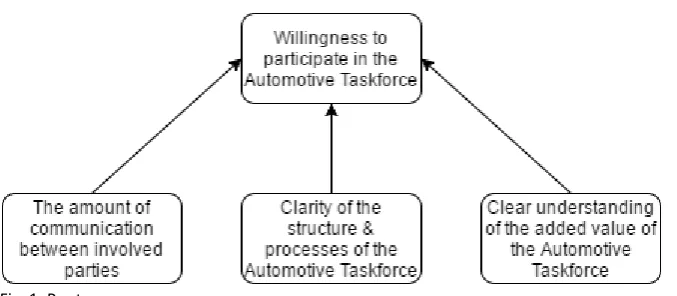
These problems need to be operationalized for research purposes. Therefore, the communication problem variable was defined as the amount of communication between involved parties. This includes the people from Teijin Aramid and the Teijin Headquarters who are involved or play a role in the Automotive Taskforce. The lack of information and details on the taskforce was defined as clarity of the structure and processes of the Automotive Taskforce. Lastly since the added value was not clearly understood, this variable will be defined as a clear understanding of the added value of the Automotive Taskforce. By clear understanding, it is meant that the stakeholders should easily be able to find what the added value is of the activities of the Automotive Taskforce. This can be achieved through analyzing changes in KPIs compared to when the Automotive Taskforce was not yet being used.
Fig. 1: Root causes
In the opinion of the interviewees at Teijin Aramid (part of) the reason why there has been little to no involvement in the Automotive Taskforce is because of the reasons above. Therefore, if the Automotive Taskforce is to gain more ground in Europe and really work together with the established group that is already active in Japan in order to create synergies and really embody the vision that was spoken out by the leader of the Taskforce and the CEO, these problems need to be addressed first.
Literature search: how can previous literature help?
In order to ensure that the literature is a good fit with the problem at hand, a systematic literature search will be performed.
As a blue print for this literature search, I have looked at the work of Crossan and Apaydin (2010) in their paper A multi-dimensional framework of organizational innovation: A systematic review of the literature.
In this work Crossan and Apaydin (2010) perform a systematic search for literature in three steps: The first step is that they take is to identify the initial selection criteria by defining key words and search terms
After this, the second step is to group the findings that come forward. apply identification criteria based on what they want to achieve with their research.
Lastly, after grouping all the papers found with the search terms identified, go on to weed out the useful papers from the useless to remain with a literature list that is applicable for their research. When applying these same steps for my literature search, the first and most important thing to identify is search terms. Based on the issues identified during the problem analysis, the literature search will focus on the following search terms:
● Cross-functional teams, which includes the following:
o Structure & processes of cross-functional teams
o Communication within/of a cross-functional team
o Knowledge sharing (in a cross-functional team)
● Participation (willingness) in a cross-functional team
● Added value of a cross-functional team
When using Web of Science and entering these search terms, for each of them, the results that returned can be seen in table 1. After these results, it is important, like Crossan and Apaydin, the results need to be sorted according to useful groups. Since the subject at hand is business and management related, I have decided to further narrow down the search to only business and management related publications. All of this sorting can be seen in table 1.
Search term used Results Results after sorting
Cross-functional team 1011 711
Structure, cross-functional team
165 145
Communication, cross-functional team
173 162
Knowledge sharing, cross-functional team
60 49
Participation*, cross-functional team
32 20
Added value, cross-functional team
[image:21.595.72.429.520.700.2]18 8
Table 1: literature search results
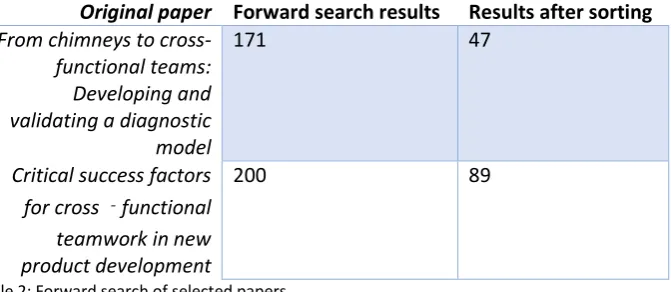
Especially with regards to the cross-functional team, a lot of results still remained, even after filtering. Because of this reason I decided to also do a forward search for some of the papers that I had already read. These papers are the work of Denison, Hart, and Kahn (1996) and Holland, Gaston, and Gomes (2000). These two papers were selected for forward search since they are on topic with the first search term of the cross-functional team, as well as its structure, communication and knowledge sharing. The only downside was the fact that these articles are a bit dated. For this reason a forward search for these two papers was conducted in order to include more recent literature. After the initial search, the selection was made on articles that were published in 2010 or later. The results of this forward search can be found in table 2.
Original paper Forward search results Results after sorting
From chimneys to cross-functional teams:
Developing and validating a diagnostic model
171 47
Critical success factors for cross‐functional teamwork in new product development
[image:22.595.84.420.237.383.2]200 89
Table 2: Forward search of selected papers.
After these selections, I summarized findings of articles and papers that I found relevant for the topic at hand. This can be found in each of the subchapters below.
The structure for cross-functional teams
In the previous section, an outline was given of the automotive taskforce. In this outline, the scope, definition and how it is supposed to work is given. In this section, I will look at what the literature has to say about cross-functional or multidisciplinary, global teams. How they can be successful, what they need, if there is a best practice or best way to approach these kind of platforms.
Govindarajan and Gupta (2001) for example identify three different factors that contribute to the success of high-performance global teams. The state that an effective team charter, team
composition and team process will lead to a better performing global business team.
They go in further details as to how these three factors should be worked out by the organisation to fully benefit from them and thus create the best global team possible. This includes; defining the team charter correctly, framing it correctly and making sure it’s understood. As well as making sure that the team has enough cognitive diversity whilst minimizing behavioral diversity, getting the right team size and selecting the appropriate leader. Lastly, team processes can be managed by paying attention to language and communication barriers, agreeing on the norms of behavior that should be instilled in each team member and cultivating a culture of trust.
According to Govindarajan and Gupta (2001) using these practices will allow organisations to create an effective global team.
organisational context, internal processes, external processes and group psychosocial traits (Holland et al., 2000). Each of these six categories is then further broken down into what could help cross-functional teams in that specific category.
Holland et al. go on to design a model of cross-functional teamwork with the factors that they’ve identified. In this model, Holland et al. (2000) show that mostly organisational context, task design and group composition have an influence on effective cross-functional teamwork. A full breakdown of each categories with factors that go with them can be found in the appendix.
[image:23.595.77.513.265.450.2]Based on these factors, Holland et al. (2000) developed a model to visualize which factors have an influence on effective cross-functional teamwork. This model can be seen in figure 2.
Fig 2: Cross-functional team success factors (Holland et al., 2000)
Based on this model, the categories that enable the performance of effective cross-functional teamwork are organisational context, task design and group composition. Other identified factors such as team processes or psycho-social traits are performance enhancers. Based on this framework, new cross-functional teams should focus on the performance enablers to ensure effective teamwork and enhancers should have second priority in that sense.
Denison et al. (1996) also proposed a method for how organisations can move from isolated chimneys to a more integrated cross-functional team structure. In their research Denison et al. attempt to find out what is needed to form an effective cross-functional team from an isolated basis. Based on their research they conclude that there are three factors that influence cross-functional team effectiveness. These are context, process and outcomes (Denison et al., 1996). Each of these factors has their own subsections. These will be briefly discussed in order to provide a better background on what makes an effective cross-functional team.
Denison et al. (1996) state that context need for a cross-functional team to function effectively consists of coordination with other teams, autonomy and power, linkage to functions, resources, mission & direction and reward for team performance.
Processes for effective cross-functional teams are important to deal with the conflicting demands that are inherent in the organisational context (Denison et al., 1996). The processes needed by cross-functional team-members that Denison et al. identified mainly demand both cross-functional
collective responsibility for resolving demands (Denison et al., 1996). Lastly, the third category outcomes points to what is expected from a cross-functional team. According to Denison et al. (1996) this is a wide range from innovation, learning and new capabilities to compressing time and hitting task targets that may be stringent.
In summary, based on the research and factors brought up by Denison et al. an effective cross-functional team needs organisational context that that does not limit autonomy, has sufficient resources, a clear mission & direction, as well as creating a team identity, norms and expected outcomes in the form of information creation, innovativeness, new capabilities and new learnings.
Organisational communication in a cross-functional team
As stated previously, the interviewees at Teijin also felt that communication within stakeholders for the Automotive Taskforce can and should be better. At this moment, there is limited information coming from the Automotive Taskforce, going through each member. Literature says the following about communication within a cross-functional team; Staples and Webster (2008), for example, base their framework on the social exchange theory of Blau to explain non-contractual interactions
between people (Staples & Webster, 2008). Staples and Webster (2008) state that interpersonal trust in other members of the team will have a positive effect on knowledge sharing.
In other research Tekleab, Karaca, Quigley, and Tsang (2016) state that functional diversity will have an influence on team cohesion. Functional diversity can be described using a definition from
Govindarajan and Gupta (2001). They state that this type of diversity can also be called cognitive diversity. It refers to differences in the substantive content of how members perceive the team’s challenges and opportunities, options to be evaluated and optimal course of action(Govindarajan & Gupta, 2001). Tekleab et al. (2016) define team cohesion as the tendency of a group to stick together and remain united in the pursuit of its instrumental objectives. Their research has found that
although there is initially a negative effect of functional diversity on team cohesion, this will eventually become a positive effect and increase team effectiveness (Tekleab et al., 2016).
According to Hirunyawipada, Beyerlein, and Blankson (2010) cross-functional integration can only be possible if knowledge and information is disseminated amongst the team in a good way.
Hirunyawipada et al. (2010) state that the tacit knowledge that each individual possess can be used in a cross-functional team through socialization. Even though a cross-functional team may possess some advantages towards socialization of knowledge, it does not do so automatically (Hirunyawipada et al., 2010).
A different study by Pinto and Pinto (1990) found a relation between communication of a cross-functional team and its effectiveness. Pinto and Pinto (1990) found that groups using informal communication methods like the telephone or informal discussions would exhibit higher
cooperation. They also found that teams with strong intra-team cooperation are able to devote more time to project related communication, as opposed to a team that needs to devote more time to resolving interpersonal difficulties between group members (Pinto & Pinto, 1990).
Knowledge sharing in a cross-functional team
During the interviews with employees from Teijin Aramid and Toho Tenax Europe, one comment often heard by almost every participant; the lack of information. This sometimes stems from lack of communication as well, but overall, there is little to no information available to the people in the European branch of the Teijin Group, even though these persons have the potential to be valuable contributors to the Automotive Taskforce. As explained previously the current Automotive Taskforce is built up of only Japanese team members. Since cultural difference has been quoted by people in the company as a barrier to communication and information sharing, it could be that this is part of why there is a lack of information.
In their article about the influence of culture on knowledge sharing in intercultural networks, Möller and Svahn (2004) define knowledge sharing as not only sharing codified information (explicit
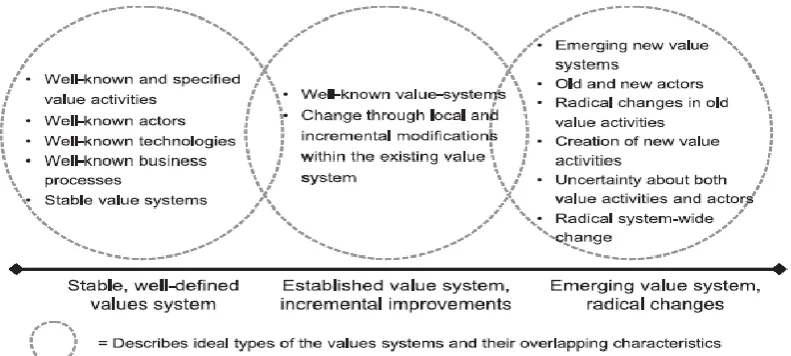
[image:25.595.83.479.497.675.2]knowledge), but also management beliefs, images, experiences and contextualized practices (Möller & Svahn, 2004). Möller and Svahn go on to describe three types of strategic networks with their own specific method of knowledge sharing. These can be defined by the value system they are trying to establish. That could be stable, well-defined value systems, established value systems and emerging value systems (Möller & Svahn, 2004). The figure below shows features of each of the systems. Möller & Svahn state that for the stable, well-defined system, knowledge sharing is essential to exploit current member-firm competencies. The emphasis lies in existing, primarily codified and codifiable knowledge. For the emerging value system, the role of tacit knowledge is much bigger. There is a bigger focus on co-creation of knowledge through exploration because of the dynamic environment for the emerging value systems. The established value system is in between the aforementioned value systems. This leads to a balance that needs to be struck with knowledge exploration and knowledge exploitation (Möller & Svahn, 2004). Möller and Svahn do note however that the value systems as they have proposed them are an ideal. In practice it is more common to find firms that have a combination of two value systems and overlap between the value systems is inevitable.
Fig 3: Value systems and their characteristics (Möller & Svahn, 2004)
These are vertical individualism (VI), vertical collectivism (VC), horizontal individualism (HI) and horizontal collectivism (HC) (Möller & Svahn, 2004). In this distinction Japan would classify as horizontal collectivism whereas the Netherlands would be more in league horizontal individualism (Möller & Svahn, 2004).
These four cultural classifications can be applied on the value systems and the knowledge sharing methods. Möller & Svahn state that, for example, stable well-defined value systems are better applicable in horizontal collectivist or vertical collectivist cultures and make knowledge sharing more easy because of hierarchical governance.
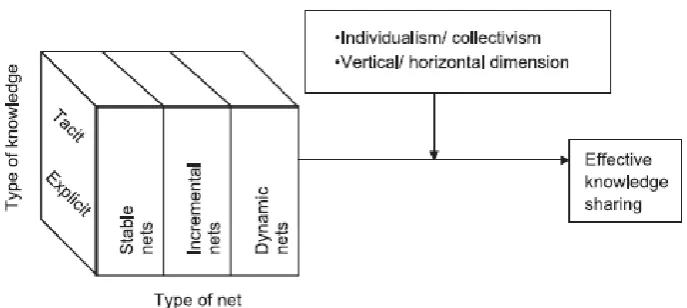
[image:26.595.122.466.247.401.2]Exactly how culture influences knowledge sharing can be seen in figure 4.
Fig 4: How culture influences knowledge sharing (Möller & Svahn, 2004)
Möller & Svahn state that knowledge sharing within a network is easiest when both parties in the network are from a similar culture type. Difficulties will arise when the culture types differ significantly. This will become more obvious in a network with individualism and collectivism, because of the uncertainty avoidance of collectivist cultures and the risk-taking factor of
individualistic cultures. Möller & Svahn conclude that the best option for emerging value systems will be to combine the individualism and collectivism into one system to benefit from both positive aspects and to play down the negative aspects. However communication-wise, this may provide problems because of cultural differences.
Another research by Majchrzak, More, and Faraj (2012) looks more into what is necessary for cross-functional teams to integrate knowledge. They observed three cross-cross-functional teams. Majchrzak et al. (2012) then go on to observe how knowledge is integrated when creating intermediate scaffolds. In this literature the scaffold is used as the product that a cross-functional team needs to work with and share knowledge on creation of said scaffold, however, the practices that are identified can be generalized for knowledge sharing in different projects as well. They state that five practices can be identified in which cross-functional teams integrate their knowledge to co-create a solution
(Majchrzak et al., 2012). These practices are the following:
● Voicing fragments: with this practice each member assembles part of the solution without discussing, clarifying or resolving knowledge differences.
● Co-creating a scaffold: this allows teams to develop collective team orientation to the problem-solving effort.
● Moving the scaffold aside: this allows for further co-creation to account for complex implementation requirements of external stakeholders.
● Sustaining engagement throughout the problem-solving effort: this helps to maintain energy and focus needed to continue the process of personally transforming one’s knowledge to collective knowledge.
Majchrzak et al. (2012) conclude that by making use of these practices, it will be easier for cross-functional teams to integrate knowledge, as well as share it.
Willingness to participate in a cross-functional team
In his research with regards to managing knowledge sharing across boundaries Carlile (2004) found that members of different teams were less willing to participate in such a sharing team at times of a conflict of interest. When interests are in conflict, the knowledge developed in one domain generates negative consequences in another. The costs for any actor are not just the costs of learning about what is new, but also the costs of transforming “current” knowledge being used. These costs negatively impact the willingness of an actor to make such changes (Carlile, 2004). In short, if the cost of the conflict of interest is negative or high, the team members will not make the changes necessary.
The added value of a cross-functional team
In his paper Daspit, Justice Tillman, Boyd, and Mckee (2013) sets out to look what the actual
effectiveness is of a cross-functional team. He states that much has been researched with regards to the structure and success factors, the research has been inconsistent in stating exactly which factors contribute to success (Daspit et al., 2013). Based on a literature review, the authors then come up with several hypotheses of which factors they believe add value to a cross-functional team in the form of effectiveness. The identified factors by Daspit et al. (2013) include team cohesion, shared leadership and internal team environment.
Application of the literature; finding a solution for the Automotive
Taskforce
After looking at the literature, a comparison can be made between the current situation at Teijin with regards to the Automotive Taskforce and the ideal situation that is laid out in the literature. This leads to a gap with things that are lacking in the current way that the Automotive Taskforce is organized and the way that it could or should be organized according to the literature.
Charter
As mentioned before Govindarajan and Gupta (2001) state that in order to be a successful global business team, an understandable team charter is needed. This is to make sure that communication problems and trust issues will be as little of a problem as possible.
For clarification of the term team charter, the definition from ice.com will be taken. A team charter is a document, developed in a group setting that clarifies team direction while establishing boundaries. It is developed early during the forming of the team. The charter should be developed in a group session to encourage understanding and buy-in.
As for the Automotive Taskforce, at this moment there is no such thing as a team charter. There is a document which states the vision of the Automotive Taskforce and what the plan is from start up to actually being active. However, things that are lacking are scope, boundaries and group
development. Direction is mentioned in the documents, however, it is all still very vague and uncertain. In order to really kick off activities and start working as a more successful team, there needs to be a transparent scope to state what will be included in the activities of the Automotive Taskforce and what will not. In order to get the European branch of Teijin on board as well, this charter should be developed in cooperation between the Automotive Taskforce leader and the stakeholders in the Teijin Aramid and Toho Tenax organisation. This will encourage understanding of the activities and create a team that people are willing to participate in and put their efforts in. This charter can for example include guidelines with regards to the activities that will fall under the Automotive Taskforce. This will prevent the fear that some interviewees expressed that there might be overlap with current activities. Furthermore, the charter can give rules and guidelines with regards to participation, rewards and time allocation. This will prevent the conflict of interest mentioned by Daspit et al. (2013) and will ensure that (knowledge sharing) practices will be implemented rather than ignored.
Processes/Task design
As mentioned before, Holland et al. (2000) state that task design, and the processes that come with it, is one of the main influencers of effective cross-functional teamwork. This will include things like team empowerment, which is labelled as autonomy or power over the team. This can also be undermined by meddling by functional managers and micro-managing by senior managers.
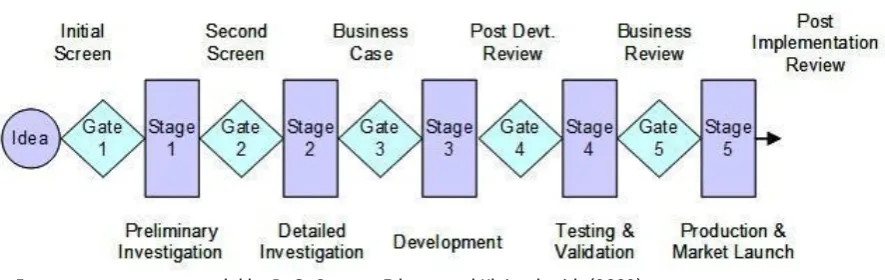
Fig 5: stage-gate process model by R. G. Cooper, Edgett, and Kleinschmidt (2002)
When looking at the Automotive Taskforce, it already has a few of the criteria posed by the
literature. There is a budget and decision-making power. However there are also things that are still lacking or that could be improved. One of these things is decision making. One of the team-members in Japan stated the following:
´it’s not always clear if a project should be stopped or not. Therefore, decisions are dragged out and
projects continue for a long time. But for the goals to be met, concrete targets should be set and decision making should be more clear cut and the responsibility should be with the leader of the
Taskforce”
-General Manager R&D High Performance Fiber Business Unit
If the Automotive Taskforce at this moment is struggling with setting milestones and targets to meet the goals, and subsequently making decisions on whether or not to continue with certain projects, then the stage gate process model could be a great help for the Automotive Taskforce to increase decision making power and to avoid two things: 1. Projects that drag on for too long without any added value or benefit and 2. Well argumented, transparent decision-making.
Organisational context
According to Holland et al. (2000) organisational context includes amongst others team training, resources, strategic alignment of functions and rewards. These contextual factors can help in creating an atmosphere for the cross-functional team to increase their performance.
In the case of the Automotive Taskforce, there are some contextual factors that are already in place, such as resources. However there are other things, such as team training and alignment of the functions that can still be improved. Holland et al. (2000) state that most companies spend more time in the structure of a cross-functional team, but forget training that will allow the members of the cross-functional team to function effectively together.
The Automotive Taskforce can benefit from team training to better coordinate cooperation between its members. This will be especially significant once the team will expand beyond Japan.
With regards to the strategic alignment, Holland et al. (2000) state that with strategic alignment, the senior management can align the level of support and prioritization of projects for the Automotive Taskforce. This will be also be relevant for the Automotive Taskforce, especially when there are different entities involved within the Teijin business group.