University of Warwick institutional repository: http://go.warwick.ac.uk/wrap
This paper is made available online in accordance with
publisher policies. Please scroll down to view the document
itself. Please refer to the repository record for this item and our
policy information available from the repository home page for
further information.
To see the final version of this paper please visit the publisher’s website.
Access to the published version may require a subscription.
Author(s): Robert Johnston and Xiangyu Kong
Article Title: The customer experience: a road-map for improvement
Year of publication: 2011
Link to published article:
http://dx.doi.org/
10.1108/09604521111100225
Publisher statement: Johnston, R. and Kong, X. (2011). The customer
experience: a road-map for improvement.
Managing Service Quality
,
21(1), pp. 5-24. To view the published open abstract, go to
The Customer Experience: A Road Map for Improvement
Robert Johnston and Xiangyu Kong Warwick Business School University of Warwick, UK Email [email protected]
Structured abstract
Purpose: This paper attempts to respond to the call to help organisations systematically engineer their customer experiences. Its objective is to investigate how organisations actually go about designing and improving their customer experiences.
Design/methodology/approach: Four organisations were chosen for this exploratory study; one business-to-business company, one business-to-consumer company, one utility and one public sector organisation. This longitudinal study over a period of four years collected data from participant observation, discussions, internal reports and from secondary data.
Findings: Despite the differences between the four organisations they appear to have taken, independently, the same approach to bring about improvements to their customer experiences. This paper proposes a ten stage „road map‟ to improvement which develops the existing models.
Contribution: The study makes four theoretical contributions including a definition of a customer experience and its difference to a service, it provides some empirical support for the existing stage models which it has develops and extends into a ten stage model. It has also identified the „triple bottom line‟ as the outcome of customer experience design not simply an improved experience.
Practical implications: This study identifies the critical importance of mindset change in the design of customer experience improvement programmes and the ways in which customers can be directly engaged in the design and improvement process. Importantly it provides a road map which organisations can use as a base for improving their customer experiences. It also suggests that it is useful to have clear objectives in three areas: customer, staff and cost efficiency and use them to assess the benefits of improving the customer experience.
Originality/value: The study organises the current literature on the customer experience, distinguishes between „service‟ and „experience‟, and provides a research-based road map for improving the customer experience.
Research limitations: Main limitations were that the in-depth, longitudinal study covered just four organisations and from a mix of sectors. Further work is needed to further test the findings in more organisations.
Research Paper
The Customer Experience: A Road Map for Improvement
Acknowledgment
We are indebted to Professor Scott Sampson from Brigham Young University for his considerable help and expertise with the literature section defining an experience and a service.
Introduction
Pine and Gilmore (1998 and 1999) were some of the first writers to address the notion of the customer experience (see also Carbone and Haeckel 1994 and Johnston 1999). In their paper in 1998; “Welcome to the Experience Economy” and their book the following year; The experience economy – Work is theatre and every business a stage, Pine and Gilmore observed that as services are becoming more commoditised leading-edge companies are competing on experiences.
The idea of the customer experience appears to have resonated with practitioners and academics alike and many managers and service researchers now talk about the customer experience. However, research on the customer experience appears to be in its infancy, certainly compared to service related topics such as service quality and loyalty. Furthermore, the customer experience is sometimes seen only as an issue for „entertainment‟ type organisations such as theme parks (experience-centric organisations – see Zomerdijk and Voss 2010). However the literature suggests that whatever the service (or indeed product) a customer is buying or receiving, that customer will have an experience; good, bad or indifferent, i.e. a service always comes with an experience (Carbone and Haeckel 1994) and that all service encounters provide an opportunity for emotional engagement, however mundane the product or service might be (Berry and Carbone 2007, Voss and Zomerdijk 2007).
The Customer Experience Literature
There appear to be three main areas covered in the current literature; why is the customer experience important? What is a customer experience? And importantly for this paper: how do organisations go about designing a better customer experience?
The importance of the customer experience
Several authors (see for example Pine and Gilmore 1998 and 1999, Shaw and Ivens 2002, Voss 2003, Prahalad and Ramaswamy 2004, Meyer and Schwager 2007), have made the point that the customer experience may provide a new means of competition. Providing a good experience is also important because it affects customer satisfaction (Liljander and Strandvik 1997), delivers customer loyalty (Yu and Dean 2001, Pullman and Gross 2004, Mascarenhas et al. 2006), influences expectations (Johnson and Mathews 1997, Flanagan
et al. 2005), instils confidence (Flanagan et al. 2005), supports the brand (Grace and O‟Cass 2004 Berry and Carbone 2007) and also creates emotional bonds with customers or, conversely, leads to emotional scarring (Pullman and Gross 2004).
However, despite these benefits, the limited amount of research in this area suggests that good customer experiences are not prevalent. For example, a recent survey by Bain & Co. of 362 companies, across several industries and their customers, found that 80 per cent of the senior executives interviewed said they provided a superior customer experience, but just eight per cent of their customers agreed (Coffman and Stotz 2007).
Customer Experience
There appears to be a good deal of confusion in the literature about the definition of an experience and its difference to a service. The first step is to try to clarify this, starting with the definition of a service.
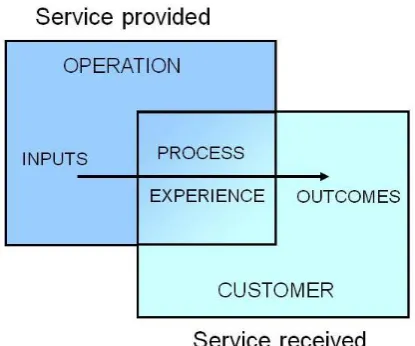
To make sense of the existing literature it is helpful to consider two perspectives on service, the service provided from the operation‟s point of view and the service received from the customer‟s point of view (see Figure 1) (Ding et al. 2010, Johnston and Clark 2008).
Figure 1 The operations and customer perspectives on service (adapted from Johnston and Clark 2008)
The operation uses its input resources, such as labour, materials, information, technologies, equipment, and customers (or something belonging to them), to design, create and enact the service together with the customer (the service process). (This is sometimes referred to as the transformation process, Slack et al. 2010 or resource integration, Lusch et al. 2007). From the operation‟s point of view, services are those processes (activities) which are created and enacted by organisations into which the customer provides an input and takes some part (from limited to significant) in the service process itself. Services are therefore „co-created‟ or „co-produced‟ along with the customer (Brudney and England 1983, Eiglier and Langeard 1987). Thus the service provided occurs, or is enacted, where the operation and the customer (as an input) meet as represented by the overlap in Figure 1.
Value is created for the organisation from the sale of the service for which the customer or some other agency pays (value-in-exchange, Lusch et al. 2007).
From a customer‟s point of view (sometimes referred to as the service-dominant logic perspective, Lusch et al. 2007) value is created for the customer in the service received; their experience of it (value-in-use, Lusch et al. 2007) and the outcomes of the service including the benefits they get from it (Carbone 2004, Edvardsson and Olsson 1996).
2007, Pullman and Gross 2004, Shaw and Ivens 2002). The experience (and value, Vargo and Lusch 2004) is perceived purely from the point of view of an individual customer and is inherently personal, existing only in the customer‟s mind. Thus, no two people can have the same experience (Pine and Gilmore 1998).
Experiencing a service results in the customer feeling emotions (powerful, subjective feelings and associated physiological states, Purves et al. 2001), of which there are many hundreds. The main ones being happiness, surprise, love, fear, anger, shame and sadness, and those feelings may range from, for example, discomfort to depression or warm to intimate or at ease to ecstatic (see for example Goleman 1996).
The benefits the customer gets from using and experiencing the service includes how they perceive they have „profited‟ or gained from the service provided and their experience of it, i.e. how well their requirements and needs have been met. Another outcome of the service from a customer's point of view will be their conscious or unconscious assessment of the service provided (Zomerdijk and Voss 2010), the perceived value of the service received (Bitner and Hubbert 1994, Oliver 1997) and their overall satisfaction or dissatisfaction (an emotion) (Carbone 2004). These judgments, good, bad or indifferent, will result in intentions, such as the intention to repurchase or not, the intention to recommend it to others, or the intention to complain or not. These intentions may or may not result in action.
The outcomes outlined above are from a customer perspective. There are also important outcomes from the organisation‟s perspective. Organisational outcomes will be concerned with meeting operational and strategic objectives and financial targets for example (Johnston and Clark 2008).
Customer experience design
While much operations management research has focused on service design, experience design has received only limited attention (Pullman and Gross 2004). However, there has been some work in this area. Several „operational‟ tools have been developed to help both design and assess the customer experience, including creating experience clues (Berry and Carbone 2007), designing the „servicescape‟ (Bitner 1992), customer journey mapping (Shaw and Ivens 2002, Zomerdijk and Voss 2010), service transaction analysis (Johnston 1999), customer experience analysis (Johnston and Clark 2008), walk-through audits (Fitzsimmons and Fitzsimmons 1994), and sequential incident technique (Stauss and Weinlich 1997).
Stuart and Tax (2004) argued that the customer experience can be enhanced by designing the service system to encourage greater active customer participation. Bate and Robert (2007) introduced an approach which involves customers in the design of the experience; experience-based design. Pickles et al. (2008) developed this methodology to demonstrate how three theoretical components of good design: functionality, engineering and aesthetics can be used as a framework to improve performance, safety and governance.
In terms of taking a more strategic and holistic approach to experience design, Carbone and Haeckel (1994) divided experience design into four phases; 1) acquisition of service experience design skills, 2) data collection and analysis, 3) service clue design, and 4) implementation and verification. Later Carbone (2004) suggested five steps; 1) build a diverse design team, 2) drill down to the experience core, 3) focus on clues, 4) develop the experience narrative or story line, and 5) prioritise implementation opportunities. In 2007 Berry and Carbone proposed a five step approach; 1) identify the emotions that evoke customer commitment, 2) establish an experience motif, 3) inventory and evaluate experience clues, 4) determine the experience gap, and 5) close the experience gap and monitor execution. Carbone also recommended that to transform an organisation to an experience-based one requires; 1) vision and strategy (clear experience statements), 2) leadership such as a CXO (chief experience officer), and 3) transfer of skills and knowledge by getting employee to think in terms of experience clues. These somewhat differing approaches (by the same author) do not appear to be supported by research-based evidence about what organisations have actually done and the impact of so doing. Thus the objective of this paper is to investigate and how organisations have gone about designing and improving their customer experiences.
Method
The chosen method for this paper is a grounded multiple case study, appropriate for exploring a relatively new topic area in order to provide descriptions to help generate theory in previously under-investigated areas (see for example Eisenhardt 1989; Gummesson 2000 and Yin 2008). While many studies recommend the use of longitudinal studies, this work employs such an approach because it concerns the implementation of a change process which takes place over a period of several years (Karlsson 2009). A longitudinal study was also chosen because asking questions at the end of an improvement process may lead to post hoc rationalisation. For example, while there may not have been a clear approach or strategy at the start, it may have become clear by the end. Further, post hoc assessment may not necessarily reflect or capture all the stages that actually took place.
Multiple cases were used to see if the approach taken was different in different contexts, where the individual cases act not as representations of populations (samples) but as replications. Four cases were selected to provide four different sector contexts; one private for-profit organisation (B2C) – a bank, one for-profit servicing business customers (B2B) – an international courier and parcels company, one public sector organisation – a hospital, and one regulated utility – a water company. Constraints of both time and opportunity precluded a voluntary organisation from being included in the set of cases.
The organisations were chosen because; firstly, they fitted into one of the chosen sectors, secondly, they had declared that they were about to embark on improving their customer experience, and thirdly, and importantly, they agreed to allow the researcher access to the organisations over a period of several years to observe how that organisation went about designing and improving the customer experience.
The unit of analysis was the organisation (not a department or unit). Being a grounded study there were no prior assumptions about how the organisations would go about their change processes.
The research was carried out over a period of four years during which time all the organisations planned and completed some substantive changes. The research design involved a combination of methods and multiple sources of evidence (suggested by Flynn
et al. 1990); historical archive analysis (from public records, newspapers and management reports, consultancy documents published and unpublished reports), participant observation (observing management discussions and meetings with executives and team members), and unstructured, ethnographic interviews (discussions) with executives and team members. Four main sub-questions provided the broad structure for the data collection:
1. Why did they want to improve the experience?
4. What was the impact of the changes?
The analysis of the wide variety of qualitative data collected involved several steps including; familiarisation, reflection, data reduction, writing narratives of the changes, coding, conceptualisation, sorting and cataloguing activities and outcomes, and re-evaluation (Easterby-Smith et al. 2008, Karlsson 2009).
Findings
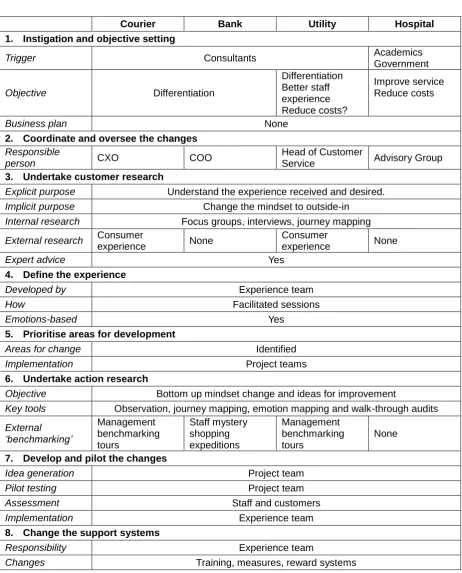
From the analysis eight broad stages emerged that captured the approaches taken by all four organisations to improve the customer experience, although the way they carried out the stages were slightly different. The eight stages of the improvement „road map‟ were; instigation and objective setting, coordinate and oversee the changes, undertake customer research, define the experience, undertake action research, prioritise areas for development, develop and pilot the changes, and change the support systems. The following sections take each of the stages in turn and briefly explain how the organisations carried them out. These findings are summarised in Table 1.
1. Instigation and objective setting
The motivation for improvement varied across the organisations. For the courier company improving the experience was an opportunity to differentiate the company in a relatively mature and commoditised market. Energised after attending an event run by a firm of consultants specialising in the customer experience, senior managers claimed that they had „discovered‟ that for many of their customers their service was quite an emotional experience and that their customers wanted to feel more engaged with the company. An important backdrop for this organisation was that it had told shareholders it wanted to improve its return on sales by ten per cent and the directors hoped that this initiative might contribute to that. In the bank, managers also saw an opportunity to differentiate the company. While they had spent some years developing their culture, values and processes they were looking for a next step. Again after being exposed to the work of a firm of consultants, they recognised they had the capability to provide quite a different experience than that of the competition. For both of these organisations there was no underlying „business plan‟ that suggested or expected these initiatives to reduce costs but it was done simply in the belief that they might at least maintain revenue levels and even increase them.
satisfaction. It was also felt that there may be opportunities for cost reduction. Again there was no business plan for the activity, just a belief that it was the right thing to do.
The hospital‟s approach was instigated by psychology academics and a health service improvement body spurred on by the NHS Improvement Plan 2005 and later by the Public Sector Transformation Programme 2007. Both of these government documents encourage public sector organisations to improve the experience they delivered to „customers‟ and also reduce costs. Again, no business plan existed.
Not only did no organisation have a business plan, there was also no clear strategy as to how they would go about improving the experience. The people leading these activities were allowed to develop it as they went along.
2. Coordinate and oversee the changes
In terms of coordination and overseeing the changes, all the organisations took a very similar approach. They all created small high powered teams (referred to here as Experience Teams) based centrally (at HQ) in the multi-site organisations to oversee, encourage, and coordinate the programme. With the exception of the hospital, the teams did not see themselves responsible for making the changes but for overseeing the changes and encouraging involvement. However, they did take responsibility for communication and strategic planning. The hospital was a smaller operation and the team was actively involved in bringing about the changes. The courier company appointed a Chief Experience Officer (CXO) to head the team which reported directly to the board. For the bank the remit was given to the Chief Operating Officer (COO). The responsibility in the utility was given to the Head of Customer Service and the hospital set up a high level advisory group which comprised a number of the most senior managers.
3. Undertake customer research
works well. The focus was on getting anecdotal data including emotive statements, positive and negative, from customers to help galvanise the need for change in the organisations. The hospital also involved patients and offered them video cameras, still cameras and paper to capture and then share their experiences with the Experience Team. All the organisations‟ Experience Teams supplemented their research using external agencies to collect industry-wide data. The courier and the utility companies, for example, commissioned external organisations to undertake consumer research, across sectors, to better understand the experience and emotions that consumers in general expected from service providers and the relative importance of each of them. The utility, for example, found two sets of factors (corresponding to satisfiers and dissatisfiers - see Johnston 1995) which they called physical and emotional. The physical factors being things like reliability, value for money, responsiveness and problem solving – with reliability being the most important) and the emotional aspects being trust, assurance, care, valued, for example, with trust recognised as the most important.
4. Define the experience
5. Prioritise areas for development
Based on their learning from the customer research and the development of experience statements the Experience Teams then set about identifying areas for change, assigning priorities (with senior managers) and also agreeing how the projects and work streams would be managed. In all cases the Experience Teams set up project teams employing project management methods. Their remit was not to redesign processes but to undertake action research to enable the redesign to happen „bottom-up‟ by getting ideas from the people involved in service delivery (step 6) then help them develop and implement the changes (step 7). One piece of action research in the courier company, for example, found that if a driver was expecting to be say 20 minutes late for a pick up or drop-off s/he had to ring their control to report it. The controller would then contact customer services, who would then contact the customer. By which time the driver would be at the company being berated for being late. This process also undermined the, usually, long-standing relationship the driver had with the staff at the company. The process was changed so that the drivers could contact the company directly and as soon as they knew they might be delayed.
6. Undertake action research
the bank small groups of staff were given tasks to „mystery shop‟ other organisations and report back. This latter method was reported to be highly successful in changing mindsets because by assessing other organisations first staff were better equipped, more able and more open-minded) to critique their own organisation.
Table 1 Road Map for Improving the Customer Experience
Courier Bank Utility Hospital
1. Instigation and objective setting
Trigger Consultants Academics
Government
Objective Differentiation
Differentiation Better staff experience Reduce costs? Improve service Reduce costs
Business plan None
2. Coordinate and oversee the changes
Responsible
person CXO COO
Head of Customer
Service Advisory Group
3. Undertake customer research
Explicit purpose Understand the experience received and desired. Implicit purpose Change the mindset to outside-in
Internal research Focus groups, interviews, journey mapping
External research Consumer
experience None
Consumer
experience None
Expert advice Yes
4. Define the experience
Developed by Experience team
How Facilitated sessions
Emotions-based Yes
5. Prioritise areas for development
Areas for change Identified Implementation Project teams
6. Undertake action research
Objective Bottom up mindset change and ideas for improvement
Key tools Observation, journey mapping, emotion mapping and walk-through audits
External ‘benchmarking’ Management benchmarking tours Staff mystery shopping expeditions Management benchmarking tours None
7. Develop and pilot the changes
Idea generation Project team
Pilot testing Project team
Assessment Staff and customers Implementation Experience team
8. Change the support systems
Responsibility Experience team
7. Develop and pilot the changes
These two activities were closely linked and iterative, and essentially one single stage. The project teams encouraged and collected ideas to deal with the issues the managers and staff identified and then helped them test them out in their own areas/departments and obtain feedback from staff and customers. If the changes were judged successful by the project teams, after any adjustments, the Experience Team would then take responsibility for coordinating the changes across the organisation/department and ensuring that appropriate training was provided by the appropriate department. The bank, for example, after a trial in several branches, changed its process for dealing with customers wanting to open a new account. Instead of this task being allocated to one individual (who was often not available – on break, on the phone etc) everyone was trained to deal with account openings so that there was no delay in signing someone up. “Come back later” was not the right experience for the customer.
8. Change the support systems
Many small but significant changes resulted, some of which required wider and deeper infrastructural changes in the organisation. The Experience Teams recognised that besides sharing the changes across the organisation they had to change organisational systems and processes, in particular revise training plans to take account of the changes but more importantly to change to customer-based measures to reflect the new customer focus, and then align measures and reward systems to support them. The water company, for example, relied on „percentage of non-major problems fixed within eight days‟ as a measure of its response to customers with a non-urgent problem. On the face of it this is similar to many organisations‟ repair measures but it is inside-out. While it might, at first glance, appear more efficient for the company to have a longer time period in which to schedule their work, it is quite unhelpful to the customer who has no idea over the next eight days when the operative is likely to arrive. So s/he either has to stay in for up to eight days or go out or to work and risk missing the operative (thereby making the process inefficient for the company as resources were frequently allocated to jobs where access could not be gained). The company introduced an integrated computerised scheduling system which enabled the operator to make specific promises with a narrow time window.
Assessment of the impact of the changes
Because the organisations did not have business or financial plans underlying the customer experience improvement activity, there were no pre-agreed measurable targets or outcomes against which they were measured or required to perform. Probably because of this none of the Experience Teams had agreed or created metrics at the start against which they would compare themselves at the end. As a result, the impact of these improvement activities was mainly anecdotal.
the greatest outcome was an increase in understanding of the business from a customer‟s point of view. Also there was a belief that the cost of poor quality had reduced as staff were making fewer mistakes as they better understood their role in creating the experience and also the impact of their making a mistake on the customer. As a result people started taking more of an end-to-end view of their processes. The leader also believed the company had become more efficient and effective as a result of the work, allowing the company to deal with higher volumes, primarily as a result of fewer mistakes and reduced rework. The company also achieved its desired ten per cent increase in return on sales and there was a view that this work had played a significant part in achieving it. There was also a belief that the work had greatly improved the customer‟s experience and also had made things much better and easier for staff.
The bank‟s Experience Team firmly believed the work had had a significant impact on the staff and therefore also on the customer. The staff, through the experience training they had undertaken, appeared to be much more engaged and were much more able to see things from the customer‟s point of view. As a result there was a view that the customers experience must have improved. There was also a view that efficiency had improved but there was no evidence to back up this assertion. The organisation believed that such information would be available within the next 18 months (after the end of the current study).
The utility company did have some metrics to substantiate the impact of their customer experience work. In one pilot area customer satisfaction had increased from 85 per cent to 97 per cent and the level of trust (one of the emotions they wanted to improve) had increased from 71 per cent to 81 per cent. They also had a reduction in complaints over the four year period of 25 per cent. They won several national awards not only for their customer service but also for staff satisfaction. The organisation also achieved 100 per cent compliance with legal and regularity standards but this was in part due to successes in the earlier parts of their transformation programme. There was a view that costs had been reduced though no hard evidence was available. However, the company had increased its profitability in non-regulated parts of the business which was believed to be due to the change in attitudes in the organisation.
The hospital saw a large number of small changes implemented in their processes. The Experience Team, which included patients, reported that the changes had vastly improved the customer‟s experience. In terms of the staff, they felt it had helped create a greater pride and also had built a sense of community. There was agreement that costs had been reduced, paperwork had been simplified, and better use had been made of professionals‟ time.
broader business and financial implications for the organisations with a range of improvements in costs and efficiency.
Discussion and contribution
It may sometimes be assumed that „customer experience‟ is predominantly concerned with „entertainment‟ type organisations. This study has demonstrated that the customer experience and its improvement were being taken seriously by a range of organisations, none of which were entertainment organisations. This supports the view in the literature that all customers, whatever the type of organisation or indeed sector, will have an experience; good, bad or indifferent. Furthermore that managers of all types of organisations need to consider the design of not only the service they deliver but also the experiences they provide.
There were three main themes in the literature; the importance of the customer experience, the nature of the experience versus the service and, importantly for this paper, how do organisations go about delivering a better customer experience.
1. Importance of the customer experience.
The literature suggested that the main reasons for improving the experience were concerned with increasing customers‟ satisfaction, and therefore loyalty, increasing confidence or trust, creating emotional bonds with customers and providing competitive advantage. These reasons focus primarily on benefits to the customer and as a result bring benefits to the organisation through retention. A good customer experience was also believed to create competitive advantage. This study has suggested that there were three areas of perceived benefit; the customer, the staff and the organisation, i.e. the „triple bottom line‟. The benefits to the staff have not been mentioned previously in the literature but were an important outcome for these organisations. Underpinning these staff benefits appeared to be a mindset change, a better understanding by staff of the customer experience delivered and desired, and the impact of their work on it. This generated greater commitment to their work, pride in it and greater satisfaction from their work. Benefits for the organisations included cost reductions and efficiency gains (not previously mentioned in the literature); these, together with the improved experience, were seen to provide the basis for competitive advantage.
2. Nature of the experience
take considerable time and effort.
3. Delivering a better experience
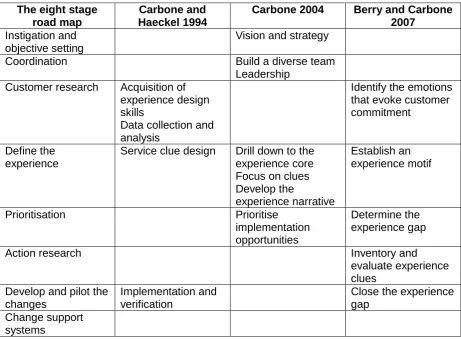
The stages of their improvement programmes were similar across these four very different organisations, although there were some differences in terms of execution. The broad eight stages fit with, and provide support for, the existing literature, in particular Berry and Carbone‟s (2007) five step approach (see Table 2).
[image:17.595.67.529.319.658.2]Importantly, this study has provided an evidence-based approach to experience design documenting how organisations have actually gone about developing their customer experiences. There are some important differences between the results and the existing models that are worthy of some discussion.
Table 2 The Eight Stage Road Map Compared to Earlier Stage Models
The eight stage road map
Carbone and Haeckel 1994
Carbone 2004 Berry and Carbone 2007
Instigation and objective setting
Vision and strategy
Coordination Build a diverse team
Leadership Customer research Acquisition of
experience design skills
Data collection and analysis
Identify the emotions that evoke customer commitment
Define the experience
Service clue design Drill down to the experience core Focus on clues Develop the
experience narrative
Establish an experience motif
Prioritisation Prioritise
implementation opportunities
Determine the experience gap
Action research Inventory and
evaluate experience clues
Develop and pilot the changes
Implementation and verification
Close the experience gap
Change support systems
explicit, was concerned with changing the mindset of the staff so that they can better see the opportunities, i.e. getting them to see outside-in. Tools and activities that encouraged staff to see the process from the customer‟s point of view played a key role here. Customers were used not just indirectly to provide information but more actively in developing and testing ideas in customer forums and in one case as members of the Experience Team. Changing the support systems was not covered by any of the stage models in the literature. The four organisations all recognised the importance of changing the broader systems and processes, such as reward and measurement systems, training activities etc and indeed organisational culture, to embed the changes in the organisation. Without so doing it is possible that the changes and the benefits from them might have been short-lived.
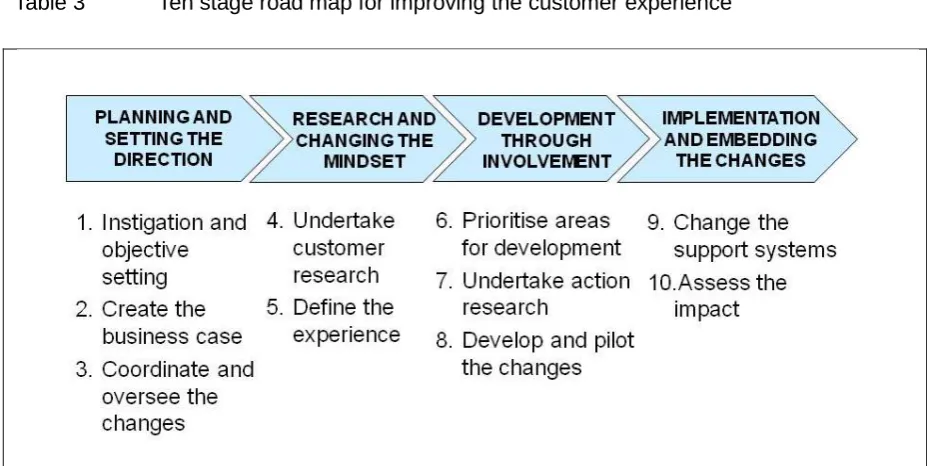
[image:18.595.65.529.469.702.2]Further, with hindsight, the organisations would have included two additional stages. The senior management of all four organisations agreed that they had allowed the programmes to go ahead without any road map in place, and importantly no means of assessing success. With the benefit of hindsight it was felt that in future they would expect an additional stage at the start – build the business case - which would require the development of a business case with the purpose of getting the senior management team on board and setting up staging points and success criteria based on the broad objectives set out in the first stage. The other additional, and related, stage would be at the end, assessing the impact of the change programme against the success criteria and the stages set out in the business case. (This was suggested by Berry and Carbone (2007) as „monitor execution‟.) As a result we propose a ten stage road map which is summarised in Table 3.
Table 3 Ten stage road map for improving the customer experience
achieving action including motivating people, using team activities, getting commitment and creating a feeling of ownership, using problem solving approaches and getting people to solve the problems for themselves (see for example Carnall 2007, Kotter 1988, 1995). Interestingly, the organisations did not have a well defined „change programme‟ at the start and none of them had laid out even the broad stages of this activity. However, some Experience Teams, at the end of the programme claimed they had road maps in mind at the start. This leads to the question – are change management programmes a normal intuitive management approach thus there is no need to have such a programme mapped out from the start? Maybe managers tend to follow, intuitively, a change management structure.
The literature also identified a range of tools that could be used to improve the customer experience including; focus groups, emotion mapping, process mapping, service transaction analysis, customer experience analysis, walk-through audits, journey mapping etc. It was clear that all of these tools were applied (in some form) by all of the organisations with emotion mapping being particularly powerful.
Conclusions
This paper has attempted to respond to the call to help organisations systematically engineer their customer experiences. Its objective was to take a grounded approach to customer experience improvement and investigate how organisations actually go about designing and improving and their customer experiences.
This research has provided a number of important contributions to the literature. Firstly it has defined an experience and its difference to a service. Secondly it has provided some empirical support for the existing customer experience change models. Thirdly it has developed the existing stage models to provide a more detailed and underpinned ten stage road map. Fourthly, it has identified that the benefits for such change programmes are not simply about an improved experience for the customer (leading to enhanced loyally and competitive advantage etc) but also importantly, cost reduction and efficiency gains and also an improved experience for staff, i.e. the „triple bottom line‟.
This work has many limitations. While this research has followed four organisations over a period of about four years, there were only four organisations, and each was from a different sector. Furthermore the methodology was not based on any easily reproducible questionnaire but based on a range of activities including discussions, and internal and external reports. It would be therefore useful to create a more robust methodology for expanding this work into many other organisations to test the stages and also obtain more robust information on the real impacts of the changes. There are also many related topics that could be studied including the role of, and for service engineers, experience research and development and innovations in customer experiences.
References
Bate, P. and Robert, G. (2007). "Toward More user-Centric OD - Lessons From the Field of Experience-Based Design and a Case Study." The Journal of Applied Behavioral Science, 41(1): 41-66.
Berry, L. L. and Carbone, L. P. (2007). "Build Loyalty Through Experience Management."
Quality Progress 40(9): 26-32.
Bitner, M-J and Hubbert A,R., (1994), “Encounter Satisfaction Versus Overall Satisfaction Versus Service Quality: The Consumer‟s Voice”, in Rust, Roland .T. and Oliver Richard L., (eds), Service Quality: New Directions in Theory and Practice, Sage Publications, Thousand Oaks, USA, 72-94
Bitner, M-J, (1992), “Servicescapes: The Impact of Physical Surroundings on Customers and Employees”, Journal of Marketing, 56 (2) 57-71
Brudney, JL., England, R.E., (1983), “Toward a Definition of the Coproduction Concept”,
Public Administration Review, 43 (1), 59
Carbone, L. P. and Haeckel, S. H. (1994). "Engineering Customer Experience." Marketing Management 3(3): 8-19.
Carbone, L.P., (2004), Clued In, FT Prentice Hall, New Jersey
Carnall, C.A., (2007), Managing Change in Organisations, 5th ed, FT Prentice Hall, Harlow Chase, R.B., (1981) “The customer contact approach to services: theoretical bases and
practical extensions”, Operations Research, 29 (4)
Coffman, J. and Stotz, D. (2007). How some banks turn clients into advocates, American Banker.
Csikszentmihalyi, M., (2000), “The Costs and Benefits of Consuming”, Journal of Consumer Research, 27 (2) 267-272
Ding, D.X., Hu P.J., Verma R. and Wardell D.G., (2010), “The Impact of Service System Design and Flow Experience on Customer Satisfaction in Online Financial Services”, Journal of Service Research, 13 (1) 96-110
Easterby-Smith, M.,Thorpe R., Jackson P., and Lowe A., (2008), Management Research: Theory and Practice, 3rd edition, Sage
Edvardsson, B., and Olsson J., (1996), “Key Concepts for New Service Development”,
The Service Industries Journal, 16 (2) 140-164
Eisenhardt, K.M., (1989), “Building Theories from Case Study Research”, Academy of Management Review, 14 (4) 532-550
Fitzsimmons, J. A. and Fitzsimmons, M. J. (1994). Service Management for Competitive Advantage. New York, McGraw-Hill.
Flanagan, P., Johnston, R., and Talbot, D. (2005). "Customer confidence: the development of a "pre-experience" concept." International Journal of Service Industry Management
16(4): 373-384.
Flynn, B.B., Sakakibara S., Schroeder R.G., Bates K.A., and Flynn E.J., (1990), “Empirical Research Methods in Operations Management”, Journal of Operations Management, 9 (2) 250-284
Goleman, D., (1996), Emotional Intelligence, Bloomsbury, London
Grace, D. and O'Cass, A. (2004). "Examining service experiences and post-consumption evaluations." Journal of Services Marketing 18(6): 450-461.
Gummesson, E., (2000), Qualitative Methods in Management Research, 2nd ed, Sage Publications Inc
Gummesson, E., (1987), “The New Marketing – Developing Long-term Interactive Relationships”, Long Range Planning, 20 (4) 10-20
H.M Government, (2007), Service Transformation Agreement, H.M. Treasury, HMSO, Norwich
Haywood-Farmer, J., and Nollet J., (1991), Services Plus: Effective Service Management, Morin, Boucherville, Quebec
Johnson, C. and Mathews, B. P. (1997). "The influence of experience on service expectations." International Journal of Service Industry Management 8(4): 290-305. Johnston, R. (1999). "Service transaction analysis: assessing and improving the
customer's experience." Managing Service Quality 9(2): 102-109.
Johnston, R. (2008). "Internal Service - barriers, flows and assessment." International Journal of Service Industry Management 19(2): 210-231.
Johnston, R. and Clark, G. (2008). Service Operations Management 3rd Edition, Financial Times / Prentice Hall.
Johnston, R., (1995), “The Determinants of Service Quality: Satisfiers and Dissatisfiers”,
International Journal of Service Industry Management, 6 (5) 53-71
Johnston, R., and Bryan R., (1993), “Products and Services - A Question of Visibility”, The Service Industries Journal, 13 (3) 125-136
Karlsson, C., (ed), (2009), Researching Operations Management, Routledge, New York Kotter, J. P., (1988), The Leadership Factor, Free Press, New York
Kotter, J. P., (1995), “Leading Change: Why transformation efforts fail”, Harvard Business Review, 73 (2) 59-67
Liljander, V. and Strandvik, T. (1997). "Emotions in Service Satisfaction." International Journal of Service Industry Management 8(2): 148-160.
Lusch, R.F., Vargo S.L., and O‟Brien M., (2007), “Competing through service: Insights from service dominant logic”, Journal of Retailing, 83 (1) 2-18
Business Review 2007 (February): 117-126.
Meyer, D. (2007). Setting the Table. New York, Harper Collins. Normann, R., (2000) Service Management, Wiley, 3rd ed, Chichester
Oliver, R.L., (1997), Satisfaction: A Behavioral Perspective on the Consumer, McGraw Hill, New York
Parasuraman, A, Zeithaml V.A., and Berry L.L., (1985), “A conceptual model of service quality and implications for future research”, Journal of Marketing, 49 (Fall) 41-50 Pickles, J., Hide, E., and Maher, L.. (2008). "Experience based design: a practical method
of working with patients to redesign services." Clinical Governance: An International Journal 13 (1) 51-58
Pine II, B. J. and Gilmore, J. H. (1998). "Welcome to the Experience Economy." Harvard Business Review 1998 (July-August): 97-105.
Pine II, B. J. and Gilmore, J. H. (1999). The Experience Economy: Work is Theatre and Every Business a Stage. Cambridge, MA., Harvard Business School Press.
Pinto, S.S., and Johnston R., (2004), “The object and nature of service specifications”, in Edvardsson B., Gustafsson A., Brown S.W., and Johnston R., (eds), Service Excellence in Management: Interdisciplinary Contributions, Karlstad University, 2004, pp 487-496
Prahalad, C. K. and Ramaswamy, V. (2004). The Future of Competition - Co-Creating Unique Value with Customers. Boston, Harvard Business School Press.
Price, R. and Brodie, R. J. (2001). "Transforming a Public Service Organization From Inside out to Outside in." Journal of Service Research 4(1): 50-59.
Pullman, M. E. and Gross, M. A. (2004). "Ability of Experience Design Elements to Elicit Emotions and Loyalty Behaviors." Decision Science 35(3): 551-578.
Purves, D., Augustine G.J., Fitzpatrick D., Katz L.C., LaMantia A-S., and Williams S.M., (2001), Neuroscience, 2nd ed, Sinauer Associates, Sunderland, Massachesetts
Sampson, S. E. (2005), Understanding Service Businesses, 2nd ed, Wiley
Sampson, S. E. and Froehle C.M., (2006), Foundations and Implications of a Proposed Unified Services Theory, Production and Operations Management, 15 (2) 329 - 343 Schmitt, B. H. (2003). Customer Experience Management. Hoboken, Wiley and Sons. Shaw, C. and Ivens, J. (2002). Building Great Customer Experiences. New York, Palgrave
MacMillan.
Slack, N., Chambers S., and Johnston R., (2010), Operations Management, 6th edition, FT Prentice Hall, Harlow
Stauss, B. and Weinlich, B. (1997). "Process-oriented measurement of service quality - Applying the sequential incident technique." European Journal of Marketing 31(1): 33-55.
Stuart, F. I. and Tax, S. (2004). "Toward and integrative approach to designing service experiences Lessons learned from the theatre." Journal of Operations Management 22: 609-627.
Vargo, S.L. and Lusch R.F., (2004), “Evolving to a New Dominant Logic of Marketing”,
Journal of Marketing, 68 (1) 1-17
Voss, C. A. (2003). "Rethinking paradigms of service - service in a virtual environment."
Voss, C. and Zomerdijk, L. (2007). Innovation in Experiential Services - An Empirical View. Innovation in services. London, DTI: 97-134.
Wild, R., (1977), Concepts for Operations Management, Wiley, Chichester
Yin, R.K., (2008), Case Study Research: Design and Methods, 4rd ed., Sage Publications, Thousand Oaks, California
Yu, Y.-T. and Dean, A. (2001). "The contribution of emotional satisfaction to customer loyalty." International Journal of Service Industry Management 12(3): 234-251.
Zomerdijk, L.G., and Voss C.A., (2010), “Service Design for Experience-Centric Services”,