Coordination-aware Dependency Parsing
(Preliminary Report)
Akifumi Yoshimoto∗ Kazuo Hara† Masashi Shimbo∗ Yuji Matsumoto∗ ∗Nara Institute of Science and Technology
Ikoma, Nara, Japan
{akifumi-y,shimbo,matsu}@is.naist.jp
†National Institute of Genetics
Mishima, Shizuoka, Japan
Abstract
Coordinate structures pose difficulties in dependency parsers. In this paper, we pro-pose a set of parsing rules specifically de-signed to handle coordination, which are intended to be used in combination with Eisner and Satta’s dependency rules. The new rules are compatible with existing similarity-based approaches to coordina-tion structure analysis, and thus the syn-tactic and semantic similarity of conjuncts can be incorporated to the parse scoring function. Although we are yet to imple-ment such a scoring function, we analyzed the time complexity of the proposed rules as well as their coverage of the Penn Tree-bank converted to the Stanford basic de-pendencies.
1 Introduction
Even for state-of-the-art dependency parsers, the recovery of dependencies involving coordinate structures remains difficult. According to Nivre et al. (2010), the accuracy in parsing the construc-tion known as right node raising, which includes a coordinate structure such as “president and chief executive of the company,” is less than fifty per-cent.
Apart from dependency parsers, there are meth-ods specialized for coordination structure analy-sis, which attempt to identify coordinate structures from the similarity of conjuncts (Kurohashi and Nagao, 1994; Hara and Shimbo, 2007; Hara et al., 2009).
Our final goal is to improve the accuracy of parsing sentences containing coordination, by tak-ing advantage of the above methodologies. In the same vein, Hanamoto et al. (2012) used dual decomposition to combine an HPSG parser with Hara et al.’s (2009) model.
In this paper, we take a different approach: we augment Eisner and Satta’s (1999) parsing rules for normal dependencies, with a new set of rules to specifically handle coordinations. This design reflects the fact that Eisner and Satta’s “split-head” (Johnson, 2007) rules construct dependency trees on the left and the right of a word independently, and thus the entire span of conjuncts cannot be captured during the course of construction.
Using the Penn Treebank (PTB) (Marcus et al., 1993) after converting the structures to Stanford basic dependency representation (de Marneffe and Manning, 2008), we verified that the proposed rules cover 94% of the sentences involving coor-dinations. Moreover, about half the failure of the remaining sentences was caused by unusually an-notated structures, rather than a weakness in the proposed rules.
2 Dependency structure for coordination In the Stanford basic dependencies, coordination is represented as a dependency structure in which the first conjunct is the head of the dependency1,
with the second and subsequent conjuncts being the dependents of the first. Commas and coordi-nate conjunctions (such as “and”, “or”) separating conjuncts are also the dependents of the first con-junct, with labelspunct andcc, respectively.
Florida , Illinois and Pennsylvania
NNP , NNP CC NNP
conj cc conj punct
Although not explicitly stated in the Stanford man-ual, in the converted PTB corpus, the first conjunct 1The Stanford dependencies manual (de Marneffe and
Manning, 2008) merely states that the first conjunct is nor-mallythe head, but we take this rule as definitive in this paper. The error analysis of our method based on this assumption is given in Section 5.
is, in most cases, also the head of extra punctua-tions (e.g., a comma in front of “and” in “A,B, and
C”), or parentheses (e.g., “he says” in “A, Band, he says,C”) that occur inside coordinate structure. 3 The Eisner-Satta algorithm
In this section, we briefly review the grammar rules used in the Eisner-Satta algorithm (1999), which our proposed rules are designed to augment. For details about the algorithm, see the original pa-per, as well as (Koo and Collins, 2010; Johnson, 2007).
The Eisner-Satta algorithm builds a parse tree in a bottom-up manner using the following four rules, each of which yields a span of different type shown next to the respective rule.
INCOMPLETELEFT
i k → i j j+1 k
(1)
INCOMPLETERIGHT
i k → i j j+1 k
(2)
CCOMPLETELEFT
i k → i j j k
(3)
COMPLETERIGHT
i k → i j j k
(4)
In these rules, i, j, and k indicate word indices. Symbol`is also used for an index later. Letw(i)
denote the ith word in a sentence. Each word
w(i) is initially associated with COMPLETELEFT
i i and COMPLETERIGHT i i . A root node
is added as the leftmost node of a sentence, with only COMPLETERIGHT.
4 Parsing rules for coordination
We augment Eisner and Satta’s split-head depen-dency parsing rules with a set of additional rules that are tailored for similarity evaluation of con-juncts. Split-head rules lead to an efficientO(n3)
parsing algorithm for a sentence of length n, but the way in which a parse tree is built does not al-low evaluation of conjunct similarity as done in Hara et al. (2009).
When a structure “AandB” is parsed with the Eisner-Satta algorithm, rule (2) is used for creat-ing a dependency arc (with label conj) between conjuncts A and B. At that moment, the avail-able spans are COMPLETERIGHT whose head is
A, and COMPLETELEFTwhose head is B. How-ever, these spans do not correspond to the entire
spans of the respective conjuncts. See the figure below for illustration.
to split into three sectors and to sell its subsidiary
AUX PREP POBJ
NUM
cc conj
AUX DOBJPOSS
Therefore, we introduce new constituents specifi-cally for coordination, which group both sides of the head of conjuncts, as in:
to split into three sectors and to sell its subsidiary
AUX PREP POBJNUM
cc conj
AUX DOBJ
POSS
4.1 Punctuations and conjunctions
Let q, r, and s signify word indices whose val-ues are restricted by the position of punctuations or conjunctions2.
We first group COMPLETELEFTand COMPLE -TERIGHT for a punctuation or a conjunction as a single constituent. We call the resulting con-stituents PUNCTMARK(or PM for short) and CC -MARK(CM), respectively.
Rule (5) can be applied only ifw(q), the word at indexq, is a commas or a semicolons, and rule (6) only ifw(q)is a coordinate conjunctions, such as “and,” “or,” “and/or,” “&,” “but,” “plus,” and “yet.”
q q q
PM
−→ q q q q O(p)
(5)
q q q
CM
−→ q q q q O(p)
(6)
As shown next to the rules, the time needed to ap-ply them is O(p), where p (n) is the number of coordinate conjunctions and punctuations in a sentence; i.e., the valuesqcan potentially take on.
4.2 Rules for cascading conjuncts
In Hara et al. (2009), the plausibility score of a coordinate structure is defined in terms of the sim-ilarity between the head conjunct and each of the remaining conjuncts. In the Stanford basic depen-dencies, the head of a coordinate structure is the first conjunct by default. Thus, to enable compu-tation similar to Hara et al., the end position of the first conjunct must be maintained throughout the 2Depending on the rules, indicesq,r,smay not represent
construction of dependency relations for a coordi-nate structure. This leads to an additional index associated with constituents, but in most cases, it is constrained by the position of punctuations and conjunctions.
Let us introduce constituent CONJ (or C for short) to represent a conjunct. The first rule for CONJsimply groups the left and right dependents for a conjunct, as follows.
C
i j k k −→ i j k O(n
3)
(7)
As we explain shortly, CONJis also used to rep-resent a partially-built coordinate structure. The indexkinside the span is used for maintaining the end of the first (head) conjunct, such that the sim-ilarity between the first and the subsequent con-juncts can be computed. However, in the above rule, the end position of the span is equal to the end of the conjunct; thus, k appears twice on the left-hand side (lhs) of the rule.
Rules (8)–(9) below deal with a series of conjuncts separated by PUNCTMARK, e.g., “A,
B, C, . . . ” The new constituent, PUNCTIN -COMPLETE (PI), represents the sequence CONJ PUNCTMARK.
i j q r PI
−→ C
i j q r−1
PM
r r r
punct
O(n2p2)
(8)
i j q s C
−→ PI
i j q r
C
r+1k s s
conj
O(n3p3)
(9)
In these rules,q, the index for the end of the first conjunct3 is inherited by their lhs, as mentioned
earlier. With q at our disposal, we can compute the score for the derivation by (9), by taking into account the similarity between the first conjunct on the span(i,q)with head j, and the subsequent conjunct on(r+1,s)with headk.
The following two rules terminate a coordi-nate structure, when CCMARKand the last CONJ are encountered. We introduce new constituents 3Note that in rules (8)–(11), the index for the end of the
first conjunct is denoted byq, meaning that it can take only O(p)different values. This opposes rule (7) in which it was denoted by k, whose range isO(n). This change owes to the fact that the end of the first conjunct is constrained by rules (8) or (10), which require the first CONJto be followed by a PUNCTMARKor CCMARK; thus the end index for the first conjunct has onlyO(p)possibilities.
CCINCOMPLETE(CI) and COMPLETE(CL).
i j q r CI
−→ C
i j q r−1
CM
r r r
cc
O(n2p2)
(10)
i j `
CL
−→ CI
i j q r
C
r+1k ` ` conj
O(n4p2)
(11)
4.3 Interfacing complete coordination with outer parse trees
Rules (12)–(13) connect a completed coordination COMPLETE to the structures made with the stan-dard Eisner-Satta rules.
i ` −→ i j j+1k `
CL
O(n4)
(12)
i ` −→
CL
i j k k+1 ` O(n 4)
(13)
We also need rules to handle the case where COMPLETEtakes a modifier.
i j ` −→
CL
i j k k+1 ` O(n 4)
(14)
i j `
CL
−→
i j k k ` O(n
4)
(15)
The lhs of rule (14) has a new constituent, which can be regarded as a concatenation of COM -PLETELEFT and INCOMPLETERIGHT in Eisner and Satta’s rules. Notice also that although the lhs of rule (15) is represented by COMPLETE, it sim-ply means a constituent having both left and right dependents, and loses the meaning of a coordina-tion as a whole.
Furthermore, to deal with recursive coordina-tions, such as “(A & B) &C,” we allow COM -PLETEto be CONJagain.4
C
i j k k −→ CL
i j k
(16)
PUNCTINCOMPLETE is also allowed to be CONJ, to tolerate patterns like “, and” (note the comma preceding “and”).
C
i j q r −→ PI
i j q r
(17)
4The computational complexity for unary rules is not
There are also cases in which COMPLETE de-pends upon another COMPLETE, which occurs with a construct such as “(V1 & V2)(N1 & N2),”
whereVi andNi represent verbs and their objects
(nouns), respectively.
i j ` −→ i
CL
j k ` O(n
4)
(18)
CL
i j ` −→
CL
i j k j k+1 ` O(n 4)
(19)
Here, we used the “hook trick” (Eisner and Satta, 1999; Huang et al., 2005) to reduce the incurred time complexity fromO(n5)toO(n4).
4.4 Time complexity
If we neglect the number p of punctuations and conjunctions in a sentence, parsing a sentence of lengthnrequiresO(n4)time, which is the same as
that of Hara et al.’s (2009) coordination analysis method. For a sentence not containing coordinate conjunctions, the run time isO(n3).
4.5 A note on spuriousity
Rule (17) causes spurious ambiguity when there are exactly two conjuncts and a comma precedes a coordinate conjunction; e.g., “A, andB.” In this case, the dependency between A and the comma can be made with not only rule (17), but also with the standard Eisner-Satta rules. Rule (16) also causes spuriousity in a similar situation. However, these spuriousities can be easily removed by im-posing restrictions on rules (7) and (16), such that they are not applicable ifw(k)is a comma or semi-colon. In the experiment in the next section, these restrictions are used.
5 Coverage of coordination rules
5.1 Experimental setup
We converted the WSJ part of PTB into Stanford basic dependencies5, and verified the coverage of
the proposed rules. Of the 43,948 sentences in WSJ sections 2–23, dependency arcs labeledconj, which indicate the presence of coordination, were contained in 40%, or 17,695 sentences.
Dependency structure for coordinations can also be derived with the standard Eisner-Satta rules, but we are only interested in the coverage 5we used the Stanford parser (converter) v. 3.5.2, with -basicand-conllxoptions to generate gold dependencies.
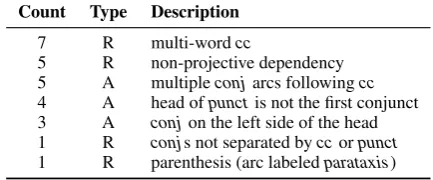
Count Type Description
7 R multi-wordcc
5 R non-projective dependency 5 A multipleconjarcs followingcc
4 A head ofpunctis not the first conjunct 3 A conjon the left side of the head 1 R conjs not separated byccorpunct
[image:4.595.307.524.65.155.2]1 R parenthesis (arc labeledparataxis)
Table 1: Causes of non-derivable dependencies in WSJ Section 22. We classified these into two types: Error type A is due to errors/inconsistencies in the gold annotation, and type R can be attributed to the deficiency for the proposed rules.
of the proposed rules in WSJ. Hence we treated
conj-labeled arcs as only derivable with the pro-posed rules, but not with Eisner-Satta. We thus essentially made Eisner and Satta’s rules to fail to derive dependencies on all the sentences con-tainingconj-dependencies, and evaluated the cov-erage of the proposed rules over these sentences. Except for this constraint onconj, we ignored all the dependency labels.
5.2 Result
[image:4.595.73.281.147.214.2]Of the 17,695 sentences containing conj-labeled dependencies in WSJ sections 2–23, the proposed rules were able to derive correct dependencies for 94%, or 16,659 sentences.
Table 1 lists the types of failures of our pars-ing rules and their frequencies in WSJ section 22. About half of the failures were due to inconsisten-cies or errors in the gold annotations.
6 Conclusion
In this paper, we have proposed a set of depen-dency parsing rules specifically designed to han-dle coordination, to be used in combination with Eisner and Satta’s rules. The new rules enable the parse scoring function to incorporate the syntac-tic and semansyntac-tic similarity of conjuncts. While we are yet to implement such a scoring function, we analyzed the time complexity of the proposed rules and their coverage in the Penn Treebank.
Acknowledgments
References
Marie-Catherine de Marneffe and Christopher D. Man-ning. 2008. Stanford typed dependencies man-ual. http://nlp.stanford.edu/software/dependencies manual.pdf. Revised in April 2015.
Jason Eisner and Giorgio Satta. 1999. Efficient pars-ing for bilexical context-free grammars and head
au-tomaton grammars. InProceedings of the 37th
An-nual Meeting of the Association for Computational Linguistics (ACL ’99), pages 457–464, College Park, Maryland, USA.
Atsushi Hanamoto, Takuya Matsuzaki, and Jun’ichi Tsujii. 2012. Coordination structure analysis
us-ing dual decomposition. InProceedings of the 13th
Conference of the European Chapter of the Asso-ciation for Computational Linguistics (EACL ’12), pages 430–438, Avignon, France.
Kazuo Hara and Masashi Shimbo. 2007. A discrimi-native learning model for coordinate conjunctions. In Proceedings of the 2007 Joint Conference on Empirical Methods in Natural Language Process-ing and Computational Natural Language Learn-ing (EMNLP-CoNLL ’07), pages 610–619, Prague, Czech Republic.
Kazuo Hara, Masashi Shimbo, Hideharu Okuma, and Yuji Matsumoto. 2009. Coordinate structure analy-sis with global structural constraints and
alignment-based local features. InProceedings of the 47th
An-nual Meeting of the ACL and the 4th IJCNLP of the AFNLP (ACL-IJCNLP ’09), pages 967–975, Singa-pore.
Liang Huang, Hao Zhang, and Daniel Gildea. 2005. Machine translation as lexicalized parsing with
hooks. In Proceedings of the 9th International
Workshop on Parsing Technology (IWPT ’05), pages 65–73, Vancouver, British Columbia, Canada.
Mark Johnson. 2007. Transforming projective bilex-ical dependency grammars into efficiently-parsable
CFGs with unfold-fold. In Proceedings of the
45th Annual Meeting of the Association of Com-putational Linguistics (ACL ’07), pages 168–175, Prague, Czech Republic.
Terry Koo and Michael Collins. 2010. Efficient
third-order dependency parsers. In Proceedings of the
48th Annual Meeting of the Association for Compu-tational Linguistics, pages 1–11, Uppsala, Sweden.
Sadao Kurohashi and Makoto Nagao. 1994. A syn-tactic analysis method of long Japanese sentences based on the detection of conjunctive structures. Computational Linguistics, 20(4):507–534.
Mitchell P. Marcus, Mary Ann Marcinkiewicz, and Beatrice Santorini. 1993. Building a large
anno-tated corpus of English: The Penn Treebank.
Com-putational Linguistics, 19(2):313–330.
Joakim Nivre, Laura Rimell, Ryan McDonald, and Car-los G´omez Rodr´ıguez. 2010. Evaluation of
depen-dency parsers on unbounded dependencies. In