Comparing attribute classifiers for interactive language grounding
Yanchao Yu Interaction Lab Heriot-Watt University
Arash Eshghi Interaction Lab Heriot-Watt University
Oliver Lemon Interaction Lab Heriot-Watt University
Abstract
We address the problem of interac-tively learning perceptually grounded word meanings in a multimodal dialogue system. We design a semantic and visual processing system to support this and il-lustrate how they can be integrated. We then focus on comparing the performance (Precision, Recall, F1, AUC) of three state-of-the-art attribute classifiers for the purpose of interactive language ground-ing (MLKNN, DAP, and SVMs), on the aPascal-aYahoo datasets. In prior work, results were presented for object classi-fication using these methods for attribute labelling, whereas we focus on their per-formance for attribute labelling itself. We find that while these methods can perform well for some of the attributes (e.g.head, ears, furry) none of these models has good performance over the whole attribute set, and none supports incremental learning. This leads us to suggest directions for fu-ture work.
1 Introduction
Identifying, classifying and talking about ob-jects or events in the surrounding environment are key capabilities for intelligent, goal-driven systems that interact with other agents and the external world (e.g. smart phones, robots, and other automated systems), as well as for image search/retrieval systems. To this end, there has recently been a surge of interest and significant progress made on a variety of related tasks, in-cluding generation of Natural Language (NL) de-scriptions of images, or identifying images based on NL descriptions (Karpathy and Fei-Fei, 2014; Bruni et al., 2014; Socher et al., 2014). Another strand of work has focused on learning to generate
object descriptions and object classification based on low level concepts/features (such as colour, shape and material), enabling systems to identify and describe novel, unseen images (Farhadi et al., 2009; Silberer and Lapata, 2014; Sun et al., 2013). Our goal is to buildinteractivesystems that can learn grounded word meanings relating to their perceptions of real-world objects – rather than ab-stract coloured shapes as in some previous work e.g. (Roy, 2002). For example, we aim to build multimodal interfaces for Human-Robot Interac-tion which can learn object descripInterac-tions and ref-erences in interaction with humans. In contrast to recent work on image description using ‘deep learning’ methods, this setting means that the sys-tem must be trainable from little data, composi-tional, able to handle dialogue, and adaptive– for instance so that it can learn visual concepts suit-able for specific tasks/domains, and even new id-iosyncratic language usage for particular users.
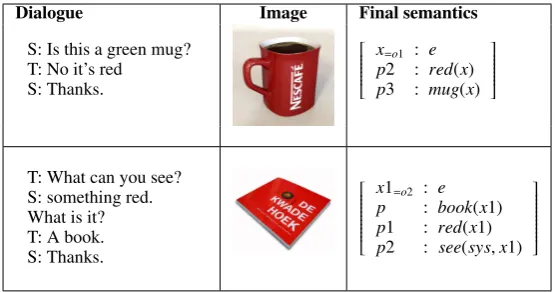
However, most of the existing systems for im-age description rely on training data of both high quantity and high quality with no possibility of on-line error correction. Furthermore, they are unsuit-able for robots and multimodal systems that need to continuously, and incrementally learn from the environment, and may encounter objects they haven’t seen in training data. These limitations are likely to be alleviated if systems can learn con-cepts, as and when needed, from situated dialogue with humans. Interaction with a human tutor en-ables systems to take initiative and seek the partic-ular information they need or lack by e.g. asking questions with the highest information gain (see e.g. (Skocaj et al., 2011), and Fig. 1).
For example, a robot could ask questions to learn the color of a “mug” or to request to be pre-sented with more “red” things to improve its per-formance on the concept (see e.g. Figure 1). Fur-thermore, such systems could allow for meaning negotiation in the form of clarification interactions
Dialogue Image Final semantics
S: Is this a green mug? T: No it’s red
S: Thanks.
xp=2 :o1 : ered(x) p3 : mug(x)
T: What can you see? S: something red. What is it? T: A book. S: Thanks.
x1=o2 : e
p : book(x1) p1 : red(x1) p2 : see(sys,x1)
[image:2.595.160.438.61.207.2]
Figure 1: Example dialogues & resulting semantic representations
with the tutor.
This paper presents initial work in a larger pro-gramme of research with the aim of developing dialogue systems that learn (visual) concepts – word meanings – through situated dialogue with a human tutor. Specifically, we compare several existing state-of-the-art classifiers with regard to their suitability for interactive language grounding tasks. We compare the performance of MLKNN (Zhang and Zhou, 2007), DAP (zero-shot learn-ing (Lampert et al., 2014)), and SVMs (Farhadi et al., 2010) on the image datasets aPascal (for train-ing) and aYahoo (testtrain-ing) – see section 4. To our knowledge, this paper is the first to compare these attribute classifiers in terms of their suitability for interactive language grounding.
Our other contribution is to integrate an incre-mental semantic grammar suited to dialogue pro-cessing – DS-TTR1(Purver et al., 2011; Eshghi et
al., 2012), see section 3 – with visual classifica-tion algorithms that provide perceptual grounding for the basic semantic atoms in the representations produced by the parser through the course of a di-alogue (see Fig. 1). In effect, the didi-alogue with the tutor continuously provides semantic information about objects in the scene which is then fed to an online classifier in the form of training instances. Conversely, the system can utilise the grammar and its existing knowledge about the world, en-coded in its classifiers, to make reference to and formulate questions about the different attributes of an object identified in the scene.
2 Related work
There has recently been a lot of research into learning to classify and describe images/objects. 1Downloadable from http://dylan.sourceforge.
net
Some approaches attempt to ground meaning of words/phrases/sentences in images/objects by mapping these modalities into the same vector space (Karpathy and Fei-Fei, 2014; Silberer and Lapata, 2014; Kiros et al., 2014), or using dis-tributional semantic models that build distribu-tional representations with the conjunction of tex-tual and visual information (Bruni et al., 2014). Other approaches, such as (Socher et al., 2014), propose Neural Network models based on Depen-dency Trees (DT), which project all words in a sentence into a DT structured representation to ex-plore parents of each node and correlations be-tween nodes.
In contrast to these approaches, which do not support NL dialogues, some approaches are de-signed based on logical semantic representations and some of them are incorporated with spoken dialogue systems (Skocaj et al., 2011; Matuszek et al., 2012; Kollar et al., 2013). A well-known logical semantic parser is the Combinatory Cate-gorial Grammar (CCG) parser, which represents natural language sentences from human tutors in the logical forms. The “Logical Semantics with Perception” (LSP) framework by Kollar et al. (Kr-ishnamurthy and Kollar, 2013) and the joint lan-guage/perception model by Matuszek et al. (Ma-tuszek et al., 2012) are based on a CCG parser or using a CCG lexicon respectively. Although a CCG parser could generate similar logical repre-sentations to the DS-TTR parser/generator we use here, we believe that DS-TTR would show bet-ter performance than CCG in bet-terms of handling the inherent incremental, fragmentary and highly context-dependent nature of dialogue.
seman-tics, and uses only synthetically generated scenes rather than real images and image processing. Our approach extends (Dobnik et al., 2012) in integrat-ing vision and language within a sintegrat-ingle formal sys-tem: Type Theory with Records (TTR). This com-bination will allow complex multi-turn dialogues for language grounding with deep NL semantics, including natural correction and clarification sub-dialogues (e.g. “No this isn’t red, it’s green.”).
2.1 Attribute classification
Regarding attribute-based classification or de-scription, Farhadi et al. (Farhadi et al., 2009) have successfully described objects with attributes by sharing appearance attributes across object cate-gories. Silberer and Lapata (Silberer and Lapata, 2014) extend Farhadi et al.’s work to predict at-tributes using L2-loss linear SVMs and to learn the associations between visual attributes and particu-lar words using Auto-encoders. Sun et al. (Sun et al., 2013) also build an attribute-based identi-fication model based on hierarchical sparse cod-ing with a K-SVD algorithm, which recognizes each attribute type using multinomial logistic re-gression. However, as these models require a large mass of training data, an increasing amount of re-search attempts to learn novel objects using ‘one-shot’ (Li et al., 2006; Krause et al., 2014) or ‘zero-shot’ learning algorithms (Li et al., 2007; Lampert et al., 2014). They enable a system to classify un-seen objects with fewer or no examples by sharing
attributes between known and unknown objects. Note that these methods ultimately focus on ob-ject class labels, using attributes as intermediate representations.
On the other hand, to learn attribute-based ob-jects through NL interaction, some approaches learn unknown objects or attributes with online incremental learning algorithms (Li et al., 2007; Kankuekul et al., 2012). The “George” system (Skocaj et al., 2011), which is similar in spirit to our work, learns object attributes from a human tu-tor and creates specific questions to request infor-mation to fill detected knowledge gaps. However, the George system only learns about 2 shapes and 8 colours. Our goal is to couple attribute classifiers with much wider coverage to the formal semantics of a full Natural Language dialogue system.
3 System Architecture
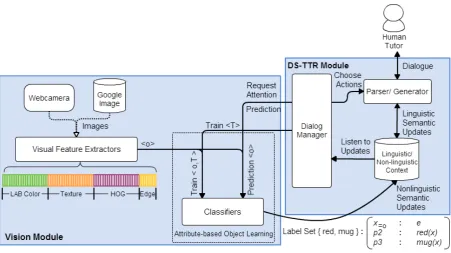
We are developing a system to support an attribute-based object learning process through natural, incremental spoken dialogue interaction. The architecture of the system is shown in Fig. 2. The system has two main modules: a vision mod-ule for visual feature extraction and classifica-tion; and a dialogue system module using DS-TTR (see below). Visual feature representations are built based on base features akin to (Farhadi et al., 2009). We do not yet have a fully inte-grated dialogue system, so for our experiments presented below, we assume access to logical se-mantic representations, that will be output by the DS-TTR parser/generator as a result of process-ing dialogues with a human tutor (more on this below) – and interface these representations with attribute-based image classifiers. Below we de-scribe these components individually and then ex-plain how they interact.
3.1 Attribute-based Classifiers used
In this research, in order to explore the best so-lution for attribute classification for an interactive system, we compare several methods which have previously shown good performance on image-labelling tasks – a multi-label classification model, a zero-shot learning model, and a linear SVM:
(a) MLkNN (Zhang and Zhou, 2007) is a su-pervised multi-label learning model based on the k-Nearest Neighbour algorithm, which predicts a label set for unknown instances. It has previously been used for scene labelling with 5 labels (sunset, desert, mountains, sea, trees) and reached a Preci-sion of 0.8;
(b) L2-loss Linear SVM as used by (Farhadi et al., 2009). We used the published feature extrac-tion and attribute training code2, though we appear
to have achieved slightly worse AUC results than achieved in (Farhadi et al., 2009) (see section 4);
Figure 2: Architecture of the simulated teachable system
attribute relations and infer the corresponding ob-ject classes using a probabilistic model. In this paper, we reimplement the DAP zero-shot learn-ing model based on Lampert’s work; but since we are here concerned only with attribute classi-fication we only test the first tier of their algo-rithm for attribute classification. (Note that al-though both (Farhadi et al., 2009) and (Lampert et al., 2014) implement a SVM classifier for each attribute, DAP learns the supervised model with the linearly combined χ2-kernels rather than the
original visual representations.) Note that the im-plementation of the DAP model is not identical to that of (Lampert et al., 2014), so our results are not directly comparable to that paper. We used the Libsvm 3.0 library (Chang and Lin, 2011), differ-ing from the Shogun library in the original imple-mentation for learning visual classifiers. To more directly compare the DAP model with other meth-ods, we moreover generated the visual represen-tation using the feature extraction algorithms by (Farhadi et al., 2009) instead of the original meth-ods.
All models will output attribute-based label sets for novel unseen images by predicting binary la-bel vectors. We build visual representations and binary label vectors as inputs to train new clas-sifiers for learning attributes, as explained in the following subsections.
3.1.1 Visual Feature Representation
Following the feature extraction methods pro-posed by (Farhadi et al., 2009), we extract a fea-ture representation consisting of the base feafea-tures for learning to classify and describe novel objects, i.e. the colour space for colour attributes, texture for materials, visual words for object components, as well as edges for shapes.
Colour descriptors, consisting of L*A*B colour space values, are extracted for each pixel and then are quantized to the nearest 128 k-means cen-tres. These descriptors inside the bounding box are binned into individual histograms. Edges and their orientations are detected using a MATLAB canny edge detector, which contributes to finding both edges and boundaries of objects within an image. Detected edges are quantized into 8 un-signed bins. A texture descriptor is computed for each pixel and then quantized to the nearest 256 k-means centres. Finally, object visual words are built in HOG descriptors using 8x8 blocks, a 4-pixel step size, and quantized into 512 k-means centres.
The feature extractor in the vision module presents a feature matrix with dimensions w ×
3.1.2 Binary Label Vectors
For learning attribute objects, the multi-label models require a multi-label vector for each train-ing instance. In the interactive system, an instance χand its related label setη ⊆ Y are given by the feature extractor and DS-TTR parser individually, where Y is a total collection of attribute-based la-bels. We suppose→−l is the binary label vector for χ, where itsi-th component→−l(i)(i ∈ η) will take the value 1 ifi ∈Y and -1 otherwise. Eventually, the system builds a binary label matrix with di-mensionsw×n, wherewis the number of instances andnis the total number of labels for all training instances. Each instance contains a full binary la-bel vector. The lala-bel vectors and feature represen-tations are used to learn new classifiers once novel object instances are learned incrementally from in-teraction.
3.2 Dynamic Syntax (DS)
The DS module is a word-by-word incremental semantic parser/generator, based around the Dy-namic Syntax (DS) grammar framework (Cann et al., 2005) especially suited to the fragmentary and highly contextual nature of dialogue. In DS, di-alogue is modelled as the interactive and incre-mental construction of contextual and semantic representations (Purver et al., 2011). The con-textual representations afforded by DS are of the fine-grained semantic content that is jointly nego-tiated/agreed upon by the interlocutors, as a re-sult of processing questions and answers, clarifi-cation requests, corrections, acceptances, etc (see Eshghi et al (2015) for an account of how this can be achieved grammar-internally as a low-level se-mantic update process). Recent versions of DS incorporate Type Theory with Records (TTR) as the logical formalism in which meaning represen-tations are couched (Purver et al., 2011; Eshghi et al., 2012), due to its useful properties. Here we do not introduce DS due to space limitations but proceed to introducing TTR.
3.3 Type Theory with Records
Type Theory with Records (TTR) is an exten-sion of standard type theory shown to be use-ful in semantics and dialogue modelling (Cooper, 2005; Ginzburg, 2012). TTR is particularly well-suited to our problem here as it allows information from various modalities, including vision and lan-guage, to be represented within a single semantic
framework (see e.g. Larsson (2013); Dobnik et al. (2012) who use it to model the semantics of spatial language and perceptual classification).
In TTR, logical forms are specified as record types(RTs), which are sequences offieldsof the form [l: T] containing a labelland a typeT. RTs can be witnessed (i.e. judged true) byrecords of that type, where a record is a sequence of label-value pairs [l = v]. We say that [l= v] is of type [l :T] just in casevis of typeT.
R1:
ll12=a :: TT12 l3=p(l2) : T3
R2:
"
l1 : T1 l2 : T20
#
R3: []
Figure 3: Example TTR record types Fields can be manifest, i.e. given a singleton type e.g. [l :Ta] where Ta is the type of which onlyais a member; here, we write this using the syntactic sugar [l=a :T]. Fields can also be
de-pendent on fields preceding them (i.e. higher) in the record type (see Fig. 3).
The standard subtype relationvcan be defined for record types: R1 v R2if for all fields [l :T2]
inR2,R1contains [l :T1] whereT1vT2. In
Fig-ure 3,R1 vR2ifT2 vT20, and bothR1andR2are
subtypes ofR3. This subtyping relation allows
se-mantic information to be incrementally specified, i.e. record types can be indefinitely extended with more information/constraints. For us here, this is a key feature since it allows the system to en-codepartialknowledge about objects, and for this knowledge (e.g. object attributes) to be extended in a principled way, as and when this information becomes available.
[image:5.595.309.528.217.254.2]3.4 Integration
can be used directly at any point to generate utter-ances, or ask questions about the objects.
On the other hand, the DS-TTR parser incre-mentally produces Record Types (RT), represent-ing the meanrepresent-ing jointly established by the tutor and the system so far. In this domain, this is ulti-mately one or more type judgements, i.e. that some scene/image/object is judged to be of a particular type, e.g. in Fig. 1 that the individuated object,o1 is a red mug. These jointly negotiated type judge-ments then go on to provide training instances for the classifiers. In general, the training instances are of the form,hO,Ti, whereOis an image/scene segment (an object), and T, a record type. T is then converted automatically to an input format suitable for specific classifiers; e.g. the dialogues in Fig. 1 provide the following instances to our classifiers:ho1,{red,mug}iandho2,{red,book}i.
What sets our approach apart from other work is that these types are constructed/negotiated in-teractively, and so both the system and the tutor can contribute to a single representation (see e.g. second row of Fig. 1).
4 Experiments and Results
4.1 Datasets for Attribute-based classification
In order to compare the different classifiers with previous work (Farhadi et al., 2009), we perform our experiments on a benchmark dataset of natu-ral object-based images with attribute annotations – the aPascal-aYahoo data set3 – which is
intro-duced by Farhadi et al. The aPascal-aYahoo data set has two subsets: the Pascal VOC 2008 dataset and the aYahoo dataset. The Pascal VOC 2008 dataset is created for visual object classifications and detections. The aPascal data set covers 20 attribute-labelled classes and each class contains a number of samples, ranging from 150 to 1000. The aYahoo dataset, as a supplement of the aPas-cal dataset, contains objects similar to aPasaPas-cal, but with different correlations between attributes. The aYahoo dataset only contains 12 objects classes. Images in both aPascal and aYahoo sets are anno-tated with 64 binary attributes, covering shape and material as well as object components (see table 1). We use the 6340 images selected by (Farhadi et al., 2009) from the aPascal dataset for training and use the whole aYahoo dataset with 2644 im-ages as the test set. As both aPascal and aYahoo data sets are imbalanced in the number of positive
3http://vision.cs.uiuc.edu/attributes/
instances for each attribute, as shown in table 1, this might affect the performance of the models on attribute classification.
4.2 Experiment Setup
We test how well the different classifiers work on learning object attributes. We implemented sev-eral classification models – MLkNN, DAP, and SVMs as described in Section 3.1. Most work on attribute classification reports the Precision and Recall only for object classes – which are com-puted using the attribute labels – but we are di-rectly interested in the performance of the attribute classifiers themselves. Thus we report Precision, Recall, and F1-Score for the attribute labels for each model. We also show the average scores across all attributes in table 2.
4.3 Results
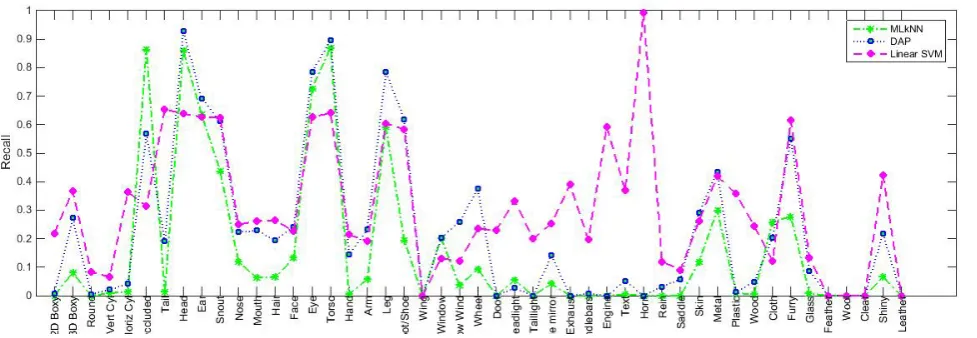
We first plot the Precision and Recall for each at-tribute for the different models, as shown in fig-ures 4 and 5. We take Precision to be 1 where the number of True Positives and False Negatives are both 0 for an attribute (otherwise it would be un-defined).
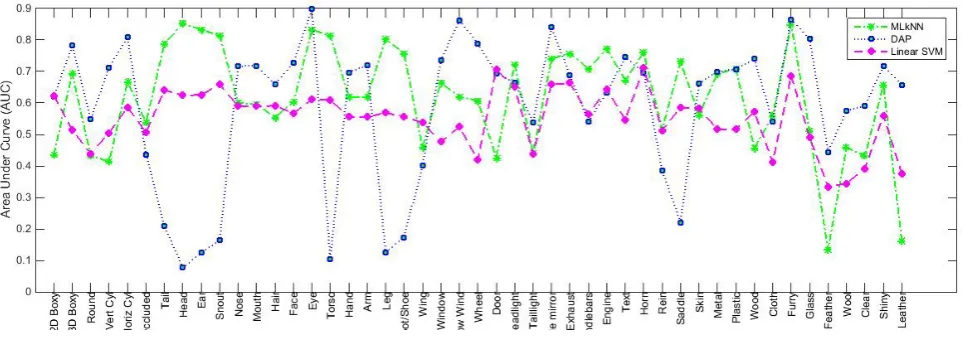
Figures 4 - 7 compare the different methods for each attribute in terms for Precision, Recall, F1, and AUC (Area Under ROC Curve). The AUC scores are computed using an open library for computer vision algorithms – Vlfeat (Vedaldi and Fulkerson, 2010).
Table 2 shows the average scores for each method, computed across all of the attributes. The results show that DAP generally has better perfor-mance across all of the attributes, although each method has specific strengths and weaknesses.
5 Discussion
sim-Attribute Label aPascal aYahoo Attribute Label aPascal aYahoo Attribute Label aPascal aYahoo
2D Boxy 207 146 3D Boxy 393 752 Round 39 179
Vert Cyl 195 334 Horiz Cyl 94 286 Occluded 1913 778
Tail 184 529 Head 1737 1157 Ear 1097 1048
Snout 237 708 Nose 995 345 Mouth 930 332
Hair 1095 216 Face 1022 392 Eye 1183 1061
Torso 1538 1024 Hand 811 364 Arm 1080 383
Leg 994 922 Foot/Shoe 604 719 Wing 114 11
Window 304 167 Row Wind 86 224 Wheel 336 64
Door 192 13 Headlight 162 36 Taillight 104 5
Side mirror 150 71 Exhaust 50 41 Handlebars 92 37
Engine 35 71 Text 84 388 Horn 4 145
Rein 32 284 Saddle 20 121 Skin 1396 161
Metal 581 739 Plastic 260 459 Wood 195 167
Cloth 1591 123 Furry 250 996 Glass 180 34
Feather 99 1 Wool 12 15 Clear 32 42
[image:7.595.76.520.61.235.2]Shiny 432 527 Leather 6 85
[image:7.595.78.562.288.457.2]Table 1: The Number of Positive instances on each attribute in aPascal-aYahoo Datasets (aPascal for training set, aYahoo for testing Set, attributes with no testing instances removed)
Figure 4: Precisions on each attribute for each method: MLkNN, DAP and Linear SVM (note that Precision is defined as 1 when there are in fact no True positives or False positives returned)
Figure 5: Recalls on each attribute for each method (MLkNN, DAP and Linear SVM)
ilar numbers of training instances are performing
[image:7.595.77.566.514.683.2]Figure 6: Macro-F1 on each attribute for each method (MLkNN, DAP and Linear SVM)
Figure 7: Area Under ROC curve for each attribute for each method (MLkNN, DAP and Linear SVM)
meanings) from human tutors, these results would lead us to pick, at least in an initial proof-of-concept system, attributes that show rapid learn-ing rates. Presumably this is why prior work on this problem has often used ‘toy’ images where real image processing is not required (e.g. (Roy, 2002; Kennington et al., 2015)).
What we would need ultimately are attribute classifier learning methods which can operate ef-fectively on small numbers of examples, and which can improve performance robustly when new examples are presented, without “unlearning” previous examples and without needing long re-training times. The dialogue abilities of the over-all system will over-allow correction and clarification interactions to correct false positives (e.g “it’s not red it’s green”) and other errors, and the attribute classification model must allow for such rapid re-training.
Finally we note that none of these algorithms are incremental. Incremental learning methods (Kankuekul et al., 2012; Tsai et al., 2014; Furao et al., 2007; Zheng et al., 2013) have been devel-oped to train object classification networks with-out abandoning previously learned knowledge or destroying the old trained prototypes. These meth-ods (such as (Kankuekul et al., 2012)) could en-able systems to label known/unknown attributes gradually through NL interaction with human tu-tors. Incremental learning approaches can also speed up the object learning/prediction process and the system responses, rather than taking a long computational time.
[image:8.595.77.559.285.456.2]Model average Precision average Recall average Macro-F1
MLkNN 0.5186 0.1537 0.2372
DAP 0.3326 0.2276 0.2703
[image:9.595.139.467.61.119.2]SVMs 0.1676 0.3118 0.2180
Table 2: Average scores across attribute labels for each method, trained on aPascal and tested on aYahoo
6 Conclusion
We are developing a multimodal interface to ex-plore the effectiveness of situated dialogue with a human tutor for learning perceptually-grounded word meanings. The system integrates the seman-tic/contextual representations from an incremen-tal semantic parser/generator, DS-TTR, with at-tribute classification models to evaluate their per-formance.
We compared the performance (Precision, Re-call, F1, AUC) of several state-of-the-art attribute classifiers for the purpose of interactive language grounding (MLKNN, DAP, and SVMs), on the aPascal-aYahoo datasets. The results show that the models can sometimes perform quite well on specific attributes (e.g.head, ears, torso), but the performance over all attributes in general is rather poor. This leads us to either restrict the attributes actually used in a real system, or to explore other methods, such as incremental learning.
The immediate future direction our research will take is in developing and evaluating a fully implemented system involving classifiers incor-porated with incremental learning algorithms for each visual attribute, DS-TTR, and a pro-active di-alogue manager that formulates the right questions to gain information and increase accuracy.
We envisage the use of such technology in mul-timodal systems interacting with humans, such as robots and smart spaces.
Acknowledgements
This research is partially supported by the EP-SRC, under grant number EP/M01553X/1 (BAB-BLE project4).
References
Elia Bruni, Nam-Khanh Tran, and Marco Baroni.
2014. Multimodal distributional semantics. J.
Ar-tif. Intell. Res.(JAIR), 49(1–47).
4https://sites.google.com/site/
hwinteractionlab/babble
Ronnie Cann, Ruth Kempson, and Lutz Marten. 2005.
The Dynamics of Language. Elsevier, Oxford.
Chih-Chung Chang and Chih-Jen Lin. 2011.
LIB-SVM: A library for support vector machines. ACM
TIST, 2(3):27.
Robin Cooper. 2005. Records and record types in
se-mantic theory. Journal of Logic and Computation,
15(2):99–112.
Simon Dobnik, Robin Cooper, and Staffan Larsson.
2012. Modelling language, action, and perception in type theory with records. InProceedings of the 7th International Workshop on Constraint Solving and
Language Processing (CSLP ¨Aˆo12), pages 51–63.
Arash Eshghi, Julian Hough, Matthew Purver, Ruth Kempson, and Eleni Gregoromichelaki. 2012. Con-versational interactions: Capturing dialogue dynam-ics. In S. Larsson and L. Borin, editors,From Quan-tification to Conversation: Festschrift for Robin
Cooper on the occasion of his 65th birthday,
vol-ume 19 ofTributes, pages 325–349. College
Publi-cations, London.
A. Eshghi, C. Howes, E. Gregoromichelaki, J. Hough, and M. Purver. 2015. Feedback in conversation
as incremental semantic update. InProceedings of
the 11th International Conference on Computational
Semantics (IWCS 2015), London, UK. Association
for Computational Linguisitics.
Ali Farhadi, Ian Endres, Derek Hoiem, and David Forsyth. 2009. Describing objects by their
at-tributes. InProceedings of the IEEE Computer
So-ciety Conference on Computer Vision and Pattern
Recognition (CVPR.
Ali Farhadi, Ian Endres, and Derek Hoiem. 2010. Attribute-centric recognition for cross-category
gen-eralization. InComputer Vision and Pattern
Recog-nition (CVPR), 2010 IEEE Conference on, pages
2352–2359. IEEE.
Shen Furao, Tomotaka Ogura, and Osamu Hasegawa. 2007. An enhanced self-organizing incremental neural network for online unsupervised learning.
Neural Networks, 20(8):893–903.
Jonathan Ginzburg. 2012. The Interactive Stance:
Meaning for Conversation. Oxford University
Press.
2012 IEEE Conference on Computer Vision and Pat-tern Recognition, Providence, RI, USA, June 16-21,
2012, pages 3657–3664.
Andrej Karpathy and Li Fei-Fei. 2014. Deep visual-semantic alignments for generating image descrip-tions. CoRR, abs/1412.2306.
Casey Kennington, Livia Dia, and David Schlangen. 2015. A discriminative model for
perceptually-grounded incremental reference resolution. In
Pro-ceedings of the 11th International Conference on
Computational Semantics, pages 195–205.
Ryan Kiros, Ruslan Salakhutdinov, and Rich Zemel.
2014. Multimodal neural language models. In
Pro-ceedings of the 31st International Conference on
Machine Learning (ICML-14), pages 595–603.
Thomas Kollar, Jayant Krishnamurthy, and Grant Strimel. 2013. Toward interactive grounded lan-guage acqusition. InRobotics: Science and Systems. Evan A. Krause, Michael Zillich, Thomas Emrys Williams, and Matthias Scheutz. 2014. Learning to recognize novel objects in one shot through human-robot interactions in natural language dialogues. In
Proceedings of the Twenty-Eighth AAAI Conference on Artificial Intelligence, July 27 -31, 2014, Qu´ebec
City, Qu´ebec, Canada., pages 2796–2802.
Jayant Krishnamurthy and Thomas Kollar. 2013.
Jointly learning to parse and perceive:
Connect-ing natural language to the physical world. TACL,
1:193–206.
Christoph H. Lampert, Hannes Nickisch, and Stefan Harmeling. 2014. Attribute-based classification for zero-shot visual object categorization. IEEE Trans.
Pattern Anal. Mach. Intell., 36(3):453–465.
Staffan Larsson. 2013. Formal semantics for
percep-tual classification. Journal of logic and
computa-tion.
Fei-Fei Li, Robert Fergus, and Pietro Perona. 2006. One-shot learning of object categories. IEEE Trans.
Pattern Anal. Mach. Intell., 28(4):594–611.
Fei-Fei Li, Robert Fergus, and Pietro Perona. 2007. Learning generative visual models from few training examples: An incremental bayesian approach tested
on 101 object categories. Computer Vision and
Im-age Understanding, 106(1):59–70.
Cynthia Matuszek, Nicholas FitzGerald, Luke Zettle-moyer, Liefeng Bo, and Dieter Fox. 2012. A joint model of language and perception for grounded at-tribute learning. InProc. of the 2012 International
Conference on Machine Learning, Edinburgh,
Scot-land, June.
Matthew Purver, Arash Eshghi, and Julian Hough. 2011. Incremental semantic construction in a di-alogue system. In J. Bos and S. Pulman, editors,
Proceedings of the 9th International Conference on
Computational Semantics, pages 365–369, Oxford,
UK, January.
Deb Roy. 2002. A trainable visually-grounded spoken
language generation system. InProceedings of the
International Conference of Spoken Language
Pro-cessing.
Carina Silberer and Mirella Lapata. 2014. Learn-ing grounded meanLearn-ing representations with
autoen-coders. In Proceedings of the 52nd Annual
Meet-ing of the Association for Computational LMeet-inguistics
(Volume 1: Long Papers), volume 1, pages 721–732,
Baltimore, Maryland, June. Association for Compu-tational Linguistics.
Danijel Skocaj, Matej Kristan, Alen Vrecko, Marko Mahnic, Miroslav Jan´ıcek, Geert-Jan M.
Krui-jff, Marc Hanheide, Nick Hawes, Thomas Keller,
Michael Zillich, and Kai Zhou. 2011. A system for interactive learning in dialogue with a tutor. In2011 IEEE/RSJ International Conference on Intelligent Robots and Systems, IROS 2011, San Francisco, CA,
USA, September 25-30, 2011, pages 3387–3394.
Richard Socher, Andrej Karpathy, Quoc V Le,
Christo-pher D Manning, and Andrew Y Ng. 2014.
Grounded compositional semantics for finding and
describing images with sentences. Transactions
of the Association for Computational Linguistics,
2:207–218.
Yuyin Sun, Liefeng Bo, and Dieter Fox. 2013. At-tribute based object identification. InRobotics and Automation (ICRA), 2013 IEEE International
Con-ference on, pages 2096–2103. IEEE.
Cheng-Hao Tsai, Chieh-Yen Lin, and Chih-Jen Lin. 2014. Incremental and decremental training for
lin-ear classification. InThe 20th ACM SIGKDD
Inter-national Conference on Knowledge Discovery and Data Mining, KDD ’14, New York, NY, USA -
Au-gust 24 - 27, 2014, pages 343–352.
Andrea Vedaldi and Brian Fulkerson. 2010. Vlfeat: an open and portable library of computer vision
al-gorithms. InProceedings of the 18th International
Conference on Multimedia 2010, Firenze, Italy,
Oc-tober 25-29, 2010, pages 1469–1472.
Min-Ling Zhang and Zhi-Hua Zhou. 2007. ML-KNN: A lazy learning approach to multi-label learning.
Pattern Recognition, 40(7):2038–2048.
Jun Zheng, Furao Shen, Hongjun Fan, and Jinxi Zhao. 2013. An online incremental learning support vector
machine for large-scale data.Neural Computing and