The DCU Terminology Translation System for the Medical Query Subtask
at WMT14
Tsuyoshi Okita, Ali Hosseinzadeh Vahid, Andy Way, Qun Liu Dublin City University, School of Computing
Glasnevin, Dublin 9 Ireland
{tokita,avahid,away,qliu}@computing.dcu.ie
Abstract
This paper describes the Dublin City University terminology translation system used for our participation in the query translation subtask in the medical trans-lation task in the Workshop on Statisti-cal Machine Translation (WMT14). We deployed six different kinds of terminol-ogy extraction methods, and participated in three different tasks: FR–EN and EN– FR query tasks, and the CLIR task. We obtained 36.2 BLEU points absolute for FR–EN and 28.8 BLEU points absolute for EN–FR tasks where we obtained the first place in both tasks. We obtained 51.8 BLEU points absolute for the CLIR task.
1 Introduction
This paper describes the terminology translation system developed at Dublin City University for our participation in the query translation subtask at the Workshop on Statistical Machine Translation (WMT14). We developed six kinds of terminol-ogy extraction methods for the problem of medi-cal terminology translation, especially where rare and new words are considered. We have several motivations which we address before providing a description of the actual algorithms undeprinning our work.
First, terminology translation cannot be seen just as a simple extension of the translation process if we use an analogy from human translation. Ter-minology translation can be considered as more important and a quite different task than transla-tion per se, so we need a considerably different way of solving this particular problem. Bilingual terminology selection has been claimed to be the touchstone in human translation, especially where scientific and legal translation are concerned. Ter-minology selection is often the hardest and most
time-consuming process in the translation work-flow. Depending on the particular requirements of the use-case (Way, 2013), users may not object to disfluent translations, but will invariably be very sensitive to the wrong selection of terminology, even if the meaning of the chosen terms is correct. This is especially true if this selected terminology does not match with that preferred by the users themselves, in which case users are likely to ex-press some kind of complaint; it may even be that the entire translation is rejected as sub-standard or inappropriate on such grounds.
Second, we look at how to handle new and rare words. If we inspect the process of human trans-lation more closely, it is easy to identify several differences compared to the methods used in sta-tistical MT (SMT). Unless stipulated by the client, the selection of bilingual terminology can be a highly subjective process. Accordingly, it is not necessarily the bilingual term-pair with the highest probability that is chosen by the human translator. It is often the case that statistical methods often forget about or delete less frequent n-grams, but rely on more frequent n-grams using maximum likelihood or Maximum A Priori (MAP) meth-ods. If some terminology is highly suitable, a human translator can use it quite freely. Further-more, there are a lot of new words in reality for which new target equivalents have to be created by the translators themselves, so the question arises as to how human translators actually select ap-propriate new terminology. Transliteration, which is often supported by many Asian languages in-cluding Hindi, Japanese, and Chinese, is perhaps the easiest things to do under such circumstances. Slight modifications of alphabets/accented charac-ters can sometimes successfully create a valid new term, even for European languages.
The remainder of this paper is organized as fol-lows. Section 2 describes our algorithms. Our decoding strategy in Section 3. Our
tal settings and results are presented in Section 4, and we conclude in Section 5.
2 Our Methods
Apart from the conventional statistical approach to extract bilingual terminology, this medical query task reminds us of two frequently occurring prob-lems which are often ignored: (i) “Can we forget about terminology which occurs only once in a corpus?”, and (ii) “What can we do if the termi-nology does not occur in a corpus?” These two problems require computationally quite different approaches than what is usually done in the stan-dard statistical approach. Furthermore, the medi-cal query task in WMT14 provides a wide range of corpora: parallel and monolingual corpora, as well as dictionaries. These two interesting aspects mo-tivate our extraction methods which we present in this section, including one relatively new Machine Learning algorithm of zero-shot learning arising from recent developments in the neural network community (Bengio et al., 2000; Mikolov et al., 2013b).
2.1 Translation Model
Word alignment (Brown et al., 1993) and phrase extraction (Koehn et al., 2003) can capture bilin-gual word- and phrase-pairs with a good deal of accuracy. We omit further details of these stan-dard methods which are freely available elsewhere in the SMT literature (e.g. (Koehn, 2010)).
2.2 Extraction from Parallel Corpora
(Okita et al., 2010) addressed the problem of capturing bilingual term-pairs from parallel data which might otherwise not be detected by the translation model. Hence, the requirement in Okita et al. is not to use SMT/GIZA++ (Och and Ney, 2003) to extract term-pairs, which are the common focus in this medical query translation task.
The classical algorithm of (Kupiec, 1993) used in (Okita et al., 2010) counts the statistics of ter-minology c(etermi, ftermj|st) on the source and
the target sides which jointly occur in a sentence
st after detecting candidate terms via POS
tag-ging, which are then summed up over the entire corpus PNt=1c(etermi, ftermj|st). Then, the
al-gorithm adjusts the length of etermi and ftermj.
It can be said that this algorithm captures term-pairs which occur rather frequently. However, this
apparent strength can also be seen in disadvanta-geous terms since the search for terminology oc-curs densely in each of the sentences which in-creases the computational complexity of this algo-rithm, and causes the method to take a consider-able time to run. Furthermore, if we suppose that most frequent term-pairs are to be extracted via a standard translation model (as described briefly in the previous section), our efforts to search among frequent pairs is not likely to bring about further gain.
It is possible to approach this in a reverse man-ner: “less frequent pairs can be outstanding term candidates”. Accordingly, if our aim changes to capture only those less frequent pairs, the situation changes dramatically. The number of terms we need to capture is considerably decreased. Many sentences do not include any terminology at all, and only a relatively small subset of sentences in-cludes a few terms, such that term-pairs become sparse with regard to sentences. Term-pairs can be found rather easily if a candidate term-pair co-occurs on the source and the target sides andon the condition that the items in the term-pair actu-ally correspond with one another.
This condition can be easily checked in various ways. One way is to translate the source side of the targeted pairs with the alignment option in the Moses decoder (Koehn et al., 2007), which we did in this evaluation campaign. Another way is to use asupervised aligner, such as the Berkeley aligner (Haghighi et al., 2009), to align the targeted pairs and check whether they are actually aligned or not.
We assume two predefined sets of terms at the outset, Eterm = {eterm1, . . . , etermn} and
Fterm = {fterm1, . . . , ftermn}. We search for
possible alignment links between the term-pair only when they co-occur in the same sentence. One obvious advantage of this approach is the computational complexity which is fairly low.
2.3 Terminology Dictionaries
Terminology dictionaries themselves are obvi-ously among the most important resources for bilingual term-pairs. In this medical query transla-tion subtask, two corpora are provided for this pur-pose: (i) Unified Medical Language System cor-pus (UMLS corcor-pus),1and (ii) Wiki entries.2
2.4 Extraction from Terminology Dictionaries: lower-ordern-grams
Terminology dictionaries provide reliable higher-order n-gram pairs. However, they do not often provide the correspondences between the lower-ordern-grams contained therein. For example, the UMLS corpus provides a term-pair of “abdominal compartment syndrome |||syndrome du compar-timent abdominal” (EN|||FR). However, such ter-minology dictionaries often do not explicitly pro-vide the correspondent pairs “abdominal ||| ab-dominal” (EN|||FR) or “syndrome||| syndrome” (EN|||FR). Clearly, these terminology dictionaries implicitly provide the correspondent pairs. Note that UMLS and Wiki entries provide terminol-ogy dictionaries. Hence, it is possible to obtain some suggestion by higher ordern-gram models if we know their alignments between words on the source and target sides. Algorithm 1 shows the overall procedure.
Algorithm 1Lower-ordern-gram extraction algo-rithm
1: Perform monolingual word alignment for higher-ordern-gram pairs.
2: Collect only the reliable alignment pairs (i.e. discard unreliable alignment pairs).
3: Extract the lower-order word pairs of our in-terest.
2.5 Extraction from Monolingual Corpora: Transliteration and Abbreviation
Monolingual corpora can be used in various ways, including:
1. Transliteration: Many languages support the fundamental mechanism of between Euro-pean and Asian languages. Japanese even supports a special alphabet – katakana – for this purpose. Chinese and Hindi also per-mit transliteration using their own alphabets. 1http://www.nlm.nih.gov/research/umls/.
2http://www.wikipedia.org.
However, even among European languages, this mechanism makes it possible to find possible translation counterparts for a given term. In this query task, we did this only for the French-to-English direction and only for words containing accented characters (by rule-based conversion).
2. Abbreviation: It is often the case that abbre-viations should be resolved in the same lan-guage. If the translation includes some ab-breviation, such as “C. difficile”, this needs to be investigated exhaustively in the same language. However, in the specific domain of medical terminology, it is quite likely that possible phrase matches will be successfully identified.
2.6 Extraction from Monolingual Corpora: Zero-Shot Learning
Algorithm 2Algorithm to connect two word em-bedding space
1: Prepare the monolingual source and target sentences.
2: Prepare the dictionary which consists of U entries of source and target sentences among non-stop-words.
3: Train the neural network language model on the source side and obtain the continuous space real vectors of X dimensions for each word.
4: Train the neural network language model on the target side and obtain the continuous space real vectors ofXdimensions for each word. 5: Using the real vectors obtained in the above
steps, obtain the linear mapping between the dictionary in two continuous spaces using canonical component analysis (CCA).
with the neural network language model, and use a continuous space representation to project words to each other on the basis of a small amount of correspondences in the dictionary. If we assume that each continuous space is linear (Mikolov et al., 2013c), we can connect them via linear projec-tion (Mikolov et al., 2013b). Algorithm 2 shows this situation.
In our experiments we use U the same as the entries of Wiki andX as 50. Algorithm 3 shows the algorithm to extract the counterpart of OOV words.
Algorithm 3Algorithm to extract the counterpart of OOV words.
1: Prepare the projection by Algorithm 2. 2: Detect unknown words in the translation
out-puts.
3: Do the projection of it (the source word) into the target word using the trained linear map-pings in the training step.
3 Decoding Strategy
We deploy six kinds of extraction methods: (1) translation model, (2) extraction from parallel cor-pora, (3) terminology dictionaries, (4) lower-order n-grams, (5) transliteration and abbreviation, and (6) zero-shot learning. Among these we deploy four of them – (2), (4), (5) and (6) – in a limited context, while the remaining two are used with-out any context, mainly owing to time constraints; only when we did not find the correspondent pairs via (1) and (3), did we complement this by the other methods.
The detected bilingual term-pairs using (1) and (3) can be combined using various methods. One way is to employ a method similar to (confu-sion network-based) system combination (Okita and van Genabith, 2011; Okita and van Genabith, 2012). First we make a lattice: if we regard one candidate of (1) and two candidates in (3) as trans-lation outputs where the words of two candidates in (3) are connected using an underscore (i.e. one word), we can make a lattice. Then, we can deploy monotonic decoding over them. If we do this for the devset and then apply it to the test set, we can incorporate a possible preference learnt from the development set, i.e. whether the query transla-tor prefers method (1) or UMLS/Wiki translation. MERT process and language model are applied in
a similar manner with (confusion network-based) system combination (cf. (Okita and van Genabith, 2011)).
We note also that a lattice structure is useful for handling grammatical coordination. Since queries are formed by real users, reserved words for database query such as “AND” (or “ET” (FR)) and “OR” (or “OU” (FR)) are frequently observed in the test set. Furthermore, there is repeated use of “and” more than twice, for example “douleur ab-nominal et Helicobacter pylori et cancer”, which makes it very difficult to detect the correct coor-dination boundaries. The lattice on the input side can express such ambiguity at the cost of splitting the source-side sentence in a different manner.
4 Experimental Results
The baseline is obtained in the following way. The GIZA++ implementation (Och and Ney, 2003) of IBM Model 4 is used as the baseline for word alignment: Model 4 is incrementally trained by performing 5 iterations of Model 1, 5 iterations of HMM, 3 iterations of Model 3, and 3 iterations of Model 4. For phrase extraction the grow-diag-final heuristics described in (Koehn et al., 2003) is used to derive the refined alignment from bidirec-tional alignments. We then perform MERT (Och, 2003) which optimizes parameter settings using the BLEU metric (Papineni et al., 2002), while a 5-gram language model is derived with Kneser-Ney smoothing (Kneser and Ney, 1995) trained using SRILM (Stolcke, 2002). We use the whole train-ing corpora includtrain-ing the WMT14 translation task corpora as well as medical domain data. UMLS and Wikipedia are used just as training corpora for the baseline.
For the extraction from parallel corpora (cf. Section 2.2), we used Genia tagger (Tsuruoka and Tsujii, 2005) and the Berkeley parser (Petrov and Klein, 2007). For the zero-shot learning (cf. Sec-tion 2.6) we used scikit learn (Pedregosa et al., 2011), word2vec (Mikolov et al., 2013a), and a recurrent neural network (Mikolov, 2012). Other tools used are in-house software.
abso-lute (43% relative) over the baseline. Our sys-tem was the best syssys-tem for both of these tasks. These improvements over the baseline were sta-tistically significant by a paired bootstrap test (Koehn, 2004).
Query task FR–EN Our method baseline
BLEU 36.2 29.9
BLEU cased 30.9 26.5
[image:5.595.307.489.62.136.2]TER 0.340 0.443
Table 1: Results for FR–EN query task.
extraction LM MERT BLEU (cased)
(1) - (6) all Y 30.9
(1), (2), (3) all Y 30.3
(1), (3), (6) all Y 30.1
(1), (3), (4) all Y 29.1
(1), (3), (5) all Y 29.0
(1) and (3) all Y 29.0
(1) and (3) medical Y 27.5
(1) and (3) WMT Y 27.0
(1) and (3) medical N 25.1
(1) and (3) WMT N 24.3
(1) medical Y 25.9
(1) WMT Y 25.0
Table 2: Table shows the effects of extraction methods, language model and MERT process. All the measurements are by BLEU (cased). In this table, “medical” indicates a language model built on all the medical corpora while “WMT” indicates a language model built on all the non-medical cor-pora. Note that some sentence in testset can be considered as non-medical domain. Extraction methods (1) - (6) correspond to those described in Section 2.1 - 2.6.
Table 4 shows the results for CLIR task. We obtained 51.8 BLEU points absolute, which is an improvement of 9.4 BLEU point absolute (22.2% relative) over the baseline. Although CLIR task al-lowed 10-best lists, our submission included only 1-best list. This resulted in the score of P@5 of 0.348 and P@10 of 0.346 which correspond to the second place, despite a good result in terms of BLEU. This is since unlike BLEU score P@5 and P@10 measure whether the whole elements in reference and hypothesis are matched or not. We noticed that our submission included a lot of
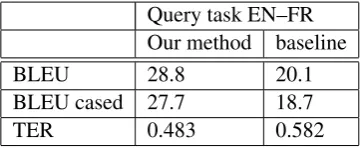
Query task EN–FR Our method baseline
BLEU 28.8 20.1
BLEU cased 27.7 18.7
TER 0.483 0.582
Table 3: Results for EN–FR query task.
near miss sentences only in terms of capitaliza-tion: “abnominal pain and Helicobacter pylori and cancer” (reference) and “abnominal pain and heli-cobacter pylori and cancer” (submission). These are counted as incorrect in terms of P@5 and [email protected] Noted that after submission we obtained the revised score of P@5 of 0.560 and P@10 of 0.560 with the same method but with 2-best lists which handles the capitalization varieties.
CLIR task FR–EN
Our method baseline
BLEU 51.8 42.2
BLEU cased 46.0 38.3
TER 0.364 0.398
P@5 0.348 (0.560∗) –
P@10 0.346 (0.560∗) –
NDCG@5 0.306 –
NDCG@10 0.307 –
MAP 0.2252 –
Rprec 0.2358 –
bpref 0.3659 –
[image:5.595.72.255.143.217.2]relRet 1524 –
Table 4: Results for CLIR task.
5 Conclusion
This paper provides a description of the Dublin City University terminology translation system for our participation in the query translation subtask in the medical translation task in the Workshop on Statistical Machine Translation (WMT14). We de-ployed six different kinds of terminology extrac-tion methods. We obtained 36.2 BLEU points ab-solute for FR–EN, and 28.8 BLEU points abso-lute for EN–FR tasks, obtaining first place on both tasks. We obtained 51.8 BLEU points absolute for the CLIR task.
3The method which incorporates variation in
[image:5.595.310.500.313.503.2]Acknowledgments
This research is supported by the Science Founda-tion Ireland (Grant 07/CE/I1142) as part of CNGL at Dublin City University.
References
Yoshua Bengio, Rejean Ducharme, and Pascal Vincent. 2000. A neural probabilistic language model. In Proceedings of Neural Information Systems, pages 1137–1155.
Peter F. Brown, Vincent J.D Pietra, Stephen A.D.Pietra, and Robert L. Mercer. 1993. The mathematics of statistical machine translation: Parameter estima-tion. Computational Linguistics, Vol.19, Issue 2, pages 263–311.
Atsushi Fujii, Masao Utiyama, Mikio Yamamoto, Takehito Utsuro, Terumasa Ehara, Hiroshi Echizen-ya, and Sayori Shimohata. 2010. Overview of the patent translation task at the NTCIR-8 workshop. In Proceedings of the 8th NTCIR Workshop Meet-ing on Evaluation of Information Access Technolo-gies: Information Retrieval, Question Answering and Cross-lingual Information Access, pages 293– 302.
Aria Haghighi, John Blitzer, John DeNero, and Dan Klein. 2009. Better word alignments with super-vised itg models. InIn Proceedings of the Confer-ence of Association for Computational Linguistics, pages 923–931.
Reinhard Kneser and Hermann Ney. 1995. Im-proved backing-off for n-gram language modeling. In Proceedings of the IEEE International Confer-ence on Acoustics, Speech and Signal Processing, pages 181–184.
Philipp Koehn, Franz Och, and Daniel Marcu. 2003. Statistical phrase-based translation. In Proceed-ings of the Human Language Technology Confer-ence of the North American Chapter of the Associ-ation for ComputAssoci-ationa Linguistics (HLT / NAACL 2003), pages 115–124.
Philipp Koehn, H. Hoang, A. Birch, C. Callison-Burch, M. Federico, N. Bertoldi, B. Cowan, W. Shen, C. Moran, R. Zens, C. Dyer, O. Bojar, A. Constantin, and E. Herbst. 2007. Moses: Open source toolkit for Statistical Machine Translation. In Proceedings of the 45th Annual Meeting of the Association for Computational Linguistics Companion Volume Pro-ceedings of the Demo and Poster Sessions, pages 177–180.
Philipp Koehn. 2004. Statistical significance tests for machine translation evaluation. In Proceedings of Conference on Empirical Methods in Natural Lan-guage Processing (EMNLP 2004), pages 388–395.
Philipp Koehn. 2005. Europarl: A parallel corpus for statistical machine translation. In Proceedings of the Machine Translation Summit, pages 79–86.
Philipp Koehn. 2010. Statistical machine translation. Cambridge University Press.
Julian. Kupiec. 1993. An algorithm for finding Noun phrase correspondences in bilingual corpora. In Proceedings of the 31st Annual Meeting of the Asso-ciation for Computational Linguistics, pages 17–22.
Tomas Mikolov, Kai Chen, Greg Corrado, and Jeffrey Dean. 2013a. Efficient estimation of word represen-tations in vector space. In Proceedings of Workshop at International Conference on Learning Represen-tations.
Tomas Mikolov, Quoc V. Le, and Ilya Sutskever. 2013b. Exploiting similarities among languages for machine translation. ArXiv:1309.4168.
Tomas Mikolov, Wen tau Yih, and Geoffrey Zweig. 2013c. Linguistic regularities in continuous space word representations. In Proceedings of the Confer-ence of the North American Chapter of the Associ-ation for ComputAssoci-ational Linguistics / Human Lan-guage Technology (NAACL/HLT 2005), pages 746– 751.
Tomas Mikolov. 2012. Statistical language models based on neural networks. PhD thesis at Brno Uni-versity of Technology.
Franz Och and Hermann Ney. 2003. A systematic comparison of various statistical alignment models. Computational Linguistics, 29(1):19–51.
Franz Och. 2003. Minimum Error Rate Training in Statistical Machine Translation. In Proceedings of the 41st Annual Meeting of the Association for Com-putational Linguistics, pages 160–167.
Tsuyoshi Okita and Josef van Genabith. 2011. DCU Confusion Network-based System Combination for ML4HMT. Shared Task on Applying Machine Learning techniques to optimising the division of labour in Hybrid MT (ML4HMT-2011, collocated with LIHMT-2011), pages 93–98.
Tsuyoshi Okita and Josef van Genabith. 2012. Mini-mum Bayes Risk Decoding with Enlarged Hypoth-esis Space in System Combination. In Proceed-ings of 13th International Conference on Intelligent Text Processing and Computational Linguistics (CI-CLING 2012), pages 40–51.
Mark Palatucci, Dean Pomerleau, Geoffrey Hinton, and Tom Mitchell. 2009. Zero-shot learning with semantic output codes. InNeural Information Pro-cessing Systems (NIPS), pages 1410–1418.
K. Papineni, S. Roukos, T. Ward, and W.J. Zhu. 2002. BLEU: A Method For Automatic Evaluation of Ma-chine Translation. In Proceedings of the 40th An-nual Meeting of the Association for Computational Linguistics (ACL-02).
F. Pedregosa, G. Varoquaux, A. Gramfort, V. Michel, B. Thirion, O. Grisel, M. Blondel, P. Pretten-hofer, R. Weiss, V. Dubourg, J. Vanderplas, A. Pas-sos, D. Cournapeau, M. Brucher, M. Perrot, and E. Duchesnay. 2011. Scikit-learn: Machine learn-ing in Python. Journal of Machine Learning Re-search, 12:2825–2830.
Slav Petrov and Dan Klein. 2007. Learning and infer-ence for hierarchically split PCFGs. InProceedings of AAAI (Nectar Track), pages 1663–1666.
Andreas Stolcke. 2002. SRILM – An extensible lan-guage modeling toolkit.In Proceedings of the Inter-national Conference on Spoken Language Process-ing, pages 901–904.
Yoshimasa Tsuruoka and Jun’ichi Tsujii. 2005. Bidi-rectional inference with the easiest-first strategy for tagging sequence data. In Proceedings of the Conference on Human Language Technology / Em-pirical Methods on Natural Language Processing (HLT/EMNLP 2005), pages 467–474.