130
APC = activated protein C; EC = endothelial cell; ecNOS = endothelial constitutive nitric oxide synthase; ICAM = intercellular adhesion molecule; ICU = intensive care unit; LPS = lipopolysaccharide; NO = nitric oxide; PC = protein C; PGI2= prostacyclin; TF = tissue factor; TFPI = tissue factor pathway inhibitor TM = thrombomodulin; vWF = von Willebrand factor.
The vascular endothelium regulates the flow of nutrient sub-stances, diverse biologically active molecules and the blood cells themselves. This role of endothelium is achieved through the presence of membrane-bound receptors for numerous mol-ecules, including proteins, lipid transporting particles, metabo-lites and hormones, as well as through specific junction proteins and receptors that govern cell–cell and cell–matrix interactions [1,2]. Endothelial dysfunction and/or injury with subendothelium exposure facilitates leucocyte and platelet aggregation, and aggravation of coagulopathy. Therefore, endothelial dysfunction and/or injury should favour impaired perfusion, tissue hypoxia and subsequent organ dysfunction.
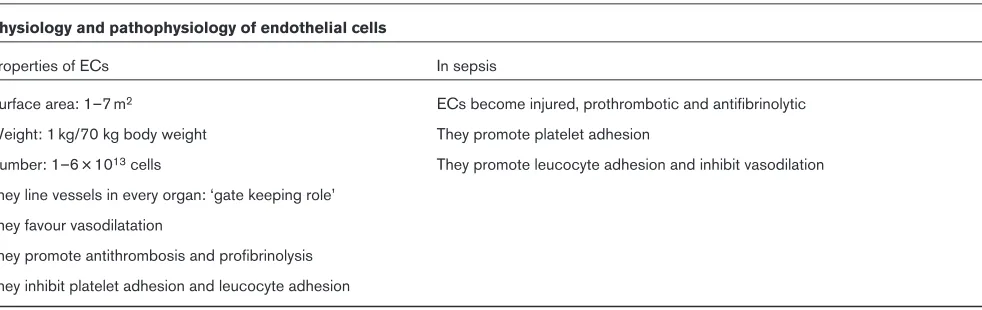
The present review describes, within the context of sepsis, why altered endothelial properties may be suspected to be involved in organ failure (Table 1).
Endothelial injury
Endothelial injury describes a state in which microscopically visible endothelial cell (EC) shape change or injury can be identified, as well as defects in endothelial lining or elevated
soluble markers of endothelial injury [3]. Anatomical damage to the endothelium during septic shock has been assessed in several studies [4–6]. A single injection of bacterial lipopolysaccharide (LPS) has long been demonstrated to be a nonmechanical technique for removing endothelium [5]. In endotoxic rabbits, observations tend to demonstrate that EC surface modification occurs easily and rapidly [5,6], with ECs being detached from the internal elastic lamina with an indica-tion of subendothelial oedema. As early as 15 min after LPS injection [7] cellular injuries are apparent, with nuclear vac-uolization, cytoplasmic swelling and protrusion, cytoplasmic fragmentation, and various degrees of detachment of the endothelium from its underlying layer. This can also be observed 10 hours after the onset of sepsis in a caecal liga-tion and puncture rat model [8]. Proinflammatory cytokines increase permeability of the ECs, and this is manifested approximately 6 hours after inflammation is triggered and becomes maximal over 12–24 hours as the combination of cytokines exert potentiating effects [8,9]. Endothelial physical disruption allows inflammatory fluid and cells to shift from the blood into the interstitial space.
Review
Bench-to-bedside review: Endothelial cell dysfunction in severe
sepsis: a role in organ dysfunction?
Benoît Vallet
Professor, Department of Anesthesiology and Intensive Care and Department of Pharmacology, University Hospital, Lille, France
Correspondence: Benoit Vallet, [email protected]
Published online: 6 January 2003 Critical Care2003, 7:130-138 (DOI 10.1186/cc1864) This article is online at http://ccforum.com/content/7/2/130
© 2003 BioMed Central Ltd (Print ISSN 1364-8535; Online ISSN 1466-609X)
Abstract
During the past decade a unifying hypothesis has been developed to explain the vascular changes that occur in septic shock on the basis of the effect of inflammatory mediators on the vascular endothelium. The vascular endothelium plays a central role in the control of microvascular flow, and it has been proposed that widespread vascular endothelial activation, dysfunction and eventually injury occurs in septic shock, ultimately resulting in multiorgan failure. This has been characterized in various models of experimental septic shock. Now, direct and indirect evidence for endothelial cell alteration in humans during septic shock is emerging. The present review details recently published literature on this rapidly evolving topic.
131 Plasma levels of thrombomodulin (TM), intercellular adhesion
molecule (ICAM)-1 and E-selectin may be measured in order to assess EC injury [10,11]. von Willebrand factor (vWF) and its propeptide can also be measured as circulating blood pro-teins to assess endothelial injury. It has been demonstrated that the half-life of mature vWF and that of its propeptide differ fourfold to fivefold [12]. The molar ratio of the propep-tide to mature vWF can serve as a tool with which to assess the extent of EC injury and to distinguish between acute and chronic disease [13]. In patients with diabetes mellitus propeptide levels are only slightly elevated, whereas vWF levels are elevated twofold to threefold. In acute sepsis, both vWF and propeptide are elevated several fold. High levels of TM, ICAM-1 and vWF have been reported in several inflam-matory diseases, sepsis and acute lung injury in patients with nonpulmonary sepsis, in which endothelial damage is thought to be important [11,14,15].
In a recent report, Mutunga et al. [16] developed a method for detecting circulating ECs that provides direct evidence of EC shedding in human sepsis. Blood samples were subse-quently taken from 11 healthy volunteers, nine ventilated intensive care unit (ICU) control patients without sepsis, eight patients with sepsis but without shock, and 15 patients with septic shock. EC were identified by indirect immunofluores-cence, using antibodies to vWF and the vascular endothelial growth factor receptor EGFR. vWF-positive EC counts per millilitre were significantly greater in patients with sepsis (16.1 ± 2.7 [mean ± SEM]) and septic shock (30.1 ± 3.3) than in healthy (1.9 ± 0.5) or ICU control individuals (2.6 ± 0.6). EGFR-positive EC counts per ongoing EC lesions were also significantly higher in patients with sepsis (4.2 ± 1.1) and septic shock (10.4 ± 1.2) than in healthy (0.7 ± 0.3) or ICU control individuals (0.5 ± 0.2). Cell counts measured using anti-vWF antibody were consistently higher than those mea-sured using anti-EGFR antibody, but correlation between the two counts was high (r2= 0.93). The number of circulating EGFR-positive ECs per millilitre was significantly higher in patients who died of septic shock than in survivors
(12.0 ± 1.6 versus 7.1 ± 1.2; P= 0.026). An increase in circu-lating ECs can therefore be identified during sepsis and septic shock. That study was among the first to support the hypothesis that endothelial damage occurs in human sepsis.
An important point is that EC injury is sustained over time. In an endotoxic rabbit model, we demonstrated that endothelium denudation is present at the level of the abdominal aorta as early as after several hours following injury and persisted for at least 5 days afterward [6,17]. After 21 days we observed that the endothelial surface had recovered. The de-endothelialized surface accounted for approximately 25% of the total surface. Similarly, in 12 human volunteers receiving 4 ng/kg Escherichia coli LPS by intravenous injection, Taylor and coworkers [18] showed that the immediate symptomatic inflammatory stage (0–8 hours after LPS injection) was fol-lowed after 12 hours by an asymptomatic noninflammatory stage (volunteers were back at work). The latter stage was characterized by decreased tumour necrosis factor, interleukin-10, thrombin–antithrombin and plasmin–antiplas-min complexes, and levels of TM peaked at 24 hours, suggest-ing ongosuggest-ing EC lesions. Increased TM was associated with a level of tissue factor (TF) that was still increasing at 48 hours, suggesting risk for activated coagulation. Indeed, TF is the principal activator of the extrinsic coagulation pathway, and as such is responsible for an intravascular procoagulant state. Taylor and coworkers concluded that sustained injury to the vascular endothelium secondary to reperfusion of the microvasculature occurred in those asymptomatic individuals. In our endotoxic model, we also demonstrated that at 5 days the rabbits had maximal monocyte TF expression, which coin-cided with maximal endothelial injury [6,17]. This, together with altered coagulation modulation properties, may ultimately result in intravascular microthrombosis.
Endothelial injury associated abnormal
coagulation and fibrinolysis
The outer membrane of ECs normally expresses various membrane-associated components with anticoagulant
prop-Table 1
Physiology and pathophysiology of endothelial cells
Properties of ECs In sepsis
Surface area: 1–7 m2 ECs become injured, prothrombotic and antifibrinolytic Weight: 1 kg/70 kg body weight They promote platelet adhesion
Number: 1–6 × 10¹³cells They promote leucocyte adhesion and inhibit vasodilation They line vessels in every organ: ‘gate keeping role’
They favour vasodilatation
They promote antithrombosis and profibrinolysis They inhibit platelet adhesion and leucocyte adhesion
[image:2.612.63.554.97.252.2]132
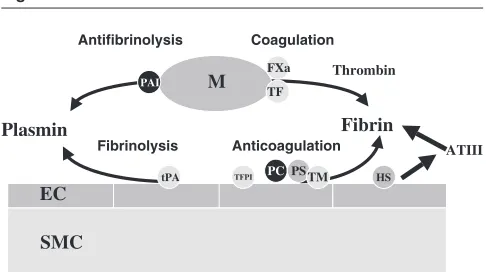
erties, among which are cell surface heparin-like molecules. These molecules accelerate inactivation of coagulation pro-teases by antithrombin and represent a TF pathway inhibitor (TFPI) reserve [19]. The EC surface thrombin-binding protein TM is responsible for inhibition of thrombin activity. TM, when bound to thrombin, forms a potent protein C (PC) activator complex (Fig. 1). Whereas unperturbed ECs confer anticoag-ulant properties (Fig. 2), exposure to inflammatory and/or septic stimuli rapidly lead to procoagulant behaviour (Figs 1 and 3). Moreover, the profibrinolytic property of ECs is blunted, because of decreased release of tissue plasminogen activator. This occurs within the context of increased release of plasminogen activator inhibitor-1. During sepsis the proco-agulant activity of TF increases, with transcriptional upregula-tion of its expression on monocytes and ECs among other cell types, whereas levels of endothelium anticoagulant mem-brane components decrease, with internalization of TM [20] and release of inactive TM into the bloodstream (Fig. 3). Loss of TM and associated PC activation represents a key event, namely decreased endothelial coagulation modulation ability. Cleavage of TM by neutrophil elastase and other proteases certainly participate in the reduced expression of TM.
In severe meningococcal sepsis, Faust and coworkers [21] recently demonstrated that PC activation is impaired – a finding that is consistent with downregulation of the endothe-lial TM–endotheendothe-lial PC receptor pathway. In 21 children (median age 41 months) with purpura fulminans (meningo-coccal sepsis), purpuric lesion skin biopsies exhibited decreased expression of endothelial TM and of the
endothe-lial PC receptor as compared with control specimens, both in vessels with and in those without thrombosis. Plasma TM levels in the children with meningococcal sepsis (median 6.4 ng/l) were higher than those in the controls (median 3.6 ng/l; P= 0.002). Plasma levels of PC antigen, protein S antigen and antithrombin antigen were lower than those in the controls. In two patients treated with unactivated PC concen-trate, activated PC (APC) was undetectable at the time of admission, and plasma levels remained low.
[image:3.612.314.557.514.650.2]Activation of coagulation concomitant with impaired fibrinoly-sis is associated with fibrin deposition, tissue ischaemia and tissue necrosis [22], and in critically ill patients with increased risk for death [23,24]. Conversely, inhibition of coagulation is associated with prevention of organ dysfunction [25,26]. Three therapeutic strategies that employ coagulation modula-tion – TFPI, antithrombin and APC – were recently proposed to reduce organ dysfunction and mortality in septic shock. It has clearly been shown in various animal models of septic shock that these treatments reduce organ dysfunction and mortality [27,28]. This was associated with a reduction in cytokine production [25,26,29]. With APC, it was further demonstrated that leucocyte–endothelial interactions were reduced [30]. Of note is the demonstration that APC was also able to improve fibrinolysis by inhibiting plasminogen activator inhibitor-1 [31]. Clinical phase II trials suggested that mortality might be reduced by using these coagulation modulators in critically ill septic patients [32–35]. Three phase III trials of antithrombin, TFPI and APC were subse-quently performed and recently completed in large popula-tions of patients with severe sepsis, the net effect being an overall lack of efficacy with antithrombin [36] and TFPI (unpublished results), and a 19.43% reduction in relative risk for death with APC [37].
Figure 1
Thrombomodulin and protein C activation at the microcirculatory level. The endothelial cell surface thrombin (Th)-binding protein
thrombomodulin (TM) is responsible for inhibition of thrombin activity. TM, when bound to Th, forms a potent protein C activator complex. Loss of TM and/or internalization results in Th–thrombin receptor (TR) interaction. Loss of TM and associated protein C activation represents the key event of decreased endothelial coagulation modulation ability and increased inflammation pathways. Adapted from Iba and coworkers [88]. ATIII, antithrombin III; NF-κ, nuclear factor-κB; PAI, plasminogen activator inhibitor.
ENDOTHELIAL CELL AT III
AT III
T
T
M
M Th
Th
Th
Th
Protein C
Activated protein C
thrombomodulin
thrombomodulin
anti coagulopathic
changes Th
Th
Th
Th
Tissue factor ↑ PAI-1 ↑ Thrombomodulin ↓ Adhesion molecules ↑ Thrombin receptor ↑ Endothelin 1 ↑ Gap formation ↑ NF-κB
T
T
R
R Th
Th
thrombin
thrombin
receptor
receptor
pro coagulopathic
changes
Figure 2
Coagulation and fibrinolysis pathways. Unperturbed endothelial cells (ECs) provide anticoagulant (tissue factor pathway inhibitor [TFPI], protein C [PC], protein S [PS], thrombomodulin [TM], heparan sulphate [HS]) and fibrinolytic (tissue plasminogen activator [tPA]) properties. ATIII, antithrombin III; FXa, coagulation factor Xa; M, activated monocyte; PAI, plasminogen activator inhibitor; SMC, smooth muscle cell; TF, tissue factor.
EC
PAI
Antifibrinolysis Coagulation
Thrombin
M
Fibrin Plasmin
PC TM
Fibrinolysis Anticoagulation ATIII
SMC
FXa
TF
133 Although ECs probably have an important role in
dissemi-nated intravascular coagulation, there is also some evidence favouring a major role for monocytes in the cellular mecha-nisms of coagulation activation. We recently assessed the relative impact of endothelial injury and monocyte activation on coagulation disorders in our rabbit endotoxic shock model.
L-arginine and the angiotensin-converting enzyme inhibitor
perindopril were tested in that model for their demonstrated ability to treat endothelial injury [38,39]. We found that both
L-arginine supplementation and perindopril could prevent septic-shock-associated deterioration in endothelium-depen-dent relaxation [40,41]. However, this preventive effect was not associated with any reduction in TF expression, suggest-ing that these two sepsis-associated abnormalities are not strictly linked. In a subsequent study [42] we used an antigly-coprotein IIb/IIIa, which attenuated endotoxin-induced mono-cyte TF expression through decreased platelet activation. This was associated with marked reduction in endothelial injury, increased endothelium-derived relaxation and improved survival rates in the treated animals. Those findings suggest that monocyte activation and TF expression may be of impor-tance in sepsis-associated injuries, and that coagulation acti-vation may itself contribute to the EC injury observed during sepsis.
Endothelial injury, in turn, exacerbates sepsis-induced coagu-lation abnormalities. Indeed, release of endothelium-derived factors such as nitric oxide (NO) and prostacyclin (PGI2) is impaired. Because NO and PGI2 not only control vascular tone but also have antiadhesive and tissue plasminogen acti-vator-like properties, loss of NO and PGI2release facilitates leucocyte and platelet aggregation, and aggravation of coag-ulopathy. Furthermore, when ECs generate adhesion mole-cules during endotoxaemia that bind leucocytes and
monocytes, they favour enhancement in local procoagulant reactions. The relationship between activation of innate immu-nity and coagulation is phylogenetically ancient [43,44]. Localized activation of the coagulation system, as with the innate immune response, serves to protect against a discrete traumatic injury [43]. However, generalized intravascular coagulation, as a generalized inflammatory response, is detri-mental to the host, favouring widespread fibrin deposition and altered tissue perfusion.
Endothelial activation
As a prelude to their migration into tissues, monocytes and leucocytes must adhere to endothelium. Both adhesion to and migration across endothelium are governed by the inter-action of complementary adhesion molecules on the poly-morphonuclear cells and endothelium [45]. The surface expression, adhesion avidity and surface modulation of these molecules are highly regulated by biological mediators such as cytokines. Local synthesis of platelet-activating factor and EC-derived cytokines such as interleukin-8, along with tumour necrosis factor and interleukin-1, are important in promoting neutrophil–EC interactions. ‘Endothelial activa-tion’ refers to increased expression or release of endothelial adhesion molecules.
The first step in migration consists of a ‘rolling’ of leucocytes on endothelium, which involves the selectin family. Selectins are molecules expressed on leucocytes (L-selectin), or even on platelets (P-selectin) and on ECs (E-selectin); these act as receptors that permit loose binding, which in turn facilitates rolling. Selectins allow leucocytes to roll in the direction of flow into the proximity of activating signals exhibited by ECs.
The second step involves receptors from the integrin family (β2-integrin) and immunoglobulin-like receptors. These recep-tors allow leucocyte arrest and adhesion strengthening. Three heterodimers of β2-integrin are present on the outer cell mem-brane of activated leucocytes and are collectively termed the CD11/CD18complex. Stimulation of ECs induces expression of cell surface adhesion molecules, which are members of the immunoglobulin superfamily. Monoclonal antibodies to these molecules have been shown to block leucocyte–EC interac-tions and to improve sepsis-associated organ dysfunction [46,47]. Endothelial adhesion molecules include ICAMs, endothelial leucocyte adhesion molecules (E-selectins), platelet EC adhesion molecules, and vascular cell adhesion molecules.
[image:4.612.57.300.88.230.2]In the third step, activated leucocytes migrate to the borders of ECs to interact with ICAMs, endothelial leucocyte adhe-sion molecules, platelet EC adheadhe-sion molecules or vascular cell adhesion molecules (for review [48]). A large number of experimental studies have documented the consequences of inhibition of adhesion molecules. Inhibition of neutrophil adherence to the ECs exerts significant protective effects in these conditions [46,49].
Figure 3
Sepsis and coagulation–fibrinolysis pathways. Exposure to inflammatory and/or septic stimuli rapidly leads to procoagulant behaviour. The profibrinolytic property of endothelial cells (ECs) is blunted, due to decreased release of tissue plasminogen activator. This occurs in a context of increased plasminogen activator inhibitor (PAI)-1 release with antifibrinolysis. LPS, lipopolysaccharide; M, activated monocyte; SMC, smooth muscle cell; TF, tissue factor; TM, thrombomodulin.
EC
SMC
M
PAI
Antifibrinolysis Coagulation
LPS, LPS, cytokines... cytokines...
inactive
inactive TF FXa
TM
134
Interestingly, decreased reactive hyperaemia (suggesting modified endothelial-derived relaxation) was also demon-strated to coexist with increased leucocyte aggregation and ICAM-1 levels [50]. It is also important to emphasize that recent evidence suggested that adhesion can occur inde-pendent of adhesion molecules in organs such as lung or liver. This led to the hypothesis that stimulus-induced increases in actin-containing stress fibres (such as LPS) at the cell periphery lead to decreased deformability, prevent-ing neutrophils from traffickprevent-ing through the capillary bed and therefore increasing their sequestration at sites of inflamma-tion [51].
Sessler and coworkers [52] measured blood level of the adhesion molecule ICAM-1 as a potential marker of EC acti-vation in septic adults and healthy volunteers. Those investi-gators established a relationship between increased ICAM-1 levels and consequences of sepsis (i.e. multiple organ failure and death). Watanabe and coworkers [53] prevented endo-toxin shock in rabbits by administering a specific monoclonal antibody against CD18(integrin β2). In a mouse lethal septic shock model, Xu and coworkers [54] observed that animals deficient in ICAM-1 were markedly protected against death. Whereas 80% of wild-type animals died within 48 hours after receiving 40 mg/kg LPS, more than 90% of ICAM-1-deficient animals survived for longer than 4 days. Interest-ingly, EC dysfunction was found to involve a CD18-dependent neutrophil adherent mechanism. Consis-tently, Matsukawa and coworkers [55] recently provided evi-dence on the contributions of E-selectin and P-selectin to lethality in septic peritonitis. Mice that genetically lacked endothelial selectins were shown to be resistant. The experi-ments demonstrated that endothelial selectin mediated leu-cocyte rolling impacts on mouse survival by influencing the serum level of cytokines and by preventing renal dysfunction – a potential cause of death in that context.
Endothelial dysfunction
The term ‘endothelial dysfunction’ refers to decreased endothelial-dependent vascular relaxation or NO release, and decreased expression or activity of endothelial constitutive NO synthase (ecNOS). Endothelium-derived relaxation and/or production of endothelium-derived NO from the amino acid L-arginine by ecNOS may be used as an indicator of EC function. For example, the relaxing response of in vitro iso-lated vascular rings to picomolar concentrations of acetyl-choline is dependent on the presence and integrity of ECs [56].In vivoendothelial function can be determined by mea-surement of forearm blood flow responses to intra-arterial infusions of endothelium-dependent (i.e. acetylcholine) and endothelium-independent vasodilators (i.e. sodium nitroprus-side). Drugs are infused at a constant rate (1 ml/min) with an infusion pump. Forearm blood flow is recorded for 10 s at 15-s intervals during the last 3 min of the drug and saline infu-sion period using venous occluinfu-sion plethysmography com-bined with a rapid cuff inflator [57–59].
Abnormal endothelial-dependent vascular relaxation has been recognized in multiple sepsis conditions. Several investiga-tions, including our own [17,60,61], have demonstrated attenuated acetylcholine-induced relaxation in vascular rings isolated from large arteries. Apart from anatomical injuries, such abnormalities observed in these vessels may result from several mechanisms: alteration in EC surface receptors; mod-ified signal transduction pathways (receptor–ecNOS cou-pling); altered function and/or density of the ecNOS; changes in pathways that lead to release of NO; and/or changes in mechanisms that participate in subsequent degra-dation of NO.
In healthy volunteers, even brief exposure to endotoxin or certain cytokines impairs endothelium-dependent relaxation for many days [62,63]. This effect has been termed ‘endothe-lial stunning’. After recovery from the acute insult, the endothelium may remain dysfunctional (‘stunned’) for a long period of time before full recovery. Hingorani and coworkers [59] also demonstrated that a mild inflammatory response, such as that generated by Salmonella typhivaccine, is asso-ciated with temporary but profound dysfunction of arterial endothelium in both resistance and conduit vessels following application of both physical and pharmacological dilator stimuli. According to the concept of intrinsic metabolic regu-lation, vasodilatation in tissues with relatively high metabolic rates competes with sympathetic vasoconstrictor tone, thereby adjusting the balance between local tissue oxygen supply and demand. Although the nature of the oxygen-sensi-tive structures that act at the local tissue level is not com-pletely understood, ECs in direct contact with blood have a number of properties that render them effective sensors. The endothelium and smooth muscle of arteries and arterioles appear to be coupled both structurally and functionally. Sensing involves local depolarization/hyperpolarization of the capillary EC, and communication is achieved by electronic spread via endothelium/smooth muscle cell–cell gap junc-tions [2,64]. During an hypoxic challenge, the ability of a tissue to extract oxygen – and to minimize shunting through areas with a high rate of perfusion relative to their oxygen uptake – may therefore be considered an integrative test of endothelial function and microcirculatory coordination [65].
135 endothelial fragments was not observed. During progressive
limitation of oxygen supply to the limb, a profound and signifi-cant impairment in limb oxygen extraction ability (41.7% versus 81% in controls) at critical oxygen delivery (at which oxygen uptake begins to decrease) was observed. We con-cluded that this severe limitation in the increase in oxygen extraction capabilities during ischaemia suggested that vas-cular endothelium plays an important role in matching oxygen supply to demand.
In order to test the role of the endothelial-derived relaxing factors NO and PGI2, we investigated, in a third group of dogs, the influence of a combination of NG-nitro-L-arginine methyl ester (an inhibitor of NO synthesis) and indomethacin (an inhibitor of PGI2 synthesis) [66]. In these dogs treated with indomethacin plus NG-nitro-L-arginine methyl ester, the severity of the oxygen extraction defect was lower than that observed in the deoxycholate-treated dogs, suggesting that other mediators and/or mechanisms may be involved in microcirculatory control during hypoxia. As suggested above, one of these mediators or mechanisms could be related to hyperpolarization. Membrane potential is an important deter-minant of vascular smooth muscle tone through its influence on calcium influx via voltage-gated calcium channels. Hyper-polarization (as well as deHyper-polarization) has been shown to be a means of cell–cell communication in upstream vasodilatation and microcirculatory coordination [67]. It is important to emphasize that intercell coupling exclusively involves ECs. Interestingly, it was recently shown that sepsis, a situation that is characterized by impaired tissue perfusion and abnormal oxygen extraction, is associated with abnormal inter-EC cou-pling and reduction in the arteriolar conducted response [68].
An intra-organ defect in blood flow related to abnormal vascu-lar reactivity, cell adhesion and coagulopathy may account for impaired organ oxygen regulation and function. If specific classes of microvessels must or must not be perfused to achieve efficient oxygen extraction during limitation in oxygen delivery, then impaired vascular reactivity and vessel injury might produce a pathological limitation in supply. In sepsis, the inflammatory response profoundly alters circulatory homeostasis, and this has been referred to as a ‘malignant intravascular inflammation’ that alters vasomotor tone and the distribution of blood flow among and within organs [69]. These mechanisms might coexist with other types of sepsis-associated cell dysfunction. For example, data suggest that endotoxin directly impairs oxygen uptake in ECs and indicate the importance of endothelium respiration in maintaining vas-cular homeostasis under conditions of sepsis [70].
Abnormal oxygen extraction is a key feature of severe sepsis and septic shock. In an experimental study in dogs, an ablated reactive hyperaemia was associated with endotox-aemia-induced impaired oxygen extraction at the level of the gastrointestinal tract [71]. Nevière and coworkers [72] showed that reactive hyperaemia is attenuated in critically ill
patients with septic shock, despite normal or elevated whole-body oxygen delivery. Proposed mechanisms to explain blunted hyperaemia in septic patients might include impaired vascular reactivity and/or microvascular obstruction that limits the number of recruitable capillaries. In critically ill patients with sepsis, it has been shown that decreased reactive hyperaemia coexists with increased leucocyte adhesion and increased release in surrogate markers of endothelium injury [50,73].
Thus, assessment of reactive hyperaemia might be used in the near future to evaluate the effects of treatments aimed at restoring endothelial function and tissue perfusion, such as coagulation modulators or leucocyte adhesion antagonists.
Conclusion
How do all of these altered properties contribute to altered perfusion and organ dysfunction? The combining effect of altered vascular relaxation, altered blood flow distribution, increased leucocyte adhesion and decreased coagulation modulation should significantly contribute to microcirculatory heterogeneity and lowered perfusion. Studies in the isolated perfused rabbit heart [74], autoperfused rat cremaster [75] and rat mesentery [76,77] suggested that these mechanisms are operative in the microvasculature. On an intravital microscopy extensor digitorum longus muscle model in rats with peritonitis [78], it was shown that sepsis is associated with a reduction in tissue perfused capillary density of up to 36%, increased perfusion heterogeneity and mean intercapil-lary distance, contributing to functional shunting. In another study [79], endotoxin administration resulted in a significant enhancement in leucocyte–EC interaction, as indicated by transiently increased number of leucocytes firmly attaching to the microvascular endothelium of arterioles and venules [79]. Microvascular injury and/or the appearance of greater hetero-geneity of microvascular distribution of oxygen supply with respect to oxygen demand in endotoxin-treated animals is consistent with the observation that endotoxin impairs oxygen extraction [80–82]. The direct relationship between hetero-geneity, decreased oxygen extraction and tissue acidosis was recently confirmed in a pig model of endotoxic shock [83].
-136
monomethyl-L-arginine in human septic shock [86] further confirm the overall importance of favoring vessel dilatation. In contrast, positive results obtained with corticosteroids [87] and APC [37] suggest that improving haemodynamics while decreasing vasopressor agents (corticosteroids) and limiting coagulation activation are logical strategies that may greatly favour tissue perfusion and improved oxygen delivery.
Competing interests
None declared.
References
1. Cines DB, Pollak ES, Buck CA, Loscalzo J, Zimmerman GA, McEver RP, Pober JS, Wick TM, Konkle BA, Schwartz BS, Bar-nathan ES, McCrae KR, Hug BA, Schmidt AM, Stern DM: Endothelial cells in physiology and in the pathophysiology of vascular disorders.Blood1998, 91:3527-3561.
2. Sandow SL, Hill CE: Incidence of myoendothelial gap junc-tions in the proximal and distal mesenteric arteries of the rat is suggestive of a role in endothelium-derived hyperpolarizing factor-mediated responses.Circ Res2000, 86:341-346. 3. Stefanec T: Endothelial apoptosis: could it have a role in the
pathogenesis and treatment of disease.Chest2000, 117 :841-854.
4. Reidy MA, Schwartz SM: Endothelial injury and regeneration. IV. Endotoxin: a nondenuding injury to aortic endothelium.Lab Invest1983, 48:25-34.
5. Reidy MA, Bowyer DE: Scanning electron microscopy: mor-phology of aortic endothelium following injury by endotoxin and during subsequent repair.Atherosclerosis1977, 26 :319-328.
6. Leclerc J, Pu Q, Corseaux D, Haddad E, Decoene C, Bordet R, Six I, Jude B, Vallet B: A single endotoxin injection in the rabbit causes prolonged blood vessel dysfunction and a procoagu-lant state.Crit Care Med2000, 28:3672-3678.
7. Lee M, Schuessler G, Chien S: Time dependent effetcs of endotoxin on the ultrastructure of the aortic endothelium. Artery1998, 15:71-89.
8. Wang P, Wood TJ, Zhou M, Ba ZF, Chaudry IH: Inhibition of the biological activity of tumor necrosis factor maintains vascular endothelial cell function during hyperdynamic sepsis. J Trauma1996, 40:694-701.
9. Bauer PR: Microvascular responses to sepsis: clinical signifi-cance.Pathophysiology2002, 8:141-148.
10. Bajaj MS, Tricomi SM: Plasma levels of the three endothelial-specific proteins von Willebrand factor, tissue factor pathway inhibitor, and thrombomodulin do not predict the develop-ment of acute respiratory distress syndrome.Intensive Care Med1999, 25:1259-1266.
11. Kayal S, Jais JP, Aguini N, Chaudiere J, Labrousse J: Elevated cir-culating E-selectin, intercellular adhesion molecule 1, and von Willebrand factor in patients with severe infection.Am J Respir Crit Care Med1998, 157:776-784.
12. Borchiellini A, Fijnvandraat K, ten Cate JW, Pajkrt D, van Deventer SJ, Pasterkamp G, Meijer-Huizinga F, Zwart-Huinink L, Voorberg J, van Mourik JA: Quantitative analysis of von Willebrand factor propeptide release in vivo: effect of experimental endotox-emia and administration of 1-deamino-8-D-arginine vaso-pressin in humans.Blood1996, 88:2951-2958.
13. Van Mourik JA, Boertjes R, Huisveld IA, Fijnvandraat K, Pajkrt D, van Genderen PJ, Fijnheer R: von Willebrand factor propeptide in vascular disorders: a tool to distinguish between acute and chronic endothelial cell perturbation.Blood1999, 94:179-185. 14. Blann AD, Babbs C, Neuberger JM: Endothelial cell damage in primary biliary cirrhosis: influence of cholestasis and immunological mechanisms.Clin Exp Immunol1992, 90 :88-92.
15. Rubin DB, Wiener-Kronish JP, Murray JF, Green DR, Turner J, Luce JM, Montgomery AB, Marks JD, Matthay MA: Elevated von Willebrand factor antigen is an early plasma predictor of acute lung injury in nonpulmonary sepsis syndrome.J Clin Invest 1990, 86:474-480.
16. Mutunga M, Fulton B, Bullock R, Batchelor A, Gascoigne A, Gille-spie JI, Baudouin SV: Circulating endothelial cells in patients with septic shock.Am J Respir Crit Care Med2001, 163 :195-200.
17. Wiel E, Vallet B: Vascular endothelial cell dysfunction in septic shock.Crit Care Med2001, 29(suppl):S36-S41.
18. Taylor FB, Haddad PA, Hack E, Chang AC, Peer GT, Morrissey JH, Li A, Allen R, Caa H, Kinasewitz GT: Two-stage response to endotoxin infusion into normal human subjects: correlation of blood phagocyte luminescence with clinical and laboratory markers of the inflammatory, hemostatic response.Crit Care Med2001, 29:326-334.
19. Bombeli T, Mueller M, Haeberli A: Anticoagulant properties of the vascular endothelium.Thromb Haemost1997, 77:408-423. 20. Rapaport S, Rao L: Initiation and regulation of tissue factor-dependent blood coagulation. Arterioscler Thromb 1992, 12: 1111-1121.
21. Faust SN, Levin M, Harrison OB, Goldin RD, Lockhart MS, Kon-daveeti S, Laszik Z, Esmon CT, Heyderman RS: Dysfunction of endothelial protein C activation in severe meningococcal sepsis.N Engl J Med2001, 345:408-416.
22. Regoeczi E, Brain MC: Organ distribution of fibrin in dissemi-nated intravascular coagulation. Br J Haematol1969, 17 :73-81.
23. Fourrier F, Chopin C, Goudemand J, Hendrycx S, Caron C, Rime A, Marey A, Lestavel P: Septic shock, multiple organ failure, and disseminated intravascular coagulation. Compared pat-terns of antithrombin III, protein C, and protein S deficiencies. Chest1992, 101:816-823.
24. Gando S, Nakanishi Y, Tedo I: Cytokines and plasminogen acti-vator inhibitor-1 in posttrauma disseminated intravascular coagulation: relationship to multiple organ dysfunction syn-drome.Crit Care Med1995, 23:1835-1842.
25. Creasey AA, Chang AC, Feigen L, Wun TC, Taylor FB, Hinshaw LB: Tissue factor pathway inhibitor reduces mortality from
Escherichia coli septic shock. J Clin Invest 1993, 91 :2850-2856.
26. Kessler CM, Tang Z, Jacobs HM, Szymanski LM: The supraphar-macologic dosing of antithrombin concentrate for Staphylo-coccus aureus-induced disseminated intravascular coagulation in guinea pigs: substantial reduction in mortality and morbidity.Blood1997, 89:4393-4401.
27. Carr C, Bild GS, Chang AC: Recombinant E. coli-derived tissue factor pathway inhibitor reduces coagulopathic and lethal effects in the baboon gram-negative model of septic shock. Circ Shock1994, 44:126-137.
28. Camerota AJ, Creasey AA, Patla V, Larkin VA, Fink MP: Delayed treatment with recombinant human tissue factor pathway inhibitor improves survival in rabbits with gram-negative peri-tonitis.J Infect Dis1998, 177:668-676.
29. Grey ST, Tsuchida A, Hau H, Orthner CL, Salem HH, Hancock WW: Selective inhibitory effects of the anticoagulant acti-vated protein C on the responses of human mononuclear phagocytes to LPS, IFN-gamma, or phorbol ester. J Immunol 1994, 153:3664-3672.
30. Grinnell BW, Hermann RB, Yan SB: Human protein C inhibits selectin-mediated cell adhesion: role of unique fucosylated oligosaccharide.Glycobiology1994, 4:221-225.
31. Jackson CV, Bailey BD, Shetler TJ: Pharmacological profile of recombinant, human activated protein C (LY203638) in a canine model of coronary artery thrombosis.J Pharmacol Exp Ther2000, 295:967-971.
32. Smith OP, White B, Vaughan D, Rafferty M, Claffey L, Lyons B, Casey W: Use of protein-C concentrate, heparin, and haemodiafiltration in meningococcus-induced purpura fulmi-nans.Lancet1997, 350:1590-1593.
33. Fourrier F, Chopin C, Huart JJ, Runge I, Caron C, Goudemand J: Double-blind, placebo-controlled trial of antithrombin III con-centrates in septic shock with disseminated intravascular coagulation.Chest1993, 104:882-888.
137 35. Eisele B, Lamy M, Thijs LG, Keinecke HO, Schuster HP, Matthias
FR, Fourrier F, Heinrichs H, Delvos U: Antithrombin III in patients with severe sepsis. A randomized, placebo-con-trolled, double-blind multicenter trial plus a meta-analysis on all randomized, placebo-controlled, double-blind trials with antithrombin III in severe sepsis.Intensive Care Med1998, 24: 663-672.
36. Warren BL, Eid A, Singer P, Pillay SS, Carl P, Novak I, Chalupa P, Atherstone A, Penzes I, Kubler A, Knaub S, Keinecke HO, Hein-richs H, Schindel F, Juers M, Bone RC, Opal SM: Caring for the critically ill patient. High-dose antithrombin III in severe sepsis: a randomized controlled trial.JAMA2001, 286 :1869-1878
37. Bernard GR, Vincent JL, Laterre PF, LaRosa SP, Dhainaut JF, Lopez-Rodriguez A, Steingrub JS, Garber GA, Helterbrand JD, Ely EW, Fisher CJ: Efficacy and safety of recombinant human acti-vated protein C for severe sepsis.N Engl J Med2001, 344: 699-709.
38. Hamon M, Vallet B, Bauters C, Wernert N, McFadden EP, Lablanche JM, Dupuis B, Bertrand ME: Long-term oral adminis-tration of L-arginine reduces intimal thickening and enhances neoendothelium-dependent acetylcholine-induced relaxation after arterial injury.Circulation1994, 90:1357-1362.
39. Van Belle E, Vallet B, Auffray JL, Bauters C, Hamon M, McFadden EP, Lablanche JM, Dupuis B, Bertrand ME: NO synthesis is involved in structural and functional effects of ACE inhibitors in injured arteries.Am J Physiol1996, 270:H298-H305. 40. Wiel E, Pu Q, Corseaux D, Robin E, Bordet R, Lund N, Jude B,
Vallet B: Effect of L-arginine on endothelial injury and hemo-stasis in rabbit endotoxin shock. J Appl Physiol 2000, 89: 1811-1818.
41. Leclerc JF, Pu Q, Bordet R, Bauters C, Vallet B: Endothelial cell dysfunction occurring during septic shock is prevented by angiotensin converting enzyme inhibitor [abstract]. Am J Respir Crit Care Med2000, 157:A101.
42. Pu Q, Wiel E, Corseaux D, Bordet R, Azrin MA, Ezekowitz MD, Lund N, Jude B, Vallet B: Beneficial effect of glycoprotein IIb/IIIa inhibitor (AZ-1) on endothelium in Escherichia coli
endotoxin-induced shock. Crit Care Med 2001, 29 :1181-1188.
43. Opal SM: Phylogenetic and functional relationships between coagulation and the innate immune response.Crit Care Med 2000, 28(suppl):S77-S80.
44. Opal SM, Palardy JE, Parejo NA, Creasey AA: The activity of tissue factor pathway inhibitor in experimental models of superantigen-induced shock and polymicrobial intra-abdomi-nal sepsis.Crit Care Med2001, 29:13-17.
45. Springer T: Traffic signals on endothelium for lymphocyte recirculation and leukocyte emigration.Ann Rev Physiol1995, 57:827-872.
46. Gardinali M, Borrelli E, Chiara O, Lundberg C, Padalino P, Conci-ato L, Cafaro C, Lazzi S, Luzi P, Giomarelli PP, Agostoni A: Inhibi-tion of CD11b/CD18 complex prevents acute lung injury and reduces mortality after peritonitis in rabbits.Am J Respir Crit CareMed 2000, 161:1022-1029.
47. Kuebler WM, Borges J, Sckell A, Kuhnle EH, Bergh K, Messmer K, Goetz AE: Role of L-selectin in leukocyte sequestration in lung capillaries in a rabbit model of endotoxemia.Am J Respir Crit Care Med2000, 161:36-43.
48. Varani J, Ward P: Mechanisms of endothelial cell injury in acute inflammation.Shock1994, 2:311-319.
49. Ma X, Tsao P, Lefer A: Antibody to CD-18 exerts endothelial cell and cardiac protective effects in myocardial ischemia and reperfusion.J Clin Invest1995, 88:1237-1243.
50. Astiz ME, DeGent GE, Lin RY, Rackow EC: Microvascular func-tion and rheologic changes in hyperdynamic sepsis.Crit Care Med1995, 23:265-271.
51. Doerschuk CM: Leukocyte trafficking in alveoli and airway pas-sages.Respir Res2000, 1:136-140.
52. Sessler C, Windsor A, Schwartz M: Circulating ICAM-1 is increased in septic shock.Am J Respir Crit Care Med1995, 151:1420-1427.
53. Watanabe S, Mukaida N, Ikeda N, Akiyama M, Harada A, Nakan-ishi I, Nariuchi H, Watanabe Y, Matsushima K: Prevention of endotoxin shock by an antibody against leukocyte integrin beta 2 through inhibiting production and action of TNF. Int Immunol1995, 7:1037-1046.
54. Xu H, Gonzalo JA, St Pierre Y, Williams IR, Kupper TS, Cotran RS, Springer TA, Gutierrez-Ramos JC: Leucocytosis and resis-tance to septic shock in intercellular adhesion molecule 1-deficient mice.J Exp Med1994, 180:95-109.
55. Matsukawa A, Lukacs NW, Hogaboam CM, Knibbs RN, Bullard DC, Kunkel SL, Stoolman LM: Mice genetically lacking endothe-lial selectins are resistant to the lethality in septic peritonitis. Exp Mol Pathol2002, 72:68-76.
56. Furchgott R, Zawadzki J: The obligatory role of endothelial cells in the relaxation of arterial smooth muscle by acetylcholine. Nature1980, 288:373-376.
57. Makimattila S, Virkamaki A, Groop PH, Cockcroft J, Utriainen T, Fagerudd J, Yki-Jarvinen H: Chronic hyperglycemia impairs endothelial function and insulin sensitivity via different mech-anisms in insulin-dependent diabetes mellitus. Circulation 1996, 94:1276-1282.
58. Vakkilainen J, Makimattila S, Seppala-Lindroos A, Vehkavaara S, Lahdenpera S, Groop PH, Taskinen MR, Yki-Jarvinen H: Endothe-lial dysfunction in men with small LDL particles. Circulation 2000, 102:716-721.
59. Hingorani AD, Cross J, Kharbanda RK, Mullen MJ, Bhagat K, Taylor M, Donald AE, Palacios M, Griffin GE, Deanfield JE, MacAl-lister RJ, Vallance P: Acute systemic inflammation impairs endothelium-dependent dilation in humans.Circulation2000, 102:994-999.
60. Parker JL, Adams HR: Selective inhibition of endothelium-dependent vasodilatator capacity by Escherichia coli endotox-emia.Circ Res1993, 72:539-551.
61. Umans JG, Wylam ME, Umans JG, Wylam ME, Samsel RW, Edwards J, Schumacker PT: Effects of endotoxin in vivo on endothelial and smooth-muscle function in rabbit and rat aorta.Am Rev Respir Dis1993, 148:1638-1645.
62. Bhagat K, Collier J, Vallance P: Local venous responses to endotoxin in humans.Circulation1996, 94:490-497.
63. Bhagat K, Moss R, Collier J, Vallance P: Endothelial ‘stunning’ following a brief exposure to endotoxin: a mechanism to link infection and infarction?Cardiovasc Res1996, 32:822-829. 64. Emerson GG, Segal SS: Endothelial cell pathway for
conduc-tion of hyperpolarizaconduc-tion and vasodilaconduc-tion along hamster feed artery.Circ Res2000, 86:94-100.
65. Vallet B: Endothelial cell dysfunction and abnormal tissue per-fusion.Crit Care Med2002, 30(suppl):S229-S234.
66. Curtis SE, Vallet B, Winn MJ, Caufield JB, King CE, Chapler CK, Cain SM: Role of the vascular endothelium in O2extraction during progressive ischemia in canine skeletal muscle.J Appl Physiol1995, 79:1351-1360.
67. Segal SS: Microvascular recruitment in hamster striated muscle: role for conducted vasodilation.Am J Physiol1991, 261:H180-H189.
68. Tyml K, Wang X, Lidington D, Ouellette Y: Lipopolysaccharide reduces intercellular coupling in vitro and arteriolar con-ducted response in vivo. Am J Physiol 2001, 281 :H1397-H1406.
69. Pinsky MR: Regional blood flow distribution.In The Splanchnic Circulation: No Longer a Silent Partner. Edited by Pinsky MR, Dhainaut JF, Artigas A. Berlin: Springer-Verlag; 1995:1-13. 70. Motterlini R, Kerger H, Green CJ, Winslow RM, Intaglietta M:
Depression of endothelial and smooth muscle cell oxygen consumption by endotoxin. Am J Physiol 1998, 275 :H776-H782.
71. Nelson DP, Samsel RW, Wood LDH, Schumacker PT: Pathologi-cal supply dependence of systemic and intestinal O2uptake during endotoxemia.J Appl Physiol1988, 64:2410-2419. 72. Nevière R, Mathieu D, Chagnon JL, Lebleu N, Millien JP, Wattel F:
Skeletal muscle microvascular blood flow and oxygen trans-port in patients with severe sepsis.Am J Respir Crit Care Med 1996, 153:191-195.
73. Kirschenbaum LA, Astiz ME, Rackow EC, Saha DC, Lin R: Microvascular response in patients with cardiogenic shock. Crit Care Med2000, 28:1290-1294.
74. Smith R, Palmer R, Moncada S: Coronary vasodilatation induced by endotoxin in the rabbit isolated perfused heart is nitric oxide-dependent and inhibited by dexamethasone.Br J Pharmacol1991, 140:5-6.
138
76. Schneider F, Schott C, Stoclet JC, Julou-Schaeffer G: L-arginine induces relaxation of small mesenteric arteries from endo-toxin-treated rats.Eur J Pharmacol1992, 211:269-272. 77. Wang P, Ba ZF, Chaudry IH: Endothelium-dependent
relax-ation is depressed at the macro- and microcirculatory levels during sepsis.Am J Physiol1995, 269:R988-R994.
78. Lam C, Tyml K, Martin C, Sibbald W: Microvascular perfusion is impaired in a rat model of normotensive sepsis.J Clin Invest 1994, 94:2077-2083.
79. Hoffmann JN, Vollmar B, Inthorn D, Schilberg FW, Menger MD: A chronic model for intravital microscopic study of microcircula-tory disorders and leukocyte/endothelial cell interaction during normotensive endotoxemia.Shock1999, 12:355-364. 80. Bredle DL, Samsel RW, Schumacker PT, Cain SM: Critical O2
delivery to skeletal muscle at high and low PO2in endotox-emic dogs.J Appl Physiol1989, 66:2553-2558.
81. Bredle DL, Cain SM: Systemic and muscle oxygen uptake/delivery after dopexamine infusion in endotoxic dogs. Crit Care Med1991, 19:198-204.
82. Vallet B, Lund N, Curtis SE, Kelly D, Cain SM: Gut and muscle tissue PO2in endotoxemic dogs during shock and resuscita-tion.J Appl Physiol1994, 76:793-800.
83. Tugtekin IF, Radermacher P, Theisen M, Matejovic M, Stehr A, Ploner F, Matura K, Ince C, Georgieff M, Trager K: Increased ileal-mucosal-arterial PCO2gap is associated with impaired villus microcirculation in endotoxic pigs.Intensive Care Med 2001, 27:757-766.
84. Yamashita T, Kawashina S, Ohashi Y: Resistance to endotoxin shock in transgenic mice overexpressing endothelial nitric oxide synthase.Circulation2000, 101:931-937.
85. Shindo T, Kurihara H, Maemura K, Kurihara Y, Kuwaki T, Izumida T, Minamino N, Ju KH, Morita H, Oh-hashi Y, Kumada M, Kangawa K, Nagai R, Yazaki Y: Hypotension and resistance to lipopolysaccharide-induced shock in transgenic mice overex-pressing adrenomedullin in their vasculature. Circulation 2000, 101:2309-2316.
86. Grover R, Lopez A, Lorente J, Steingrub J, Bakker J, Willatts S: Multi-center, randomized, placebo-controlled, double bind study of the nitric oxide synthase inhibitor 546C88: effect on survival in patients in septic shock [abstract].Crit Care Med 1999, 27:A33.
87. Annane D, Sebille V, Charpentier C, Bollaert PE, Francois B, Korach JM, Capellier G, Cohen Y, Azoulay E, Troche G, Chaumet-Riffaut P, Bellissant E: Effect of treatment with low doses of hydrocortisone and fludrocortisone on mortality in patients with septic shock.JAMA2002 , 288:862-871.