Implementation Support Group
Contents
Executive Summary ...4
Chapter 1 – Context and Background ...8
Introduction...8
The Role of the Project Maths Implementation Support Group ...9
The Importance of Mathematics to Society and to the Economy...9
Background Information on Project Maths...11
Speed of Implementation of Project Maths ...14
Syllabuses and Resources ...14
Professional Development of Teachers ...15
Chapter 2 – Increasing Take-up of Higher Level Mathematics ...17
Introduction...17
Current Position ...17
Demographics ...18
Time Spent on Mathematics ...19
Primary and Transition to Post-Primary ...20
Junior Cycle ...20
Transition Year ...21
Third Level Matriculation and Entry Points Requirements...21
Sitting the Ordinary Level Mathematics Examination in Leaving Certificate Year 1...22
Bonus Points ...23
Conclusions on Bonus Points...26
Chapter 3 – Awareness Measures ...27
Introduction...27
Awareness of Project Maths ...27
Existing Awareness Measures Relating to Mathematics, Science and Technology ...28
Mathematics in Society...29
The Importance of Mathematics in Careers...30
Chapter 4 – Adding Value to Project Maths ...32
Introduction...32
The Qualifications of Mathematics Teachers in Ireland...32
The Role of the Teaching Council ...33
Deployment of Mathematics Teachers ...35
Curricular Resources and Other Supports...35
Supporting High Achievers...36
Research and Evaluation...36
Chapter 5 – Recommendations...38
Introduction...38
Managing Implementation of the Report...38
List of Acronyms ...46
Appendix 1 – Membership of the Project Maths Implementation Support Group ...47
Appendix 2 – Summary of Recommendations/ Mathematics Issues in Key
Reports ...48 Raising National Mathematical Achievement – December 2008...48 Report of the Task Force on Education of Maths and Science at Second Level Engineers Ireland - February 2010 ...50 Out of Field Teaching in Post Primary Mathematics Education - National Centre for Excellence in Mathematics and Science Teaching and
Learning, University of Limerick - February 2010 ...52
Appendix 3 - PISA Mathematics Rankings 2006 and OECD Instruction Time for Mathematics (OECD Education at a Glance 2009) ...53
Appendix 4 – Examples of Existing Awareness Measures in Mathematics,
Executive Summary
Ireland's future economic growth and competitiveness will increasingly depend on the extent to which it can support high value knowledge based industries. Mathematics is essential for disciplines such as science, technology, engineering and finance, but it also promotes the ability to think rationally, analyse and solve problems, and process data clearly and accurately. In a globalised competitive economy it is important that Ireland moves beyond being “average” at mathematics towards the promotion of advanced levels of skills, creativity and innovation. We urgently need to improve attainment levels in mathematics generally and to encourage more students to take Higher Level Mathematics. In addition, mathematics is an essential lifeskill for citizenship and economic and social participation in an increasingly complex world.
The Project Maths Implementation Support Group is an industry-education
partnership whose mandate is to examine and report to the Tánaiste and Minister for Education and Skills on how stakeholders can work together to help achieve the objectives of the new mathematics curriculum in second level schools, Project Maths. This report sets out a range of recommendations on:
promoting positive attitudes to mathematics and encouraging more students to consider careers in this area
adding value to Project Maths through partnership with industry and higher education institutions
encouraging increased take-up of Higher Level Mathematics in schools.
The Group strongly endorses the approach being taken in Project Maths.It urges that implementation should proceed at optimum speed as planned, supported by comprehensive planning and adequate resources.
Project Maths is a programme of reform in second level schools. Its overall aim is to teach mathematics in a way which leads to real understanding. The initiative began in 24 schools in September 2008 and will begin in all post primary schools in September 2010. Changes will be phased in over a number of years covering all 5 strands of mathematics, with assessment in the examinations being adapted as each strand of mathematics comes on stream. Professional development for the 5,900 teachers of mathematics in schools began in 2009/10 and investment in this area will continue until at least 2018. Some€5m is being invested in professional development of mathematics teachers in 2010, building on a€3m investment in 2009. Funding of€7 million in each year to the end of 2013 will be needed for further professional
development.
Increasing Take-up of Higher Level Mathematics
experience for students at junior cycle will be of paramount importance in providing the foundation for increased Higher Level participation in senior cycle. It is vital that sufficient time is given to mathematics teaching and learning within the curriculum, particularly at junior cycle, and that the time is efficiently used. We recommend that every student has a mathematics class every school day, and that school
principals are encouraged to deploy their teachers who hold a qualification in mathematics at junior cycle. Primary school too provides an important basis for mathematics learning later on and it is important that teaching and learning at this level is supported and that there is good communication between primary and post-primary schools.
A range of factors are behind students’ decisions not to take mathematics at Higher Level for senior cycle. Undoubtedly, workload, fear of not meeting matriculation requirements, and the “points race” are significant factors for many. The Group recommends that the possibility of making mathematics a mandatory subject for CAO points’ purposes should be explored in further discussion with higher education institutions, to reduce the tendency for students to use mathematics as a “spare subject”. In tandem with this,third level institutions should offer
students who sit Higher Level Mathematics in the Leaving Certificate but do not meet matriculation requirement in mathematics, an opportunity to sit a second chance examination in the autumn, run by the institutions.
There was no consensus within the Group on the question of bonus CAO points for mathematics. There was agreement, however, thatif bonus points are to be
introduced, they should be designed to compensate for the perceived additional workload associated with Higher Level Mathematics, and particularly
incentivise the 20% of students who currently move to Ordinary Level having studied Higher Level for most of their senior cycle.
Awareness of Project Maths and General Mathematics Awareness Measures
Despite the extensive work carried out to date in this area,there is a continuing need to promote the message of Project Maths clearly to all stakeholders through various media.
In relation to mathematics awareness generally, there are many measures already in place to promote awareness of the importance of mathematics, science, technology and engineering and the career opportunities available in the area. There is a need to improve co-ordination of existing measures to ensure maximum impact with scarce resources. Discover Science and Engineering is a natural candidate to co-ordinate initiatives in this area.
A central source of information on awareness measures for mathematics should be developed. The ongoing work of the Project Maths Implementation Support Group provides a vehicle through which information on ongoing developments can be
shared.Existing initiatives should be strengthened to provide a more targeted approach focused on mathematics, and on the interconnectedness of
Mathematics is regarded as a “difficult” subject and Irish society is accepting of average levels of mathematical achievement. To combat this,the Group
recommends supporting parents in engaging in the mathematics education of their children and the promotion of awards for mathematics excellence in schools. An increased budget for mathematics promotion and awareness
measures for Discover Science and Engineering is also recommended. Awareness measures should, inter alia, promote positive role models in occupations with a strong mathematics focus. Clear and concise information on career opportunities should also be available.
Adding Value to Project Maths
Continuing Professional Development and Deployment of Teachers
The single most important element in improving mathematics learning is the quality of mathematics teachers. Teachers must have sufficient mathematical knowledge to develop and support good mathematics teaching for every pupil. Investment in continuing professional development of teachers is central to this enterprise. A particular need has been identified to provide intensive post graduate courses on a regionally accessible in-service basis for the estimated 2,000 teachers who do not currently hold a qualification in mathematics. Funds have been provided in 2010 to begin this process. Further funding of an estimated€21m will be required over the period to end 2013.The Group recommends that the Department of Education and Skills should work towards the achievement by 2018 of an objective that all students in second level schools are taught mathematics at all levels solely by teachers who hold a qualification in mathematics. Post graduate courses for existing teachers should be provided on a scale and level commensurate with this objective and this investment should be continued to 2018.
The Teaching Council regulates entry to the teaching profession. The elements of the Teaching Council Acts relating to continuing professional development of teachers should be commenced, and the Council should introduce a requirement as soon as possible that teachers engage in continuing professional development as a pre-requisite for maintaining registration with the Council. The Council should provide clarity on the recognition and status of post graduate
programmes in mathematics which are aimed at up-skilling mathematics teachers, so that a clear pathway is available for those wishing to qualify to teach mathematics.
Curricular Resources and Other Supports
The Group recommends that
synergies with the ICT in the Classroom (Smart Schools) programme should be leveraged to develop and deliver digital content to support Project Maths and provide support for professional development of teachers;
a volunteer programme should be developed by industry in partnership with schools providing support to teachers and students.
www.projectmaths.iewill provide a central portal for all mathematics curriculum support materials.
The Group believes that the needs of high achievers are not being met by the current system. A mentoring scheme should be developed for these students to
encourage them into careers in science, technology, engineering and mathematics. Schools should be encouraged to recognise mathematical excellence at local level by school awards.
The Group highlights the importance of research and evaluation in the implementation of and follow up to Project Maths.
Managing Implementation of the Report
The Project Maths Implementation Support Group will meet twice yearly to monitor progress in implementing the recommendations in the report. Three working groups will feed progress regularly to this Group.
The existing Project Maths Steering Group, chaired by the Department of Education and Skills, will co-ordinate initiatives in the report which fall within the lead role of the Department of Education and Skills, the NCCA, or the Project Maths Development Team.
A working group co-ordinated by the Department will be established to progress the recommendations relating to curricular resources and other supports.
General awareness measures relating to mathematics and the importance of mathematics to other disciplines, and to careers will be co-ordinated by Discover Science and Engineering.
Chapter 1 – Context and Background
Introduction
The NCCA’s“Review of Mathematics in Post-Primary Education”1succinctly states why mathematics is so vital to society:
“The learning of mathematics...transforms our ability to conceptualise and structure relationships, to model our world and thus be able to both control and change it. Young people need to develop the ability to build connections across knowledge, to identify and explore patterns, to estimate and predict, to interpret and analyse numerical and statistical data, to communicate
increasingly complex information, and to apply all of this in their daily lives and work.”
Mathematics gives us a conceptual ability to see things differently. In an increasingly complex world, the value of mathematics to all areas of society is acknowledged by policy makers, not just to support the knowledge society but also as an essential lifeskill for social and economic participation.
Ireland's future economic growth and competitiveness will increasingly depend on the extent to which it can support high value knowledge based industries. The availability of an adequate number of graduates skilled in the fields of mathematics, physical sciences, biological sciences, technology and engineering will be a critical factor in supporting this as these areas are seen as the drivers of growth and innovation in the smart economy. Industry fora consistently report difficulty in recruiting suitably qualified graduates compared to earlier years. This has been exacerbated in part by the decline in the popularity of science, technology, engineering and mathematics courses up to 2009, resulting in students with lower points entering these courses, many of whom have inadequate understanding and achievement levels in mathematics. However, third level institutions report that even those with high achievement levels may not necessarily have sufficient relational understanding to deal with problems in unfamiliar contexts. In addition, the need has been recognised for students leaving the second level system to have a good knowledge of statistics and probability as an important foundation underpinning research approaches in a wide range of disciplines.
Mathematics is essential for disciplines such as science, technology, engineering and finance, but it also promotes the ability to think rationally, analyse and solve
problems, and process data clearly and accurately. In a globalised competitive economy it is important that Ireland moves beyond being “average” at mathematics towards the promotion of advanced levels of skills, creativity and innovation. We urgently need to improve attainment levels in mathematics generally and, specifically, to encourage more students to take Higher Level Mathematics.
The Role of the Project Maths Implementation Support Group
The Project Maths Implementation Support Group is an industry-education
partnership2which believes that the reforms proposed by Project Maths are essential and need to be supported by comprehensive planning and resources. The Group's mandate is to examine and report to the Tánaiste and Minster for Education and Skills on how best stakeholders from business, second level, higher education and the DES can work together to achieve the objectives of Project Maths. The terms of reference directed the Group to focus on identifying:
awareness measures which promote positive attitudes to mathematics and encourage more students to consider careers in this area
how the partnership can add value to the teaching and learning approaches and support the curriculum change in Project Maths
how best increased take-up of mathematics at Higher Level can be encouraged.
This report sets out a series of recommendations on how these objectives can be achieved. In making its recommendations, the Group has examined a range of reports published already in regard to mathematics in Irish schools. A summary of the
recommendations in these reports is included in Appendix 2.
The Importance of Mathematics to Society and to the Economy
The 21stcentury is a mathematics economy. With increasing globalisation and a decline in demand for unskilled work, logical thinking and cognitive ability are assuming increasing importance. Mathematics develops the fundamental skills of critical reasoning, training the mind to be highly analytical and to deal with complex problems. It provides the basic language structures and theories for understanding and conceptualising the world around us.
Mathematics is not just important for STEM subjects and for the future of the Irish economy. The challenge is broader than that. Equipping our students with
mathematical knowledge and understanding is vital for every aspect of modern life. A cultural change is needed which acknowledges the benefits of mathematics
knowledge in all walks of life, where mathematics is seen as an essential lifeskill and a foundation for citizenship rather than the preserve of an elite few.
Building Ireland’s Smart Economy: A Framework for Sustainable Economic Renewal (December 2008)sets out a strategy for investing heavily in sustainable enterprise, promoting a green economy, investing in research and development capacity,
supporting Irish businesses and multinational companies, and creating an “Innovation Island”. The strategy states:
“A reliance on traditional manufacturing and low skills services will not be sufficient to allow developed countries like Ireland to remain at the forefront of economic and technological curves. The world is becoming flatter: basic tasks are now being outsourced as low-tech business services, and contract manufacturing are migrating to low cost areas such as China, India, South America and the newer EU Member States of Central and Eastern Europe as developed countries become more expensive. Developed countries can no longer rest their future on continuing to perform tasks that can easily be moved to low cost environments. Instead they must provide services higher up the value chain, in areas that are less cost sensitive, but require ingenuity and creativity.”
Key elements of the Strategy are:
strengthening research, innovation and development capacity, with a particular focus on commercialisation of opportunities arising from research;
attracting world class researchers to Ireland;
making Ireland a destination of choice for top entrepreneurs from Europe and beyond;
investing in the digital economy, new clean technology industries, bio-pharma, medical devices, science, and international financial services; and
promoting entrepreneurship and building on the strengths of the agri-food, tourism and arts, culture and creative sectors.
Enhancing skills in enterprise, improving the flow of high quality graduates into science, technology and engineering, strengthening attainment in science and
mathematics, and increasing the numbers taking Higher Level Mathematics in second level are all identified as essential to make the “Innovation Island” a reality. In
particular ingenuity, creativity and problem solving are seen as important skills in contributing to economic recovery. Accordingly, high attainment levels in m
mathematics are viewed as a vital underpinning language for science and engineering disciplines and increasingly for social and medical sciences, the ICT sector and financial services. In addition, mathematics is important because it promotes mental agility, critical thinking and problem solving.
Mathematics is a fundamental requirement for the growth of the knowledge economy and the development of a world class research and innovation system. The
proficiency level of students in mathematics is a key factor influencing the supply of graduates for sectors with growth potential such as ICT, life sciences, business and professional services.
Employers from different occupational groupings (e.g. engineers, actuaries and computer programmers) have all cited a lack of mathematical capability in Ireland as an underlying problem. Even in a far from favourable climate, the 2009 National Skills Bulletin highlights shortages of candidates for mathematics based careers including: experienced computer systems managers, fourth level research and
sector in Ireland has moved to higher value activities and demand for skills remains strong. There is a strong demand for high-skilled computing and electronic
engineering graduates with a combination of both technical and business skills.
TheReport of the Innovation Task Force (March 2010)is clear on the importance of mathematics as a foundation for economic growth. The report states that:
“Ireland’s ability to reposition industry towards knowledge intensive high-technology sectors will depend critically on the supply of people with mathematics, science, engineering and technology skills. Knowledge of mathematics is also a prerequisite for many occupations with which it may not normally be associated…
Higher-level mathematics will be a key determinant of Ireland’s ability to create a cohort of top tier, world-class engineering and science graduates. It is also a fundamental requirement for the development of a world-class research and innovation system in Ireland.”
Mathematics is important too as a basic lifeskill for participation in an increasingly complex world, as consumers negotiate their way through a maze of financial
products, services and decision-making, and the disciplines of science and technology increasingly converge, and have a profound impact on all aspects of our lives, as citizens, in work and at leisure.
Background Information on Project Maths
There have been concerns for some time regarding the teaching and learning of Mathematics in second level schools, particularly in regard to high failure rates at Ordinary Level, (10.5% in the Leaving Certificate in 2009) low levels of participation in Higher Level at Leaving Certificate (16.2% in 2009), poor levels of understanding and the inability of students to apply mathematics concepts in unfamiliar contexts.
Inside Classrooms – The teaching and learning of mathematics in social context (2003)concluded that many students have negative attitudes to Mathematics because of how it is taught, and that there was also a perception that mathematics teachers present Higher Level Mathematics as being difficult and only accessible to the select few. The study, which primarily focused on gender issues in mathematics, videotaped teacher instruction in 20 lessons in 10 case study post-primary schools. The report indicated:
“The Mathematics teachers we observed were respected and experienced teachers in their schools, people who were deeply committed to their work. While most of them believed that varying teaching methodologies and having practice at the subject improved learning, learning of itself was most often equated with the memorisation of formulae and procedures. It was not equated with thinking creatively, being able to provide reasons for solutions, or
While a very small amount of time was devoted to outlining lesson aims and homework in class, most time was spent on exposition by the teacher, followed by a programme of drill and practice. Overall teacher initiated interaction comprised 96% of all public interactions in the classes, and within this context a procedural rather than a conceptual and/or problem solving approach to the subject prevailed. Little time or attention was devoted to the problem solving nature of mathematics, to the practical application of mathematics in the physical world, to alternative methods of solving mathematical problems, other than those prescribed by the text or the teacher. Teachers were far more likely to use lower order than higher order questioning, and to use drill and repetition rather than discussion type questions, to teach mathematical concepts.”
The lead up to the current developments in mathematics was underpinned by publication in 2005 of two reports on mathematics by the National Council for Curriculum and Assessment --A Discussion Paper: Review of Mathematics in Post Primary EducationandInternational trends in Post Primary Maths Education: Perspectives on Learning Teaching and Assessmentwhich together initiated a consultation process on Mathematics. The latter highlights a general move towards reform of mathematics internationally as education systems gear up for a globalised economy. The Report indicates a move away from the formal abstract focused “new maths” of the 1960s towards a more context based, real-world and problem-focused mathematics. It indicates that many countries have identified concerns regarding second level students’ poor levels of understanding, and “schools’ focus on procedural routine inflexible abstract and inert knowledge rather than fostering students’ capacity in conceptual problem focused practical and flexible use of mathematical knowledge.”
Following the publication of these NCCA reports, an extensive consultation process was undertaken3. Consultation documentation was circulated widely, including to all post-primary schools and to the education partners. In particular, third-level education departments and the science/engineering departments of universities and institutes of technology were invited to respond. Consultation documents were also sent to
individuals who had expressed an interest in the review. A total of 384 responses and submissions were received. As part of the consultation process, the NCCA also held a number of focussed discussion groups.
The result of this process was the development by the NCCA of Project Maths. It is a major programme of reform of mathematics in second level schools. Its overall aim is to teach mathematics in a way which promotes real understanding, where students can appreciate the relevance of what they are learning and its application to everyday life, and how mathematics can be used to solve problems. The initiative is designed to ensure an appropriate balance between understanding mathematical theory and concepts and developing practical applications skills. The focus is on students understanding the concepts involved, building from the concrete to the abstract and from the informal to the formal, and learning to apply their knowledge in familiar and
3Review of Mathematics in Post-Primary Education - Report on the Consultation, NCCA, Dublin,
unfamiliar contexts. This is a significant cultural change from how mathematics is currently taught in schools, both for teachers and students.
The main features of mathematics reforms at junior and senior cycle are designed to
provide a bridging framework from the revised primary curriculum into second level;
give a greater emphasis to the understanding of mathematical concepts and the application of mathematical skills and knowledge;
contribute to the development of higher order thinking skills, including logical reasoning and problem solving;
encourage greater take-up at Higher Level; and
provide a solid foundation which prepares students for careers in science, technology, engineering, business or humanities.
Project Maths began in 24 schools in September 2008 and will begin in all schools in September 2010. It is being implemented on a phased basis over 5 strands of
mathematics as follows:
Phase 1 Strand 1: statistics and probability; Strand 2: geometry and trigonometry Phase 2 Strand 3: number; Strand 4: algebra
Phase 3 Strand 5: functions4.
The NCCA described Project Maths as“implementing a new model of curriculum development for post primary mathematics education which is incremental and which involves teachers and students from the outset. Syllabus development occurs in parallel with professional development of teachers, and changes in assessment are aligned with and underpin changes in the syllabuses and in the classroom
practice….Syllabus revision is informed by classroom experiences, with a much closer relationship between the classroom teacher, classroom teaching, and the syllabus development process. … Under Project Maths change in classroom practice commences at the beginning and progresses over the duration of the project.”
The purpose of the initial engagement with 24 schools was to learn from the
experience in these project schools while using this period to work with the schools to develop materials and lesson plans and resource materials, which would then be available for mainstreaming. This phase of development has therefore been evolutionary in nature, with syllabuses and resources being developed and refined during the project phase.
The 24 initial schools began Strands 1 and 2 of mathematics for first year and fifth year classes in 2008. These will be examined for the first time in the Leaving Certificate 2010 and the Junior Certificate in 2011. For first year and fifth year students beginning junior and senior cycle in September 2009, syllabus change in strands 1-4 are being covered and will be examined in 2012 and 2011 respectively. In subsequent years the syllabus change will apply to all 5 strands of mathematics in the 24 initial schools.
Project Maths is beginning in all schools in September 2010, providing for phasing over the 5 strands of Mathematics. Professional development for the 5,900 teachers of Mathematics in schools began in 2009/10, a year in advance of implementation, and will continue in a rolling programme to at least 2013.
Speed of Implementation of Project Maths
By the standards of curricular change, the speed and nature of implementation of Project Maths is exceptional. Changes at Junior and Leaving Certificate are being implemented simultaneously to ensure optimum speed. What is involved is a major cultural change in the way mathematics is taught in schools, and this cannot be achieved overnight. The initial involvement with 24 schools as described above affords the opportunity to fine tune both the curriculum and introduction methodology in the light of real experience prior to general introduction to all schools. Some 5,900 Mathematics teachers and some 300,000 students will be involved in the reform.
While acknowledging the extent of the change and the speed at which reform is being implemented, the Group is conscious that it will be 2015 before the first cohort of students who have studied at least some element of the revised syllabuses in mathematics from the first year of junior cycle will finish their Leaving Certificate examinations. Allowing time to complete third level, it will be almost ten years before many of these students enter the work force.
The Group is in favour of the radical approach which has been adopted in relation to mathematics education. Good progress has been made so far.
The Group considers it vital that the commitment to rollout of Project Maths is maintained and sustained, supported by comprehensive resources and long term professional development supports. Working in partnership, the stakeholders in the Group can contribute significantly to adding value to Project Maths and achieving optimum impact through a co-ordinated approach.
The Group recommends the rollout of Project Maths to all schools from September 2010 should proceed at optimum speed as planned, supported by comprehensive planning and the necessary resources.
Review and report on progress in implementing Project Maths annually.
Syllabuses and Resources
The National Council for Curriculum and Assessment is a statutory body with responsibility for advising on curriculum and assessment in early childhood, primary and second level education settings. It engages in research and widespread
approved through the Council's representative structures. The Council's proposals are informed by widespread consultation and dialogue with stakeholders.
The NCCA website (www.ncca.ie) sets out the draft syllabus for Strands 1, 2, 3 and 4 at junior and senior cycle, provides a draft common mathematics course for the first year in junior cycle, and includes a geometry course. The website
www.ProjectMaths.ie also sets out additional supports in the form of:
teaching and learning plans for Strands 1 and 2 at junior and senior cycle;
teacher handbooks for Strands 1 and 3;
a CD for students on Strands 1 and 2; and
supplementary materials.
These resources will expand over time. In addition, a DVD providing training and support on the Strand consisting of Probability and Statistics is being provided to all teachers. This is an area with which the majority of schools are unfamiliar, and is now a core part of the Mathematics syllabus.
Sample Leaving Certificate Examination Papers (Paper 2) have been published for Strands 1 and 2 by the State Examinations Commission atwww.examinations.ie. This has been supplemented by additional mock examination questions and marking schemes and model questions and solutions published by the NCCA at
www.ncca.ieand these are also available throughwww.ProjectMaths.ie.
Professional Development of Teachers
Project Maths is supported by intensive investment in professional development for teachers. This is being co-ordinated by the Project Maths Development Team
(PMDT) – consisting of 18 full time staff who are deployed regionally. The service is hosted and co-ordinated by Drumcondra Education Centre. The team is currently providing support for the initial 24 schools, in Strands 1-4 of the initiative, and professional development for all schools in Strands 1 and 2.
As part of national rollout, a suite of 10 seminars will be delivered to some 5,900 mathematics teachers over a four year period. Provision of one seminar nationwide involves the organisation and delivery of more than 270 seminar events in each round. Seminars are also provided for special schools and to schools working through the medium of Irish.
In addition, Project Maths Development Team (PMDT) has recruited and trained a number of local facilitators who are providing ancillary support to teachers through the provision of local courses in ICT skills for mathematics teachers and courses on content. Currently PMDT has a total of 56 Local Facilitators. These courses are being provided through the Education Centre Network nationally. The programmes
courses will expand on and support the DVD on Probability and Statistics which the Centre has produced. The Centre also offers a summer course to teachers.
The Education Centres and the Irish Mathematics Teachers’ Association are playing a major role in the implementation of the professional development programme. 21 evening courses are currently running in the Education Centre network.
This is a very significant investment which is unprecedented in our system. Some
€3m was provided for the programme in 2009. Of the order€5m is being invested in professional development of teachers this year to support the initiative, and
investment will continue on a rolling basis to at least 2013.
In addition, the need has been identified to provide for more intensive courses on a regionally accessible in-service basis, at post graduate level for teachers. Funds have been provided in 2010 to begin this process. Investment of€7m per year will be required in 2011, 2012 and 2013. Given the significant shortage of suitably qualified mathematics teachers and teaching resources, the Group believes that investment should be sustained to 2018 to ensure that teachers who do not hold a qualification in mathematics can avail of post-graduate programmes.
Chapter 2 – Increasing Take-up of Higher Level Mathematics
Introduction
This chapter focuses on
“how best increased take-up of mathematics at Higher Level can be encouraged”
The Group looked at the current level of take-up and considered a range of measures which might influence take-up. It considered both short and long term initiatives for incentivising participation. In its work, the Group was very conscious of the range of other reports which have also addressed this question in recent years.
Current Position
Currently, at junior and senior cycle, mathematics is offered at 3 levels, Foundation, Ordinary, and Higher Level.
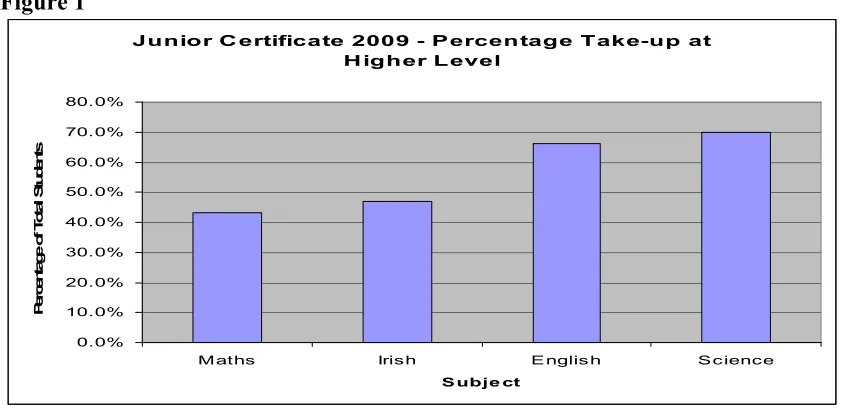
[image:17.595.90.513.461.666.2]In theJunior Certificatein 2009 98.3% of candidates sat mathematics, 9.7% took Foundation Level, 47% took Ordinary Level and 43.2% sat Higher Level. This compares with some 66% sitting English, 47% sitting Irish and 70% sitting science at Higher Level (see figure 1 below). Irish, English and Mathematics are offered at 3 levels in the Junior Certificate examination. The proportion scoring at less than grade D at Ordinary level in Mathematics was 7.3%. Of those who sat mathematics at Higher Level in the Junior Certificate 48.4% scored at grades AB and 77.6% scored at grades ABC.
Figure 1
Junior C ertificate 2009 - Percentage Take-up at H igher Level
0.0% 10.0% 20.0% 30.0% 40.0% 50.0% 60.0% 70.0% 80.0%
M aths Irish E nglis h Sc ience
S ubje ct
P er ce n ta g e o f T o ta l S tu d en ts
In theLeaving Certificatein 2009, 95.7% of students sat Mathematics, the highest participation in any subject. Of these 12% sat Foundation Level, 71.8% sat Ordinary Level and 16.2% sat Higher Level. This compares with 32.4% taking Higher Level Irish, which is also offered at 3 levels.
The proportion scoring below grade D3 at Ordinary Level has been consistently high, at 10.4% in 2009, 12.2% in 2008, and 11.5% in 2007, although it was in the range 12-16% in the years 2000 to 2002. Of the 16.2% who sat Higher Level, 48.1% scored grades AB and 80.6% scored at grades ABC.
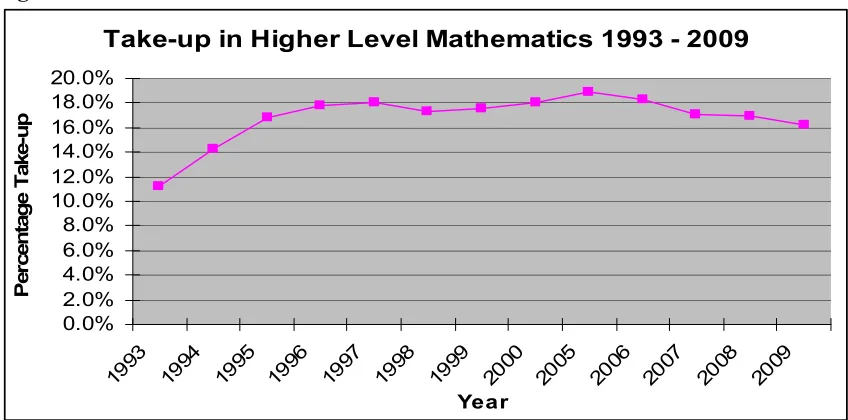
[image:18.595.92.516.342.552.2]The proportion taking Higher Level Mathematics has decreased from 18.9% in 2005 (its highest level) to 16.2% in 2009. There is a consistent reduction year on year (see figure 2 below). However participation in Higher Level Mathematics in the early 1990s was in the range 11-13%. When bonus points were removed in 1994 on foot of curriculum reform, participation increased although, there is no evidence that the removal of points was a causal factor. Participation has been in the range 16-18% over the period 1996 to 2009.
Figure 2
Take-up in Higher Level Mathematics 1993 - 2009
0.0% 2.0% 4.0% 6.0% 8.0% 10.0% 12.0% 14.0% 16.0% 18.0% 20.0%
1993 1994 1995 1996 1997 1998 1999 2000 2005 2006 2007 2008 2009
Year
P
er
ce
n
ta
g
e
T
ak
e-u
p
In 2009, 79 schools had no applicant sitting Higher Level Mathematics in the Leaving Certificate examination5. This is an increase on the 58 schools which had no Higher Level "sits" in 2008.
Demographics
It is expected that there will be a significant increase in numbers of students at first and second level over the next decade. At primary level, the Department of Education and Skills’ projections suggest that enrolments will rise steadily from the current rate
5Note that many of these schools offered Mathematics at Higher Level and had students studying
(09/10) of some 505,000 to a peak of over 569,000 in 2018/19. At post-primary level, it is projected that enrolments will rise from the current rate (09/10) of some 312,000 to 334,500 in 2018/19 and a peak of over 373,000 in 2024/256. This will drive the need for additional teachers. In addition, 5.8% of teachers are over 60 and a further 26.3% are between 50 and 607. These changes in the student cohort and the
significant changes in the teaching force in the years ahead present both challenges and opportunities.
Time Spent on Mathematics
A table is attached in Appendix 3 showing the best performing PISA 2006 countries in Mathematics and the time allocated to mathematics as shown in the OECD Education at a Glance 2009 data. The time spent on mathematics at second level in Ireland is at the OECD average. Some high performing countries in mathematics in OECD PISA do not spend more time on mathematics than Ireland. It would
undoubtedly be complex to increase the time spent on mathematics at second level in Ireland. Teacher supply and qualifications issues within the overall pupil teacher ratio, as well as the time given to other subjects, can cause difficulties. Irish students take a larger number of subjects in their terminal school examination than their counterparts in many other countries.
Project Maths involves a new approach to mathematics. It is about building
understanding, rather than learning by rote. This takes time. It is acknowledged that the CPD for teachers discussed in Chapter 1 will play a role in making more effective use of timeinthe classroom. Nevertheless, the Group expressed particular concern regarding the erosion of time spent on mathematics in second level schools,
particularly in the early stage of junior cycle where core foundation skills are built. This matter should be considered in the context of reform of the junior cycle curriculum. The Group will make a formal submission to the junior cycle review process.
The Group recommends that all schools should be required to provide a minimum of one mathematics class every school day for all students.
The table in Appendix 3 shows that time spent on mathematics at primary level, at 113 hours in Ireland, is less than the OECD average of 134 hours. In primary schools, where all subjects are taught by the same class teacher, increasing the proportion of time spent on mathematics would not pose the same structural problems, although it would have implications for the time allocated to other parts of the curriculum. This issue should be revisited in the context of the work under way on curriculum overload by the NCCA following the first two phases of evaluation of the implementation of the primary curriculum.
6Source: Projections of Full Time Enrolment in Teaching institutions aided by the Department of
Education and Science at Primary, Second and Higher level, 2009 – 2030, DES, Dublin February 2010 available at
http://www.education.ie/home/home.jsp?maincat=&pcategory=17216&ecategory=52107§ionpage =&subject=52111&language=EN&link=&page=
7OECD Education at a Glance, 2009 In other words almost a third of Irish post-primary teachers are
over 50. See: Indicator D7 on
The review of the primary school curriculum should consider the need for greater emphasis to be given to mathematics as an area of study which underpins other subject areas.
Primary and Transition to Post-Primary
The Group considered there was a need to significantly improve the teaching and learning of mathematics at primary level.
Sustained professional development needs to be provided to primary teachers in the teaching and learning of mathematics. The provision of specialist teachers of mathematics on a regional basis to support the system should be considered.
Formal mechanisms ensuring a successful transition from primary to second-level mathematics learning should be significantly improved. There should be adequate communications between primary and second level schools to ensure that
mathematics teachers in first year are well equipped to support the successful mathematics transition of students from feeder primary schools.
The bridging framework developed to ensure continuity between mathematics learning at primary level and the revised mathematics syllabuses at second level must be implemented by all schools.
Junior Cycle
It is in junior cycle that the seeds are sown for student decisions at senior cycle. Students need to enjoy mathematics, to understand fully the concepts, and to experience success at this level. Improving teaching and learning and student attainment at junior cycle is of crucial importance as a pipeline for increased participation in Higher Level Mathematics in senior cycle. The success of Project Maths will rest heavily on the quality of the learning experienced by students in junior cycle, and on the time and space devoted to mathematics at this stage of second level. Currently teachers who hold a qualification in mathematics are being deployed at Leaving Certificate level whereas students’ formative years and foundation for mathematics are at junior cycle level.
The Group recommends that schools ensure that, insofar as possible, teachers who hold a qualification in mathematics are deployed at junior cycle.
Schools and mathematics teachers should not discourage Junior Certificate Higher Level grade C students from taking Higher Level Mathematics. They should identify students who are capable of taking the Higher Level paper and provide the supports and encouragement required to ensure their participation and success.
It is recommended that reform of the Junior Cycle be used to ensure adequate time is provided for the teaching and learning of mathematics.
Transition Year
Transition Year is offered in some 550 schools and is availed of by 28,500 students annually, 50% of the cohort. It presents an opportunity for students to undertake exciting mathematics projects outside the scope of the formal curriculum.
The Group recommends that Transition Year, where available, should be used to provide innovative learning opportunities and to increase mathematics teaching hours as an important part of the strategy to develop and promote core transferable skills.
Third Level Matriculation and Entry Points Requirements
Some students move from Higher to Ordinary Level Mathematics late in their senior cycle to avoid the risk of failing to meet matriculating requirements. If a second chance examination were available to students in the autumn, they might choose to take Higher Level Mathematics in the Leaving Certificate examination.
It is not logistically possible for the State Examinations Commission to introduce a “repeat” mathematics examination in the autumn. The Leaving Certificate appeals are being processed at this key stage and the marking of the Junior Certificate
examinations must also be completed. The alternative possibility of higher education institutions organising examinations for incoming students would lead to increased workloads for colleges, but, for small numbers8, this could provide a viable solution. Some colleges already offer such examinations at the end of August. The availability of this safety net would be a factor in encouraging more students to sit Higher Level Mathematics in the Leaving Certificate.
The Group recommends that higher education institutes offer a second
8For example, in 2009 only 3.2% of the 8,420 candidates who sat Higher Level Mathematics did not
chance entrance examination in mathematics in late August/early September targeted at students who have taken Mathematics at Higher Level in the Leaving Certificate but who have failed to meet minimum matriculation requirements.
It is beyond the remit of the Group to engage in a critique of the “points race”. The recommendations which follow arise from the status quo but they are not intended to be an endorsement of the current system, which has a significant backwash effect on teaching and learning in schools.
There is a tendency for students to use mathematics as a "spare subject" for points’ purposes, concentrating their efforts on gaining points in other subjects. The Group considered that efforts should be made to ensure that the current situation does not work against take-up of Higher Level Mathematics.
The Group recommends that the following options be explored in further discussion with higher education institutions.
The feasibility of requiring that Mathematics is a mandatory subject within a student's best six subjects for CAO points purposes OR
Widening the scope of the points system to include 7 subjects, one of which must be Mathematics OR
Stipulating that both English and Mathematics should be mandatory subjects for CAO points’ purposes, given that these are core
underpinning competencies for employment and for further study.
Appropriate exemptions would have to be provided where necessary, for example, for students with special needs who have learning difficulties specifically associated with mathematics or English.
Sitting the Ordinary Level Mathematics Examination in Leaving Certificate Year 1
This proposal was included in theReport of the Expert Group on Future Skills Needs on Raising National Mathematical Achievement9. The rationale is that students could be incentivised to remain at Higher Level if they had already “banked” their points at Ordinary Level the previous year, and could at least avoid the risk of failing to meet matriculation requirements.
There is a drop of around 20% between the number of candidates who originally apply in February/March of the examination year to take Higher Level Leaving Certificate Mathematics and the number of candidates who sit the Higher Level paper in June. The main reason for this cited by students is workload, in addition to a fear of not meeting matriculation requirements.
This issue has been flagged in previous reports and the Department of Education and Skills and the State Examinations Commission considered response is that this
proposal would lead to an unsound educational experience for students. The Ordinary Level syllabus and Higher Level syllabus are both designed to be covered over a two year period. It could be a considerable challenge to encourage those who followed an Ordinary Level syllabus in year one of the cycle to take Higher Level in year 2. There is a strong risk they would not take Mathematics at all the second year. By the time these students reach further studies, they could have had an entire year without any mathematics at all, and would therefore be in a worse position than they had been a year earlier.
Bonus Points
The Group considered at length the question of bonus points for Higher Level
Mathematics but failed to reach a consensus on the matter. There was agreement that, if bonus points were to be introduced, they should be only one element of an overall strategy to enhance mathematics attainment. Any decision to introduce bonus points should be reviewed in 2018 when the revised curriculum is fully implemented. As the issue is currently an item of considerable debate, this report sets out in some detail the arguments for and against bonus points. However in making progress on the overall agenda on mathematics, the critical objective is to improve students’ attainment levels in mathematics.
Both the Department of Education and Skills and the State Examinations Commission considered it would be inappropriate to award bonus points for Higher Level
Mathematics through the mechanism of the Leaving Certificate examination. Where students get bonus marks for Irish, it is for sitting a subject other than Irish through Irish. This is an arrangement of long standing (since 1924), and is one of range of measures still in place across the public service to promote Irish. The remit of the State Examinations Commission is to operate certificate examinations which assess and certify attainment in accordance with the learning objectives set out in the syllabuses devised by the NCCA in the various subjects. Marks awarded are all traceable to published marking schemes and candidates can review their scripts. The award of bonus points for Mathematics, unrelated to achievement, would mark a departure from the long standing practice to treat all subjects individually based on the published marking scheme, with no attempt to assess weightings between
subjects. Bonus points through this route could be viewed as an artificial mechanism to boost standards in mathematics in an undeserved way, and call into question the integrity of the examination system.
mathematics throughout the education system. The views of the Irish Universities Association were conveyed in June 2008 to the then Minister for Education and Science.
There is some evidence to support the contention that bonus points, where they currently exist10, have not resulted in attracting a higher standard of candidate into STEM courses in those colleges/courses, or increased the proportion of students entering courses with Higher Level Mathematics. However, the proponents of bonus points have made it clear that they are not necessarily advocating the mainstreaming of the existing model. An effective incentive might be to target those most likely to move from Higher to Ordinary Level during their final year, who would be likely to score in the grade C range at Higher Level if they persevered.
The Group considered the arguments for and against bonus points. Some of the key arguments are set out in summary form below.
Arguments for Bonus Points for Higher Level Mathematics
Given the central importance of mathematics to the smart economy agenda a national effort needs to be made to incentivise the take up of Higher Level Mathematics. At 16.2%, current take-up is seriously out of line with Higher Level participation in other subjects. Over 30% of students take Irish at Leaving Certificate Higher Level, which also has 3 levels.
If students are moving to Ordinary Level on the basis of workload, because they can more easily score higher points in other subjects, the availability of extra points for Higher Level Mathematics might encourage them to sit the subject at Higher Level.
If students already perceive that Higher Level Mathematics is difficult, the availability of extra points might reward them for the perceived extra workload.
The relativities between subjects and between Ordinary and Higher Level in different subjects are not equal in demand. Higher Level Mathematics is generally viewed as being significantly more demanding on students than Higher Level in other subjects. It makes sense to compensate for this differential through the award of bonus points.
While Project Maths should improve understanding and attainment in mathematics and improve take up at Higher Level, this is a long term initiative. As noted above, it will be 2018 before all students have taken a complete 5 year cycle in all strands of the new syllabuses. There is a need for short term urgent action to immediately improve the supply of students with Higher Level Mathematics.
10For example, for entry to courses in the University of Limerick and one course in the Dublin Institute
The fact that bonus points have not incentivised participation at Higher Level in the limited circumstances where they are currently available (in UL
generally and on 1 course in DIT) does not mean the incentive would be unsuccessful if a workable incentive was well publicised and more generally available.
Arguments against Bonus Points for Higher Level Mathematics
There is no evidence that the availability of bonus points attracts higher participation.
The existing courses for which bonus points are available do not have a higher rate of application from students with Higher Level Mathematics, nor do they have a higher cadre of applicant than courses in the same disciplines where the bonus is not available
When bonus points for Higher Level Mathematics were removed on foot of curriculum reform, participation in Higher Level Mathematics increased, although there is no proven causal link between these factors. There is a danger that bonus points could have the opposite effect to that intended and reinforce the view that Higher Level Mathematics is difficult, thus dissuading Higher Level participation.
The Points Commission argued against bonus points on the basis that it would lead to distortions in provision and in student choice and would be inequitable for those for whom Mathematics at Higher Level is not available. In 2009, 79 schools had no Higher Level candidates sitting mathematics in the Leaving Certificate.11
Bonus points could have unintended consequences. Higher points could enable more students to take up non STEM courses, and points inflation could lead to the displacement on other courses not needing a high mathematics content of students who take Ordinary Level in Mathematics.
The higher education sector has expressed reluctance in the past to offer bonus points through the CAO system, and considers it would be difficult to get such an approach agreed through their Academic Councils. There is a reluctance to use the points system to achieve national objectives, in a manner which values some subjects more than others. This would not take account of the legitimate interests and aspirations of students, and the dynamic role which other sectors (such as the arts) can also play in promoting economic growth, innovation and creativity.
If the SEC were to give bonus points for Mathematics, it would send clear signals that the education system values achievement in Higher Level Mathematics over any other subject. It would risk devaluing student
11As noted earlier, many of these schools offered Mathematics at Higher Level and had students
achievement in other subjects and potentially demotivate students. It could equally devalue the contribution by other subject teachers in schools and cause significant friction in the allocation of time and resources at local level.
Conclusions on Bonus Points
It is clear that there is merit on both sides of the argument and the Group reached no consensus on the question of whether bonus points should be introduced. Both IBEC and Expert Group on Future Skills Needs consider it is an imperative to introduce bonus points in order to make an immediate impact on Higher Level take up of Mathematics in schools. The Tánaiste and Minister for Education and Skills has expressed a clear view on the importance of sending a signal to students on bonus points. The Report of the Innovation Task Force recommends that bonus CAO points for Higher Level Mathematics should be announced now for implementation in 2012 so that students entering senior cycle in September 2010 can make informed decisions on subject and level choice.
If bonus points are to be introduced, the Group recommends that they should:
compensate for the perceived additional workload associated with Higher Level Mathematics; and
in particular, incentivise the 20% of students who move from Higher Level to Ordinary Level Mathematics between spring and June of the examination year, to sit the Leaving Certificate examination at Higher Level.
A suitably devised system of bonus points would meet these requirements.
The issue of resources should not be a barrier to offering Higher Level Mathematics, or to the consideration of the bonus points issue.
Chapter 3 – Awareness Measures
Introduction
This chapter focuses on
“awareness measures which promote positive attitudes to mathematics and encourage more students to consider careers in this area”
The Group considered awareness measures in relation to Project Maths itself and awareness measures in relation to mathematics more generally.
Awareness of Project Maths
In relation to Project Maths, considerable work has already been undertaken to make the relevant constituencies aware of the forthcoming changes. The NCCA has provided a large number of resources to schools on Project Maths including:
publication of reports relating to the Review of Mathematics;
an information leaflet issued to all schools and stakeholders on Project Maths in 2008;
regular updates in the NCCA newsletter to schools and stakeholders – Issues 9, 10, 13 and 14 over the period April 2008 to date; and
website information and FAQs and regularly revised updates on the websitewww.ncca.ie/projectmaths.
This is in addition to information made directly available to teachers through the extensive professional development programme by the Department of Education and Skills. All schools have received a circular letter in relation to the programme which they are asked to transmit to the appropriate representatives of parents and teachers for passing on to individual parents and teachers.
The NCCA has also briefed many interest groups on the developments. Project Maths is mentioned in the reports of theExpert Group on Future Skills Needs on the ICT sector (June 2008)and onRaising National Mathematical Achievement (November 2008), in theNational Competitiveness Council Statement on Education and Training (March 2009),inBuilding Ireland's Smart Economy (December 2008), the report of theEngineers Ireland Task Force on Mathematics and Science (February 2010)and the report of theInnovation Task Force (March 2010).
Project Maths is also featured on websites of such bodies as the National Parents Council (post primary tier) the Irish Software Association, and Science4Schools. Both the NCCA and the Department have also responded in the media to counteract
negative coverage on Project Maths.
process. Several important constituencies are not adequately aware of Project Maths. This deficit can prove a fertile ground for negativity.
The Group identified a need to develop and actively communicate clear concise messages regarding Project Maths to target audiences well in advance of the September rollout of the new curriculum. Audiences which need to be particularly targeted are students, parents and third level STEM faculties.
Parents, in particular, have a key role to play in encouraging their children’s
engagement in mathematics education and it is vital that they are aware of the positive changes which are occurring. At third level, faculties need to be made aware of
Project Maths and its implications for future degree offerings.
This should be done through the most appropriate channels. For example, the National Parents Council, parents' associations and schools can best reach parents; bodies such as the Institute of Physics or the Third Level Computing Forum can reach the relevant higher education departments and disseminate information to their
stakeholders.
The Group recommends that the following measures be taken.
Identify all stakeholders clearly and promote the message of Project Maths to them through various media - print, posters and online.
Communication should include the reasons for changing the curriculum, and the overall benefits to learners.
For higher education faculties and professional bodies, clear information should be provided on changes in course content under Project Maths so that the implications for courses can be understood.
Tailor information for each of the target audiences and communicate through the most appropriate fora for each audience.
Existing Awareness Measures Relating to Mathematics, Science and Technology
While there is a certain amount of co-ordination in relation to existing measures, there is no central information point for schools and other stakeholders. There is a need to avoid duplication in and to co-ordinate current measures to ensure maximum impact with scarce resources. This process of co-ordinating current measures should help to identify gaps where additional awareness measures are required. Discover Science and Engineering is a natural candidate to co-ordinate initiatives in this area and, indeed, it carries out work in this field already.
The ongoing work of the Project Maths Implementation Support Group provides a vehicle through which information on ongoing developments can be shared. A website, for example, hosted by Discover Science and Engineering, could become a central repository for hosting and promoting awareness measures. Any such website would clearly need to be branded for mathematics and not just science and
engineering. It should also contain links to all other resources including curricular resources.
The Group recommends the creation of a central source of information on awareness measures in mathematics.
The importance of mathematics is often implicit in current awareness measures with more of an overt focus on science, engineering and technology. It needs to be made explicit.
The Group recommends existing initiatives be strengthened to provide a more targeted approach focused on mathematics and on the
interconnectedness of mathematics with other disciplines, stressing such areas as those set out below.
The importance of mathematics to the economy;
Mathematics as a key lifeskill.
Career opportunities in mathematics
The role of mathematics in problem solving, creativity and innovation in society.
Mathematics in Society
Ireland scores in the top 6 countries out of the 57 countries which participated12in the most recent OECD Programme of International Student Assessment in relation to literacy but only mid-table when it comes to mathematics.13 It is acceptable in Irish society for people to say they are "no good at maths." In addition, Higher Level Mathematics is seen as a discipline only open to elite students. Many schools
discourage participation in Higher Level Mathematics in senior cycle, if students have not scored at least grades AB at Higher Level in junior cycle.
Comprehensively addressing social attitudes to mathematics is beyond the scope of this Group. However, the Group recommends that steps should be taken to support a change to positive attitudes towards mathematics in society as a whole.
Address the fear of mathematics and replace it with the attitude that a fluency in mathematics gives skills which will help in many areas of life and work into the future.
Support parents’ engagement in the mathematics education of their children from pre-school age to second-level.
Develop award schemes for mathematics along the lines of the existing Awards for Science/ Mathematics Excellence in schools and include a strengthened mathematics focus and mathematics awards in the BT Young Scientist and Technology Exhibition.
Develop and promote award schemes for schools, supported by industry, focusing on activities which support and reinforce the mathematics curriculum and recognise excellence in teaching mathematics.
Given the importance of mathematics to the economy, an increase in the DSE budget and personnel resources for mathematics promotion and awareness measures is strongly recommended.
The Importance of Mathematics in Careers
A high level of mathematical achievement is vital for Ireland’s future competitiveness in the knowledge economy. Mathematics is an essential skill for disciplines such as science, technology, engineering and finance, but it also promotes the ability to think rationally, analyse and solve problems, and process data effectively. Proficiency in mathematics is a strong asset in any employment.
High levels of mathematical skills are essential for Ireland's future success in the knowledge society. Science, engineering and technology are an integral part of the smart economy, and mathematics is the underpinning language for these disciplines.
Mathematics is important to a wide range of careers which depend heavily on advanced level information processing and analysis skills in industries such as the pharmaceutical, biomedical, chemical, medical devices, and engineering.
Mathematics is also a key skill in design and product development, the earth sciences, environment sectors and sophisticated financial products. Mathematics is essential for a wide range of careers, from toxicology to space science, meteorology, market analysis, risk assessment, actuarial, financial service and insurance industries.
A “Maths Champions” Programme should be developed to provide positive role models for junior and senior cycle students (e.g. building on the ICT Champions Programme).
Clear and concise information on career opportunities requiring
mathematics fluency should be promoted extensively to all stakeholders.
The work of Discover Science and Engineering, and the widespread use of
Chapter 4 – Adding Value to Project Maths
Introduction
This chapter focuses on
“how the partnership can add value to the teaching and learning approaches and support the curriculum in Project Maths”
The Group believes that support provided within the framework of the curriculum is the most likely to be successful. What is needed to add value is a sustained
intervention which supports teachers in teaching the curriculum. This support should be made available both through continuing professional development (CPD) support for teachers and the provision of teaching resources to support the curriculum. The Discover Science and Engineering role in promoting primary science, Teachnet.ie, and Intel Teach to the Future are examples of many initiatives where value has been added in the form of additional training and educational resources. What is important about such developments is that:
they are appropriately student-centred and relate clearly to the curriculum in schools;
they are developed in collaboration with teachers and the curriculum support service;
they promote innovation and utilize the integration of ICT; and
they enable the teacher in the classroom as the facilitator and impact multiplier.
The Qualifications of Mathematics Teachers in Ireland
A recent report "Out of Field Teaching in Post Primary Mathematics Education"14
published by the National Centre for Excellence in Mathematics and Science
Teaching and Learning, University of Limerick, indicated that 48% of teachers in the sample surveyed did not have a teaching qualification in Mathematics. The study was based on a representative sample of 324 teachers in 51 schools. Of those without a teaching qualification in Mathematics, 35% had a Bachelor of Science degree, 34% had a Bachelor of Commerce or Business degree and 27% had a concurrent teacher education degree. Such teachers were generally deployed to teaching Ordinary, Foundation Level or Leaving Certificate Applied students, mainly in the junior cycle.
There were no teachers without a Mathematics qualification teaching at Higher Level in the Leaving Certificate classes, and only 4.5% and 3% respectively taught at Higher Level in the second and 3rd years of junior cycle. The report highlights the importance of students who may be weaker at mathematics having access to teachers who hold a qualification in mathematics.
Data from the Teaching Council, when applied to the 5,900 teachers of mathematics in Irish schools indicates that 65% of those teaching mathematics have mathematics