DETERMINING SHOCK SENSITIVITY
OF LIQUID ORGANIC PEROXIDES
J . E . G U I L L E T A N D M . F . M E Y E R
Tennessee Eastman Co., Kingsport, Tenn.
Two methods were developed for determining the relative sensitivity to shock of liquid organic peroxides and peroxide solutions. The first is a modification of the Bureau of Mines drop-weight test in which the amount of gas liberated by the decomposition can be estimated. The potential energy necessary to cause an explosion was considerably less than could be determined by observing damage to the con- tainer, indicating that some peroxides are more sensitive than was previously suspected. The second method involves subjecting the sample to shock in an autoclave using a blasting cap. Analyses of the gases given off in both tests indicate that the same products are formed as in normal thermal decomposi- tion. These data and the rate measurements obtained in the autoclave tests indicate that the peroxides decomposed as low-order deflagrations rather than as detonations. A convenient estimate of the sensi- tivity of a peroxide can be made by determining the dilution required to make the peroxide insensitive to the maximum energy of the test apparatus. By using such data, it i s possible to relate the sensitivity of a compound to sensitivities of known commercial peroxides.
RGASIC PEROXIDES are among the more hazardous chemi-
0
cals normally handled in chemical manufacturing and research. I n spite of the fact that peroxides of various kinds have been on the market for many years and have caused considerable damage to both plant and personnel, there is, as yet, no generally accepted set of tests or specifications which can be used by the supplier or user to estimate the hazards involved in the handling of specific peroxides.As a class, organic peroxides are relatively low power explo- sives. The yield of gaseous products per mole of peroxide is low compared with that of conventional explosives such as R D X or TST ( 3 ) . Further, the heat liberated per mole of peroxide is about 80 kcal. (based on data obtained in these laboratories by high-temperature calorimetry) compared with 104 kcal. for compounds such as lead azide. Peroxides are hazardous, however, because of the extreme sensitivity of certain types to shock, spark, and other forms of accidental ignition (4). Many of the peroxides handled in a routine manner in the average chemical laboratory are far more sensitive to shock than most primary explosives.
Some work has been reported on the adaptation of methods used for testing explosives to the study of hazardous chemicals, such as peroxides (7). In addition, a number of studies on the explosibility of various H202 mixtures have been reported by
Shanley and coworkers ( 8 ) . Bowden and Yoffe ( 2 ) ascribed the initiation of decomposition in liquids by impact to adiabatic compression of air bubbles resulting in hot spots. If these hot spots are of sufficient size, they will grow to explosions. More recent work on liquid propellants by Griffin (6) shows that impact sensitivity is, in certain cases, a function of bubble volume and that the potential energy at which the probability
of explosion is 507, is a function of temperature, \vhich varies according to the Arrhenius equation. The impact test in Griffin’s work was highly instrumented. A piezoelectric force transducer and oscilloscope were used to measure the rate of decomposition of the compounds.
Most of the published data on the sensitivity of peroxides resulted from tests which involved subjecting a confined sample of the compound to impact or severe shock from a blasting cap and studying the effect of the resulting explosion on the container used to confine the sample. In the present work, the explosions were studied by the amount and rate of gas evolution during the explosions.
The purpose of the present work was to obtain a reliable testing procedure for evaluating the relative sensitivity of liquid organic peroxides and peroxide solutions, and to obtain sufficient data about the nature of peroxide explosions to facilitate the design of equipment capable of handling these sensitive compounds with minimum hazard.
Materials
Most of the peroxides used in these studies were commercial samples which \vere used without further purification. Lauroyl peroxide, tert-butyl peroxybenzoate, tert-butyl peroxyisobutyr- ate, benzoyl peroxide, tert-butyl peroxyacetate, and acetyl peroxide were obtained from the Lucidol Division, Wallace and Tiernan Co. Di-tert-butyl peroxide was obtained from Shell Chemical Corp. Diisopropyl peroxydicarbonate was synthesized by reaction of isopropyl chloroformate with aqueous sodium peroxide by the procedure of Strain and coworkers ( 9 ) .
Dropweight Test
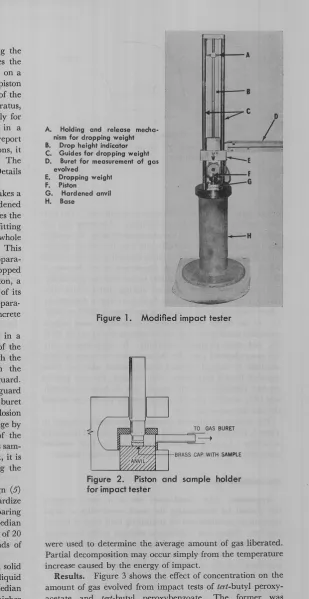
Apparatus. The apparatus generally used for testing the impact sensitivity of small samples of materials involves the use of a dropping weight which falls on a piston resting on a hardened anvil. T h e sample is placed between the piston and the anvil and is thus exposed to the entire impact of the dropping weight. The most common form of this apparatus, developed by the Bureau of Mines, is designed primarily for use with solid explosives. The explosive is confined in a metal cap, and evidence of explosion is the sound of the report or the damage done to the cap. T o study liquid solutions, it was necessary to modify this apparatus considerably. The impact tester used in this work is shown in Figure 1. Details of the piston and sample holder are shown in Figure 2.
The sample is contained in a small brass cap which makes a press-fit on the end of a piston. The piston rests on a hardened steel anvil and is surrounded by a steel ring which encloses the apparatus in a nearly gas-rig-ht fit, The ring has a tube fitting connected to the gas buret by Tygon tubing. The whole assembly is surrounded by a metal shield during- testing. This shield acts as a safety support for the weight when the appara- tus is being assembled for testing. The weight can be dropped from any height up to 30 inches. When it hits the piston, a catch is released which stops the weight at the height of its rebound, thus preventing multiple impact. The entire appara- tus is mounted on a heavy steel column bolted to a concrete slab.
For a test, 40 mg. of sample is placed in a brass cap. The piston is then forced into the mouth of the cap and the whale assembly placed on the anvil through the guide and gas-retaining ring. During this operation the guard is up and the weight (15 Ib.) is resting on the guard. The weight is then raised to the desired height and the guard dropped in place. The styrene foam rider in the gas buret is placed a t zero, and the weight is dropped. If no explosion occurs, the position of the rider in the gas buret will change by less than 0.4 cc. A larger change is an indication of the evolution of gas during decomposition. By placing a gas sam- ple bottle in the line between the ring and the gas buret, it is possible to obtain a sample of the gas given off during the
Procedure.
.~ decomposition.
The conventional “up and down” experimental design (5 was used in testing benzoyl peroxide and R D X to standardiza the impact tester and to establish a relative scale for cornparin! it with other impact testers. Benzoyl peroxide had a medial drop height of 6 inches and R D X a median drop height of 21 inches. These correspond to 90 and 300 inch-pounds o energy, respectively.
The u p and down design works satisfactorily for most soli, peroxides but has not been found reliable in this work for liqub peroxides. Tests with liquid peroxides showed that a medial drop height would he established and then drift to some highe or lower value. This may have been due to such factors a slight changes in temperature, the amount of air trapped be tween the sample and plunger, or the amount of gas dissolve( in the liquid (7). To overcome this difficulty, impact test with liquid peroxides were carried out at the maximum droi height (30 inches), and the concentration of the solution wa varied to find the concentration a t which the peroxide becam’ insensitive. All concentrations were on a weight by weigh basis and were usually determined by titration of the iodin liberated from KI solutions with sodium thiosulfate. At leas 10 tests were carried out a t each concentration. The amount o
gas liberated was determined as a function of peroxide concen tration. Only those tests in which decomposition occurrei i
S
A.
8.
C. D.
E. F. G. H.
Holding and release mecha-
nism for dropping weight Drop height indicator
Guider for dropping weight Buret for measurement of go$ evolved
Dropping weight Piston
Hardened anvil
Bate
,
[image:2.565.242.552.11.611.2], ’
Figure 1. Moditieo ~mpocr resrei
BRASS CAP WITH SAMPLE
were used to determine tne average amount 01 gas Imerarea. Partial decomposition may occur simply from the temperature increase caused by the energy of impact.
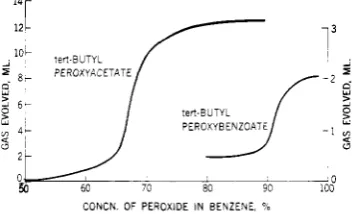
Figure 3 shows the effect of concentration on the amount of gas evolved from impact tests of tert-butyl peroxy- acetate and tert-butyl peroxybenzoate. The farmer was sensitive a t a lower concentration than tert-butyl peroxy- benzoate. Both reached maximum decomposition in this test over a fairly narrow range of concentrations, and there was considerably more gas evolved from the decomposition of the peroxyacetate than from the peroxybenzoate. This figure gives an indication of the concentration of peroxide likely to he insensitive.
A probability plot (arithmetic probability paper) for the decomposition of tert-butyl peraxyacetate and tert-butyl peroxybenzoate is shown in Figure 4. A probability of 1 indicates that the sample will decompose on every trial, whereas a probability of 0.5 indicates that half of the trials will result in decomposition. The liberation of more than 0.4 cc.
Results.
0
-0 60 70 80 90 100
5a
[image:3.614.97.275.46.153.2] [image:3.614.394.502.52.165.2]C O N C N OF PEROXIDE IN BENZEUE 'm
Figure 3. Effect of concentration on gas evolved after impact
of gas during a test was defined as decomposition. Ten tests were carried out a t each concentration. Assuming that the same distribution occurs in the extrapolated range, the straight line obtained in this probability plot may be used to estimate the probability of decomposition for concentrations of peroxide which would be impossible or impractical to test because of the large number of tests required to establish the probability. Temperatures which occurred during deflagrations were usually considerably lower than those occurring in detonations, where temperatures are usually in the range of 2000' to 5000' C. At the higher temperatures of detonations, most organic molecules break down into simple molecules such as C O , C O Z , H I , and other elemental fragments. I n these impact tests, the gases obtained were, for the most part, the same as those obtained in normal thermal decomposition and not those expected from a detonation. For example, the only gaseous product obtained from the impact test on benzoyl peroxide was Con, which is also the major gaseous product in normal thermal decomposition (70).
The relative sensitivities of various peroxides are shown in Table I, in which the peroxides are listed in order of increasing sensitivity. Lauroyl peroxide was one of the least sensitive peroxides tested, and acetyl peroxide was the most sensitive.
Closed-Vessel Test
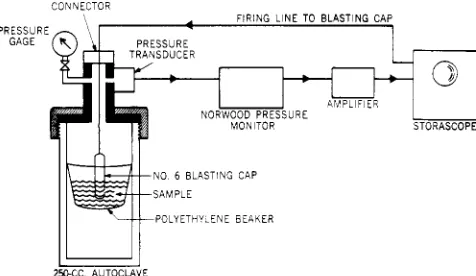
Apparatus. T h e closed-vessel test is a more stringent test devised for determining the shock sensitivities of larger amounts of peroxides and for measuring their rates of decom- position. Figure 5 is a schematic diagram of the apparatus. I n this test, a 20-ml. sample of the compound to be tested was placed in a polyethylene beaker in the center of a 250-cc. autoclave. A No. 6 blasting cap, wrapped in polyethylene
Table 1. Critical Concentrations of Various Peroxides
Concn.. Wt. %
Closed-
Peroxide vessel Impact
Lauroyl peroxide >99 > 9 9
Di-tert-butyl peroxide 91 >97
tert-Butyl peroxyisobutyrate 50.5 50.5
tert-Butyl peroxybenzoate 71 71
Diisopropyl peroxydicarbonate 54 7 8 . 4
tert-Butyl peroxyacetate 45.8 58.5
Benzoyl peroxide <50 <50
Acetyl peroxide 20 >25
PEROXYACE-ATE
m
-I I
-P E R O X V B E N Z D A T E
O.MOlp
~
_
~
~
-M 60 '0 80 9 0 1 0 0 CONCN OF PEROXIDE IN BENZENE %
Figure 4. Probability of decomposition of peroxides
film and wired to a bell transformer, was immersed in the sample in the beaker. The autoclave was equipped with a pressure gage, which was protected from shock by a valve, and with a pressure transducer, which was attached by a inch-diameter line to the autoclave head. (This line was not filled with fluid; however, there was no evidence of spurious pressure waves.) The output from the transducer was fed through a vacuum tube voltmeter (for amplification) to a Sanborne recorder. The autoclave was placed behind a concrete barricade, and flushed with nitrogen during a pre. liminary pressure test.
T o start the test, the Sanborne recorder was turned on; then the blasting cap was ignited by applica- tion of 6 volts a.c. from the bell transformer. After the transient pressure changes were complete, the Sanborne recorder was turned off, the valve opened to the pressure gage, and the residual, or equilibrium, pressure in the auto- clave recorded. The gas was then vented through a gas sample holder and analyzed. In later work, the recording system was replaced. A Norwood Controls pressure monitor, which provides calibration and amplification of the output from the transducer, was connected to a dark trace cathode ray tube recorder Storascope (Wandel and Goltermann), which allows the sweep image to be retained until it is deliberately erased,
The time required for a decomposition to reach one half its maximum pressure was measured and designated T1/2. This time is a n indication of the rate of decomposition of the per- oxide under these conditions and a t the temperature of the deflagration. This time varied from 5 to 1250 milliseconds for the peroxides tested. The residual pressure in the auto- clave, after temperature equilibrium was reached, was meas- ured by opening the valve to the pressure gage. This equi- librium pressure indicated the degree of decomposition which had occurred, since it is a measure of the permanent gases liberated at the temperature of the autoclave. Based on the amount of permanent gas liberated and with certain assump- tions about the number of moles of products which would be volatile at the explosion temperature but not a t the equilibrium temperature of the autoclave, it is possible to estimate the approximate temperature of the gases formed initially in the explosion by using the ratio of the instantaneous to the equi- librium pressures recorded. During decomposition, the temper- ature a t maximum pressure (750 p.s.i.) for di-tert-butyl peroxide a t a concentration of
>
97% is approximately 710' C. The temperature of tert-butyl peroxybenzoate (1 500 p.s.i. and>
95% concentration) is approximately 720' C . This is further evidence that the peroxides are decomposing by deflagration rather than by detonation.Procedure.
[image:3.614.65.297.643.752.2]CONAX
CONNECTOR
FIRING LINE TO BLASTING CAP PRESSURE
GAGE
J I I I I I - I
I I A 1 1
NO 6 BLASTING CAP AMPLE
POLYETtivLENE 6 E A K E A
[image:4.611.50.288.47.185.2] [image:4.611.318.551.48.381.2]250CC. AUTOCMVE
Figure
5.
Schematic diagram of closed-vessel testResults. T h e maximum pressure and as recorded by the Sanborne recorder, increased as the size of the charge increased (Table 11). I n Figure 6, the effect of mixing the peroxide with a n equal weight of dimethyl phthalate is shown by the increase of Tl/z from 26 to 110 milliseconds. I n Figure
7 , the pressure rise and T l / z for di-tert-butyl peroxide is shown as recorded by the Storascope. The velocity of the deflagra- tion of di-tert-butyl peroxide is much faster than that found for benzoyl peroxide.
The equilibrium pressure for various concentrations of tert-
butyl peroxybenzoate in the closed-vessel test is shown in Figure 8. The curve is similar to that found for the compound during the impact test but is displaced to a lower concentration, as expected, because of the greater shock involved in the closed- vessel test.
T h e gaseous products from the decomposition of various peroxides are shown in Table 111. Th e gas from the autoclave was vented through gas sample bottles and analyzed by gas chromatography. The gaseous products obtained in the closed-vessel test are similar to those found as a result of ther- mal decomposition ( 9 ) , which indicates that the temperatures during decomposition in the closed-vessel test were fairly ]OW.
A series of tests was carried out on the peroxides listed in Table I to determine their critical concentrations by the closed-vessel test. T h e critical concentration was defined as the highest concentration found to be insensitive in five succes- sive tests. This was done by running tests a t successively lower concentrations, cleaning out the autoclave, and recharg- ing it between each test, until no decomposition occurred. Four more tests were then carried out a t this level to ensure the reliability of the results. T h e order of sensitivity in the closed-vessel test was about the same as that found in the impact test.
Table II. Effect of Sample Size on Deflagration of Benzoyl Peroxide
Weight of Maximum Peroxide, Pressure,
Grams P.S. I.G.
5 400
10 750
20 2400
20 26
40
D LLTED TO 53%
200
1
2m 2.x
0 25 103
TIME MSEC
Figure 6. Effect of diluting benzoyl peroxide
c 120-
L -
97% 0i-tert.BUlYL PEROXICE
i m r
,
-1
":/
O k + k k h H a TIME, MSEC.
Figure 7. Deflagration as recorded by Storascope
CLOSEC '-VESSEL TEST
/
/ - 3
-
0;o'
CONCN. OF tert-BUWL PEROXYBENZOATE I N BENZENE, %
Figure 8. Effect of concentration on per- oxide sensitivity
I t must be emphasized that this test should not be run with compounds known to detonate, since serious damage could result to the apparatus and ancillary equipment. For this reason, in the present work the closed-vessel test was run only after the compositions had been checked in the impact machine.
Conclusions
The two tests described may be considered to be complemen- tary. The impact test may be used with small quantities of peroxides to estimate their sensitivities. A more complete evaluation then may be carried out in the closed-vessel test using larger amounts. The impact test is particularly useful as a research tool, since it makes available a reliable shock test on a scale sufficiently small that no undue hazards are in- volved in synthesis or testing of the compound.
Table 111. Gases from Decomposition of Two Peroxides Amount of Gas Liberated, %
Benzoyl Peroxide Peroxydicarbonate
Closed- Closed-
vessel vessel
Dtisopropyl
Gas Heating test Heating test
100 100 8 2 . 0 7 1 . 5
0 0 0 4 . 8
0 0 1 4 . 2 1 5 . 7
CIHR 0 0 0 0
100 100 8 2 . 0 7 1 . 5
0 0 0 4 . 8
0 0 1 4 . 2 1 5 . 7
Oih& 0 0 3 . 8 8 . 0
The decompositions of the peroxides studied in this work are believed to be deflagrations, rather than detonations, for the following reasons: The temperatures, as calculated from the instantaneous pressure rise, were about 700’ C. ; much higher temperatures would be expected from a detonation. The pressures generated were low compared with those generally found in a detonation; detonation pressures are usually about 1,000,000 p.s.i. or higher, and deflagrations are usually 50,000 p.s.i. or lower. The gaseous decomposition products obtained during these tests were similar to those obtained dur- ing normal thermal decomposition and did not show the ex- tensive breakdown into more elemental components one would expect from a detonation.
I t should be emphasized that the tests described do not esti- mate the safety of a peroxide for a given application. This can be determined only on the basis of experience in the shipping, handling, and storage of such chemicals and involves many factors in addition to shock sensitivity. I t is obvious from the data presented that dilution of a peroxide with a suitable solvent will reduce the shock sensitivity to almost any desired level. Standards have been set up in the industry, based on existing tests and experience, for shipment and storage of peroxides either in the pure form or suitably diluted (7). It is, however, the opinion of the authors that previous test procedures used with peroxides were not sufficiently sensitive to detect the low-order deflagrations which occur in diluted peroxide solutions and that, as a result, the hazards involved i n their use have often been underestimated. Since it is likely that many explosions caused by peroxides start as low-order deflagrations and propagate into higher order deflagrations or detonations, it may be advisable to re-evaluate the sig- nificance of peroxide sensitivity measurements.
Acknowledgment
T h e authors are grateful for the help of G. A. Akin, A. U. Meadows, and W. J. Showalter in designing and constructing the impact tester; E. B. Towne and J. P. Hawk in synthesizing diisopropyl peroxydicarbonate; and J. W. Henry in the instrumentation of the closed-vessel test. The helpful com- ments of R . W . Van Dolah and J. A. Herickes, Bureau of Explosives, 0. L. Mageli, Lucidol Corp., G. F. Wright, Uni- versity of Toronto, and Robert Robbins, Holston Defense Corp., are also appreciated.
literature Cited
(1) Bowden, F. P., Mulcahy, M. F. R., Vines, R. G., Yoffe, A ,
N a f u r e 157, 105 (1946).
(2) Bowden, F. P., Yoffe, A. D., “Initiation and Growth of Explosions in Liquids and Solids,” pp. 25-9, Univ. Press, Cam- bridge, 1952.
(3) Cook, M. A., “The Science of High Explosives,” Reinhold, New York, 1958.
(4) Dickey, J. B., Raley, J. H., Rust, F. F., Treseder, R. S., Vaughn. LV. E., Ind. Eng. Chem. 4 1 , 1673 (1949).
(5) Dixon, LV. J., Massey, F. J., Jr., “Introduction to Statistical Analysis,” pp. 278-86, McGraw-Hill, New York, 1951. (6) Griffin, D. N., American Rocket Society Propellants, Com-
bustion, and Liquid Rockets Conference, Palm Beach, Fla., April 1961.
(7) National Board of Fire Underwriters, New York,
N.
Y., Research Report No. 11, p. 24, 1956.(8) Shanley, E. S., Greenspan, F. P., Znd. Eng. Chem. 39, 1536-
4.3 (1 047)
(9)‘S&ain,’F., Bissinger, W. E., Dial, W. R., Rudoff, H., DelVitt, B. J., Stevens, H. C . , Langston, J. H., J . A m . Chem. Soc. 72,
1254 (1950).
(10) Tobolsky, A. V., Mesrobian, R. B., “Organic Peroxides,”
p. 72, Interscience, New York, 1954.
RECEIVED for review July 5, 1962 ACCEPTED October 8, 1962 Southwest-Southeast Combined Meeting, ACS, New Orleans, La., December 1961.