PROPELLANT DEVELOPMENT FOR INSENSITIVE MUNITIONS: IM TESTING*
Herman H. Weyland and Marvin L. Jones
Pratt & Whitney Space Propulsion, Chemical Systems Division San Jose, CA
Duane R. Blue and Alfred O. Smith Naval Air Warfare Center Weapons Division
China Lake, CA
ABSTRACT
CSD has developed and IM tested two aluminized propellants. The first, UTP-33,000, is an HTPB binder propellant having a total solids loading of 86.5 wt-%. The second, UTP-32,070, is a polyether/polyester propellant having a total solids loading of 84 wt-%. Excellent mechanical and ballistic properties were obtained on both propellants. The two propellants were IM tested in 8-inch-diameter graphite composite cases. The four IM tests were BI, FI, FCO, and SCO. Both propellants performed well in the IM tests. In addition to the IM tests, both propellants underwent BVR tests. Unburned propellant was recovered from each of the BVR tests, and no detonations occurred.
INTRODUCTION
The objective of this effort was to provide a fundamental understanding of the IM response characteristics of two promising propellant systems considered as candidate technologies for Navy missile propulsion development.
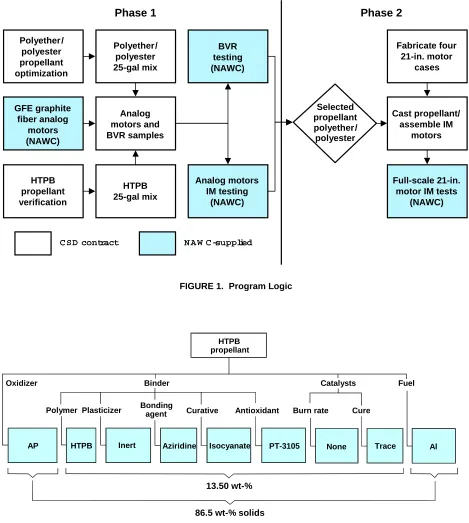
The program development logic is presented in Fig. 1. This program is a collaborative effort with NAWCWD. In Phase l the Navy supplied the graphite composite motor cases and conducted the IM testing. Phase I of the program has been completed and a downselect to the polyether/polyester propellant has been made for evaluation in full-scale motor testing in Phase ll .The two propellants developed on this program (HTPB and polyether/polyester) are delineated in the following sections.
EXPERIMENTAL
HTPB PROPELLANT VERIFICATION
The HTPB propellant, UTP-33,000, evaluated on this program was selected from CSD's well characterized Class 1.3 HTPB family of propellants. The UTP-33,000 propellant was derived from a CSD flight-proven booster propellant that had passed the 8-inch super card gap test. Figure 2 presents a graphical view of the HTPB propellant ingredient selection. In order to arrive at the final formulation parameters, a series of 1-gal and 5-gal mixes were made and characterized. The 25-gal mix formulation is shown in Table I.
The viscosity/potlife of the 25-gal mix is shown in Table II. Although the potlife of the propellant exceeded 6 hr, it was somewhat shorter than the 8–10 hr expected.
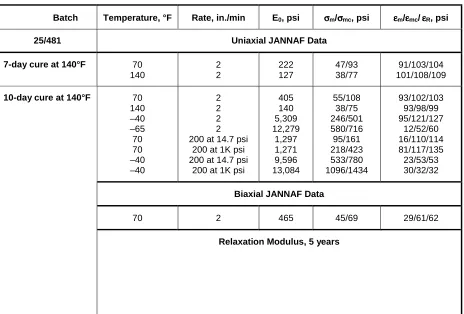
The mechanical properties of UTP-33,000-25/481 are given in Table III. The standard rate JANNAF properties are very good over the entire temperature range (140 to –65°F); the properties at ambient temperature (70°F) are exceptional. The high rate (200 in./min) pressurized (1000 psi) JANNAF properties are also very good. The biaxial strain was over 60%.
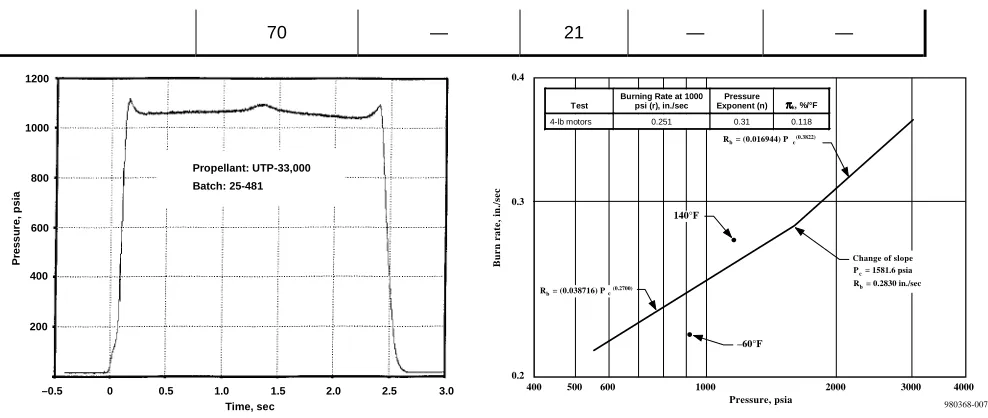
The HTPB propellant UTP-33,000-25/481 was tested in CSD's standard 4-lb motor configuration. A real time ballistic trace of one of the 4 lb motor tests is shown in Fig. 3 along with the pressure/rate data. This HTPB propellant has a burn rate of 0.251 in/sec at 1000 psi and a pressure exponent of 0.31; the πk (0.12%/°F) is in the typical range.
The IM testing of this propellant is described in a following IM test section.
*
This effort was supported by the Navy Insensitive Munitions Advanced Development (IMAD) program (Don Porada, cognizant technology manager) and conducted under Contract # N68936-98-C-0189 with NAWCWD, China Lake, California.
Polyether/ polyester propellant optimization
Polyether/ polyester 25-gal mix
BVR testing (NAWC)
Fabricate four 21-in. motor
cases
GFE graphite fiber analog
motors (NAWC)
Analog motors and BVR samples
Selected propellant polyether/ polyester
Cast propellant/ assemble IM
motors
HTPB propellant verification
HTPB 25-gal mix
Analog motors IM testing
(NAWC)
Full-scale 21-in. motor IM tests
(NAWC)
Phase 1
Phase 2
[image:2.612.70.539.89.612.2]C SD contract N A W C -supplied
FIGURE 1. Program Logic
HTPB Inert Aziridine Isocyanate PT-3105 None Trace Al
Oxidizer Binder Catalysts Fuel
Polymer Plasticizer Bondingagent Curative Antioxidant Burn rate Cure
HTPB propellant
AP
13.50 wt-%
86.5 wt-% solids
TABLE I. UTP-33,000-25/481 Mix Formulation
Ingredient wt-%
Polymer, HTPB
Plasticizer, inert
Bonding agent
Antioxidant
Cure catalyst
13.5
Oxidizer, AP
Fuel, Al
86.5
Batch size 220 kg/~485 lb
TABLE II. Viscosity Potlife UTP-33,000-25/481
Time, hr EOM 2 4 6 8
Viscosity at 5000 dynes/cm2, Kp 1.7 2.7 7.4 27.9 115
TABLE III. Mechanical Properties Evaluation, UTP-33,000-25/481
Batch Temperature, °F Rate, in./min E0, psi σσσσm/σσσσmc, psi εεεεm/εεεεmc/ εεεεR, psi
25/481 Uniaxial JANNAF Data
7-day cure at 140°F 70 140
2 2
222 127
47/93 38/77
91/103/104 101/108/109
70 140 –40 –65 70 70 –40 –40
2 2 2 2 200 at 14.7 psi
200 at 1K psi 200 at 14.7 psi
200 at 1K psi
405 140 5,309 12,279
1,297 1,271 9,596 13,084
55/108 38/75 246/501 580/716 95/161 218/423 533/780 1096/1434
93/102/103 93/98/99 95/121/127
12/52/60 16/110/114 81/117/135 23/53/53 30/32/32
Biaxial JANNAF Data
70 2 465 45/69 29/61/62
10-day cure at 140°F
[image:3.612.74.538.451.765.2]70 — 21 — —
–0.5
Time, sec 1200
Pr
ess
u
re,
p
s
ia
Propellant: UTP-33,000 Batch: 25-481 1000
800
600
400
200
0 0.5 1.0 1.5 2.0 2.5 3.0
980368-007
0.2
400 500 600 1000 2000 3000
Pressure, psia
Burn rate, in./sec
Rb = (0.016944) Pc(0.3822)
–60°F
Rb = (0.038716) Pc(0.2700)
140°F
4000 0.3
0.4
Pc = 1581.6 psia
Change of slope
Rb = 0.2830 in./sec
Test
Burning Rate at 1000 psi (r), in./sec
Pressure Exponent (n) ππππk, %/°F
[image:4.612.73.567.81.290.2]4-lb motors 0.251 0.31 0.118
FIGURE 3. 4-lb Motor Ballistic Data, UTP-33,000-25/481
POLYETHER/POLYESTER PROPELLANT OPTIMIZATION
The polyether/polyester propellant development followed the optimization procedure outlined in Fig. 4.
Select Solids Loading
! Meet or exceed current performance parameters — Oxidizer type
Process Wide Range AP Sizes
! Match burning rate of UTP-33,000, the HTPB Propellant — Oxidizer size
Optimize Mechanical Properties
! Plasticizer content/type
! NCO/OH ratio and NCO type
! Cross-linker content/type
! Bonding agent content/type
FIGURE 4. Polyether/Polyester Propellant Optimization
Presented in Fig. 5 are the ingredients that were used in the subscale 1- and 5-gal mix studies.
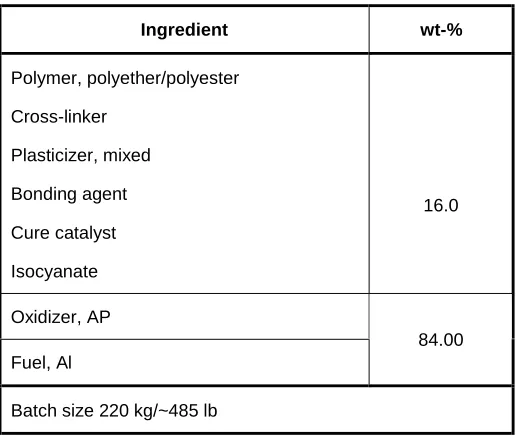
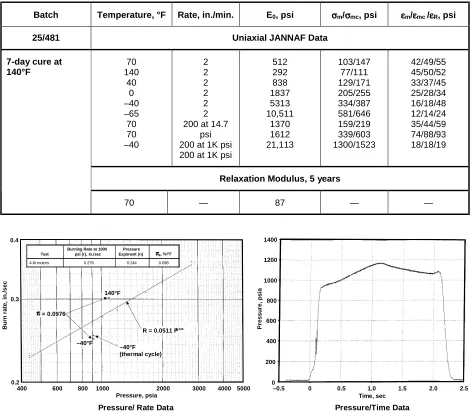
The UTP-32,070 25-gal mix formulation details are presented in Table IV. The propellant UTP-32,070-25/486 processed very well and had an excellent end-of-mix viscosity and a potlife that exceeded 8 hr (see Table V).
The mechanical properties for UTP-32,070-25/486 are presented in Table VI. The properties are very good over the entire temperature range for both the standard rate (2 in/min.) and high rate (200 in/min) JANNAF tests. The 5-year relaxation modulus is 87 psi, which was excellent.
[image:4.612.71.530.373.531.2]Polyether/ polyester
Mixed
plasticizer Aziridine Isocyanate None Trace Al
Oxidizers Binder Catalysts Fuel
Polymer Plasticizer Bondingagent Curatives Crosslinker Burn rate Cure Polyether/polyester
propellant
AP Tetra
functional
16.0 wt-%
84.0 wt-% solids
[image:5.612.74.534.91.276.2]FIGURE 5. Ingredient Trade Study
TABLE IV. UTP-32,070-25/486 Mix Formulation
Ingredient wt-%
Polymer, polyether/polyester
Cross-linker
Plasticizer, mixed
Bonding agent
Cure catalyst
Isocyanate
16.0
Oxidizer, AP
Fuel, Al
84.00
Batch size 220 kg/~485 lb
TABLE V. Viscosity/Potlife, UTP-32,070-25/486
Time, hr EOM 2 4 6 8
[image:5.612.180.441.367.587.2]TABLE VI. Mechanical Property Evaluation, UTP-32,070-25/486
Batch Temperature, °F Rate, in./min. E0, psi σσσσm/σσσσmc, psi εεεεm/εεεεmc /εεεεR, psi
25/481 Uniaxial JANNAF Data
70 140 40 0 –40 –65 70 70 –40 2 2 2 2 2 2 200 at 14.7
psi 200 at 1K psi 200 at 1K psi
512 292 838 1837 5313 10,511 1370 1612 21,113 103/147 77/111 129/171 205/255 334/387 581/646 159/219 339/603 1300/1523 42/49/55 45/50/52 33/37/45 25/28/34 16/18/48 12/14/24 35/44/59 74/88/93 18/18/19
Relaxation Modulus, 5 years 7-day cure at
140°F
70 — 87 — —
0.4
0.3
0.2
400 600 800 1000 2000 3000 4000 5000
Bu rn r a te , in ./sec Pressure, psia
–0.5 0 0.5 1.0 1.5 2.0 2.5
Time, sec 0 200 400 600 800 1000 1200 1400 P ressu re, p s ia
ππππ = 0.0976
–40°F
–40°F (thermal cycle)
R = 0.0511 P0.244
140°F
Pressure/ Rate Data Pressure/Time Data
Test
Burning Rate at 1000 psi (r), in./sec
Pressure Exponent (n) ππππk, %/°F
4-lb motors 0.276 0.244 0.098
FIGURE 6. 4-lb Motor Ballistic Data, UTP-32,070-25/486
IM TESTING
8.038 in.
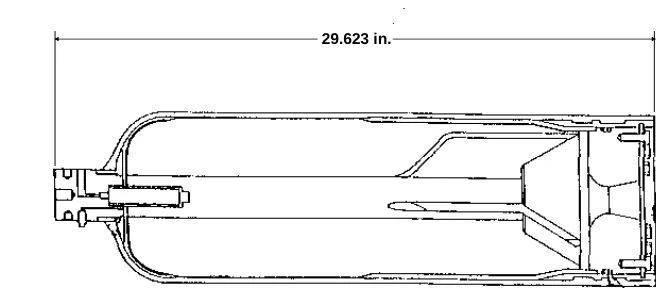
[image:7.612.191.519.116.264.2]diameter 29.623 in.
FIGURE 7. NAWCWD Standard Graphite Case Motor 0.0625-in. thick
steel plate 1.5-in. thick
propellant
Air gap Sleeve 0.75-in. diameter
steel sphere
Failure Mechanism
[image:7.612.70.519.223.511.2]~4000 ft/sec
FIGURE 8. NAWCWD BVR Test
TABLE VII. Summary of IM Test Results
IM Tests
Propellant BI* FI* FCO* SCO*
HTPB UTP-33,000 No overpressure, no
lethal debris outside test area, moderate reaction
PASS
No overpressure, no lethal debris outside test area, moderate reaction
PASS
No overpressure, no lethal debris outside test area, burning
PASS
2.8 psi overpressure, lethal debris outside test area:400°F cook off, partial detonation
FAIL
Polyether/polyester UTP-32,070
Burn only, moderate initial reaction with no overpressure
Burn only, no overpressure, no lethal debris outside
Burn only, no over-pressure , no debris outside test area
PASS
test area,
PASS PASS
test area: 3770F cook-off
PASS
*The pass/fail results were officially determined by the review board of NAWCWD China Lake, CA .
The BVR tests on both propellants resulted in no detonations (as measured by the low overpressure recorded on the gauges), and in all cases there was unburned propellant — in some cases from both the front and rear plates.
SUMMARY AND CONCLUSIONS
Two propellants have been formulated, processed, and characterized. The HTPB propellant, UTP-33,000, and the polyester/polyether propellant, UTP-32,070, both exhibited the following properties:
1. Good processibility (flowed into the motors to produce void-free grains) 2. Good pot lives
3. Excellent ballistic performance 4. Very good mechanical properties
5. Good IM characteristics (SCO a fail, however, for the HTPB)
A downselect to the polyether/polyester propellant has been made and will be used in Phase II of the program. A CSD-designed and –manufactured 21-in. diameter motor will be used for IM testing of the downselected propellant.
ACKNOWLEDGMENT
Many helpful discussions were held regarding the program's direction with Mr. Al. Smith and Mr. Duane Blue of NAWCWD, China Lake. May Chan of NAWCWD also provided guidance on the propellant effort. Marvin Jones of CSD was the project engineer.
ACRONYMS
BI bullet impact IM test
BVR burn to violent reaction test
CSD Chemical Systems Division
FCO fast cookoff IM test
FI fragment impact IM test
HTPB hydroxy-terminated polybutadiene
IM insensitive munitions
NAWCWD Naval Air Warfare Center Weapons Division, China Lake, California