Towards relation based Argumentation Mining
Lucas Carstens
Imperial College London United Kingdom SW2 7AZ, London [email protected]
Francesca Toni
Imperial College London United Kingdom SW2 7AZ, London [email protected]
Abstract
We advocate a relation based approach to Ar-gumentation Mining. Our focus lies on the extraction of argumentative relations instead of the identification of arguments, themselves. By classifying pairs of sentences according to the relation that holds between them we are able to identify sentences that may be factual when considered in isolation, but carry argu-mentative meaning when read in context. We describe scenarios in which this is useful, as well as a corpus of annotated sentence pairs we are developing to provide a testbed for this approach.
1 Introduction
Arguments form an integral part of human dis-course. Whether we argue in dialogue with an-other person or advocate the merits of a product in a review, arguments are ubiquitous, in real life as much as in the world wide web. The ever increas-ing amounts of data on the web mean that manual analysis of this content, including debates and ar-guments, seems to become increasingly infeasible. Among other problems Argumentation Mining ad-dresses this issue by developing solutions that au-tomate, or at least facilitate, the process of build-ing Argument Frameworks (AFs) (Amgoud et al., 2008; Dung, 1995) from free text. To build AFs we are generally concerned with two problems, (1) the identification of arguments and (2) the identifi-cation of relations between arguments. With this paper we highlight the intricate link between those two tasks and argue that treating them separately
raises a number of issues. On the back of this we propose a relation based way of performing Argu-mentation Mining. Instead of treating the identifica-tion of arguments and their relaidentifica-tions to each other as two problems we define it as a single task. We do this by classifying sentences according to whether they stand in anargumentativerelation to other sen-tences. We consider any sentence which supports or attacks another sentence to be argumentative. This includes cases such as the one shown in section 3.1, where a sentence contains only parts of an argu-ments (premises or a conclusion) and the remainder of the argument is left implicit for the reader to infer. The remainder of this paper is organised as fol-lows. We discuss related work in section 2. In sec-tion 3 we discuss three issues that arise when trying to decouple the process of identifying arguments and finding relations between them. Following this we describe a relation based approach to perform Argu-mentation Mining for the creation of AFs in section 4. We discuss an application in section 5.1, as well as a corpus design to help us build such applications in section 5.2. We conclude the paper in section 6.
2 Related work
Work on Argumentation Mining has addressed a number of tasks crucial to the problem, including the automatic construction ofArgument Frameworks (AFs) (Cabrio and Villata, 2012; Feng and Hirst, 2011) and the creation of resources such as anno-tated corpora (Mochales and Moens, 2008; Stab and Gurevych, 2014; Walker et al., 2012). Amidst the increasing interest in Argumentation Mining various types of online content have been the target of
ysis. (Park and Cardie, 2014) use multi-class Sup-port Vector Machines (SVM)(Crammer and Singer, 2002) to identify different classes of argumentative propositions in online user comments. (Ghosh et al., 2014) use SVM to analyse multilogue, instead, clas-sifying relations between user comments. (Boltuzic and ˇSnajder, 2014) use Textual Entailment to iden-tify support relations between posts in discussion fora. Other application areas for Argumentation Mining have been the biomedical (Faiz and Mercer, 2014; Green, 2014; Houngbo and Mercer, 2014) and legal domains, where the well-structured nature of legal text and the development of corpora such as theECHRcorpus (Mochales and Moens, 2008) have sparked development in this area (Palau and Moens, 2009; Wyner et al., 2010).
3 Motivation
The separation of identifying arguments and the re-lations between them raises a number of problems, three of which are highlighted here to motivate our approach.
3.1 This is just a fact - so why does it attack this other sentence?
The context in which a sentence appears can change its meaning significantly, and with it a sentence’s ar-gumentativeness. Consider the following statement:
(1) Nigel Farage1has attended private
school and used to work as a banker in the City.
This is a simple enough fact and, on its own, con-veys no particular attitude towards Nigel Farage, his education, or his professional past. If however, we consider the above sentence in relation to the one below, the situation changes:
(2) Nigel Farage understands the com-mon folks; he is the face of UKIP, the peo-ple’s army!
It now becomes quite possible that sentence (1) is meant to be an attack on sentence (2) and the no-tion of Nigel Farage being the leader of apeople’s army. After all, how could someone who went to
1Nigel Farage is the leader of the UK Independence Party
[image:2.612.369.487.56.199.2](UKIP), seewww.ukip.org
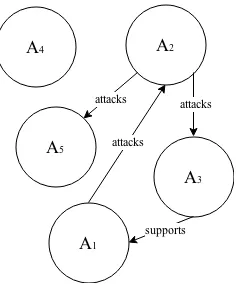
Figure 1: Example Argument Framework.
private school and has a history as a banker possibly understand the common people? This conclusion is not stated explicitly, but one may easily infer it. Try-ing to identify arguments in isolation may hence lead us to discard factual sentences such as sentence (1), even though, when considered in context with sen-tence (2), we should arguably consider it to be argu-mentative.
3.2 I have found the arguments - relating them is still a three-class problem!
Let us consider again the task of identifying a sen-tence as argumentative or non-argumentative. Say we have built a model that provides us with a good split between the two classes, so that we can reli-ably discard non-argumentative sentences (though, as discussed in section 3.1, this concept may be questionable, as well). We now need to find re-lations, i.e. attacks and supports between the sen-tences that have been classified as argumentative. In spite of our knowledge of all sentences in question being arguments, we are still faced with a three-class problem, as three scenarios need to be accounted for. A sentence may attack another, it may sup-ports another, and, lastly, both sentences may be arguments, but otherwise unrelated. By discarding non-argumentative sentences we thus simply limit the search space for the construction of an AF, the complexity of the problem itself remains unchanged.
3.3 This is an argument - but is it relevant?
input to our AF, we may also end up retaining sen-tences that are of little use. Though often enough toy examples of AFs contain isolated arguments, as shown in figure 1, such arguments may arguably not be useful in real life applications. In the example AF, argumentA4does not offer us any insight either as to whether it is viable/acceptable or in what way it may contribute to identifyinggoodarguments, by whichever measure this may be.
4 Relation based Argumentation Mining Based on the issues we describe in section 3 we have set out to offer an alternative, relation based view on Argumentation Mining. We hope that this will of-fer new ways of building AFs from text that may be useful on their own, but also complementary to other approaches. Instead of identifying sentences or other text snippets as (non)argumentative we clas-sifypairsof sentences according to their relation. If this relation is classified as anattackorsupport rela-tion we considerbothsentences to be argumentative, irrespective of their individual quality. Accordingly we classify sentence pairs as belonging to one of three classes,A = Attack,S = Support, orN = Nei-ther, where Neither includes both cases where the two sentences are unrelated and those where they are related, but not in an argumentative manner. To con-struct pairs and build AFs from them we currently consider two options. On the one hand, we create a root node, a sentence to be compared to a set of other sentences. Consider, for example, a journalist who is in the process of composing an article on UKIP. To gather insights on the attitude towards UKIP he or she may want to test a claim against an existing body of articles. A claim here is a sentence convey-ing a hypothesis, such as:
C = ”UKIP’s proposed immigration policies effectively discriminate against migrants from specific European coun-tries, thereby undermining the inclusive-ness and unity of the European Union.”
To evaluate this claim we take a set of relevant sentences S = {s1, s2, ..., sn}, for example other news articles on UKIP. We then construct a set of sentence pairs P = {(C, s1),(C, s2), ...,(C, sn)}, where eachp∈P needs to be assigned a class label
L∈ {A, S, N}. We can then determine which sen-tences from the articles attack or support the journal-ist’s claim and can iteratively establish further con-nections between the sentences related to the origi-nal claim. On the other hand we may want to cre-ate an AF from a single piece of text. If the text is not very large and/or we have the computing power available we can simply create sentence pairs by matching every sentence with every other sentence appearing in the article. This, however, means we have to classify an exponentially growing number of pairs as we consider larger texts. It may hence be prudent to preselect pairs, e.g. by matching sen-tences containing the same entities. Once we have constructed pairs in some way we need to repre-sent them in a manner that lets us classify them. To achieve this we represent each sentence pair as a sin-gle feature vector. The vector is comprised of a set of features, of which some characterise the sentences themselves and others describe the relation between the sentences. We describe preliminary work on building a corpus of such vectors, each annotated with a class label, in section 5.2.
5 Putting theory into practice
Based on the ideas described in section 4 we have defined a number of use cases, one of which we dis-cuss here, and have also developed a first annotated corpus of sentence pairs.
5.1 Application
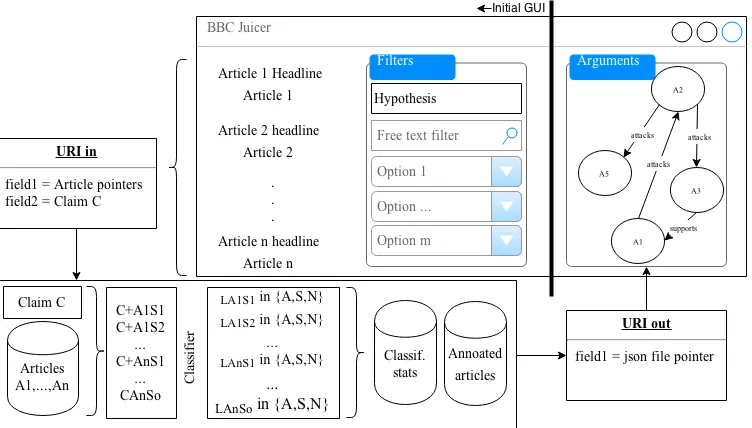
The first application we are developing following our approach offers a way of evaluating claims against a body of text, as described in section 4. As a first step, this provides us with a gauge of what pro-portion of a text argues for or against our claim. In a second step we can then discard sentences which do not appear to have an argumentative relation to our claim and try to establish further connections between those sentences that do, giving us a prelim-inary AF. At this stage the result will not be a fully fledged AF that reflects the argumentative structure of the text itself, simply because it relates to an exter-nal claim. To test our approachin real lifewe have teamed up with the BBC News Labs2to define a use
case, for which figure 2 provides an overview. One
Figure 2: Mock Up of the Juicer, including the way the API interacts with it to retrieve & classify contents and then feed it back to the Juicer. The user enters a Claim and chooses a set of articles via the available filters. Pointers to the articles, as well as the Claim are then processed via an API. The classification output is fed back into the Juicer.
of the applications developed by the News Labs is The Juicer3, a platform used to facilitate the
seman-tic tagging of BBC content. The Juicer provides an interface to a large repository of news articles and social media posts from various sources, such as the BBC websites and Twitter. Each article stored in the repository is assigned to various categories, such as topic and source, and is then semantically tagged for people, places, events, etc. We are currently de-veloping an API to integrate a concrete realisation of relation based Argumentation Mining, to be used as an additional semantic filter in the Juicer. This will allow us to utilise the existing filters of the BBC Juicer to select the articles we want to compare with the claim. Pointers to the articles retrieved using the filters, as well as the provided claim are sent to be processed via the API. The content of the arti-cles are then compared to the provided claim, as de-scribed in section 4. We are considering a number of options for how the resulting classifications may be presented to the user:
1. He or she may access simple statistics on the resulting classifications, e.g. the proportion of sentences attacking or supporting the claim.
3www.bbc.co.uk/partnersandsuppliers/connectedstudio
/newslabs/projects/juicer.html
2. Alternatively the user may access the full arti-cles, with sentences highlighted for argumenta-tive contents.
3. Another option is to just view argumentative sentences directly, without the articles in which they appear. These sentence may be repre-sented in graph form, as shown in figure 2.
5.2 Corpus development
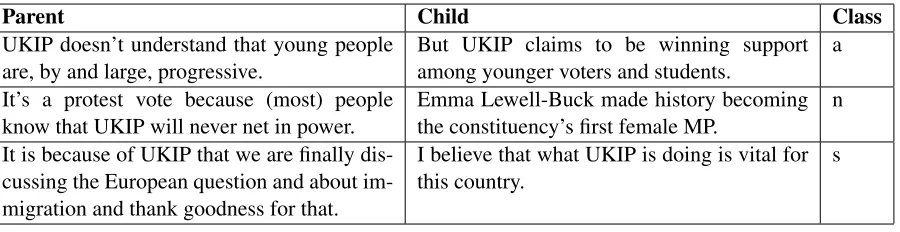
To develop applications such as the one described in section 5.1 we need to build solid classification mod-els. In turn, to build such models, we need a sizeable corpus of labeled examples, in our case sentence pairs that are labeled withL∈ {A, S, N}. To iden-tify the challenges in this we have built a preliminary corpus of854 annotated sentence pairs4, examples
of which are shown in table 1. Based on the insights gained from annotating a reasonable amount of sen-tence pairs we are now in the process of building a larger corpus in which each instance will be labeled by at least two annotators. The annotators are ei-ther native or fully proficient English speakers. We summarise the main points of the setup below.
Firstly, we do not ask annotators to identify ar-guments. This is based on the issues this raises, as
Parent Child Class
UKIP doesn’t understand that young people
are, by and large, progressive. But UKIP claims to be winning supportamong younger voters and students. a It’s a protest vote because (most) people
know that UKIP will never net in power. Emma Lewell-Buck made history becomingthe constituency’s first female MP. n It is because of UKIP that we are finally
dis-cussing the European question and about im-migration and thank goodness for that.
I believe that what UKIP is doing is vital for
[image:5.612.85.535.56.172.2]this country. s
Table 1: Example sentence pairs, labeled according to the relation pointing from the Child to the Parent
explained in section 3. Instead we ask annotators to focus on the relation, taking into account what-ever may be implied in the sentences to then decide whether one attacks or supports the other. We will also ask annotators to provide qualitative feedback on whether they can pinpoint why they have classi-fied pairs the way they have. This will be achieved via free text feedback or the completion of templates and will be used as a basis for further exploration on how we may represent and identify arguments.
This leads to the second challenge in building models that we can use in our applications: We need to decide how to represent the sentence pairs. Here, we have two options. We may either choose a Bag-of-Words (BOW) approach or develop a set of fea-tures that are representative of a sentence pair. The BOW approach is straight forward and has proven to yield reasonable results for many NLP problems, e.g. (Maas et al., 2011; Sayeedunnissa et al., 2013). We will hence use it as one of two baselines, the other being random classification. To see whether we can improve on both these baselines we have set out to collect a set of features that give us numerical representation of a sentence pair. Most broadly we distinguish two types of features,Relational features andSentential features. Relational features will be comprised of any type of features that represent how the two sentences that make up the pair relate to each other. Features we have been experimenting with on our preliminary corpus include WordNet based similarity (Miller, 1995), Edit Distance sures (Navarro, 2001), and Textual Entailment mea-sures (Dagan et al., 2006). The second category in-cludes a set of features that characterise the individ-ual sentences. Here we are considering various word lists, e.g. keeping count of discourse markers,
sen-timent scores, e.g. using SentiWordNet (Esuli and Sebastiani, 2006) or the Stanford Sentiment library (Socher et al., 2013), and other features. All fea-tures are then pooled together to create the feature vector representing a sentence pair. Experiments on the preliminary corpus, representing sentence pairs using all features described, show promising results on our approach, with classification accuracy of up to77.5% when training Random Forests (Breiman, 2001) on the corpus.
6 Conclusion
References
Leila Amgoud, Claudette Cayrol, Marie-Christine Lagasquie-Schiex, and Pierre Livet. 2008. On bipo-larity in argumentation frameworks. International Journal of Intelligent Systems, 23(10):1062–1093. Filip Boltuzic and Jan ˇSnajder. 2014. Back up your
stance: Recognizing arguments in online discussions. In Proceedings of the First Workshop on Argumenta-tion Mining, pages 49–58.
Leo Breiman. 2001. Random forests.Machine learning, 45(1):5–32.
Elena Cabrio and Serena Villata. 2012. Generating ab-stract arguments: A natural language approach. In
COMMA, pages 454–461.
Koby Crammer and Yoram Singer. 2002. On the al-gorithmic implementation of multiclass kernel-based vector machines. The Journal of Machine Learning Research, 2:265–292.
Ido Dagan, Oren Glickman, and Bernardo Magnini. 2006. The pascal recognising textual entailment challenge. In Machine learning challenges. evaluat-ing predictive uncertainty, visual object classification, and recognising tectual entailment, pages 177–190. Springer.
Phan Minh Dung. 1995. On the acceptability of argu-ments and its fundamental role in nonmonotonic rea-soning, logic programming and n-person games. Arti-ficial intelligence, 77(2):321–357.
Andrea Esuli and Fabrizio Sebastiani. 2006. Sentiword-net: A publicly available lexical resource for opinion mining. In Proceedings of LREC, volume 6, pages 417–422. Citeseer.
Syeed Ibn Faiz and Robert E Mercer. 2014. Extract-ing higher order relations from biomedical text. ACL 2014, page 100.
Vanessa Wei Feng and Graeme Hirst. 2011. Classify-ing arguments by scheme. InProceedings of the 49th Annual Meeting of the Association for Computational Linguistics: Human Language Technologies-Volume 1, pages 987–996. Association for Computational Lin-guistics.
Debanjan Ghosh, Smaranda Muresan, Nina Wacholder, Mark Aakhus, and Matthew Mitsui. 2014. Analyzing argumentative discourse units in online interactions. In Proceedings of the First Workshop on Argumenta-tion Mining, pages 39–48.
Nancy L Green. 2014. Towards creation of a corpus for argumentation mining the biomedical genetics re-search literature.ACL 2014, page 11.
Hospice Houngbo and Robert E Mercer. 2014. An automated method to build a corpus of rhetorically-classified sentences in biomedical texts. ACL 2014, page 19.
Andrew L Maas, Raymond E Daly, Peter T Pham, Dan Huang, Andrew Y Ng, and Christopher Potts. 2011. Learning word vectors for sentiment analysis. In Pro-ceedings of the 49th Annual Meeting of the Associa-tion for ComputaAssocia-tional Linguistics: Human Language Technologies-Volume 1, pages 142–150. Association for Computational Linguistics.
George A Miller. 1995. Wordnet: a lexical database for english.Communications of the ACM, 38(11):39–41. Raquel Mochales and Marie-Francine Moens. 2008.
Study on the structure of argumentation in case law.
Proceedings of the 2008 Conference on Legal Knowl-edge and Information Systems, pages 11–20.
Gonzalo Navarro. 2001. A guided tour to approximate string matching. ACM computing surveys (CSUR), 33(1):31–88.
Raquel Mochales Palau and Marie-Francine Moens. 2009. Argumentation mining: the detection, classifi-cation and structure of arguments in text. In Proceed-ings of the 12th international conference on artificial intelligence and law, pages 98–107. ACM.
Joonsuk Park and Claire Cardie. 2014. Identifying ap-propriate support for propositions in online user com-ments. ACL 2014, page 29.
S Fouzia Sayeedunnissa, Adnan Rashid Hussain, and Mohd Abdul Hameed. 2013. Supervised opinion mining of social network data using a bag-of-words approach on the cloud. In Proceedings of Seventh International Conference on Bio-Inspired Computing: Theories and Applications (BIC-TA 2012), pages 299– 309. Springer.
Richard Socher, Alex Perelygin, Jean Y Wu, Jason Chuang, Christopher D Manning, Andrew Y Ng, and Christopher Potts. 2013. Recursive deep models for semantic compositionality over a sentiment treebank. In Proceedings of the conference on empirical meth-ods in natural language processing (EMNLP), volume 1631, page 1642. Citeseer.
Christian Stab and Iryna Gurevych. 2014. Annotating argument components and relations in persuasive es-says. InProceedings of the 25th International Confer-ence on Computational Linguistics (COLING 2014), pages 1501–1510.
Marilyn A Walker, Jean E Fox Tree, Pranav Anand, Rob Abbott, and Joseph King. 2012. A corpus for research on deliberation and debate. InLREC, pages 812–817. Adam Wyner, Raquel Mochales-Palau, Marie-Francine