Sentence Compression For Automatic Subtitling
Juhani Luotolahti and Filip Ginter Department of Information Technology
University of Turku, Finland mjluot,[email protected]
Abstract
This paper investigates sentence compres-sion for automatic subtitle generation us-ing supervised machine learnus-ing. We present a method for sentence compres-sion as well as discuss generation of train-ing data from compressed Finnish sen-tences, and different approaches to the problem. The method we present outper-forms state-of-the-art baseline in both au-tomatic and human evaluation. On real data, 44.9% of the sentences produced by the compression algorithm have been judged to be useable as-is or after minor edits.
1 Introduction
Automated broadcast programme subtitling is an important task, especially with the recent intro-duction of legislation which mandates all pro-grammes of the Finnish national broadcasting cor-poration to be subtitled, even in cases where the programme is in Finnish, and not in a for-eign language. Providing such a subtitling is a resource-intensive task, requiring human editors to manually transcribe the programme and pro-duce the subtitles. There is an obvious motiva-tion to automate this process to increase the subti-tling throughput and drive the costs down. While ultimately aiming at a fully automated pipeline from speech recognition to screen-ready subtitles, in this paper we focus specifically on the task of text compression for subtitling.
The need for this task arises from the fact that the whole spoken content of the programme can-not be displayed in the area of the screen devoted to subtitles while respecting the standards setting the maximum number of characters per line and the minimum amount of time the subtitles must be shown. The subtitling naturally also needs to
remain in time synchronisation with the spoken programme. In practice, the subtitling editors thus need to compress the text of the subtitles, remov-ing or abridgremov-ing parts which are less critical for the understandability of the programme.
2 Sentence Compression
The goal of automatic sentence compression is to create a shorter version of the input sentence, in a way preserving its meaning. Sentence compres-sion is most often extractive, formed by dropping words from a sentence that are not needed for the sentence to be grammatical and do not importantly contribute to the meaning of the sentence. Many sentence compression methods are based on su-pervised learning using parallel corpora as train-ing material (Knight and Marcu, 2002; Turner and Charniak, 2005; McDonald, 2006; Cohn and La-pata, 2009). Some methods don’t require parallel corpora, but are either based on rules (Gagnon and Da Sylva, 2005) or use language models or statis-tics gathered from non-parallel sources (Chiori and Furui, 2004; Filippova and Strube, 2008; Clarke and Lapata, 2006). While some systems prune the sentence based on the linear order of the words, others prune the parse trees or modi-fied parse trees. Language models are commonly used to ensure grammatical output.
3 Data and its pre-processing
13
10:01:31,12 --> 10:01:35,24 Jaro has returned to Finland after a victorious racing trip.
14
10:01:36,01 --> 10:01:41,01 Champion Toni Gardemaister awaits him with a surprise.
15
10:01:42,00 --> 10:01:44,15 Oh, hello.
-Hi there
16
10:01:44,17 --> 10:01:49,21 Let's go to the kart racing track and let's see how good you are.
11
00:01:48,000 --> 00:01:51,600 Jaro has returned to Finland after a victorious racing trip to Estonia.
12
00:01:52,400 --> 00:01:56,000 Champion Toni Gardemaister awaits him with a surprise.
13
00:01:57,700 --> 00:02:00,000
Oh, hello hello. Hi there. What's up? Nothing much.
15
00:02:00,600 --> 00:02:05,100
Let's, you know, go cruising a little to the kart racing track. And let's see how good you are at kart racing.
[image:2.595.140.414.65.269.2]Original Subtitle
Figure 1: Example document excerpt from the data, translated to English.
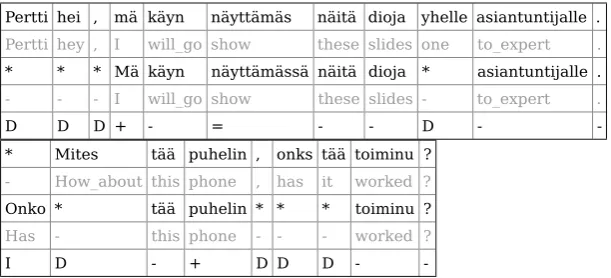
Pertti hei , mä käyn näyttämäs näitä dioja yhelle asiantuntijalle . Pertti hey , I will_go show these slides one to_expert . * * * Mä käyn näyttämässä näitä dioja * asiantuntijalle . - - - I will_go show these slides - to_expert .
D D D + - = - - D -
-* Mites tää puhelin , onks tää toiminu ? - How_about this phone , has it worked ? Onko * tää puhelin * * * toiminu ?
Has - this phone - - - worked ?
I D - + D D D -
-Figure 2: Example alignments
version of the programme is used for internal pur-poses of the company and is the result of manual correction of speech recognition output. The pressed version of the programme consists of com-pleted subtitles, exactly as delivered and subse-quently aired. The subtitles often include spoken language, with incomplete words and slang terms, making them different in style from the strictly grammatical text which would be ideal.
The first step in pre-processing the data is to ob-tain a good alignment of the texts so that the indi-vidual edits can be identified. The data was re-ceived as raw subtitle files. A subtitle file consists of text units to be shown on a screen at a partic-ular moment and the time to show it. Because the unabridged version was a result of speech recognition, its timing didn’t correspond with the abridged version’s timing. The subtitles and the amount of sentences they include are also
differ-ent in size, because in many cases whole sdiffer-entences were removed or introduced in the abridging pro-cess.
To identify the edits made to the subtitles, es-pecially tokens being removed, it was necessary to obtain token to token level alignments between the two versions of the subtitles. String alignment was created using a distance matrix generated by calculating Levenshtein distance between the two subtitles on a token level. The edits were ex-tracted from the distance matrix the method gen-erates. Tokens with only minimal modifications (eg. ’ohjelma’, ’program’ and ’ohjelmamme’, ’our program’) were aligned instead of counting as a substitution. Minimal modification of tokens was defined as being sufficiently close to each other, when calculated with a string matching al-gorithm.
[image:2.595.149.455.312.451.2]pro-WellNo kylläyes minäkinme_too mielellänihappily opettelisinlearn_would kylläyes saamenSaami languagekieltä ,,butmutitsemayvoi ollabe quiteaika hankalaahard thisnäin vanhempanaold .. advmod> <nsubj<advmod advmod> dobj> <poss <aux <cop<advmod nommod><advmod
<intj punct>cc> <nsubj-cop
[image:3.595.75.515.66.121.2]conj> punct>
Figure 3: An example of the extended SD scheme.
cess, sometimes sentences were combined and sometimes cut in the abridged version. After we had the alignments the original subtitles with the abridged ones the subtitles were sentence split and the sentences were aligned with sentences of the abridged text.
Each sentence was parsed using the recently published Finnish statistical dependency parsing pipeline (Haverinen et al., 2014). The parser pro-duces full dependency parse trees in a minor modi-fication of the well-known Stanford Dependencies (SD) scheme (de Marneffe and Manning, 2008).
4 Methods
Since we have the appropriate training data at our disposal, we will approach the task as a super-vised machine learning problem, whereby a classi-fier will predict which words will be removed from each sentence. We will test a few different ap-proaches to the task, all based on supervised learn-ing, but using different sentence reduction strate-gies. The feature set consists mainly of features based on the dependent token and features derived from the dependency tree, which we will describe later.
The first approach is to prune the dependency trees of the sentences. The goal of this approach is to produce more syntactically valid output than re-ducing the sentence based on its linear order. This, however, does not guarantee the syntactic validity of the sentence. Consider, for instance the subtree headed by hankalaa (hard)in Figure 3. Remov-ing the word, together with its subtree will leave the conjunction mut (but) orphaned, resulting in an ungrammatical sentence. We will address the most common such cases with a set of straightfor-ward post-processing rules. For dependency tree pruning we have the following strategies:
The first strategy is to let the classifier decide which dependencies (edges) to prune from the de-pendency tree and remove the complete subtree along with the removed dependency. For this we train an SVM classifier to recognize the
dependen-cies to remove and clean the training data from dependencies which would be removed by a re-moval of a dependency higher up in the tree. The SVM implementation used is libSVM (Chang and Lin, 2011). In the results table, we refer to this approach asmp svm.
Another strategy is to remove a dependency only if all of the dependencies under it in the de-pendency tree have been removed as well. For this an SVM classifier is trained which for each de-pendency makes a prediction on whether to keep or remove it. Unlike previously, this time the train-ing data contains all dependencies. The motivation behind this strategy is to conserve important sub-trees of the tree. In the results table, we refer to this approach asmk svm.
The second approach for compressing the sen-tence is to let a classifier freely remove tokens from the sentence without limitations of the de-pendency tree structure. To gain advantage from the linear order of the sentence we cast the prob-lem as a sequence classification probprob-lem and use Conditional Random Fields (CRF), as imple-mented in CRFSuite (Okazaki, 2007) with the same feature set as previously to predict which to-kens to keep and which to drop. We refer to the CRF model ascrf.
We also train another CRF model (referred to ascrf pos) without the dependency tree features to see how well it fares against the full feature set and to judge the extent to which syntax contributes to the classification.
We will also implement a baseline system based on the work of Filippova and Strube (2008), which is based on finding an optimal abridged tree us-ing Integer Linear Programmus-ing and unsupervised learning. This will be referred as base ilpin the evaluation tables.
probabil-ity of token being removed is decided by the CRF classifier and is used by the ILP process to make the final decisions. The appeal of this strategy is the use of ILP, and a direct comparison with the baseline since it uses a qualitatively different re-moval scheme than our systems. This is referred ascrf ilpin the evaluation.
All of these systems allow their rate of removal to be fixed by altering the classifier threshold and in the case of the Integer Linear Programming based method by setting a fixed rate of removal. The score used to adjust the rate of removal for SVM is simply the classifier score and for CRF, the marginal probabilities for token removal. It is to be noted that for the CRF based methods alter-ing the threshold is very important, since without threshold manipulation the classifier produces too low compression rates (∼5% of tokens removed in the dev-set with full feature set).
As with any similar supervised machine learn-ing method, feature engineerlearn-ing is an important part of the development. The first class of features we use is derived from the morphological analysis of the target word. The second class of features is based on the surrounding structure of the parse tree. These features model the syntactic context of the target word to capture its immediate syn-tactic neighbourhood. We also add combination features where appropriate, since the underlying classifier is linear. The third class of features in-cludes those that encode information about the tar-get word’s position in the sentence and within the tree. We also employ features from the Seman-tic Role Labeling system of Kanerva et al. (2014). We list the exact features used below, and in Sec-tion 5 we will present a feature ablaSec-tion study to demonstrate their relative merits.
Features
The exhaustive list of features is described in the following:
Features based on the token
• Morphological tags
• The morphological tags of the next and the previous token in the sentence
• Word and lemma of the token
• Next and previous word and lemma of the to-ken
• Next and previous pos-tags of the token
Tree structure based Features
• Dependency type
• The dependency types of the next and the pre-vious token in the sentence
• The types of dependencies that have the de-pendent token as a governor and also this fea-ture combined with the dependency type of the dependent token
• Dependency type combined with the depen-dent token’s morphological tags
• The dependency types of the tokens which are siblings of this token in the dependency tree with information about whether the to-kens are to the left or to the right of the de-pendent token in the sentence. This is also combined with the dependency type of the to-ken.
• The morphological tags of the governing to-ken
• The dependency type of the governing token with and without the dependent token’s de-pendency type combined
• How many tokens depend on the current to-ken
• How large a subtree would be removed if this dependency was pruned
• Whether this token is a leaf in the tree
• Whether this token has incoming semantic edges
Location and sentence based Features
• Whether sentence length is over 5, 10, or 15 tokens with and without the dependency type
• How long a path in the dependency tree is to the root node from this node
• Whether the number of dependencies above this dependency in the path to the root node is in the first, second, third or fourth quarter of the longest path to the root node in the tree
• Whether the dependent token is located in the first, second, third or fourth quarter of the sentence
• The two above features combined into one
5 Evaluation Problem setting
of all sentences). In the training data, only sen-tences with removals and no other edits such as substitutions are used, to ensure the classifier does not learn to remove tokens that are in fact sub-stituted for another token, possibly at some later point in the sentence. The development and test sets are, however, preserved exactly as-is, contain-ing all sentences from the original data. The com-pression experiments are done with comcom-pression rate of 85% (i.e. 15% token removal) to be in line with the test data and also 70% to see how the sys-tems fare with a higher rate of removal.
Baseline
As the baseline, we have re-implemented the method of Filippova and Strube (2008). Like our method, the baseline is based on the removal of de-pendency sub-trees, however, it is an unsupervised method, requiring only a dependency treebank for its training. This will allow us to study to what ex-tent the availability of supervised data affects the overall performance on the compression task, as compared to an unsupervised baseline previously shown to have a good performance and based on the same principle of dependency subtree removal. The baseline method has three steps: transform-ing the source tree by addtransform-ing additional edges, compression, and tree linearisation. The method assigns a score for each edge of a dependency tree and tries to find optimal edges to remove, max-imizing the score of the remaining edges and at the same time maintaining a correct tree structure. The edge scores are calculated from statistics de-rived from a treebank. The method uses integer linear programming to find a globally optimal so-lution.
In our experiment, statistics of the dependen-cies and tokens are calculated from an approxi-mately 500 million token corpus obtained by ex-tracting Finnish text from the CommonCrawl1 In-ternet crawl data and automatically parsed using the Finnish dependency parsing pipeline of Haver-inen et al. (2014).
The trees are first pre-processed by creating a dummy root node and adding an edge from the dummy root to each finite verb in the sentence, making the trees graphs. Then, auxiliary verbs, negation markers and function words are merged with their governors to ensure they are not re-moved separately. And finally, coordination
struc-1http://www.commoncrawl.org
tures are decomposed by propagating the governor of the first coordinated element to every other el-ement in the coordination, preserving the depen-dency type.
Tree compression is then cast as an optimization problem and solved using integer linear program-ming. Each dependency from a governor wordg to a dependentdwith typelis assigned a binary variable:
xlg,d=
(
1 if edge preserved; 0 if edge not preserved.
The method then optimizes the objective func-tion
f(X) =X
x
xlg,d·P(l|g)·I(d) (1)
where P(l|h) is the conditional probability of the dependency typel, given thatgis the governor. I(d)is an importance score defined as:
I(di) =
l
Nfi·log( Fa
Fi
) (2)
wherelis the number of clause nodes above the dependency, N is the maximum level of embed-ding, fi is the frequency of the word in current document, Fa is the sum of frequencies of topic words in the corpus andFi is the frequency of the word in corpus.
Constraints are added into the integer linear pro-gramming problem in order to ensure that a correct structure is produced, making sure that each word has a governor. The maximal number of tokens in the resulting tree is also encoded as a constraint to the problem, allowing the control of the compres-sion ratio. The pruned tree is then linearized in the original order of words in the sentence.
Test Set Evaluation
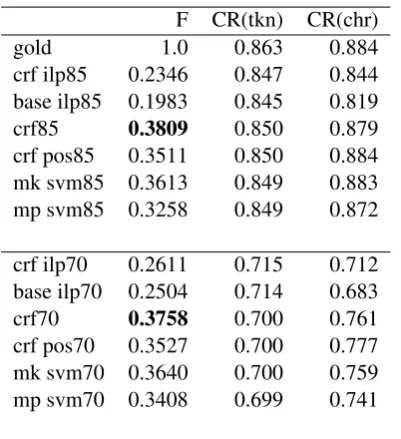
First, we compare the performance of our pro-posed methods and the baseline in terms of F-score on the test set. Precision is defined as the proportion of predicted removed tokens which were also removed in gold standard, and recall is conversely defined as the proportion of removed tokens in the gold standard, whose removal is also predicted by the system. The main results in Ta-ble 1 show that with essentially equal compres-sion ratios, the feature-rich CRF (referred to as
F CR(tkn) CR(chr)
gold 1.0 0.863 0.884
crf ilp85 0.2346 0.847 0.844 base ilp85 0.1983 0.845 0.819
crf85 0.3809 0.850 0.879
crf pos85 0.3511 0.850 0.884 mk svm85 0.3613 0.849 0.883 mp svm85 0.3258 0.849 0.872
crf ilp70 0.2611 0.715 0.712 base ilp70 0.2504 0.714 0.683
crf70 0.3758 0.700 0.761
[image:6.595.307.535.61.132.2]crf pos70 0.3527 0.700 0.777 mk svm70 0.3640 0.700 0.759 mp svm70 0.3408 0.699 0.741
Table 1: F1-Scores for the test set. CR(tkn) is to-ken level rate of compression and CR(chr) is char-acter level compression rate of the system output.
removal, followed by the SVM classifier (which makes independent predictions, unlike the CRF sequence classifier). The baseline performs sub-stantially worse. As a further insight into the methods, we present in Table 3 the ten most of-ten removed dependency types for the best scor-ing crf model, the baseline, and in the test set. As expected, with few exceptions we see depen-dency types associated with modifiers and func-tional words rather than core semantic arguments. Most of these types will also tend to have a single, leaf dependent. We can also observe a rather wide overlap (7/10) of the commonly removed depen-dency types between the two methods, showing that the systems target similar points of compres-sion.
Further, we perform a small-scale feature abla-tion study with a CRF classifier. The most impor-tant feature groups are those related to the token it-self, such as its POS-tag and lemma. The features gathered from the syntactic trees, and related loca-tion group of features both contribute positively to the classification, even though the contribution is not major.
The F-score measure can be evaluated on as many runs as necessary, for instance in param-eter selection, but it does not necessarily reflect the ability of the system to produce fluent and meaning-preserving compressions. The
underly-Feature Set Dev-set@85% F-score
Token 34.10
Token+location 35.96 Token+tree structure 36.31
All 37.16
Table 2: CRF feature ablation table on develop-ment set with 85% compression rate.
Gold Base crf
advmod 26.0% advmod 18.9% advmod 36.8% punct 17.9% nommod 13.0% punct 10.8%
nommod 7.3% punct 9.0% det 8.4%
det 5.6% amod 6.7% intj 6.1%
nsubj 5.4% dobj 5.8% cc 5.4%
intj 4.4% det 5.5% nommod 4.6%
cc 3.9% poss 5.3% nsubj 3.7%
amod 3.1% cc 4.0% complm 3.3%
conj 2.7% conj 3.5% amod 2.8%
[image:6.595.83.284.73.293.2]dobj 2.6% cop 3.4% conj 2.3%
Table 3: Dependency types pruned in the test set
ing problem is that any given sentence can have a number of valid compressions, but only one of them will be counted as a true positive, all others will be counted as false positives. To address these issues, we perform also a manual evaluation of the result, discussed in the following section.
Manual evaluation
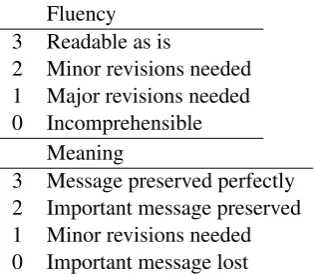
In this evaluation, we focus on the ability of the systems to produce fluent output and preserve im-portant, content-bearing parts of the sentence (i.e. its “main message”). These two qualities are to some degree independent (although clearly not en-tirely so) and we thus evaluate them separately.
We selected 399 random sentences which had been compressed by the systems from the test sec-tion of the corpus, and for each sentence we pro-duced four compressed versions: one using the baseline method, one using the crf model which got the highest F-score on the test set. In addition we testcrf pos andcrf ilp. Thecrf pos set is se-lected because of its relatively high F-score on the test set, even though it does not employ the syn-tax of the sentence. Thecrf ilpis selected to test both the integer linear programming method and to provide the baseline with a comparison using the same approach to sentence reduction. For the test, compression rates were aligned. In the end all systems had a rate of token removal of 75% for the sentences being tested.
[image:6.595.83.282.74.292.2]Fluency 3 Readable as is
2 Minor revisions needed 1 Major revisions needed 0 Incomprehensible
Meaning
[image:7.595.72.230.62.199.2]3 Message preserved perfectly 2 Important message preserved 1 Minor revisions needed 0 Important message lost
Table 4: Manual evaluation scales.
Fluency Meaning crf 799 (66.7%) 609 (50.8%) crf pos 796 (66.5%) 579 (49.9%) crf ilp 795 (66.4%) 487 (40.7%) Baseline 720 (60.2%) 383 (32.0%)
Table 5: Sum of the scores over all test sentences given by the evaluator. The percentages are given in terms of maximum possible value, which for all quantities is 399 sentences ×maximum score of 3, i.e. 1197.
terms of fluency and in terms of content preser-vation using the scales shown in Table 4. The or-der in which the compressed versions were pre-sented for evaluation was randomly changed for every sentence separately, i.e. it was not possible to distinguish the methods by the evaluator. Fur-ther, the evaluator was not involved in the develop-ment of the methods in any manner and was thus not primed to recognize features typical of com-pressions produced by any of these methods.
To gain an initial insight into the evaluation re-sults, we show in Table 5 the sum of scores given across all sentences. We can see that thecrf gains on top of the baseline in terms of both measures: 6.5pp (percent points) in terms of fluency and 18.8pp in terms of meaning. These correspond to 16.3% and 27.6% of relative error decrease over the baseline. Both differences are statistically sig-nificant with p < 0.02 (two-tailed paired t-test).
For practical deployment, the proportion of sen-tences which need no, or only minor corrections is a crucial measure. For the best performing CRF method, 75.4% and 44.9% (fluency and meaning) were assigned score of 2 or 3, i.e. usable as-is or with only minor corrections. For the baseline method, the corresponding proportions are 68.2%
and 15.3%, reflecting a notable gain of the pro-posed method over the baseline.
When both fluency and meaning had to be as-signed score of 2 or 3, 44.9% of the sentences pro-duced by thecrfmethod required only minor mod-ifications for fluency or were readily usable. For the baseline method only 15.0% of the sentences were rated as readily usable or requiring only mi-nor modifications for fluency. The 29.9pp gain of the proposed method corresponds to a 35.1% rel-ative decrease in error, and ultimately manual ef-fort saved by the proposed method. 74.2% of the
crf produced sentences are usable as-is or require minor fixing in terms of fluency and/or meaning, when using a more relaxed criteria and requiring fluency to be scored 2 or 3 and meaning to be 1 (Minor revisions needed for maintaining meaning) or greater, while baseline produces such sentences 63.9% of the time. This difference of 10.3pp cor-responds to a relative decrease in error rate of 28.5%. The difference of performance between
crf andcrf poswhen it comes to fluency or mean-ing is not statistically significant, althoughcrf is rated higher on both measures. Human evalua-tion would suggest the crf pos performs slightly worse in maintaining the meaning of the sentence (0.9pp) thancrf, while the difference in fluency is very small (0.2pp). This would suggest the syn-tax of the sentence might help the system deciding which tokens are important for the meaning of the sentence.
The difference in fluency between crf and crf ilp is not statistically significant, but difference between meaning is statistically significant (p < 0.02on two-tailed paired t-test). Because this sys-tem is identical in all respects but the scores used to prune the tree, to the baseline of which differ-ence of fluency is statistically significant to thecrf, this shows the CRF based scores do help with the fluency of the output. The comparison betweencrf ilpand the baseline is interesting, because they are essentially the same system except one is based on supervised learning and the other is based on statistics. Thecrf ilpoutperforms the baseline on both metrics and the results are statistically sig-nificant. This speaks in favour of the supervised approach.
Human agreement
process of human evaluation and the performance of the system. We were especially interested in the subjectivity of the task and the human agreement. While in this earlier experiment the test data, sys-tem and rate of removal are different from the above final test setting, it still offers insight into the evaluation process and especially the level of agreement of the human evaluators. For this hu-man evaluation round, two evaluators were used, and rate of token compression for both classifiers was set to 85%. The participants of this evaluation are mp svm against the ILP-based baseline. 200 sentences were selected and all judged indepen-dently by both evaluators.
The Kappa score of the inter-annotator agree-ment over all 800 annotation data points (2 tasks
×2 methods×200 sentences) is 0.32. When mea-sured per method and task, Kappa varies from 0.25 (baseline method, meaning task) to 0.36 (proposed method, meaning task). For the specific binary de-cision of whether the score of an individual sen-tence is ≥ 2 or not, the overall Kappa score is 0.39. The overall scores of 0.32 and 0.39 would be interpreted as “fair” using the criteria of Viera et al. (2005).
6 Discussion and conclusions
Comparison of the F-score evaluation between the supervised method and the unsupervised baseline shows that the supervised training gives a rather substantial benefit over the unsupervised base-line. Numerically, the F-scores remained very low, which, however, can be largely attributed to the rather arbitrary nature of the sentence compression task where any sentence of a reasonable length may have a number of alternative compressions. Of these, one was selected when producing the sub-titles and the alternatives count as errors in the F-score based evaluation. This cannot be ad-dressed without a major data curation effort which, in our practical setting, is not possible.
The manual evaluation not only shows consider-ably more promising results in the numeric sense, but also shows correlation with the F-score based evaluation. This suggests that it is possible to use the F-score evaluation to develop and optimize the method, while a manual evaluation is clearly nec-essary to gain insight into the practical usability of the output compressions.
Interestingly, we find a clearly better perfor-mance of the CRF-based method also in terms of
fluency, even though the baseline method uses lin-ear programming to find a globally optimal solu-tion and the statistics it relies on were gathered on a parsed corpus of a substantial size.
From a practical point of view, the manual eval-uation shows that about one half of the com-pressed sentences are acceptable as-is or nearly as-is. If deployed in a setting where the neces-sary minor edits are technically easily carried out, it would seem feasible that the sentence compres-sion would lead to a streamlining of the subtitling process and subsequent cost reduction.
The lack of training data is an often cited prob-lem for sentence compression. We have shown that subtitling data is a good source for sentence compression method development, even though non-trivial pre-processing is necessary to align the textual corpora and produce suitable training data. With the increasing pressure on the availability of subtitling and textual transcriptions, this task rep-resents an important use case for text compression and increases the chance that such data can be-come available through industry collaboration.
There are many future work opportunities. The method currently does not take into account con-text beyond a single sentence. We thus lose the op-portunity to model whether a particular sentence element has been discussed in the preceding sen-tence and may be pruned with a higher likelihood. There is also room for improvement in ensuring the grammaticality of the output. Others have used for instance language models to improve the gram-maticality and fluency of the output. Modelling subcategorization frames could also be applied for this purpose.
Studying the data, we have noticed that often long words are replaced with their shorter syn-onyms to compress the sentence without any loss of information. Finding shorter synonyms and learning to substitute words and phrases would be very helpful for the sentence compression task, possibly applying the recent advancements in vec-tor space representations and modelling phrase compositionality.
Acknowledgments
References
Chih-Chung Chang and Chih-Jen Lin. 2011. LIB-SVM: A library for support vector machines. ACM Transactions on Intelligent Systems and Technol-ogy, 2:27:1–27:27. Software available athttp:// www.csie.ntu.edu.tw/˜cjlin/libsvm.
HORI Chiori and Sadaoki Furui. 2004. Speech sum-marization: An approach through word extraction and a method for evaluation. IEICE
TRANSAC-TIONS on Information and Systems, 87(1):15–25.
James Clarke and Mirella Lapata. 2006. Constraint-based sentence compression: An integer program-ming approach. In Proceedings of the
COL-ING/ACL 2006 Main Conference Poster Sessions,
pages 144–151.
Trevor Cohn and Mirella Lapata. 2009. Sentence com-pression as tree transduction. Journal of Artificial Intelligence Research, 34:637–674.
Marie-Catherine de Marneffe and Christopher D. Man-ning. 2008. The Stanford typed dependencies rep-resentation. In Coling 2008: Proceedings of the workshop on Cross-Framework and Cross-Domain Parser Evaluation, pages 1–8.
Katja Filippova and Michael Strube. 2008. Depen-dency tree based sentence compression. In Proceed-ings of the Fifth International Natural Language
Generation Conference, pages 25–32.
Michel Gagnon and Lyne Da Sylva. 2005. Text summarization by sentence extraction and syntactic pruning. InProceedings of Computational Linguis-tics in the North East (CliNE05).
Katri Haverinen, Jenna Nyblom, Timo Viljanen, Veronika Laippala, Samuel Kohonen, Anna Missil¨a, Stina Ojala, Tapio Salakoski, and Filip Ginter. 2014. Building the essential resources for Finnish: The Turku Dependency Treebank. Language Resources
and Evaluation, 48(3):493–531.
Jenna Kanerva, Juhani Luotolahti, and Filip Ginter. 2014. Turku: Broad-coverage semantic parsing with rich features. In Proceedings of the 8th Interna-tional Workshop on Semantic Evaluation (SemEval
2014), pages 678–682.
Kevin Knight and Daniel Marcu. 2002. Summariza-tion beyond sentence extracSummariza-tion: A probabilistic ap-proach to sentence compression. Artificial Intelli-gence, 139(1):91–107, July.
Ryan T McDonald. 2006. Discriminative sentence compression with soft syntactic evidence. In
Pro-ceedings of the 11th conference of EACL, pages
297–304.
Naoaki Okazaki. 2007. CRFsuite: A fast implementa-tion of Condiimplementa-tional Random Fields (CRFs).
Jenine Turner and Eugene Charniak. 2005. Supervised and unsupervised learning for sentence compres-sion. In Proceedings of the 43rd Annual Meeting on Association for Computational Linguistics(ACL), pages 290–297.
Anthony Viera and Joanne Garrett. 2005. Understand-ing interobserver agreement: The Kappa statistic.