ACCEPTED MANUSCRIPT
Reply to Discussion on ‘A high-precision U–Pb age constraint on the Rhynie Chert
Konservat-Lagerstätte: timescale and other implications’
Journal, 168, 863–872
S. F. PARRY 1,2, S. R. NOBLE 1, Q. G. CROWLEY 3 & C. H. WELLMAN 4
1
NERC Isotope Geosciences Laboratory, British Geological Survey, Environmental Science Centre, Keyworth, Nottingham NG12 5GG, UK
2
British Geological Survey, Environmental Science Centre, Keyworth, Nottingham NG12 5GG, UK (e-mail: [email protected])
3
Department of Geology, School of Natural Sciences, Trinity College, Dublin 2, Ireland
4
Department of Animal and Plant Sciences, University of Sheffield, Alfred Denny Building, Western Bank, Sheffield S10 2TN, UK
Corresponding author: SFP
Words of text = c. 2100 in total (determined using Word’s ‘Word Count’ tool) References = 20
Tables = 1
We welcome the opportunity to address the points raised by Mark et al. in their discussion of the CA–ID– TIMS U–Pb age constraint on the Rhynie Chert Konservat-Lagerstätte presented by Parry et al. (2011) and also to make some further observations of our own. We begin by briefly providing some context for
the benefit of the wider readership. Two radio-isotopic age constraints on the Rhynie Chert
Konservat-Lagerstätte and, by corollary, its parental hydrothermal (hot-spring) system have recently been published.
analysis of two samples of vein-hosted hydrothermal K-feldspar and a single sample of hydrothermally
altered andesite (Mark et al. 2011). In order to account for systematic uncertainties associated with the 40
Ar/39Ar geochronometer, Mark et al. (2011) recalculated their individual sample ages with reference to the Fish Canyon Tuff sanidine (FCs) age of 28.201 Ma (Kuiper et al. 2008), thereby producing a “U–Pb
comparable” mean age of 407.1 ± 2.2 Ma (2σ). An alternative “preferred age” for the Rhynie hot-spring
activity (407.6 ±2.2 Ma [2σ]) has now been produced from the ‘raw’ data using the optimization model of
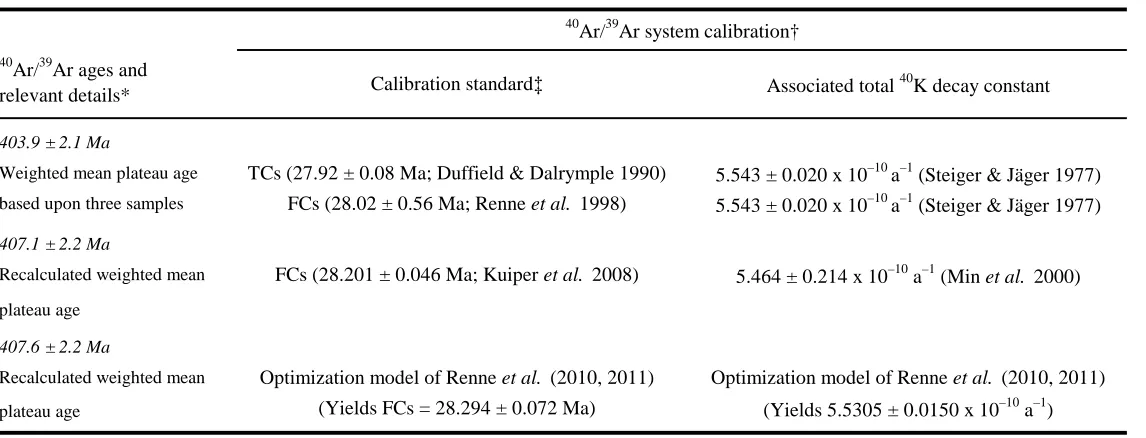
Renne et al. (2010, 2011) (this discussion). The 40Ar/39Ar system calibrations on which these various ages are based are summarized in Table 1. The second radio-isotopic age constraint in question is a weighted
mean 206Pb/238U zircon age of 411.5 ±1.3 Ma (2σ, including decay constant- and tracer calibration-related
uncertainties; MSWD = 0.12, n = 4) yielded by the Milton of Noth Andesite, a moderately altered basaltic
andesite lava flow (cum near-surface sill?) that lies along the northwestern margin of the Rhynie Outlier
(Parry et al. 2011). U–Pb titanite data corroborate the zircon data, and c. 411.5 Ma is interpreted as the crystallization/eruption age of the Milton of Noth Andesite. Lavas and tuffs of andesitic composition
occur elsewhere within the northern half of the Rhynie Outlier (Rice & Ashcroft 2004) and a holistic view
of the available evidence would suggest that these volcanic rocks represent the surficial expression of the
thermal drive for the Rhynie hot-spring system. Parry et al. (2011) therefore concluded that that the U–Pb zircon age yielded by the Milton of Noth Andesite dates the Rhynie hydrothermal activity within error
[our italics].
The recurring theme of Mark et al.’s discussion is the uncertainty over the stratigraphic position of the Milton of Noth Andesite and their doubts concerning the proposed link between the volcanic rocks of the
Rhynie Outlier and the hot-spring activity. It is true that the exact stratigraphic position of the Milton of Noth Andesite is uncertain (as stated by Parry et al. 2011). The poorly exposed Rhynie Outlier (basin) is internally complex, a consequence of its probable transtensional origins (Rice & Ashcroft 2004) and
possible subsequent tectonic modification during the Acadian Event (see Mendum & Noble (2010) for a
discussion of the evidence for Acadian tectonic activity in northern Scotland). There is little doubt,
however, that andesitic lavas occur near to the base of the succession in the northern half of the outlier
(Tillybrachty Sandstone Formation; Rice & Ashcroft 2004). From a stratigraphical perspective, this is as
distant as the Milton of Noth Andesite could lie from the Rhynie cherts (i.e. c. 700 m below; Rice & Ashcroft 2004). Parry et al. (2011) conservatively estimated that the period of time corresponding to this stratigraphic interval equates to c. 1.4 Ma, whereas Mark et al. (2011) suggested a figure of c. 700 ka (the difference arising from contrasting assumed depositional rates). These estimates are either comparable to
or, in the case of the latter, significantly less than the total uncertainty associated with the U–Pb age
statement that the “...U–Pb age yielded by the Milton of Noth Andesite does in fact date the Rhynie cherts,
and hence hot-spring activity at Rhynie, within error” [our italics]. Three further lines of evidence support this stance. Firstly, the entire volcano-sedimentary succession of the northern half of the Rhynie
Outlier seemingly belongs to a single biostratigraphic interval (of early, but not earliest, Pragian to
(?)earliest Emsian age), and a latest Pragian to (?)earliest Emsian age may be indicated by the presence of
Dictyotriletes subgranifer amongst the recovered spore assemblages. Secondly, the Milton of Noth Andesite has a peperitic ‘contact’ with sediments resembling those of the Dryden Flags Formation (the
host of the Rhynie cherts) and which pass laterally (effectively up-succession) over a few tens of metres –
and with no proven break – into strata of undoubted Dryden Flags Formation parentage (Rice & Ashcroft
2004). Thirdly, there is neither physical nor geochronological evidence (Parry 2004, unpubl. data; Parry
et al. 2011) for any other Devonian igneous activity of similar age to or younger than the Rhynie Outlier volcanism in the local area. On the basis of the collective evidence, which points to both a spatial and
temporal association, we still consider it perfectly reasonable to infer a genetic link between the Rhynie
Outlier volcanism and the hot-spring system. We see no need to appeal to a separate episode of “granitic”
igneous activity, especially one that has no surface expression, to explain the hydrothermal activity.
In the course of their discussion, Mark et al. partially reinterpret the U–Pb dataset of Parry et al. (2011) in an attempt to ‘reconcile’ the U–Pb and 40Ar/39Ar age constraints on Rhynie. The suggestions of Mark et al. are, in our opinion, implausible – there is no compelling evidence of ‘hydrothermally induced Pb-loss’ affecting the zircons upon which our U–Pb age hinges. First and foremost, a lower concordia-intercept
age of 409.9+−77..43 Ma is of no value whatsoever in terms of statistically distinguishing between an age of
407.6 ± 2.2 Ma and one of 411.5 ± 1.3 Ma. Furthermore, it is unclear why only those zircons apparently
carrying a Proterozoic inherited component would be affected by the proposed hydrothermal Pb-loss. We
reaffirm our original interpretation of the zircon data and suggest that the most likely explanation for the
plotting position of our zircon fraction 1 lies in the fact that its six constituent grains were air-abraded only
(cf. our other CA–TIMS zircon analyses). We would argue that the analysis of fraction 1 has been
displaced from a mixing line (the lower concordia-intercept of which is c. 411.5 Ma) by the effects of Pb-loss whose origin is most probably ‘recent’ based on the plotting position of this analysis (to the right of
the main data cluster) and the trajectory of the discordia defined by those zircons carrying a c. 1600 Ma inherited component. Pb-loss from c. 411.5 Ma or new hydrothermal growth at c. 407.6 Ma would be more likely to produce an essentially concordant analysis plotting between 411.5 Ma and 407.6 Ma.
Whatever the true cause of the discordance of fraction 1, its effects were evidently not fully eliminated by
the air abrasion treatment it received. This is in stark contrast to our CA–TIMS analyses, and therefore
and reproducibly eliminated by chemical abrasion, particularly when measured against the air abrasion
technique. With regard to the Parry et al. (2011) titanite data, Mark et al. imply that there exist both magmatic and hydrothermal (or fully ‘hydrothermally reset’) titanite grains within the Milton of Noth
Andesite. There is insufficient evidence to support this ad hoc assertion and it would be extremely unlikely that from amongst an optically similar population of titanite grain fragments one fraction (#4)
comprising 15 fragments of the former was simultaneously picked along with a second fraction (#5)
comprising 26 fragments of the latter. We also note that the relatively large uncertainties associated with
the 207Pb/235U of the titanite analyses make it impossible to discriminate between Pb-loss and any
hydrothermal effects. A c. 407.6–411.5 Ma discordia (running sub-parallel to concordia) created by ‘hydrothermal resetting’ or new titanite growth, integrated Pb-loss over time, or (most probably)
‘zero-age’ Pb-loss induced by acid washing of the air-abraded titanites prior to their dissolution are all
possibilities with these data.
Central to this discussion is whether there is a geochronologically resolvable difference in age between the
Milton of Noth Andesite and the Rhynie hot-spring activity (taking into consideration all sources of
internal and external analytical uncertainty). Whilst we believe that we have successfully dated the Milton
of Noth Andesite (a point not disputed by Mark et al.), the ‘direct’ age constraint on the hydrothermal activity proposed by Mark et al. (2011) derives from 40Ar/39Ar geochronology – a relative dating
technique reliant, amongst other things, upon a sound knowledge of the age (strictly, the 40Ar/40K ratio) of
the mineral standards employed as neutron fluence monitors and propagation of related uncertainty
components. There is at present no community-wide consensus on the ages of the various mineral
standards used. In the case of FCs, for example, its assumed age remains a matter of debate, with recent
estimates ranging from 27.89 to 28.294 Ma (e.g. Kuiper et al. 2008; Channell et al. 2010; Renne et al.
2010, 2011; Rivera et al. 2011; Westerhold et al. 2012). Compounding this currently unaccounted for dispersion in the age of FCs is the widely known inter-laboratory bias issue affecting the 40Ar/39Ar
community (e.g. Villa 2011). These matters are under active investigation, but pending their satisfactory
resolution U–Pb data such as those presented by Parry et al. (2011) can be considered accurate and robust on the basis of: a sound knowledge of the 238U and 235U decay constants; the confirmation of closed
system behaviour provided by the dual U–Pb decay system; effective Pb-loss elimination by means of
chemical abrasion; accurate, precise and metrologically traceable calibration of the mixed-isotope
solutions employed for spiking purposes and; the results of inter-laboratory comparison exercises that
40
Ar/39Ar bias. This hinders direct comparisons with the U–Pb data of Parry et al. (2011), irrespective of any geological uncertainties.
If and when the U–Pb and 40Ar/39Ar geochronometers can be successfully ‘synchronized’ then it will
become appropriate to realistically assess and compare age constraints on differing geological materials
such as those found within the Rhynie Outlier. Until such time, there is no value in simply fitting
40
Ar/39Ar ages to particular time scale segments (with no uncertainty assigned to the stage or period
boundary ages included) as a justification of their reliability. The geological time scale is under constant
revision as new biostratigraphical, geochronological and astronomical tuning data become available. For
example, the Silurian stage boundary ages in the new Geologic Time Scale (GTS) 2012 (Gradstein et al.
2012) have been upwardly revised by c. 1 % compared with those of the GTS 2004 (Gradstein et al.
2004). The GTS 2004 is (and was) not the ‘definitive’ time scale, and we draw attention to the fact that
the ID–TIMS data underpinning the Lower Devonian section of interest were generated prior to the advent
of chemical abrasion and the existence of the EARTHTIME tracer solutions (see also Kaufmann 2006).
The new GTS 2012 – reliant, in the case of the Lower Devonian, on the same ID–TIMS data – represents
the next of what will likely be many stages of an evolutionary process; it is the data that constrain the
geological time scale not vice versa.
In conclusion, Parry et al. (2011) and Mark et al. (2011) present new geochronological data that not only have relevance to the age of the Rhynie Chert Konservat-Lagerstätte, but have implications for the
Devonian time scale. Both of these studies, however, are dependent upon a number of assumptions or
inferences, which are explicitly stated in the original papers. Nonetheless, for the reasons that we have
highlighted, we consider the 206Pb/238U zircon age of 411.5 ± 1.3 Ma yielded by the Milton of Noth
Andesite to be a robust temporal constraint on the Rhynie hot-spring system and the polygonalis-emsiensis
Spore Assemblage Biozone. We are of the belief that efforts should be directed towards clarifying and
eliminating the systematic uncertainties associated with the 40Ar/39Ar geochronometer, further refining the
U–Pb geochronometer, and accurately and precisely constraining the Devonian stage boundary ages.
Then, and only then, will we be in a position to potentially resolve the dichotomy of opinion created by
the existing radio-isotopic age constraints on the Rhynie Chert.
(Acknowledgements)
S.F.P. and S.R.N. publish with the permission of the Executive Director of the British Geological Survey
References
Channell, J. E. T., Hodell, D. A., Singer, B. S. & Xuan, C. 2010. Reconciling astrochronological and
40
Ar/39Ar ages for the Matuyama-Brunhes boundary and late Matuyama Chron. Geochemistry Geophysics Geosystems, 11, Q0AA12, doi:10.1029/2010GC003203.
Duffield, W. A. & Dalrymple, G. B. 1990. The Taylor Creek Rhyolite of New Mexico: a rapidly
emplaced field of lava domes and flows. Bulletin of Volcanology, 52, 475-487.
Gradstein, F. M., Ogg, J. G. & Smith, A. G. 2004. A Geologic Time Scale 2004. Cambridge University Press, 610 pp.
Gradstein, F. M., Ogg, J. G., Schmitz, M. & Ogg, G. 2012. The Geologic Time Scale 2012. Elsevier, 1152 pp.
Kaufmann, B. 2006. Calibrating the Devonian Time Scale: A synthesis of U–Pb ID–TIMS ages and
conodont stratigraphy. Earth-Science Reviews, 76, 175-190.
Kuiper, K. F., Deino, A., Hilgen, F. J., Krijgsman, W., Renne, P. R. & Wijbrans, J. R. 2008.
Synchronizing Rock Clocks of Earth History. Science, 320, 500-504.
Mark, D. F., Rice, C. M., Fallick, A. E., Trewin, N. H., Lee, M. R., Boyce, A., & Lee, J. K. W. 2011.
40
Ar/39Ar dating of hydrothermal activity, biota and gold mineralization in the Rhynie hot-spring system,
Aberdeenshire, Scotland. Geochimica et Cosmochimca Acta, 75, 555-569.
Mendum, J. R. & Noble, S. R. 2010. Mid-Devonian sinistral transpressional movements on the Great
Glen Fault: the rise of the Rosemarkie Inlier and the Acadian Event in Scotland. In: Law, R. D., Butler, R. W. H., Holdsworth, R. E., Krabbendam, M. & Strachan, R. A. (eds) Continental Tectonics and Mountain Building: The Legacy of Peach and Horne. Geological Society, London, Special Publications,
335, 161-187.
Min, K., Mundil, R., Renne, P. R. & Ludwig, K. R. 2000. A test for systematic errors in 40Ar/39Ar
Parry, S. F. 2004. Age and underlying cause of hot-spring activity at Rhynie, Aberdeenshire, Scotland. PhD thesis, University of Aberdeen.
Parry, S. F., Noble, S. R., Crowley, Q. G. & Wellman, C. H. 2011. A high-precision U–Pb age constraint
on the Rhynie Chert Konservat-Lagerstätte: timescale and other implications. Journal of the Geological Society, London, 168, 863-872.
Renne, P. R., Swisher, C. C., Deino, A. L., Karner, D. B., Owens, T. L. & DePaolo, D. J. 1998.
Intercalibration of standards, absolute ages and uncertainties in 40Ar/39Ar dating. Chemical Geology, 145, 117-152.
Renne, P. R., Mundil, R., Balco, G., Min, K. & Ludwig, K. R. 2010. Joint determination of 40K decay
constants and 40Ar*/40K for the Fish Canyon sanidine standard, and improved accuracy for 40Ar/39Ar
geochronology. Geochimica et Cosmochimca Acta, 74, 5349-5367.
Renne, P. R., Balco, G., Ludwig, K. R., Mundil, R. & Min, K. 2011. Response to the Comment by W. H.
Schwarz et al. on ‘Joint determination of 40K decay constants and 40Ar*/40K for the Fish Canyon sanidine standard, and improved accuracy for 40Ar/39Ar geochronology’ by P. R. Renne et al. (2010). Geochimica et Cosmochimica Acta, 75, 5097-5100.
Rice, C. M. & Ashcroft, W. A. 2004. The geology of the northern half of the Rhynie Basin,
Aberdeenshire, Scotland. Transactions of the Royal Society of Edinburgh: Earth Sciences, 94, 299-308.
Rivera, T. A., Storey, M., Zeeden, C., Hilgen, F. J. & Kuiper, K. 2011. A refined astronomically
calibrated 40Ar/39Ar age for Fish Canyon sanidine. Earth and Planetary Science Letters, 311, 420-426.
Sláma, J., Košler, J., Condon, D. J., Crowley, J. L., Gerdes, A., Hanchar, J. M., Horstwood, M. S. A.,
Morris, G. A., Nasdala, L., Norberg, N., Schaltegger, U., Schoene, B., Tubrett, M. N. & Whitehouse, M. J.
2008. Plešovice zircon – A new natural reference material for U–Pb and Hf isotopic microanalysis.
Chemical Geology, 249, 1-35.
Steiger, R. H. & Jäger, E. 1977. Subcommission on geochronology: convention on the use of decay
Villa, I. M. 2011. Precision and accuracy of decay constants and age standards. Abstract V44A-01, 2011
Fall Meeting of the American Geophysical Union, San Francisco.
Westerhold, T., Röhl, U. & Laskar, J. 2012. Time scale controversy: Accurate orbital calibration of the
early Paleogene. Geochemistry Geophysics Geosystems, 13, Q06015, doi:10.1029/2012GC004096.
(END OF REFERENCE LIST)
Table captions:
Table 1. Summary of 40Ar/39Ar age constraints on the Rhynie Chert Konservat-Lagerstätte provided by
40
Ar/39Ar ages and relevant details*
403.9 ± 2.1 Ma
Weighted mean plateau age TCs (27.92 ± 0.08 Ma; Duffield & Dalrymple 1990) 5.543 ± 0.020 x 10⁻¹⁰ a–1 (Steiger & Jäger 1977)
based upon three samples FCs (28.02 ± 0.56 Ma; Renne et al. 1998) 5.543 ± 0.020 x 10⁻¹⁰ a–1 (Steiger & Jäger 1977)
407.1 ± 2.2 Ma
Recalculated weighted mean FCs (28.201 ± 0.046 Ma; Kuiper et al. 2008) 5.464 ± 0.214 x 10⁻¹⁰ a–1 (Min et al. 2000)
plateau age
407.6 ± 2.2 Ma
Recalculated weighted mean Optimization model of Renne et al. (2010, 2011) Optimization model of Renne et al. (2010, 2011)
plateau age (Yields FCs = 28.294 ± 0.072 Ma) (Yields 5.5305 ± 0.0150 x 10⁻¹⁰ a–1)
‡ TCs, Taylor Creek Rhyolite sanidine; FCs, Fish Canyon Tuff sanidine.
Calibration standard‡ Associated total 40K decay constant
Ar/ Ar system calibration†
* Quoted uncertainties are at the 2σ level and are those given by Mark et al. (2011).
[image:9.842.72.645.120.339.2]