ACL 2013 MultiLing Pilot Overview
Jeff Kubina
U.S. Department of Defense 9800 Savage Rd., Ft. Meade, MD 20755
John M. Conroy, Judith D. Schlesinger
IDA/Center for Computing Sciences 17100 Science Dr., Bowie, MD [email protected], [email protected]
Abstract
The 2013 Association for Computational Linguistics MultiLing Pilot posed a task to measure the performance of multi-lingual, single-document, summarization systems using a dataset derived from many Wikipedias. The objective of the pilot was to assess automatic summarization of multilingual text documents outside the news domain and the potential of using Wikipedia articles for such research. This report describes the pilot task, the dataset, the methods used to evaluate the submitted summaries, and the overall performance of each participant’s system.
1 Introduction
Document summarization is an active subject of research and development. The ACM Digital Li-brary has about 806 reports on the subject pub-lished since1993,with over half of them appear-ing in the last five years. While the impetus for much of this research is the annual Text Anal-ysis Conference (TAC) workshop on document summarization, there is a growing demand in the consumer market for news summarization appli-cations being met by tablet and smart-phone ap-plications such as Clipped1, Summoner2, TLDR3, and Yahoo News. Yahoo and Google even ac-quired two companies developing such applica-tions, Summly (Stelter, 2013) and Wavii (Tsotsis, 2013) respectively, earlier this year. While sum-marization technology for news sources is com-ing to fruition, the performance of such technol-ogy on non-English documents outside the news domain has not been throughly assessed and may need further research. Since the datasets used by
1http://goo.gl/dFKD9 2http://goo.gl/0QFaZ 3http://goo.gl/qEgCs
the TAC summarization workshops have predom-inately been English news articles, with some ex-ceptions (Giannakopoulos et al., 2011), the objec-tive of the 2013 ACL MultiLing Pilot was to assess the performance of automatic multilingual single-document summarization systems on non-English text outside the news domain and to determine the potential of using Wikipedia articles for such re-search.
This report starts with a description of the task and dataset, the methods used to evaluate the sub-mitted summaries, the performance of each partic-ipating system, and concludes with an assessment of the pilot and potential future work.
2 Task and Dataset Description
The objective of each participant system of the pi-lot was simple: compute a summary for each doc-ument in at least two of the datasets languages. No restrictions were placed on the languages that could be chosen nor was any target summary size specified.
The dataset was derived from a corpus cre-ated in 2010 to measure the performance of the CLASSY (Conroy et al., 2009) summarization al-gorithm on non-English documents outside the news domain. At the time such a corpus did not exist so one was created from the Wikipedias. To date there are Wikipedias in 285 languages comprising over 75 million pages. Some of the Wikipedias maintain a list of Feature Articles, which are articles reviewed and voted upon by ed-itors as the best that fulfill Wikipedia’s require-ments in accuracy, neutrality, completeness, and style. One such requirement is that the article have a lead section that should
. . . be able to stand alone as a concise overview. It should . . . summarize the most important points . . .[and]material in the lead should roughly reflect its
portance to the topic . . .4
So the lead section of a featured article is an excellent summary of it, hence, the fea-tured articles were used to create the corpus. In 2010 there were 41 Wikipedias with more than nine featured articles. The Perl module
Text::Corpus::Summaries::Wikipedia5 was
de-veloped to automatically create the corpus from the featured articles of those Wikipedias. The cor-pus is publicly available (Kubina, 2010) and the Perl module can be used to create an updated cor-pus.
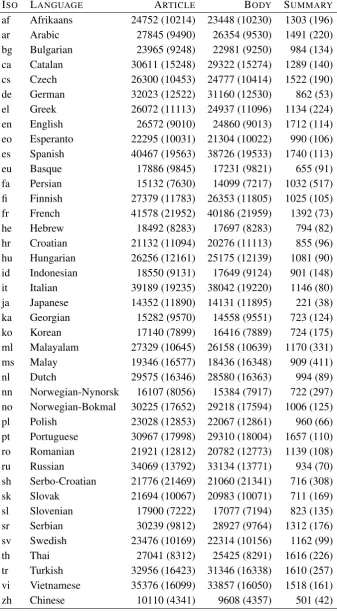
The dataset for the pilot was created from a subset of the 2010corpus. This was done to en-sure that each language had 30 articles and that the size of each article’s body text was sufficiently large. First, for each article the summary and body were compressed to approximate their informa-tion content size. For example, given a Chinese and English article with the same character length the Chinese article will usually contain more in-formation than an English article and their com-pressed sizes will approximation their true infor-mation content. Next, if the compressed body size of an article was less than five times its com-pressed summary size, then the article was dis-carded. The factor of five was simply chosen to ensure the body of each article was sufficiently large relative to the summary size. For each lan-guage the median of the ratio of compressed body size to compressed summary size was computed and only the30articles closest to the median were included in the dataset. This filtering reduced the corpus from12,819articles in41languages to the dataset containing1,200articles in40languages. For each language in the dataset Table 1 contains the mean size of the articles, their bodies, and their summaries, in characters.
3 Evaluation Methods and Results
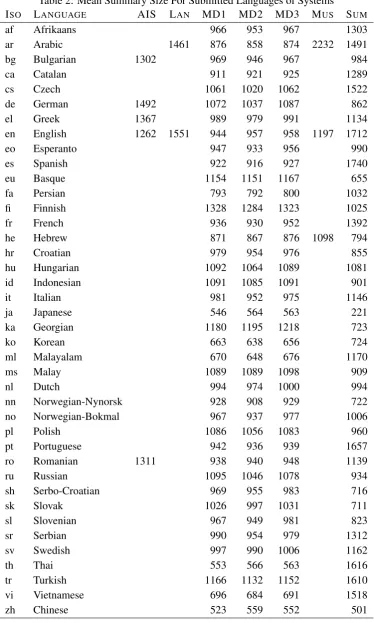
Four teams submitted the results of six summa-rization systems. The teams are denoted by AIS, LAN, MD, and MUS; the MD team submitted three systems. Throughout this report the systems are denoted by AIS, LAN, MD1, MD2, MD3, and MUS. Table 2 contains the list of languages sub-mitted for each system and the mean size, in char-acters, of the summaries submitted.
4http://en.wikipedia.org/wiki/Wikipedia:LEAD 5http://goo.gl/ySgOS
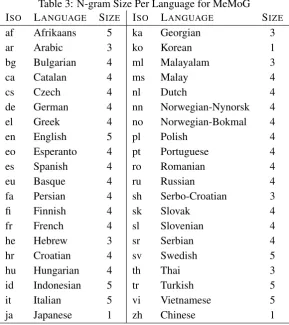
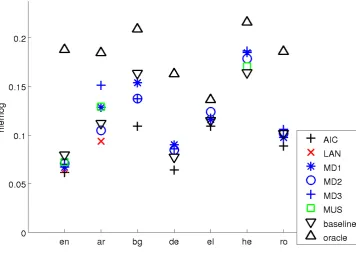
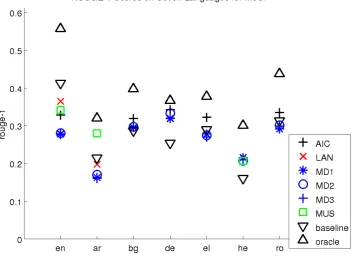
For the evaluation a baseline summary was ex-tracted from the each article in the dataset that is the prefix substring of the article’s body text with the same length as the text in the lead section of the article. For the remainder of this report the lead section of an article is called thehuman sum-mary. An oracle summary was also computed for each article by heuristically extracting sentences from its body text to maximize its ROUGE-2 score against the human summary until its size exceeded the human summary, upon which it was truncated. Submitted summaries were automatically eval-uated against the human summary of each arti-cle using ROUGE-1, ROUGE-2 (Lin, 2004) and MeMoG (Giannakopoulos et al., 2008). For ROUGE, the languages Chinese, Japanese, Ko-rean, and Thai were tokenized into individual characters. For MeMoG the character n-gram size used for each language is listed in Table 3, which is the n-gram size that maximized the standard de-viation divided by the mean of the n-gram fre-quency distribution of the language in the dataset. So the selected n-gram size maximizes the vari-ability of the distribution values relative to their mean. A shorter n-gram size would inflate the MeMoG scores because of their inherent frequent co-occurrence and conversely a longer size would penalize MeMoG scores due to their infrequent co-occurrence.
Each scoring method was performed twice, first by truncating, if necessary, each system summary to the size of the human summary, which is called HSS-scoring. The second set of scores were com-puted by truncating all the summaries of an ar-ticle, including the human summary, to the size of the shortest summary amongst the system and human summaries for the article, which is called SSS-scoring. For HSS-scoring the system sum-maries shorter that the human summary are penal-ized since ROUGE isrecall oriented. Alternately, SSS-scoring gives preference to shorter system summaries that have their best content (extracted sentences) first.
Table 1: Dataset Languages and Sizes
ISO LANGUAGE ARTICLE BODY SUMMARY
af Afrikaans 24752 (10214) 23448 (10230) 1303 (196)
ar Arabic 27845 (9490) 26354 (9530) 1491 (220)
bg Bulgarian 23965 (9248) 22981 (9250) 984 (134)
ca Catalan 30611 (15248) 29322 (15274) 1289 (140)
cs Czech 26300 (10453) 24777 (10414) 1522 (190)
de German 32023 (12522) 31160 (12530) 862 (53)
el Greek 26072 (11113) 24937 (11096) 1134 (224)
en English 26572 (9010) 24860 (9013) 1712 (114)
eo Esperanto 22295 (10031) 21304 (10022) 990 (106)
es Spanish 40467 (19563) 38726 (19533) 1740 (113)
eu Basque 17886 (9845) 17231 (9821) 655 (91)
fa Persian 15132 (7630) 14099 (7217) 1032 (517)
fi Finnish 27379 (11783) 26353 (11805) 1025 (105)
fr French 41578 (21952) 40186 (21959) 1392 (73)
he Hebrew 18492 (8283) 17697 (8283) 794 (82)
hr Croatian 21132 (11094) 20276 (11113) 855 (96)
hu Hungarian 26256 (12161) 25175 (12139) 1081 (90)
id Indonesian 18550 (9131) 17649 (9124) 901 (148)
it Italian 39189 (19235) 38042 (19220) 1146 (80)
ja Japanese 14352 (11890) 14131 (11895) 221 (38)
ka Georgian 15282 (9570) 14558 (9551) 723 (124)
ko Korean 17140 (7899) 16416 (7889) 724 (175)
ml Malayalam 27329 (10645) 26158 (10639) 1170 (331)
ms Malay 19346 (16577) 18436 (16348) 909 (411)
nl Dutch 29575 (16346) 28580 (16363) 994 (89)
nn Norwegian-Nynorsk 16107 (8056) 15384 (7917) 722 (297) no Norwegian-Bokmal 30225 (17652) 29218 (17594) 1006 (125)
pl Polish 23028 (12853) 22067 (12861) 960 (66)
pt Portuguese 30967 (17998) 29310 (18004) 1657 (110)
ro Romanian 21921 (12812) 20782 (12773) 1139 (108)
ru Russian 34069 (13792) 33134 (13771) 934 (70)
sh Serbo-Croatian 21776 (21469) 21060 (21341) 716 (308)
sk Slovak 21694 (10067) 20983 (10071) 711 (169)
sl Slovenian 17900 (7222) 17077 (7194) 823 (135)
sr Serbian 30239 (9812) 28927 (9764) 1312 (176)
sv Swedish 23476 (10169) 22314 (10156) 1162 (99)
th Thai 27041 (8312) 25425 (8291) 1616 (226)
tr Turkish 32956 (16423) 31346 (16338) 1610 (257)
vi Vietnamese 35376 (16099) 33857 (16050) 1518 (161)
zh Chinese 10110 (4341) 9608 (4357) 501 (42)
Table 2: Mean Summary Size For Submitted Languages of Systems
ISO LANGUAGE AIS LAN MD1 MD2 MD3 MUS SUM
af Afrikaans 966 953 967 1303
ar Arabic 1461 876 858 874 2232 1491
bg Bulgarian 1302 969 946 967 984
ca Catalan 911 921 925 1289
cs Czech 1061 1020 1062 1522
de German 1492 1072 1037 1087 862
el Greek 1367 989 979 991 1134
en English 1262 1551 944 957 958 1197 1712
eo Esperanto 947 933 956 990
es Spanish 922 916 927 1740
eu Basque 1154 1151 1167 655
fa Persian 793 792 800 1032
fi Finnish 1328 1284 1323 1025
fr French 936 930 952 1392
he Hebrew 871 867 876 1098 794
hr Croatian 979 954 976 855
hu Hungarian 1092 1064 1089 1081
id Indonesian 1091 1085 1091 901
it Italian 981 952 975 1146
ja Japanese 546 564 563 221
ka Georgian 1180 1195 1218 723
ko Korean 663 638 656 724
ml Malayalam 670 648 676 1170
ms Malay 1089 1089 1098 909
nl Dutch 994 974 1000 994
nn Norwegian-Nynorsk 928 908 929 722
no Norwegian-Bokmal 967 937 977 1006
pl Polish 1086 1056 1083 960
pt Portuguese 942 936 939 1657
ro Romanian 1311 938 940 948 1139
ru Russian 1095 1046 1078 934
sh Serbo-Croatian 969 955 983 716
sk Slovak 1026 997 1031 711
sl Slovenian 967 949 981 823
sr Serbian 990 954 979 1312
sv Swedish 997 990 1006 1162
th Thai 553 566 563 1616
tr Turkish 1166 1132 1152 1610
vi Vietnamese 696 684 691 1518
zh Chinese 523 559 552 501
Table 3: N-gram Size Per Language for MeMoG
ISO LANGUAGE SIZE ISO LANGUAGE SIZE
af Afrikaans 5 ka Georgian 3
ar Arabic 3 ko Korean 1
bg Bulgarian 4 ml Malayalam 3
ca Catalan 4 ms Malay 4
cs Czech 4 nl Dutch 4
de German 4 nn Norwegian-Nynorsk 4
el Greek 4 no Norwegian-Bokmal 4
en English 5 pl Polish 4
eo Esperanto 4 pt Portuguese 4
es Spanish 4 ro Romanian 4
eu Basque 4 ru Russian 4
fa Persian 4 sh Serbo-Croatian 3
fi Finnish 4 sk Slovak 4
fr French 4 sl Slovenian 4
he Hebrew 3 sr Serbian 4
hr Croatian 4 sv Swedish 5
hu Hungarian 4 th Thai 3
id Indonesian 5 tr Turkish 5
it Italian 5 vi Vietnamese 5
ja Japanese 1 zh Chinese 1
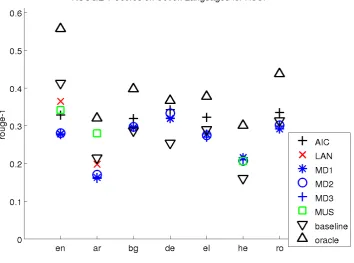
Figure 1: ROUGE-1 scores for HSS.
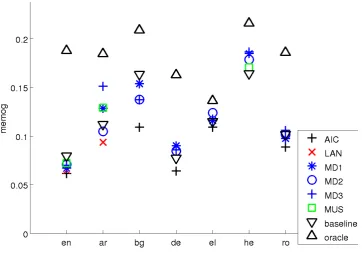
[image:6.595.135.490.92.355.2]Figure 3: MeMoG scores for HSS.
Table 4: Fraction of time a system beat the base-line for HSS.
System ROUGE-1 ROUGE-2 MeMoG
AIC 2/5 0/5 0/5
LAN 0/2 0/2 0/2
MD1 15/40 4/40 2/39
MD2 16/40 4/40 0/39
MD3 15/40 4/40 0/39
MUS 2/3 1/3 0/3
ANOVA 28/40 13/40 5/39
Table 4: The table gives the fraction of languages each system significantly outperform the base-line. The last line gives the number of times an ANOVA rejected the null hypothesis, indicating significance.
medians of the system scores were not the same, using a rejection threshold of 0.05. Also, the frac-tion of time that each system significantly outper-formed the lead baseline is also recorded. A paired Wilcoxon test was invoked whenever the ANOVA indicated a significant difference was present, with a threshold of 0.05.
Lastly, each systems performance for
SSS-scoring is provided in Figures 4, 5, and 6. Sur-prisingly, the results change little. Lastly Table 5 contains the number of times that each system beat the baseline summary with a 95% confidence mea-sured as a result of the non-parametric ANOVA and the Wilcoxon paired sign rank test. The results show that the number of significant differences go down for ROUGE scores and up for MeMoG.
4 Summary
Overall, the authors believe the pilot was success-ful in that it exposed researchers to the poten-tial for using Wikipedia articles for summarization research and demonstrated that generating sum-maries for the genre of Wikipedia articles is a more challenging task than newswire documents. No-tably, no system outperformed the baseline for En-glish! In hindsight this is not too surprising since news articles have a prose style6significantly dif-ferent from Wikipedia articles7. Wikipedia arti-cles are written as expositions having a topical flow that can vary significantly between sections but news articles are written in a style8 that ad-dresses the most important information first—the
6http://en.wikipedia.org/wiki/News_style 7http://en.wikipedia.org/wiki/MOS:
Figure 4: ROUGE-1 scores for SSS.
[image:8.595.135.490.92.354.2]Figure 6: MeMoG scores for SSS.
Table 5: Fraction of the time a system beat the lead baseline for SSS.
System ROUGE-1 ROUGE-2 MeMoG
AIC 0/5 0/5 0/5
LAN 0/2 0/2 0/2
MD1 8/40 2/40 6/39
MD2 10/40 2/40 2/39
MD3 7/40 2/40 4/39
MUS 0/3 0/3 0/3
ANOVA 11/40 5/40 7/39
Table 5: The table gives the fraction of lan-guages that each system significantly outperform the baseline on. The last line contains the number of times an ANOVA rejected the null hypothesis, indicating significance.
who, what, when, where and why—with the sub-sequent text providing more details. Hence news articles have a more even topical flow. The authors hope these results stimulate research and devel-opment of summarization algorithms outside the news domain.
As for the metrics, ROUGE-1 observed the most significant differences among the systems and MeMoG observed the least as measured by a non-parametric ANOVA. However, a human evaluation of the summaries generated would be needed to detemine which of the automatic metrics is best at predicting significant differences among systems for such data.
References
John M. Conroy, Judith D. Schlesinger, and Dianne P. O’leary. 2009. Classy 2009: summarization and metrics. InProceedings of the text analysis confer-ence (TAC).
George Giannakopoulos, Vangelis Karkaletsis, George Vouros, and Panagiotis Stamatopoulos. 2008. Summarization system evaluation revisited: N-gram graphs. ACM Trans. Speech Lang. Process., 5(3):5:1–5:39, October.
Va-sudeva Varma. 2011. Tac 2011 multiling pilot overview.
Jeff Kubina. 2010. Wikipedia featured article cor-pus. http://goo.gl/AmMGN. [Online; accessed 30-May-2013].
Chin-Yew Lin. 2004. Rouge: A package for automatic evaluation of summaries. In Text Summarization Branches Out: Proceedings of the ACL-04 Work-shop, pages 74–81.
Brian Stelter. 2013. He has millions and a new job at yahoo. soon, he’ll be 18. New York Times.