Gesture Semantics Reconstruction Based on Motion Capturing and
Complex Event Processing: a Circular Shape Example
Thies Pfeiffer, Florian Hofmann Artificial Intelligence Group
Faculty of Technology Bielefeld University, Germany
(tpfeiffe|fhofmann) @techfak.uni-bielefeld.de
Florian Hahn, Hannes Rieser, Insa R¨opke Collaborative Research Center “Alignment in Communication” (CRC 673)
Bielefeld University, Germany
(fhahn2|hannes.rieser|iroepke) @uni-bielefeld.de
Abstract
A fundamental problem in manual based gesture semantics reconstruction is the specification of preferred semantic con-cepts for gesture trajectories. This issue is complicated by problems human raters have annotating fast-paced three dimen-sional trajectories. Based on a detailed example of a gesticulated circular trajec-tory, we present a data-driven approach that covers parts of the semantic recon-struction by making use of motion captur-ing (mocap) technology. In our FA3ME framework we use a complex event pro-cessing approach to analyse and annotate multi-modal events. This framework pro-vides grounds for a detailed description of how to get at the semantic concept of cir-cularity observed in the data.
1 Introduction
Focussing on iconic gestures, we discuss the ben-efit of motion capturing (mocap) technology for the reconstruction of gesture meaning and speech meaning: A fundamental problem is the specifica-tion of semantic concepts for gesture trajectories, e.g., for describing circular movements or shapes. We start with demonstrating the limitations of our manual based annotation. Then we discuss two strategies of how to deal with these, pragmatic in-ferencevs. low level annotation based on mocap technology yielding a more precise semantics. We then argue that the second strategy is to be pre-ferred to the inferential one.
The annotation of mocap data can be re-alised semi-automatically by our FA3ME frame-work for the analysis and annotation of multi-modal events, which we use to record multi-multi-modal corpora. For mocap we use the tracking sys-tem ART DTrack2 (advanced realtime tracking
GmbH, 2013), but the framework is not restricted to this technical set-up. In cooperation with others (e.g., (Kousidis et al., 2012)), we also have used products from Vicon Motion Systems (2013) and the Microsoft Kinect (Microsoft, 2013). Pfeiffer (2013) presents an overview on mocap technology for documenting multi-modal studies.
We thus provide details about the way gestures are analysed with FA3ME and about the procedure to reconstruct the gesture meaning for the circular movement in our chosen example. We conclude with a discussion of how these low-level recon-structions can be integrated into the reconstruction of speech and gesture meaning.
2 From Linguistic Annotation to MoCap In this section we describe our methodology for the reconstruction of gesture meaning, speech meaning and its interfacing, illustrated by an ex-ample. We then show a shortcoming of our corpus-based annotation and discuss two possible solutions to amend it, pragmatic inferencevs. se-mantics based on mocap technology. The technol-ogy described in Section 3 will in the end enable us to get the preferred reconstruction of gesture se-mantics.
The reconstruction of the gesture meaning and its fusion with speech meaning to get a multi-modal proposition works as follows: On the speech side we start with a manual transcription, upon which we craft a context free syntax analy-sis followed by a formal semantics. On the ges-ture side we build an AVM-based representation of the gesture resting on manual annotation.1 Tak-ing the gesture as a sign with independent mean-ing (Rieser, 2010), this representation provides the basis for the formal gesture semantics. In the next
1We do not use an explicit gesture model, which would
go against our descriptive intentions. The range of admissible gestures is fixed by annotation manuals and investigations in gesture typology.
Figure 1: Our example: a circular gesture (left: video still) to describe the path around the pond (right).
step, the gesture meaning and the speech meaning are fused into an interface (R¨opke et al., 2013). Every step in these procedures is infested by un-derspecification which, however, we do not deal with here. These are, for instance, the selection of annotation predicates, the attribution of logical form to gestures and the speech analysis.
In our example, we focus on two gesture pa-rameters, the movement feature of the gesture and the representation technique used. It orig-inates from the systematically annotated corpus, called SaGA, the Bielefeld Speech-and-Gesture Alignment-corpus (L¨ucking et al., 2012). It con-sists of 25 dialogues of dyads conversing about a “bus ride” through a Virtual Reality town. One participant of each dyad, the so-called Route-Giver (RG), has done this ride and describes the route and the sights passed to the other participant, the so-called Follower (FO). The taped conversa-tions are annotated in a fine-grained way.
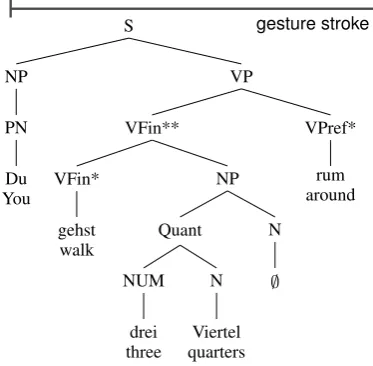
In the example, the RG describes a route section around a pond to the FO. While uttering “Du gehst drei Viertel rum/You walk three quarters around”, she produces the gesture depicted in Figure 1. In-tuitively, the gesture conveys a circularity infmation not expressed in the verbal meaning. In or-der to explicate the relation of speech and gesture meaning, we use our methodology as described above. To anticipate, we get a clear contribution of the speech meaning which is restricted by the gesture meaning conveying the roundness infor-mation. The first step is to provide a syntactical analysis which you can see in Figure 2.2
2The gesture stroke extends over the whole utterance.
Verb phrases can feature so-called “sentence brackets”. Here, due to a sentence bracket, the finite verb stem “gehst” is sepa-rated from its prefix (“rum”). Together they embrace the Ger-manMittelfeld, here “drei Viertel”. Observe the N-ellipsis “∅” in the NP. The prefix and the finite verb stem cannot be fully interpreted on their own and are therefore marked with
S
VP
VPref*
rum around VFin**
NP
N
∅ Quant
N
Viertel quarters NUM
drei three VFin*
gehst walk NP
PN
Du You
[image:2.595.76.291.61.163.2]gesture stroke
Figure 2: Syntax analysis
The speech representation is inspired by a Montague-Parsons-Reichenbach event ontology, and uses type-logic notions. Ignoring the embed-ding in an indirect speech act3, the speech se-mantics represents an AGENT (the FO) who is engaged in a WALK-AROUND event e related to some path F, and a THEME relating the WALK -AROUNDeventewith the path F.
∃eyF3/4x(WALK-AROUND(e)∧
AGENT(e,FO) ∧ THEME(e, x) ∧ F(x, y)) (1)
The gesture semantics is obtained using the an-notated gesture features. The relevant features are the movement of the wrist (Path of Wrist) and the Representation Technique used.
Path of Wrist ARC<ARC< ARC<ARC Representation Technique Drawing
4
Interpreting the values ARC<ARC< ARC<ARC and Drawing, respectively, the calculated gesture semantics represents a bent trajectory consisting of four segments:
an asterisk.
3We have treated the function of speech-gesture
ensem-bles in dialogue acts and dialogues elsewhere (Rieser and Poesio (2009), Rieser (2011), Hahn and Rieser (2011), L¨uecking et al. (2012)).
4This is a shortened version of the full gesture-AVM.
∃xy1y2y3y4(TRAJECTORY0(x) ∧BENT(y1) ∧
BENT(y2)∧BENT(y3)∧BENT(y4)∧y1 < y2 < y3 < y4 ∧ SEGMENT(y1, x) ∧ SEGMENT(y2, x) ∧
SEGMENT(y3, x) ∧SEGMENT(y4, x)). (2)
The paraphrase is: There exists a TRAJECTORY0 xwhich consists of fourBENT SEGMENTSy1,y2, y3,y4. We abbreviate this formula to:
∃x1(TRAJECTORY1(x1)) (3)
In more mundane verbiage: There is a particu-lar TRAJECTORY1 x1. In a speech-gesture inter-face5 (Rieser, 2010) both formulae are extended by adding a parameter in order to compositionally combine them:
λY.∃eyF3/4x(WALK-AROUND(e) ∧
AGENT(e,FO) ∧ THEME(e, x) ∧ F(x, y) ∧Y(y)) (4)
We read this as: There is aWALK-AROUNDevent
ethe AGENT of which is FO related to a three quarters (path) F. This mapsxontoy which is in turn equipped with property Y.
λz.∃x1(TRAJECTORY1(x1) ∧ x1 = z) (5)
This means “There is aTRAJECTORY1x1identical with an arbitraryz”. The extensions (4) and (5) are based on the intuition that the preferred reading is a modification of the (path) F by the gesture.
Taking the gesture representation as an argu-ment for the speech representation, we finally get a simplified multi-modal interface formula. The resulting proposition represents an AGENT (FO) who is engaged in aWALK-AROUNDeventeand a THEME that now is specified as being related to a bent trajectory of four arcs due to formula (2):
∃ey3/4x∃F(WALK-AROUND(e)∧
AGENT(e,FO)∧THEME(e, x)∧F(x, y) ∧TRAJECTORY1(y)) (6)
We take this to mean “There is an AGENT FO’s WALK-AROUNDeventerelated to a three quarters (path) F having aTRAJECTORY1y”.
As a result, the set of models in which the orginal speech proposition is true is restricted to
5How our model deals with interfacing speech meaning
and gesture meaning has been elaborated in a series of papers (see footnote 3). We are well aware of the work on gesture-speech integration by Lascarides and colleagues which we deal with in a paper on interfaces (Rieser (2013)).
the set of models that contain a bent trajectory standing in relation to the (path) F. But this restric-tion is too weak. Intuitively, the gesture conveys the meaning of a horizontal circular trajectory and not just four bent arcs. To see the shortcoming, note that the set of models also includes models which include a path having four bends that do not form a circular trajectory.
We envisage two methods to get the appropri-ate circularity intuition: pragmatic enrichment and an improvement of our gesture datum to capture the additional information conveyed in the ges-ture: By pragmatic enrichment, on the one hand, horizontal orientation and circularity of the ges-ture trajectory are inferred using abduction or de-faults. However, the drawback of working with defaults or abduction rules is that we would have to set up too many of them depending on the vari-ous shapes and functions of bent trajectories.
On the other hand, the datum can be improved to yield a circularly shaped trajectory instead of the weaker one consisting of four bent arcs. Our motion capture data supports the second method: The motion capture data allows us to compute the complete trajectory drawn in the gesture space. This will be the basis for producing a mapping from gesture parameters to qualitative relations which we need in the truth conditions. In the end, we achieve a circular trajectory that is defined as one approximating a circle, see Section 4.3.
In this mapping procedure resides an under-specification, which is treated by fixing a thresh-old for the application of qualitative predicates through raters’ decisions. This threshold value will be used in giving truth conditions for, e.g., (11), especially for determiningAPPROXIMATE.
We prefer the second method since it captures our hypothesis that the gesture as a sign conveys the meaning circular trajectory. The gain of the automated annotation via mocap which we will see subsequently is an improvement of our orig-inal gesture datum to a more empirically founded one. As a consequence, the set of models that sat-isfy our multi-modal proposition can be specified. This is also the reason for explicitly focussing on gesture semantics in this paper.
3 FA3ME - Automatic Annotation as Complex Event Processing
The creation of FA3ME, our Framework for the
Multi-modal Events, is inter aliamotivated by our key insight from previous studies that human raters have extreme difficulties when annotating 3D ges-ture poses and trajectories. This is especially true when they only have a restricted view on the recorded gestures. A typical example is the restric-tion to a fixed number of different camera angles from which the gestures have been recorded. In previous work (Pfeiffer, 2011), we proposed a so-lution for the restricted camera perspectives based on mocap data: Our Interactive Augmented Data Explorer (IADE) allowed human raters to immerse into the recorded data via virtual reality technol-ogy. Using a 3D projection in a CAVE (Cruz-Neira et al., 1992), the raters were enabled to move freely around and through the recorded mo-cap data, including a 3D reconstruction of the ex-perimental setting. This interactive 3D visuali-sation supported an advanced annotation process and improved the quality of the annotations but at high costs. Since then, we only know of Kipp (2010) who makes mocap data visible for anno-tators by presenting feature graphs in his annota-tion tool Anvil in a desktop-based setting. In later work, Nguyen and Kipp (2010) also support a 3D model of the speaker, but this needed to be hand-crafted by human annotators. A more holistic ap-proach for gesture visualizations are the Gesture Space Volumes Pfeiffer (2011), which summarize gesture trajectories over longer timespans or mul-tiple speakers.
The IADE system also allowed us to add visual augmentations during the playback of the recorded data. These augmentations were based on the events from the mocap data, but aggregated sev-eral events to higher-level representations. In a study on pointing gestures (L¨ucking et al., 2013), we could test different hypotheses about the con-struction of the direction of pointing by adding visual pointing rays shooting in a 3D reconstruc-tion of the original real world setting. This al-lowed us to asses the accuracy of pointing at a very high level in a data-driven manner and derive a new model for the direction of pointing (Pfeiffer, 2011).
3.1 Principles in FA3ME
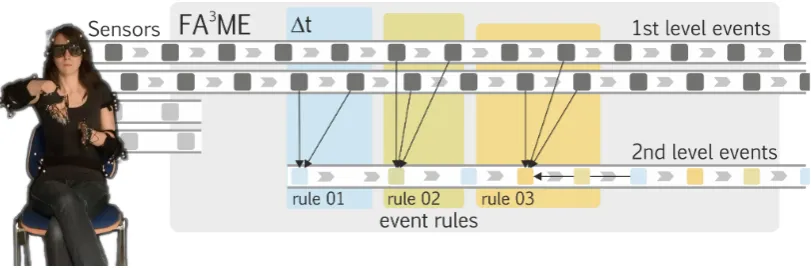
In the FA3ME project, we iteratively refine our methods for analysing multi-modal events. As a central concept, FA3ME considers any recorded datum as a first-level multi-modal event(see
Fig-ure 3, left). This can be a time-stamped frame from a video camera, an audio sample, 6-degree-of-freedom matrices from a mocap system or gaze information from an eye-tracking system (e.g., see Kousidis et al. (2012)).
A distinctive factor of FA3ME is that we con-sider annotations as second-level multi-modal events. That is, recorded and annotated data share the same representation. Annotations can be added by both, human raters and classification al-gorithms (the event rules in Figure 3, middle). An-notations can themselves be target of anAn-notations. This allows us, for example, to create automatic classifiers that rely on recorded data and manual annotations (e.g., the first yellow event in Figure 3 depends on first-level events above and the blue second-level event to the right). This is helpful when classifiers for complex events are not (yet) available. If, for instance, no automatic classifiers for the stroke of a gesture exists, these annotations can be made by human raters. Once this is done, the automatic classifiers can describe the move-ments during the meaningful phases by analysing the trajectories of the mocap data.
Third-level multi-modal events are augmenta-tions or extrapolaaugmenta-tions of the data. They might represent hypotheses, such as in the example of different pointing rays given above.
3.2 Complex Event Processing
In FA3ME, we consider the analysis of multi-modal events as acomplex event processing(CEP) problem. CEP is an area of computer science ded-icated to the timely detection, analysis, aggrega-tion and processing of events (Luckham, 2002). In the past years, CEP has gained an increased atten-tion especially in the analysis of business relevant processes where large amount of data, e.g., share prices, with high update rates are analysed. This has fostered many interesting tools and frame-works for the analysis of structured events (Arasu et al., 2004a; EsperTech, 2013; Gedik et al., 2008; StreamBase, 2013). Hirte et al. (2012) apply CEP to a motion tracking stream from a Microsoft Kinect for real-time interaction, but we know of no uses of CEP for the processing of multi-modal event streams for linguistic analysis.
Figure 3: In FA3ME, incoming multi-modal events are handled by a complex event processing frame-work that matches and aggregates events based on time windows to compose 2nd level multi-modal events. All multi-modal events can then be mapped to tiers in an annotation tool.
Gedik et al., 2008). The framework we use for FA3ME is Esper (EsperTech, 2013), which pro-vides a SQL-like query language. As a central ex-tension of SQL, CEP query languages introduce the concept of event streams and time windows as a basis for aggregation (see Figure 3).
The CEP approach of FA3ME allows us to cre-ate second- and third-level multi-modal events on-the-fly. We can thus provide near real-time anno-tations of sensor events. However, we have to con-sider the latencies introduced by sensors or com-putations and back-date events accordingly.
As a practical result, once we have specified our annotation descriptions formally in the language of CEP, these descriptions can be used to create classifiers that operate both on pre-recorded multi-modal corpora and on real-time data. This makes CEP interesting for projects where research in Lin-guistics and Human-Computer Interaction meet.
4 From MoCap to Linguistic Models In this section, we will now address the problem of annotating the circular trajectory. In order to get the preferred semantics we yet cannot rely ex-clusively on the automatic annotation. We need the qualitative predicate “phase” to identify the meaningful part of the gesture (the stroke). Addi-tionally, the qualitative predicate “representation technique” is required to select the relevant mo-cap trackers. For instance, the representation tech-nique “drawing” selects the marker of the tip of the index finger. We thus require a hybrid model of manual and automatic annotations. In the fol-lowing, we will focus on the automatic annotation. First of all, when using mocap to record data, a frame of reference has to be specified as a
ba-Figure 4: The coordinate system of the speaker (left). The orientations of the palms are classified into eight main directions (right).
sis for all coordinate systems. We chose a person-centered frame of reference anchored in the solar plexus (see Figure 4). The coronal plane is de-fined by the solar plexus and the two shoulders. The transverse plane is also defined by the solar plexus, perpendicular to the coronal plane with a normal-vector from solar plexus to the point ST (see Figure 4) between the two shoulders.
4.1 Basic Automatic Gesture Annotations
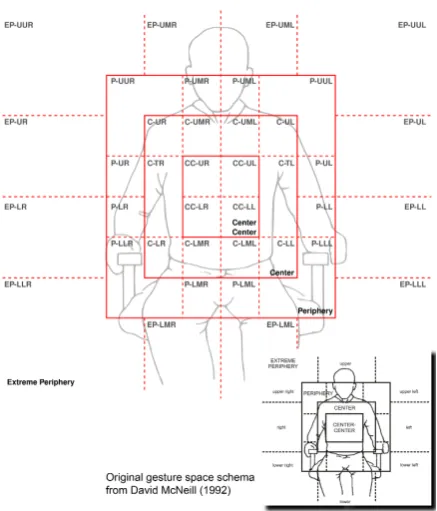
[image:5.595.309.509.264.423.2]Figure 5: Our extended gesture space categorisa-tion (upper left) is based on the work of McNeill (lower right).
video frames, we extended this model to support mocap as well (see Figure 5, left). The important point is that the areas of our schema are derived from certain markers attached to the observed par-ticipant. The upper right corner of the area C-UR (Center-Upper Right), for example, is linked to the marker for the right shoulder. Our schema thus scales directly with the size of the participant. Be-sides this, the sub-millimeter resolution of the mo-cap system also allows us to have a more detailed structure of the center area. The schema is also oriented according to the current coronal plane of the participant and not, e.g., according to the per-spective of the camera.
A second example is the classification of the ori-entation of the hand, which is classified according to the scheme depicted in Figure 4, right. This classification is made relative to the transversal plane of the speaker’s body.
4.2 Example: The Circular Trajectory
For the detection and classification of gestures drawing shapes two types of multi-modal events are required. First, multi-modal events generated by the mocap system for the hand. These events contain matrices describing the position and ori-entation of the back of the hand. Second,
multi-modal events that mark the gesture stroke (one event for the start and one for the end) have to be generated, either by hand or automatically. At the moment, we rely on our manual annotations for the existing SaGA corpus.
We realise the annotation of circular trajecto-ries in two steps. First, we reduce the trajectory provided by the mocap system to two dimensions. Second, we determine how closely the 2D trajec-tory approximates a circle.
Projection of the 3D Trajectory
The classifier for circles collects all events for the hand that happened between the two events for the stroke. As noted above, these events represent the position and orientation of the hand in 3D-space. There are several alternatives to reduce these three dimensions to two for classifying a circle (a 3D Object matching a 2D circle would be a sphere, a circular trajectory through all 3 dimensions a spi-ral). The principal approach is to reduce the di-mensions by projecting the events on a 2D plane.
∃xy(TRAJECTORY(x)∧PROJECTION-OF(x, y) ∧ TRAJECTORY2D(y)) (7)
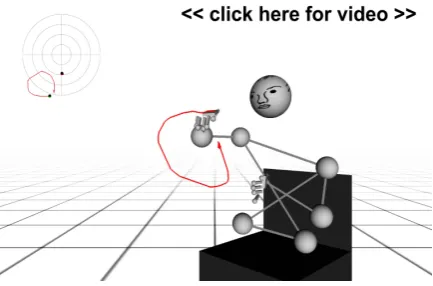
Which plane to chose depends on the choice made for the annotation (e.g., global for the cor-pus) and thus on the context. For the description of gestures in dialogue there are several plausible alternatives. First, the movements could be pro-jected onto one of the three body planes (sagit-tal plane, coronal plane, transversal plane). In our context, the transversal plane is suitable, as we are dealing with descriptions of routes, which in our corpus are made either with respect to the body of the speaker or with respect to the plane of an imaginary map, both extend parallel to the floor. Figure 6 (upper left) shows the circular movement in the transversal plane. A different perspective is presented in Figure 6 (right). There the tive of a bystander is chosen. This kind of perspec-tive can be useful for describing what the recipient of a dialogue act perceives, e.g., to explain misun-derstandings. For this purpose, the gesture could also be annotated twice, once from the speaker’s and once from the recipient’s perspective.
Figure 6: The circle-like gesture from our exam-ple can be visualised based on the mocap data. The right side shows the visualisation from the per-spective of an interlocutor, the visualisation in the upper left corner is a projection of the movement on the transversal plane of the speaker.
transversal planes will move accordingly and the gestures are always interpreted according to the current orientation.
The plane used for projection can also be de-rived from the gesture itself. Using principal com-ponent analysis, the two main axes used by the gesture can be identified. These axes can then have arbitrary orientations. This could be a useful ap-proach whenever 3D objects are described and the correct position and orientation of the ideal circle has to be derived from the gesture.
Circle Detection
Once the gesture trajectory has been projected onto a 2D plane, the resulting coordinates are clas-sified. For this, several sketch-recognition algo-rithms have been proposed (e.g., (Alvarado and Davis, 2004; Rubine, 1991)). These algorithms have been designed for sketch-based interfaces (such as tablets or digitisers), either for recognis-ing commands or for prettifyrecognis-ing hand-drawn dia-grams. However, once the 3D trajectory has been mapped to 2D, they can also be applied to natural gestures. The individual sketch-recognition algo-rithms differ in the way they are approaching the classification problem. Many algorithms follow a feature-based approach in which the primitives to be recognised are described by a set of features (such as aspect ratio or ratio of covered area) (Ru-bine, 1991). This approach is especially suited, when new primitives are to be learned by example. An alternative approach is the model-based ap-proach in which the primitives to be recognised are
described based on geometric models (Alvarado and Davis, 2004; Hammond and Davis, 2006). Some hybrid approaches also exist (Paulson et al., 2008). The model-based approaches are in line with our declarative approach to modelling, and are thus our preferred way for classifying shapes.
In our case, the projected 2D trajectory of the gesture is thus classified by a model-based sketch-recognition algorithm, which clas-sifies the input into one of several shape classes (circle, rectangle, ...) with a correspond-ing member function ISSHAPE(y,CIRCLE) ∈ [0. . .1]. By this, we can satisfy a subformula APPROXIMATES(y, z)∧CIRCLE(z)by pre-setting
a certain threshold. The threshold has to be cho-sen by the annotators, e.g., by rating positive and negative examples, as it may vary between partic-ipants and express the sloppiness of their gestures.
4.3 From MoCap to a Revision of Semantics
The result of the FA3ME reconstruction of our gesture example can be expressed as follows:
∃xyz(TRAJECTORY(x)
∧PROJECTION-OF(x, y)∧TRAJECTORY2D(y) ∧ APPROXIMATES(y, z) ∧ CIRCLE(z)) (8)
So we have: There is a projection of TRAJEC -TORYx,TRAJECTORY2Dy, which is approximat-ing a circle. We can now provide a description of the domain which can satisfy formula (8). Conse-quently, formula (8) is enhanced by definition (9).
CIRCULAR TRAJECTORY(x) =DEF
∃yz(TRAJECTORY2(x)∧PROJECTION-OF(x, y)∧
APPROXIMATES(y, z) ∧ circle(z)) (9)
This definition reads as “a CIRCULAR TRAJEC -TORYxis aTRAJECTORY2which has a PROJEC
-TIONythat approximates some circlez”.
The formula (9) substitutes the TRAJECTORY1 notion. The improved multi-modal meaning is (10):
∃ey3/4x∃F(WALK-AROUND(e)∧
AGENT(e,FO)∧THEME(e, x)∧F(x, y) ∧CIRCULAR TRAJECTORY(y)) (10)
Speech
Semantics SemanticsGesture
Linguistic Model
Classication of Real World Events
FA3ME
[image:8.595.72.292.64.181.2]Preferred Models
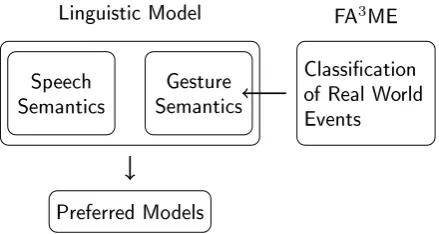
Figure 7: Specification of gesture semantics due to results of classification in FA3ME. Simulation data feed into the gesture semantics which inter-faces with the speech semantics.
The division of labour between linguistic seman-tics and FA3ME technology regarding the seman-tic reconstruction is represented in Figure 7.
By way of explanation: We have the multi-modal semantics integrating speech semantics and gesture semantics accomplished via λ-calculus techniques as shown in Section 2. As also ex-plained there, it alone would be too weak to de-limit the models preferred with respect to the gesture indicating roundness. Therefore FA3ME technology leading to a definition of CIRCU -LAR TRAJECTORY is used which reduces the set of models to the preferred ones assuming a thresh-oldn for the gestures closeness of fit to a circle. Thus, the relation between some gesture parame-ters and qualitative relations like circular can be considered as a mapping, producing values in the range [0 . . . 1]. Still, it could happen that formula (8) cannot be satisfied in the preferred models. As a consequence, the multi-modal meaning would then fall short of satisfaction.
5 Conclusion
During our work on the interface between speech and gesture meaning our previous annotations turned out to be insufficient to support the seman-tics of concepts such asCIRCULAR TRAJECTORY. This concept is a representative of many others that for human annotators are difficult to rate with the rigidity required for the symbolic level of se-mantics. Scientific visualisations, such as depicted in Figure 6, can be created to support the human raters. However, there is still the problem of per-spective distortions three dimensional gestures are subject to when viewed from different angles and in particular when viewed on a 2D screen. It is
also difficult to follow the complete trajectory of such gestures over time. Thus, one and the same gesture can be rated differently depending on the rater, while an algorithm with a defined threshold is not subject to these problems.
The presented hybrid approach based on quali-tative human annotations, mocap and our FA3ME framework is able to classify the particular 2D tra-jectories we are interested in following a three-step process: After the human annotator identi-fied the phase and selected relevant trackers, the dimensions are reduced to two and a rigid model-based sketch-recognition algorithm is used to clas-sify the trajectories. This classification is re-peatable, consistent and independent of perspec-tive. A first comparison of the manually anno-tated data and the automatic annotations revealed a high match. All differences between the annota-tions can be explained by restricannota-tions of the video data which yielded a lower precision in the hu-man annotations specifying the slant of the hand. Thus, the main issues we had with the results of human raters have been addressed, however a more formal evaluation on a large corpus remains to be done. What also remains is a specification of membership functions for each kind of ges-ture trajectories of interest (e.g., circular, rectan-gular, etc.). For this, a formal specification of what we commonly mean by, for instance, CIRCULAR, RECTANGULARetc. is required.
The automated annotation via mocap im-proves our original gesture datum to capture the circularity-information conveyed in the gesture. We have a better understanding of the gesture meaning adoptedvis-`a-vis the datum considered. As it turns out, resorting to pragmatic inference cannot be avoided entirely, but we will exclude a lot of unwarranted readings which the manual-based logical formulae would still allow by us-ing the approximation provided by body trackus-ing methods. Not presented here is the way third-level multi-modal events are generated by re-simulating the data in a 3D world model to generate context events, e.g., to support pragmatics.
Acknowledgments
References
[advanced realtime tracking GmbH2013] A.R.T. advanced realtime tracking GmbH. 2013. Homepage. Retrieved May 2013 from
http://www.ar-tracking.de.
[Alvarado and Davis2004] Christine Alvarado and Randall Davis. 2004. SketchREAD: a multi-domain sketch recognition engine. InProceedings of the 17th annual ACM symposium on User interface software and technology, UIST ’04, pages 23–32, New York, NY, USA. ACM.
[Arasu et al.2004a] Arvind Arasu, Brian Babcock, Shivnath Babu, John Cieslewicz, Mayur Datar, Keith Ito, Rajeev Motwani, Utkarsh Srivastava, and Jennifer Widom. 2004a. Stream: The stanford data stream management system. Technical report, Stan-ford InfoLab.
[Arasu et al.2004b] Arvind Arasu, Shivnath Babu, and Jennifer Widom. 2004b. CQL: A language for continuous queries over streams and relations. In Database Programming Languages, pages 1–19. Springer.
[Cruz-Neira et al.1992] Carolina Cruz-Neira, Daniel J. Sandin, Thomas A. DeFanti, Robert V. Kenyon, and John C. Hart. 1992. The cave: audio visual expe-rience automatic virtual environment. Communica-tions fo the ACM 35 (2), 35(6):64–72.
[EsperTech2013] EsperTech. 2013. Homepage of Es-per. Retrieved May 2013 fromhttp://esper. codehaus.org/.
[Gedik et al.2008] Bugra Gedik, Henrique Andrade, Kun-Lung Wu, Philip S Yu, and Myungcheol Doo. 2008. SPADE: The System S Declarative Stream Processing Engine. InProceedings of the 2008 ACM SIGMOD international conference on Management of data, pages 1123–1134. ACM.
[Hahn and Rieser2011] Florian Hahn and Hannes Rieser. 2011. Gestures supporting dialogue struc-ture and interaction in the Bielefeld speech and gesture alignment corpus (SaGA). InProceedings of SEMdial 2011, Los Angelogue, 15th Workshop on the Semantics and Pragmatics of Dialogue, pages 182–183, Los Angeles, California.
[Hammond and Davis2006] Tracy Hammond and Ran-dall Davis. 2006. LADDER: A language to describe drawing, display, and editing in sketch recognition. InACM SIGGRAPH 2006 Courses, page 27. ACM.
[Hirte et al.2012] Steffen Hirte, Andreas Seifert, Stephan Baumann, Daniel Klan, and Kai-Uwe Sattler. 2012. Data3 – a kinect interface for OLAP using complex event processing. Data Engineering, International Conference on, 0:1297–1300.
[Kipp2010] Michael Kipp. 2010. Multimedia annota-tion, querying and analysis in anvil. Multimedia in-formation extraction, 19.
[Kousidis et al.2012] Spyridon Kousidis, Thies Pfeiffer, Zofia Malisz, Petra Wagner, and David Schlangen. 2012. Evaluating a minimally invasive labora-tory architecture for recording multimodal conversa-tional data. InProceedings of the Interdisciplinary Workshop on Feedback Behaviors in Dialog, IN-TERSPEECH2012 Satellite Workshop, pages 39–42. [Luckham2002] David Luckham. 2002. The Power of Events: An Introduction to Complex Event Pro-cessing in Distributed Enterprise Systems. Addison-Wesley Professional.
[L¨ucking et al.2012] Andy L¨ucking, Kirsten Bergman, Florian Hahn, Stefan Kopp, and Hannes Rieser. 2012. Data-based analysis of speech and gesture: the Bielefeld Speech and Gesture Alignment corpus (SaGA) and its applications. Journal on Multimodal User Interfaces, -:1–14.
[L¨ucking et al.2013] Andy L¨ucking, Thies Pfeiffer, and Hannes Rieser. 2013. Pointing and reference recon-sidered. International Journal of Corpus Linguis-tics. to appear.
[McNeill1992] David McNeill. 1992. Hand and Mind: What Gestures Reveal about Thought. University of Chicago Press, Chicago.
[Microsoft2013] Microsoft. 2013. Homepage of KINECT for Windows. Retrieved May 2013 fromhttp://www.microsoft.com/en-us/ kinectforwindows/develop/.
[Nguyen and Kipp2010] Quan Nguyen and Michael Kipp. 2010. Annotation of human gesture using 3d skeleton controls. InProceedings of the 7th In-ternational Conference on Language Resources and Evaluation. ELDA.
[Paulson et al.2008] Brandon Paulson, Pankaj Rajan, Pedro Davalos, Ricardo Gutierrez-Osuna, and Tracy Hammond. 2008. What!?! no Rubine features?: us-ing geometric-based features to produce normalized confidence values for sketch recognition. In HCC Workshop: Sketch Tools for Diagramming, pages 57–63.
[Pfeiffer2011] Thies Pfeiffer. 2011. Understanding Multimodal Deixis with Gaze and Gesture in Con-versational Interfaces. Berichte aus der Informatik. Shaker Verlag, Aachen, Germany, December. [Pfeiffer2013] Thies Pfeiffer. 2013. Documentation
with motion capture. In Cornelia M¨uller, Alan Cienki, Ellen Fricke, Silva H. Ladewig, David McNeill, and Sedinha Teendorf, editors, Body-Language-Communication: An International Hand-book on Multimodality in Human Interaction, Hand-books of Linguistics and Communication Science. Mouton de Gruyter, Berlin, New York. to appear. [Rieser and Poesio2009] Hannes Rieser and M.
[Rieser2010] Hannes Rieser. 2010. On factoring out a gesture typology from the Bielefeld Speech-And-Gesture-Alignment corpus (SAGA). In Ste-fan Kopp and Ipke Wachsmuth, editors, Proceed-ings of GW 2009: Gesture in Embodied Communi-cation and Human-Computer Interaction, pages 47– 60, Berlin/Heidelberg. Springer.
[Rieser2011] Hannes Rieser. 2011. Gestures indicat-ing dialogue structure. In Proceedings of SEMdial 2011, Los Angelogue, 15th Workshop on the Seman-tics and PragmaSeman-tics of Dialogue, pages 9–18, Los Angeles, California.
[Rieser2013] Hannes Rieser. 2013. Speech-gesture Interfaces. An Overview. In Heike Wiese and Malte Zimmermann, editors, Proceedings of 35th Annual Conference of the German Linguistic Society (DGfS), March 12-15 2013 in Potsdam, pages 282– 283.
[R¨opke et al.2013] Insa R¨opke, Florian Hahn, and Hannes Rieser. 2013. Interface Constructions for Gestures Accompanying Verb Phrases. In Heike Wiese and Malte Zimmermann, editors, Proceed-ings of 35th Annual Conference of the German Lin-guistic Society (DGfS), March 12-15 2013 in Pots-dam, pages 295–296.
[Rubine1991] Dean Rubine. 1991. Specifying gestures by example. InProceedings of the 18th annual con-ference on Computer graphics and interactive tech-niques, SIGGRAPH ’91, pages 329–337, New York, NY, USA. ACM.
[StreamBase2013] StreamBase. 2013. Homepage of StreamBase. Retrieved May 2013 from http:// www.streambase.com/.
[Vicon Motion Systems2013] Vicon Motion Systems. 2013. Homepage. Retrieved May 2013 from