Improving Translation Model by Monolingual Data
∗Ondˇrej Bojar and Aleˇs Tamchyna
[email protected], [email protected] Institute of Formal and Applied Linguistics,
Faculty of Mathematics and Physics, Charles University in Prague
Abstract
We use target-side monolingual data to ex-tend the vocabulary of the translation model in statistical machine translation. This method called “reverse self-training” improves the de-coder’s ability to produce grammatically cor-rect translations into languages with morphol-ogy richer than the source language esp. in small-data setting. We empirically evalu-ate the gains for several pairs of European languages and discuss some approaches of the underlying back-off techniques needed to translate unseen forms of known words. We also provide a description of the systems we submitted to WMT11 Shared Task.
1 Introduction
Like any other statistical NLP task, SMT relies on sizable language data for training. However the par-allel data required for MT are a very scarce resource, making it difficult to train MT systems of decent quality. On the other hand, it is usually possible to obtain large amounts of monolingual data.
In this paper, we attempt to make use of the monolingual data to reduce the sparseness of surface forms, an issue typical for morphologically rich guages. When MT systems translate into such lan-guages, the limited size of parallel data often causes the situation where the output should include a word form never observed in the training data. Even though the parallel data do contain the desired word
∗ This work has been supported by the grants
EuroMatrix-Plus (FP7-ICT-2007-3-231720 of the EU and 7E09003 of the Czech Republic), P406/10/P259, and MSM 0021620838.
in other forms, a standard phrase-based decoder has no way of using it to generate the correct translation. Reverse self-training addresses this problem by incorporating the available monolingual data in the translation model. This paper builds upon the idea outlined in Bojar and Tamchyna (2011), describing how this technique was incorporated in the WMT Shared Task and extending the experimental evalu-ation of reverse self-training in several directions – the examined language pairs (Section 4.2), data size (Section 4.3) and back-off techniques (Section 4.4).
2 Related Work
The idea of using monolingual data for improving the translation model has been explored in several previous works. Bertoldi and Federico (2009) used monolingual data for adapting existing translation models to translation of data from different domains. In their experiments, the most effective approach was to train a new translation model from “fake” parallel data consisting of target-side monolingual data and their machine translation into the source language by a baseline system.
Ueffing et al. (2007) used a boot-strapping tech-nique to extend translation models using mono-lingual data. They gradually translated additional source-side sentences and selectively incorporated them and their translations in the model.
Our technique also bears a similarity to de Gis-pert et al. (2005), in that we try to use a back-off for surface forms to generalize our model and pro-duce translations with word forms never seen in the original parallel data. However, instead of a rule-based approach, we take advantage of the available
Source English Target Czech Czech Lemmatized Parallel (small) a cat chased. . . = koˇcka honila. . . koˇcka honit. . .
I saw a cat = vidˇel jsem koˇcku vidˇet b´yt koˇcka
I read about a dog = ˇcetl jsem o psovi ˇc´ıst b´yt o pes
Monolingual (large) ? ˇcetl jsem o koˇcce ˇc´ıst b´yt o koˇcka
[image:2.612.90.525.56.142.2]I read about a cat ← Use reverse translation backed-off by lemmas.
Figure 1: The essence of reverse self-training: a new phrase pair (“about a cat” = “o koˇcce”) is learned based on a small parallel corpus and large target-side monolingual texts.
data and learn these forms statistically. We are there-fore not limited to verbs, but our system is only able to generate surface forms observed in the target-side monolingual data.
3 Reverse Self-Training
Figure 1 illustrates the core of the method. Using available parallel data, we first train an MT system to translate from the target to the source language. Since we want to gather new word forms from the monolingual data, this reverse model needs the abil-ity to translate them. For that purpose we use a fac-tored translation model (Koehn and Hoang, 2007) with two alternative decoding paths: form→form and back-off→form. We experimented with several options for the back-off (simple stemming by trun-cation or full lemmatization), see Section 4.4. The decoder can thus use a less sparse representation of words if their exact forms are not available in the parallel data.
We use this reverse model to translate (much larger) target-side monolingual data into the source language. We preserve the word alignments of the phrases as used in the decoding so we directly ob-tain the word alignment in the new “parallel” cor-pus. This gives us enough information to proceed with the standard MT system training – we extract and score the phrases consistent with the constructed word alignment and create the phrase table.
We combine this enlarged translation model with a model trained on the true parallel data and use Minimum Error Rate Training (Och, 2003) to find the balance between the two models. The final model has four separate components – two language models (one trained on parallel and one on monolin-gual data) and the two translation models.
We do not expect the translation quality to
im-prove simply because more data is included in train-ing – by addtrain-ing translations generated ustrain-ing known data, the model could gain only new combinations of known words. However, by using a back-off to less sparse units (e.g. lemmas) in the factored target→source translation, we enable the decoder to produce previously unseen surface forms. These translations are then included in the model, reducing the data sparseness of the target-side surface forms.
4 Experiments
We used common tools for phrase-based translation – Moses (Koehn et al., 2007) decoder and tools, SRILM (Stolcke, 2002) and KenLM (Heafield, 2011) for language modelling and GIZA++ (Och and Ney, 2000) for word alignments.
For reverse self-training, we needed Moses to also output word alignments between source sentences and their translations. As we were not able to make the existing version of this feature work, we added a new option and re-implemented this funcionality.
We rely on automatic translation quality eval-uation throughout our paper, namely the well-established BLEU metric (Papineni et al., 2002). We estimate 95% confidence bounds for the scores as described in Koehn (2004). We evaluated our trans-lations on lower-cased sentences.
4.1 Data Sources
Aside from the WMT 2011 Translation Task data, we also used several additional data sources for the experiments aimed at evaluating various aspects of reverse self-training.
JRC-Acquis
Source Target Corpus Size (k sents) Vocabulary Size Ratio Baseline +Mono LM +Mono TM
Para Mono
English Czech 94 662 1.67 40.9±1.9 43.5±2.0 *44.3±2.0 English Finnish 123 863 2.81 27.0±1.9 27.6±1.8 28.3±1.7 English German 127 889 1.83 34.8±1.8 36.4±1.8 37.6±1.8 English Slovak 109 763 2.03 35.3±1.6 37.3±1.7 37.7±1.8
French Czech 95 665 1.43 39.9±1.9 42.5±1.8 43.1±1.8
French Finnish 125 875 2.45 26.7±1.8 27.8±1.7 28.3±1.8
French German 128 896 1.58 38.5±1.8 40.2±1.8 *40.5±1.8
German Czech 95 665 0.91 35.2±1.8 37.0±1.9 *37.3±1.9
Table 1: BLEU scores of European language pairs on JRC data. Asterisks in the last column mark experiments for which MERT had to be re-run.
of legislative texts of the European Union. The fact that all data in the corpus come from a single, very narrow domain has two effects – models trained on this corpus perform mostly very well in that domain (as documented e.g. in Koehn et al. (2009)), but fail when translating ordinary texts such as news or fic-tion. Sentences in this corpus also tend to be rather long (e.g. 30 words on average for English).
CzEng
CzEng 0.9 (Bojar and ˇZabokrtsk´y, 2009) is a par-allel richly annotated Czech-English corpus. It con-tains roughly 8 million parallel sentences from a variety of domains, including European regulations (about 34% of tokens), fiction (15%), news (3%), technical texts (10%) and unofficial movie subtitles (27%). We do not make much use of the rich anno-tation in this paper, however we did experiment with using Czech lemmas (included in the annotation) as the back-off factor for reverse self-training.
4.2 Comparison Across Languages
In order to determine how successful our approach is across languages, we experimented with Czech, Finnish, German and Slovak as target languages. All of them have a rich morphology in some sense. We limited our selection of source languages to English, French and German because our method focuses on the target language anyway. We did however com-bine the languages with respect to the richness of their vocabulary – the source language has less word forms in almost all cases.
Czech and Slovak are very close languages, shar-ing a large portion of vocabulary and havshar-ing a very similar grammar. There are many inflectional rules
for verbs, nouns, adjectives, pronouns and numerals. Sentence structure is exhibited by various agreement rules which often apply over long distance. Most of the issues commonly associated with rich morphol-ogy are clearly observable in these languages.
German also has some inflection, albeit much less complex. The main source of German vocabulary size are the compound words. Finnish serves as an example of agglutinative languages well-known for the abundance of word forms.
Table 1 contains the summary of our experimen-tal results. Here, only the JRC-Acquis corpus was used for training, development and evaluation. For every language pair, we extracted the first 10 per-cent of the parallel corpus and used them as the par-allel data. The last 70 percent of the same corpus were our “monolingual” data. We used a separate set of 1000 sentences for the development and an-other 1000 for testing.
For the back-off in the reverse self-training, we used a simple suffix-trimming heuristic suitable for fusional languages: cut off the last three characters of each word always keeping at least the first three characters. This heuristic reduces the vocabulary size to a half for Czech and Slovak but it is much less effective for Finish and German (Table 2), as can be expected from their linguistic properties.
Language Vocabulary reduced to (%)
Czech 52
Finnish 64
German 73
[image:4.612.326.534.98.249.2]Slovak 51
Table 2: Reduction of vocabulary size by suffix trimming
We did not use any linguistic tools, such as mor-phological analyzers, in this set of experiments. We see the main point of this section in illustrating the applicability of our technique on a wide range of lan-guages, including languages for which such tools are not available.
We encountered problems when using MERT to balance the weights of the four model components. Our model consisted of 14 features – one for each language model, five for each translation model (phrase probability and lexical weight for both di-rections and phrase penalty), word penalty and dis-tortion penalty. The extra 5 weights of the reversely trained translation model caused MERT to diverge in some cases. Since we used the mert-moses.pl script for tuning and kept the default parameters, MERT ran for 25 iterations and stopped. As a result, even though our method seemed to improve trans-lation performance in most language pairs, several experiments contradicted this observation. We sim-ply reran the final tuning procedure in these cases and were able to achieve an improvement in BLEU as well. These language pairs are marked with a ’*’ sign in Table 1.
A possible explanation for this behaviour of MERT is that the alternative decoding paths add a lot of possible derivations that generate the same string. To validate our hypothesis we examined a diverging run of MERT for English→Czech transla-tion with two translatransla-tion models. Our n-best lists contained the best 100 derivations for each
trans-Figure 2: Vocabulary ratio and BLEU score
0.2 0.4 0.6 0.8 1 1.2
0.8 1 1.2 1.4 1.6 1.8 2 2.2 2.4 2.6 2.8 3
Gain in BLEU (absolute)
Vocabulary size ratio en-cs
en-fi en-de
en-sk fr-cs
fr-fi
fr-de de-cs
lated sentence from the development data. On av-erage (over all 1000 sentences and over all runs), the n-best list only contained 6.13 different translations of a sentence. The result of the same calculation applied on the baseline run of MERT (which con-verged in 9 iterations) was 34.85 hypotheses. This clear disproportion shows that MERT had much less information when optimizing our model.
Overall, reverse self-training seems helpful for translating into morphologically rich languages. We achieved promising gains in BLEU, even over the baseline including a language model trained on the monolingual data. The improvement ranges from roughly 0.3 (e.g. German→Czech) to over 1 point (English→German) absolute. This result also indi-cates that suffix trimming is a quite robust heuristic, useful for a variety of language types.
[image:4.612.96.277.190.248.2]4.3 Data Sizes
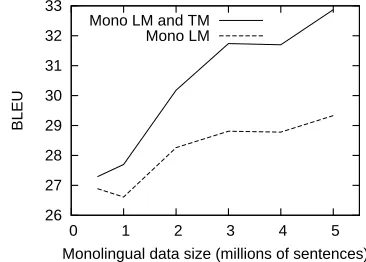
We conducted a series of English-to-Czech experi-ments with fixed parallel data and a varying size of monolingual data. We used the CzEng corpus, 500 thousand parallel sentences and from 500 thousand up to 5 million monolingual sentences. We used two separate sets of 1000 sentences from CzEng for development and evaluation. Our results are sum-marized in Figure 3. The gains in BLEU become more significant as the size of included monolingual data increases. The highest improvement can be ob-served when the data are largest – over 3 points ab-solute. Figure 4 shows an example of the impact on translation quality – the “Mono” data are 5 million sentences.
When evaluated from this point of view, our method can also be seen as a way of considerably improving translation quality for languages with lit-tle available parallel data.
We also experimented with varying size of paral-lel data (500 thousand to 5 million sentences) and its effect on reverse self-training contribution. The size of monolingual data was always 5 million sentences. We first measured the percentage of test data word forms covered by the training data. We calculated the value for parallel data and for the combination of parallel and monolingual data. For word forms that appeared only in the monolingual data, a different form of the word had to be contained in the parallel data (so that the model can learn it through the back-off heuristic) in order to be counted in. The differ-ence between the first and second value can simply be thought of as the upper-bound estimation of re-verse self-training contribution. Figure 5 shows the results along with BLEU scores achieved in transla-tion experiments following this scenario.
Our technique has much greater effect for small parallel data sizes; the amount of newly learned word forms declines rapidly as the size grows. Similarly, improvement in BLEU score decreases quickly and becomes negligible around 2 million parallel sentences.
4.4 Back-off Techniques
We experimented with several options for the back-off factor in English→Czech translation. Data from training section of CzEng were used, 1 million
par-Figure 3: Relation between monolingual data size and gains in BLEU score
26 27 28 29 30 31 32 33
0 1 2 3 4 5
BLEU
Monolingual data size (millions of sentences) Mono LM and TM
[image:5.612.333.516.107.238.2]Mono LM
Figure 5: Varying parallel data size, surface form cov-erage (“Parallel”, “Parallel and Mono”) and BLEU score (“Mono LM”, “Mono LM and TM”)
26 28 30 32 34 36 38
0 0.5 1 1.5 2 2.5 3 3.5 4 4.5 90 92 94 96 98
BLEU
Coverage of surface forms (%)
Parallel data size (millions of sentences) Mono LM and TM
Mono LM
26 28 30 32 34 36 38
0 0.5 1 1.5 2 2.5 3 3.5 4 4.5 90 92 94 96 98
BLEU
Coverage of surface forms (%)
Parallel data size (millions of sentences) Parallel and Mono
Parallel
allel sentences and another 5 million sentences as target-side monolingual data. As in the previous section, the sizes of our development and evaluation sets were a thousand sentences.
CzEng annotation contains lexically disam-biguated word lemmas, an appealing option for our purposes. We also tried trimming the last 3 ters of each word, keeping at least the first 3 ters intact. Stemming of each word to four charac-ters was also evaluated (Stem-4).
Table 3 summarizes our results. The last column shows the vocabulary size compared to original vo-cabulary size, estimated on lower-cased words.
[image:5.612.322.541.332.492.2]System Translation Gloss
Baseline Jsi tak zrcadla? Are youSG so mirrors? (ungrammatical)
+Mono LM Jsi neobjedn´avejte zrcadla? Did youSGdon’t orderP Lmirrors? (ungrammatical)
+Mono TM Uˇz sis objednal zrcadla? Have youSGorderedSGthe mirrors (for yourself) yet?
Figure 4: Translation of the sentence “Did you order the mirrors?” by baseline systems and a reversely-trained system. Only the last one is able to generate the correct form of the word “order”.
worst – the equivalence classes generated by this simple heuristic are too broad. Using lemmas seems optimal from the linguistic point of view, however suffix trimming outperformed this approach in our experiments. We feel that finding well-performing back-off techniques for other languages merits fur-ther research.
Back-off BLEU Vocabulary Size (%) Baseline 31.82±3.24 100
Stem-4 32.73±3.19 19
Lemma 33.05±3.40 54
Trimmed Suffix 33.28±3.32 47
Table 3: Back-off BLEU scores comparison
4.5 WMT Systems
We submitted systems that used reverse self-training (cu-tamchyna) for English→Czech and English→German language pairs.
Our parallel data for German were constrained to the provided set (1.9 million sentences). For Czech, we used the training sections of CzEng and the sup-plied WMT11 News Commentary data (7.3 million sentences in total).
In case of German, we only used the supplied monolingual data, for Czech we used a large col-lection of texts for language modelling (i.e. uncon-strained). The reverse self-training used only the constrained data – 2.3 million sentences in German and 2.2 in Czech. In case of Czech, we only used the News monolingual data from 2010 and 2011 for reverse self-training – we expected that recent data from the same domain as the test set would improve translation performance the most.
We achieved mixed results with these systems – for translation into German, reverse self-training did not improve translation performance. For Czech, we were able to achieve a small gain, even though the reversely translated data contained less sentences
than the parallel data. Our BLEU scores were also affected by submitting translation outputs without normalized punctuation and with a slightly different tokenization.
In this scenario, a lot of parallel data were avail-able and we did not manage to prepare a reversely trained model from larger monolingual data. Both of these factors contributed to the inconclusive re-sults.
Table 4 shows case-insensitive BLEU scores as calculated in the official evaluation.
Target Language Mono LM +Mono TM
German 14.8 14.8
Czech 15.7 15.9
Table 4: Case-insensitive BLEU of WMT systems
5 Conclusion
We introduced a technique for exploiting monolin-gual data to improve the quality of translation into morphologically rich languages.
We carried out experiments showing improve-ments in BLEU when using our method for trans-lating into Czech, Finnish, German and Slovak with small parallel data. We discussed the issues of in-cluding similar translation models as separate com-ponents in MERT.
We showed that gains in BLEU score increase with growing size of monolingual data. On the other hand, growing parallel data size diminishes the ef-fect of our method quite rapidly. We also docu-mented our experiments with several back-off tech-niques for English to Czech translation.
References
Nicola Bertoldi and Marcello Federico. 2009. Do-main adaptation for statistical machine translation with monolingual resources. In Proceedings of the Fourth
Workshop on Statistical Machine Translation, pages
182–189, Athens, Greece, March. Association for Computational Linguistics.
Ondˇrej Bojar and Aleˇs Tamchyna. 2011. Forms Wanted: Training SMT on Monolingual Data. Abstract at Machine Translation and Morphologically-Rich Lan-guages. Research Workshop of the Israel Science Foundation University of Haifa, Israel, January. Ondˇrej Bojar and Zdenˇek ˇZabokrtsk ´y. 2009. CzEng
0.9: Large Parallel Treebank with Rich Annotation.
Prague Bulletin of Mathematical Linguistics, 92:63–
83.
Adri`a de Gispert, Jos´e B. Mari˜no, and Josep M. Crego. 2005. Improving statistical machine translation by classifying and generalizing inflected verb forms. In
Eurospeech 2005, pages 3185–3188, Lisbon, Portugal.
Kenneth Heafield. 2011. Kenlm: Faster and smaller language model queries. In Proceedings of the Sixth
Workshop on Statistical Machine Translation,
Edin-burgh, UK, July. Association for Computational Lin-guistics.
Philipp Koehn and Hieu Hoang. 2007. Factored Transla-tion Models. In Proc. of EMNLP.
Philipp Koehn, Hieu Hoang, Alexandra Birch, Chris Callison-Burch, Marcello Federico, Nicola Bertoldi, Brooke Cowan, Wade Shen, Christine Moran, Richard Zens, Chris Dyer, Ondrej Bojar, Alexandra Con-stantin, and Evan Herbst. 2007. Moses: Open source toolkit for statistical machine translation. In ACL. The Association for Computer Linguistics.
Philipp Koehn, Alexandra Birch, and Ralf Steinberger. 2009. 462 machine translation systems for europe. In
MT Summit XII.
Philipp Koehn. 2004. Statistical significance tests for machine translation evaluation. In EMNLP, pages 388–395. ACL.
Franz Josef Och and Hermann Ney. 2000. Improved sta-tistical alignment models. pages 440–447, Hongkong, China, October.
Franz Josef Och. 2003. Minimum error rate training in statistical machine translation. In ACL, pages 160– 167.
Kishore Papineni, Salim Roukos, Todd Ward, and Wei-Jing Zhu. 2002. Bleu: a method for automatic evalua-tion of machine translaevalua-tion. In ACL, pages 311–318. Ralf Steinberger, Bruno Pouliquen, Anna Widiger,
Camelia Ignat, Tomaz Erjavec, Dan Tufis, and Daniel Varga. 2006. The JRC-acquis: A multilingual
aligned parallel corpus with 20+ languages. CoRR, abs/cs/0609058. informal publication.
Andreas Stolcke. 2002. Srilm — an extensible language modeling toolkit, June 06.