Boosting N-gram Coverage for Unsegmented Languages Using
Multiple Text Segmentation Approach
Solomon Teferra Abate
LIG Laboratory,
CNRS/UMR-5217
[email protected]
Laurent Besacier
LIG Laboratory,
CNRS/UMR-5217
[email protected]
Sopheap Seng
LIG Laboratory,
CNRS/UMR-5217
MICA Center,
CNRS/UMI-2954
[email protected]
Abstract
Automatic word segmentation errors, for languages having a writing system without word boundaries, negatively af-fect the performance of language mod-els. As a solution, the use of multiple, instead of unique, segmentation has re-cently been proposed. This approach boosts N-gram counts and generates new N-grams. However, it also pro-duces bad N-grams that affect the lan-guage models' performance. In this pa-per, we study more deeply the contribu-tion of our multiple segmentacontribu-tion ap-proach and experiment on an efficient solution to minimize the effect of adding bad N-grams.
1
Introduction
A language model is a probability assignment over all possible word sequences in a natural language. It assigns a relatively large probabili-ty to meaningful, grammatical, or frequent word sequences and a low probability or a zero proba-bility to nonsensical, ungrammatical or rare ones. The statistical approach used in N-gram language modeling requires a large amount of text data in order to make an accurate estimation of probabilities. These data are not available in large quantities for under-resourced languages and the lack of text data has a direct impact on the performance of language models. While the word is usually a basic unit in statistical lan-guage modeling, word identification is not a simple task even for languages that separate words by a special character (a white space in general). For unsegmented languages, which
have a writing system without obvious word de-limiters, the N-grams of words are usually esti-mated from the text corpus segmented into words employing automatic methods. Automat-ic segmentation of text is not a trivial task and introduces errors due to the ambiguities in natu-ral language and the presence of out of vocabu-lary words in the text.
While the lack of text resources has a nega-tive impact on the performance of language models, the errors produced by the word seg-mentation make those data even less usable. The word N-grams not found in the training corpus could be due not only to the errors introduced by the automatic segmentation but also to the fact that a sequence of characters could have more than one correct segmentation.
In previous article (Seng et al., 2009), we have proposed a method to estimate an N-gram language model from the training corpus on which each sentence is segmented into multiple ways instead of a unique segmentation. The ob-jective of multiple segmentation is to generate more N-grams from the training corpus to use in language modeling. It was possible to show that this approach generates more N-grams (com-pared to the classical dictionary-based unique segmentation method) that are potentially useful and relevant in language modeling. The applica-tion of multiple segmentaapplica-tion in language mod-eling for Khmer and Vietnamese showed im-provement in terms of tri-gram hits and recogni-tion error rate in Automatic Speech Recognirecogni-tion (ASR) systems.
counts that are generated with first best segmen-tation and generating new N-grams. We have also identified that there are N-grams that nega-tively affect the performance of the language models. In this paper, we study the contribution of boosting N-gram counts and of new N-grams to the performance of the language models and consequently to the recognition performance. We also present experiments where rare or bad N-grams are cut off in order to minimize their negative effect on the performance of the lan-guage models.
The paper is organized as follows: section 2 presents the theoretical background of our mul-tiple segmentation approach; in section 3 we point out the set up of our experiment; in sec-tion 4 we present the results of our detailed sta-tistical analysis of N-grams generated by multi-ple segmentation systems. Section 5 presents the evaluation results of our language models for ASR and finally, we give concluding re-marks.
2
Multiple Text Segmentation
Text segmentation is a fundamental task in nat-ural language processing (NLP). Many NLP ap-plications require the input text segmented into words before making further progress because the word is considered the basic semantic unit in natural languages. For unsegmented languages segmenting text into words is not a trivial task. Because of ambiguities in human languages, a sequence of characters may be segmented in more than one way to produce a sequence of valid words. This is due to the fact that there are different segmentation conventions and the definition of word in a language is often am-biguous.
Text segmentation techniques generally use an algorithm which searches in the text the words corresponding to those in a dictionary. In case of ambiguity, the algorithm selects the one that optimizes a parameter dependent on the chosen strategy. The most common optimiza-tion strategies consist of maximizing the length of words (“longest matching”) or minimizing the number of words in the entire sentence (“maximum matching”). These techniques rely heavily on the availability and the quality of the dictionaries and while it is possible to automati-cally generate a dictionary from an
unsegment-ed text corpus using unsupervisunsegment-ed methods, dic-tionaries are often created manually. The state-of-the-art methods generally use a combination of hand-crafted, dictionary and statistical tech-niques to obtain a better result. However, statis-tical methods need a large corpus segmented manually beforehand. Statistical methods and complex training methods are not appropriate in the context of under-resourced languages as the resources needed to implement these methods do not exist. For an under-resourced language, we seek segmentation methods that allow better exploitation of the limited resources. In our pre-vious paper (Seng et al., 2009) we have indicat-ed the problems of existing text segmentation approaches and introduced a weighted finite state transducer (WFST) based multiple text segmentation algorithm.
with the word transducer M yields a transducer that represents all possible segmentations. This transducer is then composed with the language model L, resulting in a transducer that repre-sents all possible segmentations for the input string I, scored according to L. The highest scoring paths of the compound transducer is the segmentation m that can be defined as:
P
m
=maxP
m
k
The segmentation procedure can then be ex-pressed formally as:
m=bestpath
I◦M◦L
where ◦ is the composition operator. The N-best segmentations are obtained by decoding the final lattice to output the N-best highest scoring paths and will be used for the N-gram count.
3
Experimental Setup
3.1 Language Modeling
First, it is important to note that Vietnamese texts are naturally segmented into syllables (not words). Each syllable tends to have its own meaning and thus a strong identity. However, the Vietnamese monosyllable is not automati-cally a word as we would define a word in Eng-lish. Often, two syllables go together to form a single word, which can be identified by the way it functions grammatically in a sentence. To have a word-based language model, word seg-mentation would, therefore, be a must in Viet-namese.
A Vietnamese training corpus that contains 3 millions sentences from broadcast news domain has been used in this experiment. A Vietnamese dictionary of 30k words has been used both for the segmentation and counting the N-grams. Therefore, in the experiments, the ASR vocabu-lary always remains the same and only the lan-guage model is changing. The segmentation of the corpus with dictionary based, “longest matching” unique segmentation method gives a corpus of 46 millions words. A development corpus of 1000 sentences, which has been seg-mented automatically to obtain 44k words, has been used to evaluate the tri-gram hits and the perplexity. The performance of each language model produced will be evaluated in terms of the tri-gram hits and perplexity on the develop-ment corpus and in terms of ASR performance
on a separate speech test set (different from the development set).
First of all, a language model named lm_1 is trained using the SRILM toolkit (Stolcke 2002) from the first best segmentation (Segmul1), which has the highest scoring paths (based on the transducer explained in section 2) of each sentence in the whole corpus. Then, additional language models have been trained using the corpus segmented with N-best segmentation: the number of N-best segmentations to generate for each sentence is fixed to 2, 5, 10, 50, 100 and 1000. The resulting texts are named accord-ingly as Segmul2, Segmul5, Segmul10, Seg-mul50, Segmul100, Segmul1000. Using these as training data, we have developed different language models. Note that a tri-gram that ap-pears several times in multiple segmentations of a single sentence has a count set to one.
3.2 ASR System
Our automatic speech recognition systems use the CMU’s Sphinx3 decoder. The decoder uses Hidden Markov Models (HMM) with continu-ous output probability density functions. The model topology is a 3-state, left-to-right HMM with 16 Gaussian mixtures per state. The pre-processing of the system consists of extracting a 39 dimensional features vector of 13 MFCCs, the first and second derivatives. The CMU’s SphinxTrain has been used to train the acoustic models used in our experiment.
4
Statistical Analysis of N-grams in
Multiple Text Segmentation
The change in the N-gram count that results from multiple segmentation is two fold: first there is a boosting of the counts of the N-grams that are already found with the first best seg-mentation, and secondly new N-grams are added. As we have made a closed-vocabulary counting, there are no new uni-grams resulting from multiple segmentation. For the counting, the SRILM toolkit (Stolcke 2002) is used set-ting the -gtnmin option to zero so that all the N-gram counts can be considered.
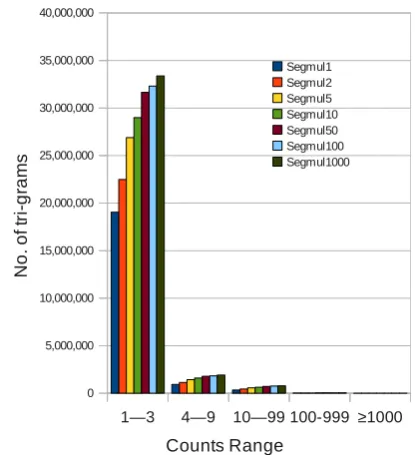
[image:4.595.304.519.159.265.2]Figure 1 shows the distribution of tri-gram counts for the unique and multiple segmentation of the training corpus. It can be seen that the majority of the tri-grams have counts in the range of one to three.
Figure 1: Distribution of
tri-gram counts
The boosting (the counts of the tri-grams that are already found with the first best segmenta-tion) effect of the multiple segmentation is indi-cated in table 1. We can see from the table that Segmul2, for example, reduced the number of rare tri-grams (count range 1-3) from 19.04 to 16.15 million. Consequently, the ratio of rare tri-grams to all tri-grams that are in Segmul1 is reduced from 94% (19.04/20.31*100) of Seg-mul1 only to 79% (15.96/20.31*100) by the boosting effect of Segmul1000, which increased
the number of tri-grams with count range of 4-9 from 0.91M to 3.34M. This implies, in the con-text of under-resourced languages, that multiple segmentation is boosting the N-gram counts. However, one still has to verify if this boosting is relevant or not for ASR.
Multiple Seg.
Counts Range 1–3
(M) 4-9 (M)
10-99 (M)
100-999 (M)
≥1000 (M) Segmul1 19.04 0.91 0.34 0.016 0.00054 Segmul2 16.15 3.23 0.89 0.043 0.0017 Segmul5 16.06 3.28 0.92 0.045 0.0017 Segmul10 16.03 3.30 0.93 0.045 0.0017 Segmul50 15.99 3.33 0.95 0.046 0.0017 Segmul100 15.98 3.33 0.95 0.046 0.0017 Segmul1000 15.96 3.34 0.96 0.046 0.0017
Table 1. boosting tri-gram counts
We have also analyzed the statistical behav-ior of the newly added tri-grams with regard to their count distribution (see figure 2). As we can see from the figure, the distribution of the new tri-grams is somehow similar to the distribution of the whole tri-grams that is indicated in figure 1.
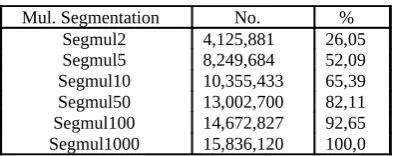
[image:4.595.81.289.323.551.2]As shown in table 2, the total number of newly added tri-grams is around 15 millions. We can see from the table that the rate of new tri-gram contribution of each segmentation in-creases as N inin-creases in the N-best segmenta-tion. However, as it is indicated in figure 2, the major contribution is in the area of rare tri-grams.
Figure 2: Distribution of new tri-gram counts 1—3 4—9 10—99 100-999 ≥1000
0 5,000,000 10,000,000 15,000,000 20,000,000 25,000,000 30,000,000 35,000,000 40,000,000
Segmul1 Segmul2 Segmul5 Segmul10 Segmul50 Segmul100 Segmul1000
Counts Range
N
o
. o
f t
ri
-g
ra
m
s
1—3 4—9 10—99 100-999 ≥1000 0
2,000,000 4,000,000 6,000,000 8,000,000 10,000,000 12,000,000 14,000,000 16,000,000
Segmul 2 Segmul 5 Segmul 10 Segmul 50 Segmul 100 Segmul 1000
Counts Range
N
u
m
b
e
r
o
f t
ri
-g
ra
m
[image:4.595.312.517.487.703.2]Mul. Segmentation No. %
Segmul2 4,125,881 26,05
Segmul5 8,249,684 52,09
Segmul10 10,355,433 65,39
Segmul50 13,002,700 82,11
Segmul100 14,672,827 92,65
[image:5.595.83.281.68.146.2]Segmul1000 15,836,120 100,0
Table 2. tri-gram contribution of multiple seg-mentation
5
Experimental Results
In this section we present the various language models we have developed and their perfor-mance in terms of perplexity, tri-gram hits and ASR performance (syllable error rate).
We use the results obtained with the method presented in (Seng et al., 2009) as baseline. This method consists in re-estimating the N-gram counts using the multiple segmentation of the training data and add one to the count of a tri-gram that appears several times in multiple seg-mentations of a single sentence. These baseline results are presented in Table 3. The results show an increase of the tri-gram coverage and slight improvements of the ASR performance.
Language
Models 3gs(M) 3g hit(% ) Ppl SER
Lm_1 20.31 46.9 126.6 27
lm_2 24.06 48.6 118.1 26.2
Lm_5 28.92 49.2 125.9 27
Lm_10 32.82 49.4 129.0 26.5
Lm_50 34.20 49.7 133.4 26.7
lm_100 34.93 49.7 134.8 26.9
[image:5.595.86.291.397.496.2]lm_1000 36.11 49.88 137.7 27.3
Table 3. Results of experiments using the base-line method presented in (Seng et al., 2009)
5.1 Separate effect of boosting tri-gram
counts
To see the effect of boosting tri-gram counts only, we have updated the counts of the tri-grams obtained from the 1-best segmentation (baseline approach) by the tri-gram counts of different multiple segmentations. Note that no new tri-grams are added here, and we evaluate only the effect and, therefore, the tri-gram hit remains the same as that of lm_1.
We have then developed different language models using the uni-gram and bi-gram counts of the first best segmentation and the updated trigram counts after multiple segmentation. The performance of the language models have been
evaluated in terms of perplexity and their contri-bution to the performance improvement of a speech recognition system. We have observed (detailed results are not reported here) that boosting only the tri-gram counts has not con-tributed any improvement in the performance of the language models. The reason is probably due to the fact that simply updating tri-gram counts without updating the uni-grams and the bi-grams lead to a biased and inefficient LM.
5.2 Separate effect of new tri-grams
To explore the contributions of only newly added tri-grams, we have added their counts to the N-gram counts of Segmul1. It is important to note that the model obtained in that case is different from the baseline model whose results are presented in Table 3 (the counts of the tri-grams already found in the unique segmentation are different between models). As it is presented in table 4, including only the newly added tri-grams consistently improved tri-gram hits, while the improvement in perplexity stopped at Segmul10. Moreover, the use of only new tri-grams do not reduce the speech recognition er-ror rate.
Language Models
3gs (M)
3g hit(% )
ppl SER
lm_1 20.3 46.9 126.6 27
lm_2_new 24.4 48.7 119.1 26.9
lm_5_new 28.6 49.0 122.5 27.8
lm_10_new 30.7 49.2 124.2 27.9
lm_50_new 33.3 49.4 126.8 27.8
lm_100_new 35 49.8 127.8 28
lm_1000_new 36.1 49.9 129.7 27.9
Table 4. Contributions of new tri-grams
5.3 Pooling unique and multiple
segmenta-tion models
We have developed language models by pooling unique and multiple segmentation models alto-gether. For instance, all the N-grams of lm_5 multiple segmentation are pooled with all N-grams of lm_1 unique segmentation before esti-mating the language model probabilities. In oth-er words, ngram-count command is used with multiple count files. The results are presented in table 5.
[image:5.595.313.513.411.511.2]of 46.91% and SER of 27. The best result ob-tained (25.4) shows a 0.8 absolute SER reduc-tion compared to the best result presented in (Seng et al., 2009).
Language Models
3gs (M)
3g hit(% )
ppl SER
lm_1 20.31 46.9 126.6 27
lm_2+lm_1 24.4 48.7 120.9 25.4
lm_5+lm_1 29.12 49.2 123.2 26.2
lm_10+lm_1 31.4 49.4 124.2 26
lm_50+lm_1 34.3 49.7 126 26
lm_100+lm_1 35 49.8 126.5 26.2
lm_1000+lm_1 36.2 49.9 128 26.2
Table 5. Performance with pooling
5.4 Cutting off rare tri-grams
With the assumption that bad N-grams occur rarely, we cut off rare tri-grams from the counts in developing language models. We consider all tri-grams with a count of 1 to be rare. Our hope, here, is that using this cut off we will remove bad N-grams introduced by the multiple seg-mentation approach, while keeping correct new N-grams in the model. Table 6 shows the per-formance of the language models developed with or without tri-gram cut off for the baseline method (the results presented on the lines indi-cating All3gs are the same as the ones presented in Table 3) .
Language models Evaluation Criteria 3gs
(M)
3g hit (%)
ppl SER
lm_1 All 3gs 20.31 46.91 126.6 27
Cut off 4.17 38.09 129.3 26.6 lm_2 All 3gs 24.06 48.6 118.1 26.2 Cut off 5.11 39.6 121.0 26.7
lm_5 All 3gs 28.92 49.2 125.9 27
Cut off 6.4 40.11 129.2 26.6 lm_10 All 3gs 32.82 49.41 129.0 26.5 Cut off 6.98 40.27 132.4 26.6 lm_50 All 3gs 34.20 49.68 133.4 26.7 Cut off 7.8 40.51 136.9 26.9 lm_100 All 3gs 34.93 49.74 134.8 26.9 Cut off 7.98 40.59 138.4 26.8 lm_1000 All 3gs 36.11 49.88 137.7 27.3 Cut off 8.33 40.71 141.3 26.8
Table 6. Performance with cut off.
The result shows that cutting off reduced the number of tri-grams highly (4 tri-grams over 5 are removed in that case). It, therefore, reduces the size of the language models significantly. Although the results obtained are not conclu-sive, a reduction of recognition error rate has
been observed in four out of the seven cases while the perplexity increased and the tri-gram hits decreased in all cases.
5.5 Hybrid of pooling and cutting off
methods
As it has been already indicated, cutting off in-creased the perplexity of the language models and decreased the tri-gram hits. To reduce the negative effect of cutting off on tri-gram hits and perplexity, we have developed language models using both pooling and cut off methods. We then cut off tri-grams of count 1 from the pooled N-grams. The result, as presented in ta-ble 7, shows that we can gain significant reduc-tion in recognireduc-tion error rate and improvement in tri-gram hits as compared to lm_1 that is de-veloped with cut off, even if no improvement in perplexity is observed.
The best result obtained (25.9) shows a 0.3 absolute SER reduction compared to the best system presented in (Seng et al., 2009).
Language Models 3gs
(M) 3g hit(% ) ppl SER lm_1 (no cutoff) 20.3 46.9 126.6 27
lm_1 (cutoff) 4.2 38.1 129.3 26.6 lm_2+lm_1 (cutoff) 5.2 39.7 126.4 26.8 lm_5+lm_1 (cutoff) 6.4 40.2 129.5 25.9
lm_10+lm_1 (cutoff) 7.0 40.3 131.1 26.3 lm_50+lm_1 (cutoff) 7.8 40.5 133.5 26.4 lm_100+lm_1 (cutoff) 8.0 40.6 134.3 26.4 lm_1000+lm_1 (cutoff) 8.3 40.7 161.5 26.7
Table 7. Performance with hybrid method
6
Conclusion
which we obtained the maximum (0.8 absolute) reduction in recognition error rate.
To minimize the effect of adding bad N-grams, we have cut off rare tri-grams in lan-guage modeling and got reduction in recogni-tion error rate. The significant reducrecogni-tion of tri-grams that resulted from the cut off revealed that the majority of tri-grams generated by mul-tiple segmentation have counts 1. Cutting off such a big portion of the trigrams reduced tri-gram hits and as a solution, we proposed a hy-brid of both pooling and cutting off tri-grams from which we obtained a significant reduction in recognition error rate.
It is possible to conclude that our methods make the multiple segmentation approach more useful by minimizing the effect of bad N-grams that it generates and utilizing the contribution of different multiple segmentations.
However, we still see rooms for improve-ment. A systematic selection of new tri-grams (for example, based on the probabilities of the N-grams and/or application of simple linguistic criteria to evaluate the usefulness of new tri-grams), with the aim of reducing bad tri-grams, might lead to performance improvement. Thus, we will do experiments in this line. We will also apply these methods to other languages, such as Khmer.
References
Lee, Young-Suk, Papineni, Kishore, Roukos, Salim Emam, Ossama and Hassan, Hany. 2003. Lan-guage model based arabic word segmentation. In Proceedings of the ACL’03, pp. 399–406.
Le, Viet-Bac, Besacier, Laurent, Seng, Sopheap, Bigi, Brigite and Do, Thi-Ngoc-Diep. 2008. Re-cent advances in automatic speech recognition for vietnamese. SLTU’08, Hanoi Vietnam. Mohri, Mehryar, Fernando C. N. Pereira, and
Michael Riley, “A rational design for a weighted finite-state transducer library,” in Lecture Notes in Computer Science. Springer, 1998, pp. 144–158. Seng, Sopheap, Besacier, Laurent, Bigi, Brigitte,
Castelli, Eric. 2009. Multiple Text Segmentation for Statistical Language Modeling. InterSpeech, Brighton, UK,