Proceedings of the EACL 2009 Workshop on GEMS: GEometical Models of Natural Language Semantics, pages 57–65,
Paraphrase assessment in structured vector space:
Exploring parameters and datasets
Katrin Erk
Department of Linguistics
University of Texas at Austin
[email protected]
Sebastian Padó
Department of Linguistics
Stanford University
[email protected]
Abstract
The appropriateness of paraphrases for words de-pends often on context: “grab” can replace “catch” in “catch a ball”, but not in “catch a cold”. Struc-tured Vector Space (SVS) (Erk and Padó, 2008) is a model that computesword meaning in context in order to assess the appropriateness of such para-phrases. This paper investigates “best-practice” pa-rameter settings forSVS, and it presents a method to obtain large datasets for paraphrase assessment from corpora with WSD annotation.
1
Introduction
The meaning of individual occurrences ortokens of a word can change vastly according to its context. A central challenge for computational lexical semantics is describe thesetoken meaningsand how they can be computed for new occurrences.
One prominent approach to this question is the dictionary-based model of token meaning: The differ-ent meanings of a word are a set of distinct, disjoint senses enumerated in a lexicon or ontology, such as WordNet. For each new occurrence, determining token
meaning means choosing one of the senses, a
classifica-tion task known as Word Sense Disambiguaclassifica-tion (WSD). Unfortunately, this task has turned out to be very hard
both for human annotators and for machines (Kilgarriff
and Rosenzweig, 2000), not at least due to granularity problems with available resources (Palmer et al., 2007; McCarthy, 2006). Some researchers have gone so far as to suggest fundamental problems with the concept of categorical word senses (Kilgarriff, 1997; Hanks, 2000).
An interesting alternative is offered byvector space modelsof word meaning (Lund and Burgess, 1996; Mc-Donald and Brew, 2004) which characterize the
mean-ing of a word entirely without reference to word senses.
Word meaning is described in terms of a vector in a high-dimensional vector space that is constructed with dis-tributional methods. Semantic similarity is then simply distance to vectors of other words. Vector space models
have been most successful in modeling the meaning of
word types (i.e. in constructingtype vectors). The
char-acterization of token meaning by correspondingtoken vectorswould represent a very interesting alternative to dictionary-based methods by providing a direct, graded,
unsupervised measure of (dis-)similarity between words in context that completely avoids reference to dictionary
senses. However, there are still considerable theoretical and practical problems, even though there is a
substan-tial body of work (Landauer and Dumais, 1997; Schütze, 1998; Kintsch, 2001; Mitchell and Lapata, 2008).
In a recent paper (Erk and Padó, 2008), we have intro-duced thestructured vector space (SVS)model which
addresses this challenge. It yields one token vector per
input word. Token vectors are not computed by com-bining the lexical meaning of the surrounding words – which risks resulting in a “topicality” vector – but by modifying the type meaning of a word with the semantic expectations of syntactically related words, which can be thought of as selectional preferences. For example,
incatch a ball, the token vector forballis computed by
combining the type vector ofballwith a vector for the
selectional preferencesofcatchfor its object. The to-ken vector forcatch, conversely, is constructed from the type vector ofcatchand theinverse object preference
vectorofball. The resulting token vectors describe the meaning of a word in a particular sentence not through a
sense label, but through the distance of the token vector
to other vectors.
A natural question that arises is how vector-based models of token meaning can be evaluated. It is of course possible to apply them to a traditional WSD task. However, this strategy remains vulnerable to all
criticism concerning the annotation of categorical word
senses, and also does not take advantage of the vec-tor models’ central asset, namely gradedness. Thus, paraphrase-based assessment for models of token mean-ing was proposed as a representation-neutral disam-biguation task that can replace WSD (McCarthy and Navigli, 2007; Mitchell and Lapata, 2008). Given a word token in context and a set of potential paraphrases, the task consists of identifying thesubsetof valid para-phrases. For example, in the following example, the first paraphrase is appropriate, but the second is not:
(1) GoogleacquiredYouTube⇒
GoogleboughtYouTube
(2) How childrenacquireskills6⇒
How childrenbuyskills
This task is graded in the sense that there is no
dis-joint set of labels from which exactly one is picked for
and the appropriate sets for two tokens may overlap to varying degrees. In an ideal vector-based model, valid
paraphrases such as (1) should possess similar vectors,
and invalid ones such as (2) dissimilar ones.
In Erk and Padó (2008), we evaluatedSVSon two
variants of the paraphrase assessment test: first, the
pre-diction of human judgments on a seven-point scale for paraphrases for verb-subject pairs (Mitchell and Lap-ata, 2008); and second, the original Lexical Substitution task by McCarthy and Navigli (2007). To avoid overfit-ting, we optimized our parameters on the first dataset and evaluated only the best model on the second dataset. However, given evidence for substantial inter-task differ-ences, it is unclear to what extent these parameters are optimal beyond the Mitchell and Lapata dataset. This paper addresses this question with two experiments:
Impact of parameters. We re-examine three central parameters ofSVS. The first one is the choice ofvector
combination function. Following Mitchell and Lap-ata (2008), we previously used componentwise multi-plication, whose interpretation in vector space is not straightforward. The second one isreweighting. We obtained the best performance when the context expec-tations were reweighted by taking each component to a (high)n-th power, which is counterintuitive. Finally, we found subjects to be more informative in judging the appropriateness of paraphrases than objects. This
appears to contradict work in theoretical syntax (Levin
and Rappaport Hovav, 2005).
To reassess the role of these parameters, we construct a controlled dataset of transitive instances from the Lex-ical Substitution corpus to reexamine and investigate these issues, with the aim of providing “best practice” settings forSVS. This turns out to be more difficult than expected, leading us to suspect that a globally optimal parameter setting across tasks may simply not exist. We also test a simple extension ofSVSthat uses a richer context (both subject and object) to construct the token vector, with first positive results.
Dataset creation. The Lexical Substitution dataset used in Erk and Padó (2008) was very small, which lim-its the conclusions that can be drawn from it. This points towards a more general problem of paraphrase-based assessment for models of token meaning: Until now, all
datasets for this task were specifically created by hand.
It would provide a strong boost for paraphrase assess-ment if the large annotated corpora that are available for WSD could be reused.
We present an experiment on converting the WordNet-annotated SemCor corpus into a set of “pseudo-paraphrases” for paraphrase-based assessment. We use the synonyms and direct hypernyms of an annotated synset as these “pseudo-paraphrases”. While the syn-onyms and hypernyms are not guaranteed to work as direct replacements of the target word in the given con-text, they are semantically similar to the target word. The result is a dataset ten times larger than the
Lex-Sub dataset. As we describe in this paper, we find that this method is nevertheless problematic: The resulting dataset is considerably more difficult to model than the existing hand-built paraphrase corpora, and its proper-ties differ considerably from the manually constructed Lexical Substitution dataset.
2
The structured vector space model
The main intuition behind theSVSmodel is to treat the interpretation of a word in context as guided by expecta-tions about typical events. This move to include typical
arguments and predicates into a model of word meaning is motivated both on cognitive and linguistic grounds. In cognitive science, the central role of expectations about typical events on almost all aspects of human language processing is well-established (McRae et al.,
1998; Narayanan and Jurafsky, 2002). In linguistics,
ex-pectations have long been used in semantic theories in
the form ofselectional restrictionsandselectional
pref-erences(Wilks, 1975), and more recently induced from
corpora (Resnik, 1996). Attention has mostly been lim-ited to selectional preferences of verbs, which have been used for for a variety of tasks (Hindle and Rooth, 1993; Gildea and Jurafsky, 2002). A recent result that theSVS model builds on is that selectional preferences can be represented asprototypevectors constructed from seen arguments (Erk, 2007; Padó et al., 2007).
Representing lemma meaning. To accommodate
in-formation about semantic expectations, theSVSmodel
extends the traditional representation of word meaning
as a single vector by a set of vectors, each of which represents the word’sselectional preferences for each relation that the word can assume in its linguistic con-text. While we ultimately think of these relations as “properly semantic” in the sense of semantic roles, the instantiation ofSVSwe consider in this paper makes use of dependency relations as a level of representation that generalizes over a substantial amount of surface variation but that can be obtained automatically with high accuracy using current NLP tools.
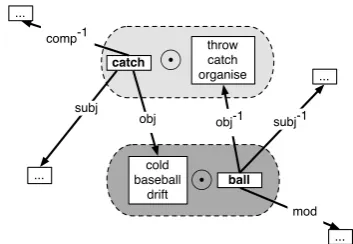
The idea is illustrated in Figure 1. In the representa-tion of the verbcatch, the central square stands for the
lexical vector ofcatch itself. The three arrows link it to
catch’s preferences for dependency relations it can par-ticipate in, such as for itssubjects, itsobjects, and for
verbs for which it appears as a complement(comp−1). The figure shows the head words that enter into the
com-putation of the selectional preference vector. Likewise,
ball is represented by one vector forball itself, one for ball’s preferences for its modifiers (mod), and two for the verbs of which it can occur as a subject (subj−1) and an object (obj−1), respectively.
This representation includes selectional preferences (likesubj,obj,mod) exactly parallel toinverse
catch
he fielder
dog
cold baseball
drift obj subj
accuse say claim
comp-1
ball whirl
fly provide
throw catch organise
obj-1 subj-1
mod
[image:3.595.73.293.63.171.2]red golf elegant
Figure 1: Structured Vector Space representations for noun ball and verb catch: Each box represents one vector (lexical information or expectations)
represent the meaning of a lemmawas a triple
m(w) = (vw, R, R−1)
wherevw ∈Dis the type vector of the wordwitself, R : R → D maps each relation label onto a vector that describesw’s selectional preferences, and R−1 :
R → D maps from role labels to vectors describing inverse selectional preferences ofw. BothRandR−1 are partial functions. For example, the direct object preference is undefined for intransitive verbs.1
Computing meaning in context. SVScomputes the meaning of a wordain the context of another word b via their selectional preferences as follows: Let m(a) = (va, Ra, Ra−1)andm(b) = (vb, Rb, R−
1 b )be the representations of the two words, and letr ∈ R
be the relation linkingatob. Then, the meaning ofa andbin this context is defined as a pair of structured vector triples:m(a→r b)is the meaning ofawithbas
itsr-argument, andm(br −1
→ a)the meaning ofbas the r-argument ofa:
m(a→r b) = vaRb−1(r), Ra− {r}, R−a1
m(br −1
→ a) = vbRa(r), Rb, R−b1− {r}
(3) wherev1v2is a direct vector combination function as in traditional models, e.g. addition or component-wise multiplication. If eitherRa(r)orR−b1(r)are not defined, the combination fails. Afterward, the filled argument positionris deleted fromRaandR−b1.
Figure 2 illustrates the procedure on the representa-tions from Figure 1. The dotted lines indicate that the lexical vector forcatch is combined with the inverse object preference ofball. Likewise, the lexical vector forballcombines with the object preference vector of
catch.
Recursive application. In Erk and Padó (2008), we considered only one combination step; however, the
1
We use separate functionsR,R−1 rather than a joint syntactic context preference function because (a) this sepa-ration models the conceptual difference between predicates and arguments, and (b) it allows for a simpler, more elegant formulation of the computation of meaning in context in Eq. 3.
catch
... baseballcold drift obj subj ...
comp-1
ball
... throw
catch organise
obj-1 subj-1
mod
...
!
!
Figure 2: Combining predicate and argument via relation-specific semantic expectations
syntactic context of a word in a dependency tree often consists of more than one word. It seems intuitively plausible that disambiguation should profit from more context information. Thus, we extendSVSwith recur-sive application. Let astand in relation r to b. As defined above, the result of combiningm(a)andm(b)
by relationrare two structured vector triplesm(a→r b)
andm(b r −1
→ a). Ifaalso stands in relations6= rto a wordc withm(c) = (va, Ra, R−a1), we define the meaning ofain the context ofbandccanonically as
m(m(a→r b)→s c) = (vaR−b1(r))R−1 c (s), Ra− {r, s}, R−a1
(4) Ifis associative and commutative, thenm(m(a→r
b)→s c) = m(m(a→s c)→r b). This will be the case for all the combination functions we use in this paper.
Note that this is a simplistic model of the influence of multiple context words: it computes only lexical meaning recursively, but does not model the influence
of context on theselectional preferences. For example,
the subject selectional preferences ofcatchare identical to those ofcatch the ball, even though one would ex-pect that theoutfieldercorresponds much better to the expectations ofcatch the ballthan of justcatch.
3
Experimental Setup
The task that we are considering isparaphrase assess-ment in context. Given a predicate-arguassess-ment pair and
a paraphrase candidate, the models have to decide how
appropriate the paraphrase is for the predicate-argument combination. This is the main task against which token
vector models have been evaluated in the past (Mitchell
and Lapata, 2008; Erk and Padó, 2008). In
Experi-ment 1, we use manually created paraphrases. In
Exper-iment 2, we replaces human-generated paraphrases with “pseudo-paraphrases”, contextually similar words that may not be completely appropriate as paraphrases in the given context, but can be collected automatically. Our
parameter choices forSVSare as similar as possible to the second experiment of our earlier paper.
[image:3.595.326.503.64.186.2]as co-occurring in a sentence if they are connected by an “informative” path in the dependency graph for the sentence.2 We build the space from a Minipar-parsed version of the British National Corpus with dependency parses obtained from Minipar (Lin, 1993). It uses raw co-occurrence counts and 2000 dimensions.
Selectional preferences and reweighting. We use a prototype-based selectional preference model (Erk,
2007). It models the selectional preferences of a
predi-cate for an argument position as the weighted centroid of the vectors for all head words seen for this position
in a large corpus. Letf(a, r, b)denote the frequency of
aoccurring in relationrtobin the parsed BNC. Then, we compute the selectional preferences as:
R0b(r) = 1
N
X
a:f(a,r,b)>0
f(a, r, b)·~va (5)
whereNis the number of fillersawithf(a, r, b)>0. In Erk and Padó (2008), we found that applying a reweightingstep to the selectional preference vector by taking each component of the centroid vectorR0b(r)to
then-th power lead to substantial improvements. The motivation for this technique is to alleviate noise aris-ing from the use of unfiltered head words for the con-struction. The reweighted selectional preference vector Rb(r)is defined as:
Rb(r) =hv1n, . . . , vmniforR0b(r) =hv1, . . . , vmi (6)
where we writehv1, . . . , vmifor the sequence of values that make up a vectorR0b(r). Inverse selectional pref-erencesR−b1(r)of nouns are defined analogously, by computing the centroid of the verbs seen as governors of the noun in relationr.
In this paper, we test reweighting parameters ofn
be-tween 0.5 and 30. Generally, smallns will decrease the
influence of the selectional preference vector. The result can be thought of as a “word type vector modified by context expectations”, while largens increase the role of context, until we arrive at a “contextual expectation vector modified by the word type vector”.3
Vector combination. We test three vector combina-tion funccombina-tions, which have different interpretations in vector space. The simplest one is componentwise addition, abbreviated asadd, i.e., simple vector addi-tion.4With addition, context dimensions receive a high count whenever either of the two vectors has a high co-occurrence count for the context.
2We used the minimal context specification and plain weight of the DependencyVectors software package.
3
For the component-wise minimum combination (see be-low), where we normalize the vectors before the combination,
the reweighting has a different effect. It shifts most of the mass onto the largest-value dimensions and sets smaller dimensions to values close to zero.
4
Since we subsequently focus on cosine similarity, which is length-invariant, vector addition can also be interpreted as centroid computation.
Next, we test component-wise multiplication (mult). This operation is more difficult to interpret in terms of vector space, since it does not correspond to the standard inner or outer vector products. The most straightforward interpretation is to reinterpret the second vector as a di-agonal matrix, i.e., as a linear transformation of the first vector. Large entries in the second vector increase the
weight of the corresponding contexts; small entries
de-crease it. Mitchell and Lapata (2008) found this method to yield the best results.
The third vector combination function we consider
is component-wise minimum (min). This combination
function results in a vector with high counts only for contexts which co-occur frequently with both input vec-tors and can thus be understood as an intersection be-tween the two context sets. Since the entries of two vectors need to be on the same order to magnitude for this method to yield meaningful results, we normalize vectors before the combination formin.
Assessing models of token meaning. Given a transi-tive verbvwith subjectaand direct objectb, we test three variants of computing a token vector forv. The first two involve only one combination step. In thesubj
condition,v’s type vector is combined with the inverse
subject preference vector ofa. In theobjcondition,v’s
type vector is combined with the inverse object pref-erence vector ofb. The third variant is the recursive application of theSVScombination procedure described in Section 2 (conditionboth). Specifically, we combine v’s type vector with botha’s inverse subject preference and withb’s inverse object preference to obtain a “richer” token vector.
In all three cases, the resulting token vector is com-pared to thetype vector of the paraphrase (in Experi-ment 1) or the semantically related word (in ExperiExperi-ment 2). We use Cosine Similarity, a standard choice as vector space similarity measure.
4
Experiments
4.1 Experiment 1: The impact of parameters
In our 2008 paper, we tested the LexSub data only with
the parameters that showed best results on the Mitchell and Lapata data: vector combination using component-wise multiplication (mult), and the computation of (in-verse) selectional preference vectors with high powers ofn= 20orn= 30. However, there were indications that the two datasets showed fundamental differences. In particular, the Mitchell and Lapata data could only be modeled using a PMI-transformed vector space, while the LexSub data could only be modeled using raw co-occurrence count vectors.
Sentence Substitutes By asking people who work
there, I have since determined that he didn’t. (# 2002)
be employed 4; labour 1
Remember how hard your
ances-torsworked. (# 2005)
[image:5.595.73.292.63.138.2]toil 4; labour 3; task 1
Figure 3: Lexical substitution example items for “work”
the notion of verb phrase has been motivated, among other things, with the claim that direct objects contribute more to a verb’s disambiguation than subjects (Levin and Rappaport Hovav, 2005). Empirically, subjects are known to be realized more often as pronouns than objects, which makes their vector representations less semantically specific. However, we usedtwo different datasets – the subject results on a set of intransitive verbs, and the object results on a set of transitive verbs, so the results are not comparable.
In this experiment, we construct a new, more con-trolled dataset from the Lexical Substitution corpus to systematically assess the importance of the three main parameters: the relation used for disambiguation, the combination function, and the reweighting parameter.
Construction of the LEXSUB-PARA dataset. The original Lexical Substitution corpus, constructed for the SemEval-1 lexical substitution task (McCarthy and Nav-igli, 2007), consists of 10 instances each of 200 target words in sentential contexts, drawn from a large inter-net corpus (Sharoff, 2006). Contextually appropriate paraphrases for each instance of each target word were elicited from up to 6 participants. Figure 3 shows two in-stances for the verbto work. The frequency distribution over paraphrases can be understood as a characterization of the target word’s meaning in each context.
For the current paper, we constructed a new subset of LexSub we call LEXSUB-PARAby parsing LexSub with Minipar (Lin, 1993) and extracting all 177 sentences with transitive verbs that had overtly realized subjects and objects, regardless of voice. We did not manually verify the correctness of the parses, but discarded 17 sentences where we were not able to compute inverse selectional preferences for the subject or object head word (these were mostly rare proper names). This left 160 transitive instances of 42 verbs.
Evaluation For evaluation, we use a variant of the Se-mEval “out of ten” (OOT) evaluation metrics defined by McCarthy and Navigli (2007). They developed two met-rics, OOT Precision and Recall, which compare where a
predicted set of appropriate paraphrases must be
evalu-ated against a gold standard set. Their metrics are called “out of ten” because they are measure the accuracy of the first ten paraphrases predicted by the system. Since they allow systems to abstain from predictions for any num-ber of tokens, their two variants average this accuracy (a), over the tokens with a prediction (OOT Precision), and (b), over all tokens (OOT Recall). Since our system
0.5 1 2 5 10 20
add obj 61.5 59.7 58.9 56.1 56.0 55.7 add subj 61.7 61.7 59.5 58.4 57.3 57.0 add both 61.3 60.0 60.2 57.7 57.1 56.7 mult obj 59.8 59.7 57.8 55.7 55.7 55.4 mult subj 60.3 59.7 59.3 57.3 57.7 56.7 mult both 59.9 58.8 57.1 55.8 55.3 <1Pr min obj 60.2 60.0 59.5 57.3 55.7 55.8 min subj 62.2 60.5 59.1 58.5 57.8 57.0 min both 62.3 60.2 59.8 57.3 55.8 55.1
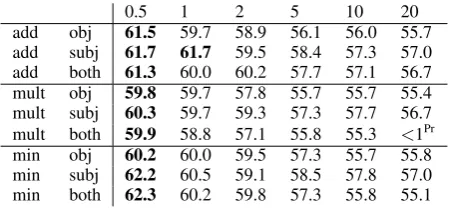
Table 1: OOT accuracy on the LEXSUB-PARAdataset across models and reweighting values (best results for each model boldfaced). Random baseline: 53.7. Target type vector baseline: 57.1.Pr: Numerical problem.
produces predictions for all tokens, OOT Precision and Recall become identical.
Formally, letGi be the gold paraphrases for occur-rencei, and letf(s, i)be the frequency with whichs has been named as paraphrase fori. LetMibe the ten
paraphrase candidates top-ranked by theSVSmodel for
i. We write out-of-ten accuracy (OOT) as:
OOT= 1/|I|X
i
P
s∈Mi∩Gif(s, i)
P
s∈Gif(s, i)
(7)
We compute two baselines. The first one is random baseline that guesses whether paraphrases are appropri-ate. The second baseline uses the original type vector
of the target verb without any combination, i.e., its “out
of context meaning”, as representation for the token.
Results. Table 1 shows the results on the LEXSUB-PARAdataset. Recall that the task is to decide the
ap-propriateness of paraphrases for verb instances, disam-biguated by the inverse selectional preferences of their
subjects (subj), their objects (obj), andboth. The ran-dom baseline attains an OOT accuracy of 53.7, and the type vector of the target vector performs at 57.1.
SVSis able to outperform both baselines for all
val-ues of the reweighting parametern <2, and we find the
best results for the lowest value,n= 0.5. As for the influence of the vector combination function, the best result is yielded bymin(OOT=62.3), followed byadd
(OOT=61.7), whilemultshows generally worse results
(OOT=60.3). For bothaddandmult, using only the sub-ject as context only is optimal. The overall best result,
usingmin, is seen forboth; however, the improvement
oversubjis very small.
In the modelmult-both-20, where target vectors were multiplied with two very large expectation vectors, al-most all instances failed due to overflow errors.
Discussion. Our results indicate that our parameter optimization strategy in Erk and Padó (2008) was in fact
flawed. The parameters that were best for the Mitchell
and Lapata (2008) data (mult,n= 20) are suboptimal
for LEXSUB-PARAdata.5 The good results for low
val-5
[image:5.595.307.532.64.168.2]ues ofnindicate that good discrimination between valid and invalid paraphrases can be obtained by relatively small modifications of the target vector in the direction indicated by the context. Surprisingly, we still find that the results in thesubjcondition are almost always better than those in theobjcondition, even though the dataset
consists only of transitive verbs, where we would have
expected the inverse result. We have two partial ex-planations. First, we find that pronouns, which occur frequently in subject position (I,he), are still
informa-tive enough to distinguish “animate” from “inanimate”
paraphrases of verbs such astouch. Second, we see a higher number of Minipar errors in for object posi-tions than for subject posiposi-tions, and consequently more data both for object fillers and for object selectional preferences.
The overall best result was yielded by a condition that usedboth(subject plus object) for disambiguation, using the recursive modification from Eq. (4). While we see this as a promising result, the difference to the second-best result is very small, in almost all other conditions the performance ofbothis close to the average ofobj
andsubjand thus a suboptimal choice.
4.2 Experiment 2: Creating larger datasets with pseudo-paraphrases
With a size of 2,000 sentences, even the complete LexSub dataset is tiny in comparison to many other resources in NLP. Limiting attention to successfully parsed transitive instances results in an even smaller dataset on which it is difficult to distinguish noise from genuine differences between models. This is a large problem for the use of paraphrase appropriateness as evaluation task for models of word meaning in context.
In consequence, the automatic creation of larger
datasets is an important task. While unsupervised
meth-ods for paraphrase induction are becoming available (e.g., Callison-Burch (2008)), they are still so noisy that the created datasets cannot serve as gold standards. However, there is an alternative strategy: there is a considerable amount of data in different languages an-notated withcategorical word sense, created (e.g.) for
Word Sense Disambiguation exercises such as Senseval.
We suggest to convert these data for use in a task similar to paraphrase assessment, interpreting available infor-mation about the word sense as pseudo-paraphrases. Of course, the caveat is that these pseudo-paraphrases may behave differently than genuine paraphrases. To investigate this issue, we repeat Experiment 1 on this dataset.
Construction of the SEMCOR-PARA dataset The SemCor corpus is a subset of the Brown corpus that
contains 23,346 lemmas annotated with senses
accord-ing to WordNet 1.6. Fortunately, WordNet provides a rich characterization of word senses. This allows us to use the WordNetsynonymsof a given word sense as pseudo-paraphrases. Since it can be the case that the target word is the only word in a synset, we also
0.5 1 2 5 10 20
[image:6.595.308.530.64.170.2]add obj 21.7 20.7 23.2 24.3 24.2 21.8 add subj 20.6 20.1 22.9 24.4 23.3 19.7 add both 21.1 20.3 23.2 24.4 23.3 18.9 mult obj 22.6 24.8 25.0 24.4 24.2 21.4 mult subj 21.1 23.9 24.4 24.4 23.5 19.8 mult both 24.5 24.5 25.6 24.3 20.0 17.4 min obj 20.9 19.5 23.6 24.4 24.3 21.9 min subj 20.1 19.6 22.5 24.2 23.9 19.6 min both 20.1 19.8 25.2 24.5 24.3 19.0
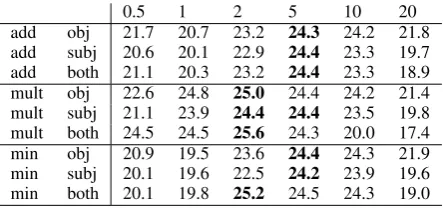
Table 2: OOT accuracy on the SEMCOR-PARAdataset across models and reweighting values (best results for each line boldfaced). Random baseline: 19.6. Target type vector baseline: 20.8
need to adddirect hypernyms. Direct hypernyms have
been used in annotation tasks to characterize WordNet
senses (Mihalcea and Chklovski, 2003), an indicator that they are usually close enough in meaning to func-tion as pseudo-paraphrases.
Again, we parsed the corpus with Minipar and iden-tified all sense-tagged instances of the verbs from LEXSUB-PARA, to keep the two corpora as compa-rable as possible. For each instancewiof wordw, we collected all synonyms and direct hypernyms of the synset as the set of appropriate paraphrases. The list of synonyms and direct hypernyms of all other senses ofw, whether they occur in SemCor or not, were con-sidered inappropriate paraphrases for the instancewi. This method does not provide us with frequencies for the pseudo-paraphrases; we thus assumed a uniform fre-quency of 1. This does not do away with the gradedness of the meaning representation, though, since each token is still associated with a set of appropriate paraphrases. Out of 2242 transitive verb instances, we further re-moved 153 since we could not compute selectional pref-erences for at least one of the fillers. 484 instances were
removed because WordNet did not list any verbal
para-phrases for the annotated synset or its direct hypernym. This resulted in 1605 instances for 40 verbs, a dataset an order of magnitude larger than LEXSUB-PARA. (See Section 4.3 for an example verb with paraphrases.)
Results and Discussion. We again use the OOT ac-curacy measure. The results for paraphrase assessment
on SEMCOR-PARAare shown in Table 2. The numbers
are substantially lower than for LEXSUB-PARA. This is first and foremost a consequence of the higher “poly-semy” of the pseudo-paraphrases. In LEXSUB-PARA, the average numbers of possible paraphrases per tar-get word is 20; in SEMCOR-PARA, 54. This is to be expected and also reflected in the much lower random
baseline (19.6% OOT). However, we also observe that
the reduction in error rate over the baseline is consider-ably lower for SEMCOR-PARAthan for LEXSUB-PARA (10% vs. 20% reduction).
with both lower and higher weights yielding consid-erably lower scores. Apparently, it is more difficult to strike the right balance between the target and the expectations on this dataset. This is also mirrored in the smaller improvement of the target type vector base-line over the random basebase-line. As for vector combi-nation functions, we find the best results for the more “intersection”-like multandmin combinations, with somewhat lower results foradd; however, the differ-ences are rather small. Finally, combination withobj
works better than combination withsubj. At least among the best results,bothis able to improve over the use of ei-ther individual relation. The best result usesmult-both, with an OOT accuracy of 25.6.
4.3 Further analysis
In our two experiments, we have found systematic rela-tionships between theSVSmodel parameters and their performance within the LEXSUB-PARAand SEMCOR
-PARAdatasets. Unfortunately, few of the parameter
set-tings we found to work well appear to generalize across the two datasets; neither do they correspond to the
op-timal parameter values we established for the Mitchell
and Lapata dataset in our 2008 paper. Variables that vary particularly strikingly are the reweighting parame-ter and the performance of different relations. To betparame-ter understand these differences, we perform a further
vali-dation analysis that attempts to link model performance
to a variable that (a) behaves consistently across the two datasets used in this paper and (b) sheds light onto the patterns we have observed for the parameters.
The quantity we will use for this purpose is the aver-agediscriminativityof the model. We define
discrimina-tivity as the degree to which the token vector computed
by the model is on average more similar to the valid than to the invalid paraphrases. For a paraphrase ordering task such as the one we are considering, we want this quantity to be as large as possible; very small quantities indicate that the model is basically “guessing” an order.
Figure 4 plots disciminativity against model perfor-mance. As can be expected, it is indeed a very strong correlation between discriminativity and OOT accu-racy across all models. A Pearson’s correlation test confirms that the correlation is highly significant for both datasets (LEXSUB-PARA: r=0.65, p < 0.0001; SEMCOR-PARA: r=0.76,p <0.0001).
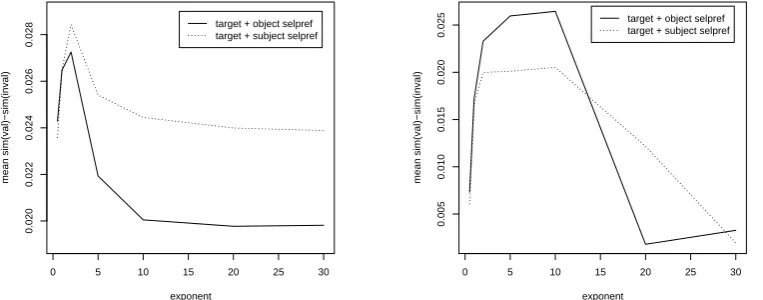
Next, we considered the relationship between the mean discriminativity for different combinations and reweighting valuesn. Figure 5 shows the resulting plots,
which reveal two main differences between the datasets. The first one is the influence of the reweighting
parame-ter. For LEXSUB-PARA, the highest discriminativity is
found for small values ofn, with decreasing values for
higher parameter values. In contrast, SEMCOR-PARA shows the highest discriminativity for middle values of n(on the order of 5–10), with lowest values on either side. The second difference is the relative discrimina-tivity ofobj and subj. On LEXSUB-PARA, the subj
predictions are more discriminative thanobjpredictions for all values ofn. On SEMCOR-PARA, this picture is reversed, with more discriminativeobjpredictions for the best (and thus relevant) values ofn.
We interpret these patterns, which fit the observed OOT accuracy numbers well, as additional evidence that
the variations we see between the datasets are not noise
or artifacts of the setup, but arise due to the different makeup of the two datasets. This ties in with our intu-itions about the differences between human-generated paraphrases and WordNet “pseudo-paraphrases”. Com-pare the following paraphrase lists:
dismiss (LexSub): banish, deride, discard, discharge, dis-patch, excuse, fire, ignore, reject, release, remove, sack
dismiss (SemCor/WordNet): alter, axe, brush, can, change,
discount, displace, disregard, dissolve, drop, farewell, fire, force, ignore, modify, notice, packing, push, reject, remove, sack, send, terminate, throw, usher
The SEMCOR-PARAlist contains a larger number of unspecific pseudo-paraphrases such aschange, push, send, which stem from direct WordNet hypernyms of the more specific dismisssenses. Presumably, these terms are assigned rather general vectors which theSVS finds difficult to rule out as paraphrases. This lowers the discriminativity of the models, in particular forsubj, and results in the smaller relative improvement over the baseline we observe for SEMCOR-PARA. This sug-gests that the usability of word sense-derived datasets
in evaluations could be improved by taking depth in the WordNet hierarchy into account when including direct
hypernyms among the pseudo-paraphrases.
5
Conclusions
In this paper, we have explored the parameter space for the computation of vector-based representations of token meaning with theSVSmodel.
Our evaluation scenario was paraphrase assessment. To systematically assess the impact of parameter choice, we created two new controlled datasets. The first one, the LEXSUB-PARAdataset, is a small subset of the
Lex-ical Substitution corpus (McCarthy and Navigli, 2007)
that was specifically created for this task. The second
dataset, SEMCOR-PARA, which is considerably larger,
consists in instances from the SemCor corpus whose WordNet annotation was automatically converted into “pseudo-paraphrase” annotation.6
We found a small number of regularities that hold for both datasets: namely, that the reweighting parameter is the most important choice for aSVSmodel, followed by the relation used as context, while the influence of
the vector combination function is comparatively small.
Unfortunately, the actual settings of these parameters appeared not to generalize well from one dataset to the other. We have collected evidence that these diver-gences are not due to noise, but to genuine differences
6
● ● ●
●
● ●
●
●
●
●
●
●
●
●
●
● ● ● ●
● ●
● ●
●
●
●
●
●
●
● ●
● ●
● ●
● ●
●
●
●
●
●
0.018 0.020 0.022 0.024 0.026 0.028 0.030
0.56
0.57
0.58
0.59
0.60
0.61
0.62
mean sim(val)−sim(inval)
out of ten precision
● ●
● ●
● ● ● ●
● ●
● ●
● ●
● ●
● ● ●
● ● ● ●
●
● ●
● ●
● ●
● ●
● ● ●
● ● ●
● ●
●●
0.005 0.010 0.015 0.020 0.025 0.030
0.18
0.20
0.22
0.24
mean sim(val)−sim(inval)
o
[image:8.595.104.485.64.222.2]ut of ten precision
Figure 4: Scatterplot of "out of ten" accuracy against model discriminativity between valid and invalid paraphrases.
Left: LEXSUB-PARA, right: SEMCOR-PARA.
0 5 10 15 20 25 30
0.020
0.022
0.024
0.026
0.028
exponent
mean sim(val)−sim(inval)
target + object selpref target + subject selpref
0 5 10 15 20 25 30
0.005
0.010
0.015
0.020
0.025
exponent
mean sim(val)−sim(inval)
target + object selpref target + subject selpref
Figure 5: Average amount to which predictions are more similar to valid than to invalid paraphrases, for different
reweighting values. Left: LEXSUB-PARA, right: SEMCOR-PARA.
in the datasets. We describe an auxiliary quantity, dis-criminativity, that measures the ability of the model’s predictions to distinguish between valid and invalid para-phrases.
The consequence we draw from this study is that it
is surprisingly difficult to establish generalizable “best
practice” parameter setting forSVS. Good parameter values appear to be sensitive to the properties of datasets. For example, we have attributed the observation that subjects are more informative on LEXSUB-PARA, while objects work better on SEMCOR-PARA, to differences in the set of paraphrase competitors. In this regard,
the conversion of the WSD corpus can be considered a
partial success. We have constructed the largest existing paraphrase assessment corpus. However, the use of
WordNet information to create paraphrases results in a
very difficult corpus. We will investigate methods that exclude overly general hypernyms of the target words as paraphrases to alleviate the problems we see currently.
Discriminativity further suggests that paraphrase as-sessment can be improved by selectional preference representations that are trained to maximize the dis-tance between valid and invalid paraphrases. Such a
representation could be provided by discriminative
for-mulations (Bergsma et al., 2008), or by exemplar-based
models that are able to deal better with the ambiguity present in the preferences of very general words.
Another important topic for further research is the computation of token vectors that incorporate more than one context word. The current results we obtain for “both” are promising but limited; it appears that the suc-cessful integration of multiple context words requires
strategies that go beyond simplistic addition or
intersec-tion of observed contexts.
References
S. Bergsma, D. Lin, and R. Goebel. 2008.
Discrimina-tive learning of selectional preference from unlabeled text. InProceedings of EMNLP, pages 59–68.
C. Callison-Burch. 2008. Syntactic constraints on para-phrases extracted from parallel corpora. In Proceed-ings of EMNLP, pages 196–205.
K. Erk and S. Padó. 2008. A structured vector space
[image:8.595.105.487.269.419.2]K. Erk. 2007. A simple, similarity-based model for
se-lectional preferences. InProceedings of ACL, pages
216–223.
D. Gildea and D. Jurafsky. 2002. Automatic label-ing of semantic roles. Computational Linguistics, 28(3):245–288.
P. Hanks. 2000. Do word meanings exist? Computers and the Humanities, 34(1-2):205–215.
D. Hindle and M. Rooth. 1993. Structural ambigu-ity and lexical relations. Computational Linguistics, 19(1):103–120.
A. Kilgarriff and J. Rosenzweig. 2000. Framework and results for English Senseval.Computers and the
Humanities, 34(1-2).
A. Kilgarriff. 1997. I don’t believe in word senses.
Computers and the Humanities, 31(2):91–113.
W. Kintsch. 2001. Predication. Cognitive Science, 25:173–202.
T. Landauer and S. Dumais. 1997. A solution to Platos problem: the latent semantic analysis theory of ac-quisition, induction, and representation of knowledge.
Psychological Review, 104(2):211–240.
B. Levin and M. Rappaport Hovav. 2005. Argument
Realization. Research Surveys in Linguistics Series.
CUP.
D. Lin. 1993. Principle-based parsing without
overgen-eration. InProceedings of ACL, pages 112–120.
K. Lund and C. Burgess. 1996. Producing high-dimensional semantic spaces from lexical co-occurrence. Behavior Research Methods,
Instru-ments, and Computers, 28.
D. McCarthy and R. Navigli. 2007. SemEval-2007 Task 10: English Lexical Substitution Task. In
Pro-ceedings of SemEval, pages 48–53.
D. McCarthy. 2006. Relating WordNet senses for word
sense disambiguation. In Proceedings of the ACL
Workshop on Making Sense of Sense, pages 17–24.
S. McDonald and C. Brew. 2004. A distributional
model of semantic context effects in lexical
process-ing. InProceedings of ACL, pages 17–24.
K. McRae, M. Spivey-Knowlton, and M. Tanenhaus. 1998. Modeling the influence of thematic fit (and
other constraints) in on-line sentence comprehension.
Journal of Memory and Language, 38:283–312.
R. Mihalcea and T. Chklovski. 2003. Open Mind Word Expert: Creating large annotated data collec-tions with web users’ help. InProceedings of the EACL 2003 Workshop on Linguistically Annotated
Corpora (LINC 2003), Budapest, Hungary.
J. Mitchell and M. Lapata. 2008. Vector-based models of semantic composition. InProceedings of ACL, pages 236–244.
S. Narayanan and D. Jurafsky. 2002. A Bayesian model predicts human parse preference and reading time in
sentence processing. InProceedings of NIPS, pages
59–65.
S. Padó, U. Padó, and K. Erk. 2007. Flexible, corpus-based modelling of human plausibility judgements. InProceedings of EMNLP/CoNLL, pages 400–409.
M. Palmer, H. Dang, and C. Fellbaum. 2007. Making fine-grained and coarse-grained sense distinctions,
both manually and automatically.Journal of Natural
Language Engineering. To appear.
P. Resnik. 1996. Selectional constraints: An information-theoretic model and its computational realization.Cognition, 61:127–159.
H. Schütze. 1998. Automatic word sense discrimina-tion.Computational Linguistics, 24(1):97–124.
Serge Sharoff. 2006. Open-source corpora: Using the net to fish for linguistic data. International Journal
of Corpus Linguistics, 11(4):435–462.
Y. Wilks. 1975. Preference semantics. In Formal