Classical Chinese Sentence Segmentation
Hen-Hsen Huang†, Chuen-Tsai Sun‡ and Hsin-Hsi Chen†
†Department of Computer Science and Information Engineering, National Taiwan University, Taipei, Taiwan ‡Department of Computer Science, National Chiao Tung University, Hsinchu, Taiwan
[email protected] [email protected] [email protected]
Abstract
Sentence segmentation is a fundamental issue in Classical Chinese language processing. To facilitate reading and processing of the raw Classical Chinese data, we propose a statistical method to split unstructured Classical Chinese text into smaller pieces such as sentences and clauses. The segmenter based on the conditional random field (CRF) model is tested under different tagging schemes and various features including n-gram, jump, word class, and phonetic informa-tion. We evaluated our method on four datasets from several eras (i.e., from the 5th century BCE to the 19th century). Our CRF segmenter achieves an F-score of 83.34% and can be applied on a varie-ty of data from different eras.
1
Introduction
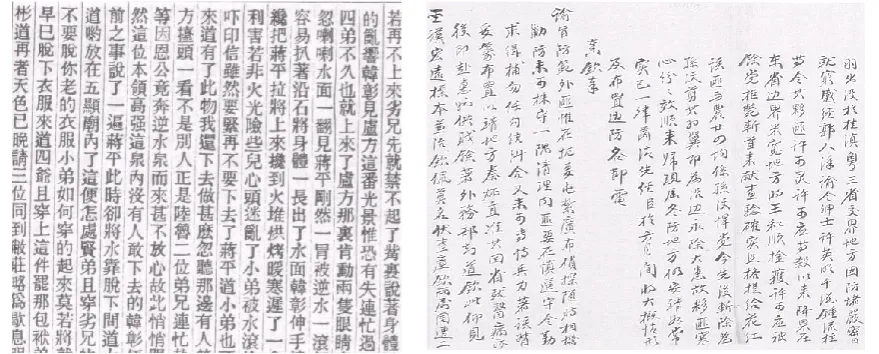
Chinese word segmentation is a well-known and widely studied problem in Chinese language processing. In Classical Chinese processing, sen-tence segmentation is an even more vexing issue. Unlike English and other western languages, there is no delimiter marking the end of the word in Chinese. Moreover, not only is there a lack of delimiters between the words, almost all pre-20th century Chinese is written without any punctuation marks. Figure 1 shows photocopies of printed and hand written documents from the 19th century. Within any given paragraph, the Chinese characters are printed as evenly spaced characters, with nothing to separate words from words, phrases from phrases, and sentences from sentences. Thus, inside a paragraph, explicit
boundaries of sentences and clauses are lacking. In order to understand the structure, readers of Classical Chinese have to manually identify these boundaries during the reading. This process is called Classical Chinese sentence segmentation, or Judo (句讀).
For example, the opening lines of the Daoist classic Zhuangzi originally lacked segmentation:
北/north 冥/ocean 有/have魚/fish 其/it 名/name 為/is 鯤/Kun (a kind of big fish) 鯤/Kun 之/of 大/big 不/not 知/know 幾/how 千/thousand 里 /mile 也/exclamation
The meaning of the text is hard to interpret without segmentation. Below is the identical text as segmented by a human being. It is clearly more readable.
北冥有魚/in the north ocean there is a fish 其名為鯤 /its name is Kun
鯤之大/the size of the Kun
不知幾千里也/I don’t know how many thousand miles the fish is
Figure 1. A Printed Page (Left) and a Hand Written Manuscript (Right) from the 19th Century.
Because of the importance of sentence seg-mentation, beginning in the 20th century, some editions of the Chinese classics have been labor-intensively segmented and marked with modern punctuation. However, innumerable documents in Classical Chinese from the centuries of Chi-nese history remain to be segmented. To aid in processing these documents, we propose an au-tomated Classical Chinese sentence segmenta-tion approach that enables complesegmenta-tion of seg-mentation tasks quickly and accurately. To con-struct the sentence segmenter for Classical Chi-nese, the popular sequence tagging models, con-ditional random field (CRF) (Lafferty et al., 2001), are adopted in this study.
The rest of this paper is organized as follows. First, we describe the Classical Chinese sentence segmentation problem in Section 2. In Section 3, we review the relevant literature, including sen-tence boundary detection (SBD) and Chinese word segmentation. In Section 4, we introduce the tagging schemes along with the features, and show how the sentence segmentation problem can be transformed into a sequence tagging problem and decoded with CRFs. In Section 5, the experimental setup and data are described. In Section 6, we report the experimental results and discuss the properties and the challenges of the Classical Chinese sentence segmentation prob-lem. Finally, we conclude the remarks in Section 7.
2
Problem Description
The outcomes of Classical Chinese sentence
segmentation are not well-defined in linguistics at present. In general, the results of segmentation consist of sentences, clauses, and phrases. For instance, in the segmented sentence “野馬也 / 塵埃也 / 生物之以息相吹也”, “野馬也” (“the mists on the mountains like wild horses”) and “塵埃也” (“the dust in the air”) are phrases, and ” 生物之以息相吹也” (“the living creatures blow their breaths at each other”) is a clause. A sentence such as “吾以是狂而不信也” (“I do not believe it because it is ridiculous.”) is a short sentence itself, and does not require any segmentation. For a given text, there is no strict rule to determine at which level the segmentation should be performed. For instance, the opening lines of the Daoist classic Daodejing is “道可道非常道名可名非常名” (“The way that can be spoken is not the eternal way. The name that can be given is not the eternal name.”) which is usually segmented as “道可道 / 非常道 / 名可名 / 非常名”, but may also be segmented as “道 / 可道 / 非常道 / 名 / 可名 / 非常名”. Either segmentation is reasonable.
3
Related Work
Besides Classical Chinese, sentence boundary detection (SBD) is also an issue in English and other western languages. SBD in written texts and speech represents quite different problems. For written text, the SBD task is to distinguish periods used as the end-of-sentence indicator (full stop) from other usages, such as parts of abbreviations and decimal points. By contrast, the task of SBD in speech is closely related to the task of Classical Chinese sentence segmenta-tion. In speech processing, the outcome of speech recognizers is a sequence of words, in which the punctuation marks are absence, and the sentence boundaries are thus lacking. To re-cover the syntactic structure of the original speech, SBD is required.
Like Classical Chinese sentence segmentation, the task of SBD in speech is to determine which of the inter-word boundaries in the stream of words should be marked as end-of-sentence, and then to divide the entire word sequence into in-dividual sentences. Empirical methods are com-monly employed to deal with this problem. Such methods involve many different sequence labe-ling models including HMMs (Shriberg et al., 2000), maximum entropy (Maxent) models (Liu et al., 2004), and CRFs (Liu et al., 2005). Among these, a CRF model used in Liu et al (2005) offered the lowest error rate.
Chinese word segmentation is a problem closely related to Classical Chinese sentence segmentation. The former identifies the bounda-ries of the words in a given text, while the latter identifies the boundaries of the sentences, claus-es, and phrases. In contrast to sentences and clauses, the length of Chinese words is shorter, and the variety of Chinese words is more limited. Despite the minor unknown words, most of the frequent words can be handled with a dictionary predefined by Chinese language experts or ex-tracted from the corpus automatically. However, it is impossible to maintain a dictionary of the infinite number of sentences and clauses. For these reasons, the Classical Chinese sentence segmentation problem is more challenging.
Methods of Chinese word segmentation can be mainly classified into heuristic rule-based approaches, statistical machine learning proaches, and hybrid approaches. Hybrid
ap-proaches combine the advantages of heuristic and statistical approaches to achieve better re-sults (Gao et al., 2003; Xue, 2003; Peng et al., 2004).
Xue (2003) transformed the Chinese word segmentation problem into a tagging problem. For a given sequence of Chinese characters, the author applies a Maxent tagger to assign each character one of four positions-of-character (POC) tags, and then coverts the tagged se-quence into a segmented sese-quence. The four POC tags used in Xue (2003) denote the posi-tions of characters within a word. For example, the first character of a word is tagged “left boundary”, the last character of a word is tagged “right boundary”, the middle character of a word is tagged “middle”, and a single character that forms a word by itself is tagged “single-character-word”. Once the given sequence is tagged, the boundaries of words are also re-vealed, and the task of segmentation becomes straightforward. However, the Maxent models used in Xue (2003) suffer from an inherent the label bias problem. Peng et al (2004) uses the CRFs to address this issue. The tags used in Peng et al (2004) are of only two types, “start” and “non-start”, in which the “start” tag denotes the first character of a word, and the characters in other positions are given the “non-start” tag.
The closest previous works to Classic Chinese sentence segmentation are Huang (2008) and Zhang et al. (2009). Huang combined the Xue’s tagging scheme (i.e., 4-tag set) and CRFs to ad-dress the Classical Chinese sentence segmenta-tion problem and reported an F-score of 80.96% averaged over various datasets. A similar work by Zhang et al. reported an F-score of 71.42%.
4
Methods
Conditional random field is our tagging model, and the implementation is CrfSgd 1.31 provided
by Léon Bottou. As denoted by the tool name, the parameters in this implementation are opti-mized using Stochastic Gradient Descent (SGD) which convergences much faster than the com-mon optimization algorithms such as L-BFGS and conjugate gradient (Vishwanathan, et al., 2006). To construct the sentence segmenter on
CRF, the tagging scheme and the feature func-tions play the crucial roles.
4.1 Tagging Schemes
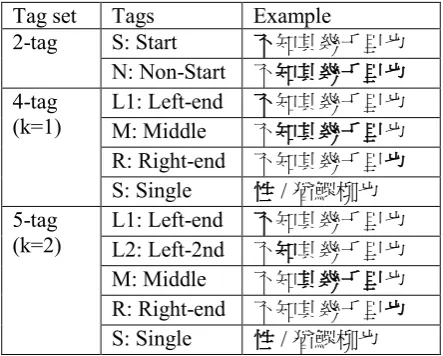
In the previous works (Huang, 2008; Zhang et al., 2009), POC tags used in Chinese word seg-mentation (Xue, 2003) are converted to denote the positions of characters within a clause. The 4-tag set is redefined as L (“the left boundary of a clause”), R (“the right boundary of a clause”), M (“the middle character of a clause”), and S (“a single character forming a clause”). For example, the sentence “北冥有魚其名為鯤鯤之大不知幾 千里也” should be tagged as follows.
北/L 冥/M 有/M 魚/R 其/L 名/M 為/M 鯤/R 鯤 /L 之/M 大/R 不/L 知/M 幾/M 千/M 里/M 也/R
We can easily split the sentence into clauses by making a break after each character tagged R and S and obtain the final outcome “北冥有魚 / 其名為鯤 / 鯤之大 / 不知幾千里也”.
In this work, more tagging schemes are expe-rimented. The basic tagging scheme for segmen-tation is 2-tag set in which only two types of tags, “start” and “non-start”, are used to label the se-quence. The segmented fragments (clauses) for sentence segmentation are usually much longer than those for word segmentation. Thus, we add more middle states into the 4-tag set to model the nature of long fragments. The Markov chain of our tagging scheme is shown in Figure 2, where L2, L3, …, Lk are the additional states to extend Xue’s 4-tag set. In our experiments, vari-ous k values are tested. If the k value is 1, the scheme is identical to the one used in the two previous works (Zhang et al., 2009; Huang, 2008). The 2-tag set, 4-tag set, 5-tag set and their corresponding examples are listed in Table 1. With the tagging scheme, the Classical Chinese sentence segmentation task is transformed into a sequence labeling or tagging task.
4.2 Features
[image:4.595.307.522.70.170.2]Due to the flexibility of the feature function in-terface provided by CRFs, we apply various fea-ture conjunctions. Besides the n-gram character patterns, the phonetic information and the part-
Figure 2. Markov Chain of Our Tagging Scheme.
Tag set Tags Example
2-tag S: Start 不知其幾千里也 N: Non-Start 不知其幾千里也 4-tag
(k=1)
L1: Left-end 不知其幾千里也 M: Middle 不知其幾千里也 R: Right-end 不知其幾千里也 S: Single 性 / 猶鰥柳也 5-tag
(k=2)
L1: Left-end 不知其幾千里也 L2: Left-2nd 不知其幾千里也 M: Middle 不知其幾千里也 R: Right-end 不知其幾千里也 S: Single 性 / 猶鰥柳也 Table 1. Examples of Tag Sets.
of-speech (POS) are also included. The pronun-ciation of each Chinese character is labeled in three ways. The first one is Mandarin Phonetic Symbols (MPS), also known as Bopomofo, which is a phonetic system for Modern Chinese. The initial/final/tone of each character can be obtained from its MPS label.
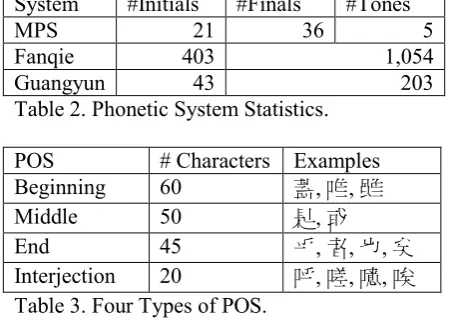
However, Chinese pronunciation varies in the thousands of years, and the pronunciation of Modern Chinese is much different from the Classical Chinese. For this reason, two Ancient Chinese phonetic systems, Fanqie (反切) and Guangyun (廣韻), are applied to label the cha-racters. The pronunciation of a target character is represented by two characters in the Fanqie sys-tem. The first character indicates the initial of the target character, and the second character indicates the combination of the final and the tone. The Guangyun system is in a similar man-ner with a smaller phonetic symbol set. There are 8,157 characters in our phonetic dictionary and the statistics are shown in Table 2.
[image:4.595.304.526.214.392.2]System #Initials #Finals #Tones MPS 21 36 5 Fanqie 403 1,054 Guangyun 43 203 Table 2. Phonetic System Statistics.
POS # Characters Examples Beginning 60 蓋, 唯, 雖 Middle 50 是, 或
End 45 乎, 者, 也, 矣 Interjection 20 呼, 嗟, 噫, 唉 Table 3. Four Types of POS.
tagger at this moment. Instead, we collected three types of particles that are usually placed at the beginning, at the middle, and at the end of Classical Chinese clauses. In addition, the inter-jections which are usually used at the end of clauses are also collected. Some examples are given in Table 3. The five feature sets and the feature templates are shown in Table 4.
5
Experiments
There are three major sets of experiments. In the 1st set of experiments, we test different tagging schemes for Classical Chinese sentence segmen-tation. In the 2nd set of experiments, all kinds of
feature sets and their combinations are tested. The performances of the first two sets of expe-riments are evaluated by 10-fold cross-validation on four datasets which cross both eras and con-texts. In the 3rd set of experiments, we train the system on one dataset, and test it on the others. In last part of the experiments, the generality of the datasets and the toughness of our system are tested (Peng et al., 2004). The cut-off threshold for the features is set to 2 for all the experiments. In other words, the features occur only once in the training set will be ignored. The other op-tions of CrfSgd remain default.
5.1 Datasets
The datasets used in the evaluation are collected from the corpora of the Pre-Qin and Han Dynas-ties (the 5th century BCE to the 1st century BCE) and the Qing Dynasty (the 17th century CE to the 20th century CE). Chinese in the 19th cen-tury is fairly different from Chinese in the era before 0 CE. In ancient Chinese, the syntax is much simpler, the sentences are shorter, and the words are largely composed of a single character. Those are unlike later and more modern Chinese, where word segmentation is a serious issue. Given these properties, the task of segmenting
Feature Set Template Function Character 𝐶𝑖, −2 ≤ 𝑖 ≤ 2 Unigrams
𝐶𝑖𝐶𝑖+1, −2 ≤ 𝑖 ≤ 1 Bigrams
𝐶𝑖𝐶𝑖+1𝐶𝑖+2, −2 ≤ 𝑖 ≤ 0 Trigrams
𝐶𝑖𝐶𝑖+2, −2 ≤ 𝑖 ≤ 0 Jumps
POS 𝑃𝑂𝑆_𝐵(𝐶0) Current character serves as a clause-beginning particle.
𝑃𝑂𝑆_𝑀(𝐶0) Current character serves as a clause-middle particle.
𝑃𝑂𝑆_𝐸(𝐶0) Current character serves as a clause-end particle.
𝑃𝑂𝑆_𝐼(𝐶0) Current character serves as an interjection.
MPS 𝑀_𝐼(𝐶0) The initial of current character in MPS.
𝑀_𝐹(𝐶0) The final of current character in MPS.
𝑀_𝑇(𝐶0) The tone of current character in MPS.
𝑀_𝐹(𝐶−1)𝑀_𝑇(𝐶−1)𝑀_𝐼(𝐶0) The connection between successive characters. Fanqie 𝐹_𝐼(𝐶0) The initial of current character in Fanqie.
𝐹_𝐹(𝐶0) The final and the tone of current character in Fanqie.
𝐹_𝐹(𝐶−1)𝐹_𝐼(𝐶0) The connection between successive characters.
Guangyun 𝐺_𝐼(𝐶0) The initial of the current character in Guangyun.
𝐺_𝐹(𝐶0) The final and the tone of current character in
Guan-gyun.
[image:5.595.67.535.444.717.2]𝐺_𝐹(𝐶−1)𝐺_𝐼(𝐶0) The connection between successive characters.
Corpus Author Era # of data
entries characters # of Size of cha-racter set characters/clause Average # of
Zuozhuan Zuo Qiuming 500 BCE 3,381 195,983 3,238 4.145
Zhuangzi Zhuangzi 300 BCE 1,128 65,165 2,936 5.183
Shiji Qian Sima 100 BCE 4,778 503,890 4,788 5.049
Qing Documents Qing Dynasty
[image:6.595.72.529.72.148.2]Officials 19th century 1,000 111,739 3,147 7.199
Table 5. Datasets and Statistics.
ancient Chinese sentences is easier than that of segmenting later Chinese ones. Thus, we col-lected texts from the pre-Qin and Han period, and from the late Qing Dynasty closer to the present, to show that our system can handle Classical Chinese as it has evolved across a span of two thousand years.
A summary of the four datasets is listed in Table 5. The Zuozhuan is one of earliest histori-cal works, recording events of China in the Spring and Autumn Period (from 722 BCE to 481 BCE). The book Zhuangzi was named after its semi-legendary author, the Daoist philoso-pher Zhuangzi, who lived around the 4th century BCE. The book consists of stories and fables, in which the philosophy of the Dao is propounded. The Shiji, known in English as The Records of the Grand Historian, was written by Qian Sima in the 1st century BCE. It narrates Chinese histo-ry from 2600 BCE to 100 BCE. The Shiji is not only an extremely long book of more than 500,000 characters, but also the chief historical work of ancient China, exerting an enormous influence on subsequent Chinese literature and historiography.
The three ancient works are the most impor-tant classics of Chinese literature. We fetched well-segmented electronic editions of these works from the online database of the Institute of History and philology of the Academia Sinica, Taiwan.2 Each work was partitioned into
para-graphs forming a single data entry, which acted as the basic unit of training and testing. The da-taset of Qing documents is selected from the Qing Palace Memorials (奏摺) related to Taiwan written in the 19th century. These documents were kindly provided by the Taiwan History Digital Library and have also been human-segmented and stored on electronic media (Chen et al., 2007). We randomly selected 1,000 para-graphs from them as our dataset.
2http://hanji.sinica.edu.tw
5.2 Evaluation Metrics
For Classical Chinese sentence segmentation, we define the precision P as the ratio of the bounda-ries of clauses which are correctly segmented to all segmented boundaries, the recall R as the ra-tio of correctly segmented boundaries to all ref-erence boundaries, and the score F as the har-monic mean of precision and recall:
𝐹 =𝑃 × 𝑅 × 2 𝑃 + 𝑅
[image:6.595.307.528.288.421.2]Dataset Precision Recall F-Score Zuozhuan 100% 32.80% 42.73% Zhuangzi 100% 19.84% 29.83% Shiji 100% 14.11% 20.63% Qing Doc. 100% 33.08% 41.42% Average 100% 24.96% 33.65% Table 6. Performance of Majority-Class Baseline.
[image:6.595.306.526.538.711.2]Tag Set Precision Recall F-Score 2-tag set 85.00% 82.16% 82.92% 4-tag set 85.11% 82.13% 82.95% 5-tag set 85.26% 82.36% 83.18% 7-tag set 84.47% 82.18% 82.74% Baseline 100% 24.96% 33.65% Table 7. Comparison between Tagging Schemes.
Features Precision Recall F-Score Character 85.26% 82.36% 83.18% POS 61.04% 40.35% 43.93% MPS 65.31% 54.00% 56.31% Fanqie 80.96% 76.80% 77.95% Guangyun 73.11% 69.13% 69.59%
POS + Fanqie
81.07% 74.91% 76.77%
Character + Fanqie
85.43% 82.52% 83.34%
Character + POS +
Fanqie
85.67% 81.70% 82.98%
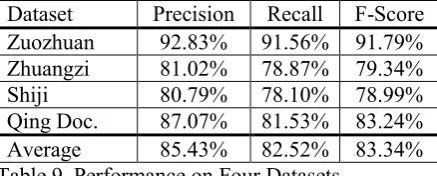
Dataset Precision Recall F-Score Zuozhuan 92.83% 91.56% 91.79% Zhuangzi 81.02% 78.87% 79.34% Shiji 80.79% 78.10% 78.99% Qing Doc. 87.07% 81.53% 83.24% Average 85.43% 82.52% 83.34% Table 9. Performance on Four Datasets.
6
Results
Our baseline is a majority-class tagger which always regards the whole paragraph as a single sentence (i.e., never segments). In Table 6, the performance of the baseline is given. In the 1st set of experiments, four tagging schemes are tested while the feature set is Character. The re-sults are shown in Table 7. In the table, each of the precision, the recall, and the F-score are av-eraged over the four datasets for each scheme. The results show that the CRF with the 5-tag set is superior to the 4-tag set used in previous works. However, the performance is degraded when the k is larger.
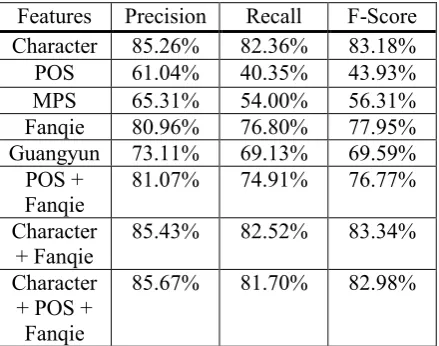
In the 2nd set of experiments, the tag scheme is fixed to the 5-tag set and a number of feature set combinations are tested. The results are shown in Table 8. The performance of MPS is significantly inferior to the other two phonetic systems. As expected, the pronunciation of Clas-sical Chinese is much different from that of Modern Chinese, thus the Ancient Chinese pho-netic systems are more suitable for this work. The Fanqie has a surprisingly performance close to the Character. However, performance of the combination of Character and Fanqie is similar to the performance of Character only model. This result indicates that the phonetic informa-tion is an important clue to Classical Chinese sentence segmentation but such information is mostly already covered by the characters. Be-sides, the simple POS features do not help a lot. The higher precision and the lower recall of the
POS features show that the particles such as 之/ 乎/者/也 is indeed a clue to segmentation, but does not catch enough cases.
The best performance comes from the com-bination of Character and Fanqie with the 5-tag set. We use this configuration as our final tagger. The performances of our tagger for each dataset are given in Table 9. The result shows that our tagger achieves fairly good performance on the Zuozhuan segmentation, while obtaining accept-able performance overall. Because the 19th cen-tury Chinese is more complex than ancient Chi-nese, what we had assumed was that segmenta-tion of the Qing documents would more difficult. However, the results indicate that our assump-tion does not seem to be true. Our tagger per-forms the sentence segmentation on the Qing documents well, even better than on the Zhuang-zi and on the Shiji. The issues of longer clauses and word segmentation described earlier in this paper do not significantly affect the performance of our system.
In the last experiments, our system is trained and tested on different datasets, and the results are presented in Table 10, where the training datasets are in the rows and the test datasets are in the columns, and the F-scores of the segmen-tation performance are shown in the inner entries. As expected, the results of segmentation tasks across datasets are significantly poorer than the segmentation in the first two experiments.
These results indicate that our system main-tains its performance on a test dataset differing from the training dataset, but the difference in written eras between the test dataset and training dataset cannot be very large. Among all datasets, Shiji is the best training dataset. As training on Shiji and testing on the two other ancient corpo-ra Zuozhuan and Zhuangzi, the performances of our CRF segmenter are not bad.
Training Set Testing Set
Zuozhuan Zhuangzi Shiji Qing doc. Average Zuozhuan 72.04% 59.12% 38.85% 56.67% Zhuangzi 63.70% 52.51% 42.75% 52.99% Shiji 76.27% 75.46% 44.11% 65.28% Qing doc. 52.68% 53.13% 42.61% 49.47%
[image:7.595.76.295.72.160.2]7
Conclusion
Our Classical Chinese sentence segmentation is important for many applications such as text mining, information retrieval, corpora research, and digital archiving. To aid in processing such kind of data, an automatic sentence segmenta-tion system is proposed. Different tagging schemes and various features are introduced and tested. Our system was evaluated using three sets of experiments. Five main results are de-rived. First, the CRF segmenter achieves an F-score of 91.79% in the best case and 83.34% in overall performance. Second, a little longer tag-ging scheme improves the performance. Third, the phonetic information, especially sourced from Fanqie, is an important clue for Classical Chinese sentence segmentation and may be use-ful in the related tasks. Fourth, our method per-forms well on data from various eras. In the ex-periments, texts from both 500 BCE and the 19th century were well-segmented. Last, the CRF segmenter maintains a certain level of per-formance in situations which the test data and the training data differ in authors, genres, and written styles, but eras in which they were pro-duced are sufficiently close.
References
Chen, Szu-Pei, Jieh Hsiang, Hsieh-Chang Tu, and Micha Wu. 2007. On Building a Full-Text Digital Library of Historical Documents. In Proceedings of the 10th International Conference on Asian Digital Libraries, Lecture Notes in Computer Science, Springer-Verlag 4822:49-60.
Gao, Jianfeng, Mu Li, and Chang-Ning Huang. 2003. Improved Source-Channel Models for Chinese Word Segmentation. In Proceedings of the 41st Annual Meeting of the Association for Computa-tional Linguistics, 272-279.
Huang, Hen-Hsen. 2008. Classical Chinese Sentence
Division by Sequence Labeling Approaches.
Mas-ter’s Thesis, National Chiao Tung University, Hsinchu, Taiwan.
Lafferty, John, Andrew McCallum, and Fernando Pereira. 2001. Conditional Random Fields: Proba-bilistic Models for Segmentation and Labeling Se-quence Data. In Proceedings of the 18th
Interna-tional Conference on Machine Learning, 282-289.
Liu, Yang, Andreas Stolcke, Elizabeth Shriberg, and Mary Harper. 2004. Comparing and Combining Generative and Posterior Probability Models: Some Advances in Sentence Boundary Detection in Speech. In Proceedings of the Conference on Empirical Methods in Natural Language Processing.
Liu, Yang, Andreas Stolcke, Elizabeth Shriberg, and Mary Harper. 2005. Using Conditional Random Fields for Sentence Boundary Detection in Speech.
In Proceedings of the 43rd Annual Meeting of the
Association for Computational Linguistics, 451-458. Ann Arbor, Mich., USA.
Peng, Fuchun, Fangfang Feng, and Andrew McCal-lum. 2004. Chinese Segmentation and New Word Detection using Conditional Random Fields. In
Proceedings of the 20th International Conference on Computational Linguistics, 562-568.
Shriberg, Elizabeth, Andreas Stolcke, Dilek Hakkani-Tür, and Gökhan Tür. 2000. Prosody-Based Au-tomatic Segmentation of Speech into Sentences and Topics. Speech Communication, 32(1-2):127-154.
Vishwanathan, S. V. N., Nicol N. Schraudolph, Mark W. Schmidt, and Kevin P. Murphy. 2006. Accele-rated training of conditional random fields with stochastic gradient methods. In Proceedings of the 23th International Conference on Machine Learn-ing, 969–976. ACM Press, New York, USA. Xue, Nianwen. 2003. Chinese Word Segmentation as
Character Tagging. Computational Linguistics and
Chinese Language Processing, 8(1):29-48.
Zhang, Hel, Wang Xiao-dong, Yang Jian-yu, and Zhou Wei-dong. 2009. Method of Sentence Seg-mentation and Punctuating for Ancient Chinese.