Findings of the 2009 Workshop on Statistical Machine Translation
Chris Callison-Burch
Johns Hopkins University ccb cs jhu edu
Philipp Koehn
University of Edinburgh pkoehn inf ed ac uk
Christof Monz
University of Amsterdam christof science uva nl
Josh Schroeder
University of Edinburgh j schroeder ed ac uk
Abstract
This paper presents the results of the WMT09 shared tasks, which included a translation task, a system combination task, and an evaluation task. We con-ducted a large-scale manual evaluation of 87 machine translation systems and 22 system combination entries. We used the ranking of these systems to measure how strongly automatic metrics correlate with human judgments of translation quality, for more than 20 metrics. We present a new evaluation technique whereby system output is edited and judged for correctness.
1 Introduction
This paper presents the results of the shared tasks of the 2009 EACL Workshop on Statistical Ma-chine Translation, which builds on three previ-ous workshops (Koehn and Monz, 2006; Callison-Burch et al., 2007; Callison-Callison-Burch et al., 2008). There were three shared tasks this year: a transla-tion task between English and five other European languages, a task to combine the output of multiple machine translation systems, and a task to predict human judgments of translation quality using au-tomatic evaluation metrics. The performance on each of these shared task was determined after a comprehensive human evaluation.
There were a number of differences between this year’s workshop and last year’s workshop:
• Larger training sets– In addition to annual increases in the Europarl corpus, we released a French-English parallel corpus verging on 1 billion words. We also provided large mono-lingual training sets for better language mod-eling of the news translation task.
• Reduced number of conditions – Previ-ous workshops had many conditions: 10 language pairs, both in-domain and out-of-domain translation, and three types of man-ual evaluation. This year we eliminated the in-domain Europarl test set and defined sentence-level ranking as the primary type of manual evaluation.
• Editing to evaluate translation quality – Beyond ranking the output of translation sys-tems, we evaluated translation quality by hav-ing people edit the output of systems. Later, we asked annotators to judge whether those edited translations were correct when shown the source and reference translation.
The primary objectives of this workshop are to evaluate the state of the art in machine transla-tion, to disseminate common test sets and pub-lic training data with published performance num-bers, and to refine evaluation methodologies for machine translation. All of the data, translations, and human judgments produced for our workshop are publicly available.1 We hope they form a valuable resource for research into statistical ma-chine translation, system combination, and auto-matic evaluation of translation quality.
2 Overview of the shared translation and system combination tasks
The workshop examined translation between En-glish and five other languages: German, Spanish, French, Czech, and Hungarian. We created a test set for each language pair by translating news-paper articles. We additionally provided training data and a baseline system.
2.1 Test data
The test data for this year’s task was created by hiring people to translate news articles that were drawn from a variety of sources during the pe-riod from the end of September to mid-October of 2008. A total of 136 articles were selected, in roughly equal amounts from a variety of Czech, English, French, German, Hungarian, Italian and Spanish news sites:2
Hungarian: hvg.hu (10), Napi (2), MNO (4), N´epszabads´ag (4)
Czech: iHNed.cz (3), iDNES.cz (4), Li-dovky.cz (3), aktu´alnˇe.cz (2), Novinky (1)
French: dernieresnouvelles (1), Le Figaro (2), Les Echos (4), Liberation (4), Le Devoir (9)
Spanish: ABC.es (11), El Mundo (12)
English: BBC (11), New York Times (6), Times of London (4),
German: S¨uddeutsche Zeitung (3), Frankfurter Allgemeine Zeitung (3), Spiegel (8), Welt (3)
Italian: ADN Kronos (5), Affari Italiani (2), ASCA (1), Corriere della Sera (4), Il Sole 24 ORE (1), Il Quotidiano (1), La Republica (8)
Note that Italian translation was not one of this year’s official translation tasks.
The translations were created by the members of EuroMatrix consortium who hired a mix of professional and non-professional translators. All translators were fluent or native speakers of both languages. Although we made efforts to proof-read all translations, many sentences still contain minor errors and disfluencies. All of the transla-tions were done directly, and not via an interme-diate language. For instance, each of the 20 Hun-garian articles were translated directly into Czech, English, French, German, Italian and Spanish. The total cost of creating the test sets consisting of roughly 80,000 words across 3027 sentences in seven languages was approximately 31,700 euros (around 39,800 dollars at current exchange rates, or slightly more than $0.08/word).
Previous evaluations additionally used test sets drawn from the Europarl corpus. Our rationale be-hind discontinuing the use of Europarl as a test set was that it overly biases towards statistical systems that were trained on this particular domain, and
2For more details see the XML test files. Thedocid
tag gives the source and the date for each document in the test set, and theoriglangtag indicates the original source language.
that European Parliament proceedings were less of general interest than news stories. We focus on a single task since the use of multiple test sets in the past spread our resources too thin, especially in the manual evaluation.
2.2 Training data
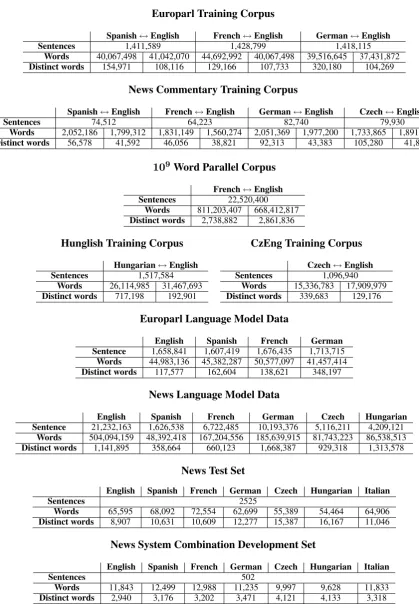
As in past years we provided parallel corpora to train translation models, monolingual corpora to train language models, and development sets to tune parameters. Some statistics about the train-ing materials are given in Figure 1.
109word parallel corpus
To create the large French-English parallel cor-pus, we conducted a targeted web crawl of bilin-gual web sites. These sites came from a variety of sources including the Canadian government, the European Union, the United Nations, and other international organizations. The crawl yielded on the order of 40 million files, consisting of more than 1TB of data. Pairs of translated documents were identified using a set of simple heuristics to transform French URLs into English URLs (for in-stance, by replacingfr withen). Documents that matched were assumed to be translations of each other.
All HTML and PDF documents were converted into plain text, which yielded 2 million French files paired with their English equivalents. Text files were split so that they contained one sen-tence per line and had markers between para-graphs. They were sentence-aligned in batches of 10,000 document pairs, using a sentence aligner that incorporates IBM Model 1 probabilities in ad-dition to sentence lengths (Moore, 2002). The document-aligned corpus contained 220 million segments with 2.9 billion words on the French side and 215 million segments with 2.5 billion words on the English side. After sentence alignment, there were 177 million sentence pairs with 2.5 bil-lion French words and 2.2 bilbil-lion English words.
Europarl Training Corpus
Spanish↔English French↔English German↔English
Sentences 1,411,589 1,428,799 1,418,115
Words 40,067,498 41,042,070 44,692,992 40,067,498 39,516,645 37,431,872
Distinct words 154,971 108,116 129,166 107,733 320,180 104,269
News Commentary Training Corpus
Spanish↔English French↔English German↔English Czech↔English
Sentences 74,512 64,223 82,740 79,930
Words 2,052,186 1,799,312 1,831,149 1,560,274 2,051,369 1,977,200 1,733,865 1,891,559
Distinct words 56,578 41,592 46,056 38,821 92,313 43,383 105,280 41,801
109Word Parallel Corpus
French↔English
Sentences 22,520,400
Words 811,203,407 668,412,817
Distinct words 2,738,882 2,861,836
Hunglish Training Corpus CzEng Training Corpus
Hungarian↔English
Sentences 1,517,584
Words 26,114,985 31,467,693
Distinct words 717,198 192,901
Czech↔English
Sentences 1,096,940
Words 15,336,783 17,909,979
Distinct words 339,683 129,176
Europarl Language Model Data
English Spanish French German
Sentence 1,658,841 1,607,419 1,676,435 1,713,715
Words 44,983,136 45,382,287 50,577,097 41,457,414
Distinct words 117,577 162,604 138,621 348,197
News Language Model Data
English Spanish French German Czech Hungarian
Sentence 21,232,163 1,626,538 6,722,485 10,193,376 5,116,211 4,209,121
Words 504,094,159 48,392,418 167,204,556 185,639,915 81,743,223 86,538,513
Distinct words 1,141,895 358,664 660,123 1,668,387 929,318 1,313,578
News Test Set
English Spanish French German Czech Hungarian Italian
Sentences 2525
Words 65,595 68,092 72,554 62,699 55,389 54,464 64,906
Distinct words 8,907 10,631 10,609 12,277 15,387 16,167 11,046
News System Combination Development Set
English Spanish French German Czech Hungarian Italian
Sentences 502
Words 11,843 12,499 12,988 11,235 9,997 9,628 11,833
[image:3.595.84.504.86.700.2]Distinct words 2,940 3,176 3,202 3,471 4,121 4,133 3,318
In addition to cleaning the sentence-aligned par-allel corpus we also de-duplicated the corpus, re-moving all sentence pairs that occured more than once in the parallel corpus. Many of the docu-ments gathered in our web crawl were duplicates or near duplicates, and a lot of the text is repeated, as with web site navigation. We further elimi-nated sentence pairs that varied from previous sen-tences by only numbers, which helped eliminate template web pages such as expense reports. We used a Bloom Filter (Talbot and Osborne, 2007) to do de-duplication, so it may have discarded more sentence pairs than strictly necessary. After de-duplication, the parallel corpus contained 28 mil-lion sentence pairs with 0.8 bilmil-lion French words and 0.7 billion English words.
Monolingual news corpora
We have crawled the news sources that were the basis of our test sets (and a few more additional sources) since August 2007. This allowed us to assemble large corpora in the target domain to be mainly used as training data for language mod-eling. We collected texts from the beginning of our data collection period to one month before the test set period, segmented these into sentences and randomized the order of the sentences to obviate copyright concerns.
2.3 Baseline system
To lower the barrier of entry for newcomers to the field, we provided Moses, an open source toolkit for phrase-based statistical translation (Koehn et al., 2007). The performance of this baseline sys-tem is similar to the best submissions in last year’s shared task. Twelve participating groups used the Moses toolkit for the development of their system.
2.4 Submitted systems
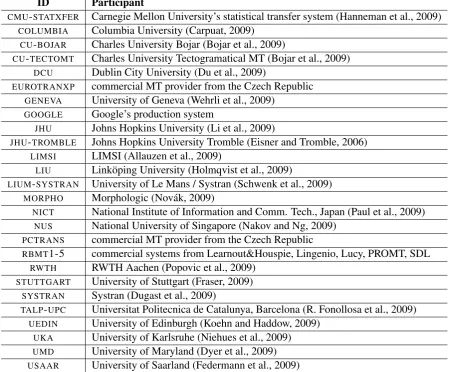
We received submissions from 22 groups from 20 institutions, as listed in Table 1, a similar turnout to last year’s shared task. Of the 20 groups that participated with regular system sub-missions in last year’s shared task, 12 groups re-turned this year. A major hurdle for many was a DARPA/GALE evaluation that occurred at the same time as this shared task.
We also evaluated 7 commercial rule-based MT systems, and Google’s online statistical machine translation system. We note that Google did not submit an entry itself. Its entry was created by
the WMT09 organizers using Google’s online sys-tem.3 In personal correspondence, Franz Och clarified that the online system is different from Google’s research system in that it runs at faster speeds at the expense of somewhat lower transla-tion quality. On the other hand, the training data used by Google is unconstrained, which means that it may have an advantage compared to the re-search systems evaluated in this workshop, since they were trained using only the provided materi-als.
2.5 System combination
In total, we received 87 primary system submis-sions along with 42 secondary submissubmis-sions. These were made available to participants in the sys-tem combination shared task. Based on feedback that we received on last year’s system combina-tion task, we provided two addicombina-tional resources to participants:
• Development set: We reserved 25 articles to use as a dev set for system combina-tion (details of the set are given in Table 1). These were translated by all participating sites, and distributed to system combination participants along with reference translations.
• n-best translations: We requested n-best lists from sites whose systems could produce them. We received 25100-best lists accom-panying the primary system submissions, and 5 accompanying the secondary system sub-missions.
In addition to soliciting system combination en-tries for each of the language pairs, we treated sys-tem combination as a way of doingmulti-source
translation, following Schroeder et al. (2009). For the multi-source system combination task, we pro-vided all 46 primary system submissions from any language into English, along with an additional 32 secondary systems.
Table 2 lists the six participants in the system combination task.
3 Human evaluation
As with past workshops, we placed greater em-phasis on the human evaluation than on the auto-matic evaluation metric scores. It is our contention
ID Participant
CMU-STATXFER Carnegie Mellon University’s statistical transfer system (Hanneman et al., 2009)
COLUMBIA Columbia University (Carpuat, 2009)
CU-BOJAR Charles University Bojar (Bojar et al., 2009)
CU-TECTOMT Charles University Tectogramatical MT (Bojar et al., 2009)
DCU Dublin City University (Du et al., 2009)
EUROTRANXP commercial MT provider from the Czech Republic
GENEVA University of Geneva (Wehrli et al., 2009)
GOOGLE Google’s production system
JHU Johns Hopkins University (Li et al., 2009)
JHU-TROMBLE Johns Hopkins University Tromble (Eisner and Tromble, 2006)
LIMSI LIMSI (Allauzen et al., 2009)
LIU Link¨oping University (Holmqvist et al., 2009)
LIUM-SYSTRAN University of Le Mans / Systran (Schwenk et al., 2009)
MORPHO Morphologic (Nov´ak, 2009)
NICT National Institute of Information and Comm. Tech., Japan (Paul et al., 2009)
NUS National University of Singapore (Nakov and Ng, 2009)
PCTRANS commercial MT provider from the Czech Republic
RBMT1-5 commercial systems from Learnout&Houspie, Lingenio, Lucy, PROMT, SDL
RWTH RWTH Aachen (Popovic et al., 2009)
STUTTGART University of Stuttgart (Fraser, 2009)
SYSTRAN Systran (Dugast et al., 2009)
TALP-UPC Universitat Politecnica de Catalunya, Barcelona (R. Fonollosa et al., 2009)
UEDIN University of Edinburgh (Koehn and Haddow, 2009)
UKA University of Karlsruhe (Niehues et al., 2009)
UMD University of Maryland (Dyer et al., 2009)
[image:5.595.74.528.108.480.2]USAAR University of Saarland (Federmann et al., 2009)
Table 1: Participants in the shared translation task. Not all groups participated in all language pairs.
ID Participant
BBN-COMBO BBN system combination (Rosti et al., 2009)
CMU-COMBO Carnegie Mellon University system combination (Heafield et al., 2009)
CMU-COMBO-HYPOSEL CMU system comb. with hyp. selection (Hildebrand and Vogel, 2009)
DCU-COMBO Dublin City University system combination
RWTH-COMBO RWTH Aachen system combination (Leusch et al., 2009)
USAAR-COMBO University of Saarland system combination (Chen et al., 2009)
Language Pair Sentence Ranking Edited Translations Yes/No Judgments
German-English 3,736 1,271 4,361
English-German 3,700 823 3,854
Spanish-English 2,412 844 2,599
English-Spanish 1,878 278 837
French-English 3,920 1,145 4,491
English-French 1,968 332 1,331
Czech-English 1,590 565 1,071
English-Czech 7,121 2,166 9,460
Hungarian-English 1,426 554 1,309
All-English 4,807 0 0
Multisource-English 2,919 647 2184
Totals 35,786 8,655 31,524
Table 3: The number of items that were judged for each task during the manual evaluation.
that automatic measures are an imperfect substi-tute for human assessment of translation quality. Therefore, we define the manual evaluation to be primary, and use the human judgments to validate automatic metrics.
Manual evaluation is time consuming, and it re-quires a large effort to conduct it on the scale of our workshop. We distributed the workload across a number of people, including shared-task partic-ipants, interested volunteers, and a small number of paid annotators. More than 160 people partic-ipated in the manual evaluation, with 100 people putting in more than an hour’s worth of effort, and 30 putting in more than four hours. A collective total of 479 hours of labor was invested.
We asked people to evaluate the systems’ output in two different ways:
• Ranking translated sentences relative to each other. This was our official determinant of translation quality.
• Editing the output of systems without dis-playing the source or a reference translation, and then later judging whether edited transla-tions were correct.
The total number of judgments collected for the different modes of annotation is given in Table 3.
In all cases, the output of the various translation outputs were judged on equal footing; the output of system combinations was judged alongside that of the individual system, and the constrained and unconstrained systems were judged together.
3.1 Ranking translations of sentences
Ranking translations relative to each other is a rea-sonably intuitive task. We therefore kept the in-structions simple:
Rank translations from Best to Worst rel-ative to the other choices (ties are al-lowed).
In our the manual evaluation, annotators were shown at most five translations at a time. For most language pairs there were more than 5 systems submissions. We did not attempt to get a com-plete ordering over the systems, and instead relied on random selection and a reasonably large sample size to make the comparisons fair.
Relative ranking is our official evaluation met-ric. Individual systems and system combinations are ranked based on how frequently they were judged to be better than or equal to any other sys-tem. The results of this are reported in Section 4. Appendix A provides detailed tables that contain pairwise comparisons between systems.
3.2 Editing machine translation output
edit the translation to be as fluent as possible with-out seeing the reference. Our hope was that this would reflect people’s understanding of the out-put.
The instructions that we gave our judges were the following:
Correct the translation displayed, mak-ing it as fluent as possible. If no correc-tions are needed, select “No correccorrec-tions needed.” If you cannot understand the sentence well enough to correct it, select “Unable to correct.”
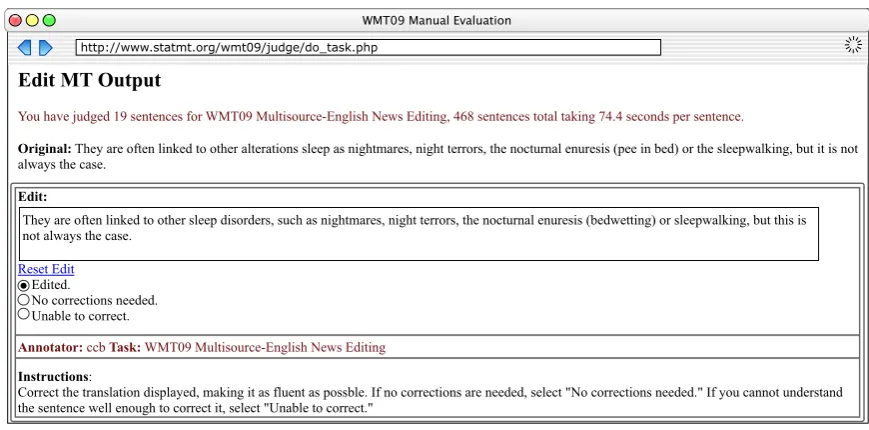
Each translated sentence was shown in isolation without any additional context. A screenshot is shown in Figure 2.
Since we wanted to prevent judges from see-ing the reference before editsee-ing the translations, we split the test set between the sentences used in the ranking task and the editing task (because they were being conducted concurrently). More-over, annotators edited only a single system’s out-put for one source sentence to ensure that their un-derstanding of it would not be influenced by an-other system’s output.
3.3 Judging the acceptability of edited output
Halfway through the manual evaluation period, we stopped collecting edited translations, and instead asked annotators to do the following:
Indicate whether the edited transla-tions represent fully fluent and meaning-equivalent alternatives to the reference sentence. The reference is shown with context, the actual sentence isbold.
In addition to edited translations, unedited items that were either marked as acceptable or as incom-prehensible were also shown. Judges gave a sim-ple yes/no indication to each item. A screenshot is shown in Figure 3.
3.4 Inter- and Intra-annotator agreement
In order to measure intra-annotator agreement 10% of the items were repeated and evaluated twice by each judge. In order to measure inter-annotator agreement 40% of the items were ran-domly drawn from a common pool that was shared across all annotators so that we would have items that were judged by multiple annotators.
INTER-ANNOTATOR AGREEMENT
Evaluation type P(A) P(E) K
Sentence ranking .549 .333 .323 Yes/no to edited output .774 .5 .549
INTRA-ANNOTATOR AGREEMENT
Evaluation type P(A) P(E) K
Sentence ranking .707 .333 .561 Yes/no to edited output .866 .5 .732
Table 4: Inter- and intra-annotator agreement for the two types of manual evaluation
We measured pairwise agreement among anno-tators using the kappa coefficient (K) which is de-fined as
K = P(A)−P(E) 1−P(E)
whereP(A)is the proportion of times that the an-notators agree, andP(E)is the proportion of time that they would agree by chance.
For inter-annotator agreement we calculated
P(A) for the yes/no judgments by examining all items that were annotated by two or more anno-tators, and calculating the proportion of time they assigned identical scores to the same items. For the ranking tasks we calculatedP(A)by examin-ing all pairs of systems which had been judged by two or more judges, and calculated the proportion of time that they agreed thatA > B, A = B, or
A < B. Intra-annotator agreement was computed similarly, but we gathered items that were anno-tated on multiple occasions by a single annotator.
Table 4 givesK values for inter-annotator and intra-annotator agreement. These give an indi-cation of how often different judges agree, and how often single judges are consistent for repeated judgments, respectively. The interpretation of Kappa varies, but according to Landis and Koch (1977),0−.2is slight, .2−.4is fair, .4−.6is moderate,.6−.8is substantial and the rest almost perfect.
Based on these interpretations the agreement for yes/no judgments is moderatefor inter-annotator agreement and substantial for intra-annotator agreement, but the inter-annotator agreement for sentence level ranking is onlyfair.
Edit MT Output
You have judged 19 sentences for WMT09 Multisource-English News Editing, 468 sentences total taking 74.4 seconds per sentence.
Original: They are often linked to other alterations sleep as nightmares, night terrors, the nocturnal enuresis (pee in bed) or the sleepwalking, but it is not always the case.
Edit:
Reset Edit Edited.
No corrections needed. Unable to correct.
Annotator: ccb Task: WMT09 Multisource-English News Editing
Instructions:
Correct the translation displayed, making it as fluent as possble. If no corrections are needed, select "No corrections needed." If you cannot understand the sentence well enough to correct it, select "Unable to correct."
They are often linked to other sleep disorders, such as nightmares, night terrors, the nocturnal enuresis (bedwetting) or sleepwalking, but this is not always the case.
http://www.statmt.org/wmt09/judge/do_task.php
[image:8.595.80.515.85.300.2]WMT09 Manual Evaluation
Figure 2: This screenshot shows an annotator editing the output of a machine translation system.
http://www.statmt.org/wmt09/judge/do_task.php
WMT09 Manual Evaluation
Judge Edited MT Output
You have judged 84 sentences for WMT09 French-English News Edit Acceptance, 459 sentences total taking 64.9 seconds per sentence.
Source: Au même moment, les gouvernements belges, hollandais et luxembourgeois ont en parti nationalisé le conglomérat européen financier, Fortis. Les analystes de Barclays Capital ont déclaré que les négociations frénétiques de ce week end, conclues avec l'accord de sauvetage" semblent ne pas avoir réussi à faire revivre le marché".
Alors que la situation économique se détériorasse, la demande en matières premières, pétrole inclus, devrait se ralentir.
"la prospective d'équité globale, de taux d'intérêt et d'échange des marchés, est devenue incertaine" ont écrit les analystes de Deutsche Bank dans une lettre à leurs investisseurs."
"nous pensons que les matières premières ne pourront échapper à cette contagion.
Reference:Meanwhile, the Belgian, Dutch and Luxembourg governments partially nationalized the European financial conglomerate Fortis. Analysts at Barclays Capital said the frantic weekend negotiations that led to the bailout agreement "appear to have failed to revive market sentiment."
As the economic situation deteriorates, the demand for commodities, including oil, is expected to slow down.
"The outlook for global equity, interest rate and exchange rate markets has become increasingly uncertain," analysts at Deutsche Bank wrote in a note to investors.
"We believe commodities will be unable to escape the contagion.
Translation Verdict
While the economic situation is deteriorating, demand for commodities, including oil, should decrease. Yes No
While the economic situation is deteriorating, the demand for raw materials, including oil, should slow down. Yes No
Alors que the economic situation deteriorated, the request in rawmaterial enclosed, oil, would have to slow down. Yes No
While the financial situation damaged itself, the first matters affected, oil included, should slow down themselves. Yes No
While the economic situation is depressed, demand for raw materials, including oil, will be slow. Yes No
Annotator: ccb Task: WMT09 French-English News Edit Acceptance
Instructions:
[image:8.595.91.515.375.706.2]Indicate whether the edited translations represent fully fluent and meaning-equivalent alternatives to the reference sentence. The reference is shown with context, the actual sentence is bold.
0.32 0.33 0.34 0.35 0.36 0.37 0.38 0.39 0.40 0.41
0.1 0.2 0.3 0.4 0.5 0.6 0.7 0.8 0.9 1.0
0.51 0.52 0.53 0.54 0.55 0.56 0.57 0.58 0.59 0.60 0.61
Inter-annotator agreement
[image:9.595.309.520.116.656.2]Intra-annotator agreement Proportion of judgments retained
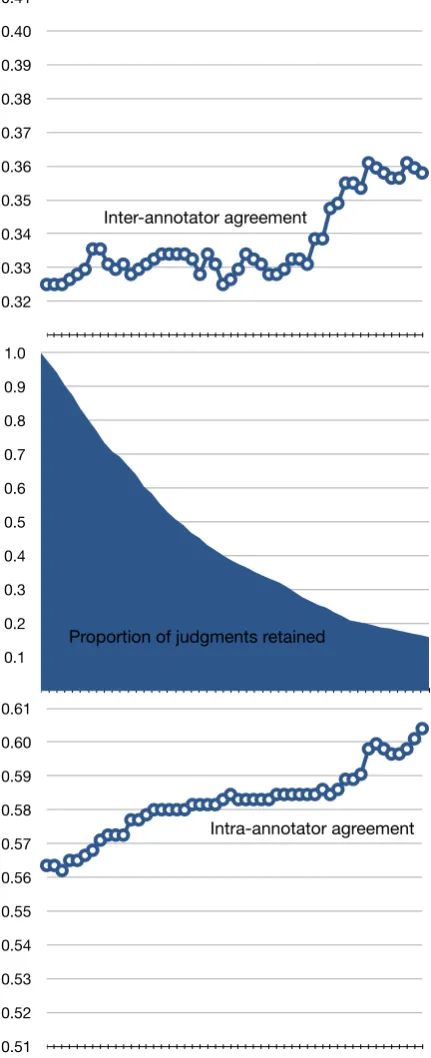
Figure 4: The effect of discarding every annota-tors’ initial judgments, up to the first 50 items
0.32 0.33 0.34 0.35 0.36 0.37 0.38 0.39 0.40 0.41
0.1 0.2 0.3 0.4 0.5 0.6 0.7 0.8 0.9 1.0
0.51 0.52 0.53 0.54 0.55 0.56 0.57 0.58 0.59 0.60 0.61
Inter-annotator agreement
[image:9.595.74.290.128.658.2]Intra-annotator agreement Proportion of judgments retained
annotators a chance to learn to how to perform the task. Second, we tried disregarding annota-tors who have very low agreement with others, by throwing away judgments for the annotators with the lowest judgments.
Figures 4 and 5 show how the K values im-prove for intra- and inter-annotator agreement un-der these two strategies, and what percentage of the judgments are retained as more annotators are removed, or as the initial learning period is made longer. It seems that the strategy of removing the worst annotators is the best in terms of improv-ing inter-annotatorK, while retaining most of the judgments. If we remove the 33 judges with the worst agreement, we increase the inter-annotator
K fromfairtomoderate, and still retain 60% of
the data.
For the results presented in the rest of the paper, we retain all judgments.
4 Translation task results
We used the results of the manual evaluation to analyze the translation quality of the different sys-tems that were submitted to the workshop. In our analysis, we aimed to address the following ques-tions:
• Which systems produced the best translation quality for each language pair?
• Did the system combinations produce better translations than individual systems?
• Which of the systems that used only the pro-vided training materials produced the best translation quality?
Table 6 shows best individual systems. We de-fine the best systems as those which had no other system that was statistically significantly better than them under the Sign Test atp≤0.1.4 Multi-ple systems are listed for many language pairs be-cause it was not possible to draw a statistically sig-nificant difference between the systems. Commer-cial translation software (including Google, Sys-tran, Morphologic, PCTrans, Eurotran XP, and anonymized RBMT providers) did well in each of the language pairs. Research systems that utilized
4
In one case this definition meant that the system that was ranked the highest overall was not considered to be one of the best systems. For German-English translation RBMT5 was ranked highest overall, but was statistically significantly worse thanRBMT2.
only the provided data did as well as commercial vendors in half of the language pairs.
The table also lists the best systems among those which used only the provided materials. To determine this decision we excluded
uncon-strained systems which employed significant
ex-ternal resources. Specifically, we ruled out all of the commercial systems, since Google has access to significantly greater data sources for its statisti-cal system, and since the commercial RBMT sys-tems utilize knowledge sources not available to other workshop participants. The remaining sys-tems were research syssys-tems that employ statisti-cal models. We were able to draw distinctions between half of these for each of the language pairs. There are some borderline cases, for in-stance LIMSI only used additional monolingual training resources, and LIUM/Systran used addi-tional translation dictionaries as well as addiaddi-tional monolingual resources.
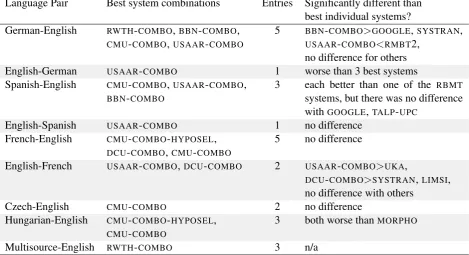
Table 5 summarizes the performance of the system combination entries by listing the best ranked combinations, and by indicating whether they have a statistically significant difference with the best individual systems. In general, system combinations performed as well as the best indi-vidual systems, but not statistically significantly better than them. Moreover, it was hard to draw a distinction between the different system combi-nation strategies themselves. There are a number of possibilities as to why we failed to find signifi-cant differences:
• The number of judgments that we collected were not sufficient to find a difference. Al-though we collected several thousand judg-ments for each language pair, most pairs of systems were judged together fewer than100 times.
• It is possible that the best performing indi-vidual systems were sufficiently better than the other systems and that it is difficult to im-prove on them by combining them.
• Individual systems could have been weighted incorrectly during the development stage, which could happen if the automatic evalu-ation metrics scores on the dev set did not strongly correlate with human judgments.
Language Pair Best system combinations Entries Significantly different than best individual systems? German-English RWTH-COMBO,BBN-COMBO,
CMU-COMBO,USAAR-COMBO
5 BBN-COMBO>GOOGLE,SYSTRAN,
USAAR-COMBO<RMBT2,
no difference for others English-German USAAR-COMBO 1 worse than 3 best systems Spanish-English CMU-COMBO,USAAR-COMBO,
BBN-COMBO
3 each better than one of the RBMT
systems, but there was no difference
withGOOGLE,TALP-UPC
English-Spanish USAAR-COMBO 1 no difference
French-English CMU-COMBO-HYPOSEL,
DCU-COMBO,CMU-COMBO
5 no difference
English-French USAAR-COMBO,DCU-COMBO 2 USAAR-COMBO>UKA,
DCU-COMBO>SYSTRAN,LIMSI, no difference with others
Czech-English CMU-COMBO 2 no difference
Hungarian-English CMU-COMBO-HYPOSEL,
CMU-COMBO
3 both worse thanMORPHO
[image:11.595.73.543.67.322.2]Multisource-English RWTH-COMBO 3 n/a
Table 5: A comparison between the best system combinations and the best individual systems. It was generally difficult to draw a statistically significant differences between the two groups, and between the combinations themselves.
there is significant overlap in the strategies that they employ.
Improved system combination warrants further in-vestigation. We would suggest collecting addi-tional judgments, and doing oracle experiments where the contributions of individual systems are weighted according to human judgments of their quality.
Understandability
Our hope is that judging the acceptability of edited output as discussed in Section 3 gives some indi-cation of how often a system’s output was under-standable. Figure 6 gives the percentage of times that each system’s edited output was judged to be acceptable (the percentage also factors in in-stances when judges were unable to improve the output because it was incomprehensible).
The edited output of the best perform-ing systems under this evaluation model were deemed acceptable around 50% of the time for French-English, English-French, English-Spanish, German-English, and English-German. For Spanish-English the edited output of the best system was acceptable around 40% of the time, for English-Czech it was 30% and for Czech-English and Hungarian-English it was around 20%.
This style of manual evaluation is experimental and should not be taken to be authoritative. Some caveats about this measure:
• Editing translations without context is diffi-cult, so the acceptability rate is probably an underestimate of how understandable a sys-tem actually is.
• There are several sources of variance that are difficult to control for: some people are better at editing, and some sentences are more dif-ficult to edit. Therefore, variance in the un-derstandability of systems is difficult to pin down.
• The acceptability measure does not strongly correlate with the more established method of ranking translations relative to each other for all the language pairs.5
Please also note that the number of corrected translations per system are very low for some language pairs, as low as 23 corrected sentences per system for the language pair English–French.
5The Spearman rank correlation coefficients for how the
French–English 625–836 judgments per system
System C? ≥others
GOOGLE• no .76
DCU? yes .66
LIMSI• no .65
JHU? yes .62
UEDIN? yes .61
UKA yes .61
LIUM-SYSTRAN no .60
RBMT5 no .59
CMU-STATXFER? yes .58
RBMT1 no .56
USAAR no .55
RBMT3 no .54
RWTH? yes .52
COLUMBIA yes .50
RBMT4 no .47
GENEVA no .34
English–French 422–517 judgments per system
System C? ≥others
LIUM-SYSTRAN• no .73
GOOGLE• no .68
UKA•? yes .66
SYSTRAN• no .65
RBMT3• no .65
DCU•? yes .65
LIMSI• no .64
UEDIN? yes .60
RBMT4 no .59
RWTH yes .58
RBMT5 no .57
RBMT1 no .54
USAAR no .48
GENEVA no .38
Hungarian–English 865–988 judgments per system
System C? ≥others
MORPHO• no .75
UMD? yes .66
UEDIN yes .45
German–English 651–867 judgments per system
System C? ≥others
RBMT5 no .66
USAAR• no .65
GOOGLE• no .65
RBMT2• no .64
RBMT3 no .64
RBMT4 no .62
STUTTGART•? yes .61
SYSTRAN• no .60
UEDIN? yes .59
UKA? yes .58
UMD? yes .56
RBMT1 no .54
LIU? yes .50
RWTH yes .50
GENEVA no .33
JHU-TROMBLE yes .13
English–German 977–1226 judgments per system
System C? ≥others
RBMT2• no .66
RBMT3• no .64
RBMT5• no .64
USAAR no .58
RBMT4 no .58
RBMT1 no .57
GOOGLE no .54
UKA? yes .54
UEDIN? yes .51
LIU? yes .49
RWTH? yes .48
STUTTGART yes .43
Czech–English 1257–1263 judgments per system
System C? ≥others
GOOGLE• no .75
UEDIN? yes .57
CU-BOJAR? yes .51
Spanish–English 613–801 judgments per system
System C? ≥others
GOOGLE• no .70
TALP-UPC•? yes .59
UEDIN? yes .56
RBMT1• no .55
RBMT3• no .55
RBMT5• no .55
RBMT4• no .53
RWTH? yes .51
USAAR no .51
NICT yes .37
English–Spanish 632–746 judgments per system
System C? ≥others
RBMT3• no .66
UEDIN•? yes .66
GOOGLE• no .65
RBMT5• no .64
RBMT4 no .61
NUS? yes .59
TALP-UPC yes .58
RWTH yes .51
RBMT1 no .25
USAAR no .48
English–Czech 4626–4784 judgments per system
System C? ≥others
PCTRANS• no .67
EUROTRANXP• no .67
GOOGLE no .66
CU-BOJAR? yes .61
UEDIN yes .53
CU-TECTOMT yes .48
Systems are listed in the order of how often their translations were ranked higher than or equal to any other system. Ties are broken by direct comparison.
C? indicates constrained condition, meaning only using the supplied training data and possibly standard monolingual linguistic tools (but no additional corpora).
• indicates awinin the category, meaning that no other system is statistically significantly better at p-level≤0.1 in pairwise comparison.
? indicates aconstrained win, no other constrained system is statistically better.
For all pairwise comparisons between systems, please check the appendix.
[image:12.595.77.535.58.626.2]Given these low numbers, the numbers presented in Figure 6 should not be read as comparisons be-tween systems, but rather viewed as indicating the state of machine translation for different language pairs.
5 Shared evaluation task overview
In addition to allowing us to analyze the transla-tion quality of different systems, the data gath-ered during the manual evaluation is useful for validating the automatic evaluation metrics. Last year, NIST began running a similar “Metrics for MAchine TRanslation” challenge (Metrics-MATR), and presented their findings at a work-shop at AMTA (Przybocki et al., 2008).
In this year’s shared task we evaluated a number of different automatic metrics:
• Bleu (Papineni et al., 2002)—Bleu remains
thede facto standard in machine translation
evaluation. It calculates n-gram precision and a brevity penalty, and can make use of multi-ple reference translations as a way of captur-ing some of the allowable variation in trans-lation. We use a single reference translation in our experiments.
• Meteor (Agarwal and Lavie, 2008)—Meteor measures precision and recall for unigrams and applies a fragmentation penalty. It uses flexible word matching based on stemming and WordNet-synonymy. meteor-ranking is optimized for correlation with ranking judg-ments.
• Translation Error Rate (Snover et al., 2006)—TER calculates the number of ed-its required to change a hypothesis transla-tion into a reference translatransla-tion. The possi-ble edits in TER include insertion, deletion, and substitution of single words, and an edit which moves sequences of contiguous words. Two variants of TER are also included: TERp (Snover et al., 2009), a new version which in-troduces a number of different features, and (Bleu−TER)/2, a combination of Bleu and Translation Edit Rate.
• MaxSim (Chan and Ng, 2008)—MaxSim calculates a similarity score by comparing items in the translation against the reference. Unlike most metrics which do strict match-ing, MaxSim computes a similarity score
for non-identical items. To find a maxi-mum weight matching that matches each sys-tem isys-tem to at most one reference isys-tem, the items are then modeled as nodes in a bipar-tite graph.
• wcd6p4er (Leusch and Ney, 2008)—a mea-sure based on cder with word-based substitu-tion costs. Leusch and Ney (2008) also sub-mitted two contrastive metrics: bleusp4114, a modified version of BLEU-S (Lin and Och, 2004), with tuned n-gram weights, and bleusp, with constant weights. wcd6p4er is an error measure and bleusp is a quality score.
• RTE (Pado et al., 2009)—The RTE metric follows a semantic approach which applies recent work inrich textual entailmentto the problem of MT evaluation. Its predictions are based on a regression model over a feature set adapted from an entailment systems. The features primarily model alignment quality and (mis-)matches of syntactic and semantic structures.
• ULC (Gim´enez and M`arquez, 2008)—ULC is an arithmetic mean over other automatic metrics. The set of metrics used include Rouge, Meteor, measures of overlap between constituent parses, dependency parses, se-mantic roles, and discourse representations. The ULC metric had the strongest correlation with human judgments in WMT08 (Callison-Burch et al., 2008).
• wpF and wpBleu (Popovic and Ney, 2009) -These metrics are based onwords andpart of speech sequences. wpF is an n-gram based F-measure which takes into account both word n-grams and part of speech n-grams. wp-BLEU is a combnination of the normal Blue score and a part of speech-based Bleu score.
ref bbn-c google cmu-combo cu-bojar uedin 0.14 0.16 0.18 0.23 0.25 0.98 Czech-English ref google
cmu-statxbbn-combocolumbia cmu-combo
cmu-combo-hyp dcu-combo
uka rwth
rbmt4 limsi rbmt1 lium-systr
n
usaar -combo
dcu uedin jhu
rbmt3 rbmt5 usaar geneva 0.21 0.28 0.28 0.28 0.29 0.30 0.31 0.33 0.33 0.34 0.34 0.34 0.35 0.38 0.39 0.40 0.41 0.41 0.47 0.50 0.52 0.85 French-English ref rwth-c cmu-combobbn-combo rbmt5 usaar -c google cmu-cmb-h usaar rbmt3
stuttgart rbmt4 rbmt1
uka rwth umd
uedin rbmt2 systran liu geneva jhu-tr omble 0.03 0.06 0.20 0.21 0.25 0.26 0.26 0.27 0.28 0.30 0.30 0.31 0.31 0.32 0.33 0.34 0.35 0.36 0.37 0.41 0.47 0.83 German-English ref usaar -c
google rbmt5 rwth talp-upc uedin usaar rbmt3 nus rbmt4 rbmt1 0.08 0.10 0.19 0.21 0.27 0.27 0.28 0.32 0.33 0.38 0.52 0.69 English-Spanish ref usaar -c
google rbmt5 rbmt3 bbn-cmb
uedin talp-upc rbmt1
rwth
cmu-c rbmt4 nict usaar 0.23 0.26 0.27 0.28 0.28 0.28 0.28 0.31 0.31 0.36 0.37 0.38 0.41 0.88 Spanish-English ref google pctrans eurotranxp uedin cu-bojar cu-tectomt 0.19 0.21 0.23 0.26 0.32 0.32 0.91 English-Czech ref google uka limsi usaar -c
rbmt3 rbmt5 uedin usaar rbmt4 lium-sys
rwth dcu-cmb
dcu
systran rbmt1 geneva 0.08 0.10 0.22 0.27 0.30 0.31 0.32 0.34 0.37 0.40 0.40 0.43 0.44 0.45 0.48 0.49 0.79 English-French ref morpho cmu-cmb-hcmu-combo umd uedin bbn-cmb 0.11 0.12 0.15 0.19 0.21 0.22 0.93 Hungarian-English ref
rbmt5 rbmt3 google rbmt1 rbmt2 usaar usaar
-cmb rbmt4 rwth uka uedin stuttgart liu 0.12 0.18 0.19 0.26 0.28 0.31 0.31 0.32 0.33 0.35 0.37 0.42 0.47 0.85 English-German ref
rwth bbn cmu 0.25 0.27 0.32 0.90
[image:14.595.73.525.63.679.2]Multsource-English
Figure 6: The percent of time that each system’s edited output was judged to be an acceptable translation. These numbers also include judgments of the system’s output when it was marked either
incomprehen-sibleoracceptableand left unedited. Note that the reference translation was edited alongside the system
5.1 Measuring system-level correlation
We measured the correlation of the automatic met-rics with the human judgments of translation qual-ity at the system-level using Spearman’s rank cor-relation coefficientρ. We converted the raw scores assigned to each system into ranks. We assigned a human ranking to the systems based on the per-cent of time that their translations were judged to be better than or equal to the translations of any other system in the manual evaluation.
When there are no tiesρcan be calculated using the simplified equation:
ρ= 1− 6 P
d2i n(n2−1)
where di is the difference between the rank for
systemi andnis the number of systems. The
pos-sible values ofρ range between1(where all sys-tems are ranked in the same order) and−1(where the systems are ranked in the reverse order). Thus an automatic evaluation metric with a higher abso-lute value forρis making predictions that are more similar to the human judgments than an automatic evaluation metric with a lower absoluteρ.
5.2 Measuring sentence-level consistency
Because the sentence-level judgments collected in the manual evaluation are relative judgments rather than absolute judgments, it is not possi-ble for us to measure correlation at the sentence-level in the same way that previous work has done (Kulesza and Shieber, 2004; Albrecht and Hwa, 2007a; Albrecht and Hwa, 2007b).
Rather than calculating a correlation coefficient at the sentence-level we instead ascertained how consistent the automatic metrics were with the hu-man judgments. The way that we calculated con-sistency was the following: for every pairwise comparison of two systems on a single sentence by a person, we counted the automatic metric as being consistent if the relative scores were the same (i.e. the metric assigned a higher score to the higher ranked system). We divided this by the total num-ber of pairwise comparisons to get a percentage. Because the systems generally assign real num-bers as scores, we excluded pairs that the human annotators ranked as ties.
de-en
(21
systems)
fr
-en
(21
systems)
es-en
(13
systems)
cz-en
(5
systems)
hu-en
(6
systems)
A
v
erage
ulc .78 .92 .86 1 .6 .83
maxsim .76 .91 .98 .7 .66 .8
rte (absolute) .64 .91 .96 .6 .83 .79
meteor-rank .64 .93 .96 .7 .54 .75
rte (pairwise) .76 .59 .78 .8 .83 .75
terp -.72 -.89 -.94 -.7 -.37 -.72
meteor-0.6 .56 .93 .87 .7 .54 .72
meteor-0.7 .55 .93 .86 .7 .26 .66
bleu-ter/2 .38 .88 .78 .9 -.03 .58
nist .41 .87 .75 .9 -.14 .56
wpF .42 .87 .82 1 -.31 .56
ter -.43 -.83 -.84 -.6 -.01 -.54
nist (cased) .42 .83 .75 1 -.31 .54
bleu .41 .88 .79 .6 -.14 .51
bleusp .39 .88 .78 .6 -.09 .51
bleusp4114 .39 .89 .78 .6 -.26 .48
bleu (cased) .4 .86 .8 .6 -.31 .47
wpbleu .43 .86 .8 .7 -.49 .46
[image:15.595.320.517.95.356.2]wcd6p4er -.41 -.89 -.76 -.6 .43 -.45
Table 7: The system-level correlation of the au-tomatic evaluation metrics with the human judg-ments for translation into English.
en-de
(13
systems)
en-fr
(16
systems)
en-es
(11
systems)
en-cz
(5
systems)
A
v
erage
terp .03 -.89 -.58 -.4 -.46
ter -.03 -.78 -.5 -.1 -.35
bleusp4114 -.3 .88 .51 .1 .3
bleusp -.3 .87 .51 .1 .29
bleu -.43 .87 .36 .3 .27
bleu (cased) -.45 .87 .35 .3 .27
bleu-ter/2 -.37 .87 .44 .1 .26
wcd6p4er .54 -.89 -.45 -.1 -.22
nist (cased) -.47 .84 .35 .1 .2
nist -.52 .87 .23 .1 .17
wpF -.06 .9 .58 n/a n/a
wpbleu .07 .92 .63 n/a n/a
[image:15.595.327.502.480.676.2]SemPOS .4 BLEUtecto .3
Meteor .4 BLEU .3
GTM(e=0.5)tecto .4 NISTlemma .1
GTM(e=0.5)lemma .4 NIST .1
GTM(e=0.5) .4 BLEUlemma .1
WERtecto .3 WERlemma -.1
TERtecto .3 WER -.1
PERtecto .3 TERlemma -.1
F-measuretecto .3 TER -.1
F-measurelemma .3 PERlemma -.1
F-measure .3 PER -.1
[image:16.595.94.268.61.183.2]NISTtecto -.3
Table 9: The system-level correlation for auto-matic metrics ranking five English-Czech systems
6 Evaluation task results
6.1 System-level correlation
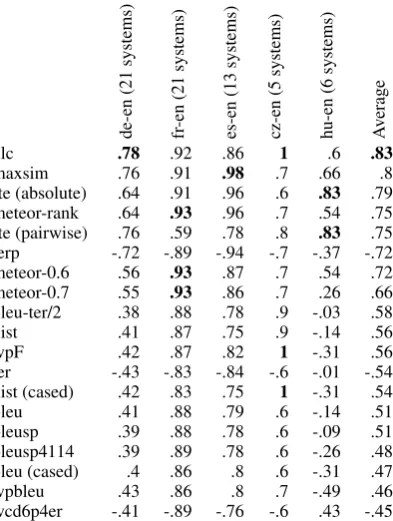
Table 7 shows the correlation of automatic met-rics when they rank systems that are translating into English. Note that TERp, TER and wcd6p4er are error metrics, so a negative correlation is bet-ter for them. The strength of correlation varied for the different language pairs. The automatic met-rics were able to rank the French-English systems reasonably well with correlation coefficients in the range of .8 and .9. In comparison, metrics per-formed worse for Hungarian-English, where half of the systems had negative correlation. The ULC metric once again had strongest correlation with human judgments of translation quality. This was followed closely by MaxSim and RTE, with Me-teor and TERp doing respectably well in 4th and 5th place. Notably, Bleu and its variants were the worst performing metrics in this translation direc-tion.
Table 8 shows correlation for metrics which op-erated on languages other than English. Most of the best performing metrics that operate on En-glish do not work for foreign languages, because they perform some linguistic analysis or rely on a resource like WordNet. For translation into for-eign languages TERp was the best system overall. The wpBleu and wpF metrics also did extremely well, performing the best in the language pairs that they were applied to. wpBleu and wpF were not applied to Czech because the authors of the met-ric did not have a Czech tagger. English-German proved to be the most problematic language pair to automatically evaluate, with all of the metrics having a negative correlation except wpBleu and TER.
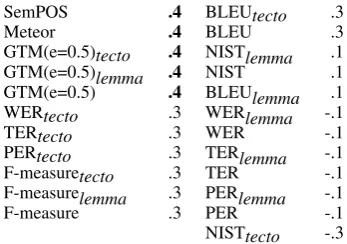
Table 9 gives detailed results for how well
vari-ations on a number of automatic metrics do for the task of ranking five English-Czech systems.6 These systems were submitted by Kos and Bojar (2009), and they investigate the effects of using Prague Dependency Treebank annotations during automatic evaluation. They linearizing the Czech trees and evaluated either the lemmatized forms of the Czech (lemma) read off the trees or the Tec-togrammatical form which retained only lemma-tized content words (tecto). The table also demon-strates SemPOS, Meteor, and GTM perform better on Czech than many other metrics.
6.2 Sentence-level consistency
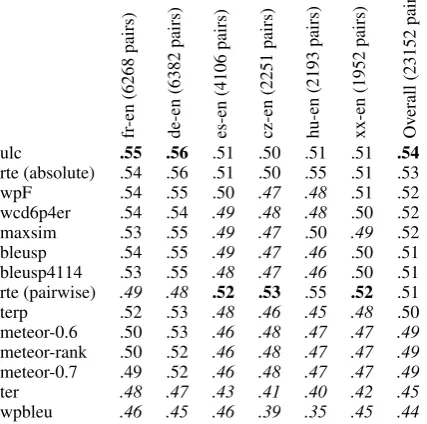
Tables 10 and 11 show the percent of times that the metrics’ scores were consistent with human rank-ings of every pair of translated sentences.7 Since we eliminated sentence pairs that were judged to be equal, the random baseline for this task is 50%. Many metrics failed to reach the baseline (includ-ing most metrics in the out-of-English direction). This indicates that sentence-level evaluation of machine translation quality is very difficult. RTE and ULC again do the best overall for the into-English direction. They are followed closely by wpF and wcd6p4er, which considerably improve their performance over their system-level correla-tions.
We tried a variant on measuring sentence-level consistency. Instead of using the scores assigned to each individual sentence, we used the system-level score and applied it to every sentence that was produced by that system. These can be thought of as a metric’s prior expectation about how a system should preform, based on their per-formance on the whole data set. Tables 12 and 13 show that using the system-level scores in place of the sentence-level scores results in considerably higher consistency with human judgments. This suggests an interesting line of research for improv-ing sentence-level predictions by usimprov-ing the perfor-mance on a larger data set as a prior.
7 Summary
As in previous editions of this workshop we car-ried out an extensive manual and automatic eval-uation of machine translation performance for translating from European languages into English,
6
PCTRANSwas excluded from the English-Czech systems because its SGML file was malformed.
fr
-en
(6268
pairs)
de-en
(6382
pairs)
es-en
(4106
pairs)
cz-en
(2251
pairs)
hu-en
(2193
pairs)
xx-en
(1952
pairs)
Ov
erall
(23152
pairs)
ulc .55 .56 .51 .50 .51 .51 .54
rte (absolute) .54 .56 .51 .50 .55 .51 .53
wpF .54 .55 .50 .47 .48 .51 .52
wcd6p4er .54 .54 .49 .48 .48 .50 .52
maxsim .53 .55 .49 .47 .50 .49 .52
bleusp .54 .55 .49 .47 .46 .50 .51
bleusp4114 .53 .55 .48 .47 .46 .50 .51
rte (pairwise) .49 .48 .52 .53 .55 .52 .51
terp .52 .53 .48 .46 .45 .48 .50
meteor-0.6 .50 .53 .46 .48 .47 .47 .49
meteor-rank .50 .52 .46 .48 .47 .47 .49
meteor-0.7 .49 .52 .46 .48 .47 .47 .49
ter .48 .47 .43 .41 .40 .42 .45
[image:17.595.318.513.106.327.2]wpbleu .46 .45 .46 .39 .35 .45 .44
Table 10: Sentence-level consistency of the auto-matic metrics with human judgments for transla-tions into English. Italicized numbers fall below the random-choice baseline.
en-fr
(2967
pairs)
en-de
(6563
pairs)
en-es
(3249
pairs)
en-cz
(11242
pairs)
Ov
erall
(24021
pairs)
wcd6p4er .57 .47 .52 .49 .50
bleusp4114 .57 .46 .54 .49 .50
bleusp .57 .46 .53 .48 .49
ter .50 .41 .45 .37 .41
terp .51 .39 .48 .27 .36
wpF .57 .46 .54 n/a .51
wpbleu .53 .37 .46 n/a .43
Table 11: Sentence-level consistency of the auto-matic metrics with human judgments for transla-tions out of English. Italicized numbers fall below the random-choice baseline.
fr
-en
(6268
pairs)
de-en
(6382
pairs)
es-en
(4106
pairs)
cz-en
(2251
pairs)
hu-en
(2193
pairs)
Ov
erall
(21200
pairs)
Oracle .61 .63 .59 .61 .67 .62
rte (absolute) .60 .61 .59 .57 .65 .61
ulc .61 .62 .58 .61 .59 .60
maxsim .61 .62 .59 .57 .61 .60
meteor-rank .61 .61 .59 .57 .61 .60
meteor-0.6 .61 .61 .58 .57 .60 .60
rte (pairwise) .56 .61 .57 .59 .64 .59
terp .60 .61 .59 .57 .56 .59
meteor-0.7 .61 .61 .58 .57 .55 .59
ter .60 .59 .57 .55 .51 .58
wpF .60 .59 .57 .61 .46 .58
bleusp .61 .59 .56 .55 .48 .57
bleusp4114 .61 .59 .56 .55 .46 .57
wcd6p4er .61 .59 .57 .55 .44 .57
[image:17.595.78.292.120.332.2]wpbleu .60 .59 .57 .57 .43 .57
Table 12: Consistency of the automatic met-rics when their system-level ranks are treated as sentence-level scores. Oracle shows the consis-tency of using the system-level human ranks that are given in Table 6.
en-fr
(2967
pairs)
en-de
(6563
pairs)
en-es
(3249
pairs)
en-cz
(11242
pairs)
Ov
erall
(24021
pairs)
Oracle .62 .59 .63 .60 .60
terp .62 .50 .59 .53 .54
ter .61 .51 .58 .50 .53
bleusp .62 .48 .59 .50 .52
bleusp4114 .63 .48 .59 .50 .52
wcd6p4er .62 .46 .58 .50 .52
wpbleu .63 .51 .60 n/a .56
wpF .63 .50 .59 n/a .55
[image:17.595.334.499.492.648.2] [image:17.595.105.264.505.649.2]and vice versa.
The number of participants remained stable compared to last year’s WMT workshop, with 22 groups from 20 institutions participating in WMT09. This year’s evaluation also included 7 commercial rule-based MT systems and Google’s online statistical machine translation system.
Compared to previous years, we have simpli-fied the evaluation conditions by removing the in-domain vs. out-of-in-domain distinction focusing on news translations only. The main reason for this was eliminating the advantage statistical systems have with respect to test data that are from the same domain as the training data.
Analogously to previous years, the main focus of comparing the quality of different approaches is on manual evaluation. Here, also, we reduced the number of dimensions with respect to which the different systems are compared, with sentence-level ranking as the primary type of manual eval-uation. In addition to the direct quality judgments we also evaluated translation quality by having people edit the output of systems and have as-sessors judge the correctness of the edited output. The degree to which users were able to edit the translations (without having access to the source sentence or reference translation) served as a mea-sure of the overall comprehensibility of the trans-lation.
Although the inter-annotator agreement in the sentence-ranking evaluation is only fair (as mea-sured by the Kappa score), agreement can be im-proved by removing the first (up to 50) judgments of each assessor, focusing on the judgments that were made once the assessors are more familiar with the task. Inter-annotator agreement with re-spect to correctness judgments of the edited trans-lations were higher (moderate), which is proba-bly due to the simplified evaluation criterion (bi-nary judgments versus rankings). Inter-annotator agreement for both conditions can be increased further by removing the judges with the worst agreement. Intra-annotator agreement on the other hand was considerably higher ranging between moderate and substantial.
In addition to the manual evaluation criteria we applied a large number of automated metrics to see how they correlate with the human judgments. There is considerably variation between the differ-ent metrics and the language pairs under consid-eration. As in WMT08, the ULC metric had the
highest overall correlation with human judgments when translating into English, with MaxSim and RTE following closely behind. TERp and wpBleu were best when translating into other languages.
Automatically predicting human judgments at the sentence-level proved to be quite challeng-ing with many of the systems performchalleng-ing around chance. We performed an analysis that showed that if metrics’ system-level scores are used in place of their scores for individual sentences, that they do quite a lot better. This suggests that prior probabilities ought to be integrated into sentence-level scoring.
All data sets generated by this workshop, in-cluding the human judgments, system translations and automatic scores, are publicly available for other researchers to analyze.8
Acknowledgments
This work was supported in parts by the EuroMa-trix project funded by the European Commission (6th Framework Programme), the GALE program of the US Defense Advanced Research Projects Agency, Contract No. HR0011-06-C-0022, and the US National Science Foundation under grant IIS-0713448.
We are grateful to Holger Schwenk and Preslav Nakov for pointing out the potential bias in our method for ranking systems when self-judgments are excluded. We analyzed the results and found that this did not hold. We would like to thank Maja Popovic for sharing thoughts about how to improve the manual evaluation. Thanks to Cam Fordyce for helping out with the manual evalua-tion again this year.
An extremely big thanks to Sebastian Pado for helping us work through the logic of segment-level scoring of automatic evaluation metric.
References
Abhaya Agarwal and Alon Lavie. 2008. Meteor, M-BLEU and M-TER: Evaluation metrics for high-correlation with human rankings of machine trans-lation output. InProceedings of the Third Workshop on Statistical Machine Translation, pages 115–118, Columbus, Ohio, June. Association for Computa-tional Linguistics.
Joshua Albrecht and Rebecca Hwa. 2007a. A
re-examination of machine learning approaches for
8http://www.statmt.org/wmt09/results.
sentence-level MT evaluation. InProceedings of the 45th Annual Meeting of the Association for Compu-tational Linguistics (ACL-2007), Prague, Czech Re-public.
Joshua Albrecht and Rebecca Hwa. 2007b. Regres-sion for sentence-level MT evaluation with pseudo references. InProceedings of the 45th Annual Meet-ing of the Association for Computational LMeet-inguistics (ACL-2007), Prague, Czech Republic.
Alexandre Allauzen, Josep Crego, Aur´elien Max, and Fran cois Yvon. 2009. LIMSI’s statistical
transla-tion systems for WMT’09. In Proceedings of the
Fourth Workshop on Statistical Machine Transla-tion, Athens, Greece, March. Association for Com-putational Linguistics.
Ondˇrej Bojar, David Mareˇcek, V´aclav Nov´ak, Mar-tin Popel, Jan Pt´aˇcek, Jan Rouˇs, and Zdenˇek
ˇ
Zabokrtsk´y. 2009. English-Czech MT in 2008. In Proceedings of the Fourth Workshop on Statistical Machine Translation, Athens, Greece, March. Asso-ciation for Computational Linguistics.
Chris Callison-Burch, Cameron Fordyce, Philipp Koehn, Christof Monz, and Josh Schroeder. 2007. (Meta-) evaluation of machine translation. In Pro-ceedings of the Second Workshop on Statistical Ma-chine Translation (WMT07), Prague, Czech Repub-lic.
Chris Callison-Burch, Cameron Fordyce, Philipp Koehn, Christof Monz, and Josh Schroeder. 2008. Further meta-evaluation of machine translation. In Proceedings of the Third Workshop on Statistical Machine Translation (WMT08), Colmbus, Ohio.
Marine Carpuat. 2009. Toward using morphology
in French-English phrase-based SMT. In Proceed-ings of the Fourth Workshop on Statistical Machine Translation, Athens, Greece, March. Association for Computational Linguistics.
Yee Seng Chan and Hwee Tou Ng. 2008. An automatic metric for machine translation evaluation based on
maximum similary. InIn the Metrics-MATR
Work-shop of AMTA-2008, Honolulu, Hawaii.
Yu Chen, Michael Jellinghaus, Andreas Eisele,
Yi Zhang, Sabine Hunsicker, Silke Theison, Chris-tian Federmann, and Hans Uszkoreit. 2009. Com-bining multi-engine translations with moses. In Pro-ceedings of the Fourth Workshop on Statistical Ma-chine Translation, Athens, Greece, March. Associa-tion for ComputaAssocia-tional Linguistics.
Jinhua Du, Yifan He, Sergio Penkale, and Andy Way. 2009. MATREX: The DCU MT system for WMT
2009. In Proceedings of the Fourth Workshop on
Statistical Machine Translation, Athens, Greece, March. Association for Computational Linguistics.
Lo¨ıc Dugast, Jean Senellart, and Philipp Koehn. 2009. Statistical post editing and dictionary ex-traction: Systran/Edinburgh submissions for
ACL-WMT2009. InProceedings of the Fourth Workshop
on Statistical Machine Translation, Athens, Greece, March. Association for Computational Linguistics.
Chris Dyer, Hendra Setiawan, Yuval Marton, and
Philip Resnik. 2009. The University of
Mary-land statistical machine translation system for the fourth workshop on machine translation. In Pro-ceedings of the Fourth Workshop on Statistical Ma-chine Translation, Athens, Greece, March. Associa-tion for ComputaAssocia-tional Linguistics.
Jason Eisner and Roy W. Tromble. 2006. Local
search with very large-scale neighborhoods for op-timal permutations in machine translation. In Pro-ceedings of the Human Language Technology Con-ference of the North American chapter of the Associ-ation for ComputAssoci-ational Linguistics (HLT/NAACL-2006), New York, New York.
Christian Federmann, Silke Theison, Andreas Eisele, Hans Uszkoreit, Yu Chen, Michael Jellinghaus, and
Sabine Hunsicker. 2009. Translation
combina-tion using factored word substitucombina-tion. In Proceed-ings of the Fourth Workshop on Statistical Machine Translation, Athens, Greece, March. Association for Computational Linguistics.
Alexander Fraser. 2009. Experiments in morphosyn-tactic processing for translating to and from German. InProceedings of the Fourth Workshop on Statistical Machine Translation, Athens, Greece, March. Asso-ciation for Computational Linguistics.
Jes´us Gim´enez and Llu´ıs M`arquez. 2007. Linguis-tic features for automaLinguis-tic evaluation of heterogenous
MT systems. InProceedings of ACL Workshop on
Machine Translation.
Jes´us Gim´enez and Llu´ıs M`arquez. 2008. A smor-gasbord of features for automatic MT evaluation. InProceedings of the Third Workshop on Statistical Machine Translation, pages 195–198.
Greg Hanneman, Vamshi Ambati, Jonathan H. Clark,
Alok Parlikar, and Alon Lavie. 2009. An
improved statistical transfer system for French-English machine translation. InProceedings of the Fourth Workshop on Statistical Machine Transla-tion, Athens, Greece, March. Association for Com-putational Linguistics.
Kenneth Heafield, Greg Hanneman, and Alon Lavie.
2009. Machine translation system combination
with flexible word ordering. In Proceedings of the Fourth Workshop on Statistical Machine Transla-tion, Athens, Greece, March. Association for Com-putational Linguistics.
Almut Silja Hildebrand and Stephan Vogel. 2009.
CMU system combination for WMT’09. In
Maria Holmqvist, Sara Stymne, Jody Foo, and Lars Ahrenberg. 2009. Improving alignment for SMT by reordering and augmenting the training corpus. In Proceedings of the Fourth Workshop on Statistical Machine Translation, Athens, Greece, March. Asso-ciation for Computational Linguistics.
Philipp Koehn and Barry Haddow. 2009.
Edin-burgh’s submission to all tracks of the WMT2009 shared task with reordering and speed improvements to Moses. In Proceedings of the Fourth Workshop on Statistical Machine Translation, Athens, Greece, March. Association for Computational Linguistics.
Philipp Koehn and Christof Monz. 2006. Manual and automatic evaluation of machine translation between
European languages. In Proceedings of NAACL
2006 Workshop on Statistical Machine Translation, New York, New York.
Philipp Koehn, Nicola Bertoldi, Ondrej Bojar, Chris
Callison-Burch, Alexandra Constantin, Brooke
Cowan, Chris Dyer, Marcello Federico, Evan Herbst, Hieu Hoang, Christine Moran, Wade Shen, and Richard Zens. 2007. Open source toolkit for statistical machine translation: Factored translation
models and confusion network decoding. CLSP
Summer Workshop Final Report WS-2006, Johns Hopkins University.
Kamil Kos and Ondˇrej Bojar. 2009. Evaluation of Ma-chine Translation Metrics for Czech as the Target
Language. Prague Bulletin of Mathematical
Lin-guistics, 92. in print.
Alex Kulesza and Stuart M. Shieber. 2004. A learn-ing approach to improvlearn-ing sentence-level MT evalu-ation. InProceedings of the 10th International Con-ference on Theoretical and Methodological Issues in Machine Translation, Baltimore, MD, October 4–6.
J. Richard Landis and Gary G. Koch. 1977. The mea-surement of observer agreement for categorical data. Biometrics, 33:159–174.
Gregor Leusch and Hermann Ney. 2008. BLEUSP, PINVWER, CDER: Three improved MT evaluation
measures. In In the Metrics-MATR Workshop of
AMTA-2008, Honolulu, Hawaii.
Gregor Leusch, Evgeny Matusov, and Hermann Ney. 2009. The RWTH system combination system for WMT 2009. InProceedings of the Fourth Workshop on Statistical Machine Translation, Athens, Greece, March. Association for Computational Linguistics.
Zhifei Li, Chris Callison-Burch, Chris Dyer, Juri Ganitkevitch, Sanjeev Khudanpur, Lane Schwartz, Wren Thornton, Jonathan Weese, and Omar Zaidan. 2009. Joshua: An open source toolkit for parsing-based machine translation. In Proceedings of the Fourth Workshop on Statistical Machine Transla-tion, Athens, Greece, March. Association for Com-putational Linguistics.
Chin-Yew Lin and Franz Josef Och. 2004.
Auto-matic evaluation of machine translation quality us-ing longest common subsequence and skip-bigram statistics. InProceedings of the 42nd Annual Meet-ing of the Association for Computational LMeet-inguistics (ACL-2004), Barcelona, Spain.
Robert C. Moore. 2002. Fast and accurate sentence alignment of bilingual corpora. In Proceedings of the 5th Biennial Conference of the Association for Machine Translation in the Americas (AMTA-2002), Tiburon, California.
Preslav Nakov and Hwee Tou Ng. 2009. NUS
at WMT09: Domain adaptation experiments for English-Spanish machine translation of news com-mentary text. In Proceedings of the Fourth Work-shop on Statistical Machine Translation, Athens, Greece, March. Association for Computational Lin-guistics.
Jan Niehues, Teresa Herrmann, Muntsin Kolss, and
Alex Waibel. 2009. The Universit¨at Karlsruhe
translation system for the EACL-WMT 2009. In
Proceedings of the Fourth Workshop on Statistical Machine Translation, Athens, Greece, March. Asso-ciation for Computational Linguistics.
NIST. 2008. Evaluation plan for gale go/no-go phase 3 / phase 3.5 translation evaluations. June 18, 2008.
Attila Nov´ak. 2009. Morphologic’s submission for the WMT 2009 shared task. In Proceedings of the Fourth Workshop on Statistical Machine Transla-tion, Athens, Greece, March. Association for Com-putational Linguistics.
Sebastian Pado, Michel Galley, Dan Jurafsky, and Christopher D. Manning. 2009. Machine transla-tion evaluatransla-tion with textual entailment features. In Proceedings of the Fourth Workshop on Statistical Machine Translation, Athens, Greece, March. Asso-ciation for Computational Linguistics.
Kishore Papineni, Salim Roukos, Todd Ward, and Wei-Jing Zhu. 2002. Bleu: A method for auto-matic evaluation of machine translation. In Pro-ceedings of the 40th Annual Meeting of the Asso-ciation for Computational Linguistics (ACL-2002), Philadelphia, Pennsylvania.
Michael Paul, Andrew Finch, and Eiichiro Sumita.
2009. NICT@WMT09: Model adaptation and
transliteration for Spanish-English SMT. In Pro-ceedings of the Fourth Workshop on Statistical Ma-chine Translation, Athens, Greece, March. Associa-tion for ComputaAssocia-tional Linguistics.
Maja Popovic and Hermann Ney. 2009.
Maja Popovic, David Vilar, Daniel Stein, Evgeny Ma-tusov, and Hermann Ney. 2009. The RWTH
ma-chine translation system for WMT 2009. In
Pro-ceedings of the Fourth Workshop on Statistical Ma-chine Translation, Athens, Greece, March. Associa-tion for ComputaAssocia-tional Linguistics.
Mark Przybocki, Kay Peterson, and
Se-bastien Bronsart. 2008. Official results
of the NIST 2008 “Metrics for MAchine
TRanslation” challenge (MetricsMATR08).
http://nist.gov/speech/tests/metricsmatr/2008/results/.
Jos´e A. R. Fonollosa, Maxim Khalilov, Marta R. Costa-juss´a, Jos´e B. Mari˜no, Carlos A. Henr´aquez Q., Adolfo Hern´andez H., and Rafael E. Banchs. 2009. The TALP-UPC phrase-based translation system
for EACL-WMT 2009. In Proceedings of the
Fourth Workshop on Statistical Machine Transla-tion, Athens, Greece, March. Association for Com-putational Linguistics.
Antti-Veikko Rosti, Bing Zhang, Spyros Matsoukas,
and Richard Schwartz. 2009. Incremental
hy-pothesis alignment with flexible matching for build-ing confusion networks: BBN system description
for WMT09 system combination task. In
Proceed-ings of the Fourth Workshop on Statistical Machine Translation, Athens, Greece, March. Association for Computational Linguistics.
Josh Schroeder, Trevor Cohn, and Philipp Koehn. 2009. Word lattices for multi-source translation. In12th Conference of the European Chapter of the Association for Computational Linguistics (EACL-2009), Athens, Greece.
Holger Schwenk, Sadaf Abdul Rauf, Loic Barrault, and Jean Senellart. 2009. SMT and SPE machine trans-lation systems for WMT’09. InProceedings of the Fourth Workshop on Statistical Machine Transla-tion, Athens, Greece, March. Association for Com-putational Linguistics.
Matthew Snover, Bonnie Dorr, Richard Schwartz, Lin-nea Micciulla, and John Makhoul. 2006. A study of translation edit rate with targeted human annotation. InProceedings of the 7th Biennial Conference of the Association for Machine Translation in the Ameri-cas (AMTA-2006), Cambridge, Massachusetts.
Matthew Snover, Nitin Madnani, Bonnie Dorr, and
Richard Schwartz. 2009. Fluency, adequacy,
or HTER? exploring different human judgments with a tunable MT metric. In Proceedings of the Fourth Workshop on Statistical Machine Transla-tion, Athens, Greece, March. Association for Com-putational Linguistics.
David Talbot and Miles Osborne. 2007. Smoothed Bloom filter language models: Tera-scale lms on the cheap. In Proceedings of the 2007 Joint Con-ference on Empirical Methods in Natural Language Processing and Computational Natural Language Learning (EMNLP-CoNLL), Prague, Czech Repub-lic.
Eric Wehrli, Luka Nerima, and Yves Scherrer.
2009. Deep linguistic multilingual translation