Munich Personal RePEc Archive
Students’ dependence on smart phone
and its effect on purchase behavior
Arif, Imtiaz and Aslam, Wajeeha
Faculty of Management Science, IQRA University
8 August 2014
Students’ Dependence on Smart-phones and its Effect on
Purchase Behavior
Imtiaz Arif
Faculty of Management Science
IQRA University
[email protected]
Wajeeha Aslam
Faculty of Management Science
IQRA University
Abstract
This study explores effect of social need, social influence and convenience on university student’s dependence on smart phones and on its purchase behavior. Survey method was used to collect data from 337 respondents and structural equation modeling was used to test the hypothesis. Overall results provide evidence that social need, social influence and convenience significantly affect students’ dependence on smart phone. A significant rela-tion also existed between student’s dependence on smart phone and purchase behavior. This research provides customer insight to smart phone manufacturers and suppliers in meeting customer needs. Further it provides an exclusive viewpoint of students’ depen-dence on smart phone and its effect on purchase behavior, which were not covered earlier in Pakistani context.
JEL classification codes:M00,M31
Key words: smart-phones, university student, purchase behavior
1
Introduction
In the preceding few years, technological development in mobile phones has totally changed the ways we access, share, and create information. Within the academic environment, EDUCAUSE reported that 63% of North American undergraduates students now have an internet capable smart phone or mobile device including Blackberry, iPhone, iPad, Android. More than half of them said that they accessed the Internet through their devices on a daily basis to read and send e-mail, check the news and weather, use GPS, get maps and directions, and access social networking sites like Facebook and Twitter. A smaller, but growing group, also used their phones to do online banking, shop, or download and stream music and videos. The online PC Magazine Encyclopedia1defines a smart phone as a cellular telephone with built-in applications
and Internet access. Smart phones provide digital voice service as well as text messaging, e-mail, Web browsing, still and video cameras, MP3 player and video viewing smart phones can run myriad applications, turning the once single-minded cell phone.
University students tend to adopt electronic devices earlier compared with other demo-graphic groups (Nielsen 2010). The smartphones market data indicate that university students are early adopters. According to the report by Pew Internet (Smith, 2011), younger people tend to adopt a smartphone earlier than older people. For example, 52% of 18-29 year olds owned a smartphone in 2011 while only 24% of 50-64 year olds owned a smartphone in the
same year. Furthermore, a report from eMarketer (2012) shows that 61% of university students owned a smartphone in 2011. This higher smartphone adoption rate,among university students than among people in other age groups,indicates that a large portion of the early adopters of smartphones are university students. Spectacular increase of smart phone possession among university students over a relatively short period of time was also noted (Paterson & Low, 2011; Jacob & Issac, 2008).
This higher smartphone adoption rate, among university students in North America is also prominent in emerging nations. According to the report by Pew (Rainie & Poushter, 2014) it is indicated that a large portion of the early adopters of smartphones are aged 18-29 years-old i.e. university going age. A significant difference in age group and ownership of smartphone is noted in every country that was pooled, consumer with age under 30 were found more likely to own a smartphone than other. In China 69% of 18- 29 year-olds were having a smartphone, so as more than (62%) in Lebanon, Chile (55%), Jordan (53%) and Argentina (50%). Further it was also noted that the education of the owners is also significantly related to the ownership of smartphone. In the surveyed nations, those with a university degree are more likely to own a smartphone. This is especially true in the Middle East. A huge gap is also noted in China, where 83% of university graduates owned smartphone.
In April 2014 before the auction of 3G and 4G spectrum Pakistan smartphone market was only 15% of the mobile industry but after availability of 3G and 4G mobile networking in Pakistan through three major network operators, the demand for smartphones has shoot up and it is expected that within a year it will increase to 50%. It is, perhaps, this positive outlook that United Mobile, which had been one of the country’s major distributors for Nokia, launched its own smartphone recently. The optimism of mobile phone makers ahead of the spectrum auction was also reflected in the country’s telecoms imports. Mobile phone imports for the month of February, 2014 increased by 20% to Rs 6 billion compared to Rs 5 billion in February, 2013 (Baloch, 2014).
The recent expected demand for smartphones in Pakistan and the earlier adoption of it among university students make it utmost important to understand the purchase behavior of the university students in Pakistan. In addition to this fact, the factors that influence university students’ smartphone adoption are likely to influence their adoption behavior of other electronic devices (e.g., tablet PCs and video game consoles) hence purchase behavior in a similar way, also makes it important to study university students’ smartphone purchase behavior.
2
Social Needs
The need for social interaction with others refers as social need which is fulfill through commu-nication with friends, family and affiliates such as group member, clubs and work (Tikkanen, 2009). Social need is one of the crucial factor of consumers’ dependence on smartphones. The versatility of smartphones and availability of social networking apps allowed consumers to increase usage of it for communication and maintaining relationships between and among individuals (Yuan, 2012; Pearson, Carmon, Tobola, & Fowler, 2010; Lippincott, 2010). Smart-phones through availability of internet have made it is easy to use social networks services (SNS)like twitter, facebook and MySpace. People feel dependence on smart phones as they can shop, research and connect with world and feel friendliness among their social circle (Raskin, 2006; Goldman, 2010; Jung, 2014; Kang & Jung, 2014). The most popular mobile activities on smartphones are to send and receive short text messages, send and receive emails, transfer files and use of social network services (Jung, 2014). As a result the underlying hypothesis is proposed:
3
Social Influence
Social influence arises when one person’s feelings, emotions and activities are affected or in-fluenced by other i.e. social group (Mason, Conrey, & Smith, 2007). D. Lee, Rheeand, and Dunham (2009) identified that social relationships are strongly connected to consumer’s deci-sions to adopt a technology. Social influences come from a variety of people, such as neighbors, relatives, family members, and friends, as well as inspirational figures in the media, such as sports celebrities or movie star. Commonly it is noted that friends and family members are the major influencers who affect consumer evaluation while selecting a product (Schiffman, Kanuk, & Wisenbut, 2010; Auter, 2007). Several researchers identified social influence as a key con-struct that influences both usage intention and usage behavior, hence they play an important role in consumer adoption of new technology (Kulviwat, BrunerII, & Al-Shuridah, 2009; S. Lee, 2013; Ting, Lim, Patanmacia, Low, & Ker, 2011). A satisfied smartphones user’s dependency on smartphones will increase and consequently will lead to positive word-of-mouth communi-cation to others. Consumers who rely on positive word-of-mouth opinions of members of the social group start their usage by either transforming them into beliefs, or through a process of imitation (Ting et al., 2011). This lead to the following hypothesis:
H2: Social influence significantly affect the university students’ dependence on smartphones
4
Convenience
Convenience refers to a situation where works are simplified, easy and can be done with less effort, without discomfort or difficulty. Consumers have a high need for convenience where they are able to use their smartphones at any time and any place without having to port the smartphone in a fixed workstation (Ting et al., 2011; Genova, 2010; Holub, Green, & Valenti, 2010). Smartphones provide quick access of multiple products on multiple channels with greater level of quality, efficiency and personalization and can almost do everything that a laptops do (Persaud & Azhar, 2012). The fusion of normal mobile phones and laptops into smartphones was merely due to consumers’ convenience (Stephens & Davis, 2009). This dual-use nature has increase the usage of smartphones (Hahn, 2010). Further now with the availability of high speed 3G/4G and Wi-Fi networks especially in university campuses, malls, restaurants and at home makes surfing internet more convenient in circumstances that have severe time constraints (Lu & Su, 2009).
Hence, consumers have become more dependent on smartphones than before to retrieve useful information as it has become ubiquitous device and is always with them when they commute, relax at home, travel overseas and so on (Genova, 2010). The convenience which smartphones offers to its consumers makes them more dependent on smartphones. As a result, the third hypothesis is:
H3: Convenience significantly affect students’ dependence on smart phones.
5
Dependence on and Purchase Behavior
devices of their choice and they view them as a necessity which increase the propensity for continuous high usage. Having used and being engaged with smartphones allow consumers to have personal knowledge about their characteristics and the personal experience about how they work for them and how to satisfy their needs (Keaveney & Parthasarathy, 2001). This further affect consumers’ expectation for future purchase as they are highly dependent on smartphones because of the benefits they are extracting from it(Kuhlmeier & Knight, 2005). Ting et al. (2011); Mafe and Blas (2006) also observed that users’ high dependence on smartphone is positively correlated with future purchase behavior.
H4: Students’ dependence on smartphones positively affects their purchase behavior.
6
Methodology
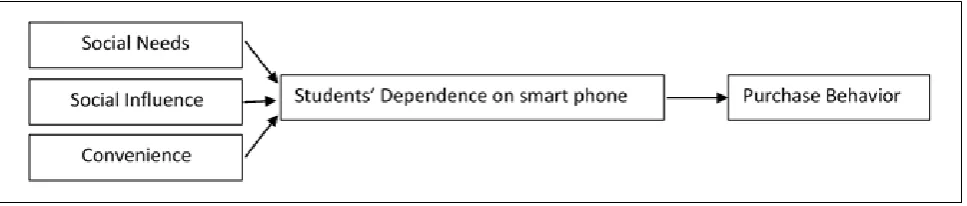
[image:5.595.57.541.437.540.2]Data were collected from students of different universities in Karachi who are using smart-phones. A questionnaires was designed to use as a survey instrument to record respondents experience with and perception about smartphones on a five-point Likert-type scale that varied from “strongly disagree” ‘1’ to “strongly agree”‘5’. To have a representative sample both pri-vate and public universities were targeted and no-probability sampling method was adopted. For content validity, the measurement items used in the questionnaire were adapted from wide range of earlier relevant research (Ting et al., 2011; Verkasalo et al., 2010; Kim & Park, 2011; Jin, Yoon, & Ji, 2013) and were used to operationalize research constructs in this study. 337 usable and completed questionnaires were received and statistical procedures were applied to analyze the data. Cronbach’s alpha was used to evaluate the internal consistency of the items and for construct validity Exploratory Factor Analysis (EFA) using principal component anal-ysis was performed by using SPSS 22. Further to test the hypothesized relationship among the latent variables structural equation model was used by using AMOS 22.
Figure 1: Conceptual Framework
7
Results and Discussion
Table 1: Demographic profile of respondents
Frequency %
Gender
Male 208 61.72
Female 129 38.28
Age
20-24 229 67.95
25-29 97 28.78
30-34 11 3.26
Education Level
MBA 171 50.74
BBA 39 11.57
BE 26 7.72
MPHIL 7 2.08
BS 72 21.36
MBBS 21 6.23
BA 1 0.3
Table 2: Experiences with the smart phone
Frequency %
I have been using smart phone more than two years
Yes 204 60.53
No 133 39.47
My smart phone application is easy to find
Yes 294 87.24
No 43 12.76
My smart phone is reliable in any time
Yes 284 84.27
No 53 15.73
My smart phone is fast & effective
Yes 293 86.94
No 44 13.06
When I buy my smart phone price is
<8000 37 10.98
8001-15000 115 34.12
15001-30000 121 35.91
>30000 64 18.99
Operating system used
Andriod 231 68.55
IOS 37 10.98
RIM Blackberry OS 21 6.23
Symbian OS 14 4.15
Window Phone 17 5.04
Others 17 5.04
7.1
The Measurement Model
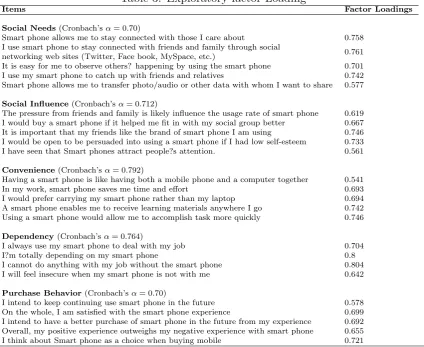
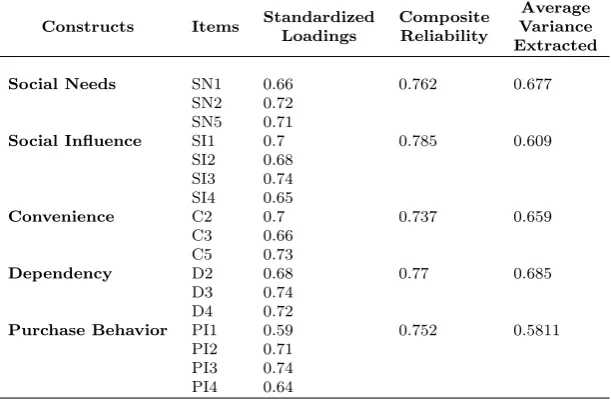
Before testing conceptual model for a significant relationship in the structural model; satis-factory level of reliability and validity of measurement model was determine using criteria for reliability and validity. Internal consistency of the survey instrument (questionnaire) was cal-culated by Cronbach’sα. As shown in Table 3, all values ofα are above the recommended level of 0.7 (Nunnally, 1970). Other psychometric properties of the model in terms of composite reliability, construct validity, convergent validity and discriminant validity were evaluated via Exploratory Factor Analysis (EFA) and Confirmatory Factor Analysis (CFA).
[image:6.595.158.447.279.520.2]Further, average variance extracted by each latent variable is also above acceptable level of 0.5 (Table 4), which validates the convergent validity of the measurement variables. Finally the discriminant validity analysis, which is use to show how different each construct is from other. A greater value of square root of AVE (average variance extracted) in compare to the correlation value among the latent variables demonstrate that the latent variables are not related to each other (Table 5). Consequently, the measurement variables and latent variables used in this research were confirmed to be reliable and valid for the model. Furthermore, as the correlations between each of the latent variables were also lower than 0.7, the test for no multicollinearity was also confirmed.
Table 3: Exploratory factor Loading
Items Factor Loadings
Social Needs(Cronbach’sα= 0.70)
Smart phone allows me to stay connected with those I care about 0.758
I use smart phone to stay connected with friends and family through social
0.761 networking web sites (Twitter, Face book, MySpace, etc.)
It is easy for me to observe others? happening by using the smart phone 0.701
I use my smart phone to catch up with friends and relatives 0.742
Smart phone allows me to transfer photo/audio or other data with whom I want to share 0.577
Social Influence(Cronbach’sα= 0.712)
The pressure from friends and family is likely influence the usage rate of smart phone 0.619
I would buy a smart phone if it helped me fit in with my social group better 0.667
It is important that my friends like the brand of smart phone I am using 0.746
I would be open to be persuaded into using a smart phone if I had low self-esteem 0.733
I have seen that Smart phones attract people?s attention. 0.561
Convenience(Cronbach’sα= 0.792)
Having a smart phone is like having both a mobile phone and a computer together 0.541
In my work, smart phone saves me time and effort 0.693
I would prefer carrying my smart phone rather than my laptop 0.694
A smart phone enables me to receive learning materials anywhere I go 0.742
Using a smart phone would allow me to accomplish task more quickly 0.746
Dependency(Cronbach’sα= 0.764)
I always use my smart phone to deal with my job 0.704
I?m totally depending on my smart phone 0.8
I cannot do anything with my job without the smart phone 0.804
I will feel insecure when my smart phone is not with me 0.642
Purchase Behavior(Cronbach’sα= 0.70)
I intend to keep continuing use smart phone in the future 0.578
On the whole, I am satisfied with the smart phone experience 0.699
I intend to have a better purchase of smart phone in the future from my experience 0.692
Overall, my positive experience outweighs my negative experience with smart phone 0.655
I think about Smart phone as a choice when buying mobile 0.721
7.2
Model Fitness
To evaluate whether the data set used in this research is usable for the suggested model; model fitness analysis is done for the confirmation and modification of the model. Verification of model fitness is done by using three types of fit measures which are Absolute Fit Measure
includes Chi-square (χ2), Goodness of Fitness Index (GFI) and Root Mean Square Error of
Ap-proximation (RMESA);Incremental Fit Measuresincludes Adjusted Goodness of Fit Index (AGFI), Normed Fit Index (NFI), Comparative Fit Index (CFI), Incremental Fit Index (IFI), Relative Fit Index (RFI); and Parsimony Fit Measures includes Parsimony Comparative Fit Index (PCFI), Parsimony Normed Fit Index (PNFI) (Bollen, 1989; Hair et al., 2010).
Table 4: Reliability & Confirmatory Factor Loading
Constructs Items Standardized Loadings
Composite Reliability
Average Variance Extracted Social Needs SN1 0.66 0.762 0.677
SN2 0.72
SN5 0.71
Social Influence SI1 0.7 0.785 0.609
SI2 0.68
SI3 0.74
SI4 0.65
Convenience C2 0.7 0.737 0.659
C3 0.66
C5 0.73
Dependency D2 0.68 0.77 0.685
D3 0.74
D4 0.72
Purchase Behavior PI1 0.59 0.752 0.5811
PI2 0.71
PI3 0.74
PI4 0.64
Table 5: Correlations Analysis Between Variables
1 2 3 4 5
(1) Social Needs 0.823
(2) Convenience .417** 0.812
(3) Purchase Behavior .532** .438** 0.762
(4) Social Influence .367** .207** .367** 0.78
(5) Dependency .243** .246** .271** .480** 0.827
Mean 4.19 3.83 4.02 3.21 2.79
Std. Deviation 0.81 0.85 0.7 0.92 1.02
Skewness -1.53 -0.9 -1.38 -0.25 0.03
Kurtosis 2.65 0.96 3.42 -0.31 -0.75
**. Correlation is significant at the 0.01 level (2-tailed).
Finally structural model was estimated to provide an empirical measure of the hypothesized relationships among the research variables and constructs by performing a simultaneous test.
Based on the model-fit indices obtained, the model has adequate and acceptable goodness-of-fit indices: χ2/df = 1.347(<3), GF I = 0.954(>0.90), RM SEA= 0.032(<0.08), AGF I =
0.931(> 0.80), N F I = 0.931(> .90), CF I = 0.981(> 0.95), IF I = 0.981(> 0.95), RF I = 0.907(>0.90), P CF I = 0.728(>0.50) and P N F I = 0.691(>0.50) . These indices are among the most frequently used, as they are less affected by sample size (Hair et al., 2010).
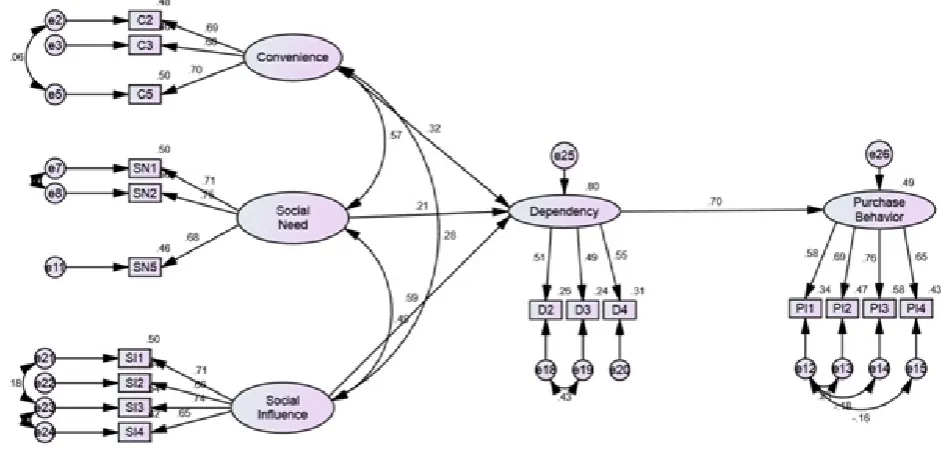
The results indicated that convenience, social needs, social influences and university stu-dents’ dependency on smartphones are positively related at p ≤ 0.01 level. Convenience was
found to be significantly related to university students’ dependency on smartphones (β = 0.32, p ≤ 0.01). Thus, H1 is supported. Moreover, the results indicated that social needs
had a significant impact on the dependency on smartphones (β = 0.21, p ≤ 0.05). Therefore,
the second hypothesis (H2) is supported. Finally, social influences was significantly related to university students’ dependency on smartphones (β = 0.59, p≤ 0.01) hence, H3 is supported.
Figure 2 shows that the R square between the independent variables on dependency are at 0.80. This indicates that 80.0 percent of the variation in university students’ dependency on smartphones is explained by the convenience, social needs and social influences. This evidence supports the interaction effect of convenience, social needs and social influences on university students’ dependency towards smartphones. Hence, H1, H2 and H3 are supported.
As for the path between dependency and purchase behavior, it was found to be significant as well (β = 0.70, p ≤ 0.01). Therefore, H4 is supported. The adjusted R square for this
Figure 2: Structural Equation Model
H4 is supported.
Table 6: Goodness of Fit Indices for Structural model
Fit Indices Recommended
Level of Fit Model Value Absolute Fit Measures
x2 (chi-square) 136.053
df (degrees of freedom) 101
Chi-square/df (x2/df) <3 1.347
GFI (Goodness of Fit Index) >0.9 0.954
RMSEA (Root Mean Square Error of Approximation) <0.08 0.032
Incremental Fit Measures
AGFI (Adjusted Goodness of Fit Index) >0.80 0.931
NFI (Normed Fit Index) >0.90 0.931
CFI (Comparative Fit Index) >0.90 0.981
IFI (Incremental Fit Index) >0.90 0.981
RFI (Relative Fit Index) >0.90 0.907
Parsimony Fit Measures
PCFI (Parsimony Comparative of Fit Index) >0.50 0.728
PNFI (Parsimony Normed Fit Index >0.50 0.691
Table 7: Goodness of Fit Indices for Structural model
Path β S.E. C.R. P Results
Convenience → Dependency 0.32 0.059 3.395 0 Supported
Social Need → Dependency 0.21 0.096 2.014 0.044 Supported
Social Influence → Dependency 0.59 0.083 5.695 0 Supported
Dependency → Purchase Behavior 0.7 0.113 5.678 0 Supported
8
Conclusion
on smart phones. Positive significant relationship between Social Influence and dependence on smartphone should be view by marketers as an important factor in influencing university stu-dents’ smartphone dependency. Marketers should promote smartphones as a necessity within a social community (Raento, Oulasvirta, & Eagle, 2009). This can be achieve by initiating and spreading positive word-of-mouth through promotions via endorsement from effective reference groups that are at the center of attention among students. This will allow social influencers to make positive recommendations and increase awareness about the smartphone’s functions, by giving them a greater encouragement to use smartphones.
The positive significant relationship between social needs and university students’ depen-dency on smartphones signifies need of university students’ to stay connected. Smartphone providers should design their smartphones with a provision of high speed data connection for on-line multi media application which will allow multimedia connectivity between university students and among their social circle. Multi media communications and feedback will allow students to get further engage with smartphones, and it will contribute to the sense of com-munity and networks where communications are encouraged. In addition to this, marketers in their promotional strategy to engage university students to use smartphones may offer and use the need for belonging and the importance of staying connected through smartphones.
Similarly positive significant relationship between convenience and university students’ de-pendence on smartphone indicates that convenience due to smartphones has enhance the depen-dence on smartphones. In other words, university students consider convenience of smartphones as a factor that motivates them to increase their smartphone usage. Smartphone manufacturers should emphasize on convenience feature when promoting smartphones to students. They may further increase the convenience by providing greater memory space, user friendly interface, high speed internet connection, option for connecting input and output devices and ability to write, edit and view documents, images, and presentations.
Strong positive and significant relationship between university students’ dependency on smartphone and their future purchase behavior indicates that dependency on smartphones has a direct effect on the formation of predictive expectations in future purchase behavior.
8.1
Limitation
References
Auter, P. J. (2007). Portable social groups: willingness to communicate, interpersonal com-munication gratifications, and cell phone use among young adults. International Journal Mobile Communications,5(2), 139-56.
Baloch, F. (2014, May). Technology adoption : Smarter phones to become the need of the hour.
Retrieved March 23, 2014, from http://tribune.com.pk/story/686305/technology -adoption\newline-smarter-phones-to-become-the-need-of-the-hour/
Bollen, K. A. (1989). Structural equation with latent variables. Wiley.
Genova, G. L. (2010). The anywhere office = anywhere liability. Business Communication Quarterly, 73(119). doi: 10.1177/1080569909358104
Goldman, S. M. (2010). Transformers. Journal of Consumer Marketing, 27(5), 469-473. Hahn, J. (2010). Information seeking with wikipedia on ipod touch. Reference Services Review,
38(2), 284-298.
Hair, J. F., Black, W. C., Babin, B. J., & Anderson, R. E. (2010). Multivariate data analysis
(7th ed.). Pearson.
Holub, S. F., Green, M. C., & Valenti, S. P. (2010). The smartphone: The tax practitioner’s portable office. Tax Adviser, 41(3), 206 - 8.
Jacob, S. M., & Issac, B. (2008). The mobile devices and its mobile learning usage analysis. In editor (Ed.),In proceedings of the international multiconference of engineers and computer scientists (Vol. 1, p. 19-21).
Jin, B. S., Yoon, S. H., & Ji, Y. G. (2013). Development of a continuous usage model for the adoption and continuous usage of a smartphone. International Journal of Human-Computer Interaction, 29, 563 - 581.
Jung, Y. (2014). What a smartphone is to me: understanding user values in using smartphones.
Information Systems Journal, 24(4), 299-321.
Kang, S., & Jung, J. (2014). Mobile communication for human needs: A comparison of smartphone use between the us and korea. Computers in Human Behavior,35, 376-387. Keaveney, S., & Parthasarathy, M. (2001). Customer switching behaviour in online services:
an exploratory study of the role of selected attitudinal, behavioural, and demographic factors. Journal of the Academy of Marketing Science, 29(4), 374-90.
Kim, S., & Park, H. J. (2011). Effects of social influence on consumers’ voluntary adoption of innovations prompted by others. Journal of Business Research, 64(11), 1190 – 1194. Kuhlmeier, D., & Knight, G. (2005). Antecedents to internet based purchasing: A multinational
study. International Marketing Review, 22(4), 460-473.
Kulviwat, S., BrunerII, G. C., & Al-Shuridah, O. (2009). The role of social influence on adoption of high tech innovations: The moderating effect of public/private consumption.
Journal of Business Research, 62.
Lee, D., Rheeand, Y., & Dunham, R. B. (2009). The role of organizational and individ-ual characteristics in technology acceptance. International Journal of Human–Computer Interaction, 25, 623–646.
Lee, S. (2013). Examining the factors that influence early adopters’ smartphone adoption: The case of college students. Telematics and Informatics. Retrieved from http://dx.doi .org/10.1016/j.tele.2013.06.001
Lippincott, J. K. (2010). A mobile future for academic libraries. Reference Services Review,
38(2), 205 - 213.
Lu, H., & Su, P. Y. (2009). Factors affecting purchase intention on mobile shopping web sites.
Internet Research, 19(4), 442-458.
Mason, W. A., Conrey, F. D., & Smith, E. R. (2007). Situating social influence processes: dynamic, multidirectional flows of influence within social networks.Personality and Social Psychology Review, 11(3), 279-300.
Nunnally, J. C. (1970). Introduction to psychological measure (2nd ed.). McGraw-Hill.
Paterson, L., & Low, B. (2011). Student attitudes towards mobile library services for smart-phones. Library Hi Tech, 29(3), 412-423.
Pearson, J. C., Carmon, A., Tobola, C., & Fowler, M. (2010). Motives for communication: Why the millennial generation uses electronic devices. Journal of the Communication, Speech and Theatre Association of North Dakota,22, 45-55.
Persaud, A., & Azhar, I. (2012). Innovative mobile marketing via smartphones: are consumers ready? Marketing Intelligence and Planning, 30(4), 3-36.
Raento, M., Oulasvirta, A., & Eagle, N. (2009). A social cognitive perspective on mobile communication technology use and adoption. Social Science Computer Review, 37(3), 426-54.
Rainie, L., & Poushter, J. (2014). Emerging nations catching up to u.s. on technology adoption, especially mobile and social media use [Report].
Raskin, R. (2006). Facebook faces its future. Young Consumers, 4(1), 56-8.
Schiffman, L. G., Kanuk, L. L., & Wisenbut, J. (2010).Consumer behavior (10th ed.). Pearson. Stephens, K. K., & Davis, J. (2009). The social influences on electronic multitasking
in organizational meetings. Management Communication Quarterly. doi: 10.1177/ 0893318909335417
Tam, K. Y., & Ho, S. Y. (2006). Understanding the impact of web personalization on user information processing and decision outcomes. MIS Quarterly, 30, 865–890.
Tikkanen, I. (2009). Maslow’s hierarchy and pupils’ suggestions for developing school meals.
Nutrition and Food Science,39(5), 534-43.
Ting, D. H., Lim, S. F., Patanmacia, T. S., Low, C. G., & Ker, G. C. (2011). Dependency on smartphone and the impact on purchase behaviour. Young Consumers,12(3), 193-203. Tossell, C. C., Kortum, P., Shepard, C., Rahmati, A., & Zhong, L. (2012). An empirical
analysis of smartphone personalization: measurement and user variability. Behaviour and Information Technology, 31(10), 995-1010.
Verkasalo, H., L´opez-Nicol´as, C., Molina-Castillo, F. J., & Bouwman, H. (2010). Analysis of users and non-users of smartphone applications. Telematics and Informatics, 27, 242–255.