A multimodal corpus for the evaluation of computational models for
(grounded) language acquisition
Judith Gaspersa, Maximilian Panznera, Andre Lemmeb, Philipp Cimianoa,
Katharina J. Rohlfingc, Sebastian Wredeb
aSemantic Computing Group, CITEC, Bielefeld University, Germany
{jgaspers|mpanzner|cimiano}@cit-ec.uni-bielefeld.de
bResearch Institute for Cognition and Robotics (CoR-Lab), Bielefeld University, Germany
{alemme|swrede}@cor-lab.uni-bielefeld.de cEmergentist Semantics Group, CITEC, Bielefeld University, Germany
Abstract
This paper describes the design and ac-quisition of a German multimodal cor-pus for the development and evaluation of computational models for (grounded) lan-guage acquisition and algorithms enabling corresponding capabilities in robots. The corpus contains parallel data from multi-ple speakers/actors, including speech, vi-sual data from different perspectives and body posture data. The corpus is designed to support the development and evalua-tion of models learning rather complex grounded linguistic structures, e.g. syn-tactic patterns, from sub-symbolic input. It provides moreover a valuable resource for evaluating algorithms addressing sev-eral other learning processes, e.g. concept formation or acquisition of manipulation skills. The corpus will be made available to the public.
1 Introduction
Children acquire linguistic structures through ex-posure to (spoken) language in a rich context and environment. The semantics of language may be learned by establishing connections between lin-guistic structures and corresponding structures in the environment, i.e. in different domains such as the visual one (Harnad, 1990). Both with re-spect to modeling language acquisition in chil-dren and with respect to enabling corresponding language acquisition capabilities in robots, which may ideally be also grounded in their environment, it is hence of great interest to explore i) how lin-guistic structures of different levels of complexity,
e.g. words or grammatical phrases, can be derived from speech input, ii) how structured representa-tions for entities observed in the environment can be derived, e.g. how concepts and structured rep-resentations of actions can be formed, and iii) how connections can be established between structured representations derived from different domains. In order to gain insights concerning the mechanisms at play during language acquisition (LA), which enable children to solve these learning tasks, mod-els are needed which ideally cover several learning tasks. For instance, they may cover the acquisition of both words and grammatical rules as well as the acquisition of their grounded meanings. Comple-mentarily, data resources are needed which enable the design and evaluation of these models by pro-viding suitable parallel data.
Aiming to provide a basis for the development and evaluation of LA models addressing the ac-quisition of rather complex and grounded linguis-tic structures, i.e. syntaclinguis-tic patterns, from sub-symbolic input, we designed a German multi-modal input corpus. The corpus consists of data of multiple speakers/actors who performed actions in front of a robot and described these actions while executing them. Subjects were recorded, i.e. par-allel data of speech, stereo vision (including the view-perspective of the “infant”/robot) and body postures were gathered. The resulting data hence allow grounding of linguistic structures in both vision and body postures. Among others, learn-ing processes that may be evaluated uslearn-ing the cor-pus include: acquisition of several linguistic struc-tures, acquisition of visual strucstruc-tures, concept for-mation, acquisition of generalized patterns which abstract over different speakers and actors, estab-lishment of correspondences between structures
from different domains, acquisition of manipula-tion skills, and development of appropriate models for the representations of actions.
This paper is organized as follows. Next, we will provide background information concerning computational models of LA. In Section 3, we will then describe the corpus design and acqui-sition, including the desired properties of the collected data, corresponding experimental set-tings and technical implementation. We will then present the resulting data set and subsequently conclude..
2 Background
To date, several models addressing LA learning tasks have been proposed and evaluated using dif-ferent copora. Yet, these models typically focus on a subset or certain aspects of the LA learning tasks mentioned in the previous section, often assuming other learning tasks, e.g. those of lower complex-ity, as already solved by the learner. For instance, models addressing the acquisition of grammatical constructions and their meaning (Kwiatkowski et al., 2012; Alishahi and Stevenson, 2008; Gaspers and Cimiano, in press; Chang and Maia, 2001) typically learn from symbolic input. In particu-lar, assuming that the child is already able to seg-ment a speech signal into a stream of words and to extract structured representations from the visual context, such models typically explore learning from sequences of words and symbolic descrip-tions of the non-linguistic context. Models ad-dressing the acquisition of word-like units directly from a speech signal (R¨as¨anen, 2011; R¨as¨anen et al., 2009) have also been explored. These, how-ever, typically do not address learning of more complex linguistic structures/constructions. Taken together, lexical acquisition from speech and syntactic acquisition have been mainly stud-ied independently of each other, often assuming that syntactic acquisition follows from knowledge of words. However, learning processes might ac-tually be interleaved, and top-down learning pro-cesses may play an important role in LA. For instance, with respect to computational learn-ing from symbolic input, it has been shown that knowledge of syntax can facilitate word learning (Yu, 2006). Children may, for instance, also make use of syntactic cues during speech segmentation and/or word learning, but models addressing lexi-cal acquisition from speech have to date mainly
ig-nored syntax (R¨as¨anen, 2012). Models addressing the acquisition of syntactic patterns directly from speech provide a basis for exploring to what extent learning mechanisms might be interleaved in early LA. Moreover, they allow to investigate the pos-sible role of several top-down learning processes which have to date been little explored.
Several corpora comprising interactions of chil-dren with their caregivers have been collected. A large such resource is the CHILDES data base (MacWhinney, 2000), which contains transcribed speech. Data from CHILDES have been often used to evaluate models learning from symbolic input, in particular models for syntactic acquisi-tion from sequences of words; addiacquisi-tional accom-panying symbolic context representations have been often created (semi–)automatically. More-over, multimodal corpora containing caregiver-child interactions have been recorded and anno-tated (Bj¨orkenstam and Wirn, 2013; Yu et al., 2008), thus also allowing to study the role of social interaction and extra-linguistic cues in language learning. By contrast, in this work we aim to pro-vide a basis for developing and evaluating models which address the acquisition of syntactic patterns from speech. Hence, allowing to derive general-ized patterns, linguistic units as well as the objects and actions they refer to have to re-appear in the data several times. Thus, in line with the CARE-GIVER corpus (Altosaar et al., 2010) we did not record caregiver-child interactions but attempted to approximate speech used by caregivers with re-spect to the learning task(s) at hand. However, the focus of the CAREGIVER corpus is on mod-els learning word-like units from speech. Thus, a number of keywords were spoken in different carrier sentences; speech is accompanied by only limited non-linguistic context information in the corpus. In contrast to CAREGIVER, we did not restrict language use directly and recorded paral-lel context information from different modalities, focusing not only on the acquisition of word-like units from speech and word-to-object mapping but moreover on the acquisition of simple syntactic patterns and mapping language to actions.
3 Corpus design and acquisition
imple-mentation of the robot behavior and the data ac-quisition as well as the resulting corpus.
3.1 Desired properties
Our goal was to design a corpus comprising multi-modal data which supports the evaluation of com-putational models addressing several LA learn-ing tasks, and in particular the acquisition of grounded syntactic patterns from sub-symbolic in-put only as well as the development of compo-nents supporting the acquisition of language by robots. Thus, the main focus was to design the corpus in such a way that the data acquisition scenario was simplified enough to allow solving the task of learning grounded syntactic patterns from sub-symbolic input with the resulting data set (which of course contains much less data when compared to the innumerable natural language ex-amples children receive when acquiring language over several years). In particular, since the ac-quisition of rather complex structures should be enabled using sub-symbolic information, several (repeated) examples for contained structures were needed, allowing the formation of generalized rep-resentations. Thus, we opted for a rather sim-ple scenario. Specifically, the following properties were taken into account:
• Rather few objects and actions were included that could moreover be differentiated rather easily from a visual point of view. How-ever, in order to reflect differences between actions, these differed i) with respect to the number of their referents as well as ii) with respect to their specificity to certain objects. In particular, we included actions which could be performed on different sub-sets of the objects, ranging from specificity to one certain object to being executed with all of the objects.
• Objects and actions reappeared several times, yielding several examples for each of them. Repeated appearance is an essential aspect, since the formation of generalized represen-tations starting from continuous input re-quires several observations in order to allow abstraction over observed examples/different actors and speakers.
• The scenario was designed such that it en-couraged human subjects to use rather simple
syntactic patterns/short sentences. Yet, lan-guage use was in principle unrestricted in or-der to acquire rather natural data and to cap-ture speaker-dependent differences. This also reflects the input children receive in that par-ents use rather simple language when talking to children.
• Data were gathered from several human sub-jects in order to allow for the evaluation of generalization over different speakers (with different acoustic properties and different language use, e.g. different words for ob-jects, different syntactic patterns with differ-ent complexity, etc) as well as over differdiffer-ent actors in case of actions, since children inter-act with different people and are able to solve this task. Moreover, generalization to dif-ferent speakers/actors is also important with respect to learning in artificial agents which should preferably not be operable by a single person only.
• Parallel data were gathered in which ob-jects and actions were explicitly named when they were used. This is an important as-pect because the corpus should allow learn-ing connections between vision, i.e. objects and actions, and speech (segments) referring to these objects/actions, i.e. (sequences of words) and syntactic patterns. It reflects the input children receive in that caregivers also explain/show objects directly to their chil-dren and may show them how to use ob-jects/perform actions in front of them (Rolf et al., 2009; Schillingmann et al., 2009). We opted for the collection of parallel data con-cerning vision and body postures for human tutors. Hence, the corpus allows grounding of linguistic structures in both vision and body postures. In-cluding body postures moreover allows the eval-uation of algorithms showing manipulation skills which is of interest with respect to learning in robots.
the robot moved its eyes (and thus the cameras) and focused on the tutor’s hand performing the ac-tions, thus reflecting how a child may focus her/his attention to the important aspects of a scene/a per-formance of her/his caregiver.
3.2 Participants
A total of 27 adult human subjects participated in data collection (7 male, 20 female, mean age: 26). Subjects were paid for their participation.
3.3 Experimental setting
Human subjects performed pre-defined actions and simultaneously described their performances in front of the robot iCub (Metta et al., 2008); Fig. 1 depicts a human subject interacting with iCub. While interacting with iCub, human subjects’
be-Figure 1: A human subject interacting with iCub.
havior was recorded. In particular, the following data were recorded simultaneously:
• Speech/Audio (via a headset microphone)
• Vision/Video, static perspective (via two cameras, allowing for stereo vision)
• iCub-Vision/Video, iCub’s (attentive) per-spective (via iCub’s two internal cameras, again allowing for stereo vision)
• Body postures (via a Kinect).
An experimental sketch showing the experimental setting including the positions of the human sub-ject and iCub, as well as camera and Kinect po-sitions, is illustrated in Fig. 2. As can be seen, the human subject was placed directly opposite to iCub. The two external cameras and the Kincet were placed slightly sloped opposite to the sub-ject. Subjects were instructed about which actions should be performed via a computer screen which was operated by an experimentator.
[image:4.595.314.515.67.174.2]In order to encourage subjects to perform the tu-toring task rather naturally, i.e. just like they were
Figure 2: Experimental sketch.
interacting with a human (child), iCub provided feedback (Nagai and Rohlfing, 2009; Fischer et al., 2011). In particular, a gazing behavior was implemented to make the robot appear attentively following the tutoring.
3.4 Stimuli
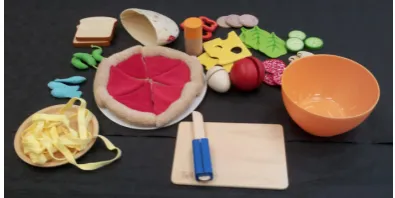
Data were gathered in the framework of a toy cooking scenario. In particular, subjects prepared several dishes in front of iCub using toy objects. Specifically, 21 toy objects were chosen such that
Figure 3: Utilized objects.
[image:4.595.71.290.301.399.2] [image:4.595.317.515.392.491.2]certain degree, i.e. they were to be executed with a certain subset of the objects each. Theshow ac-tion was to be executed using each of the objects. Furthermore, 20 different dishes, i.e. preparation processes each consisting of a sequence of actions, were created (four dishes including salad, pizza, pita bread, spaghetti and sandwich/toast, respec-tively). This was done in order to gather rather fluent/consistent courses of action and rather flu-ent communication in case of descriptions. For in-stance, one sequence for preparing a salad started as follows: showing bowl, showing lettuce leafs,
putting lettuce leafs into bowl, showing cutting board, showing knife, showing tomato, putting tomato onto cutting board,cutting tomato into two pieces,putting tomato pieces into bowl, etc.
3.5 Procedure
Subjects first prepared one dish while not being recorded in order to get familiar with the task. They were instructed to perform presented actions and to describe their performance simultaneously. Moreover, they were asked to name objects and actions explicitly, since a goal of the corpus is to allow learning connections between speech, vision and body postures. Subjects were not asked to use particular words or phrases, but were free to make own choices. For instance, when being ex-posed to a picture of the pita bread, they were sup-posed to explicitly name the pita bread. Yet, they were free to choose a suitable word (or sequence of words), e.g. “Pita”, “Pitatasche”, “Teigtasche”, “D¨onertasche”, “Brottasche”, etc.
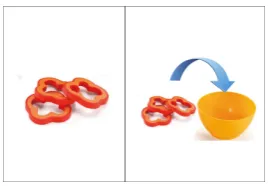
[image:5.595.349.484.60.153.2]Actions to be performed were presented to the subjects via a computer screen; either one action was presented or – in most cases – two actions were presented at once to be executed one after another. In most cases two actions were presented in order to gain more fluent communications and courses of action. In no case more than two ac-tions were presented together because we wanted subjects to focus on performance and not on re-membering a certain course of action. Actions were presented only in the form of pictures in or-der to elicit rather natural language use. In par-ticular, as mentioned previously, subjects could choose freely how to name objects and actions. An example for a screen/picture showing two actions to be performed one after another is presented in Fig. 4. An experimentator operated the screen, i.e. guided the subjects through the sequences of
Figure 4: Example screen showing the actions
show red pepperandput red pepper into bowl.
actions. Subjects participated for approximately one hour; only subject’s actual performances were recorded, yielding approximately 20–30 minutes of usable material per subject.
3.6 Robot behavior
As mentioned previously, a gazing behavior was implemented to make the robot appear attentively following the tutoring. In particular, the robot’s gaze followed a subject’s presentation of an action by gazing at her/his right wrist. At times when subjects did not move their hands (to present ac-tions) the robot was looking around, i.e. it gazed at random targets. In the following, the implemen-tation of the robot behavior will be described in more detail.
as long as targets were received. If no targets were arriving duringt = 2 sec. after the gazing con-verged on the last target, the “background” behav-ior took over. Due to the difference in distance between targets, the motion duration was different as well. Therefore, time delays were added to the target generation, which resulted in a more natural behavior of the robot gazing.
4 Acquired data
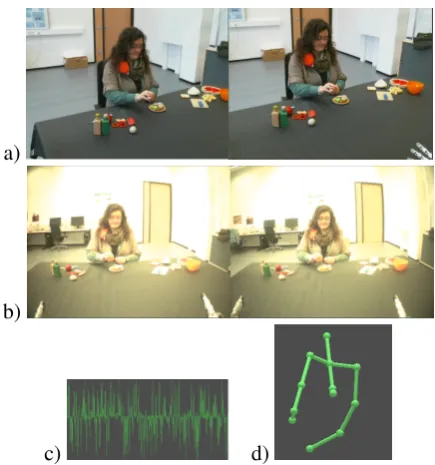
In order to record synchronized data from the external sensors, the robot system and the ex-perimental control software, we utilized a ded-icated framework for the acquisition of multi-modal human-robot interaction data sets (Wienke et al., 2012). The framework and the underly-ing technology (Wienke and Wrede, 2011) allows to directly capture the network communication of robotics software components. Through this ap-proach, system-internal data from the iCub such as its proprioception and stereo cameras images can be synchronously captured and transformed into an RETF1-described log-file format with explicit time and type information. Moreover, additional recording devices such as the Kinect sensors, the external pair of stereo cams or the audio input from a close-talk microphone are captured directly with this system and stored persistently. An exam-ple of the acquired parallel data is provided by Fig. 5 while Table 6 summarizes the technical aspects of the acquired data.
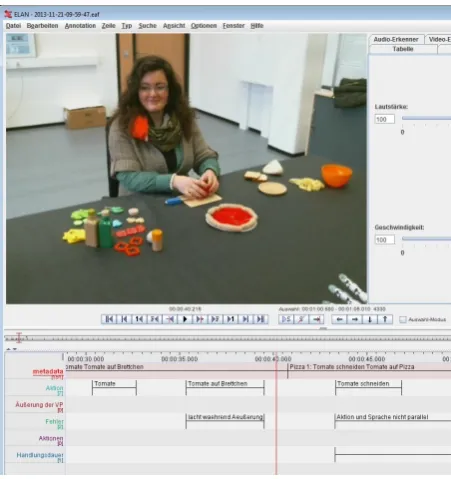
The applied framework also supports the auto-matic export and conversion of synchronized parts of the multimodal data set to common formats used by other 3rd party tools such as the annota-tion tool ELAN (Sloetjes and Wittenburg, 2008) used for ground truth annotation of the acquired corpus. In this experiment, we additionally cap-tured the logical state of the experiment control software which allowed us to efficiently post-process the raw data and, e.g., automatically pro-vide cropped pro-video files containing only single ut-terances. A logical state corresponds to the image seen at the screen by a human subject at a certain time, showing the action(s) to be performed.
The acquired corpus contains in total 11.45 hours / approx. 2.3 TB of multimodal input data recorded in 27 trials. Each trial was recorded in about 1 hour of wallclock time and cropped to 20– 30 minutes of effective parallel data. While in 5
1Robot Engineering Task-Force, cf. http://retf.info/
a)
b)
[image:6.595.307.525.59.292.2]c) d)
Figure 5: Example of acquired parallel data com-prising a) visual data from two static cameras, b) visual data from two cameras contained in the robot’s eyes, c) audio and d) body posture data recorded by the Kinect. In this example the sub-ject is preparing a sandwich, and currently strew-ing pepper onto it.
cases not all of the parallel data streams are avail-able due to difficulties with the robot and the wire-less microphones, we decided to leave this data in the corpus to evaluate machine learning pro-cesses addressing learning from one or a subset of the modalities only, e.g. blind segmentation of a speech stream.
# Device Description Data type Frequency Dimension Throughput 1 Cam 1 Scene video rst.vision.Image ≈30 Hz 640×480×3 ≈28 MB/s 2 Cam 2 Scene video rst.vision.Image ≈30 Hz 640×480×3 ≈28 MB/s
3 Mic 1 Speech rst.audition.SoundChunk ≈50 kHz 1-2 ≈0.5 MB/s
4 iCub Cam 1 Ego left bottle/yarp::sig::Image ≈30 Hz 320×240×3 ≈7 MB/s 5 iCub Cam 2 Ego right bottle/yarp::sig::Image ≈30 Hz 320×240×3 ≈7 MB/s 6 Kinect Body posture TrackedPosture3DFloat2 ≈30 Hz 36 ≈6 kB/s
[image:7.595.73.524.62.147.2]7 Control Logical state string ≈0.05 Hz - ≈5 B/s
Figure 6: Description of acquired data streams, type specifications, average frequency, data dimension and throughput as measured during recording.
information either in sub-symbolic form or in the form of predicate logic formulas.
Figure 7: Example of acquired data and corre-sponding annotations in ELAN.
Word transcriptions for utterances for the whole data set are not yet available. According to the ex-perimentators’ impressions, most subjects indeed used, as desired, rather short sentences. Further-more, a few subjects tried to vary their linguis-tic descriptions, i.e. to use different sentences for each description. Thus, the corpus appears to cover not only several examples of rather sim-ple linguistic constructions with variations across speakers, but moreover input examples with a rather large degree of linguistic variation for a sin-gle speaker, hence providing examples of more challenging data.
We will make the corpus available to the public once post-processing is completely finished.
5 Conclusion
In this paper, we have described the design and acquisition of a German multimodal data set for the development and evaluation of grounded lan-guage acquisition models and algorithms enabling corresponding abilities in robots. The corpus con-tains parallel data including speech, visual data from four different cameras with different per-spectives and body posture data from multiple speakers/actors. Among others, learning pro-cesses that may be evaluated using the corpus in-clude: acquisition of several linguistic structures, acquisition of visual structures, concept forma-tion, acquisition of generalized patterns which ab-stract over different speakers and actors, establish-ment of correspondences between structures from different domains and acquisition of manipulation skills.
Acknowledgments
We are deeply grateful to Jan Moringen, Michael G¨otting and Stefan Kr¨uger for providing techni-cal support. We wish to thank Luci Filinger, Christina Lehwalder, Anne Nemeth and Frederike Strunz for support in data collection and annota-tion. This work has been funded by the German Research Foundation DFG within the Collabora-tive Research Center 673Alignment in Communi-cationand the Center of ExcellenceCognitive In-teraction Technology. Andre Lemme is funded by FP7 under GA. No. 248311-AMARSi.
References
Afra Alishahi and Suzanne Stevenson. 2008. A com-putational model of early argument structure acqui-sition. Cognitive Science, 32(5):789–834.
[image:7.595.72.298.252.492.2]Proceed-ings of the International Conference on Language Resources and Evaluation.
Kristina Nilsson Bj¨orkenstam and Mats Wirn. 2013. Multimodal annotation of parent-child interaction in a free-play setting. In Proceedings of the Thir-teenth International Conference on Intelligent Vir-tual Agents.
Nancy C. Chang and Tiago V. Maia. 2001. Learn-ing grammatical constructions. In Proceedings of the 23rd Cognitive Science Society Conference.
Kerstin Fischer, Kilian Foth, Katharina J. Rohlfing, and Britta Wrede. 2011. Mindful tutors: Linguis-tic choice and action demonstration in speech to in-fants and to a simulated robot. Interaction Studies, 12(1):134–161.
Judith Gaspers and Philipp Cimiano. in press. A computational model for the item-based induction of construction networks. Cognitive Science.
Stevan Harnad. 1990. The symbol grounding problem.
Physica D: Nonlinear Phenomena, 42(1-3):335– 346.
Tom Kwiatkowski, Sharon Goldwater, Luke Zettle-moyer, and Mark Steedman. 2012. A probabilis-tic model of syntacprobabilis-tic and semanprobabilis-tic acquisition from child-directed utterances and their meanings. In
Proceedings of the 13th Conference of the European Chapter of the Association for Computational Lin-guistics.
Brian MacWhinney. 2000. The CHILDES Project: Tools for analyzing talk. Mahwah, NJ.
Giorgio Metta, Giulio Sandini, David Vernon, Lorenzo Natale, and Francesco Nori. 2008. The iCub hu-manoid robot: an open platform for research in em-bodied cognition. In Proceedings of the 8th Work-shop on Performance Metrics for Intelligent Sys-tems, pages 50–56, New York, NY. ACM.
Yukie Nagai and Katharina J. Rohlfing. 2009. Com-putational analysis of motionese toward scaffolding robot action learning. IEEE Transactions on Au-tonomous Mental Development, 1:44–54.
Ugo Pattacini. 2010. Modular Cartesian Controllers for Humanoid Robots: Design and Implementation on the iCub. Ph.D. thesis, RBCS, Istituto Italiano di Tecnologia, Genova.
Okko R¨as¨anen, Unto K. Laine, and Toomas Altosaar. 2009. Computational language acquisition by sta-tistical bottom-up processing. InProceedings Inter-speech.
Okko R¨as¨anen. 2011. A computational model of word segmentation from continuous speech using transi-tional probabilities of atomic acoustic events. Cog-nition, 120:149176.
Okko R¨as¨anen. 2012. Computational modeling of phonetic and lexical learning in early language ac-quisition: existing models and future directions.
Speech Communication, 54:975–997.
Matthias Rolf, Marc Hanheide, and Katharina J. Rohlf-ing. 2009. Attention via synchrony. making use of multimodal cues in social learning. IEEE Transac-tions on Autonomous Mental Development, 1:55–67. Lars Schillingmann, Britta Wrede, and Katharina J. Rohlfing. 2009. A computational model of acous-tic packaging. IEEE Transactions on Autonomous Mental Development, 1:226–237.
Han Sloetjes and Peter Wittenburg. 2008. Annota-tion by category: Elan and iso dcr. In Proceed-ings of the International Conference on Language Resources and Evaluation.
Johannes Wienke and Sebastian Wrede. 2011. A Mid-dleware for Collaborative Research in Experimen-tal Robotics. In IEEE/SICE International Sympo-sium on System Integration (SII2011), Kyoto, Japan. IEEE.
Johannes Wienke, David Klotz, and Sebastian Wrede. 2012. A Framework for the Acquisition of Multi-modal Human-Robot Interaction Data Sets with a Whole-System Perspective. InLREC Workshop on Multimodal Corpora for Machine Learning: How should multimodal corpora deal with the situation?, Istanbul, Turkey.
Chen Yu, Linda B. Smith, and Alfredo F. Pereira. 2008. Grounding word learning in multimodal sensorimo-tor interaction. InProceedings of the 30th Annual Conference of the Cognitive Science Society. Chen Yu. 2006. Learning syntax-semantics mappings