A Statistical Approach for Non-Sentential Utterance Resolution for
Interactive QA System
Dinesh Raghu∗
IBM Watson [email protected]
Sathish Indurthi∗
IBM Watson [email protected]
Jitendra Ajmera
IBM Watson [email protected]
Sachindra Joshi
IBM Watson [email protected]
Abstract
Non-Sentential Utterances (NSUs) are short utterances that do not have the form of a full sentence but nevertheless convey a complete sentential meaning in the context of a conversation. NSUs are frequently used to ask follow up questions during in-teractions with question answer (QA) sys-tems resulting into in-correct answers be-ing presented to their users. Most of the current methods for resolving such NSUs have adopted rule or grammar based ap-proach and have limited applicability. In this paper, we present a data driven sta-tistical method for resolving such NSUs. Our method is based on the observation that humans identify keyword appearing in an NSU and place them in the context of conversation to construct a meaningful sentence. We adapt the keyword to ques-tion (K2Q) framework to generate natu-ral language questions using keywords ap-pearing in an NSU and its context. The resulting questions are ranked using differ-ent scoring methods in a statistical frame-work. Our evaluation on a data-set col-lected using mTurk shows that the pro-posed method perform significantly bet-ter than the previous work that has largely been rule based.
1 Introduction
Recently Question Answering (QA) systems have been built with high accuracies [Ferrucci, 2012]. The obvious next step for them is to assist peo-ple by improving their experience in seeking day to day information needs like product support and troubleshooting. For QA systems to be effective
∗D. Raghu and S. Indurthi contributed equally to this work
and usable they need to evolve into conversational systems. One extra challenge that conversational systems throw is that users tend to form succes-sive queries that allude to the entities and concepts made in the past utterances. Therefore, among other things, such systems need to be equipped with the ability to understand what are called Non-Sentential Utterances (NSUs) [Fern´andez et al., 2005, Fern´andez, 2006].
NSUs are utterances that do not have the form of a full sentence, according to the most tradi-tional grammars, but nevertheless convey a com-plete sentential meaning. Consider for example, the conversation between a sales staff of a mobile store (S) and one of their customers (C), where C:2 and C:3 are examples of NSUs.
S:1Hi, How may I help you
C:1How much does an Apple iPhone 6 cost ?
S:2$. . .
C:2What about 6S ?
S:3$. . .
C:3with 64 GB ?
S:4$. . .
Humans have the ability to understand these NSUs in a conversation based on the context de-rived so far. The conversation context could in-clude topic(s) under discussion, the past history between the participants or even their geograph-ical location.
In the example above, the sales staff, based on her domain knowledge, knows that iPhone 6 and iPhone 6S are different models of iPhone and all phones have a cost feature associated with them. Therefore an utteranceWhat about 6S, in the con-text of utteranceHow much does an Apple iPhone 6 cost, would mean How much does an Apple iPhone 6S cost. Similarly, 64 GB is an attribute of iPhone 6S and therefore the utterancewith 64
GBin the context of utteranceHow much does an Apple iPhone 6S costwould meanHow much does an Apple iPhone 6s with 64 GB cost.
In fact, studies have suggested that users of in-teractive systems prefer on being as terse as pos-sible and thus give rise to NSUs frequently. Cog-nizant of this limitation, some systems explicitly ask the users to avoid usage of pronouns and in-complete sentences [Carbonell, 1983]. The cur-rent state of the QA systems would not be able to handle such NSUs and would result into inappro-priate answers.
In this paper we propose a novel approach for handling such NSUs arising when users are trying to seek information using QA systems. Resolving NSUs is the process of recovering a full clausal meaningful question for an NSU utterance, by uti-lizing the context of previous utterances.
The occurrence and resolution of NSUs in a conversation have been studied in the literature and is an active area of research. However, most of the proposed approaches in the past have adopted a rule or grammar based approach [Carbonell, 1983, Fern´andez et al., 2005, Giuliani et al., 2014]. The design of the rules or grammars in these works were motivated by the frequent patterns observed empirically which may not scale well for unseen or domain specific scenarios.
Also, note that while the NSU resolution task can be quite broad in scope and cover many as-pects including ellipsis [Giuliani et al., 2014], we limit the investigation in this paper to only the
Question aspect of NSU, i.e. resolving C:2 and C:3 in the example above. More specifically, we would not be trying to resolve the system (S:2, S:3, S:4) and other non-question utterances (e.g. OK, Ohh! I see). This focus and choice is primarily driven by our motivation of facilitating a QA sys-tem.
We propose a statistical approach to NSU reso-lution which is not restricted by limited number of patterns. Our approach is motivated by the obser-vation that humans try to identify the keywords ap-pearing in the NSU and place them in the context to construct a complete sentential form. For con-structing a meaningful and relevant sentence from keywords, we adapt the techniques proposed for generating questions from keywords, also known as keyword-to-question (K2Q).
The K2Q [Zhao et al., 2011, Zheng et al., 2011, Liu et al., 2012] is a recently investigated
prob-lem with the motivation to convert succinct web queries to natural language (NL) questions to di-rect users to cQA (community QA) websites. As an example, the queryticket Broadway New York
could be converted to a NL questionWhere do I buy tickets for the Broadway show in New York ?. We leverage the core idea for the question genera-tion module from these approaches.
The main contributions of this paper are as fol-lows:
1. We propose a statistical approach for NSU resolution which is not limited by a set of pre-defined patterns. To the best of our knowl-edge, statistical approaches have not been in-vestigated for the purpose of NSU resolution.
2. We also propose a formulation that uses syn-tactic, semantic and lexical evidences to iden-tify the most likely clausal meaningful ques-tion from a given NSU.
In Section 2 we present the related work. We describe the a simple rule based approach in sec-tion 3. In secsec-tion 4 we present the details of the proposed NSU resolution system. In Section 5, we report experimental results on dataset collected through mTurk and finally conclude our work and discuss future work in section 6.
2 Related Work
A taxonomy of different types of NSUs used in conversations was proposed by [Fern´andez et al., 2005]. According to their taxonomy the replies from the sales staff (S:2, S:3 and S:4) are NSUs of type Short Answers. However, the utterances C:2 and C:3 which are the focus of this paper and referred to as Question NSU, are not a good fit in any of the proposed types. One possible rea-son why the authors in [Fern´andez et al., 2005] did not consider them, may be because of the type of dialog transcripts used in the study. The tax-onomy was constructed by performing a corpus study on the dialogue transcripts of the British Na-tional Corpus (BNC) [Burnard, 2000]. Most of the used transcripts were from meetings, seminars and interviews.
have been investigated for the purpose of ellipsis detection [Fern´andez et al., 2004, Nielsen, 2004, Giuliani et al., 2014], it has been a common prac-tice to use rules – syntactic or semantic – for the purpose of Ellipsis resolution [Carbonell, 1983, Dalrymple et al., 1991, Giuliani et al., 2014].
A special class of ellipsis, verb phrase ellipsis (VPE) was investigated in [Nielsen, 2004] in a do-main independent manner. The authors have taken the approach of first finding the modal verb which can be then used as a substitute for the verb phrase. For example, in the utterance“Bill loves his wife. John does too”, the modal verb does can be re-placed by the verb phraseloves his wife to result in the resolved utterance“John loves his wife too”. Authors used a number of syntactical features such as part-of-speech (POS) tags and auxiliary verbs, derived from the automatic parsed text to detect the ellipsis.
Another important class of NSUs referred to as
Sluicewas investigated in [Fern´andez et al., 2004]. Sluices are those situations where a follow-up bare
wh-phrase exhibits a sentential meaning. For ex-ample:
SueYou were getting a real panic then.
AngelaWhen?
Authors in [Fern´andez et al., 2004] extract a set of heuristic principles from a corpus-based sample and formulate them as probabilistic Horn clauses. The predicates of such clauses are used to create a set of domain independent features to annotate an input dataset, and run machine learning algo-rithms. Authors achieved a success rate of90%in identifying sluices.
Most of the previous work, as discussed here, have used statistical approaches for detection of ellipsis. However, the task of resolving these in-complete utterances – NSU resolution – has been largely based on rules. For example, a semantic space was defined based on “CaseFrames” in [Car-bonell, 1983]. The notion of these frames is sim-ilar to a SQL query where conditions or rules can be defined for different attributes and their values. In contrast to this, we present a statistical approach for NSU resolution in this paper with the motiva-tion of scaling the coverage of the overall solu-tion.
3 Rule Based Approach
As a baseline, we built a rule based approach sim-ilar to the one proposed in [Carbonell, 1983]. The
rules capture frequent discourse patterns in which NSUs are used by users of a question answering system.
As a first step, let us consider the following con-versation involving an NSU:
• Utt1:Who is the president of USA?
• Ans1:Barack Obama
• Utt2:and India?
We use the following two rules for NSU resolution.
Rule 1: if ∃s|s ∈ phrase(Utt1)∧s.type = PUtt2.typethen create an utterance by substituting
swithPUtt2 in the utteranceUtt1.
Rule 2: ifwhUtt2is the onlywh−word inUtt2 andwhUtt2 6=whUtt1 then create an utterance by substitutingwhUtt1bywhUtt2inUtt1.
Here phrase(Utt1) denotes the set of all the phrases inUtt1andPUtt2 denotes the key phrase that occurs in utteranceUtt2. s.typedenotes the named entity type associated with the phrase s whS1 andwhS2 denote thewh word used in the
Utt1andUtt2respectively.
This rule based approach suffers from two main problems. One, it is only as good as the named entity recognizer (NER). For example, ifantonym ?occurs in context ofWhat is the synonym of neb-ulous ?, it is not likely for the NER to detect syn-onym and antsyn-onym are of the same type. Two, the approach has a very limited scope. For example, if
with 64 GB ?occurs in context ofWhat is the cost of iPhone 6?, the approach will fail as the resolu-tion cannot be modeled with a simple substituresolu-tion.
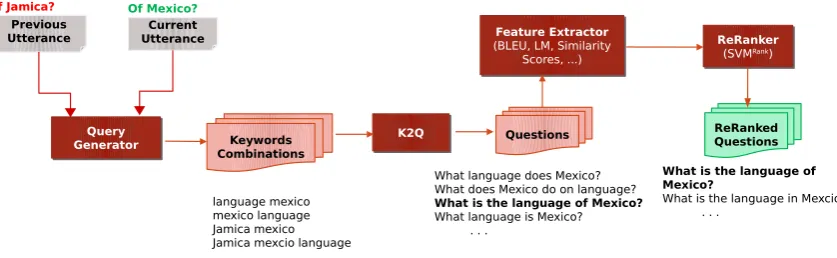
4 Proposed NSU Resolution Approach
consists of the following three steps as shown in Figure 1.
• Candidate Keyword Set Generation
• Keyword to Question Generation (K2Q)
• Learning to Rank Generated Questions These three steps are explained in the following subsections.
4.1 Candidate Keyword Set Generation
GivenUtt1,Ans1andUtt2as outlined in the previ-ous section, the first step is to remove all the non-essential words (stop words) from these and gen-erate different combinations of the essential words (keywords).
Let U2 = {U2i, i ∈ 1. . . N} be the set of
keywords in Utt2and U1 = {U1i, i ∈ 1. . . M}
be the set of keywords in Utt1. For the exam-ple above, U2 would be {India} and U1 would be {president, USA}. Let ΦU1,U2 represent the power set resulting from the union ofU1 andU2. Now, we use the following constraints to further rule out some invalid combinations:
• Filter out all the sets that do not contain all the keywords inU2.
• Filter out all the sets that do not contain at least one keyword fromU1.
The basis for these constraints is coming from the observation that the NSU resolution is about inter-preting the current utterance in the context of the conversation so far. Therefore it should contain all the keywords from the current utterance and at least one keyword from the context.
The valid keyword sets that satisfy these con-straint are now used to form a meaningful question as explained in the following section.
4.2 Keyword to Question Generation
Keyword-to-question (K2Q) generation is the pro-cess of generating a meaningful and relevant ques-tion from a given set of keywords. For each key-word set K ∈ ΦU1,U2 resulting from the previ-ous step, we use the following template based ap-proach to generate a set of candidate questions.
4.2.1 Template Based Approach for K2Q
In this section, we summarize the template based approach proposed by [Zhao et al., 2011] that was adopted for this work. It consists of the following three steps:
• Template Generation: This step takes as in-put a corpus of reference questions. This corpus should contain a large number of ex-ample meaningful questions, relevant for the task or domain at hand. The keyword terms (all non-stop words) in each question are re-placed by variable slots to induce templates. For example, questions“what is the price of laptop?”and“what is the capital of India”
would induce a template“what is the T1 of
T2?”. In the following discussion, we would denote these associated questions as Qref.
Subsequently, the rare templates that occur less than a pre-defined threshold are filtered out.
This step is performed once in an offline man-ner. The result of this step is a database of templates associated with a set of questions
{Qref}that induced them.
• Template Selection: Given a set of keywords
K, this step selects templates that meet the following criteria:
– The template has the same number of slots as the number of query keywords.
– At least one question Qref associated
with the template has one user keyword in exact same position.
For example, given a query“price phone”, the template“what is the T1 of T2” would be selected, if there is a question“what is the price of laptop”associated with this template that haspricekeyword at the first position.
• Question Generation: For each of the tem-plates selected in the previous step, a ques-tionQis hypothesized by substituting the slot variables by the keywords in K. For exam-ple, if the keywords arepresident, Indiaand the template is“who is the T1 of T2”, then the resulting question would be“ who is the president of India”.
4.3 Learning to Rank Generated Questions
The previous step of question generation results in a set of questions{Q}given a set of keywords
fea-Query Generator
Query Generator Previous
Utterance
Keywords Combinations Current
Utterance
What is the language
of Jamica? Of Mexico?
language mexico mexico language Jamica mexico Jamica mexcio language . . .
K2Q
K2Q Questions
Feature Extractor
(BLEU, LM, Similarity Scores, ...)
Feature Extractor
(BLEU, LM, Similarity Scores, ...)
ReRanker
(SVMRank)
ReRanker
(SVMRank)
ReRanked Questions
What language does Mexico? What does Mexico do on language?
What is the language of Mexico?
What language is Mexico? . . .
What is the language of Mexico?
[image:5.595.93.512.76.205.2]What is the language in Mexcio? . . .
Figure 1: Architecture of NSU Resolution System
tures and ranking algorithm used to rank the gen-erated questions.
• Semantic Similarity Score: A semantic similarity score is computed between the key-word setK and each example questionQref
associated with the template from whichQ
was generated. The computation is based on the semantic similarity of the keywords in-volved inQandQref.
Sim(Q, Qref) = ΠNi Sim(Ki, Qref,i)N1 (1) where the similarity between the keywords involvedSim(K., Qref,.)is computed as the
cosine similarity of their word2vec represen-tations [Mikolov et al., 2013].
• Language Model Score: To evaluate the syntactic correctness of the generated candi-date question Q, we compute the language model scoreLM(Q). A statistical language model assigns a probability to a sequence of
nwords (n-gram) by means of a probability distribution. The LM score represents how well a given sequence ofnwords is likely to be generated by this probability distribution. The distribution for the work presented in this paper is learned from the question corpus used in the template generation step above.
• BLEU Score: Intuitively, the intended sen-tential form of the resolved NSU should be similar to the preceding sentential form (Utt1
in the example above). A similar require-ment arises in evaluation of machine trans-lation (MT) systems and BLEU score is the
most commonly used metric for MT evalua-tion [Papineni et al., 2002]. We compute it as the amount of n-gram overlap between the generated question Q and the preceding ut-teranceUtt1.
• Rule Based Score:Intuitively, the candidate question from K2Q should be similar to the resolved question generated by the rule based system (iff rules apply). As discussed in Sec-tion 3, we assign1to this feature when a rule fires, otherwise assign0.
We use a learning to rank model for scoring each questionQ∈ {Q}, in the candidate pool for a given keyword set K: w.Ψ(Q), where w is a model weight vector andΨ(Q)is the feature vec-tor of questionQ. The weights are trained using
SV Mrank [Joachims, 2006] algorithm. To train
it, for a givenK, we assign higher rank to the cor-rect candidate questions and all other candidates are ranked below.
5 Experiments
In this section, we present the datasets, evalua-tion approaches and results. We also present the comparative analysis of the performance obtained when we employ a rule-based baseline approach (Section 3) for this task.
5.1 Data
Question Answer Q2e Q2r
What does the golden marmoset eat? flowers and tiger? What do tigers eat?
What is the average life span of Indian men? 65 And women Average life span of women in India, is?
Who is the highest paid athlete today? Tiger Woods And in the 1990? Who was the highest paid athlete in 1990?
[image:6.595.74.526.61.117.2]Does a solid or liquid absorb more heat? Liquid What about gas or liquid? Does a gas or a liquid absorb more heat?
Table 1: Examples of collected data entries from Amazon Mechanical Turk
5.1.1 Dataset for the K2Q Step
In section 4.2 we noted that the template genera-tion step involves a large corpus of reference ques-tions. One such large collection of open-domain questions is provided by the WikiAnswers∗ dataset.
The WikiAnswers corpus contains clusters of questions tagged by WikiAnswers users as para-phrases. Each cluster optionally contains an an-swer provided by WikiAnan-swers users. Since the scope of this work was limited to forming tem-plates for the K2Q system, we use only the ques-tions from this corpus. The corpus is split into 40 gzip-compressed files. The total compressed file size is 8GB. We use only the first two parts (out of 40) for the purpose of our experiments. After re-placing the keywords by slot variables as required for template induction, this results into a total of
≈ 8M unique question-keyword-template tuples. Further, we filter out those templates which have less than five associated reference questions and this results into a total of ≈ 74K templates and corresponding≈3.7M associated reference ques-tions.
5.1.2 Dataset for NSU Resolution
In this section, we describe the data that we use for evaluating the performance of the proposed method for NSU resolution.
We used a subset of the data that was collected using Amazon Mechanical Turk. For collecting this data a question answer pair (Q,A) was pre-sented to an mTurk worker and who was then asked to conceive another questionQ2 related to the pair (Q, A). The Q2 was to be given in two different versions, an elliptical versionQ2eand a
fully resolved versionQ2r. The original data
con-tains7400such entries and contains examples for NSUs as well as anaphora in Q2. We selected a subset of500entries from this dataset for our eval-uation. Table 1 presents some examples entries from this data.
∗Available at http://knowitall.cs.
washington.edu/oqa/data/wikianswers/
5.2 Evaluations
We present our evaluations based on the following three different configurations to investigate the im-portance of various scoring and ranking modules. The configurations used are,
1. Rule Based: This configuration is used as a baseline system, as described in section 3. As rule based methodologies are dominant in the field of NSU resolutions, we compare to clearly illustrate the limitations of just using rules.
2. Semantic Similarity: We investigate how well the semantic similarity score as de-scribed in Section 4.3 works when we sort the candidate questions generated based on this feature alone.
3. SVM Rank:In this configuration, we use all the scores as described in Section 4.3 in an SVM Rank formulation.
5.2.1 Evaluation Methodology
Given the input conversation{Utt1, Ans1, Utt2}, system generated resolved utterance Q (corre-sponding to NSUUtt2) and the intended utterance
Qr, the goal of the evaluation metric is to judge
how similarQis toQr. We use BLEU score and
human judgments for the purpose of this evalua-tion.
BLEU score is often used for evaluation of ma-chine translation systems to judge the goodness of the translated text with the reference text. Please note that we also used the BLEU score as one of the features as mentioned in Section 4.3. There, it was computed between the generated question
Q and the preceding utterance Utt1. Whereas, for evaluation purposes, this score is computed be-tween the generated questionQand the intended question provided by the ground truthQr.
Rule Based Sem. Similarity SVM Rank 0.0
0.1 0.2 0.3 0.4 0.5
Av
g.
Ble
u S
co
[image:7.595.198.390.70.177.2]re
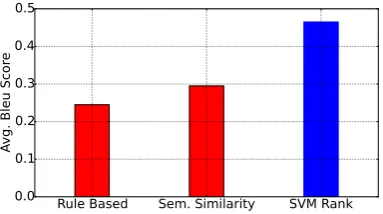
Figure 2: Average BLEU score for different configurations
Method Recall@1
Rule Based 0.17
[image:7.595.171.420.307.448.2]SVM Rank 0.21
Table 2: Comparing Recall@1 using Human Judgments
0 1 2 3 4 5 6
N Best List 0.0
0.2 0.4 0.6
R
ec
al
l
Figure 3: Recall@N obtained using human judgments
We use Recall@N to present the evalua-tion results when human judgments are used. Our test set comprises only of those utterances ({Utt2}) which require a resolution and there-fore Recall@Ncaptures how many of these NSUs were correctly resolved if candidates only up to topN are to be considered.
5.2.2 BLEU Score Evaluation
We compute the BLEU score between the can-didate resolution Q and the ground truth utter-ance Qr and compare it across the three
config-urations. Figure 2 shows the comparison of the average BLEU score at position 1. A low score for the rule based approach is expected as it re-solves only those cases in which rules fire. The semantic similarity configuration gains over the rule based approach as it is able to utilize the tem-plate database generated using the WikiAnswers corpus. Finally, the SVM Rank uses various other
scores (LM, BLEU score) on top of rule-based and semantic similarity score and therefore achieves higher BLEU Score.
5.2.3 Human Judgments Evaluation
Finally, to account for the paraphrasing artifacts manifested in human language, we use human judgments to make a true comparison between the rule based approach and the SVM Rank configu-ration.
For human judgments, we presented just the re-solvedQand the ground truthQr. For all the 200
data points in the test set, top 5 candidates were presented to human annotators who were asked to decide if it was a correct resolution or not. We choose just the top 5 just to analyze the quality of the candidates generated at various positions by the system.
SVM configuration signifies the better coverage of the proposed approach beyond a pre-defined set of rules. The Recall@1was used for this comparison since the rule-based approach can only yield a sin-gle candidate. To further see the behavior of the proposed approach as more candidates are consid-ered, Recall@N is presented in Figure 3. The fig-ure shows that a recall of 42.5% can be achieved when results up to top 5 are considered. The ob-jective of this experiment is to study the quality of top (1-5) ranked generated questions. This exper-iment helps us conclude that improving the rank-ing module has the potential to improve the overall performance of the system.
5.3 Discussion
We discuss two types of scenarios where our SVM rank based approach works better than the baseline rule based approach. One of the rules to generate resolved utterance is to replace a phrase in Utt1
with a phrase of the same semantic type inUtt2. Such an approach is limited by the availability of an exhaustive list of semantic types which is in general difficult to capture. In the following exam-ple, the phrasesantidoteandsymptomsbelong to the entity typedisease attribute. However it may not be obvious to includedisease attributeas a se-mantic type unless the context is specified. Our approach aims at capturing such semantic types automatically using the semantic similarity score.
Utt1What is the antidote of streptokinase?
Utt2What are the symptoms?
Resolvedwhat are the symptoms of streptokinase
The baseline approach fails to handle cases where the resolved utterance cannot be generated by merely replacing a phrase inUtt1with a phrase in Utt2. While our approach can handle cases which requires sentence transformations such as the one shown below.
Utt1Is cat scratch disease a viral or bacterial disease?
Utt2What’s the difference?
Resolvedwhat’s the difference between a viral and bacterial disease
One of the scenarios where our approach fails is when there are no keywords inUtt2. This is be-cause the K2Q module tries to generate questions without any keywords (information) fromUtt2. A few examples are given below.
Utt1 (a)Kansas sport teams?
Utt2 (a)What others?
Utt1 (b)Cell that forms in fertilization?
Utt2 (b)And ones that don’t are called what?
6 Conclusion and Future Work
In this paper we presented a statistical ap-proach for resolving questions appearing as non-sentential utterances (NSU) in an interactive ques-tion answering session. We adapted a keyword-to-question approach to generate a set of candi-date questions and used various scoring methods to generate scores for the generated questions. We then used a learning to rank framework to select the best generated question. Our results show that the proposed approach has significantly better per-formance than a rule based method. The results also show that for many of the cases where the cor-rect resolved question does not appear at the top, a correct candidate exists in the top5candidates. Thus it is possible that by employing more fea-tures and better ranking methods we can get fur-ther performance boost. We plan to explore this further and extend this method to cover other types of NSUs in our future work.
Acknowledgments
We thank Martin Schmid, IBM Watson Prague and Adam J Sporka, Pavel Slavik, Czech Techincal University Prague for providing us with the cor-pus of dialog ellipsis (dataset for NSU resolution) without which training and evaluation of our sys-tem would not have been possible.
References
Lou Burnard. Reference guide for the british na-tional corpus. Oxford University Computing Services, 2000.
Jaime G. Carbonell. Discourse pragmatics and ellipsis resolution in task-oriented natural lan-guage interfaces. InProceedings of the 21st An-nual Meeting on Association for Computational Linguistics, pages 164–168, 1983.
Fern´andez, Raquel, Jonathan Ginzburg, and Shalom Lappin. Classifying ellipsis in dia-logue: A machine learning approach. In Pro-ceedings of the 20th International Conference on Computational Linguistics, 2004.
Raquel Fern´andez. Non-sentential utterances in dialogue: classification, resolution and use.
PhD thesis, University of London, 2006. Raquel Fern´andez, Jonathan Ginzburg, and
Shalom Lappin. Using machine learning for non-sentential utterance classification. pages 77–86, 2005.
David A Ferrucci. Introduction to this is watson.
IBM Journal of Research and Development, 56 (3.4), 2012.
Manuel Giuliani, Thomas Marschall, and Amy Is-ard. Using ellipsis detection and word similar-ity for transformation of spoken language into grammatically valid sentences. InProceedings of the 15th Annual Meeting of the Special In-terest Group on Discourse and Dialogue, pages 243–250, 2014.
Thorsten Joachims. Training linear svms in linear time. InProceedings of the 12th ACM SIGKDD International Conference on Knowledge Dis-covery and Data Mining, pages 217–226, 2006. Qiaoling Liu, Eugene Agichtein, Gideon Dror, Yoelle Maarek, and Idan Szpektor. When web search fails, searchers become askers: Under-standing the transition. In Proceedings of the 35th International ACM SIGIR Conference on Research and Development in Information Re-trieval, pages 801–810, 2012.
Tomas Mikolov, Kai Chen, Greg Corrado, and Jef-frey Dean. Efficient estimation of word rep-resentations in vector space. In Proceedings of Workshop at International Conference on Learning Representations, 2013.
Leif Arda Nielsen. Robust vpe detection using au-tomatically parsed text. In Proceedings of the ACL Workshop on Student Research, 2004. Kishore Papineni, Salim Roukos, Todd Ward, and
Wei-Jing Zhu. Bleu: a method for automatic evaluation of machine translation. In Proceed-ings of the 40th Annual Meeting on Associa-tion for ComputaAssocia-tional Linguistics, pages 311– 318. Association for Computational Linguis-tics, 2002.
Shiqi Zhao, Haifeng Wang, Chao Li, Ting Liu, and Yi Guan. Automatically generating tions from queries for communitybased ques-tion answering. In Proceedings of 5th Inter-national Joint Conference on Natural Language Processing, pages 929–937, 2011.