Active Learning for Constrained Dirichlet Process Mixture Models
Andreas Vlachos Computer Laboratory University of Cambridge
Zoubin Ghahramani Department of Engineering
University of Cambridge
Ted Briscoe Computer Laboratory University of Cambridge
Abstract
Recent work applied Dirichlet Process Mixture Models to the task of verb cluster-ing, incorporating supervision in the form ofmust-linksandcannot-linksconstraints between instances. In this work, we intro-duce an active learning approach for con-straint selection employing uncertainty-based sampling. We achieve substantial improvements over random selection on two datasets.
1 Introduction
Bayesian non-parametric mixture models have the attractive property that the number of components used to model the data is not fixed in advance but is determined by the model and the data. This property is particularly interesting for NLP where many tasks are aimed at discovering novel in-formation. Recent work has applied such mod-els to various tasks with promising results, e.g. Teh (2006) and Cohn et al. (2009).
Vlachos et al. (2009) applied the basic model of this class, the Dirichlet Process Mixture Model (DPMM), to lexical-semantic verb clustering with encouraging results. The task involves discov-ering classes of verbs similar in terms of their syntactic-semantic properties (e.g. MOTION class fortravel, walk, run, etc.). Such classes can pro-vide important support for other tasks, such as word sense disambiguation, parsing and seman-tic role labeling. (Dang, 2004; Swier and Steven-son, 2004) Although some fixed classifications are available these are not comprehensive and are in-adequate for specific domains.
Furthermore, Vlachos et al. (2009) used a con-strained version of the DPMM in order to guide clustering towards some prior intuition or consid-erations relevant to the specific task at hand. This supervision was modelled as pairwise constraints
between instances and it informs the model of re-lations between them that cannot be recovered by the model on the basis of the feature representa-tion used. Like other forms of supervision, these constraints require manual annotation and it is im-portant to maximize the benefits obtained from it. Therefore it is natural to consider active learning (Settles, 2009) in order to focus the supervision on clusterings on which the model is uncertain.
In this work, we propose a simple yet effec-tive aceffec-tive learning method employing uncertainty based sampling. The effectiveness of the AL method is demonstrated on two datasets, one of which has multiple gold standards.
2 Constrained DPMMs for clustering
In DPMMs, the parameters of each component are generated by a Dirichlet Process (DP) which can be seen as a distribution over distributions. Each instance, represented by its features, is generated by the component it is assigned to. The compo-nents discovered correspond to the clusters. The prior probability of assigning an instance to a par-ticular component is proportionate to the number of instances already assigned to it, in other words, the DPMM exhibits the “rich get richer” prop-erty. A popular metaphor to describe the DPMM which exhibits an equivalent clustering property is the Chinese Restaurant Process (CRP). Cus-tomers (instances) arrive at a Chinese restaurant which has an infinite number of tables (compo-nents). Each customer sits at one of the tables that is either occupied or vacant with popular tables at-tracting more customers.
Following Navarro et al. (2006), parameter es-timation is performed using Gibbs sampling by sampling the assignment zi of each instance xi given all the othersz−iand the dataX:
P(zi =z|z−i, X)∝
p(zi =z|z−i)P(xi|zi =z, X−i) (1)
In Eq. 1 p(zi = z|z−i) is the CRP prior and
P(xi|zi = z, X−i) is the distribution that gener-ates instancexigiven it has been assigned to com-ponent z. This sampling scheme is possible be-cause the assignments in the model are exchange-able, i.e. their order is not relevant.
The constrained version of the DPMM uses pairwise constraints over instances in order to adapt the clustering discovered. Following Wagstaff & Cardie (2000), a pair of instances is either linked together (must-link) or not ( cannot-link). For example,chargeandrunshould form a
must-link if the aim is to cluster MOTION verbs together, but they should form acannot-linkif we are interested in BILL verbs. All links are as-sumed to be consistent with each other. In order to incorporate the constraints in the DPMM, the Gibbs sampling scheme is modified so that must-linkedinstances are generated by the same compo-nent andcannot-linkedinstances always by differ-ent ones. Following Vlachos et al. (2009), for each instance that does not belong to alinked-group, the sampler is restricted to choose components that do not contain instances cannot-linked with it. For instances in a linked-group, their assignment is sampled jointly, again taking into account their
cannot-links. This is performed by adding each instance of the linked-group successively to the same component. In terms of the CRP metaphor, customers connected withmust-linksarrive at the restaurant and choose a table jointly, respecting theircannot-linkswith other customers.
3 Active Constraint Selection
In active learning, the model selects the supervi-sion to be provided by a human expert. In the con-text of the DPMMs, the model chooses a pair of instances for which a must-link or a cannot-link
must be provided. To select the pair, we employ the simple but effective idea of uncertainty based sampling. We consider the most informative link as that on which the model is most uncertain, more formally the link between instanceslij∗ that maxi-mizes the following entropy:
l∗ij = arg max
i,j H(zi=zj) (2)
If we consider clustering as binary classification of links intomust-linksandcannot-links, it is equiv-alent to selecting the pair with the highest label entropy. During the sampling process used for parameter inference, component assignments vary
between samples and the components themselves are not identifiable, i.e. one cannot match the com-ponents of one sample with those of another. Fur-thermore, the conditional assignments estimated during Gibbs sampling (Eq. 1) they do not capture the uncertainty of the assignments z−i on which they condition. Therefore, we resort to generating a set of samples from the (possibly constrained) DPMM and pick the link on which these sam-ples maximally disagree, i.e. we approximate the distribution in Eq. 2 with the probability that in-stances i, j are in the same cluster or not. Thus, in a given set of samples the most uncertain link would be the one between two instances which are in the same cluster in exactly half of these sam-ples. Using multiple samples allows us to take into account the uncertainty in the assignments of the other instances, as well as the varying number of components.
Compared to standard pool-based AL, when clustering with constraints the possible links be-tween two instances (ignoring transitivity) are
C(N,2) = N(N −1)/2 (N is the size of the dataset) and there is an equal number of candi-date queries to be considered, as opposed to N
queries in a supervised classification task. Another interesting difference is that the the AL process can be initiated without any supervision, since the DPMM is unsupervised. On the other hand, in the standard AL scenario a (usually small) labelled seed set is used. Therefore, we rely exclusively on the model and the features to guide the constraint selection process. If the model combined with the features is not appropriate for the task then the constraints chosen are unlikely to be useful.
4 Datasets and Evaluation
belonging to 17 fine-grained classes in Levin’s (Levin, 1993) taxonomy so that each class con-tains 12 verbs. The biomedical dataset consists of 193 medium to high frequency verbs from a cor-pus of 2230 full-text articles from 3 biomedical journals. A team of linguists and biologists cre-ated a three-level gold standard with 16, 34 and 50 classes. Both datasets were pre-processed us-ing non-negative matrix factorization (Lin, 2007) which decomposes a large sparse matrix into two dense matrices (of lower dimensionality) with non-negative values. In all experiments 35 dimen-sions were kept. Preliminary experiments with different number of dimensions kept did not affect the performance substantially.
We evaluate our results using three informa-tion theoretic measures: Variainforma-tion of Informa-tion (Meil˘a, 2007), V-measure (Rosenberg and Hirschberg, 2007) and V-beta (Vlachos et al., 2009). All three assess the two desirable proper-ties that a clustering should have with respect to a gold standard, homogeneity and completeness. Homogeneity reflects the degree to which each cluster contains instances from a single class and is defined as the conditional entropy of the class distribution of the gold standard given the clus-tering. Completeness reflects the degree to which each class is contained in a single cluster and is de-fined as the conditional entropy of clustering given the class distribution in the gold standard. V-beta balances these properties explicitly by taking into account the ratio of the number of cluster discov-ered over the number of classes in the gold stan-dard. While an ideal clustering should have both properties, naively improving one of them can be harmful for the other. Compared to the more com-monly used F-measure (Fung et al., 2003), these measures have the advantage that they do not as-sume a mapping between clusters and classes.
5 Experiments
We performed experiments in order to assess the effectiveness of the AL algorithm for the con-strained DPMM comparing it to random selection. In each AL round, we run the Gibbs sampler for the (constrained) DPMM five times, using 100 it-erations for burn-in, draw 20 samples from each run with 5 iterations lag between samples and se-lect the most uncertain link to be labeled. Fol-lowing Navarro et al. (2006), the concentration parameter is inferred from the data using Gibbs
sampling. The performances were averaged across the collected samples. Random selection was re-peated three times. The three levels of the biomed-ical gold standard were used independently and to-gether with the general English dataset result in four experimental setups.
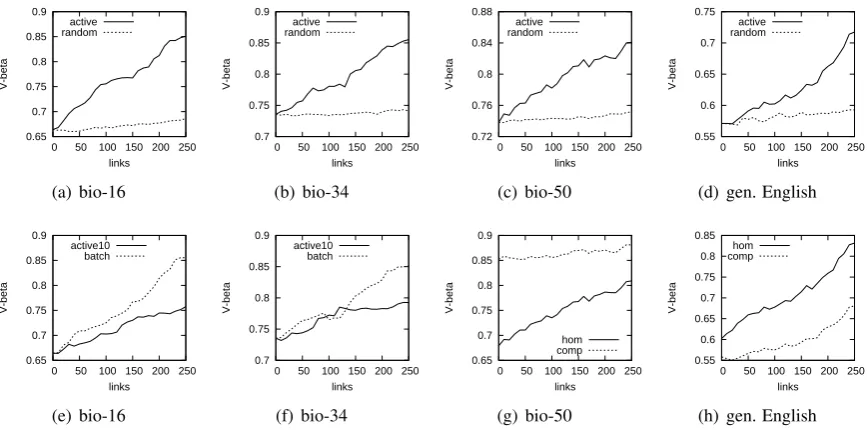
The comparison between AL and random se-lection for each dataset is shown in graphs 1(a)-1(d) using V-beta, noting that the observations made hold with all evaluation metrics used. Con-straints selected via AL improve the performance rapidly. Indicatively, the performance reached us-ing 1000 randomly chosen constraints is obtained using only110actively selected ones in thebio-50
dataset. AL performance levels out in later stages with performance superior to the one achieved us-ing random selection with the same number of constraints. The poor performance of random se-lection is expected, since the unsupervised DPMM predicts more than 90% of the binary links cor-rectly. Another interesting observation is that, dur-ing AL, homogeneity increased faster than com-pleteness (graphs 1(g) and 1(h)). This suggests that the features used lead the model towards finer-grained clusters, which is further confirmed by the fact that the highest scores on the biomedical dataset are achieved when comparing against the finest-grained version of the gold standard. While it is possible to choose constraints to the model that would increase completeness with respect to the gold standard, we argue that this would not al-low us to obtain obtain insights on the model and the features used.
0.65 0.7 0.75 0.8 0.85 0.9
0 50 100 150 200 250
V-beta
links active random
(a) bio-16
0.7 0.75 0.8 0.85 0.9
0 50 100 150 200 250
V-beta
links active random
(b) bio-34
0.72 0.76 0.8 0.84 0.88
0 50 100 150 200 250
V-beta
links active random
(c) bio-50
0.55 0.6 0.65 0.7 0.75
0 50 100 150 200 250
V-beta
links active random
(d) gen. English
0.65 0.7 0.75 0.8 0.85 0.9
0 50 100 150 200 250
V-beta
links active10
batch
(e) bio-16
0.7 0.75 0.8 0.85 0.9
0 50 100 150 200 250
V-beta
links active10
batch
(f) bio-34
0.65 0.7 0.75 0.8 0.85 0.9
0 50 100 150 200 250
V-beta
links hom comp
(g) bio-50
0.55 0.6 0.65 0.7 0.75 0.8 0.85
0 50 100 150 200 250
V-beta
links hom comp
(h) gen. English
Figure 1: (a)-(d): Constrained DPMM learning curves comparing random selection and AL. (e),(f): Batch selection comparison. (g),(h): Homogeneity and completeness curves during AL.
avoid selecting links involving the same instance, unless their uncertainty was not reduced by the constraints added. A consideration that arises is that by reducing the number of samples used for uncertainty estimation, progressively we are left with fewer samples to rank the remaining links. Each labeled link reduces the number of samples approximately by half since the most uncertain link is likely to be a must-link in half the sam-ples and a cannot-lnk in the remaining half. As a result, for a batch with size|B|the uncertainty of the last link will be estimated using|S|/2|B|−1
samples. A crude solution would be to generate enough samples for the desired batch size. How-ever, obtaining a very large number of samples can be computationally expensive. Therefore, we set a threshold for the minimum number of samples to be used to estimate the link uncertainty and when it is reached, more samples are generated using the constraints selected. In graphs 1(e) and 1(f) we demonstrate the effectiveness of the batch selec-tion method proposed (labeled “batch”) compared to naive batch selection (labeled “active10”).
6 Discussion and Future Work
We presented an AL method for constrained DP-MMs employing uncertainty based sampling. We applied it to two different verb clustering datasets with 4 gold standards in total and obtained very good results compared to random selection. The idea, while explored in the context of verb
cluster-ing with the constrained DPMM, is likely to be ap-plicable to other models that can incorporate must-linksandcannot-linksin MCMC sampling.
Most literature on AL for NLP considers super-vised methods for classification or sequential tag-ging. However, AL for clustering is a relatively under-explored area. Klein et al. (2002) incorpo-rated actively selected constraints in hierarchical agglomerative clustering. Basu et al. (2006) have applied AL to obtainmust-linksandcannot-links
however, the clustering framework used requires the number of clusters to be known in advance which restricts counter-intuitively the clustering solutions that are discovered. Moreover, semi-supervised clustering is a form of semi-semi-supervised learning and in this light, our approach is related to the work of Zhu et al. (2003).
[image:4.595.87.521.63.278.2]References
Sugato Basu, Mikhail Bilenko, Arindam Banerjee, and Raymond J. Mooney. 2006. Probabilis-tic semi-supervised clustering with constraints. In O. Chapelle, B. Schoelkopf, and A. Zien, edi-tors,Semi-Supervised Learning, pages 73–102. MIT Press.
Ted Briscoe and John Carroll. 2002. Robust accurate statistical annotation of general text. InProceedings of the 3rd International Conference on Language Resources and Evaluation, pages 1499–1504.
Trevor Cohn, Sharon Goldwater, and Phil Blun-som. 2009. Inducing compact but accurate tree-substitution grammars. In Proceedings of Human Language Technologies: The 2009 Annual Confer-ence of the North American Chapter of the Associa-tion for ComputaAssocia-tional Linguistics, pages 548–556.
Hoa Trang Dang. 2004. Investigations into the role of lexical semantics in word sense disambiguation. Ph.D. thesis, University of Pennsylvania, Philadel-phia, PA, USA.
Benjamin C. M. Fung, Ke Wang, and Martin Ester. 2003. Hierarchical document clustering using fre-quent itemsets. In Proceedings of SIAM Interna-tional Conference on Data Mining, pages 59–70.
Dan Klein, Sepandar D. Kamvar, and Christopher D. Manning. 2002. From instance-level constraints to space-level constraints: Making the most of prior knowledge in data clustering. InProceedings of the Nineteenth International Conference on Machine Learning, pages 307–314.
Anna Korhonen, Yuval Krymolowski, and Nigel Col-lier. 2006. Automatic classification of verbs in biomedical texts. InProceedings of the 21st Interna-tional Conference on ComputaInterna-tional Linguistics and 44th Annual Meeting of the Association for Compu-tational Linguistics, pages 345–352.
Beth Levin. 1993. English Verb Classes and Alter-nations: a preliminary investigation. University of Chicago Press, Chicago.
Chih-Jen Lin. 2007. Projected gradient methods for nonnegative matrix factorization. Neural Compua-tion, 19(10):2756–2779.
Marina Meil˘a. 2007. Comparing clusterings—an in-formation based distance. Journal of Multivariate Analysis, 98(5):873–895.
Daniel J. Navarro, Thomas L. Griffiths, Mark Steyvers, and Michael D. Lee. 2006. Modeling individual dif-ferences using Dirichlet processes. Journal of Math-ematical Psychology, 50(2):101–122, April.
Andrew Rosenberg and Julia Hirschberg. 2007. V-measure: A conditional entropy-based external clus-ter evaluation measure. InProceedings of the 2007 Joint Conference on Empirical Methods in Natural
Language Processing and Computational Natural Language Learning, pages 410–420.
Burr Settles. 2009. Active learning literature survey. Computer Sciences Technical Report 1648, Univer-sity of Wisconsin–Madison.
Lin Sun, Anna Korhonen, and Yuval Krymolowski. 2008. Verb class discovery from rich syntactic data. InProceedings of the 9th International Conference on Intelligent Text Processing and Computational Linguistics.
Robert S. Swier and Suzanne Stevenson. 2004. Unsu-pervised semantic role labelling. InProceedings of the 2004 Conference on Empirical Methods in Nat-ural Language Processing, pages 95–102.
Yee Whye Teh. 2006. A hierarchical Bayesian lan-guage model based on Pitman-Yor processes. In Proceedings of the 21st International Conference on Computational Linguistics and 44th Annual Meet-ing of the Association for Computational LMeet-inguis- Linguis-tics, pages 985–992, Sydney, Australia, July.
Andreas Vlachos, Anna Korhonen, and Zoubin Ghahramani. 2009. Unsupervised and Constrained Dirichlet Process Mixture Models for Verb Cluster-ing. InProceedings of the EACL workshop on GEo-metrical Models of Natural Language Semantics.
Kiri Wagstaff and Claire Cardie. 2000. Clustering with instance-level constraints. In Proceedings of the Seventeenth International Conference on Ma-chine Learning, pages 1103–1110.