This before That:
Causal Precedence in the Biomedical Domain
Gus Hahn-Powell Dane Bell Marco A. Valenzuela-Esc´arcega Mihai Surdeanu
University of Arizona Tucson, AZ 85721, USA
Abstract
Causal precedence between biochemical interactions is crucial in the biomedi-cal domain, because it transforms collec-tions of individual interaccollec-tions, e.g., bind-ings and phosphorylations, into the causal mechanisms needed to inform meaning-ful search and inference. Here, we an-alyze causal precedence in the biomedi-cal domain as distinct from open-domain, temporal precedence. First, we describe a novel, hand-annotated text corpus of causal precedence in the biomedical do-main. Second, we use this corpus to inves-tigate a battery of models of precedence, covering rule-based, feature-based, and la-tent representation models. The highest-performing individual model achieved a micro F1 of 43 points, approaching the best performers on the simpler temporal-only precedence tasks. Feature-based and latent representation models each outform the rule-based models, but their per-formance is complementary to one an-other. We apply a sieve-based architec-ture to capitalize on this lack of overlap, achieving a micro F1 score of 46 points.
1 Introduction
In the biomedical domain, an enormous amount of information about protein, gene, and drug in-teractions appears in the form of natural language across millions of academic papers. There is a tremendous ongoing effort (N´edellec et al., 2013; Kim et al., 2012; Kim et al., 2009) to extract indi-vidual chemical interactions from these texts, but these interactions are only isolated fragments of larger causal mechanisms such as protein signal-ing pathways. Nowhere, however, includsignal-ing any
database, is the complete mechanism described in a form that lends itself to causal search or infer-ence. The absence of such a database is not for lack of trying; Pathway Commons (Cerami et al., 2011) aims to address the need, but its authors esti-mate it currently covers 1% of the literature due to the high cost of annotation1. This issue only grows
more pressing with the yearly growth in biomedi-cal publishing, which presents an otherwise insur-mountable challenge for biomedical researchers to query and interpret.
The Big Mechanism program (Cohen, 2015) aims to construct exactly such large-scale mecha-nistic information by reading and assembling pro-tein signaling pathways that are relevant for can-cer, and exploit them to generate novel explana-tory and treatment hypotheses. Although prior work (Chambers et al., 2014; Mirza, 2016) has addressed the challenging area of temporal prece-dence in the open domain, the biomedical domain presents very different data and, consequently, re-quires novel techniques. Precedence in mech-anistic biology is causal rather than temporal. Though event temporality is crucial to understand-ing electronic health records for individual pa-tients (Bethard et al., 2015; Bethard et al., 2016), its contribution to the understanding of biomolec-ular reactions is less clear as these events and pro-cesses may repeat in extremely short cycles, con-tinue without end, or overlap in time. At any level of abstraction, causal precedence encodes mech-anistic information and facilitates inference over spotty evidence. For the purpose of this work, precedenceis defined for two events, A and B, as
A precedes B if and only if the output of A is necessary for the successful execu-tion of B.2
1Personal communication.
2See the “precedes” examples in Table 1.
Very little annotated data exists for causal precedence, especially efforts focusing on signal-ing pathways. BioCause (Mih˘ail˘a et al., 2013), for instance, is centered on connections between claims and evidence and contains only 51 an-notated examples of causal precedence3. Our
work4 offers three contributions in aid of
auto-matically extracting causal ordering in biomedical text. First, we provide and describe a dataset of real text examples, manually annotated for causal precedence. Second, we analyze the efficacy of a battery of different models in automatically de-termining precedence, built on top of the Reach automatic reading system (Valenzuela-Esc´arcega et al., 2015a; Valenzuela-Esc´arcega et al., 2015c) and measured against this novel corpus. In partic-ular, we investigate three classes of models: (a) deterministic rule-based models inspired by the precedence sieves proposed by Chambers et al. (2014), (b) feature-based models, and (c) mod-els that rely on latent representations such as long short-term memory (LSTM) networks (Hochre-iter and Schmidhuber, 1997). Our analysis indi-cates that while independently the top-performing model achieves a micro F1 of 43, these models are largely complementary with a combined recall of 58 points. Lastly, we conduct an error analysis of these models to motivate and inform future re-search.
2 A Corpus for Causal Precedence in the Biomedical Domain
Our corpus annotates several types of relations between mentions of biochemical interactions. Following common terminology promoted by the BioNLP shared tasks, we will interchange-ably use “events” to refer to these interactions. To generate candidate events for our planned annotations, we ran the Reach event extrac-tion system (Valenzuela-Esc´arcega et al., 2015a; Valenzuela-Esc´arcega et al., 2015c) over the full text5 of 500 biomedical papers taken from the
3These are marked in the BioCause corpus as
Causality events with Cause and Effect argu-ments. The remaining 800 annotations are claim-evidence relations.
4The corpus, tools, and system introduced in this
work are publicly available at https://github.com/ myedibleenso/this-before-that
5We chose to ignore the “references”, “materials”, and
“methods” sections, which generally do not contain mech-anistic information.
Relation Example
E1 precedes E2 A is phosphorylated by B.
Following its phosphorylation, A binds with C.
E2 precedes E1 A is phosphorylated by B.
Prior to its phosphorylation, A binds with D.
Equivalent The phosphorylation of A by B. A is phosphorylated by B.
E1 specifies E2 A is phosphorylated by B at Site 123. A is phosphorylated by B.
E2 specifies E1 A is phosphorylated by B.
A is phosphorylated by B at Site 123. Other B does not regulate C when C is
bound to A. None A phosphorylates B.
[image:2.595.307.526.65.277.2]A ubiquitinates C.
Table 1: The seven inter-event relation labels an-notated in the corpus. The “precedes” labels are causal. Subsumption is captured with the “speci-fies” labels.
Open Access subset of PubMed6. The events
ex-tracted by Reach are biochemical events of two types: simple events such as phosphorylation that modify one or more entities (typically proteins), and nested events (regulations) that have other events as arguments.
To improve the likelihood of finding pairs of events with a relevant link, we filtered event pairs by imposing the following requirements for inclu-sion in the corpus:
1. Event pairs must share at least one partic-ipant. This constraint is based on the obser-vation that interactions that share participants are more likely to be connected.
2. Event pairs must be within 1 sentence of each other.Similarly, discourse proximity in-creases the likelihood of two events being re-lated.
3. Event pairs must not share the same type. This helps to maximize the diversity of the dataset.
4. Event pairs must not already be contained in an extracted Regulation event. For ex-ample, we did not annotate the relation be-tween the binding and the phosphorylation events in “The binding of X and Y is inhibited
6http://www.ncbi.nlm.nih.gov/pmc/
by X phosphorylation”, because it is already captured by most state-of-the-art biomedical event extraction systems.
After applying these constraints, only 1700 event pairs remained. In order to rapidly anno-tate the event pairs, we developed a browser-based annotation UI that is completely client-side (see Figure 3). Using this tool, we annotated 1000 event pairs for this work; 84 of these were dis-carded due to severe extraction errors. The an-notations include the event spans, event triggers (i.e., the verbal or nominal predicates that indicate the type of interaction such as “binding” or “phos-phorylated”), source document, minimal senten-tial span encompassing both event mentions, and whether or not the event pair involves coreference for either the event trigger or the event partici-pants. For events requiring coreference resolution, we expanded the encompassing span of text to also capture the antecedent. Note that domain-specific coreference resolution is a component of the event extraction system used here (Bell et al., 2016).
When describing the relations between these event pairs, we refer to the event that occurs first in text as Event 1 (E1) and the event that follows as Event 2 (E2). Each (E1, E2) pair was assigned one of seven labels: “E1 precedes E2”, “E2 pre-cedes E1”, “Equivalent”, “E1 specifies E2”, “E2 specifies E1”, “Other”, or “None”. Table 1 pro-vides examples for each of these labels. We con-verged on these labels because they are fundamen-tal to the assembly of causal mechanisms from a collection of events. Collectively, the seven labels address three important assembly tasks: equiva-lence, i.e., understanding that two event mentions discuss the same event,subsumption, i.e., the two mentions discuss the same event, but one is more specific than the other, and, most importantly, causal precedence, the identification of which is the focus of this work. During the annotation pro-cess, we came across examples of other relevant phenomena. We grouped these instances under the label “Other” and leave their analysis for future work.
Though simplified, the examples in Table 3 il-lustrate that this is a complex task sensitive to lin-guistic evidence. For example, the direction of the precedence relations in the first two rows in the ta-ble changes based on a single word in the context (“prior” vs. “following”).
[image:3.595.308.523.61.173.2]In terms of the distribution of relations, causal
Figure 1: The distribution of assembly relation la-bels both within and across sentences.
Figure 2: The distribution of event pairs involving coreference across assembly relations.
precedence pairs appear more frequently within the same sentence, while cases of the subsump-tion (“specifies”) and equivalence relasubsump-tions are far more common across sentences (see Figure 1). Coreference is involved in 10–15% of the in-stances for each relation label (see Figure 2).
The annotation process was performed by two linguists familiar with the biomedical domain. To minimize errors, the annotation task was initially performed together at the same workstation.7 On
a randomly selected sample of 100 event pairs, the two annotators had a Cohen’s kappa score (Cohen, 1960) of 0.82, indicating “almost perfect” agree-ment for the precedes labels (Landis and Koch, 1977).
3 Models of Causal Precedence
We have developed both deterministic, inter-pretable models and automatic, machine-learning models for detecting causal precedence in our dataset. Importantly, the models covered in this work focus solely on causal precedence, which is the most complex relation annotated in the dataset previously introduced. Thus, for all experiments discussed here, we reduce these annotations to three labels: “E1 precedes E2”, “E2 precedes E1”, andNil, which covers all the other labels in the
[image:3.595.308.524.216.328.2]Figure 3: Browser-based tool for annotating assembly relations in text. An annotation instance consists of a pair of event mentions. The annotator assigns a label to each pair of events using the number keys and navigates from annotation to annotation using the arrow keys. E1 refers to the event in the pair that appears first in the text. The event span is formatted to stand out from the surrounding text. The “Paper” field provides the annotator with easy access to the full text of the source document for the current annotation instance. Annotations can be exported to JSON and reloaded via a local storage cache or through file upload.
corpus.
Model Rules
Intra-sentence 29 Inter-sentence 5 Reichenbach 8
Table 2: Few rules defined each deterministic model of precedence compared with the number of features for the machine learning models.
3.1 Deterministic Models
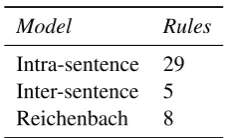
The deterministic models are defined by a small number of hand-written rules using the Odin event extraction framework (Valenzuela-Esc´arcega et al., 2015b). The number of rules for each model is shown in Table 2, and sharply contrast with the 92,711 features introduced later (Table 3) that are used by our machine-learning models. In order to avoid overfitting, all of the deterministic models were created without reference to the annotation corpus, using general linguistic expertise and do-main knowledge.
Intra-sentence ordering Within sentences, syntactic regularities can be exploited to cover a large variety of grammatical constructions indi-cating precedence relations. Rules defined over dependency parses (De Marneffe and Manning, 2008) capture precedence in sentences like those in (1) and (2) as well as many others.
(1) [The RBD of PI3KC2B binds HRAS]after,
when[HRAS is not bound to GTP]before
(2) [The ubiquitination of A]beforeis followed
by[the phosphorylation of B]after
Other phrases captured include: “precedes”, “due to”, “leads to”, “results in”, etc.
Inter-sentence ordering Although syntax oper-ates over single sentences, cross-sentence time ex-pressions can indicate ordering, as shown in Ex-amples (3) and (4). We exploit these regularities as well by checking for sentence-initial word com-binations.
(3) [A is phosphorylated by B]before. As a
downstream effect,[C is . . .]after
(4) [A is phosphorylated by B]before.[C is then
. . .]after
Other phrases captured include: “Later”, “In re-sponse”, “For this”, and “Ultimately”.
[image:4.595.124.238.360.429.2]aspect, this model concludes that it precedesshare (present tense, simple aspect) and thus the binding of histone H2A.
(5) These [PTIP] proteins also share the ability to bind histone H2A (or H2AX in mammals) that has been phosphory-lated. . . .
The logic determining which tense-aspect com-binations receive which precedence relations is identical to CAEVO, which is possible because it is open source8. However, CAEVO operates over
annotations that include gold tense and aspect val-ues, whereas this model additionally detects tense and aspect using Odin rules before applying this logic.
3.2 Feature-based Models
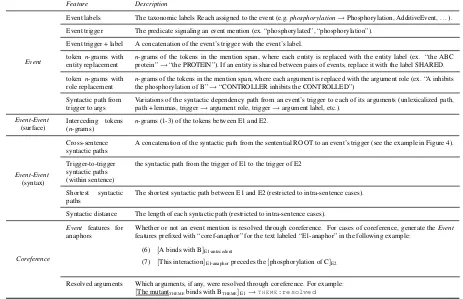
Most instances of causal precedence cannot be captured with deterministic rules, because they lack explicit words, phrases, or syntactic struc-tures that unambiguously mark the relation. Using a combination of the surface, syntactic, and tax-onomic features outlined in Table 3, we trained a set of statistical classifiers to detect causal prece-dence relations between pairs of events in our cor-pus. For training and testing purposes, we treated any instance not labeled as either “E1 precedes E2” or “E2 precedes E1” as a negative example. We examined the following statistical models: a linear kernel SVM (Chang and Lin, 2011), logis-tic regression (Fan et al., 2008), and random for-est9(Surdeanu et al., 2014). For the SVM and
lo-gistic regression (LR) models, we also compared the effects of L1 and L2 regularization.
3.3 Latent Representation Models
Due to the complexity of the task and variety of causal precedence instances encountered dur-ing the annotation process, it is unclear whether a linear combination of engineered features is sufficient for broad coverage classification. For this reason, we introduce a latent feature repre-sentation model using an LSTM (Hochreiter and Schmidhuber, 1997; Bergstra et al., 2010; Chol-let, 2015) to capture underlying semantic features by incorporating long-distance contextual infor-mation and selectively persisting memory of pre-vious event pairs to aid in classification.
8https://github.com/nchambers/caevo 9Abbreviated as RF
The basic architecture is shown in Figure 5. The input to this model is the provenance of the rela-tion, i.e., the whole text containing the two events and the text in between. Formally, this is repre-sented as a concatenated sequence of 200 dimen-sional vectors where each vector in the sequence corresponds to a token in the minimal sentential span encompassing the event pair being classified. Intuitively, this LSTM “reads” the text from left to right and outputs a classification label from the set of three when done. We consider two vari-ations of this model: the basic model (LSTM) with the vector weights for each token uninitial-ized and a second form (LSTM+P) where the vec-tors are initialized using training. In the pre-training configuration, the vector weights are ini-tialized using word embeddings generated by a word2vec (Mikolov et al., 2013; ˇReh˚uˇrek and So-jka, 2010) model trained on the full text of over 1 million biomedical papers taken from the Open Access subset of PubMed. Because the corpus is only 1000 annotations, it was thought that pre-training could improve prediction of causal prece-dence and guide the model with distributional se-mantic representations specific to this domain.
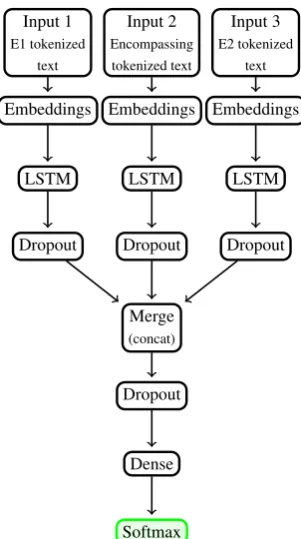
Building on this simple blueprint, we designed a three-pronged “pitchfork” (FLSTM) where the span of E1, the span of E2, and the minimal sen-tential span encompassing E1 and E2 each serve as a separate input, allowing the model to explicitly address each of them as well as discover how these three inputs relate to one another. This architec-ture is shown in Figure 6. Each input feeds into its own LSTM and corresponding dropout layer be-fore the three forks are merged via a concatena-tion of tensors. Like the basic model, one version of the “pitchfork” is trained with vector weights initialized using the pre-trained word embeddings (FLSTM+P).
4 Results
Feature Description
Event
Event labels The taxonomic labels Reach assigned to the event (e.g.phosphorylation→Phosphorylation, AdditiveEvent, . . . ). Event trigger The predicate signaling an event mention (ex. “phosphorylated”, “phosphorylation”).
Event trigger + label A concatenation of the event’s trigger with the event’s label. tokenn-grams with
entity replacement nprotein”-grams of the tokens in the mention span, where each entity is replaced with the entity label (ex. “the ABC→“the PROTEIN”). If an entity is shared between pairs of events, replace it with the label SHARED. tokenn-grams with
role replacement nthe phosphorylation of B”-grams of the tokens in the mention span, where each argument is replaced with the argument role (ex. “A inhibits→“CONTROLLER inhibits the CONTROLLED”) Syntactic path from
trigger to args Variations of the syntactic dependency path from an event’s trigger to each of its arguments (unlexicalized path,path + lemmas, trigger→argument role, trigger→argument label, etc.).
Event-Event
(surface) Interceding tokens(n-grams) n-grams (1-3) of the tokens between E1 and E2.
Event-Event
(syntax)
Cross-sentence
syntactic paths A concatenation of the syntactic path from the sentential ROOT to an event’s trigger (see the example in Figure 4). Trigger-to-trigger
syntactic paths (within sentence)
the syntactic path from the trigger of E1 to the trigger of E2
Shortest syntactic
paths The shortest syntactic path between E1 and E2 (restricted to intra-sentence cases). Syntactic distance The length of each syntactic path (restricted to intra-sentence cases).
Coreference
Event features for
anaphors Whether or not an event mention is resolved through coreference. For cases of coreference, generate thefeatures prefixed with “coref-anaphor” for the text labeled “E1-anaphor” in the following example: Event (6) [A binds with B]E1-antecedent
(7) [This interaction]E1-anaphorprecedes the[phosphorylation of C]E2
Resolved arguments Which arguments, if any, were resolved through coreference. For example:
[image:6.595.66.529.66.365.2][The mutantTHEMEbinds with BTHEME]E1→T H E M E:resolved
Table 3: An overview of the primary features used in the feature-based classifier, grouped into four classes:Event– features extracted from the two participating events, in isolation;Event-Event (surface) – features that model the lexical context between the two events; Event-Event (syntax) – features that model the syntactic context between the two events; andCoreference– features that capture coreference resolution information that impact the participating events.
In addition,binding of nucleotide-free Ras to PI3KC2βinhibits its lipid kinase activity. The PI3KC2βand Ras complex may then translocate to distal sites such as early endosomes (EE) whereITSN1 then binds to PI3KC2β leading to the release of nucleotide-free Ras and activation of the lipid kinase activity of PI3KC2β.
IN NN , NN IN JJ NN TO NN PRP$ NN NN NN . In addition , binding of nucleotide-free Ras to PI3KC2beta inhibits lipid kinase activity .
root nsubj
THEME
THEME
NN MD RB VB TO JJ NNS JJ IN JJ NNS NN RB VBZ TO NN . . . complex may then translocate to distal sites such as early endosomes . . . ITSN1 then binds to PI3KC2beta . . .
root
prep to prep such as rcmod
THEME
THEME
ROOT>NSUBJ+ROOT>PREP TO>PREP SUCH AS>RCMOD
[image:6.595.103.501.492.661.2]Input (tokenized text)
Embeddings (optional pre-trained weights)
Dropout (50%)
Dense (dim. 3)
Softmax
[image:7.595.90.289.62.197.2]concatenated vectors
Figure 5: Architecture for the basic latent feature model using the minimal sentential span encom-passing events 1 and 2 as input.
Input 1
E1 tokenized text
Embeddings
LSTM
Dropout
Input 2
Encompassing tokenized text
Embeddings
LSTM
Dropout
Input 3
E2 tokenized text
Embeddings
LSTM
Dropout
Merge
(concat)
Dropout
Dense
[image:7.595.329.503.193.408.2]Softmax
Figure 6: Modified architecture for a latent feature model with three-pronged input: the text of event 1 (left), the minimal sentential span encompassing events 1 and 2 (middle), and the text of event 2 (right).
epochs with support for early stopping through monitoring of validation loss10. Weight updates
were made on batches of 32 examples and all folds completed in fewer than 50 epochs.
The table also includes a sieve-based ensemble system, which performs significantly better than the best-performing single model. In this archi-tecture, the sieves are applied in descending order
10The validation set used for each fold came from a
differ-ent class-balanced fold.
of precision, so that the positive predictions of the higher precision sieves will always be preferred to contradictory predictions made by subsequent, lower-precision sieves. Figure 7 illustrates that as sieves are added, the F1 score remains fairly con-stant, while recall increases at the cost of preci-sion.
Model p r f1
Intra-sentence 0.5 0.01 0.01 Inter-sentence 0.5 0.01 0.01 Reichenbach 0 0 0 LR+L1 0.58 0.32 0.41 LR+L2 0.65 0.26 0.37 SVM+L1 0.54 0.35 0.43
[image:7.595.105.256.257.527.2]SVM+L2 0.54 0.29 0.38 RF 0.62 0.25 0.36 LSTM 0.40 0.25 0.31 LSTM+P 0.39 0.20 0.26 FLSTM 0.43 0.15 0.22 FLSTM+P 0.38 0.22 0.28 Combined 0.38 0.58 0.46*
Table 4: Results of all proposed causal models, using stratified 10-fold cross-validation. The com-bined system is a sieve-based architecture that ap-plies the models in decreasing order of their pre-cision. The combined system significantly outper-forms the best single model, SVM with L1 regu-larization, according to a bootstrap resampling test (p = 0.022).
0.2 0.3 0.4 0.5 0.6 0.7
LR+L2+RF +LR+L1+SVM+L1+SVM+L2+RBW+RBB+FLSTM+LSTM+LSTM+P+FLSTM+P
Sieves
V
alue
P
R
F1
Figure 7: The performance of the sieve-based combined model varies with each model added.
5 Discussion
Overall, results are promising, particularly in light of the conscious choice to omit (causal) regulation reactions from this task, as they are already cap-tured by the Reach reading system.
However, the deterministic models created so far have extremely low recall, such that it is diffi-cult even to determine their precision. An analysis of the Reichenbach model reveals one source of this low coverage. In short, although writerscould describe causal mechanisms using temporal indi-cators such as tense and aspect, temporal descrip-tion is rare enough in this domain not to be repre-sented in our randomly sampled database. Table 5 illustrates the lack of overlap with informative tense-aspect combinations; a single tense is used per passage, and no perfective aspect is used.
E1↓, E2→ simplepastperf. simplepres.perf. simplefut. perf.
past simpleperf. 690 00 380 00 00 00
pres. simpleperf. 490 00 1340 00 10 00
[image:8.595.75.290.62.187.2]fut. simpleperf. 00 00 00 00 00 00
Table 5: Event tense and aspect for events contain-ing verbs in the present study. Highlighted cells are tense-aspect combinations that are informa-tive for establishing temporal precedence, follow-ing Chambers et al. (2014). All but one event pair fall outside of these informative combinations, and that exceptional pair was a false positive case.
Similarly, the time expressions required by the deterministic intra- and inter-sentence precedence rules are rare enough to make them ineffective on this sample.
5.1 Model overlap
As Chambers et al. (2014), Mirza (2016), and many other algorithms have shown, models can be applied sequentially in “sieves” to produce higher-quality output. Ideally, each model in a sieve-based system will capture different portions of the data through a mixture of approaches, distin-guishing this method from more naive ensembles in which the contributions of a lone component would be washed out. Figure 8 details this ob-servation by showing the coverage difference be-tween the models described here.
4
3 9
4
1
16 2
2
13
3
14 0 1
6
6
LSTM LSTM+P
FLSTM FLSTM+P
(a) Overlap of true positive predictions made by LSTM mod-els. Though in Table 4 the models appear to perform simi-larly, the learned representations are largely distinct and com-plementary in their coverage.
43
34 47
2
Feature-based Latent
Rules
[image:8.595.334.498.242.374.2](b) Similarly, the overlap between the feature-based models and the latent models was low overall.
Figure 8: The overlap of true positives among the investigated models was low.
5.2 Error analysis
[image:8.595.336.498.456.575.2]Discourse information More than half of the false positives share contrastive discourse fea-tures, suggesting that a model of discourse could improve classifier discrimination. Example (8) demonstrates such a contrastive structure, which whereas introduces a clause (and event) that is contrasted and therefore both temporally and causally distinct from the following clause (and event). The existence of regular cues likewhereas indicates that a feature to explicitly model these structures is possible.
(8) Whereas [PRAS40 inhibits the mTORC1 activity via raptor]E1, DEPTOR was
identified to interact directly with mTOR in both [mTORC1 and mTORC2 complexes]E2
6 Related Work
Though focused on temporal ordering, Cham-bers et al. (2014) adopt a sieve-based approach, with high-precision deterministic sieves preced-ing and constrainpreced-ing lower-precision, higher-recall machine learning sieves. As with our system, the deterministic sieves were linguistically motivated, and had the additional advantage of operating over time expressions (during,Friday, etc.) as well as events, the former of which are typically lacking in the biomedical domain.
Mirza (2016) implemented a hybrid sieve-based approach for causal relation detection between events that includes a set of causal verb rules and corresponding syntactic dependencies and a feature-based classifier. However, both of these works focus on open-domain texts. To our knowl-edge, we are the first to investigate causal prece-dence in the biomedical domain.
7 Conclusion
These are the first experiments regarding au-tomatic annotation of causal precedence in the biomedical domain. Although the dearth of tem-poral expressions and other regular linguistic cues make the task especially difficult in this domain, the initial results are promising, and demonstrate that a sieve-based system of the models tested here improves performance over the top-performing in-dividual component. Both the annotation cor-pus and the models described here represent large steps toward linking automatic reading to a larger, more informative biological mechanism.
Acknowledgments
This work was funded by the Defense Advanced Research Projects Agency (DARPA) Big Mecha-nism program under ARO contract W911NF-14-1-0395.
References
Dane Bell, Gus Hahn-Powell, Marco A. Valenzuela-Esc´arcega, and Mihai Surdeanu. 2016. An investi-gation of coreference phenomena in the biomedical domain. In Proceedings of the 10th International Conference on Language Resources and Evaluation. LREC 2016. Paper available athttp://arxiv.
org/abs/1603.03758.
James Bergstra, Olivier Breuleux, Fr´ed´eric Bastien, Pascal Lamblin, Razvan Pascanu, Guillaume Des-jardins, Joseph Turian, David Warde-Farley, and Yoshua Bengio. 2010. Theano: a CPU and GPU math expression compiler. In Proceedings of the Python for Scientific Computing Conference (SciPy), June. Oral Presentation.
Steven Bethard, Leon Derczynski, Guergana Savova, Guergana Savova, James Pustejovsky, and Marc Verhagen. 2015. Semeval-2015 task 6: Clinical tempeval. In Proceedings of the 9th International Workshop on Semantic Evaluation (SemEval 2015), pages 806–814.
Steven Bethard, Guergana Savova, Wei-Te Chen, Leon Derczynski, James Pustejovsky, and Marc Verha-gen. 2016. Semeval-2016 task 12: Clinical tempe-val. InProceedings of the 10th International Work-shop on Semantic Evaluation (SemEval 2016), San Diego, California, June. Association for Computa-tional Linguistics.
Ethan G Cerami, Benjamin E Gross, Emek Demir, Igor Rodchenkov, ¨Ozg¨un Babur, Nadia Anwar, Nikolaus Schultz, Gary D Bader, and Chris Sander. 2011. Pathway commons, a web resource for biological pathway data. Nucleic acids research, 39(suppl 1):D685–D690.
Nathanael Chambers, Taylor Cassidy, Bill McDowell, and Steven Bethard. 2014. Dense event ordering with a multi-pass architecture. Transactions of the Association for Computational Linguistics, 2:273– 284.
Chih-Chung Chang and Chih-Jen Lin. 2011. LIB-SVM: A library for support vector machines. ACM Transactions on Intelligent Systems and Technol-ogy, 2:27:1–27:27. Software available athttp://
www.csie.ntu.edu.tw/˜cjlin/libsvm.
Franois Chollet. 2015. keras. https://github.
com/fchollet/keras.
Paul R. Cohen. 2015. DARPA’s Big Mechanism pro-gram. Physical Biology, 12(4):045008.
Marie-Catherine De Marneffe and Christopher D Man-ning. 2008. Stanford typed dependencies manual. Technical report, Stanford University.
Leon Derczynski and Robert Gaizauskas. 2013. Em-pirical validation of Reichenbach’s tense framework. InProceedings of the 10th International Conference on Computational Semantics, pages 71–82.
Rong-En Fan, Kai-Wei Chang, Cho-Jui Hsieh, Xiang-Rui Wang, and Chih-Jen Lin. 2008. Liblinear: A li-brary for large linear classification. J. Mach. Learn. Res., 9:1871–1874, June.
Sepp Hochreiter and J¨urgen Schmidhuber. 1997. Long short-term memory. Neural computation, 9(8):1735–1780.
Jin-Dong Kim, Tomoko Ohta, Sampo Pyysalo, Yoshi-nobu Kano, and Jun’ichi Tsujii. 2009. Overview of bionlp’09 shared task on event extraction. In Proceedings of the Workshop on Current Trends in Biomedical Natural Language Processing: Shared Task, pages 1–9. Association for Computational Lin-guistics.
Jin-Dong Kim, Ngan Nguyen, Yue Wang, Junichi Tsu-jii, Toshihisa Takagi, and Akinori Yonezawa. 2012. The genia event and protein coreference tasks of the bionlp shared task 2011. BMC bioinformatics, 13(11):1.
J Richard Landis and Gary G Koch. 1977. The mea-surement of observer agreement for categorical data. biometrics, pages 159–174.
Claudiu Mih˘ail˘a, Tomoko Ohta, Sampo Pyysalo, and Sophia Ananiadou. 2013. Biocause: Annotating and analysing causality in the biomedical domain. BMC Bioinformatics, 14(1):1–18.
Tomas Mikolov, Kai Chen, Greg Corrado, and Jeffrey Dean. 2013. Efficient estimation of word repre-sentations in vector space. In Proceedings of the International Conference on Learning Representa-tions (ICLR).
Paramita Mirza. 2016. Extracting temporal and causal relations between events.
Claire N´edellec, Robert Bossy, Jin-Dong Kim, Jung-Jae Kim, Tomoko Ohta, Sampo Pyysalo, and Pierre Zweigenbaum. 2013. Overview of bionlp shared task 2013. In Proceedings of the BioNLP Shared Task 2013 Workshop, pages 1–7.
Radim ˇReh˚uˇrek and Petr Sojka. 2010. Software Framework for Topic Modelling with Large Cor-pora. InProceedings of the LREC 2010 Workshop on New Challenges for NLP Frameworks, pages 45– 50, Valletta, Malta, May. ELRA. http://is.
muni.cz/publication/884893/en.
Hans Reichenbach. 1947.Elements of Symbolic Logic. Macmillan, London.
Mihai Surdeanu, Marco Valenzuela-Esc´arcega, Gus Hahn-Powell, Peter Jansen, Daniel Fried, Dane Bell, and Tom Hicks. 2014. processors. https://
github.com/clulab/processors.
Marco Valenzuela-Esc´arcega, Gus Hahn-Powell, Dane Bell, Tom Hicks, Enrique Noriega, and Mihai Sur-deanu. 2015a. Reach. https://github.com/
clulab/reach.
Marco A. Valenzuela-Esc´arcega, Gus Hahn-Powell, and Mihai Surdeanu. 2015b. Description of the odin event extraction framework and rule language. Marco A. Valenzuela-Esc´arcega, Gustave