1087
J.
Med. Chem. 1986,29, 1087-1093elution from silica gel) led to a sample of 19 (67 mg, about 8% yield) homogeneous by TLC; mass spectrum, m/e 538
(M
+
.')1 Anal. (C27H35N705~0.6H20) C, H, N.N-[4-[ [
(2,4-Diamino-5-methylpyrido[
2,341pyrimidin-6- yl)methyl]ethylamino]benzoyl]- glutamic acid (21, 5- methyl-5-deaza-10-et hylaminopterin) was prepared by sapo- nification of 19 as described for the conversion of 18 to 20; yield 97% (56 mg from 60 mg (0.109 "01) of [email protected]), homogeneous by HPLC. Spectral data: mass, m/e 482 (M+
;')1 UV (0.1 N HCl) 228 (40.8), 313 (17.1), (pH 7) 227 (39.2), 308 (30.2), (0.1 N NaOH) 228 (36.0), 308 (29.0). Anal. (Cz3Hz7N7O5.2.8Hz0) C, H, N.N-[
4-[ [ (2-Amino-5-methyl-4(3H)-oxopyrido[ 2,3-d]pyri- midin-6-y1)met hyl]amino]benzoyl]- glutamic Acid (22,5- Methyl-5-deazafolic Acid). Hydrolysis of 12-2.65Hz0 (300 mg, 0.600 mmol) in boiling 1 N NaOH (15 mL) under N2 during 4.25 h (as previously reported for the conversion of 5-deazaaminopterin to 5-deazafolic acidlB) followed by acidification to pH 3.1 afforded material whose assay by HPLC revealed the presence of about 4% unchanged 12. This sample (250 mg) was again dissolved in 1 N NaOH (10 mL), and the solution was boiled as before for 1 h. Subsequent acidification to pH 3.5 gave 22 (235 mg, 79% yield), homogeneous by HPLC. Spectral data: mass, m/e 455 (M+
1)'; plateau (10.5), (pH 7 ) 223 (39.8), 280 (25.9), 287-293 plateau (25.6), UV (0.1 N HC1) 220 (32.8), 280 (26.4), 295 sh (23.4), 328-340(0.1 N NaOH) 221 (34.1), 283 (25.4), 295 sh (24.8). Anal. (Czl- N-[4-[ [ (2-Amino-5-methyl-4(3H)-oxopyrido[2,3-d]pyri- midin-6-y1)met hyl]methylamino]benzoyl]- glutamic Acid
(23,5,10-Dimethyl-5-deazafolic
Acid). Treatment of 20.3Hz0 (100 mg, 0.192 mmol) with refluxing 1 N NaOH (5 mL) under N2 for 4.25 h followed by acidification to pH 3.1 afforded 23 in 83% yield (80 mg). Assay by HPLC [acetate buffer (pH 3.6)- MeCN (8515)l indicated 99% purity. Spectral data: mass, m/e 469 (M+
;')1 UV (0.1 N HC1) 223 (32.1), 278 (21.3), 306 (24.9), (pH 7) 224 (40.8), 307 (29.9), 275 sh (17.9), (0.1 N NaOH) 226 (34.9), 309 (28.0). Anal. (C22H24NB06-1.75H20) C, H, N.Acknowledgment.
This investigation was supported
by PHS Grants CA25236 (J.R.P.), CA18856 (F.M.S.),
CA22764 (F.M.S.), and CA10914 (R.L.K.), awarded by the
National Cancer Institute, DHHS. Support for the work
a t Memorial Sloan-Kettering Cancer Center was
alsoprovided by a grant from the Elsa
U.
Pardee Foundation.
The in vivo studies were conducted at Southern Research
Institute under PHS Contract N01-CM-37552 awarded
by the National Cancer Institute, DHHS. We thank Sheila
Campbell for skillful assistance in performing the HPLC
analyses.
HzzNsO6.1.25HzO) C, H, N.
Probes for Narcotic Receptor Mediated Phenomena.
12.'
cis
-(
+
)-3-Methylfentanyl
Isothiocyanate, a Potent Site-Directed Acylating Agent for
6
Opioid Receptors.
Synthesis, Absolute Configuration, and Receptor Enantioselectivity
Terrence R. Burke, Jr.,? Arthur
E.
Jacobson,+ Kenner C. Rice,*+
J.
V.
Silverton,* William
F.
Simonds,B
Richard A. Streaty,f and Werner A. Klee*
Section on Medicinal Chemistry, National Institute of Diabetes, Digestive and Kidney Diseases, Laboratory of Chemistry, National Heart, Lung and Blood Institute, and Laboratory of General and Comparative Biochemistry, National Institute of Mental Health, National Institutes of Health, Bethesda, Maryland 20892. Received September 16, 1985
The first enantiomeric pair of irreversible opioid ligands [(+)- and (-)-41 were synthesized in >99.6% optical purity as determined by HPLC analysis of diastereoisomeric derivatives of the intermediate 3-methyl-N-phenyl-4- piperidinamine (9) enantiomers. Single-crystal X-ray analysis of the (R,R)-L-(+)-tartaric acid salt of (-)-9 revealed the absolute configuration to be 3S,4R. The absolute configuration of (-)-3 [cis-(-)-3-methylfentanyl] and (-)-4 derived from (-)-9 is thus 3S,4R and that of (+)-3 and (+)-4 is 3R,4S. The (+) enantiomer of 4 (SUPERFIT) was shown to be highly potent and specific for acylation of 6 opioid receptors (to the exclusion of p ) in rat brain membranes like ita achiral prototype FIT (2) and was about 10 times as potent as the latter in this assay. The (+)-4 was about 5 times as potent as FIT in acylation of 6 receptors in NG108-15 neuroblastoma X glioma hybrid cells and about 50 times as potent as its enantiomer. Both FIT and (+)-4 behaved as partial agonists in inhibition of 6 receptor coupled adenylate cyclase in NG108-15 membranes and (+)-4 was 5-10 times more potent than FIT and about 100 times more potent than ita enantiomer in this assay. Dibromination of amine 12, catalytic exchange of bromine with tritium gas, and reaction of the labeled amine with thiophosgene afforded [3H]-(+)-4 with a specific activity of 13 Ci/mmol. Previous experiments indicated (+)-4 acylates the same 58000-dalton glycoprotein previously shown to be acylated by FIT but with less nonspecific labeling. In view of the high potency and specificity of (+)-4 and the availability of ita enantiomer, it seems likely that these compounds will prove to be valuable tools for study of the opioid receptor complex.
Opioid drugs possess a wide spectrum of activity, and
there has been great effort expended trying to understand
the function of these agents a t the molecular level. A
variety of structurally diverse opioids have been used to
provide evidence
ofa multiplicity
ofopioid
receptors, withthe three major types commonly referred to as
p,6, and
K . ~
Presently a number of researchers are attempting to
isolate and characterize individual receptor subtypes, and
numerous reports of synthesis of opioid receptor irre-
versible ligands
as
tools for such studies have a ~ p e a r e d . ~ - ~
National Institute of Diabetes, Digestive and Kidney Diseases.
*
National Heart, Lung and Blood Institute.*National Institute of Mental Health.
We recently described the @-specific
acylating drug ben-
zimidazole isothiocyanate (BIT) based on etonitazene, and
(1) For the previous paper in this series, see: Burke, T. R., Jr.;.
Rice, K. C.; Pert, C. B. Heterocycles 1985, 23, 99.
(2) Kosterlitz, H. W.; Paterson, S. J. Proc. R. SOC. London B 1980, 210, 113.
(3) Sayre, L. M.; Larson, D. L.; Fries, D. S.; Takemori, A. E.; Portoghese, P. S. J . Med. Chem. 1983,26,1229 and references cited therein.
(4) Sayre, L. M.; Larson, D. L.; Takemori, A. E.; Portoghese, P. S.
J . Med. Chem. 1984, 27, 1325 and references cited therein.
( 5 ) Fujioka, T.; Matsunaga, T.; Nakayama, H.; Kanaoka, Y.; Ha- yashi, y.; Kangawa, K.; Matsuo, H. J. Med. Chem. 1984,27,
Scheme I
-
CH3O5: R = H , R , = H 6: R=CH30CO, R t = H 7: R = CH3OC0, R 1 = CH3
9: R = H
10: R = P - O ~ N - C ~ H ~ C H ~ C H ~
the &specific ligand fentanyl isothiocyanate (FIT,
2)F9
an
isothiocyanate derivative of the potent opioid agonist
fentanyl
(1).We utilized [3H]FIT
([3H]fentanyl isothio-
cyanate, 2)'O
to demonstrate a
M,
58
O00
component of the
6 receptor from
NG108-15
neuroblastoma X glioma hybrid
ce1ls;ll however, one difficulty encountered in this latter
study was the nonspecific labeling of material not asso-
ciated with the receptor.
R
1: X = H , R = H 2: X = N C S , R = H
3:
X = H , R=CH3 4: X = N C S , R=CH3We have undertaken the present study with the goals
of obtaining
(1)a higher affinity ligand to decrease
non-Maryanoff, B. E.; Simon, E. J.; Gioannini, T.; Gorissen, H. J .
Med. Chem. 1982, 25, 913 and references cited therein.
For an excellent review, see: Takemori, A. E.; Portoghese, P. S. Ann. Reu. Pharmacol. Toxicol. 1985, 25, 193.
Rice, K. C.: Jacobson. A. E.: Burke. T. R.. Jr.: Baiwa. B. S.:
8
11: X=NO2 12: X=NH2
specific labeling and (2) an enantiomeric pair of opiate
receptor irreversible ligands. The (+)-cis-3-methyl de-
rivative of fentanyl, (+)-3,12 exhibits an in vivo ED50 20
times lower than that of fentanyl itself (ED50
=
0.011
mg/kg for fentanyl, EDs0
=0.00058 mg/kg for
(+)-3
in
a tail-withdrawal assay12) and is 100 times more potent in
vivo than the enantiomeric
(-)-3
(ED5,,
=0.068 mg/kg,
tail-withdrawal assay12). This enhancement of potency of
the more active enantiomer relative to the parent drug is
also
observed by the introduction of a 3-methyl substituent
cis to the phenyl group in the 3-methyl-4-phenylpiperidine
analgesic series.13 These differences in in vivo potency
partially reflect their binding affinities to opioid receptor
preparations from rat brain. The respective IC50 values
are 25, 21, and 1.3 nM for fentanyl, (-)-cis-3-methyl-
fentanyl, and (+)-cis-3-methylfentanyl vs. (-)-[3H]nal-
oxone,14 and the enantiomeric cis compounds differ by a
factor of
85
in brain receptor binding vs. [3H]fentanyl with
the
(+)enantiomer again being most potent.15 It seemed
highly probable that the analogous isothiocyanate deriv-
ative of
(+)-cis-3-methylfentanyl
[ (+)-41would exhibit an
increased binding affinity as compared to FIT
(2)
and
might show
similar 6 specificity. Furthermore, preparation
of optical isomers of cis-3-methyl-FIT
(4)could well
pro-
vide enantiomers of very different affinities, which in
principle would be extremely useful in receptor identifi-
cation studies.
In this study, we describe the synthesis of both
(+)-cis-3-methylfentanyl isothiocyanate
[ (+)-41(which we refer
to as SUPERFIT) and its enantiomer
[(-)-41,
the first
enantiomeric pair of irreversible opioid ligands to be de-
scribed. We also present comparison of their biological
activities, determination of the absolute configuration of
Streaty, R. A.; Klee, W. A. Science (Washington, 5.C.) 1983;
220, 314.
Burke, T. R., Jr.; Bajwa, B. S.; Jacobson, A. E.; Rice, K. C.; Streaty, R. A.; Klee, W. A. J. Med. Chem. 1984, 27, 1570. Burke, T. R., Jr.; Rice, K. C.; Jacobson, A. E.; Simonds, W.
F.;
Klee, W. A. J . Labelled Compd. Radiopharm. 1984, 21, 693. Klee, W. A.; Simonds, W.F.;
Sweat,F.
W.; Burke, T. R., Jr.; Jacobson, A. E.; Rice, K. C. FEBS L e t t . 1982, 150, 125.(12) Van Bever, W. F. M.; Niemegeers, C. J. E.; Janssen, P. A. J.
J . Med. Chem. 1974, 17, 1047.
(13) Portoghese, P. S.; Larson, D. L. J . Pharm. Sci. 1968, 57, 711. (14) Stahl, K. D.; Van Bever, W.; Janssen, P.; Simon, E. J. Eur. J.
Pharmacol. 1977, 46, 199.
(15) Leysen, J. E.; Laduron, P. M. Arch. I n t . Pharmacodyn. 1978,
Probes for Narcotic Receptor Mediated Phenomena
the antipodes by single-crystal X-ray diffractometry, and
synthesis of high specific activity [,H]-(+)-4. The
[,HI-
(+)-4
has recently proven to be an essential tool for pu-
rification of the
6
opioid receptor from neuroblastoma
Xglioma hybrid cells to apparent homogeneity.16
Synthesis.
The routes
to
both
(+)-and (-1-4 proceeded
from a common intermediate, (f)-cis-3-methyl-N-
phenyl-4-piperidinamine
(9) as shown in Scheme
I.
Synthesis of
9 from methyl 3-methyl-4-oxo-1-piperidine-
carboxylate
(8)
followed literature procedures.12 The pi-
peridone
8
was obtained in high yield from commercially
available
3-carbomethoxy-4-oxopiperidine
(5)in three
steps. Acylation of
5
with methyl chloroformate gave
methyl
3-carbomethoxy-4-oxol-piperidinecarboxylate
(6),which was methylated (MeI/K2C0, in acetone), giving
methyl
3-carbomethoxy-3-methyl-4-oxo-l-piperidine-
carboxylate (7). Hydrolysis and decarboxylation in re-
fluxing aqueous HC1 gave the desired piperidone
(8).
Optical resolution of
9 was performed by fractional
crystallization of the tartrate salts
as
previously reported.12
Because a primary goal of this work was to obtain enan-
tiomeric acylating ligands possessing a large difference in
receptor affinity, it was important
to
have each enantiomer
as optically pure as possible. This was particularly im-
portant in the case of the lower affinity
(-)isomer where
contamination with even traces of the higher affinity
(+)isomer could have a significant effect. The resulting
amines,
(+)-9 (obtained by crystallization of the
D-(-)-tartrate salt, [a]=D
+
6.2', lit.12
+
6.1'), and
(-)-9(obtained
by crystallization of the L-(+)-tartrate salt, [(Ul2,D -6.9',
lit.12 -5.95'), were examined for optical purity by con-
version to their diastereoisomer 2-methyl-2-benzyl carba-
mates and analysis by HPLC. This derivatization proce-
dure followed by HPLC17 or NMR18 analysis had previ-
ously provided a facile method of optical purity analysis
in the isoquinoline series. Reaction of
(+)-9with
(S)-
(-)-a-methylbenzyl isocyanate followed by chromatography
gave peaks a t 12.3 and 14.6 min in a ratio of 0.30:99.70,
respectively. Similarly, derivatization of
(-)-9with
( R ) -
(+)-a-methylbenzyl isocyanate gave peaks at 12.3 and 14.6
min in a ratio of 0.15:99.85. Derivatization of
racemic 9
with (23)-(+)-a-methylbenzyl isocyanate gave respective
peak ratios of 1.00:1.03, indicating equal reactivity and
detection for both
(+)-and (-)-9. These results indicate
an optical purity of 99.70% for
(+)-9and 99.85% for
(-)-9,In cases such
as
this, where accurate measurement of very
small levels of enantiomeric impurity is required, it is
essential that the optical purity of the chiral derivatizing
agent itself be rigorously e~tab1ished.l~
It had previously
been shown that the chiral a-methylbenzyl isocyanates
used in this procedure were free from enantiomeric con-
t a m i n a t i ~ n . ' ~
Alkylation of
(+)-9and
(-)-9 with 4-nitrophenethyl
bromide (K2C03 in 4-methyl-2-pentanone12) gave the
corresponding
cis-3-methyl-l-[2-(4-nitrophenyl)ethyl]-N-
phenyl-4-piperidinamines (+)-lo and (-)-lo, respectively.
The white dihydrochloride salt [(+)-10*2HCl,
[ a I z 3 D+11.2']
was unstable and dissociated to the bright yellow
monohydrochloride salt [(+)-lO.HCl, [aIz3D +72.5'] when
heated
orbrought into contact with moisture. Acylation
of amines
(+)-loand
(-)-lowith propionic anhydride gave
(16) Simonds, W. F.; Burke, T.
R., Jr.;
Rice, K. C.; Jacobson, A. E.; Klee, W. A. Proc. Natl. Acad. Sci. U.S.A. 1985,82, 4974. (17)Rice,
K. C. In Problems of Drug Dependence 1981; Harris, L.S., Ed.; NIDA Research Monograph 41, Washington, DC, 1982; pp 99-104.
(18) Rice, K. C.; Brossi, A. J. Org. Chem. 1980, 45,
592.
(19) Pirkle, W. H.; Simmons, K. A. J. Org. Chem. 1981, 46, 3239.
Journal of Medicinal Chemistry, 1986, Vol. 29,
No.
6 1089h
[image:3.617.325.557.48.297.2]9
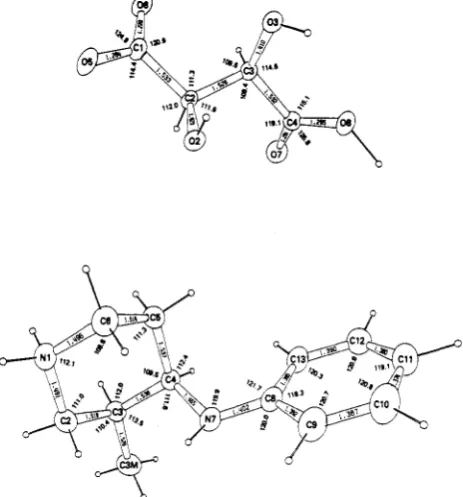
Figure 1. O R T E P ~
drawing
of (-)-9(R,R)-L-(+)-tartaric
acid salt
showing bond lengths and angles. Thermal ellipsoid boundaries
aredrawn at
36%probability and hydrogen atoms are arbitrary.
amides
(+)-11 and (-1-11, respectively, which displayed
almost no measurable optical rotation at the sodium D line,
a feature exhibited by the remaining compounds in this
series; however, rotations were larger a t shorter wave-
lengths [(+)-11, [a]23435.8
+6.2']. Hydrogenation (Pd/C)
of the enantiomeric (+)-11 and (-)-11 gave the corre-
sponding amino derivatives (+)-12 and (-)-12, which were
converted to isothiocyanates
(+)-4and
(-)-4by reaction
with thiophosgene in a biphasic CHCl,/aqueous NaHCO,
system.
X-ray Analysis of
(-)-9.An X-ray crystallographic
study of the (R,R)-L-(+)-tartaric acid salt of
(-)-9estab-
lished the absolute configuration as 3S,4R. The bond
lengths, bond angles, and absolute configuration are as
depicted in Figure
1.'OThe protonated
N
atom is N(1)
as
might be expected chemically.
Two
H atoms were found
on this atom and the bond lengths and angles are also
consistent with this finding. The establishment of the
absolute configuration of
(-)-9as
3S,4R (Figure 1) indicates
that the absolute configuration of the derived
(-)-3
[cis-
(-)-3-methylfentanyl] and
( 3 - 4is
also
3S,4R. The absolute
configuration of the more potent
(+)enantiomer of
3
is
thus 3R,4S are shown in structure
3,
in contrast to a
previous suggestion.12 The same absolute configuration
follows for (+)-4 (structure
4),found also to be the more
potent enantiomer in the present study.
Tritiation
of
(+)-4.
As
noted below,
(+)-4can acylate
6
opioid receptors selectively and with high affinity.
Therefore, radiolabeled (+)-4 could be extremely useful
for labeling the 6 receptor. Tritiation of
(+)-4to high
specific activity was accomplished in a manner similar to
that used in the tritiation
ofFIT itself.'O The procedure,
which has also been applied to the tritiation of other ir-
reversible ligands,'0,21 relies on the Pd/C-catalyzed ex-
change of aromatic bromine atoms with tritium gas. The
(20) Johnson, C. ORTEP, Report ORNL-3794, Oak Ridge National
Laboratory, Oak Ridge, TN,
1965.
(21) Guan, J. H.; Neumeyer,
J.
L.; Filer, C. N.; Ahern, D. G.; Leslie,L.; Watanabe, M.; Grigoriadis, D.; Seeman,
P.
J. Med. Chem.i
I 1 I I I
0 2 4 6 8 10
[image:4.616.98.258.44.195.2]nM
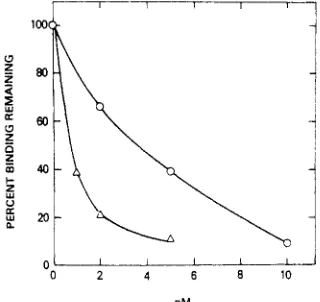
Figure 2.
The number
ofDalamid binding sites remaining
inmembranes
ofNG108-15 cells
afterincubation
withFIT
(2) (0)or (+)-4 (A) at
the concentrations shown. Each
pointis the mean
of duplicatedeterminations.
necessary brominated precursor was obtained from amine
(+)-12
by reaction with Br, in H20. Catalytic exchange
of bromine under an atmosphere
of
tritium gas gave crude
[3H]-(+)-12, which was purified by TLC. Reaction of
[?H]-(+)-12 with thiophosgene and purification of the re-
sulting isothiocyanate by TLC gave E3H]-(+)-4. The con-
centration of [3H]-(+)-4 was determined by saturation
binding to anti-FIT antibodies with use
of
[3H]FIT-N-
acetyl-L-lysine as a standard. From these data a specific
activity
of
13 Ci/mmol was calculated.
Biology.
The antinociceptive activity of
(+)-4was de-
termined in mice (sc injection) by the hot plate assay,22
and it (or its metabolite) was found
to
have an ED,
of
0.34
(0.25-0.45) pmol/kg. Thus, it was about 9 times more
potent than morphine and
15
times more potent than FIT
in this assay. The 144-min duration
of
action observed
for
(+)-4was similar
to
that
of morphine; thus, by sc injection,
(+)-4
is not a dramatically long acting agonist.
The membranes of NG108-15 neuroblastoma X glioma
hybrid cells are richly endowed with opioid receptorsB
that
are exclusively 6 in nature.24 When such membranes are
incubated with FIT
or
(+)-4
for
30
min a t 37 "C and
washed and the remaining receptors are measured, results
as
shown in Figure 2 are observed. Both agents irreversibly
inactivate receptors a t very low concentrations, but
(+)-4does so with ca.
5
times the potency of FIT. Evidence for
covalent binding of FIT to 6 receptors was presented
earlierg and similar evidence for covalent labeling by (+)-4
has been obtained. Each point in the figure is the maxi-
mum binding remaining
as
measured by Scatchard analysis
of a complete binding isotherm with [3H]Dalamid as the
ligand. The number of binding sites is reduced without
appreciably affecting the affinity of the remaining sites.
Thus, reversibly bound FIT or
(+)-4have been removed
by the washings.
Opioid agonist binding
toreceptors in
NG108-15mem-
branes is accompanied by the inhibition of adenylate
cyclase.25 The data presented in Figure 3 show that both
FIT and (+)-4 inhibit adenylate cyclase in these mem-
branes and that
(+)-a
is, again, more potent than
FIT.
The
data also show that both are partial agonists because
saturating concentrations of neither inhibit the activity of
the enzyme to the extent that the full agonist Dalamid
(22) Atwell, L.; Jacobson, A. E. Lab. Anima2 1978, 7, 42. (23) Klee, W. A.; Nirenberg, M. Proc. Natl. Acad. Sci. U.S.A. 1974,
71, 3474.
(24) Chang, J.-K.; Cuatrecasas, P. J . Biol. Chem. 1979 254, 2610. (25) Sharma, S. K.; Klee, W. A.; Nirenberg, M. Proc. Natl. A c a d .
Scz. I1.S.A. 1975, 72, 590.
o i o 9 i o 8 1 0 7 i o 6 10-5
[image:4.616.348.534.45.212.2]MOLARITY
Figure 3.
Inhibition
ofadenylate cyclase activity
ofmembranes
of NG108-15 cells byFIT
(2) (0) and by (+)-4 (A) over a range ofconcentrations, and
byDalamid
(0)at
asaturating
concen- tration (10 WM).The data shown are representative
fromthree
determinations.
,r----
' I I '7".
- I,
[image:4.616.327.556.272.447.2]i o l o i o 9 i o 8 1 0 ' i o - 6 10-5 10-4
Figure 4.
Displacement
of 8nM
[3H]Dalamid
from opioid re-ceptors
ofrat brain membranes
byetonitazene
atthe concen-
trations shown without
drug (O), with 2 nMFIT
(2)(e),
orwith
2 nM (+)-4 ( A ) .These are representative data
from three de-terminations.
does. Interestingly,
(+)-4has both higher potency and
higher efficacy than FIT in this test.
It
is not clear from
this experiment whether the inhibitory effects of the lig-
ands are due to reversible or to covalent interactions.
With rat brain membranes, we have previously demon-
strated by competition experiments that etonitazene dis-
placement of Dalamid binding is biphasic and that the two
phases correspond to etonitazene binding to
preceptors
(Kd
near
M) and to
dreceptors
(Kd
near
lo4
Mh3
An
example of such a biphasic curve is shown in Figure
4
(upper curve) for rat brain membranes in a control ex-
periment. After preincubation of the membrane with
2nM FIT or
(+)-4,the middle and lower curves of the figure
are obtained, respectively. Neither reagent appreciably
changes the number of
preceptors present and both reduce
the number of
6receptors in the membrane, although to
different extents. Receptor subtype numbers present are
obtained simply by subtracting the appropriate plateau
binding values from one another. A summary of many
experiments
ofthe type shown is provided by the data
ofFigure 5. In all experiments FIT and
(+)-4affect &re-
ceptor numbers without reducing the number of recep-
torspresent. The data show that (+)-4 is ca.
10times more
potent than FIT in this type
ofassay and that both
reagents can reduce &receptor numbers to relatively
lowProbes
forNarcotic Receptor Mediated Phenomena
Journal of
Medicinal Chemistry,
1986, Vol. 29,No.
6 1091I 1 I I
I I
0 1 5 10 50
[image:5.623.327.556.45.228.2]nM
Figure 5.
Number
of fi andS
opioid receptors remaining
inrat
brain membranes after treatment with various concentrations
ofFIT
(2) or (+)-4.The symbols represent the receptor numbers
remaining as follows:
fireceptors after treatment with FIT
(2) (0) or (+)-4 (A); 6receptors after treatment with FIT
(2) ( 0 ) or (+)-4 (A).Each
pointis calculated from a complete etonitazene
displacement
curve asshown Figure 4 and is the average of
twoto three determinations.
2000
I-
\
O \MOLARITY
O
1
,;-lo 1h.9,A-s
lo.>l;-€!
Figure 6.
Comparison
ofthe potencies
ofthe enantiomers
of 4by
measurement ofresidual specific Dalamid binding sites of
NG108-15membranes
afterpreincubation with
(+)-4 (0) or (-)-4 ( 0 )at the concentrations shown. The data are representative
ofsix determinations.
values when used a t the appropriate concentrations.
As we had hoped,
(+)-4
and its enantiomer
(-)-4
display
markedly different biological activities. Figure
6 sum-
marizes the data of a number of experiments in which
opioid binding remaining after pretreatment of NG108-15
membranes with each of the enantiomers of
4is shown
as
a function of the concentration of acylating agent used.
The
(+)-4is ca.
50
times were potent than its
(-)enan-
tiomer although both can inactivate essentially all of the
receptors present. Similarly,
(+)-4is much more effective
as an inhibitor of adenylate cyclase in these membranes
than is the
(-)enantiomer (Figure
7).These results are
as expected since both
(+)-4and the more active
(+)en-
antiomer of 3-methylfentanyl
[(+)-31
are derived from the
same amine
(+)-9'.
Discussion
The experiments described in this paper show that the
newly prepared 3-methyl analogue of FIT,
(+)-4,is, like
the parent compound, an heversible ligand for
S
but not
for
popioid reppptors. These experiments do not rule out
T
10-9 10-6 10-7 10-6 lo-!
[image:5.623.74.282.47.215.2]MOLARITY
Figure 7.
Inhibition
ofadenylate cyclase activity of NG108-15
membranes by
(+)-4 (0) or (-)-4 ( 0 )at the concentrations shown.
Each
pointis the mean
ofthree determinations (SE
I 5%).reversible interaction of
FIT
and
(+)-4with
preceptors
that might be expected since fentanyl is a preferential
pligand,26 and indeed
reversible
binding2I of FIT to
pre-
ceptors can be demonstrated with the proper experimental
design. The likely explanationB for the observed selectivity
of
FIT
and
(+)-4
in brain receptor acylation is that the
bound drug is orientated in the preceptor matrix with the
electrophilic isothiocyanate function located too distant
from a suitably reactive nucleophile for acylation to occur,
in contrast to its interaction with 6 receptors where a nu-
cleophile appears
to
have ready access to the electrophilic
isothiocyanate moiety.
In each of the assays used,
(+)-4is more potent than
FIT. Interestingly, whereas
(+)-4is only
4-5
times more
potent than FIT in acylation of the 6 receptors of
NGlO8-15 membranes, it is 10 times more potent than
FIT
in its acylation of 6 receptors of rat brain membranes. The
possible significance of this small but consistently observed
difference between the two types of 6 receptors is unclear
but may deserve further study. The high potency of
(+)-4
as an irreversible 6 ligand is the result of the selective
interaction with the receptor. The enantiomers differ by
a factor of 50 in potency, even though either will, at a
sufficiently high concentration, acylate
all
of the 6 receptors
present. Although we have not yet studied the effects of
(+)-4
on
Kopioid receptors, we have shown that pre-
treatment of rat brain membranes and sections and guinea
pig brain sections with FIT
(4)and the p-specific acylating
agent BIT8l9 provides membranes and sections greatly
enriched with
Kreceptors.29 Considering the similarity
in profile of
FIT
and
(+)-4
described here, we expect that
similar results will be obtained with
(+)-4.We have found that
[3H]-(+)-4,
reacts with the same
58000-dalton subunit of the receptor as does FIT1' but
with considerably less nonspecific labeling of other mem-
brane constituents.16 This observation should facilitate
study of receptors from sources less ricbly endowed than
(26) Essawi, M. Y. H.;
Portoghese,
P. S. J. Med. Chem. 1983, 26, 348.(27) Lessor, R. A.; Rice, K. C.; Streaty, R. A.; Klee, W. A.; Jacobson,
A. E. Neuropeptides 1985,5, 229.
(28) Portoghese, P. S.;
Takemori,
A. E. InThe
Chemical Regula-tion of Biochemical Mechanisms; Creighton, A. M., Turner, S.,
Eds.;
Burlington House: London, 1982; pp180-199.
[image:5.623.68.292.306.496.2]a r e neuroblastoma
x
glioma hybrid cell membranes.Experimental Section
Melting points were determined on a Fisher-Johns apparatus and are corrected. NMR spectra were recorded with a Varian 220-MHz spectrometer. Electron-ionization mass spectra (EIMS) were obtained with a Hitachi Perkin-Elmer RMU-6E spectrometer (70 eV). Chemical-ionization mass spectra (CIMS) were obtained with a Finnigan 1015D spectrometer with a Model 6000 data collection system, and high-resolution mass spectra were obtained with a VG Micromass 7070F spectrometer. Column chroma- tography (HPLC) was performed with Gilson Model 303 pumps with Model 811 solvent mixer and Model 620 Data Master coupled to an Apple IIe computer. Optical rotations were measured with a Perkin-Elmer 241MC polarimeter using the solvents, concen- trations, and wavelengths specified. Mass spectra and elemental analysis were obtainied from the Section on Analytical Services, NIADDK. All compounds gave NMR and IR spectra consistent with their assigned structure.
Methyl 3-Carbomethoxy-4-oxo- 1-piperidinecarboxylate (6). Solid 3-carbomethoxy-4-oxopiperidine hydrochloride (5.HC1) (150.0 g, 0.78 mol) was added in portions to a 5-L flask containing a mechanically stirred mixture of NaHCO, (153.0 g, 1.94 mol) and methyl chloroformate (66 mL, 0.85 mol) in 1 L of HzO and 1 L of ether. After 30 min the reaction was discontinued and the ether layer collected. The aqueous phase was extracted with CHC13 (200 mL), and the combined ether and CHC1, layers were allowed to remain undisturbed for 24 h during which time a red liquid separated. The red liquid was discarded and the supernatant evaporated to give 6 as a light red oil (169.0 g, 100%); high-res- olution MS (C6H13N05) calcd 215.0793, found 215.0776.
Methyl 3-Methyl-3-carbomethoxy-4-oxo-l-piperidine- carboxylate (7).
A
mixture of 6 (107.0 g, 0.50 mol), KzC03 (138.0 g, 1.0 mol), and Me1 (62 mL, 1.0 mol) was stirred a t reflux in acetone (600 mL). After 24 h K&O3 was removed by filtration and the filtrate evaporated to an oil. Chloroform (300 mL) was added, and precipitated salts were removed by filtration. Evaporation of the filtrate gave crude 7 as a light brown oil (116.0 8). Distillation (138 'C head, 175 'C bath, 1.0 mm) gave 7 as a clear, colorless oil (97.0 g, 85%): high-resolution MS (Cl0Hl5NO5) calcd 229.0950, found 229.0975.Methyl 3-Methyl-4-oxo-1-piperidinecarboxylate (8). A solution of 7 (82.0 g, 0.30 mol) in MeOH (300 mL) was diluted with aqueous HCl(450 mL, 5 N) and stirred a t reflux. After 20 h the mixture was cooled, diluted with HzO (600 mL), extracted with CHzClz (2 X 300 mL), and dried (NazS04). Evaporation gave 8 (62.0 g, 100%) as a light yellow oil: bp 86 "C (0.1 mm); high- resolution MS (C8H13N03) calcd 171.0895, found 171.0886.
(f)-cis-3-Methy1-Nhr-phenyl-4-piperidinamine (9). The preparation of 9 was by literature methods from 8. Product 9 was obtained as a clear coloress oil: bp 114 "C (0.2 mm) [lit.12 bp 140-145 "C (0.4 mm)].
Optical Resolution of 9. Optical resolution of 9 was per- formed according to reported procedures12 by crystallization of the D-(-)-tartaric acid and L-(+)-tartaric acid salts from MeOH/acetone to yield after conversion to the free amines (+)-cis-9 and (-)-cis-g, respectively [(+)-cis-9, [aIz3D +6.2' (c 3.7, MeOH) [lit.12 [a]25D +6.1' (MeOH)], and (-)-cis-9, [ a I z 3 D -6.8'
(c 2.6, MeOH) [lit." [a]25D -5.9" (MeOH)]]. Six crystallizations were required to obtain 99.7% enantiomeric purity for (+)-9. In the case of (-)-9, six crystallizations were carried out and then the resolution was carried further by neutralization to the free base followed by recrystallization two more times with tartaric acid to obtain 99.85% enantiomeric purity.
Determination of Enantiomeric Purity. A sample (ca. 5
mg) of either (+)-9 (-)-tartaric acid or (-)-9 (+)-tartaric acid salt was partitioned between CHCl, (1 mL) and aqueous NaHC03 (1
mL). The organic phase was evaporated to dryness and then taken up in CHCl, (1 mL) and mixed with the appropriate a-methyl- benzyl isocyanate (1 pL). [Amines (+)-9 and (-)-9 were reacted with (R)-(+)- and (S)-(-)-a-methylbenzyl isocyanates, respec- tively.] The reaction was complete in less than 5 min, and samples of the reaction mixture were analyzed directly by HPLC (Waters p-Porasil column, hexane-isopropyl alcohol (88:12), 1 mL/min, absorbance 254 nm). For both mixtures, the major urea peak occurred a t 14.6 min with the minor urea peak resulting from
enantiomeric contamination occurring a t 12.3 min. Integration of peak areas indicated enantiomeric purities of 99.7% and 99.85% for (+)-9 and (-)-9, respectively. Derivatization of racemic 9 with (R)-(+)-isocyanate yielded HPLC peaks from (-)-9 and (+)-9 in a ratio of 1.03:1.00, respectively, indicating equal reactivity and detection for both enantiomers.
(3R ,4S)-(+)-cis -3-Methyl-1-[2-(4-nitrophenyl)ethyl]-N- phenyl-4-piperidinamine [(+)-lo]. A mixture of (+)-9 (2.23 g, 11.7 mmol), 4-nitrophenethyl bromide (8.10 g, 58.7 mmol), and a few crystals of KI were stirred at 105 "C in 4-methyl-2-penta- none12 for 18 h. Solvent was evaporated and residue partitioned between CHC1, (2 X 100 mL) and NaOH (1.0 N , 100 mL). Evaporation of solvent gave an oil, which was purified by silica gel flash chromatography (CHZClz then 10% MeOH in CH2Clz), yielding a brown oil. This was dissolved in MeOH, acidified with 37% HCl, evaporated to a syrup, and crystallized (MeOH/2- propanol) to yield (+)-lo as a mixture of mono and dihydro- chloride salts (3.8 g, mp 251-253 "C). A sample was dissolved in MeOH, a drop of 37 % HCl was added, and then the solution was diluted with isopropyl ether to yield (+)-10*2HCl as a white salt: mp 254-255 'C; [aIz3D +11.2' (c 0.5,0.05 N HCl in MeOH). Anal. (C&-IaN3OZ-2Hz0) C, H, N. Another sample was dissolved in boiling HzO to afford a colorless solution, which deposited (+)-lO-HCl as bright yellow crystals: mp 25C-252 "C; [a]21D +72.5"
(c 0.5, MeOH). Anal. (CZ0Hz3N3) C, H, N.
(35,4R )-(-)-cis -3-Methyl- 1-[ 2- (4-nitrophenyl)ethyll-N- phenyl-4-piperidinamine [(-)-lo]. In a manner analogous to the preparation of (+)-10-2HCl, (-)-10.2HC1 was prepared in 56% yield: mp 248-250
"c;
[ a I z 3 D -11.1" (c 1.4, -0.05 N HCl in MeOH). Anal. ~CzoHzsN3Oz~2HCl~2Hz0) C, H, N.(3R , 4 S ) - ( + ) - c i s - N - [ 3-Methyl-1-[2-(4-nitrophenyl)-
ethyl]-4-piperidyl]-N-phenylpropanamidq { ( + ) - l I.HCl]. Neutralization of (+)-10*2HCl gave an oil (2.1 g, 6.2 mmol), which was dissolved in toluene and refluxed 16 h with propionic an- hydride (3.4 mL, 6 equiv). The solvent was evaporated and the syrup acidified with aqueous methanolic HCI, evaporated, and crystallized from 2-propanol/isopropyl ether to yield (+)-ll.HCl as a white salt (1.69 g, 63%): mp 180 "C (partial melting), 200-202 "C (complete melting); [.Iz3D Oo, [a]23435.8 +6.2' (c 4, MeOH). Anal. (Cz3Hz9N303-HCl~1/2H20) C, H, N.
( 3 5 , 4 R ) - ( - ) - c i s -N-[3-Methyl-1-[2-(4-nitrophenyl)-
ethyl]-4-piperidyl]-N-phenylpropanamide [ (-)-1 l.HCl]. In a manner analogous to the preparation of (+)-ll.HCl, (-)-ll.HCl was obtained from (-)-lo in 75% yield: mp 180 "C (partial melting), 202-204 "C (complete melting); [a]234358 -5.4" (c 4, MeOH). Anal. (C23Hz9N303~HCl~'/2HzO) C, H, N.
( 3 R , 4 S )-(+)-cis - N - [ 1-[2-(4-Aminophenyl)ethyl1-3-
methyl-4-piperidyll-N-phenylpropanamide Hydrochloride [(+)-12*HCl]. A solution of (+)-ll.HCl (2.0 g, 4.6 "01) in MeOH (30 mL) was hydrogenated under 40 psig Hz over 5% Pd/C (250 mg). After 3 h the mixture was filtered, evaporated to a syrup, and crystallized (2-propanol/isopropyl ether), yielding (+)-12*HCl as a white salt (1.89 g, 96%): mp 181-183 "C; [a]23365 +18.5" (c
1, MeOH): high-resolution MS (CBH3,N30) calcd 366.2545, found ( 3 s ,4R ) - ( - ) - c i s - N - [ 1-[2-(4-Aminophenyl)ethy1]-3-
methyl-4-piperidyll-N-phenylpropanamide Hydrochloride [(-)-12mHC1]. In a manner similar to the preparation of (+)- 12.HC1, (-)-12.HC1 was prepared in 96% yield from (-)-ll-HCl: mp 181-183 "C; [a]233s5 -18.5' (c 1, MeOH); high-resolution MS (Cz,H,2N30) calcd m / e 366.2545, found m / e 366.2576 (CIMS, NH3).
(3R ,4S )-(
+
)-cis - N - [ 1-[ 2-(4-Isothiocyanatophenyl)- ethyl]-3-methyl-4-piperidyl]-N-phenylpropanamide Hy- drochloride [(+)-4*HCl]. A mixture of (+)-12*HC1(300 mg, 0.75 mmol) in CHCl? (20 mL) was stirred with NaHC03 (440 mg, 5.24 mmol) in HzO (10 mL) to which redistilled thiophosgene (68 pL, 0.90 mmol) was added. After 15 min the CHC13 was collected, the aqueous layer extracted (10 mL of CHCl,), and the organic phase evaporated to yield a syrup, which was acidified with methanolic HCl. Evaporation and crystallization from 2-propanol yielded (+)-4.HC1 as white crystals (210 mg, 67%): mp 204-211 'C; [ a ] 2 3 3 6 5 +18.3' (c 1.2, MeOH). Anal. (Cz4Hz9N3S0.HC1) C, H, N.Probes for Narcotic Receptor Mediated Phenomena
drochloride [(-)-4*HCl]. In a manner similar to that above, (-)-4*HC1 was prepared from (+)-12aHCl in 92% yield mp 201-209 "C; [aIBm -17.8" ( c 1, MeOH). Anal. (CaHd3SO.HC1) C, H, N.
Tritiation of (+)-4. T o a vigorously stirred solution of (+)-12.HC1 (200 mg, 0.5 mmol) in H 2 0 (20 mL) was added a mixture of Br2 (77 wL, 1.5 mmol) in H 2 0 (10 mL). The resulting suspension of yellow solid was stirred for 15 min and then made alkaline (pH >lo) by addition of saturated aqueous NaZCO3. The suspension was then extracted (2 X 30 mL of CHCl,), evaporated, and chromatographed through a short silica gel column (CH2Cl2-MeOH, 1O:l). Evaporation of the appropriate column fractions, acidification of the resulting foam (48% HBr in MeOH), and trituration of the residue with ether gave an amorphous powder (200 mg: CIMS (NH,) (M
+
1)' 523,524,525 indicated dibromination). A sample of this powder (10 mg in 2 mL of MeOH with 15 mg of 10% Pd/C) was tritiated under an atmosphere of ,Hz (25 Ci) for 24 h. (Tritiation was performed at New England Nuclear Corp., Boston, MA.) Labile tritium was removed in vacuo, yielding 230 mCi of remaining activity. In an identical procedure using Hz rather than 3Hz, product was obtained that was identical (TLC, MS, NMR) with (+)-12. Crude [3H]-(+)-12 was purified by TLC (CHCl3-MeOH-NH4OH, 9:l:0.1). Reaction with thio- phosgene as previously reportedlo for the synthesis of 4 and purification by TLC on silica gel eluted with CHC13-MeOH (201) gave [3H]-(+)-4 in 10% overall radiochemical yield with a specific activity of 13 Ci/mmol.X-ray Analysis. Cell dimensions: a = 7.7890 (5)
A,
b = 7.3626 (4)A,
c = 14.804 (1)A,
0
= 92.56 (1)";E,;
2
= 2. The phase problem was solved by generating sets of 100 random phases for input to M U L T A N ~ ~ and all heavy atoms were found in anE
map. All expected H atoms were found later, and the structure was refined, using the programs of XRAY72F1 with anisotropic thermal parameters for the heavy atoms to an R factor of 3.29%. The model atomic coordinates were chosen so that the anion had the knownR,R
configuration of L-(+)-tartaric acid and thus the ab- solute configuration of the cation follows. Tables of atomic pa- rameters, structural factors, and comments on crystal packing and hydrogen bonding are available as supplemental material. Determination of Residual Dalamid Binding Sites in Membranes of NG108 Neuroblastoma X Glioma Hybrid Cells after Treatment with FIT (2) or (+)-4 (Figure 2). Incubation of the membranes% with the isothiocyanates was a t 37 "C in 10 mM potassium phosphate buffer, pH 8.0, at 1 mg of protein/mL. After 30 min, the membranes were diluted with 5 volumes of 10 mM Tris-Cl, pH 7.5, and centrifuged a t 20000 rpm for 30 min. After two more such washes, [3H]Dalamid binding was measured a t a series of concentrations between 1 and 20 nM. Bound ra- dioactivity was separated from free by gel filtration as previously and specific binding was estimated as the difference between total binding and that found in the presence of 10 pM nonradioactive Dalamid. Numbers of binding sites remaining were Main, P.; Hull, S. E.; Lessinger, L.; Germain, G.; Declercq, J. P.; Woolfson, M. M. MULTAN78, a system of computer programs for the automatic solution of crystal structures from X-ray diffraction data; Universities of York and Louvain, 1978. Stewart, J. M.; Kruger, G. J.; Ammon, H. L.; Dickinson, C.; Hall, S. R. XRAY system, version of June 1972, Tech. Report TR-192, University of Maryland.Simonds, W. E.; Koshi, G.; Streaty, R. A.; Hjelmeland, L. M.; Klee, W. A. Proc. Natl. Acad. Sci. U.S.A. 1980, 77, 4623.
Journal of Medicinal Chemistry, 1986, Vol. 29, No. 6 1093 estimated by extrapolation of the data to infinite concentration by the method of Scatchard.,,
Inhibition of Adenylate Cyclase Activity of Membranes of NGlO8-15 Cells by FIT (2), (+)-4, and Dalamid (Figure 3). Incubation with a range of concentrations of the drugs were for 5 min at 37 "C; using a previously described m o d i f i ~ a t i o n ~ ~ of the method of S a l ~ m o m . , ~
Displacement of [3H]Dalamid from Opioid Receptors of Rat Brain Membranes by Etonitazene before and after Treatment with FIT (2) or (+)-4 (Figure 4). The membranes, prepared as described were pretreated for 30 min a t 37 "C without drug, with 2 nM FIT (2), or with 2 nM (+)-4. The membranes were washed and the binding of 8 nM [,H]Dalamid was then measured as described for the generation of data shown in Figure 2.
Measurement of p and 6 Opioid Receptors Remaining after Treatment with FIT (2) and (+)-4 (Figure 5). Receptor type numbers were measured from curves as shown in Figure 4 after treatment with the concentrations of drugs indicated in the figure. Each experiment included a control of membranes in- cubated without drug and receptor numbers remaining are ex- pressed as percent of that control value. The points are averages of two or three such measurements that agreed with one another within 10%.
Comparison of the Potencies of (+)- and (-)-4 by Mea- surement of Residual Dalamid Binding Sites of NGlOS-15 Membranes after Preincubation with the Enantiomers (Figure 6). Experimental conditions are as described in the experiments of Figure 2. Specific Dalamid binding is the dif- ference between the amount of opioid bound to membranes in- cubated with 10 nM [3H]Dalamid and that bound in the presence also of 10 pM nonradioactive Dalamid. The concentration of [3H]Dalamid used is 5 times its dissociation constant.
Inhibition of Adenylate Cyclase Activity of NGlOS-15 Membranes by (+)- and (-)-4 (Figure 7). The activity of the enzyme was determined as described previously25 after a 5-min incubation a t 37 "C with (+)- and (-)-4 at the concentrations shown.
Registry No. 2, 85951-63-9; (+)-4, 101472-19-9; (-)-4, 101472-20-2; [3H]-(+)-4, 101472-14-4; (+)-4*HCl, 101472-11-1; (-)-4*HCl, 101472-12-2; (*)-5sHCl, 101493-71-4; (*)-6,93757-83-6; (*)-7, 101472-04-2; (*)-8, 101472-05-3; (f)-cis-9, 53757-54-3; (+)-cis-9, 53757-49-6; (-)-cis-9, 53757-51-0; (+)-9.(-)-tartrate, 53757-50-9; (-)-9.(+)-tartrate, 53757-52-1; (+)-lo, 101472-06-4; (-)-lo, 101472-07-5; (+)-lO-HCl, 101472-15-5; (+)-10*2HC1, 101472-16-6; (-)-10*2HCl, 101472-17-7; (+)-1l*HC1,101472-08-6; (-)-ll*HCl, 101472-09-7; (+)-12*HCl, 101472-10-0; (-)-12*HC1, 101493-72-5; [3H]-(+)-12, 101472-13-3; (+)-a-methylbenzyl iso- cyanate, 33375-06-3; 4-nitrophenethyl bromide, 5339-26-4; pro- pionic anhydride, 123-62-6; (-)-a-methylbenzyl isocyanate, Supplementary Material Available: Tables of atomic pa- rameters for heavy atoms and hydrogens, structural factors, and comments on crystals packing and hydrogen bonding (11 pages). Ordering information is given on any current masthead page. 14649-03-7.
(33) Scatchard, G. Ann. N.Y. Acad. Sci. 1949, 51, 660.
(34) Salomon, Y.; Londos, C.; Rodbell, M. Anal. Riochen. 1974,58, 541.