Geometric Approximation Searching Algorithm for
Spatial Straightness Error Evaluation
Jishun Li, Xianqing Lei, Yujun Xue, Weimin Pan Henan University of Science and Technology, Luoyang, China
Email: [email protected]
Received December 27, 2012; revised January 20, 2013; accepted January 27,2013
ABSTRACT
Considering the characteristics of spatial straightness error, this paper puts forward a kind of evaluation method of spa- tial straightness error using Geometric Approximation Searching Algorithm (GASA). According to the minimum con- dition principle of form error evaluation, the mathematic model and optimization objective of the GASA are given. The algorithm avoids the optimization and linearization, and can be fulfilled in three steps. First construct two parallel quadrates based on the preset two reference points of the spatial line respectively; second construct centerlines by con- necting one quadrate each vertices to another quadrate each vertices; after that, calculate the distances between mea- sured points and the constructed centerlines. The minimum zone straightness error is obtained by repeating comparing and reconstructing quadrates. The principle and steps of the algorithm to evaluate spatial straightness error is described in detail, and the mathematical formula and program flowchart are given also. Results show that this algorithm can evaluate spatial straightness error more effectively and exactly.
Keywords: Error Evaluation; Spatial Straightness; Geometric Approximation Searching Algorithm; Minimum Zone
1. Introduction
Spatial straightness is one of important geometric ele- ments. Spatial straightness error is defined as “the mini- mum cylindrical diameter subsuming measured line” in ISO/TS 12780-1 [1] and its evaluation is normally car- ried out by Least Square Method (LSM) and Minimum Zone Method (MZM).
LSM for spatial straightness error first uses linear least square fitting to obtain a line as centerline, then calcu- lates the distances between measured points and the cen- terline, at last constructs a cylinder including all meas- ured points by taking the maximum distance as radius, and the maximum distance is spatial straightness error by least square method. Owing to its ease of computation and uniqueness of solution, it is now widely applied in engineering. It can be easily found that LSM does not exactly coincide with spatial straightness error definition and brings some defectiveness in error evaluation such as spatial straightness error by LSM is usually not the mi- nimal [2]. It is very likely that overestimated form toler- ance may be artificially introduced and rejection of good parts may occur.
MZM is used to determine the minimum cylinder in diameter to enclose the measured spatial line. The eva- luation of spatial straightness error can be carried out ba- sed on the minimum cylinder diameter which is an accu-
rate and applicable method conforming to the definition of form error. However, how to find the minimum zone enclosing all measured points of the spatial line and ve- rify if the minimum zone is the smallest zone is still a problem received the widespread attention and urgent to be solved. Unfortunately there is no final conclusion in the academia in recent years.
Straightness error based on the disadvantages in evaluat- ing spatial straightness error with traditional method, such as difficulty in solving the nonlinear simultaneous equation, the evaluating precision is lower and data pro- cessing can’t be automated. The feasibility of method is validated by practical measurement. Altarazi Safwan and Mandahawi Nabeel [6] present a simulated annealing (SA) based methodology for the evaluation of straight- ness error of median line, tested the procedure and ana-lyzed the results. Zhu and Ding [7] argue that spatial straightness evaluation is formulated as a linear complex Chebyshev approximation problem, and then reformula- ted as a semi-infinite linear programming problem. Both models for the primal and dual programs are developed. An efficient simplex-based algorithm is employed to solve the dual linear program to yield the straightness va- lue. Also a general algebraic criterion for checking the optimality of the solution is proposed. Numerical ex- periments are given to verify the effectiveness and effi- ciency of the presented algorithm. Zhong and Xu [8] ana- lyzed theoretical defects of the Least Squares Method (LSM) in the evaluation of the spatial straightness error with geometry, the theory of errors, and optimization principle so as to effectively boost the precision of the assessment of the spatial straightness error, and proposed the improved LSM algorithm for the spatial straightness error, the experiment results have shown that the im- proved LSM algorithm as overcome the theoretical de-fects of LSM with higher accuracy. Wen and Song [9] proposed an improved genetic algorithm (GA) to imple- ment the minimum zone evaluation of planar and spatial straightness errors simultaneously. The algorithm em- ploys the generation alternation model based Minimal Generation Gap (MGP) and blend crossover operators (BLX-a), the experimental results evaluated by different methods confirm the effectiveness of the proposed GA. Compared to conventional evaluation methods; it has the advantages of algorithm simplicity and good flexibility. Zhang and Fan[10] affirmed the mathematical model for spatial straightness error evaluation cannot be linearized and established a nonlinear mathematical model for spa- tial straightness error evaluation based on the minimum zone condition, proposed a new computational method and criterion for verification of the existence and unique- ness of the minimum zone solution.
We know from the references that the assessment methods of spatial straightness error are very important in metrology. The construction of the cylinder containing and enclosing all measured points of the line is a very complex geometric problem and can be formulated as a nonlinear optimization. In the process of the nonlinear optimization, the selection and application of algorithms are of great importance. Meanwhile, the convergence rate, precision of result and reliability of the algorithm directly
affect the evaluating precision. In other words, the sim- plified algorithms might not bring about accurate evalua- tion; the computation process of the optimization algo- rithms might be very complex and may be not under- stood by the non-professional.
According to the definition of spatial straightness error, an innovative and simple evaluation method, named as Geometric Approximation Searching Algorithm (GASA) is presented, in which the spatial straightness error can be gained by repeatedly calculating spatial distance and simple judgment without any optimization and lineariza- tion processing.
2. The Evaluation Principle of the GASA
The essence of spatial straightness error evaluation methods is to resolve the parameters of the centerline of cylindrical surface containing all real measuring points [1-10]. It is obvious that the ideal centerline must be closed to the least square centerline, or closed to the con- necting line between the starting measured point and end measured point of measured straight line. If take the two endpoints the of the least square centerline as reference points, or take the two endpoints the of the measured line as reference points, the straightness error of the measured line can easily to get and expressed as F2, evidently , it
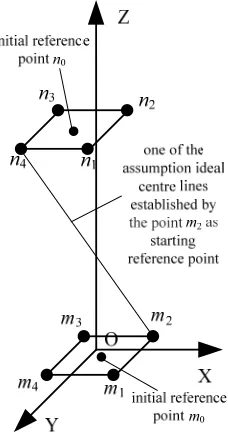
is not an outcome we look forward to. Now, take the two endpoints as reference points, a square is allocated re-spectively (the length of side is f, f is estimated value according to the machining accuracy of the measured straight line, or f is the error of the LSM), and then, the 16 lines can be arranged by connecting each vertices of one square to another square (Figure 1). If take one of the 16 lines as assumption ideal centerline of measured spatial straightness respectively, by calculating the radi- uses of all measurement points, the 16 cylindrical surface can be gained which containing all the data points. If the least radius of the 16 cylindrical surface is less than the
2
F
, take the crossing points between the assumption ideal axis and initial and end measured section (i.e. crossing points are certain vertex of the pre-set square) as new reference points, the side length remain unchanged, the new square are re-established, So, 16 new assumption ideal centerlines and corresponding cylindrical surface can be gained. If the least radius is not less than the F2,
Figure 1. The principle of Construct assumption ideal cen-terlines.
3. Implementation of the GASA
Assuming that the measuring points arem X Y Z0
0, ,0 0
0 z, ,z z
n X Y Z , the LSM spatial straightness error is f (the LSM method has been discoursed in many papers, and its computational process is not given in this paper).
3.1. Determination of Initial Reference Points
It can be seen that from Refs [1-10] and actual measure- ments, the ideal center line for evaluating spatial straight- ness error must be closed the least square center line and the line between the initial measured point and end mea- sured point. Then the two endpoints of measured line or the least square center line can be chosen as the initial reference points for simplicity, the two initial reference points are expressed by m X Y Z0
0, ,0 0
and n X Y Z0
z, ,z z
respectively.
3.2. Construction of Supposed Ideal Centerline
Using the points m X Y Z0
0, ,0 0
and n X Y Z0
z, ,z z
1, 2,3, 4
as reference points, a square is set by the f as side length in initial measured section and end measured section re- spectively (as shown in Figure1), the coordinates of the square vertex m Xi
mi,Y Zmi, mi
i and
, ,
j nj nj nj
n X Y Z
an be expressed in Equa- tions (7) and (8).
1, 2,3, 4
j c
1 2 0
3 4 0
1 4 0
2 3 0
0
2 2 2 2
m m
m m
m m
m m
mi
X X X f
X X X f
Y Y Y f
Y Y Y f
Z Z
(7)
1 2 3 4 1 4 0 2 3 0
2 2 2 2
n n Z
n n z
n n
n n
nj z
X X X f
X X X f
Y Y Y f
Y Y Y f
Z Z
(8)
And then, the 16 supposed ideal centerlines can be constructed by connecting vertex of the one square to another square, the lines can be expressed in the form of (x − a)/P = (y − b)/Q = z, based on geometric principle, the direction cosines of the lines are defined in Equation (9).
0
0
mi nj
ji
z
mi nj
ji
z
X X
P
Z Z
Y Y
Q
Z Z
(9)
3.3. Calculation of Distances between Measured Points and Constructed Ideal Centerlines The spatial distance from measured pointsK x y zl
l, ,l l
to the constructed ideal centerlines can be calculated by Equation (10).
2 2
, , , ,1
1
l nj l nj l z ji ji
ijl
ji ji
x X y Y z Z P Q
R
P Q
(10)
There are 16 presumptive ideal centerlines lines, there- fore the 16 maximum distances Rmax can be gained. Take
one of the 16 maximum distances as radius and the cor- responding assumption ideal centerlines as axis, the cy- lindrical surface containing all measuring points can be constituted. According to definition of the spatial straight- ness error, we can know, the diameter of the cylindrical surface is spatial straightness error. There are 16 presum- ptive ideal centerlines lines and the 16 maximum dis- tances, therefore there are 16 cylindrical surface contain- ing all measuring points and 16 diameters. Among the 16 diameter, the minimum diameter is expressed byF1,
and then:
1 2 min
F R
max (11)
3.4. Calculate the Distances between Measured Points and the Line of Two Reference Points
The spatial distance from measured pointK x y zl
l, ,l l
0 0, ,Y Z0 0
to the line of two reference points m X and
0 z, ,z z
n X Y Z can be calculated by Equation (12).
0 0 0
0 0
0 2 2
0 0
, , , ,1
1
l l l
l
x X y Y z Z P Q
R
P Q
[image:3.595.376.472.88.164.2]where, is the direction cosines of the line linking the point0 0 and
,
P Q
0 0
m X
, ,Y Z0 0
n X Y Z0
z, ,z z
,
0 z 0 z 0
P X X Z Z , Q0 XzX0 ZzZ0
.Take maximum distances as radius and the line of two reference points as axis; one cylindrical sur- face containing all measuring points can be constituted. According to definition of the spatial straightness error, we can know, the diameter of the cylindrical surface is spatial straightness error and expressed
max 0 R
2
F
, and then
2 2 0 ma
F R
x (13)
3.5. Geometric Approximation Searching
Comparing F1 and F2
,Y Z, 0
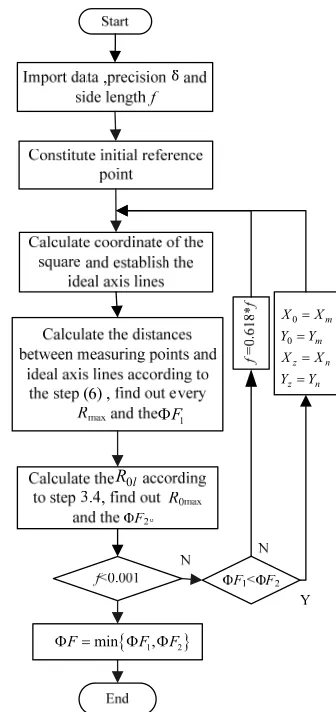
, if 1 2, the refer- ence points change to the endpoints of the assumption ideal centerline corresponding with the 1, that is, the reference point change to the pre-set square vertex (ex- pressed as m m m and z respect-
tively) correspond with the 1 (for example, the as- sumption ideal centerline correspond with the 1
F F
F
, ,n n n
O X Y
O X Z
F
F
is
line ,so the reference point 0and 0change to the
point 2and 4), the new square are re-established by using f as the side length, repeat steps 3.2 - 3.5.
2 4
m n m
m n
n
If F1 F2, the reference points remain unchanged
and the new square are re-establish by using the 0.618f (i.e. f = 0.618f) as the new side length, repeat steps 3.2 - 3.5.
When the square side length f is less than a given value (normally, J < 0.0001 mm), it could be considered that the searched assumption ideal centerline is getting close to the actual centerline of the cylinders which the mini- mum radius and contain all the data points, the search terminates.
And then, the minimum betweenF1 andF2 is
spa-tial straightness error of the MZM and expressed F. That is
1 2min ,
F F F
(14)
The flowchart of the GASA is shown in Figure2.
4. Examples
The measurement data from reference [10] are trans- ferred into Cartesian coordinate system shown in Table 1.
The LSM spatial straightness is 0.031408 mm [10], and the endpoints coordinates of the least-square center- line are (−0.00087307, −0.00148151, 50) mm and (−0.00016736, −0.00350018, 600) mm.
4.1. Algorithm
In order to validate the correctness of the proposed algo- rithm, the initial conditions are given as follows:
a) The endpoints of the least-square centerline as
ini-tial reference points and the straightness error of the least square method as the side length of the initial square.
1 2
min ,
F F F
1
F
n z
n z
m m
Y Y
X X
Y Y
X X
0 0
l
[image:4.595.336.504.118.474.2]R0
Figure 2. The program flowchart of the GASA.
Table1. Measurement data.
Point x/mm y/mm z/mm
1 0.005057 0.003411 50
2 −0.01239 −0.0023 100
3 −0.01046 0.004014 150
4 −0.00923 −0.01182 200
5 0.001436 0.003947 250
6 0.011883 0.00167 300
7 −0.00918 0.000642 350
8 −0.00617 −0.00849 400
9 0.015217 −0.00494 450
10 −0.00134 −0.01092 500
11 0.005835 0.006042 550
b) The endpoints of the measured line as initial refer- ence points and the straightness error the least square method as the side length of the initial square.
c) The endpoints of the measured line as initial refer-ence points and the side length of the initial square is assumed.
The initial condition is shown in Table 2.
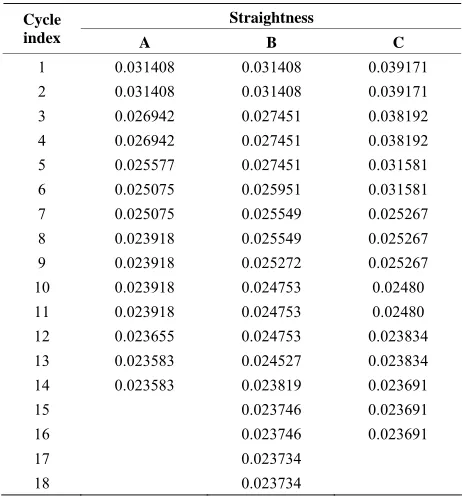
The straightness errors and cycle index of three initial conditions by the proposed searching algorithm are car-ried out. Table 3 and Table 4 show the straightness errors and cycle index terminated when the final side length of the square is less 0.001 mm and 0.0001 mm respectively.
4.2. Processing Results Analysis and Comparison
It is seen from Tables 3 and 4 that, the straightness er- rors obtained by the proposed evaluation algorithm is the nearly same in despite of the initial reference point and the side length of the initial square are different, only a few nanometer difference. Therefore, the initial reference does not affect straightness error evaluation resultgained by this algorithm. For the sake of calculation, the initial reference points usually choose the endpoints of the measured line and the side length of the initial square is assumed by the manufacturing precision of parts.
It was also seen by comparing Tables 3 and 4 that the results are of no significant difference with different ter- mination conditions such as f < 0.001 mm and f < 0.0001 mm. Generally, mm can satisfy straightness error evaluating requirement. 0.001
f
[image:5.595.307.538.100.348.2]The straightness errors obtained by the proposed evaluation algorithm are in accordance with the results in
Table 2. Initial conditions.
Condition Side coordinates the endpoints/mm length/mm
A 0 0 0 0 0.00087307 0.00148151 50 X m Y Z 0 0.00016736 0.00350018 600 z z z X n Y Z 0.031408 f B 0 0 0 0 0.005057 0.003411 50 X m Y Z 0 0.00191 0.0.003172 600 z z z X n Y Z 0.031408 f C 0 0 0 0 0.005057 0.003411 50 X m Y Z 0 0.00191 0.0.003172 600 z z z X n Y Z 0.1 f
Table 3. Straightness and cycle (f < 0.001 mm)/mm. Straightness
Cycle
index A B C
1 0.031408 0.031408 0.039171 2 0.031408 0.031408 0.039171 3 0.026942 0.027451 0.038192 4 0.026942 0.027451 0.038192 5 0.025577 0.027451 0.031581 6 0.025075 0.025951 0.031581 7 0.025075 0.025549 0.025267 8 0.023918 0.025549 0.025267 9 0.023918 0.025272 0.025267 10 0.023918 0.024753 0.02480 11 0.023918 0.024753 0.02480 12 0.023655 0.024753 0.023834 13 0.023583 0.024527 0.023834 14 0.023583 0.023819 0.023691
15 0.023746 0.023691
16 0.023746 0.023691
[image:5.595.307.538.375.736.2]17 0.023734 18 0.023734
Table 4. Straightness and cycle (f < 0.001 mm)/mm. Straightness
Cycle
index A B C
1 0.031408 0.031408 0.039171 2 0.031408 0.031408 0.039171 3 0.026942 0.027451 0.038192 4 0.026942 0.027451 0.038192 5 0.025577 0.027451 0.031581 6 0.025075 0.025951 0.031581 7 0.025075 0.025549 0.025267 8 0.023918 0.025549 0.025267 9 0.023918 0.025272 0.025267
10 0.023918 0.024753 0.0248
11 0.023918 0.024753 0.0248
12 0.023655 0.024753 0.023834
13 0.023583 0.024527 0.023834
14 0.023583 0.023819 0.023691
15 0.023583 0.023746 0.023691
16 0.023583 0.023746 0.023691
17 0.023563 0.023734 0.023691
18 0.023563 0.023734 0.023647
19 0.023547 0.023664 0.023639
20 0.023545 0.023664 0.023634
21 0.023545 0.023624 0.023629
22 0.023624 0.023629
23 0.023624 0.023567
24 0.023617 0.023532
25 0.023617 0.023532
26 0.023532
[image:5.595.58.287.483.734.2]reference [10], and therefore the proposed algorithm could be an easy and effective minimum zone method for the evaluation of spatial straightness.
5. Conclusion
The GASA for spatial straightness error presented in this paper is a new spatial straightness evaluation algorithm. It is not necessary to require evenly distributed sampling interval and assume small error or deviation in this algo- rithm, the evaluating accuracy of the GASA depends on the pre-set termination condition, the smaller the values of the termination condition is, the more precise the evaluation is. Generally, take the endpoints of the meas- ured line as initial reference points and the side length of the initial square is assumed by the manufacturing preci- sion of parts and the termination condition is f 0.001 mm can satisfy spatial straightness error evaluating re- quirement. The algorithm is simple, intuitive and easy to program, and it has the commonality and better practica- bility.
6. Acknowledegments
The authors gratefully acknowledge the National Key Technology R&D Program of China (2012ZX04004011) and Innovation Scientists and Technicians Troop Con- struction Projects of Henan Province for financial sup- port of this research work.
REFERENCES
[1] ISO/TC, “Geometrical Product Specifications (GPS) Straight- ness Part 1: Vocabulary and Parameters of Straightness,” ISO, Geneva, 2003,
[2] S. Y. Tian, W. N. Lu and T. Hui, “Comparing Evaluated Precision of Straightness Error among Two Spot, Least Square Method and Minimum Envelope Zone Method,”
2010 2nd IITA International Conference on Geosciences and Remote Sensing, Qingdao, 28-31 August 2010, pp. 67-70.
[3] W. L. Yue and Y. Wu, “Evaluation of Spatial Straight-ness Errors Based on Multi-Target Optimization,” Optics and Precision Engineering, Vol. 16, No. 8, 2008, pp. 1423-1428.
[4] K. Zhang, “Spatial Straightness Error Evaluation with an Ant Colony Algorithm,” 2008 IEEE International Con-ference on Granular Computing, Hangzhou, 26-28 Au-gust 2008, pp. 793-796.
[5] F. G. Huang and C. C. Cui, “New Method for Evaluating Arbitrary Spatial Straightness Error,” Chinese Journal of Mechanical Engineering, Vol. 44, No. 7, 2008, pp. 221- 224.
[6] A. A. Safwan and F. M. Nabeel, “A Simulated Annealing Algorithm for Spatial Straightness Error Evaluation,” IIE Annual Conference and Expo, Vancouver, 17-21 May 2008, pp. 1254-1259.
[7] L. M. Zhu, Y. Ding and H. Ding, “Algorithm for Spatial Straightness Evaluation Using Theories of Linear Com-plex Chebyshev Approximation and Semi-Infinite Linear Programming,” Journal of Manufacturing Science and Engineering, Vol. 128, No. 1, 2006, pp. 167-174.
[8] X. Y. Zhong, J. J. Xu and Z. Xiang, “Analysis and Im-provement of the LSM Algorithm for Assessing Spatial Straightness Error,” Journal of Hunan University Natural Sciences, Vol. 37, No. 2, 2010, pp. 27-31.
[9] X. L. Wen and A. G. Song, “An Improved Genetic Algo-rithm for Planar and Spatial Straightness Error Evalua-tion,” International Journal of Machine Tools & Manu-facture, Vol. 43, No. 11, 2003, pp. 1157-1162.
doi:10.1016/S0890-6955(03)00105-6