Dependency-Based Text Compression for Semantic Relation Extraction
Marcos Garcia Center for Research in Information Technologies (CITIUS) University of Santiago de Compostela [email protected]
Pablo Gamallo Center for Research in Information Technologies (CITIUS) University of Santiago de Compostela
Abstract
The application of linguistic patterns and rules are one of the main approaches for Information Extraction as well as for high-quality ontology population. However, the lack of flexibility of the linguistic patterns of-ten causes low coverage. This paper presents a weakly-supervised rule-based approach for Relation Extraction which performs partial dependency parsing in order to simplify the linguistic structure of a sentence. This sim-plification allows us to apply generic seman-tic extraction rules, obtained with a distant-supervision strategy which takes advantage of semi-structured resources. The rules are added to a partial dependency grammar, which is compiled into a parser capable of extract-ing instances of the desired relations. Experi-ments in different Spanish and Portuguese cor-pora show that this method maintains the high-precision values of rule-based approaches while improves the recall of these systems.
1 Introduction
In recent years, the interest in obtaining structured data from unstructured resources has been increased, namely due to the exponential growth of informa-tion in the Web. Regarding this objective, Relainforma-tion Extraction (RE) aims to automatically identify se-mantic relations between entities. For instance, from the sentence “Nick Cave was born in the small town of Warracknabeal”, a RE system may identify that Warracknabeal is the birthplace of Nick Cave.
The obtained data are arranged in machine-readable formats (“Nick Cave hasBirthplace
Warracknabeal”), and then incorporated into databases and ontologies, used to improve appli-cations such as Question Answering engines or Information Retrieval systems.
RE systems usually need a set of sentences containing instances of a semantic relation (e.g., hasBirthplace). These sentences are processed in order to provide a rich linguistic space with dif-ferent knowledge (tokens, lemmas, PoS-tags, syn-tactic dependencies, etc.). This knowledge is used to extract semantic relations by (i) training machine-learning classifiers or by (ii) applying on large cor-pora lexico-syntactic patterns (LSP) derived from the linguistic space.
Relation Extraction approaches rely on the as-sumption that lexico-syntactic regularities (e.g., LSP) may characterize the same type of knowledge, such as semantic information. However, one of the main problems of these strategies is the low cover-age of LSP, which varies with small differences in punctuation, adjective or adverb modification, etc. For instance, the previous example sentence could be represented in a great variety of manners:
• “Nick Cave was born in the small town of War-racknabeal”
• “Nick Cave was born in the town of Warrackn-abeal”
• “Nick Cave was born in Warracknabeal”
• “Nick Cave, born in the small town of War-racknabeal”
larger training data or by applying syntactic parsers that identify the constituents of a sentence as well as their functions. However, obtaining large collec-tions of high-quality training data for different se-mantic relations is not always feasible, since a lot of manual effort is needed. Furthermore, parsers for other languages than English often perform very par-tial analyses, or are not freely available.
In this paper, we introduce a rule-based approach for RE that overcomes the low coverage problem by simplifying the linguistic structures: we perform a sort of sentence compression technique that uses partial dependency parsing to remove some satellite elements from the input of the extraction rules.
In order to obtain high-quality extraction rules, we use a distant-supervision strategy that takes advantage of semi-structures resources, such as Wikipedia infoboxes or Freebase:1 First, large sets of semantically related pairs are used for automati-cally extracting and annotating sentences containing instances of the desired relation. Then, we transform these sentences into LSP, which are generalized through a longest common string algorithm. Finally, the generic patterns are converted into syntactico-semantic rules and added to a dependency grammar. We performed several experiments with different semantic relations in Portuguese and Spanish, using encyclopedic and journalistic corpora. The results show that dependency-based text compression al-lows us to improve the recall without losing the high precision values of pattern-matching techniques.
This paper is organized as follows: Section 2 introduces some related work. Section 3 presents the motivation of our Relation Extraction method. Then, Sections 4 and 5 show the strategy for extract-ing patterns as well as the method for transformextract-ing them into semantic rules. In Section 6, some exper-iments are performed. Finally, Section 7 reports the conclusions of our work.
2 Related Work
In this section we briefly introduce some related work concerning text compression methods as well as strategies for semantic Relation Extraction.
In recent years, several approaches have been pro-posed for sentence compression, whose aim is to
re-1
www.wikipedia.organdwww.freebase.com
duce the size of a text while preserving its essential information (Chandrasekar et al., 1996). There are statistical methods (with different degree of supervi-sion) for sentence compression, which require train-ing corpora in order to learn what constituents could be removed from the original input (Clarke and La-pata, 2006). Cohn and Lapata (2009) present Tree-to-Tree Transducer, a state-of-the-art sentence com-pression method which transforms a source parse tree into a compressed parse tree. We have to note that our approach differs from common sentence compression strategies in a key point: it is not cen-tered in maintaining the grammaticality of a sen-tence, but just in simplifying its structure and keep-ing its essential information.
Regarding Relation Extraction, Hearst (1992) was the first one to experiment a pattern-based strategy for the identification of semantic relations, using a small set of initial patterns to get hyperonymy re-lations by means of a bootstrapping technique. In Brin (1998), a similar method is applied, but it only selects those patterns that show a good per-formance. Other works make use of Question-Answering pair examples to automatically extract patterns (Ravichandran and Hovy, 2002). A novelty of this system lies in the application of a suffix tree, leading to discover generalized patterns by calculat-ing their common substrcalculat-ings.
In the previously cited work, the learning process starts with patterns that have high precision but low recall. So, recall is increased by automatically learn-ing new patterns. By contrast, in Pantel and Pen-nacchiotti (2006), the starting point are patterns with high recall and low precision. The goal is to exploit these patterns by filtering incorrect related pairs us-ing the Web. There are also interestus-ing works usus-ing more supervised strategies for domain-specific cor-pora: in Aussenac-Gilles and Jacques (2006), it is described a method and a tool to manually define new specific patterns for specialized text corpora.
Recently, distant-supervision and self-supervised approaches take advantage of large amounts of freely available structured data, in order to automat-ically obtain training corpora to build extraction sys-tems (Mintz et al., 2009; Hoffman et al., 2010).
with-out manually specifying semantic relations (Etzioni et al., 2008). woe is an Open Information Extrac-tion method that takes advantage of the high qual-ity semi-structures resources of Wikipedia (Wu and Weld, 2010). Finally, Bollegala’s Relational Dual-ity (Bollegala et al., 2010) applies a sequential co-clustering algorithm in order to cluster different LSP for extracting relations.
3 Motivation
The method presented in this paper follows a com-mon statement which suggests that some linguis-tic constructs reliably convey the same type of knowledge, such as semantic or ontological rela-tions (Aussenac-Gilles and Jacques, 2006; Aguado de Cea et al., 2009). Furthermore, it is based on the following assumption:
Semantic relations can be expressed in the same simple way as syntactic dependen-cies
A semantic relation found in a sentence can be usually represented by a dependency link between two entities, even if there are items of extra informa-tion that can make the sentence very complex. This extra information does not express the target rela-tion, but it may extend the meaning of the related en-tities or introduce knowledge not relevant for the re-lation. Among the most frequent patterns expressing relations, we can find variations of the same original pattern, which differ by the existence of modifiers, coordination, etc. Since these simple patterns have high precision, it is crucial to find a way of making them still more generic to increase coverage. For this purpose, we follow a two-step strategy:
1. Sentence compression: We use a partial gram-mar that establishes syntactic dependencies be-tween items of extra information (modifiers, adjuncts, punctuation. . . ). The grammar main-tains only the dependency Heads and therefore allows us to obtain a sort of simplified linguis-tic structure.
2. Pattern extraction: We extract LSP, which are then simplified by means of a longest common string algorithm. These simplified patterns are transformed into generic semantic rules and added to our dependency grammar.
The combination of both standard dependency rules and generic semantic rules for RE allows the system to increase coverage without losing preci-sion.
4 Partial Parsing for Sentence Compression
One of the main processes of our strategy attempts to simplify linguistic structures in order to easily ex-tract their information. For this purpose, we use an open-source suite of multilingual syntactic analy-sis, DepPattern (Gamallo and Gonz´alez, 2011). The suite includes basic grammars for five languages as well as a compiler to build parsers from each one. The parser takes as input the output of a PoS-tagger, in our case, FreeLing (Padr´o et al., 2010), which also lemmatizes the sentences and performs Named En-tity Recognition and Classification (NER/NEC).
The basic grammars of DepPattern contain rules for many types of linguistic phenomena, from noun modification to more complex structures such as ap-position or coordination. However, for our simpli-fication task, only some types of dependencies are required, in particular those that compress the sen-tences maintaining their basic meaning. Following other strategies for sentence compression (Molina et al., 2010), we modified the default grammar by mak-ing use of rules that identify the followmak-ing satellites and subordinate constituents:
• Punctuation (quotation marks, commas, brack-ets, etc.).
• Common noun and adjective coordination.
• Noun, Adverb, and Adjectival Phrases.
• Prepositional complements, verbal periphrasis and apposition.
• Negative sentences (where the verb inherits the negative tag).
Nick Cave was born in the small town of Warracknabeal
SpecL AdjnL SpecL
CprepR Term
(1)
Nick Cave ( born in the town of Warracknabeal )
PunctR AdjnL CprepR Term PunctR
(2)
Taking into account that only the Heads (that are not Dependents) are maintained, the compression process on the two initial sentences will produce an unique simplified structure (note that the Heads of location phrases (“town of NP”, “region of NP”, etc.) inherit the location information provided by the dependent proper nouns, so in the examples, “town” represents a specific location):
<Nick Cave born in town>
Generic semantic rules are then applied on these structures. For instance:
if a personal name is the Head, a location noun is the Dependent, and the verb “to be born” is a Relator, then ahasBirthplacerelation is identified.
This rule can be proposed to cover both the previ-ous examples as well as many others. Moreover, our parsing also prevents from applying the previous ex-traction rule on sentences such as 3, where the Head of the first Noun Phrase is not the personal name, but a common noun (“son”).
The son of Nick Cave was born in Brazil
SpecL CprepR Term SpecL
(3)
<son born in Brazil>
This way, in this type of sentences (or in negative ones, where the verb has a negative tag), our seman-tic rule will not extract the incorrect pair “Nick Cave hasBirthplaceBrazil” (but we will be able to know the birthplace of “the son of Nick Cave”).
The grammar formalism also allows the parser to maintain the Dependents of a rule after the rule ap-plication. Therefore, if we want to add several sets
of rules for extracting various relations, the system will only need a single pass over the corpus.
In sum, the sentence compression performed by partial parsing simplifies the linguistic structures maintaining their basic information. This way, the addition of generic semantic rules (converted from LSP) at the end of a depedency grammar allows the parser to increase the coverage of the extraction.
5 Obtaining the Patterns and Rules
This section presents the distant-supervision method for extracting the lexico-syntactic patterns as well as the strategy for generating the generic rules.
5.1 Pattern Extraction
Following the assumption that most instances of a semantic relation are represented by similar LSP, we intend to obtain examples of those patterns and extract from them their original structures (without extra information), then transformed into semantic rules. In order to automate this process, we use the following strategy:
We get a large set of entity pairs of a de-sired relation from (semi)structured resources. For instance, for the hasBirthplace relation we get pairs from Wikipedia infoboxes (e.g., “Nick Cave - Warracknabeal”, “Josep Guardiola - Sampe-dor”, etc.). Note that the attributes of many re-lations are language-dependent (e.g., “Nick Cave” hasProfession: English: “singer/songwriter”; Spanish: “cantante/cantautor”; Portuguese: “can-tor/cantautor”, etc.), so the use of resources like Freebase is not always feasible. If we do not have a large amount of pairs, we manually introduce a small set of pairs regarding a particular relation.
lemma-Sentence: Nick Cave was born in the town of War-racknabeal.
Polarity: Nick Cave hasBirthplace War-racknabeal, true.
Pattern: <X be V born V in PRP DA town N
of PRP Y>
Figure 1: Example of a Sentence with the Polarity label of the related terms and its Pattern (V means verb, DT determiner, PRP preposition and N common noun).
tized and PoS-tagged. We also apply a NEC, in or-der to semantically classify the named entities.
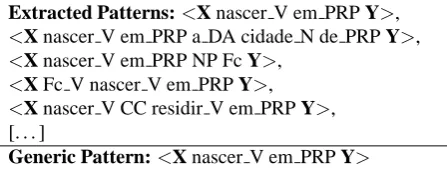
Finally, the two target entities are replaced by both X and Y, standing for the first and the second entities of the pair, respectively. Only the context between the two entities are considered. To rep-resent this context, we only take into account lem-mas of verbs, common nouns and prepositions. We have observed in preliminary experiments that the performance of the patterns decreased when either these types of lemmas were removed or all lem-mas including grammatical words (stop words), ad-jectives and proper names were retained. It fol-lows that verbs, common nouns and prepositions are critical pieces of information to define the lexico-syntactic contexts of the target terms. Figure 1 con-tains an example of a pattern associated to the rela-tionhasBirthplace(Table 1 also shows a set of extracted patterns in Portuguese).
All the process is performed without human revi-sion. Note that this method may lead us to annotate
false positives or false negatives. However, a manual
evaluation on 1000 patterns show that this method has a precision of about 80%.
5.2 Pattern Generalization
We use the following method for making generic patterns, then transformed into high-precision rules:
1. First, we take all the patterns of type “X[...]Y” and select the most precise ones according to their confidence value. This value is obtained as follows: we calculate the positive and neg-ative frequencies of each pattern; then we sub-tract the negative frequency from the positive, and sort the patterns by this value. Finally, the top n most confident patterns are selected
(where n = 20in our experiments). The same process is made for “Y[...]X” patterns.
2. Then, we apply a generalization algorithm for extracting the longest common string (lcs) from these patterns. In order to generalize two pat-terns, we check first if they are similar and then all those units that they do not share are removed. The similarity, noted Dice lcs, be-tween two patternsp1 and p2 is defined using the longest common string and Dice metric as follows:
Dice lcs(p1, p2) = 2∗lcs(p1, p2)
length(p1) +length(p2) (4)
wherelcs(p1, p2)is the size of the longest
com-mon string between patterns p1 and p2, and length(pi)represents the size of patternpi. It
means the similarity between two patterns is a function of their longest common string and their lengths.
After computing the similarity between two patterns p1 and p2, the lcs is extracted if and only ifp2 is the most similar pattern top1 and the similarity score is higher than a particular threshold (0.75 in our tests). The longest com-mon string of two patterns is considered as the generalized pattern out of them.
3. We filter out those generalized patterns that are not in the best initial 20 patterns, so we auto-matically obtain a few set of very confident pat-terns (see Table 1 for an example).
4. All these generic patterns are added as blocks of rules into a grammar, which already has a set of dependency rules for text compression. The new semantic rules take the first entity X as the Head, and the second one Y as the Dependent of the relation. This process is made manually.
5. Finally, the grammar is compiled into a parser, which is applied on a corpus to obtain triples “XrelationY”.
Extracted Patterns:<X nascer V em PRP Y>, <X nascer V em PRP a DA cidade N de PRP Y>, <X nascer V em PRP NP Fc Y>,
[image:6.595.74.298.71.157.2]<X Fc V nascer V em PRP Y>, <X nascer V CC residir V em PRP Y>, [. . . ]
Generic Pattern:<X nascer V em PRP Y>
Rule: N<tp:P>V<l:nascer>[P<l:em>] N<tp:L>
Table 1: Example of pattern generalization for the hasBirthplacerelation in Portuguese (nascer means “to be born”, cidade means “city” and residir, “to live”).
In sum, the application of the longest common string algorithm on the best extracted patterns al-lows us to obtain a small set of high-quality rules in a weakly-supervised way. These rules, added at the end of a partial dependency grammar, extract in-stances of pairs belonging to the initial relation.
6 Experiments
We carried out three major experiments in order to know the performance of our RE method. First, we compared the rule-based approach to two baselines in a manually revised corpus containing examples of the relation hasProfessionin Spanish. We also compared the performance of the system using a large amount of initial pairs (see Section 5.1) as well as with a small set of seed pairs.
Second, we applied a parser with the ob-tained extraction rules for the biographical relations hasProfessionand hasBirthplaceon the whole Spanish and Portuguese Wikipedias.
Finally, we applied the same Portuguese parser on a journalistic corpus, in order to know the perfor-mance on the system in different text genres.
6.1 Initial Data
We first obtained about 10,000 pairs for each rela-tion and language (Portuguese and Spanish) from the Wikipedia infoboxes. Then, we identified near
20,000 sentences containing a personal name and (i) an occupation noun (hasProfession) or (ii) a location (hasBirthplace), which were auto-matically classified as positive or negative using the distant-supervision strategy described in Sec-tion 5.1. Finally, we randomly selected two sets of 2,000 sentences for each relation and language
as well as a small set of 200 for the relation hasProfession. The latter set was selected for evaluating the use of a small input.
For testing, we randomly selected 1,000 sen-tences of hasProfession (different from the previous sets), which were manually revised.2
6.2 Results
Our first experiment evaluates the performance of the rule-based method compared to two baselines (in Spanish): Baseline 1 performs a pattern-matching approach applying on the test set the whole positive sentences (except for the proper nouns, replaced by a PoS-tag) from the initial2,000set. Baseline 2 uses the2,000initial sentences to train a Support Vector Machine classifier, representing each instance with thetoken TAGelements as features. For this pur-pose, we used the WEKA implementation of the SMO algorithm (Witten and Frank, 2005).
To evaluate the rule-based system, we performed two experiments: the first one extracted the rules from the initial 200 sentences (Rule 1, with only 2 extraction rules) while the second one used the
2,000 set of sentences (Rule 2, with 8 rules). The test only contains the15most frequent occupations found in the Wikipedia infoboxes, so the evalua-tion only takes into account the extracevalua-tion contain-ing these15nouns.
Table 2 shows the results of the four described methods over the test set. Precision is the number of correct positive decisions divided by the number of positive decisions (true and false positives). Recall is the number of correct positive decisions divided by the total of positive examples found in the test.
The pattern-matching baseline (Baseline 1) has a precision of 100%, but its f-score is merely 10% due to its low recall values. Baseline 2 performs better, but it produces many false positives, so its precision values do not achieve 45%.
Both rule-based methods perform clearly better than the proposed baselines. Rule 1, with only two generic rules, achieves over 55% recall, maintaining the same precision as the pattern-matching models. The use of more data allowed us to add a set of 8 generic rules, so the Rule 2 method increased its
re-2Both training and testing sets will be avaliable at
Model Precision Recall F-score
Baseline 1 100% 5.8% 10.1%
Baseline 2 44.51% 42.54% 43.5%
Rule 1 99.02% 55.8% 71.38%
[image:7.595.312.548.71.142.2]Rule 2 99.16% 65.2% 78.7%
Table 2: Precision, Recall and F-score of the Baselines and the two rule-based models for thehasProfession relation in Spanish. Test set of1,000sentences.
call in more than 10% without losing precision. Since the test sentences used in these experi-ments were filtered with a small list of frequent occupation nouns, we performed other extractions in order to know the performance of our system in real text conditions. So we used the Rule 2 method to parse the whole Spanish and Portuguese Wikipedias. For this purpose, we extracted seven hasProfessionrules for Portuguese. Moreover, we add the hasBirthplacerules for each lan-guage obtained from the initial 2,000 sets of this relation (four different rules were added for each language). Semantic information obtained from the NEC was used only in those hasBirthplace rules that did not have verb lemmas (such as
nacer/nascer, “to be born”).
Before evaluating the extraction in the whole corpora, we automatically remove some noise by eliminating tokens with less than 3 characters or with numbers. hasProfessionpairs were fil-tered with the occupation nouns obtained from the Spanish and Portuguese Wikipedia infoboxes (about 500 and 250, respectively). To evaluate the hasBirthplacerelation, the complete output of the extraction was used. We randomly selected and revised samples of50pairs from each rule, and cal-culate the weighted average of the extraction.
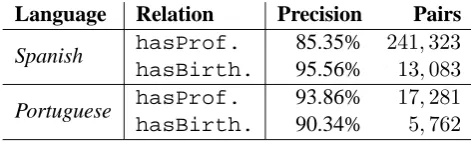
Table 3 shows the results of the two extractions over the Spanish and Portuguese Wikipedias. Only a single parsing was performed for each language (with both hasProfession and hasBirthplace extraction rules). Note that the corpora have about 3.2 and 1.8 gigabytes for Spanish and Portuguese, respectively.
In Spanish, almost 241,000 unique pairs of hasProfessionrelated entities were extracted, and more than 13,000 different instances of hasBirthplace. Precision values for the first
Language Relation Precision Pairs
Spanish hasProf. 85.35% 241,323
hasBirth. 95.56% 13,083
Portuguese hasProf. 93.86% 17,281
hasBirth. 90.34% 5,762
Table 3: Precision and unique extracted pairs for each relation in the whole Spanish and Portuguese Wikipedias.
relation were worse than those obtained in the previous experiment (85% vs 99%). However, a deep evaluation of the errors shows that many of them were produced in previous processing steps (namely the identification of proper nouns), so the precision of these rules is likely to be bet-ter. hasBirthplacehad better precision results (95%), but the amount of extracted pairs was notice-ably lower.
In Portuguese, the system extracted about
17,000 and 5,700 hasProfession and hasBirthplace unique pairs, respectively. The differences between the Portuguese and the Spanish extractions have probably several reasons: on the one hand, the size of the Spanish corpus is almost the double. On the other hand, the number of occupation nouns used as a filter was also half in the Portuguese experiments. However, the extractions in Portuguese maintain high-precision values (90-93%).
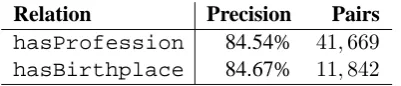
Note that both hasBirthplace and hasProfession relations extract biograph-ical data, so it is expected that encyclopedic resources such as Wikipedia contain many instances of these relations. Nevertheless, as we intend to perform extractions on texts of different genres, we applied the same Portuguese parser on a journalistic corpus from P ´ublico, a general-purpose Portuguese newspaper (with about 1.2 gigabytes).
[image:7.595.83.291.71.141.2]Relation Precision Pairs hasProfession 84.54% 41,669
[image:8.595.87.288.71.114.2]hasBirthplace 84.67% 11,842
Table 4: Precision and unique extracted pairs for each relation in the Portuguese newspaper P´ublico.
7 Conclusions
This paper presents a novel weakly-supervised ap-proach for semantic Relation Extraction in different languages. We apply a sort of text compression strat-egy by means of partial dependency parsing which simplifies the linguistic structures, thus allowing the extraction rules to increase their coverage.
In order to (semi)automatically obtain these rules, we first extract lexico-syntactic patterns using a distant-supervision strategy. These patterns are gen-eralized by a longest common string algorithm and finally transformed into semantic rules added at the end of a formal grammar.
Several experiments in different languages and corpora showed that this method maintains the high-precision values of pattern-matching techniques, while the recall is significantly improved.
In future work, we will carry out further experi-ments with other relations as well as in different cor-pora. Moreover, we will analyze the performance of the method with different Named Entity Classi-fiers, in order to avoid some noise during the extrac-tion. Finally, we intend to take advantage of some anaphora and coreference resolution methods that might allow us to extract a large number of instances and to make a fusion process easier.
Acknowledgments
This work has been supported by the MICINN, within the project with reference FFI2010-14986.
References
Aguado de Cea, G., G´omez P´erez, A., Montiel-Ponsoda, E. and Su´arez-Figueroa, M. C. 2009. Using Linguis-tic Patterns to Enhance Ontology Development. In: Proceedings of KEOD, 206–213.
Aussenac-Gilles, N. and Jacques, M.-P. 2006. Designing and Evaluating Patterns for Ontology Enrichment from Texts. In Proceedings of EKAW, 158–165.
Bollegala, D. T., Matsuo, Y. and Ishizuka, M. 2010. Re-lational duality: unsupervised extraction of semantic relations between entities on the web. In: Proceedings of IW3C2, 151–160.
Brin, S. 1998. Extracting patterns and relations from the world wide web. In: WebDB Workshop at EDBT, 172–183.
Chandrasekar, R., Doran, C. and Srinivas, B. 1996. Mo-tivations and methods for text simplification. In: Pro-ceedings of COLING, 2, 1041–1044.
Clarke, J. and Lapata, M. 2006. Models for Sentence Compression: A Comparison across Domains, Train-ing Requirements and Evaluation Measures. In: Pro-ceedings of COLING/ACL, 377–384.
Cohn, T. and Lapata, M. 2009. Sentence Compression as Tree Transduction. Journal of Artificial Intelligence Research, 34: 637–674.
Etzioni, O., Banko, M., Soderland, S. and Weld, D. S. 2008. Open Information Extraction from the Web. In: ACM 51, 12, 68–74.
Gamallo P. and Gonz´alez, I. 2011. A Grammatical For-malism Based on Patterns of Part-of-Speech Tags. In-ternational Journal of Corpus Linguistics, 16: 1, 45– 71.
Hearst, M. A. 1992. Automatic acquisition of hyponyms from large text corpora. In: Proceedings of COLING, 2, 539–545.
Hoffmann, R., Zhang, C. and Weld, D.S. 2010. Learning 5000 Relational Extractors In: Proceedigns of ACL, 286–295.
Mintz, M., Bills, S., Snow, R. and Jurafsky, D. 2009. Distant supervision for relation extraction without la-beled data. In: Proceedings of ACL/IJCNLP, 2. Molina, A., da Cunha, I., Torres-Moreno, J-M. and
Velazquez-Morales, P. 2010. La compresi´on de frases: un recurso para la optimizaci´on de resumen au-tom´atico de documentos. Linguam´atica, 2: 3, 13–27. Padr´o, Ll., Collado, M., Reese, S., Lloberes, M. and
Castell´on, I. 2010. FreeLing 2.1: Five Years of Open-Source Language Processing Tools. In: Proceedings of LREC.
Pantel, P. and Pennacchiotti, M. 2006. Espresso: Leveraging Generic Patterns for Automatically Har-vesting Semantic Relations. In: Proceedings of COL-ING/ACL, 113–120.
Ravichandran, D. and Hovy, E. 2002. Learning surface text patterns for a question answering system. In: Pro-ceedings of ACL, 41–47.
Witten, I. H. and Frank, E. 2005. Data mining: prac-tical machine learning tools and techniques with Java implementations. Elsevier Inc., San Francisco. Wu, F. and Weld, D. 2010. Open information extraction