Supervised and Semi-Supervised Sequence Learning for Recognition of
Requisite Part and Effectuation Part in Law Sentences
Le-Minh Nguyen and Ngo Xuan Bach and Akira Shimazu Japan Advanced Institute of Science and Technology (JAIST)
Asahidai 1-1, Nomi, Ishikawa, 923-1292 Japan {nguyenml,bachnx,shimazu}@jaist.ac.jp
Abstract
Analyzing the logical structure of a sentence is important for understanding natural language. In this paper, we present a task of Recogni-tion of Requisite Part and EffectuaRecogni-tion Part in Law Sentences, or RRE task for short, which is studied in research on Legal Engineering. The goal of this task is to recognize the struc-ture of a law sentence. We empirically inves-tigate how the RRE task is conducted with re-spect to various supervised machine learning models. We also compared the impact of un-labeled data to RRE tasks. Experimental re-sults for Japanese legal text domains showed that sequence learning models are suitable for RRE tasks and unlabled data also significantly contribute to the performance of RRE tasks.
1 Introduction
Legal Engineering (Katayama 07) is a new research field which aims to achieve a trustworthy electronic society. There are two important goals of Legal En-gineering. The first goal is to help experts make complete and consistent laws, and the other is to de-sign an information system which works based on laws. To achieve this we need to develop a system which can process legal texts automatically.
Legal texts have some specific characteristics that make them different from other daily-use docu-ments. Legal texts are usually long and complicated. They are composed by experts who spent a lot of time to write and check them carefully. One of the most important characteristics of legal texts is that law sentences have some specific structures. In most
cases, a law sentence can roughly be divided into two parts: arequisite part and aneffectuation part
(Nakamura et al., 07; Tanaka et al., 93). For ex-ample, the Hiroshima city provision 13-2When the mayor designates a district for promoting beautifi-cation, s/he must in advance listen to opinions from the organizations and the administrative agencies which are recognized to be concerned with the dis-trict, includes a requisite part (before the comma) and an effectuation part (after the comma) (Naka-mura et al., 07).
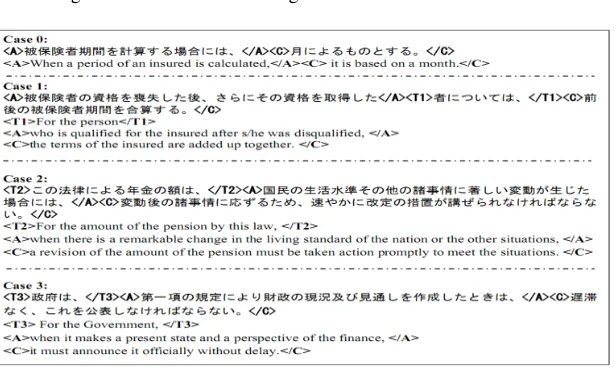
The requisite part and the effectuation part of a law sentence are composed from three parts: atopic part, an antecedent part, and a consequent part. There are four cases (illustrated in Figure 1) bas-ing on where the topic part depends on: case 0 (no topic part), case 1 (the topic part depends on the an-tecedent part), case 2 (the topic part depends on the consequent part), and case 3 (the topic part depends on both the antecedent part and the consequent part). In case 0, the requisite part is the antecedent part and the effectuation part is the consequent part. In case 1, the requisite part is composed from the topic part and the antecedent part, while the effectuation part is the consequent part. In case 2, the requisite part is the antecedent part, while the effectuation part is composed from the topic part and the consequent part. In case 3, the requisite part is composed from the topic part and the antecedent part, while the ef-fectuation part is composed from the topic part and the consequent part. Figure 2 gives examples of law sentences in four cases.
Analyzing the logical structure of law sentences is an important task in Legal Engineering. This task is
Figure 1: Four cases of the logical structure of a law sentence.
Figure 2: Examples of four cases of the logical structure of a law sentence. A means antecedent part, C means
consequent part, andT1,T2,T3meantopic partswhich correspond to case 1, case 2, and case 3 (the translations keep the ordinal sentence structures).
a preliminary step to support tasks in legal text pro-cessing, such as translating legal articles into log-ical and formal representations and verifying legal documents, legal article retrieval, legal text summa-rization, question answering in legal domains, etc (Katayama 07; Nakamura et al., 07). In a law sen-tence, the consequent part usually describes a law provision, and the antecedent part describes cases in which the law provision can be applied. The topic part describes the subjects which are related to the law provision. Hence, the outputs of the RRE task will be very helpful to not only lawyers but also peo-ple who want to understand the law sentence. They can easily understand 1) what does a law sentence
say? 2) what cases in which the law sentence can be applied? and 3) what subjects are related to the provision described in the law sentence?
[image:2.612.155.462.257.443.2]learn-ing models for RRE task. In addition, We depict a simple semi-supervised learning method for the RRE task using the Brown clustering algorithm. We also show experimental results on an annotated cor-pus of Japanese national pension law sentences. Our models achieved 88.58% (using supervised learn-ing) and 88.84% (using semi-supervised learnlearn-ing) in theFβ=1score.
The remainder of this paper is organized as fol-lows. First, Section 2 presents how to model the RRE task as a sequence labeling problem, and shows experimental results about the effect of features on the task. Next, we describe another setting for the task based on Bunsetsu (chunks in English) in Sec-tion 3. Then, SecSec-tion 5 describes a simple semi-supervised learning method for the task. Finally, some conclusions are given in Section 6.
2 RRE as a Sequence Learning Problem 2.1 Problem Setting
Let x be an input law sentence in a law sentence spaceX, thenxcan be represented by a sequence of words[w1, w2, . . . , wn]. Let P be the set of
prede-fined logical part categories. A logical part p(s, e) is the sequence of consecutive words spanning from wordwsto wordwewith categoryp∈P.
We define two kinds of relationships between two logical parts: overlappingandembedded. Let
p1(s1, e1) and p2(s2, e2) be two different logical
parts of one sentencex. We say thatp1(s1, e1) and p2(s2, e2)areoverlappingif and only ifs1 < s2 ≤ e1 < e2 or s2 < s1 ≤ e2 < e1. We denote the overlapping relationship by ∼. We also say that
p1(s1, e1) is embedded in p2(s2, e2) if and only if s2 ≤s1 ≤e1 ≤e2, and denote theembedded
rela-tionship by≺.
In the RRE task, we try to split a source sentence into somenon-overlappingandnon-embedded log-ical parts. Let S be the set of all possible logical parts, S = {p(s, e)|1 ≤ s ≤ e ≤ n, p ∈ P}. A
solutionof the RRE task is a subset y ⊆ S which does not violate theoverlappingrelationship and the
embeddedrelationship. Formally, thesolution space
can be described as follows: Y = {y ⊆S|∀u, v ∈
y, uv, u⊀v}. The learning problem in the RRE task is to learn a functionR:X→ Y from a set of
mtraining samples{(xi, yi)|xi ∈ X, yi ∈ Y,∀i=
1,2, . . . , m}.
One important characteristic of our task is that the input sentences are usually very long and compli-cated, so the logical parts are also long.
We model the RRE task as a sequence labeling problem, in which each sentence is a sequence of words. Figure 3 illustrates an example in IOB no-tation. In this notation, the first word of a part is tagged byB, the other words of the part are tagged byI, and a word not included in any part is tagged by O. This law sentence consists of an antecedent part (tagA) and a consequent part (tagC) (we will use this example for all the sections of this paper).
In the RRE task, we consider two types of law sentences: implication type1 and equivalence type.
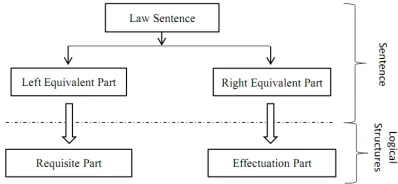
[image:3.612.326.525.362.454.2]Figure 4 shows the logical structure of a law sen-tence in the equivalence type. In this type, a sensen-tence consists of aleft equivalent part and aright equiv-alent part. The requisite part is the left equivalent part, and the effectuation part is the right equivalent part. In all, we have 7 kinds of parts, as follows:
Figure 4: The logical structure of a law sentence in the equivalence type.
1. Implication sentences:
• Antecedent part (A)
• Consequent part (C)
• Three kinds of topic partsT1,T2,T3
(cor-respond to case 1, case 2, and case 3)
2. Equivalence sentences:
• The left equivalent part (EL)
• The right equivalent part (ER)
1The logical structure of a law sentence in this type is shown
Figure 3: A law sentence in the IOB notation.
In the IOB notation, we will have 15 kinds of tags: B-A, I-A, B-C, I-C, B-T1, I-T1, B-T2, I-T2, B-T3, I-T3, B-EL, I-EL, B-ER, I-ER, and O2. For example,
an element with tag B-A begins an antecedent part, while an element with tag B-C begins a consequent part.
2.2 Discriminative Sequence Learning Models In this section, we briefly introduce three discrimi-native sequence learning models for RRE problems. 2.2.1 Conditional Random Fields
Conditional Random Fields (CRFs) (Lafferty et al., 01) are undirected graphical models used to cal-culate the conditional probability of values on des-ignated output nodes, given values assigned to other designated input nodes for data sequences. CRFs make a first-order Markov independence assumption among output nodes, and thus correspond to finite state machine (FSMs).
Leto = (o1, o2, . . . , oT) be some observed input
data sequence, such as a sequence of words in a text (values on T input nodes of the graphical model). LetS be a finite set of FSM states, each is associ-ated with a label l such as a clause start position. Lets=(s1, s2, . . . , sT)be some sequences of states
(values on T output nodes). CRFs define the condi-tional probability of a state sequence given an input sequence to be
PΛ(s|o) =Z1
oexp T
X
t=1
F(s, o, t)
!
(1)
where Zo = PsexpPTt=1F(s, o, t)
is a nor-malization factor over all state sequences. We de-noteδ to be the Kronecker-δ. LetF(s, o, t)be the sum of CRFs features at time positiont:
X
i
λifi(st−1, st, t) +
X
j
λjgj(o, st, t) (2)
2Tag O is used for an element not included in any part.
wherefi(st−1, st, t) = δ(st−1, l0)δ(st, l)is a tran-sition feature function which represents sequential dependencies by combining the labell0 of the previ-ous statest−1 and the labellof the current statest,
such as the previous label l0 =B −A and the cur-rent labell=I−A.gj(o, st, t) =δ(st, l)xk(o, t)is
aper-statefeature function which combines the la-bellof current statestand a context predicate, i.e.,
the binary functionxk(o, t)that captures a particular
property of the observation sequence o at time posi-tiont. For instance, the current label isB−Aand the current word is“conditional“.
Training CRFs is commonly performed by max-imizing the likelihood function with respect to the training data using advanced convex optimization techniques like L-BFGS. Recently, several works apply Stochastic Gradient Descent (SGD) for train-ing CRFs models. SGD has been historically associ-ated with back-propagation algorithms in multilayer neural networks.
Inference in CRFs, i.e., searching the most likely output label sequence of an input observation se-quence, can be done using the Viterbi algorithm. 2.2.2 Online Passive-Aggressive Learning
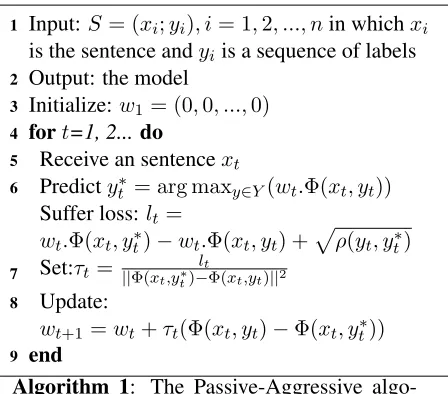
Online Passive-Aggressive Learning (PA) was proposed by Crammer (Crammer et al, 2006) as an alternative learning algorithm to the maximize mar-gin algorithm. The PA algorithm has been shown to be successful for many sequence classification tasks. The details of the PA algorithm for RRE task are pre-sented as follows.
Assume that we are given a set of sentences
xi and their labels yi where i = 1, ..., n.
Let the feature mapping between a sentence x
and a sequence of labels y be: Φ(x, y) = Φ1(x, y),Φ2(x, y), ...,Φd(x, y) where each feature
mappingΦj maps(x, y)to a real value. We assume
Figure 5: New setting for RRE task.
hinge-loss function and the margin of learning data.
Input:S= (xi;yi), i= 1,2, ..., nin whichxi
1
is the sentence andyiis a sequence of labels
Output: the model 2
Initialize:w1 = (0,0, ...,0)
3
fort=1, 2...do 4
Receive an sentencext
5
Predicty∗
t = arg maxy∈Y(wt.Φ(xt, yt))
6
Suffer loss:lt=
wt.Φ(xt, yt∗)−wt.Φ(xt, yt) +pρ(yt, y∗t)
Set:τt= ||Φ(xt,y∗ lt
t)−Φ(xt,yt)||2
7
Update: 8
wt+1 =wt+τt(Φ(xt, yt)−Φ(xt, y∗t)) end
9
Algorithm 1: The Passive-Aggressive algo-rithm for RRE task.
Algorithm 1 shows briefly the Online Learning for sequence learning problem. The detail about this algorithm can be referred to the work of (Crammer et al, 2006). In Line 7, the argmax value is com-puted by using the Viterbi algorithm. Algorithm 1 is terminated afterT rounds3
2.2.3 Feature Set
In the previous setting (Ngo et al., 10), we model the RRE task as a sequence labeling problem in which elements of sequences are words. Because a sentence may contain many words, the length of a sequence becomes large. Our idea is that, instead of considering words as elements, we consider each Bunsetsu as an element. This can be done because no Bunsetsu can belong to two different parts in this task. By doing this, we can reduce the length of se-quences significantly. The process of obtaining a new setting from the previous one is illustrated in Figure 5.
3T is set to 10 in our experiments.
In this example, the length of the sequence is re-duced from 17 to 6. On average, in the Japanese Na-tional Pension Law corpus, the length of a sequence with the old setting (words) is47.3, while only17.6 with the new setting (Bunsetsus).
We use features including head words, functional words, punctuations, and the co-occurrence of head words and functional words in a window size 1. A window size 1 in this model will cover three Bun-setsu. So, it is much longer than a window size 2 (which covers five words) in a model based on words. This is the reason why a window size 1 is suf-ficient in this model. The results show that model-ing based on Bunsetsu, an important unit in Japanese sentences, is suitable for the RRE task.
There are two reasons that may explain why the Bunsetsu-based model is better than the word-based model. The first reason is that Bunsetsus are ba-sic units in analyzing Japanese (in fact, dependency parsing of Japanese based on Bunsetsus, not words). Bunsetsus convey the meaning of a sentence bet-ter than words. In the Bunsetsu-based model, we only use head words and functional words to repre-sent a Bunsetsu. Hence, the Bunsetsu-based model also take advantages of the model using head words and functional words. The second reason is that the Bunsetsu-based model reduces the length of se-quences significantly compared with the word-based models. It helps the Bunsetsu-based model so much in the learning process. We choose the IOE stregy for our RRE task because this representation at-tained highest results on our development set (Ngo et al., 10).
3 A Simple Semi-Supervised Learning Method for RRE
This section describes a brief survey of supervised learning, and presents a simple semi-supervised method for the RRE task using Brown word clusters (Brown et al., 92).
3.1 Brown Clustering
clus-ter. The algorithm then gradually groups clusters to build a hierarchical clustering of words.
[image:6.612.104.270.260.343.2]Figure 6 shows an example of Brown word-cluster hierarchy in a binary tree style. In this tree, each leaf node corresponds to a word, which is uniquely identified by the path from the root node to it. This path can be represented by a bit string, as shown in Figure 6. From the root node, we add bit0to the left branch and bit1to the right branch. A word-cluster hierarchy is reduced to depthnif all words with the samen-bit prefix are grouped in one cluster. For example, if the word-cluster hierarchy in Figure 6 is reduced to depth2, we will obtain a new hierarchy in Figure 7.
[image:6.612.101.273.397.471.2]Figure 6: An example of Brown word-cluster hierarchy.
Figure 7: A Brown word-cluster hierarchy after reduction to depth 2.
Features extracted atn-bit depth are binary strings with lengthn. By reducing the word-cluster tree to different values of depthn, we can group words at various levels, from coarse clusters (small value of
n) to fine clusters (large value ofn). 3.2 RRE with Extra Word Features
The main idea of our semi-supervised learning method is to useunsupervisedword representations as extra word features of a supervised model. We use Brown word clusters as the word representa-tion method. In this framework,unlabeled dataare used to produce word clusters. From these word clusters, we extract extra word features, and add
these features to asupervised model (labeled data
are used to train this model). Figure 8 shows our semi-supervised learning framework. This frame-work consists of two phase: unsupervised phase with the Brown clustering algorithm, andsupervised
phase with CRFs.
Figure 8: Semi-supervised learning framework.
To produce word representations, we first collected plain text from the address http://www.japaneselawtranslation.go.jp4. Our
plain text corpus includes more than 13 thousand sentences about Japanese laws. After word seg-menting (using Cabocha tool 5), we conducted the
Brown clustering algorithm to cluster words. In our work, we used the implementation of Percy Liang (Liang 05), and the number of clusters was set to 200. Experimental results showed that CRFs-LBFG obtained highest result in both supervised and semi-supervised experiments. In order to consider the impact of learning size to RRE tasks, we do an experiment with various size of training data.
Figure 9: Comparison between the supervised method and the semi-supervised method with respect to the train-ing sizes and F-measure scores.
The result in Fig 9 clearly showed that semi-supervised models are useful for RRE tasks with re-spect to various size of training data.
4This website provides many Japanese law articles in both
Japanese and English.
[image:6.612.325.527.471.558.2]4 Experimental Results
We test our system on the corpus of Japanese Na-tional Pension Law, using F-measure for evaluation.
4.1 Corpus and Evaluation Method
This sub-section presents our corpus for the RRE task and evaluation method.The Japanese National Pension Law corpus includes 764 an-notated Japanese law sentences6. Some statistics
on this corpus are shown in Table 1. We have some remarks to make here. First, about 98.5% of sentences belong to the implication type, and only 1.5% of sentences belong to the equivalence type. Second, about 83.5% of topic parts are T2,
15.2% of topic parts areT3, and only 1.3% of topic
parts areT1. Finally, four main types of parts, C, A,T2, andT3make up more than 98.3% of all types.
4.2 Evaluation Method
We divided the corpus into 10 sets and performed 10-fold cross-validation tests. The results were eval-uated using precision, recall, andFβ=1scores as
fol-lows:
precision= ##predicted partscorrect parts , recall= ##actual partscorrect parts (3)
Fβ=1= 2precision∗precision+∗recallrecall (4)
A logical part is recognized correctly if and only if it has correct start word, correct end word, and correct part category (kind of logical part).
4.3 Experimental Results
Table 1 shows the comparison of three discrim-inative learning methods for RRE tasks. Three sequence learning methods include: CRFs using the LBFGS method, CRFs with SGD, and Online Learning. Experiment results show that the CRFs-LBFGS is the best in comparison with others. How-ever, the computational times for training is slower than either SGD or Online Learning. The SGD is faster than CRF-LBFS approximately 6 times.
6The corpus consists of only the first sentence of each
arti-cle.
Note that we used CRF++7for Conditional
[image:7.612.323.529.122.208.2]Ran-dom Fields using LBFGS, and for Stochastic Gradi-ent DescGradi-ent (SGD) we used SGD1.3 which is devel-oped by Leon Bottou8.
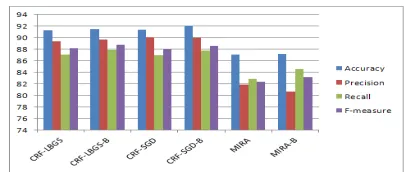
Figure 10: Comparison between the supervised method and the semi-supervised method.
For the RRE task, we extracted features at 4-bit depth and 6-bit depth. We integrated these fea-tures into three sequence learning models: CRFs-LBFG, CRF-SGD, and online learning (MIRA). The experimental results of the semi-supervised method with extra word features are shown in Figure 10. In three models, the semi-supervised method out-performs the supervised method. For CRF-LBFG model, theFβ=1 score was 88.80%, compared with
88.18% for the supervised method. The CRF-sgd model got 88.58% in the Fβ=1 score, compared
with 88.03% for the supervised method. MIRA method got 82.3% and 83.21% for supervised and semi-supervised models. In conclusion, word clus-ter models significantly improve the performance of sequence learning models for RRE tasks. We be-lieve that word cluster models are also suitable for other sequence learning models.
5 Conclusions
In this paper, we report an investigation of develop-ing a RRE task usdevelop-ing discriminative learndevelop-ing models and semi-supervised models. Experimental results using 10 Folds cross-validation test have showed that the discriminative models are well suitable for RRE task. Conditional random fields show a bet-ter performance in comparison with other methods. In addition, word cluster models are suitable for im-proving the performance of sequence learning mod-els for RRE tasks.
Table 1: Statistics on the Japanese National Pension Law corpus.
Sentence Type Number Part Type Number Equivalence 11 EREL 1111
Implication 753
C 745
A 429
T1 9
T2 562
T3 102
Table 2: Experimental results with sequence learning models for RRE task. Methods Accuracy Precision Recall F-measure CRF-LBFG 91.27 89.328% 87.039% 88.158
CRF-LBFG-B 91.45 89.708% 87.866% 88.807 CRF-SGD 91.39 90.046% 86.953% 88.023
CRF-SGD-B 92.041 90.011% 87.787% 88.584 MIRA 87.081 81.881% 82.909% 82.339
MIRA-B 87.139 80.679% 84.59% 83.213
There are still room for improving the perfor-mance of RRE tasks. For example, more attention on features selection is necessary. We would like to solve this in future work.
Acknowledgments
The work on this paper was partly supported by the grants for Grants-in-Aid for Young Scientific Re-search 22700139.
References
K. Crammer et al. 2006. Online Passive-Aggressive Algorithm. Journal of Machine Learning Re-search, 2006
P.F. Brown, P.V. deSouza, R.L. Mercer, V.J.D. Pietra, J.C. Lai. Class-Based n-gram Models of Natural Language.Computational Linguistics, Volume 18, Issue 4, pp.467-479, 1992.
X. Carreras, L. M`arquez, J. Castro. Filtering-Ranking Perceptron Learning for Partial Parsing.
Machine Learning, Volume 60, pp.41-71, 2005. M. Collins. Discriminative Training Methods for
Hidden Markov Models: Theory and Experiments with Perceptron Algorithms. In Proceedings of EMNLP, pp.1-8, 2002.
T. Katayama. Legal engineering - an engineering ap-proach to laws in e-society age. In Proceedings of the 1st International Workshop on JURISIN, 2007.
T. Kudo, K. Yamamoto, Y. Matsumoto. Applying conditional random fields to Japanese morpholog-ical analysis. InProceedings of EMNLP, pp.230-237, 2004.
J. Lafferty, A. McCallum, F. Pereira. Conditional Random Fields: Probabilistic Models for Seg-menting and Labeling Sequence Data. In Proceed-ings of ICML, pp.282-289, 2001.
P. Liang. Semi-Supervised Learning for Natural Language. Master’s thesis, Massachusetts Insti-tute of Technology, 2005.
M. Murata, K. Uchimoto, Q. Ma, H. Isahara. Bunsetsu identification using category-exclusive rules. In Proceedings of COLING, pp.565-571, 2000.
[image:8.612.162.448.217.309.2]M. Nakamura, S. Nobuoka, A. Shimazu. To-wards Translation of Legal Sentences into Logi-cal Forms. InProceedings of the 1st International Workshop on JURISIN, 2007.
E.T.K. Sang, S. Buchholz. Introduction to the CoNLL-2000 Shared Task: Chunking. In Pro-ceedings of CoNLL, pp.127-132, 2000.
K. Tanaka, I. Kawazoe, H. Narita. Standard struc-ture of legal provisions - for the legal knowledge processing by natural language. InIPSJ Research Report on Natural Language Processing, pp.79-86, 1993.