Unsupervised Name Ambiguity Resolution Using A Generative Model
Zornitsa Kozareva and Sujith Ravi USC Information Sciences Institute
4676 Admiralty Way Marina del Rey, CA 90292-6695
{kozareva,sravi}@isi.edu
Abstract
Resolving ambiguity associated with names found on the Web, Wikipedia or medical texts is a very challenging task, which has been of great interest to the research community. We propose a novel approach to disambiguat-ing names usdisambiguat-ing Latent Dirichlet Allocation, where the learned topics represent the under-lying senses of the ambiguous name. We con-duct a detailed evaluation on multiple data sets containing ambiguous person, location and or-ganization names and for multiple languages such as English, Spanish, Romanian and Bul-garian. We conduct comparative studies with existing approaches and show a substantial improvement of 15 to 35% in task accuracy.
1 Introduction
Recently, ambiguity resolution for names found on the Web (Artiles et al., 2007), Wikipedia articles (Bunescu and Pasca, 2006), news texts (Pedersen et al., 2005) and medical literature (Ginter et al., 2004) has become an active area of research. Like words, names are ambiguous and can refer to multiple enti-ties. For example, a Web search forJerry Hobbson Google returns a mixture of documents associated with two different entities in the top 10 search re-sults. One refers to a computational linguist at Uni-versity of Southern California and the other refers to a fugitive and murderer. Disambiguating the names and identifying the correct entity is very important especially for Web search applications since 11-17% of the Web search queries are composed of person name and a term (Artiles et al., 2009a).
In the past, there has been a substantial body of work in the area of name disambiguation under a va-riety of different names and using diverse set of ap-proaches. Some refer to the task ascross-document coreference resolution(Bagga and Baldwin, 1998), name discrimination(Pedersen et al., 2005) orWeb People Search (WebPS) (Artiles et al., 2007). The majority of the approaches focus on person name ambiguity (Chen and Martin, 2007; Artiles et al., 2010), some have also explored organization and lo-cation name disambiguation (Pedersen et al., 2006). The intuition behind most approaches follows the distributional hypothesis (Harris, 1954) according to which ambiguous names sharing the same con-texts tend to refer to the same individual. To model these characteristics, Bunescu and Pasca (2006) and Cucerzan (2007) incorporate information from Wikipedia articles, Artiles et al. (2007) use Web page content, Mann and Yarowsky (2003) extract bi-ographic facts. The approaches used in the WebPS tasks mainly rely on bag-of-words representations (Artiles et al., 2007; Chen and Martin, 2007; Artiles et al., 2009b). Most methods suffer from a com-mon drawback—they rely on surface features such as word co-occurrences, which are insufficient to capture hidden information pertaining to the entities (senses) associated with the documents.
We take a novel approach for tackling the prob-lem of name ambiguity using an unsupervised topic modeling framework. To our knowledge, no one has yet explored the disambiguation of names using Latent Dirichlet Allocation (LDA) nor has shown LDA’s behavior on multiple data sources and set-tings. Our motivation for using an unsupervised
topic modeling framework for name disambiguation is based on the advantages generative models offer in contrast to the existing ones. For instance, topic models such as Latent Dirichlet allocation (LDA) method (Blei et al., 2003) have been widely used in the literature for other applications to uncover hid-den (or latent) groupings underlying a set of obser-vations. Topic models are capable of handling ambi-guity and distinguishing between uses of words with multiple meanings depending on context. Thereby, they provide a natural fit for our name disambigua-tion task, where latent topics correspond to the en-tities (name senses) representing the documents for an ambiguous name. Identifying these latent topics helps us identify the particular sense of a given am-biguous name that is used in the context of a particu-lar document and hence resolve name ambiguity. In addition, this approach offers several advantages— (1) entities (senses) can be learnt automatically from a collection of documents in an unsupervised man-ner, (2) efficient methods already exist for perform-ing inference in this model so we can easily scale to Web data, and (3) unlike typical approaches, we can easily apply our learnt model to resolve name ambiguity for unseen documents.
The main contributions of this paper are:
• We propose a novel model for name disam-biguation using Latent Dirichlet Allocation.
• Unlike previous approaches, which are de-signed for specific tasks, corpora and lan-guages, we conduct a detailed evaluation taking into consideration the multiple properties of the data and names.
• Our experimental study shows that LDA can be used as a general name disambiguation frame-work, which can be successfully applied on anycorpora(i.e. Web, news, Wikipedia), lan-guages (i.e. English, Spanish, Romanian and Bulgarian) andtypes of ambiguous names(i.e. people, organizations, locations).
• We conduct a comparative study with existing state-of-the-art clustering approaches and show substantial improvements of 15 to 35% in task accuracy.
The rest of the paper is organized as follows. In Sec-tion 2 we describe related work. SecSec-tion 3 describes
the Latent Dirichlet Allocation model used to dis-ambiguate the names. Section 4 describes the exper-iments we have conducted on multiple data sets and languages. Finally, we conclude in Section 5.
2 Related Work
Ambiguous names have been disambiguated with varying success from structured texts (Pedersen et al., 2006), semi-structured texts such as Wikipedia articles (Bunescu and Pasca, 2006; Cucerzan, 2007) or unstructured texts such as those found on the Web (Pedersen and Kulkarni, 2007; Artiles et al., 2009b). Most approaches (Artiles et al., 2009b; Chen et al., 2009; Lan et al., 2009) focus on person name dis-ambiguation, while others (Pedersen et al., 2006) also explore ambiguity in organization and location names. In the medical domain, Hatzivassiloglou et al. (2001) and Ginter et al. (2004) tackle the problem of gene and protein name disambiguation.
Due to the high interest in this task, researchers have explored a wide range of approaches and fea-tures. Among the most common and efficient ones are those based on clustering and bag-of-words rep-resentation (Pedersen et al., 2005; Artiles et al., 2009b). Mann and Yarowsky (2003) extract bio-graphic facts such as date or place of birth, occu-pation, relatives among others to help resolve am-biguous names of people. Others (Bunescu and Pasca, 2006; Cucerzan, 2007; Nguyen and Cao, 2008) work on Wikipedia articles, using infobox and link information. Pedersen et al. (2006) rely on second order co-occurrence vectors. A few oth-ers (Matthias, 2005; Wan et al., 2005; Popescu and Magnini, 2007) identify names of people, locations and organizations and use them as a source of evi-dence to measure the similarity between documents containing the ambiguous names. The most simi-lar work to ours is that of Song et al. (2007) who use a topic-based modeling approach for name dis-ambiguation. However, their method explicitly tries to model the distribution of latent topics with regard to person names and words appearing within docu-ments whereas in our method, the latent topics rep-resent the underlying entities (name senses) for an ambiguous name.
task or a corpus such as Wikipedia or the Web, in this paper we show a novel unsupervised topic mod-eling approach for name disambiguation for any cor-pora (i.e. Web, news, Wikipedia), languages (i.e. English, Spanish, Romanian and Bulgarian) and se-mantic categories (i.e. people, location and organi-zation). The obtained results show substantial im-provements over the existing approaches.
3 Name Disambiguation with LDA
Recently, topic modeling methods have found widespread applications in NLP for various tasks such as summarization (Daum´e III and Marcu, 2006), inferring concept-attribute attach-ments (Reisinger and Pasca, 2009), selectional preferences (Ritter et al., 2010) and cross-document co-reference resolution (Haghighi and Klein, 2010). Topic models such as LDA are generative models for documents and represent hidden or latent top-ics (where a topic is a probability distribution over words) underlying the semantic structure of docu-ments. An important use for methods such as LDA is to infer the set of topics associated with a given document (or a collection of documents). Next, we present a novel approach for the task of name dis-ambiguation using unsupervised topic models.
3.1 Method Description
Given a document corpusDassociated with a cer-tain ambiguous name, our task is to group the docu-ments intoK sets such that each document set cor-responds to one particular entity (sense) for the am-biguous name. We first formulate the name disam-biguation problem as a topic modeling task and then apply the standard LDA method to infer hidden top-ics (senses). Our generative story is as follows:
foreach name senseskwherek∈ {1, ..., K}do Generateβsk according toDir(η)
end for
foreach documentiin the corpusDdo
Chooseθi∼Dir(α)
foreach wordwi,jwherej∈ {1, ..., Ni}do Choose a sensezi,j ∼M ultinomial(θi) Choose a wordwi,j ∼M ultinomial(βzi,j)
end for end for
3.2 Inference
We perform inference on this model using collapsed Gibbs sampling, where each of the hidden sense variables zi,j are sampled conditioned on an as-signment for all other variables, while integrating over all possible parameter settings (Griffiths and Steyvers, 2002). We use the MALLET (McCallum, 2002) implementation of LDA for our experiments. We ran LDA with different parameter settings on a held out data set and found that the following con-figuration resulted in the best performance. We set the hyperparameter η to the default value of 0.01. For the name discrimination task, we have to choose from a smaller set of name senses and each docu-ment is representative of a single sense, so we use a sparse prior (α=0.1). On the other hand, the Web People Search data is more noisy and also involves a large number of senses, so we use a higher prior (α=50).
For the name discrimination task (Section 4.1), we are given a set of senses to choose from and hence we can use this value to fix the number of top-ics (senses)K in LDA. However, it is possible that the number of senses may be unknown to us apriori. For example, it is difficult to identify all the senses associated with names of people on the Web. In such scenarios, we set the value ofKto a fixed value. For experiments on Web People Search, we setK= 40, which is roughly the average number of senses as-sociated with people names on the Web. An alter-native strategy is to automatically choose the num-ber of senses based on the model that leads to the highest posterior probability (Griffiths and Steyvers, 2004). It is easy to incorporate this technique into our model, but we leave this for future work.
3.3 Interpreting Name Senses From Topics
As a result of training, our model outputs the topic (sense) distributions for each document in the cor-pus. Although the LDA model can assign multi-ple senses to a document, the name disambiguation task specifies that each document should be assigned only to a single name sense. Hence, for each docu-mentiwe assign it the most probable sense from its sense distribution. This allows us to cluster all the documents inDintoKsets.
data, we further need to find a mapping between our document clusters and the true name sense labels. For each clusterk, we identify the true sense labels (using the gold data) for every document which was assigned to sensekin our output, and pick the ma-jority sense labellabelkmaj. as being representative
of the entire cluster (i.e., all documents in clusterk will be labeled as belonging to senselabelkmaj.).
Fi-nally, we evaluate our labeling against the gold data.
4 Experimental Evaluation
Our objective is to study LDA’s performance on multiple datasets, name categories and languages. For this purpose, we evaluate our approach on two tasks: name discriminationandWeb People Search, which are described in the next subsections. We use freely available data from (Pedersen et al., 2006) and (Artiles et al., 2009b), which enable us to compare performance against existing methods.
4.1 Name Discrimination
Pedersen et al. (2006) create ambiguous data by conflating together tuples of non-ambiguous well known names. The goal is to cluster the contexts containing the conflated names such that the origi-nal and correct names are re-discovered. This task is known asname discrimination.
An advantage of the name conflation process is that data can be easily created for any type of names and languages. In our study, we use the whole data set developed by Pedersen et al. (2006) for the En-glish, Spanish, Romanian and Bulgarian languages.
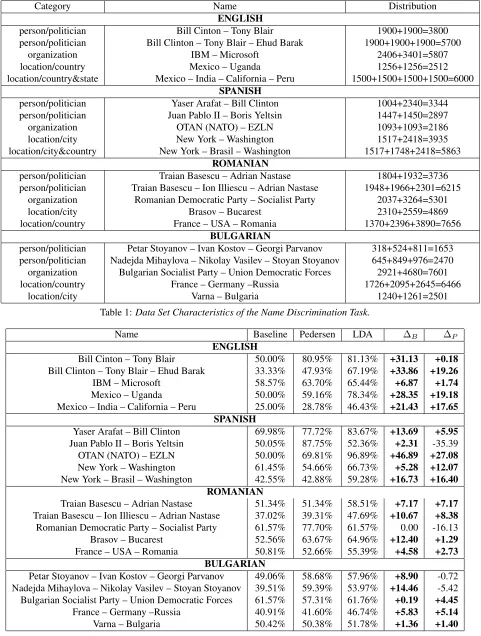
Table 1 shows the conflated names and the seman-tic category they belong to (i.e. person, organization or location) together with the distribution of the in-stances for each underlying entity in the name. In total there are eight person, eight location and three organization conflated name pairs which represent a diverse set of names of politicians, countries, cities, political parties and software companies. For four conflated name pairs the data is balanced. For ex-ample, there are 3800 examples in total for the con-flated nameBill Clinton – Tony Blairof which 1900 are for the underlying entity Bill Clintonand 1900 forTony Blair. For the rest of the cases the data is imbalanced. For example, there are 3344 examples for the conflated nameYaser Arafat – Bill Clintonof
which 1004 belong toYaser Arafatand 2340 toBill Clinton. The balanced and imbalanced data also lets us study whether LDA’s performance if affected by the different sense distributions.
Next, we show in Table 2 the overall results from the disambiguation process. For each name, we first show the baseline score which is calculated as the percentage of instances belonging to the most fre-quent underlying entity over all instances of that conflated name pair. For example, for theBill Clin-ton – Tony Blair conflated name pair, the baseline is 50% since both underlying entities have the same number of examples. This baseline is equivalent to a clustering method that would assign all of the con-texts to exactly one cluster.
The second column corresponds to the results achieved by the second order co-occurrence cluster-ing approach of (Pedersen et al., 2006). This ap-proach is considered as state-of-the-art in name dis-crimination after numerous features like unigram, bigram, co-occurrence and multiple clustering algo-rithms were tested. We denote this approach in Table 2 asPedersenand use it as a comparison. Note that in this experiment (Pedersen et al., 2006) predefine the exact number of clusters, therefore we also use the exact number of senses for the LDA topics. The third column shows the results obtained by our LDA approach. The final two columns represent the dif-ference between our LDA approach and the baseline denoted as ∆B, as well as the difference between our LDA approach and those ofPedersendenoted as ∆P. We have highlighted in bold the improvements of LDA over these methods.
The obtained results show that for all experiments independent of whether the name sense data was bal-anced or imbalbal-anced, LDA has a positive increase over the baseline. For some conflated tuples like the Spanish NATO–ETZIN, the improvement over the baseline is 47%. For seventeen out of the twenty name conflated pairs LDA has also improved upon Pedersen. The improvements range from +1.29 to +19.18.
Category Name Distribution ENGLISH
person/politician Bill Cinton – Tony Blair 1900+1900=3800
person/politician Bill Clinton – Tony Blair – Ehud Barak 1900+1900+1900=5700
organization IBM – Microsoft 2406+3401=5807
location/country Mexico – Uganda 1256+1256=2512
location/country&state Mexico – India – California – Peru 1500+1500+1500+1500=6000 SPANISH
person/politician Yaser Arafat – Bill Clinton 1004+2340=3344
person/politician Juan Pablo II – Boris Yeltsin 1447+1450=2897
organization OTAN (NATO) – EZLN 1093+1093=2186
location/city New York – Washington 1517+2418=3935
location/city&country New York – Brasil – Washington 1517+1748+2418=5863 ROMANIAN
person/politician Traian Basescu – Adrian Nastase 1804+1932=3736
person/politician Traian Basescu – Ion Illiescu – Adrian Nastase 1948+1966+2301=6215 organization Romanian Democratic Party – Socialist Party 2037+3264=5301
location/city Brasov – Bucarest 2310+2559=4869
location/country France – USA – Romania 1370+2396+3890=7656
BULGARIAN
person/politician Petar Stoyanov – Ivan Kostov – Georgi Parvanov 318+524+811=1653 person/politician Nadejda Mihaylova – Nikolay Vasilev – Stoyan Stoyanov 645+849+976=2470 organization Bulgarian Socialist Party – Union Democratic Forces 2921+4680=7601
location/country France – Germany –Russia 1726+2095+2645=6466
location/city Varna – Bulgaria 1240+1261=2501
Table 1:Data Set Characteristics of the Name Discrimination Task.
Name Baseline Pedersen LDA ∆B ∆P
ENGLISH
Bill Cinton – Tony Blair 50.00% 80.95% 81.13% +31.13 +0.18
Bill Clinton – Tony Blair – Ehud Barak 33.33% 47.93% 67.19% +33.86 +19.26
IBM – Microsoft 58.57% 63.70% 65.44% +6.87 +1.74
Mexico – Uganda 50.00% 59.16% 78.34% +28.35 +19.18
Mexico – India – California – Peru 25.00% 28.78% 46.43% +21.43 +17.65 SPANISH
Yaser Arafat – Bill Clinton 69.98% 77.72% 83.67% +13.69 +5.95
Juan Pablo II – Boris Yeltsin 50.05% 87.75% 52.36% +2.31 -35.39
OTAN (NATO) – EZLN 50.00% 69.81% 96.89% +46.89 +27.08
New York – Washington 61.45% 54.66% 66.73% +5.28 +12.07
New York – Brasil – Washington 42.55% 42.88% 59.28% +16.73 +16.40 ROMANIAN
Traian Basescu – Adrian Nastase 51.34% 51.34% 58.51% +7.17 +7.17
Traian Basescu – Ion Illiescu – Adrian Nastase 37.02% 39.31% 47.69% +10.67 +8.38 Romanian Democratic Party – Socialist Party 61.57% 77.70% 61.57% 0.00 -16.13
Brasov – Bucarest 52.56% 63.67% 64.96% +12.40 +1.29
France – USA – Romania 50.81% 52.66% 55.39% +4.58 +2.73
BULGARIAN
Petar Stoyanov – Ivan Kostov – Georgi Parvanov 49.06% 58.68% 57.96% +8.90 -0.72 Nadejda Mihaylova – Nikolay Vasilev – Stoyan Stoyanov 39.51% 59.39% 53.97% +14.46 -5.42 Bulgarian Socialist Party – Union Democratic Forces 61.57% 57.31% 61.76% +0.19 +4.45
France – Germany –Russia 40.91% 41.60% 46.74% +5.83 +5.14
[image:5.612.71.552.59.695.2]Varna – Bulgaria 50.42% 50.38% 51.78% +1.36 +1.40
there is a single context in which both names Nade-jda MihaylovaandStoyan Stoyanovare mentioned. This context is used to create two name conflated examples. In the first case only the name Nadejda Mihaylovawas hidden with theNadejda Mihaylova – Nikolay Vasilev – Stoyan Stoyanovlabel while the name Stoyan Stoyanov was preserved as it is. In the second case, the nameStoyan Stoyanovwas hid-den with the label Nadejda Mihaylova – Nikolay Vasilev – Stoyan Stoyanovwhile the nameNadejda Mihaylovawas preserved. Since the example con-tains two name conflations of the same context, it becomes very difficult for any algorithm to identify this phenomenon and discriminate the names cor-rectly.
According to a study conducted by (Pedersen et al., 2006), the conflated entities in the automatically collected data sets can be ambiguous and can be-long to multiple semantic categories. For example, they mention that the cityVarnaoccurred in the col-lection as part of other named entities such as the University of Varna, the Townhall of Varna. There-fore, by conflating the nameVarnain the organiza-tion named entity University of Varna, the context starts to deviate the meaning ofVarnaas a city into the meaning of university. Such cases transmit ad-ditional ambiguity to the conflated name pair and make the task even harder.
Finally, our current approach does not use stop-words except for English. According to Pedersen et al. (2006) the usage of stop-words is crucial for this task and leads to a substantial improvement.
4.2 Web People Search
Recently, Artiles et al. (2009b) introduced the Web People Search task (WebPS), where given the top 100 web search results produced for an ambiguous person name, the goal is to produce clusters that con-tain documents referring to the same individual.
We have randomly selected from the WebPS-2 test data three names from the Wikipedia, ACL’08 and Census categories. Unlike the previous data, WebPS has (1) names with higher ambiguity from 3 to 56 entities per name, (2) only person names and (3) unstructured and semi-structured texts from the Web and Wikipedia1. Table 3 shows the number of
1
We clean allhtmltags and remove stopwords.
entities (senses) (#E) and the number of documents for each ambiguous name (#Doc).
In contrast to the previous task where the number of topics is equal to the exact number of senses, in this task the number of topics is approximate to the number of senses2. In our experiments we set the number of topics to 40. We embarked on this exper-imental set up in order to make our results compara-ble with the rest of the systems in WebPS. However, if we use the exact number of name senses then LDA achieves higher results.
To evaluate the performance of our approach, we use the official WebPS evaluation script. We re-port BCubed Precision, Recall and F-scores for our LDA approach, two baseline systems and the ECNU (Lan et al., 2009) system from the WebPS-2 chal-lenge. We compare our results against ECNL, be-cause they use similar word representation but in-stead of relying on LDA they use a clustering algo-rithm. We denote in Table 3 the difference between the F-score performances of LDA and the ECNU system as∆F1. We highlight the differences in bold.
Since a name disambiguation system must have good precision and recall results, we decided to compare our results against two baselines which rep-resent the extreme case of a system that reaches 100% precision (called ONE-IN-ONE) or a sys-tem that reaches 100% recall (called ALL-IN-ONE). Practically ONE-IN-ONE corresponds to assign-ing each document to a different cluster (individ-ual sense), while the ALL-IN-ONE baseline groups together all web pages into a single cluster corre-sponding to one name sense (the majority sense). A more detailed explanation about the evaluation mea-sures and the intuition behind them can be found in (Artiles et al., 2007) and (Artiles et al., 2009b).
For six out of the nine names, LDA outperformed the two baselines and the ECNU system with 5 to 41% on F-score. Precision and recall scores for LDA are comparable except for Tom Linton and Helen Thomas where precision is much higher. The de-crease in performance is due to the low number of senses (entities associated with a name) and the fact that LDA was tuned to produce 40 topics. To over-come this limitation, in the future we plan to work on estimating the number of topics automatically.
2
ONE-IN-ONE ALL-IN-ONE ECNU LDA
Name #E #Doc BEP BER F1 BEP BER F1 BEP BER F1 BEP BER F1 ∆F1
Wikipedia Names
Louis Lowe 24 100 1.00 .32 .48 .23 1.00 .37 .39 .78 .52 .63 .52 .57 +5
Mike Robertson 39 123 1.00 .44 .61 .11 1.00 .19 .14 .96 .25 .59 .62 .61 +36
Tom Linton 10 135 1.00 .11 .19 .54 1.00 .70 .68 .48 .56 .89 .22 .35 -21
ACL ’08 Names
Benjamin Snyder 28 95 1.00 .51 .67 .08 1.00 .15 .16 .79 .27 .59 .81 .68 +41
Emily Bender 19 120 1.00 .21 .35 .24 1.00 .39 .45 .60 .51 .78 .42 .55 +4
Hao Zhang 24 100 1.00 .26 .41 .21 1.00 .35 .45 .78 .57 .72 .36 .48 -9
Census Names
Helen Thomas 3 127 1.00 .03 .06 .96 1.00 .98 .96 .24 .39 .97 .08 .15 -24
Jonathan Shaw 26 126 1.00 .32 .49 .10 1.00 .18 .18 .60 .34 .66 .51 .58 +24
[image:7.612.75.578.55.226.2]Susan Jones 56 110 1.00 .70 .82 .03 1.00 .06 .13 .81 .22 .51 .79 .62 +40
Table 3:Results for Web People Search-2.
5 Conclusion
We have shown how ambiguity in names can be modeled and resolved using a generative probabilis-tic model. Our LDA approach learns a distribution over topics which correspond to entities (senses) as-sociated with an ambiguous name. We evaluate our novel approach on two tasks: name discrimination andWeb People Search. We conduct a detailed eval-uation on (1) Web, Wikipedia and news documents; (2) English, Spanish, Romanian and Bulgarian lan-guages; (3) people, location and organization names. Our method achieves consistent performance and substantial improvements over baseline and existing state-of-the-art clustering methods.
In the future, we would like to model the bi-ographical fact extraction approach of (Mann and Yarowsky, 2003) in our LDA model. We plan to es-timate the number of topics automatically from the distributions. We want to explore variants of our current model. For example, currently all words are generated by multiple topics (senses), but ideally we want them to be generated by a single topic. Finally, we want to impose additional constraints within the topic models using hierarchical topic models.
Acknowledgments
We acknowledge the support of DARPA contract FA8750-09-C-3705 and NSF grant IIS-0429360.
References
Javier Artiles, Julio Gonzalo, and Satoshi Sekine. 2007. The semeval-2007 weps evaluation: Establishing a benchmark for the web people search task. In
Pro-ceedings of the Fourth International Workshop on Se-mantic Evaluations (SemEval-2007, pages 64–69. Javier Artiles, Enrique Amig´o, and Julio Gonzalo.
2009a. The role of named entities in Web People Search. In Proceedings of the 2009 Conference on Empirical Methods in Natural Language Processing, pages 534–542.
Javier Artiles, Julio Gonzalo, and Satoshi Sekine. 2009b. WePS 2 evaluation campaign: overview of the web people search clustering task. In 2nd Web Peo-ple Search Evaluation Workshop (WePS 2009), 18th WWW Conference.
Javier Artiles, Andrew Borthwick, Julio Gonzalo, Satoshi Sekine, and Enrique Amig´o. 2010. WePS-3 evalu-ation campaign: Overview of the web people search clustering and attribute extraction ta. In Conference on Multilingual and Multimodal Information Access Evaluation (CLEF).
Amit Bagga and Breck Baldwin. 1998. Entity-based cross-document coreferencing using the vector space model. In Proceedings of the 36th Annual Meeting of the Association for Computational Linguistics and 17th International Conference on Computational Lin-guistics - Volume 1, ACL ’98, pages 79–85.
David M. Blei, Andrew Y. Ng, and Michael I. Jordan. 2003. Latent dirichlet allocation. J. Mach. Learn. Res., 3:993–1022, March.
Razvan C. Bunescu and Marius Pasca. 2006. Using en-cyclopedic knowledge for named entity disambigua-tion. InEACL 2006, 11st Conference of the European Chapter of the Association for Computational Linguis-tics, Proceedings of the Conference.
Ying Chen, Sophia Yat Mei Lee, and Chu-Ren Huang. 2009. Polyuhk: A robust information extraction system for web personal names. In 2nd Web Peo-ple Search Evaluation Workshop (WePS 2009), 18th WWW Conference.
Silviu Cucerzan. 2007. Large-scale named entity dis-ambiguation based on wikipedia data. In EMNLP-CoNLL 2007, Proceedings of the 2007 Joint Confer-ence on Empirical Methods in Natural Language Pro-cessing and Computational Natural Language Learn-ing, pages 708–716.
Hal Daum´e III and Daniel Marcu. 2006. Bayesian query-focused summarization. InProceedings of the 21st In-ternational Conference on Computational Linguistics and 44th Annual Meeting of the Association for Com-putational Linguistics, pages 305–312, Sydney, Aus-tralia, July. Association for Computational Linguistics. Filip Ginter, Jorma Boberg, Jouni J¨arvinen, and Tapio Salakoski. 2004. New techniques for disambiguation in natural language and their application to biological text. J. Mach. Learn. Res., 5:605–621, December. Thomas L Griffiths and Mark Steyvers. 2002. A
prob-abilistic approach to semantic representation. In Pro-ceedings of the Twenty-Fourth Annual Conference of Cognitive Science Society.
Thomas L Griffiths and Mark Steyvers. 2004. Find-ing scientific topics. Proceedings of the National Academy of Sciences of the United States of America, 101 Suppl 1(Suppl 1):5228–5235.
Aria Haghighi and Dan Klein. 2010. Coreference reso-lution in a modular, entity-centered model. InHuman Language Technologies: The 2010 Annual Conference of the North American Chapter of the Association for Computational Linguistics, pages 385–393.
Zellig Harris. 1954. Distributional structure. 10(23):146–162.
Vasileios Hatzivassiloglou, Pablo A. Duboue, and An-drey Rzhetsky. 2001. Disambiguating proteins, genes, and rna in text: A machine learning approach. In Pro-ceedings of the 9th International Conference on Intel-ligent Systems for Molecular Biology.
Man Lan, Yu Zhe Zhang, Yue Lu, Jian Su, and Chew Lim Tan. 2009. Which who are they? people attribute ex-traction and disambiguation in web search results. In
2nd Web People Search Evaluation Workshop (WePS 2009), 18th WWW Conference.
Gideon S. Mann and David Yarowsky. 2003. Unsuper-vised personal name disambiguation. InProceedings of the seventh conference on Natural language learn-ing at HLT-NAACL 2003 - Volume 4, CONLL ’03, pages 33–40.
Matthias Blume Matthias. 2005. Automatic entity dis-ambiguation: Benefits to ner, relation extraction, link
analysis, and inference. In International Conference on Intelligence Analysis.
Andrew Kachites McCallum. 2002.
Mal-let: A machine learning for language toolkit. http://www.cs.umass.edu/ mccallum/mallet.
Hien T. Nguyen and Tru H. Cao. 2008. Named entity dis-ambiguation: A hybrid statistical and rule-based incre-mental approach. InProceedings of the 3rd Asian Se-mantic Web Conference on The SeSe-mantic Web, ASWC ’08, pages 420–433.
Ted Pedersen and Anagha Kulkarni. 2007. Unsuper-vised discrimination of person names in web contexts. InComputational Linguistics and Intelligent Text Pro-cessing, 8th International Conference, CICLing 2007, pages 299–310.
Ted Pedersen, Amruta Purandare, and Anagha Kulka-rni. 2005. Name discrimination by clustering simi-lar contexts. InComputational Linguistics and Intel-ligent Text Processing, 6th International Conference, CICLing 2005, pages 226–237.
Ted Pedersen, Anagha Kulkarni, Roxana Angheluta, Zor-nitsa Kozareva, and Thamar Solorio. 2006. An unsupervised language independent method of name discrimination using second order co-occurrence fea-tures. In Computational Linguistics and Intelligent Text Processing, 7th International Conference, CI-CLing 2006, pages 208–222.
Octavian Popescu and Bernardo Magnini. 2007. Irst-bp: Web people search using name entities. In Proceed-ings of the Fourth International Workshop on Semantic Evaluations (SemEval-2007, pages 195–198. Associa-tion for ComputaAssocia-tional Linguistics.
Joseph Reisinger and Marius Pasca. 2009. Latent vari-able models of concept-attribute attachment. In Pro-ceedings of the Joint Conference of the 47th Annual Meeting of the ACL and the 4th International Joint Conference on Natural Language Processing of the AFNLP, pages 620–628. Association for Computa-tional Linguistics, August.
Alan Ritter, Mausam, and Oren Etzioni. 2010. A latent dirichlet allocation method for selectional preferences. InProceedings of the 48th Annual Meeting of the Asso-ciation for Computational Linguistics, pages 424–434. Association for Computational Linguistics, July. Yang Song, Jian Huang, Isaac G. Councill, Jia Li, and
C. Lee Giles. 2007. Efficient topic-based unsuper-vised name disambiguation. InProceedings of the 7th ACM/IEEE-CS Joint Conference on Digital libraries, pages 342–351.