Improving Bilingual Lexicon Extraction Performance from
Comparable Corpora via Optimizing Translation Candidate Lists
Shaoqi Wang
University of Science and Technology
of China, Institute of Intelligent Machines
Chinese Academy of Sciences
Hefei, China
[email protected]
Miao Li, Zede Zhu, Zhenxin Yang,
Shizhuang Weng
Institute of Intelligent Machines Chinese
Academy of Sciences
Hefei, China
[email protected],
[email protected],
[email protected],
[email protected]
Abstract
In this paper, we propose a novel method to optimize translation candidate lists derived from window-based approach for the task of bilingual lexicon extraction. The optimizing process consists of two cross-comparisons between 1th translation candidate of each target word, and between set of all the 1th candidates and that of each word’s 2th to Nth ones. Experiment results demonstrate that the proposed method leads to a significant improvement on accuracy over window-based approach in bilingual lexicon extraction from both English-Chinese and Chinese-English comparable corpora.
1
Introduction
Bilingual lexicon is a basic resource in the field of Natural Language Processing such as machine translation and cross-language information retrieval (AbduI-Rauf et al., 2009). Parallel corpora (Och and Ney, 2000) are typically applied to automatically extracting bilingual lexicon with high precision, but they are difficult to obtain in several domains. Due to the high cost of acquiring parallel corpora, comparable corpora, which consist of sets of documents in different languages dealing with a given topic or domain and are much easier to collect from the increasingly rich web data (Xiao and McEnery, 2006), become an alternative resource to the task. Based on comparable corpora, researchers begin to use a variety of approaches to exploit them for bilingual lexicon extraction in recent years (Tanaka and Iwasaki,
1996; Fung and McKeown, 1997; Fung and Yee, 1998; Rapp, 1999; Morin et al., 2007; Saralegui et al., 2008; Kun Yu, Junichi Tsujii, 2009). These approaches mainly share a standard strategy based on the assumption that a word and its translation appear in similar context.
These previous work shows that equivalent extraction from comparable corpora is unstable on all but the most frequent words. An explanation for the phenomenon is that translation candidate lists of target words, coming from matrix of context similarities, are always disturbed by lots of noises introduced by many-to-many mapping between the contexts of words in different languages and only more frequent ones keep comparatively robust (Pekar et al., 2006).
Regardless of the polysemy, in the candidate list of a certain target word, there may be only one correct candidate and the rest ones can be regarded as noises. Moreover, the correct candidate of one target word may become the noise in the candidate list of another target one. Therefore, to retain the correct candidate in one list and remove it (viewed as noise) from others’ list when it appears, comparison between candidates in each list need to be done.
In this paper, we propose a novel method to remove these noises via optimizing translation candidate lists. The optimizing process is on the basis of cross-comparison which means comparison object lies on different candidate lists. Firstly, we adopt window-based approach to acquire translation candidate lists (Rapp, 1999; Chiao and Zweigenbaum, 2002). Then, we use the proposed two cross-comparisons of similarity. The first one called identical ranking
cross-comparison is the comparison between 1th translation candidate of each target word. The second named distinct ranking cross-comparison is the comparison between set of all the 1th candidates and that of each word’s 2th to Nth ones. Finally, we conduct the experiments to find target words with different frequencies from both Chinese-English and English-Chinese.
The organization of the paper is as follows: Related work is presented in Section 2. Section 3 is devoted to the introduction of window-based approach. In Section 4, we present the proposed optimizing process. In Section 5 we describe the experimental setup and report the results of bilingual lexicon extraction. Section 6 summarizes the paper with a final conclusion.
2
Related work
Previous work about bilingual lexicon extraction from comparable corpora usually focused on utilizing context similarity. Fung (1995) firstly used context heterogeneity in the task. Subsequently, context vectors were modeled and similarities between source-language and target-language contexts were measured with the aid of a general dictionary by many researchers (Fung, 2000; Chiao and Zweigenbaum, 2002; Robitaille et al., 2006; Morin et al., 2007).
The approaches based on context vectors differ in the way they defined word contexts. Window-based approach uses the window of the compared word to construct context (Rapp, 1999; Chiao and Zweigenbaum, 2002; Dejean et al., 2002; Gamallo, 2007). Apart from that, Syntax-based approach utilizes syntactic information for bilingual dictionary extraction (Otero, 2007).
The above approaches simply yield candidates according to the calculation of vector similarity without any subsequent processing. The proposed method can be viewed as the extension of window-based approach. Different from previous work, we emphasize the optimizing process of translation candidate lists.
3
Window-BasedApproach
In window-based approach, some windows of words are firstly considered as forming the context vectors. The approach then translates source words’ context vectors by using a general bilingual dictionary, and calculates the similarity between each source and target vector.
3.1 Building Context Vectors
In this step, we first choose a window size β and get β number words from both left and right of every source word
w
sin corpora to form the source context information set1
{ , }
s Ns
w s s
I w w . Similarly, we acquire the
target context information set
1
{ , }
t Nt
w t t
I w w
of target word
w
t, where Ns and Nt means the number of words ins
w
I and
t
w
I . The weight
( , )
k
s s
W w w of word
(1
)
k
s s
w
k
N
, which is represented as follows, is calculated on the basis of mutual information.( , ) ( , ) ln
( ) ( ) k k k s s s s s s
count w w W w w
count w count w
. (1) Where ( , )
k
s s
count w w is the number of
co-occurrence between
w
s andk
s
w in all the
contexts.
count w
(
s)
and ( )k
s
w
count take as
values the number of occurrence of
w
sandk
s
w .
We compute weights of every word
(1 )
k
s s
w k N in
s
w
I to form the source
context vector
s
w
V . Similar method is adopted to
transfer
t
w
I to the target context vector t w
V
.3.2 Vector Similarity
Using a general bilingual dictionary, we map the
s
w
I into the target language context information
s
trans w
I
whose corresponding context vector iss
trans w
V : If kth component in
t
w
I equals to gth
component in
s
trans w
I
(1 ≤ k ≤ Ns, 1 ≤ g ≤ Nt), weassign the value of gth component in
s
w
V to kth
component in
s
trans w
V ; if there is no equal word, the value is zero.
By calculating
s
trans w
V of each
w
s and t wV
ofeach
w
t, we create a vector matrix, where rowscorrespond to
V
wt , columns to s trans wV and cells
2 2
( , )
( ) ( )
t s
trans j j j trans
w w trans
j j
j j
v v
Sim V V
v v
. (2)wherevj and
v
transj is the component of vectort w
V
ands
trans w
V respectively.
4
Optimizing Translation Candidate
Lists
We take into account top N ranking translation candidates in the total M lists, where M means the number of target words and N means the lowest ranking considered in the section, and optimize them with two cross-comparisons of similarity between each candidate. The optimizing process consists of 2 steps: identical ranking cross-comparison between each first 1th candidate; distinct ranking cross-comparison between all the 1th candidates and each word’s 2th to Nth ones. The architecture of our method is described in Fig.1.
Figure1: Architecture of the proposed method
4.1 Identical Ranking Cross-comparison
Identical ranking cross-comparison relies on the assumption that each target word’s 1th candidate is unique. When there are two words having the same 1th candidate, we regard the one with higher similarity as potential correct translation and remove another one defined as noise. This step is presented as follows:
Step1. Choose all the target words’ first top ranking candidates
(
1,
,
1)
1 tM
t w
w
T
T
and extracttheir similarities
(
1,
,
1)
1 tM
t w
w
Sim
Sim
.Step2. Scan
(
1,
,
1)
1 tM
t w
w
T
T
. If there existsseveral equal candidates ( 1 , 1 , 1
ta tb tc
w w w
T T T ) (1 ≤
a, b, c≤ M), jump to Step3. If all the candidates are different, go to Step4.
Step3. Compare the corresponding similarities ( 1 , 1 , 1
c t b t a
t w w
w Sim Sim
Sim ). Retain
candidate with the highest value and remove others. Jump to Step2.
Step4. Complete identical ranking cross-comparison.
4.2 Distinct Ranking Cross-comparison
In light of hypothesis that all target words’ 1th candidates are regarded as optimal translations, the main idea of distinct ranking cross-comparison is that these 1th candidates are assumed as noises when they appear in each word’s 2th to Nth ones with higher similarities. The following describes this step:
Step1. build a noise set
(
1,
,
1)
1 tM
t w
w
T
T
.Step2. use the noise set to scan rest candidates )
, , ( w2 wN
n t n
t T
T of
n
t
w (n ranging from 1 to M).
Step3. when wj
n t
T (2 ≤ j ≤ N) equals to any
element T( m N) m
t
w 2 1
in the noise set,
remove wj
n t
T if 1
m t
w
Sim is higher than wj
n t
Sim .
4.2 Algorithm Description and Illustration
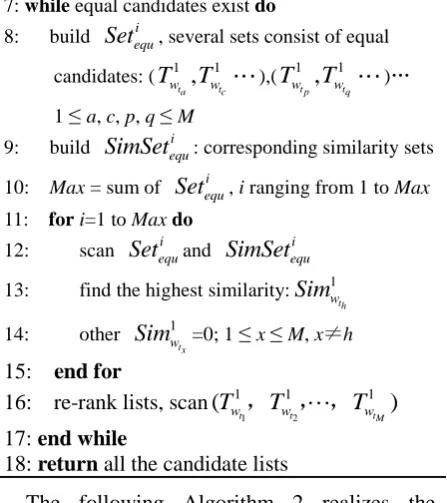
This part detailedly introduces the proposed method by means of algorithm description. After the description, we illustrate our method with a specific example. Algorithm 1 depicts the identical ranking cross-comparison as follows:
Algorithm 1 Input:
Target words’ number M, Lowest ranking N Unranked Candidate lists from
L
1toL
M Unranked similarity lists fromS
1toS
MOutput:
New-ranking candidate lists fromL1ranktoLrankM
1: fori=1 to Mdo
2: rank Candidate list i:
3:
L
i→Lranki :( w1 ,, wN,)i t i
t T
T
4:
S
i→ rank iS :(Sim1wti,,SimwNti,)
5: end for
6: scan
(
1,
,
1)
1 tM
t w
w
T
7: while equal candidates exist do
8: build Setequi , several sets consist of equal
candidates: ( 1 , 1
ta tc
w w
T T ),( 1
,
1tp tq
w w
T
T
)… 1 ≤ a, c, p, q ≤ M9: build
SimSet
equi : corresponding similarity sets 10: Max = sum of Setequi , i ranging from 1 to Max 11: fori=1 to Maxdo12: scan Setequi and
SimSet
equi13: find the highest similarity: 1
th
w
Sim
14: other 1
tx
w
Sim =0; 1 ≤ x ≤ M, x≠h
15: end for
16: re-rank lists, scan( 1 1 1 ) 2
1 t tM
t w w
w T T
T , ,,
17: end while
18: return all the candidate lists
The following Algorithm 2 realizes the distinct ranking cross-comparison.
Algorithm 2 Input:
Target words’ number M
Lowest ranking N
Ranked Candidate lists fromL1ranktoLrankM
Ranked similarity lists fromS1ranktoSMrank
Output:
New-ranking candidate lists fromL1ranktoLrankM
1: fori=1 to Mdo
2: forj=1 to M do
3: fork=2 to N do
4: if
ti
k w
T = 1
t j
w
T &
ti
k w
Sim < 1
j t
w
Sim then
5:
ti
k w
Sim =0;
6: end if
7: end for
8: end for
9: re-rank candidate list Lranki
10: end for
11: return all the candidate lists
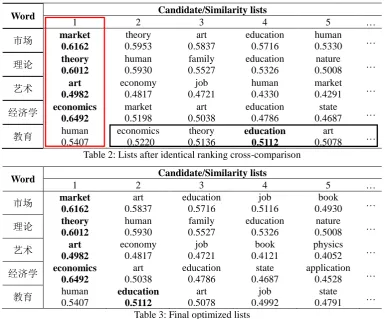
For example, following the above algorithm, we get sorted candidate lists (see Tab.1). In identical ranking cross-comparison, we scan all the 1th candidates in each list (see red square in Tab.1) and find two sets of equal candidates: (‘market/0.6162’, ‘market/0.6097’) and (‘economics/0.5627’, ‘economics/0.6492’) (see black square in Tab.1) . Through the comparison of similarity, the ‘market/0.6097’ and ‘economics/0.5627’ become ‘market/0’ and ‘economics/0’. Then we re-rank the lists and scan again, finding that each 1th candidate is unique. So Algorithm 1 is finished. Tab. 2 shows the re-ranking lists after identical ranking cross-comparison.
In distinct ranking cross-comparison, we build a noise set (‘market/0.6162’, ‘theory/0.6012’, ‘art/0.4982’, ‘economics/6492’, ‘human/0.5627’) (see red square in Tab.2) to scan each list’s 2th to Nth candidates. Taking the list of word ‘教育’ as example, we first use the noise set to scan the remaining candidates (‘economics/0.5220’, ‘theory/0.5136’,‘education/0.5112’,‘art/0.5078’, …) (see black square in Tab.2) , and then find that ‘economics’, ‘art’ and ‘theory’ exist in the noise set. So we compare the similarity between ‘economics/0.6492’ and ‘economics/0.5220’, ‘theory/0.6012’ and ‘theory/0.5136’, and ‘art/0.4982’ and ‘art/0.5078’. Thus, ‘economics/0.5220’ and ‘theory/0.5136’ with lower value are turned into ‘economics/0’ and ‘theory/0’. Afterwards, we re-rank this list. Tab. 3 presents the finally optimized lists. Correct translations in Tab.1 to Tab.3 are highlighted in bold.
Word Candidate/Similarity lists
1 2 3 4 5 …
市场 market
0.6162
theory 0.5953
art 0.5837
education 0.5716
human
0.5330 …
理论 market
0.6097
theory 0.6012
human 0.5930
family 0.5527
education 0.5326 …
艺术 economics
0.5627
art 0.4982
economy 0.4817
job 0.4721
human
0.4330 …
经济学 economics
0.6492
market 0.5198
art/ 0.5038
education/ 0.4786
state
0.4687 …
教育 human
0.5407
economics 0.5220
theory 0.5136
education 0.5112
art
[image:4.595.69.293.75.327.2]Word Candidate/Similarity lists
1 2 3 4 5 …
市场 market
0.6162
theory 0.5953
art 0.5837
education 0.5716
human
0.5330 …
理论 theory
0.6012
human 0.5930
family 0.5527
education 0.5326
nature
0.5008 …
艺术 art
0.4982
economy 0.4817
job 0.4721
human 0.4330
market
0.4291 …
经济学 economics
0.6492
market 0.5198
art 0.5038
education 0.4786
state
0.4687 …
教育 human
0.5407
economics 0.5220
theory 0.5136
education 0.5112
art
0.5078 … Table 2: Lists after identical ranking cross-comparison
Word Candidate/Similarity lists
1 2 3 4 5 …
市场 market
0.6162
art 0.5837
education 0.5716
job 0.5116
book
0.4930 …
理论 theory
0.6012
human 0.5930
family 0.5527
education 0.5326
nature
0.5008 …
艺术 art
0.4982
economy 0.4817
job 0.4721
book 0.4121
physics 0.4052 …
经济学 economics
0.6492
art 0.5038
education 0.4786
state 0.4687
application 0.4528 …
教育 human
0.5407
education 0.5112
art 0.5078
job 0.4992
state
[image:5.595.105.492.68.387.2]0.4791 … Table 3: Final optimized lists
5
Experiments and Analysis
5.1 Experiment Datasets and Setup
We conduct experiments on a Chinese-English corpora derived from the data used in bilingual Wikipedia with 3254 comparable document pairs. The general bilingual dictionary is constructed from an online dictionary which contains 42,373 distinct entries. In addition, we perform the following linguistic preprocessing steps on the comparable corpora: tokenization, lemmatization and removing stop words. After these steps the corpora contain ca. 925,000 Chinese words, and ca. 785,000 English words. The windows size β in building the context vectors is defined as 5, and different sizes are assessed and the above setting turns out to have the best performance in window-based method.
Two experiments are performed on target words with random frequency distribution and certain frequency in order to evaluate the proposed method. During each experiment we also absorb in the extraction performance from both English-Chinese and Chinese-English. The baseline in our experiments is the window-based approach without any optimizing, and we successively use two cross-comparisons in the proposed method and focus on performance
respectively.
5.2 Evaluation Metric
We adopt the accuracy as evaluation metric.
Accuracy,which means precision among the top
n ranking, is a common metric in bilingual lexicon extraction. In this paper, translation candidates in lists from 1th to 20th ranking are kept for automatic and manual evaluation of
accuracy, and score of accuracy is calculated in the following equation:
n
top
count Accuracy
M
. (3)
Where n means top n evaluation (n ranging from 1 to 20), M means the number of target words and
n
top
count means the number of correct
translation in top n ranking.
5.3 Results and analysis
Experiment 1: target words with random frequency distribution
Meanwhile, we conduct the experiment of finding translations of 1000 target words from English documents. N in this experiment is assign as 1020. Fig. 2 and Fig. 3 demonstrate the resulting accuracy of different methods from two directions.
Figure 2: Extraction Results of different methods from English-Chinese
Figure 3: Extraction Results from Chinese-English
The results show that accuracy is improved significantly from both English-Chinese and Chinese-English, thereby indicate the robustness and effectiveness of our method. In particular, two steps in the proposed method can gradually improve the accuracy. Improvements of
accuracy in top1 and top5 are mainly attributed to identical ranking cross-comparison as it processes candidate lists’ top-ranking area. Distinct ranking cross-comparison can markedly boost accuracy in top10, top15 and top20, since it removes noises in larger area of the lists.
Experiment 2: target words with certain frequency
Previous work showed that frequent words’ correct translations are easier to be found than infrequent ones (Pekar et al., 2006). Allowing for this fact, we distinguish different frequency ranges to assess the validity of the proposed
approach. Target words with frequency more than 400 are defined as high-frequency words (WH), whereas words with frequency less than 100 are low-frequency words (WL). The number of target words from either Chinese or English documents is 1000 (M=1000) and N equals to 1020. Extraction performance on accuracy
[image:6.595.305.525.170.762.2]beyond WH and WL are showed in Fig. 4, Fig. 5, Fig. 6 and Fig. 7.
Figure 4: Extraction Results of WH from English-Chinese
Figure 5: Extraction Results of WH from Chinese-English
Figure 7: Extraction Results of WL from Chinese-English
From Fig. 4 and Fig. 5 we have the following observation: accuracy improvement effect of identical ranking cross-comparison in top1 and top5 becomes more obvious in the process on
WH. In addition, Fig. 6 and Fig. 7 indicate that in processing WL distinct ranking cross-comparison promotes accuracy in top10, top15 and top20 to a larger extent. The main reason is that for WH each word’s correct translation, which is also high-frequency source word, happens to be noise existing in top-ranking area of other words’ lists. This situation leads to increasing number of identical ranking cross-comparison which can eliminate noises more effectively. Meanwhile, for WL noises in each target word’s translation candidate lists are all high-frequency source words, leading high repetition rate between the noises set and top N candidates in the lists. Therefore, distinct ranking cross-comparison can boost most optimal translations which locate in lower ranking before to concentrate in the area between 5th and 20th ranking.
6
Conclusion
In this paper, we address the ‘noise’ problem in extracting translation equivalent from comparable corpora. To solve the problem, we develop a novel method to optimize translation candidate lists. The optimizing process includes two step cross-comparisons between translation candidate of each target word. Experimental results show that the proposed method can boost
accuracy significantly and outperform
window-based approach in bilingual lexicon extraction from both English-Chinese and Chinese-English. Moreover, identical ranking and distinct ranking cross-comparison can improve the accuracy respectively in different ranking area, and their improvements depend on
the frequency of target words. Future work may focuses on conducting experiment between the proposed method and syntax-based approach, and eliminating our method’s impact on synonyms.
Acknowledgements
The work is supported by the Informationization Special Projects of Chinese Academy of Science under No. XXH12504-1-10 and the Open Projects Program of National Laboratory of Pattern Recognition.
Reference
AbduI-Rauf S, Schwenk H. On the use of comparable corpora to improve SMT performance[C] //Proceedings of the 12th Conference of the European Chapter of the Association for Computational Linguistics. Association for Computational Linguistics, 2009: 16-23.
Chiao Y-C, Zweigenbaum P. Looking for candidate translational equivalents in specialized, comparable corpora[C] //Proceedings of COLING. 2002.
Dejean H, Gaussier E, Sadat F. Bilingual terminology extraction: an approach based on a multilingual thesaurus applicable to comparable corpora[C] //Proceedings of COLING, Tapei, Taiwan. 2002.
Fung Pascale. Compiling Bilingual Lexicon Entries from a Nonparallel English-Chinese Corpus[C] // Proceedings of the 3rd Annual Workshop on Very Large Corpora. 1995: 173-183.
Fung Pascale, Kathleen McKeown. Finding terminology translation from non-parallel corpora[C] //5th Annual Workshop on Very Large Corpora, Hong Kong. 1997: 192-202.
Fung Pascale, Lo Yuen Yee. An IR approach for translating new words from nonparallel, comparable texts[C] //Proceedings of the 17th international conference on Computational linguistics, Montreal, Quebec, Canada. 1998: 414–420.
Fung Pascale. A Statistical View on Bilingual Lexicon Extraction from Parallel Corpora to Non-parallel Corpora[J]. Parallel Text Processing: Alignment and Use of Translation Corpora, 2000.
Hiroyuki Kaji. 2005. Extracting translation equivalents from bilingual comparable corpora[C] //Proceedings of the LREC-2008 Workshop on Comparable Corpora. 2008: 313–323.
comparable corpora[C] //Proceedings of the 45th annual meeting of the Association of Computational Linguistics, Prague, Czech Republic. 2007: 664–671.
Och F J, Ney H. Improved Statistical Alignment Models[C] //Proceedings of ACL. 2000: 440-447.
Otero P. Learning Bilingual Lexicons from Comparable English and Spanish Corpora[C] // Proceedings of MT Summit XI. 2007: 191-198.
Pekar, Viktor, Ruslan Mitkov, Dimitar Blagoev, Andrea Mulloni. Finding translations for low-frequency words in comparable corpora[J]. Machine Translation, 2006, 20(4): 247–266.
Pablo Gamallo. Learning bilingual lexicons from comparable english and spanish corpora[C] // Machine Translation SUMMIT XI, Copenhagen, Denmark. 2007.
Rapp, Reinhard. Automatic identification of word translations from unrelated English and German corpora[C] //Proceedings of the 37th Annual Meeting of the Association for Computational Linguistics, College Park, Maryland, USA. 1999: 519–526.
Robitaille X. Compiling French Japanese Terminologies from the Web[C] //Proceedings of EACL. 2006.
Saralegi X, San Vicente I, Gurrutxaga A. Automatic generation of bilingual lexicons from comparable corpora in a popular science domain[C] //Workshop on Building and Using Comparable Corpora in LREC. 2008.
Tanaka K, Iwasaki H. Extraction of lexical translations from non-aligned corpora[C] //Proceedings of COLING-96: The 16th international conference on computational linguistics, Copenhagen, Denmark. 1996: 580–585.
Xiao Z, McEnery A. Collocation, Semantic Prosody and Near Synonymy: A Cross-linguistic Perspective[J]. Applied Linguistics, 2006, 27(1): 103-129.