http://www.scirp.org/journal/wjm ISSN Online: 2160-0503 ISSN Print: 2160-049X
DOI: 10.4236/wjm.2017.78019 Aug. 20, 2017 211 World Journal of Mechanics
Radiation Absorption and Variable Electrical
Conductivity Effect on High Speed MHD Free
Convective Flow past an Exponential
Accelerated Inclined Plate
B. M. Jewel Rana, Raju Roy, Lasker Ershad Ali, S. F. Ahmmed
Mathematics Discipline Khulna University, Khulna, Bangladesh
Abstract
The effects of variable electrical conductivity and radiation absorption on high-speed MHD (Magnetohydrodynamics) free convective flow past an ex-ponential accelerated inclined plate with higher order chemical reaction have been investigated. The electrical conductivity has been considered as a func-tion of temperature. The chemical reacfunc-tion has also been considered as the higher order. The usual transformations have been used to obtain the coupled dimensionless momentum, energy and concentration equations. Then the obtained non-dimensional partial differential equations have been solved nu-merically by explicit finite difference method. For excellent accuracy, stability and convergence test have been carried out. A computer program Compaq Visual FORTRAN 6.6a has been used to calculate the numerical results. The obtained numerical results concerned with the fluid velocity, temperature, concentration, concerned with skin friction, Nusselt number, Sherwood number, streamlines and isotherms are imprinted graphically by Tecplot and discussed in details. It is noticed that increasing of magnetic parameter in-creases the temperature and dein-creases the velocity, skin friction and Nusselt number. It is also observed that the temperature profile is increasing with the increasing values of Dufour number. However, the order of the chemical reac-tion increases the concentrareac-tion profile.
Keywords
Radiation Absorption, Thermal Radiation, Variable Electrical Conductivity, Variable Temperature, Higher Order Chemical Reaction
How to cite this paper: Jewel Rana, B.M., Roy, R., Ali, L.E. and Ahmmed, S.F. (2017) Radiation Absorption and Variable Electrical Conductivity Effect on High Speed MHD Free Convective Flow past an Exponential Accelerated Inclined Plate. World Journal of Mechanics, 7, 211-241.
https://doi.org/10.4236/wjm.2017.78019
Received: June 22, 2017 Accepted: August 17, 2017 Published: August 20, 2017 Copyright © 2017 by authors and Scientific Research Publishing Inc. This work is licensed under the Creative Commons Attribution International License (CC BY 4.0).
http://creativecommons.org/licenses/by/4.0/
DOI: 10.4236/wjm.2017.78019 212 World Journal of Mechanics
1. Introduction
A fluid is a substance that is subject to deformation upon application of any shear force or stress. Fluid dynamics is an area of study that deals with the flow of fluids. The fluids in consideration include gases, liquids and ionized gases are also called plasma. Electromagnetism on the other hand studies the interaction between the electric and magnetic fields. Magnetohydrodynamics (MHD) is the study of motion of electrically conducting fluids with the influence of electro-magnetic phenomena. Magnetohydrodynamics is now undertaking a stage of great development. The MHD in the current form is due to contributions of several notable authors like Shercliff [1], Ferraro and Plumpton [2], Jaffrey [3]
and Pop and Ingham [4]. There are numerous engineering applications for this phenomenon, such as solar structures, astrophysics, purification of crude oil, underground water storage system, soil sciences, paper industry, textile industry, pulp, nuclear power reactor, accelerators in geophysics and design of MHD ge-nerators. The applications of MHD principles in medicine and biology are of sa-lient interest owing to their importance in biomedical engineering such as car-diac MRI, ECG etc.
Convection flows have greatly fascinated the researchers and engineers due to their presence both in nature and engineering applications. Free convection re-fers to the motion of fluid initiated exclusively owing to the density difference during the cooling or heating of the fluid. It might also arise due to the differ-ence in both temperature gradients and species concentration. The study of free convection flow has many momentous applications such as the nuclear reactor, thermal hydraulics, frost formation and channel-chimney systems. Laminar free convection has many industrial and environmental applications such as thermal regulation process, motors, atmospheric flows, human comfort in buildings, and electronic cooling devices. A free convective heat transfer problem was first per-formed by Finston [5]. The first elementary assumptions of fluid dynamics are the conservation of mass or the continuity of mass with a flow system. The second elementary assumptions of fluid dynamics are the conservation of linear momentum or Newton’s second law of motion. The third elementary assump-tions of fluid dynamics are the conservation of energy or the first law of ther-mo-dynamics.
A fundamental law linking pressure drop and velocity in fluid flow through porous media is Darcy’s law. The flow of a fluid through a porous medium is de-lineated by the Darcy’s law.
With the experimental results on the flow of water through beds of sand, Henry Darcy was initiated the Darcy’s law. Darcy’s law is employed to scrutinize water flow through an aquifer. Also Darcy’s law is applied to recount gas, water, and oil flows through petroleum reservoirs. The Darcy linear model is insuffi-cient in the presence of higher velocities. In this case an inertial term is added to the Darcy’s equation, which is known as Forchheimer term. Forchheimer [6]
DOI: 10.4236/wjm.2017.78019 213 World Journal of Mechanics observed that as the flow velocity increases, the inertial effects start dominating the flow. In order to account for these high velocity inertial effects, he prescribed the inclusion of an inertial term representing the kinetic energy of the fluid to the Darcy equation. Apparently the most popular modification to Darcian flows is the Darcy Forchheimer model. Many scholars have modified Darcy’s law such as Wooding [7] and Brinkman [8] [9] to study the convective flow in porous media accurately.
When the solid boundary permits fluid to pass through it, then we can con-sider a porous medium. A porous medium is said to be homogenous if the ratio of the pore area to the total area of the solid boundary is a constant. Otherwise the medium is termed as non-homogeneous. Porous media can be used as an insulator and also can be utilized as a heat transfer promoter for either sensible or latent heat transfer. The heat transfer flow through a porous media has em-piric applications particularly in geophysical fluid dynamics such as beach sand, sandstone, limestone, wood, small blood vessels, and in the human lung. Free convection with the porous medium has various technological applications such as porous material regenerative heat exchangers, energy storage, oil extraction, cool combustors, granular insulation, electronic system cooling, fiber, and fluid flow through filtering devices. The coupled mass and heat transfer arise in the fluid owing to buoyancy forces generated by concentration difference and tem-perature difference. Coupled heat and mass transfer in porous media has mo-mentous applications such as underground energy transport, enhanced oil re-covery, cooling of nuclear reactors and geothermal reservoirs. MHD free con-vective, dissipative boundary layer flow past a porous vertical surface in the presence of thermal radiation, chemical reaction and constant suction have been investigated by Raju et al. [10] using a regular perturbation technique.
DOI: 10.4236/wjm.2017.78019 214 World Journal of Mechanics diffusion and radiation absorption has been explicated by Umamaheswar et al.
[14]. From the observation of Vedavathi et al. [12], Prakash et al. [13] and Umamaheswar et al. [14], it is noticed that the velocity and temperature in the boundary layer increase owing to the presence of absorption of radiation.
The free convection problem in the presence of high-speed magnetic field has enormous industrial applications such as welding, the safety aspect of gas-cooled reactors, solar energy collectors, crystal growth, materials processing and cooling reactors. Desale and Pradhan [15] have used implicit finite difference technique to obtain the solution of MHD boundary layer heat transfer over a moving plate. Mishra and Jena [16] have used Runge-Kutta fourth-order algorithm to calculate the numerical results of boundary layer MHD flow with viscous dissipation and the computations have been done by a computational computer language, MATLAB. Haque and Sarder [17] have imposed explicit finite difference scheme to complete the investigation of convective heat and mass transfer of high-speed MHD flow over a stretching sheet with the influence of thermal diffusion. Haque and Sarder [17] have also discussed the stability criteria of the explicit finite dif-ference method in a nutshell. From the experiments of Desale and Pradhan [15], Mishra and Jena [16] and Haque and Sarder [17], it is observed that temperature enhances in the presence of high-speed MHD.
Dissipation is the strait of metamorphosing mechanical energy of down-ward-flowing water into acoustical and thermal energy. Viscous dissipation ef-fects play a momentous role in free convection in various devices which are op-erated at high speeds. To define the viscosity of dilute suspensions, dissipation function is used (Einstein [18]). Viscous dissipation with magneto hydrody-namic flow has many momentous geothermal, technological and industrial ap-plications such as MHD accelerators and MHD power generation, liquid, and metal nuclear reactors. When the flow field is in high gravitational field or at low temperature or of exhaustive size, the viscous dissipation heat in the free convec-tive flow is momentous. The importance of viscous dissipaconvec-tive heat in free con-vection flow in the case of constant heat flux and isothermal at the plate has been demonstrated by Gebharat [19]. Variable heat and mass transfer under the as-sumption of different physical phenomena have already been carried out by many scholars. Kishore et al. [20] have employed implicit finite difference me-thod of Crank-Nicolson’s type to obtain the numerical solution of viscous dissi-pation and heat transfer on MHD free convection flow past an exponentially ac-celerated vertical plate with variable temperature. They have also analyzed sta-bility and convergence test of implicit finite difference method. The flow of an electrically conducting fluid past a continuously moving plate was initiated by Sakiadis [21].
DOI: 10.4236/wjm.2017.78019 215 World Journal of Mechanics technique. Rajput and Kumar [23] have studied radiation effects on MHD flow past an impulsively started vertical plate in the presence of variable heat and mass transfer with the help of Laplace transformation technique. Unsteady Magnetohydrodynamics free convective flow past a vertical porous plate has been presented by Gundagani et al. [24] by employing a finite element method. Javaherdeh et al. [25] have imposed implicit finite difference method to find the numerical solution of MHD free convection heat and mass transfer flow past a moving vertical plate in a porous medium. The temperature and concentration level at the plate surface have been followed a power law type of distribution in their observation. Pattnaik et al. [26] have investigated mass transfer and radia-tion effects on MHD flow through porous medium past an exponentially accele-rated inclined plate with variable temperature. The Laplace transformation me-thod has been used to solve the governing equations in the computations of Pattnaik et al. [26]. From the analysis of Pattnaik et al. [26], it is reported that the presence of magnetic field and angle of inclination prevents the flow reversal. The effect of variable electrical conductivity has not been taken into consider-ation, in the above pointed out investigations. Engineers can control many me-tallurgical processes by taking suitable electrical conductivity of fluids. Steady MHD natural convection flow with variable electrical conductivity and heat generation along an isothermal vertical plate has been studied by Shrama and Singh [27] by applying Runge-Kutta fourth order method along with shooting iteration scheme. The authors have used similarity transformation for convert-ing partial differential equations into ordinary differential equations. Also, the authors have used commercial software Mathematica for drawing graphs. Cha-kraborty and Medhi [28] have investigated MHD convective flow along a vertic-al isothermvertic-al plate under variable electricvertic-al conductivity and heat generation in a porous medium by using Runge-Kutta method of shooting iteration technique. They have considered that the electrical conductivity is a function of tempera-ture and the Prandtl number is very low.
The rate of mass diffusion can be changed effectively by the presence of chemical reactions. In nature it is quite improbable to find pure fluid unless spe-cial efforts are taken to get it. The most common fluids like water and air are contaminated with impurities like CO2, C6H6 and H2SO4 etc. When such
DOI: 10.4236/wjm.2017.78019 216 World Journal of Mechanics l-power of concentration. Chemical reaction can be classified as either hetero-geneous or homohetero-geneous processes. The reaction is homohetero-geneous if it occurs in solution and heterogeneous if it occurs at an interface in a well mixed system. The combined heat and mass transfer problems in the presence of higher order chemical reaction are important in chemical industries like in curing of plastics, food processing, manufacture of pulp, insulated cables and polymer production. It is significant to investigate the effects of heat generation or absorption when fluids undertaking endothermic or exothermic chemical reactions. The presence of heat generation or absorption can be used in semiconductor wafers and elec-tronic chips. Alam and Ahammad [31] have applied Nachtsheim-Swigert shoot-ing iteration technique with sixth-order Runge-Kutta integration scheme to study the effects of variable chemical reaction and variable electric conductivity on free convective heat and mass transfer flow along an inclined stretching sheet with variable heat and mass fluxes under the influence of Dufour and Soret ef-fects. They have considered that electrical conductivity is a function of velocity. They have observed that velocity and concentration profiles increase but tem-perature profiles decrease with the increasing values of order of chemical reac-tion. MHD free convective flow over a vertical cone with variable electric con-ductivity in the presence of chemical reaction has been delineated by Kumar et al. [32] by applying an efficient finite difference technique of the Crank-Nicol- son type.
In the above study, most of the scholars have used Pr= 0.71 and Sc= 0.60 in
their computations. The ultimate aim of the this present problem is to develop the effects of variable electrical conductivity and radiation absorption on high speed MHD fee convective flow past an exponential accelerated inclined plate. The electrical conductivity has been taken as a function of temperature. The chemical reaction has also been assumed as higher order. From Alam and Ahammad [31] it is noticed that the reaction having order four or more are practically improbable. Therefore we have also considered the order of the reac-tion as l = 1; 2 and 3 in this research investigation. The coupled partial differen-tial equations are transformed into dimensionless by applying non-dimensional quantities. Then the resultant dimensionless equations are solved numerically by employing an efficient, accurate and conditionally stable finite difference tech-nique of explicit type with the help of a program FORTRAN 6.6a. The stability and convergence analysis has been carried out to establish the effect of velocity, temperature, concentration, skin friction, Nusselt number and Sherwood num-ber. At last, the effects of momentous parameters are presented graphically and discussed qualitatively.
2. Mathematical Formulation
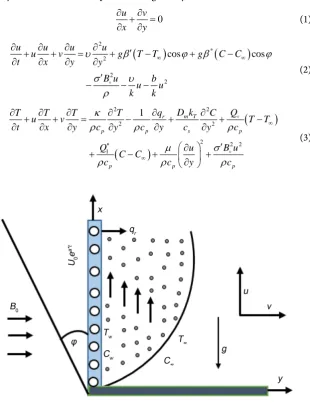
DOI: 10.4236/wjm.2017.78019 217 World Journal of Mechanics emitting radiation but not scattering the medium. The plate is inclined to the vertical direction by an angle φ. The x-axis is directed along the plate in the di-rection of the fluid and y-axis is considered normal to the plate in the fluid. At first, it is taken that the plate and the fluid are of the same temperature T∞ with
concentration level C∞ at all points. At time t > 0, the plate is exponentially
acce-lerated in its own plane with a velocity Uoexp(a*t). At the same time, the
temper-ature of the plate and the concentration level are also decreased or increased ex-ponentially with respect to time t. It is considered that a radiative heat flux qris
employed in the perpendicular direction to the plate. It is also considered that a higher order chemical reaction taking place between the fluid and the diffusing species. A transverse magnetic field of fixed magnitude Bo is employed
perpen-dicular to the direction of the flow. It is considered that the induced magnetic field is insignificant in comparison to the employed magnetic field. The physical diagram of the problem is elucidated in Figure 1.
Under the boundary layer approximation, governing equations that deliberate the physical condition of the problem are given by
0
u v
x y
∂ ∂
+ =
∂ ∂ (1)
(
)
(
)
2 * 2 2 2 cos cosu u u u
u v g T T g C C
t x y y
B u b
u u
k k
υ
β
ϕ
β
ϕ
σ
υ
ρ
∞ ∞ ∂ + ∂ + ∂ = ∂ + ′ − + − ∂ ∂ ∂ ∂ ′ − − − (2)(
)
(
)
2 2 2 22 2 2
1
1 r m T
p p s p
p p p
D k
q Q
T T T T C
u v T T
t x y c y c y c y c
Q u B u
C C
c c y c
κ
ρ ρ ρ
σ µ
ρ ρ ρ
[image:7.595.226.537.305.709.2]∞ ∗ ∞ ∂ ∂ ∂ ∂ ∂ ∂ + + = − + + − ∂ ∂ ∂ ∂ ∂ ∂ ′ ∂ + − + + ∂ (3)
DOI: 10.4236/wjm.2017.78019 218 World Journal of Mechanics
(
)
2 2 2 2 l m T m r m D kC C C C T
u v D k C C
t x y y T y ∞
∂ ∂ ∂ ∂ ∂
+ + = + − −
∂ ∂ ∂ ∂ ∂ (4)
where x and y are the dimensional distance along and perpendicular to the plate respectively. u and v are the velocity components in the x and y directions re-spectively, t is the time, υ is the kinematics viscosity, μ is the viscosity, g is the gravitational acceleration, σ is the electric conductivity of the fluid in the boun-dary layer region depending on the fluid temperature, Bo is the magnetic
induc-tion, ρ is the fluid density, β′ and β* are the heat and mass transfer volume
expansion coefficients respectively, k is the Darcy permeability, b is the empiri-cal constant (Vedavathi et al. [8]), κ is the thermal conductivity, cp is the specific
heat at constant pressure, cs is the concentration susceptibility, Dmis the
mole-cular diffusivity of the species concentration, Q1
∗ is the coefficient of
propor-tionality of the radiation, Tmis the mean fluid temperature, κTis the thermal
diffusion ratio, ɑ* is the dimensional acceleration parameter, kris the reaction
rate constant, l is the order of chemical reaction and Qois the heat generation
constant, which may be either positive or negative. The heat source becomes positive in case of heat generation and negative in case of heat absorption.
The initial and boundary conditions relevant to the present problem are as follows:
}
( )
(
)
(
)
}
2 * 20 : 0, 0, , for all
0 : exp , 0, exp ,
at 0
exp
0, , as
w
w
t u v T T C C y
U
t u U a t v T T T T t
y U
C C C C t
u T T C C y
υ υ ∞ ∞ ∞ ∞ ∞ ∞ ∞ ∞ ≤ = = = =
> = = = + −
= = + − = → → → ∞ (5)
A few forms of electrical conductivity difference are found in the literature. Among them we have taken that one which is absolute for liquid as follows:
(
)
1 1
1
ε
T Tσ
′=σ
+ ′ − ∞ (6) where σ is the electrical conductivity at the surface temperature andε
′ is acon-stant based on the electrical property of the fluid.
Here we introduce a non-dimensional electrical conductivity variation para-meter ε such that
(
Tw T)
ε ε= ′ − ∞ (7)
Substituting variable (7) into (6) takes to the following form
1
σ
σ
εθ
′ =
+ (8)
A similar result (8) has been presented by Shrama and Singh [27]
DOI: 10.4236/wjm.2017.78019 219 World Journal of Mechanics * 4 1 4 3 r T q k y σ ∂ = −
∂ (9)
where σ* and k1 are the Stefan-Boltzmann constant and mean absorption
coeffi-cient respectively. We considered that the temperature changes within the flow are adequately small such that T4 may be expanded as a linear function of the
temperature. Expanding T4 in a Taylor series about T
∞ and ignoring higher
or-der terms, we obtain
4 3 4
4 3
T ≅ T T∞ − T∞ (10)
Substituting Equation (10) into (9) leads to the following form
* 3 1 16 3 r T T q k y
σ ∞ ∂ = −
∂ (11)
The non-dimensional variables appropriate to this problem are as follows:
(
)
(
)
(
)
2
* 2 2
*
2 3 3 2 2
* 3 2
1 1
* 2 2
, , , , , , , , , , , , 4 , , , , , , w w w w
r m a
p
s r c
p w
p p
m T u
s p
xU yU u v tU T T C C
X Y U V
U U T T C C
g T T g C C B kU
a
a G G M D
U U U U
c
bU T Q Q U
F P R Q Q E
k k k c U c U c T T
D k D
c c
τ θ φ
υ υ υ
βυ β υ σ υ
υ
ρ υ
µ σ υ υ
υ ρ ρ
υ ∞ ∞ ∞ ∞ ∞ ∞ ∗ ∞ ∞ − − = = = = = = = − − − − = = = = = = = = = = = − =
(
)
12 0
, , ,
l
r w
w m T w
c r c
w m m w
k C C
C C D k T T
S S K
T T D T C C U
υ υ υ − ∞ ∞ ∞ ∞ ∞ − − − = = = − − (12)
Insertion of Equations (12), (11) and (8) into (1)-(4) leads to the following dimensionless equations:
0
U V
X Y
∂ +∂ =
∂ ∂ (13)
2 2 2 1 cos cos 1 s r m a a F
U U U U M
U V G G U U
X Y Y
ϕ
ϕ
D Dτ
εθ
∂ + ∂ + ∂ =∂ + + − + −
∂ ∂ ∂ ∂ + (14)
2 2 2 2 1 2 2 1 4 1
3 u c c 1
r
U M
U V R D Q Q E E U
X Y P Y Y Y
θ θ θ θ φ θ φ
τ εθ
∂ + ∂ + ∂ = + ∂ + ∂ + + + ∂ +
∂ ∂ ∂ ∂ ∂ ∂ + (15)
2 2
2 2
1 l
r c
c
U V S K
X Y S Y Y
φ φ φ φ θ φ
τ
∂ ∂ ∂ ∂ ∂
+ + = + −
∂ ∂ ∂ ∂ ∂ (16)
The corresponding initial and boundary conditions are as follows:
( )
( )
( )
}
}
0 : exp , 0, exp , exp at 0 0, 0, 0 as
U a V C Y
U Y
τ
τ
θ
τ
τ
θ
φ
> = = = = =
→ → → → ∞ (17)
DOI: 10.4236/wjm.2017.78019 220 World Journal of Mechanics the analysis of velocity, temperature and concentration field. The dimensionless forms of skin-friction, Nusselt number and Sherwood number are as follows:
3 4 0 1 2 2 f r Y U C G Y − = ∂ = − ∂
(18)
3 4 0 1 2 u r Y N G Y θ − = ∂ = ∂
(19)
3 4 0 1 2 h r Y S G Y φ − = ∂ = ∂
(20)
3. Numerical Solution
The present problem has required a set of finite difference equations. In this process the region within the boundary layer is divided into grid or meshes of lines parallel to X and Y coordinates where X-axis is considered along the plate and Y-axis is perpendicular to the plate. Here the plate of height is taken Xmax
(=20) i.e. X varies from 0 to 20 and as corresponds to Ymax (=25) i.e. Y varies
from 0 to 25. Grid spacing in the X and Y direction are mmax = 100 and nmax =
respectively. ∆X and ∆Y are constant mesh size along X and Y directions as fol-lows ∆ =X 0.20 0
(
≤X ≤20)
and ∆ =Y 0.125 0(
≤ ≤Y 25)
with a smaller time- step ∆τ = 0.0002.Let U′,
θ
′ and φ′ indicated the values of U, θ and ϕ at the end of atime-step respectively. Applying the explicit finite difference technique, the fol-lowing appropriate set of finite difference equations are obtained from the di-mensionless coupled partial differential Equations (13)-(16)
, , 1 , , 1
0
i j i j i j i j
U U V V
X Y
− −
− −
+ =
∆ ∆ (21)
( )
( )
, , , 1, , 1 ,
, ,
2
, 1 , , 1
, , , , 2 , 2 1 cos cos 1
i j i j i j i j i j i j
i j i j
i j i j i j s
r i j m i j i j i j
i j
U U U U U U
U V
X Y
U U U M F
G G U U
Da Da Y τ ϕθ ϕφ εθ − + + − ′ − − − + + ∆ ∆ ∆ − + = + + − + − + ∆ (22)
( )
( )
( )
, , , 1, , 1 ,
, ,
, 1 , , 1 , 1 , , 1
2 2
2
2 , 1 ,
, 1 , ,
, 2 2 1 4 1 3 1
i j i j i j i j i j i j
i j i j
i j i j i j i j i j i j
u r
i j i j
i j i j c c i j
i j
U V
X Y
R
D
P Y Y
U U M
Q Q E E U
Y
θ θ θ θ θ θ
τ
θ θ θ φ φ φ
θ φ εθ − + + − + − + ′ − − − + + ∆ ∆ ∆ − + − + = + + ∆ ∆ − + + + ∆ + + (23)
( )
( )
( )
, , , 1, , 1 ,
, ,
, 1 , , 1 , 1 , , 1
,
2 2
2 2
1
i j i j i j i j i j i j
i j i j
l
i j i j i j i j i j i j
r c i j
c
U V
X Y
S K
S Y Y
φ
φ
φ
φ
φ
φ
τ
φ
φ
φ
θ
θ
θ
φ
− + + − + − ′ − − − + + ∆ ∆ ∆ − + − + = + − ∆ ∆ (24)tech-DOI: 10.4236/wjm.2017.78019 221 World Journal of Mechanics nique are
(
)
(
)
(
)
}
}
,0 , , ,0 : exp , 0, exp , exp at 0 0, 0, 0 as
p i
p p p
i L i L i L
U ap V p C p Y
U Y
τ τ θ τ τ
θ φ
> = ∆ = = ∆ = ∆ =
→ → → → ∞ (25)
Here the subscripts i and j represent the mesh points with X and Y axes re-spectively and the superscripts p designates a value of time, τ = p∆τ where
0,1, 2,3,
p
=
.4. Stability and Convergence Analysis
The analysis of this present problem will remain incomplete unless we study the stability of explicit finite difference method. The general term of the Fourier ex-pansion for U, θ and ϕ at a time arbitrarily called τ = 0, is taken to be of the form eiαXeiβY, where i= −1. At a later time τ, these terms become
( )
( )
( )
: e e : e e : e e
i X i Y i X i Y
i X i Y
U F G H α β α β α β τ θ τ φ τ (26)
and after the time step the terms of the Fourier expansion for U, θ and ϕ will be:
( )
( )
( )
: e e : e e : e e
i X i Y i X i Y
i X i Y
U F G H α β α β α β τ θ τ φ τ ′ ′ ′ (27)
Applying the Expressions (26) and (27) into Equations (22)-(24), taking the coefficients U and V as constants over any one time step, we get the following equations upon simplification
(
)
(
)
(
)
(
)
( )
2 2e e 1 e e e e 1
e e
e e cos e e cos e e
2 e e cos 1 1
,
i X i Y i X i X i Y i Y
i X i Y
i X i Y i X i Y i X i Y
r m
i X i Y
s a a F F F F U V X Y
G G G H MG U
F Y F
M U U
D D
Y
α β α α β β
α β
α β α β α β
α β
τ
ϕ ϕ ε
β − ∆ ∆ − − ′ − + + ∆ ∆ ∆ = + + ∆ − + − + − ∆ (28)
The Equations (28)-(30) can be written in the following form
1 2 3
F′ =A F+A G+A H (31)
4 5 6
G′ =A F+A G+A H (32)
7 8
H′ =A G+A H (33)
where
(
)
( )
(
)
(
)
1 2
2 cos 1 1 1
1 e e 1
s
a a
i X i Y
Y F
A M U
D D Y U V X Y α β τ β τ τ
τ − ∆ τ ∆
∆ ∆ − = + − + ∆ − ∆ ∆ ∆ − ∆ − − − ∆ ∆ (34)
2 r cos
DOI: 10.4236/wjm.2017.78019 222 World Journal of Mechanics
3 m cos
A =G ∆τ ϕ (36)
2
4
ei Y 1
c c
A E MU E U
Y β
τ τ ∆ −
= ∆ + ∆
∆
(37)
(
)
( )
(
)
(
)
2
5 2
2 cos 1 1 4
1 1 3
1 e e 1
c r
i X i Y
Y
A R Q E M U
P Y
U V
X Y
α β
τ
β
τ
ε
τ
τ
− ∆τ
∆∆ ∆ − = + + + ∆ − ∆ ∆ ∆ − ∆ − − − ∆ ∆ (38)
(
)
( )
6 2 1
2 cos 1
u
Y
A D Q
Y
τ
β
τ
∆ ∆ −
= + ∆
∆ (39)
(
)
( )
7 2
2 cos 1
r Y A S Y
τ
β
∆ ∆ − =∆ (40)
(
)
( )
(
)
(
)
8 2
1 e e 1 2 cos 1
1 1
i X i Y
c c
Y
A K U V
S Y X Y
α β τ τ τ β τ − ∆ ∆ ∆ − ∆ − ∆ ∆ − = + − ∆ − − ∆ ∆
∆ (41)
The Equations (31)-(33) can be designated in matrix-vector form are as fol-lows:
1 2 3
4 5 6
7 8
0
F A A A F
G A A A G
H A A H
′ ′ = ′ (42)
Equation (42) is implied in *
T
η′ = η
where F G H η ′ ′= ′ ′ ,
1 2 3
*
4 5 6
7 8
0
A A A
T A A A
A A = , F G H η =
To obtain the stability criterion, it is sufficient to find out eigenvalues of the amplification matrix T* but this study is very difficult since all the elements of T* are different. So the time-step ∆τ is considered to be very small and tends to zero. Under this assumption we have A2 → 0, A3 → 0, A4 → 0, A6 → 0, A7 → 0, and
the amplification matrix takes the following form
1 * 5 8 0 0 0 0 0 0 A T A A = (43)
The eigenvalues of the amplification matrix T* are obtained as λ =1 A1,
2 A5
λ = , λ =3 A8. For stability test each of the eigenvalues must not exceed unity
in modulus. Under this consideration, the stability conditions are as follows:
1 1, 5 1, 8 1
A ≤ A ≤ A ≤ (44)
Let we choose,
( )
1 , 1 , 1 and 1 2 2
a b U c V d
X X Y
τ τ τ
τ ∆ ∆ ∆
= ∆ = = − =
∆ ∆ ∆
con-DOI: 10.4236/wjm.2017.78019 223 World Journal of Mechanics sider that U is everywhere nonnegative and V is everywhere non-positive. We can demonstrate that the maximum modulus of A1, A5 and A8 occurs when
π
X m
α
∆ = andβ∆ =
Y
n
π
, where m and n are integers. The Expressions (45)can occur when m and n both are odd integers. Thus the Expression (45) can be written into the followings form
1 1 1 1 1
1
1 2 Fs
A d a M b c U
Da Da
= − + + + + +
(45)
(
2)
1
5 1 1 1
1 4 1 2 1
3 2 c
r
a
A d R Q U E M b c
P
ε
= − + − − + +
(46)
1
8 1 1 1
1 1 2
2 c
c
a
A d b c K
S
= − + + +
(47)
The most negative allowable values of A1, A5 and A8are −1. Then the stability
conditions for the present problem are as furnished, upon simplification of Equ-ations (45)-(47)
1
1
s
F
U V M U
X Y Da Da
τ
τ
τ
τ
∆ + ∆ + ∆ + + ∆ ≤
∆ ∆ (48)
( )
2
2
2 1 4
1 1
3 2 2
c r
U E M Q
U V R
X Y Y P
τ
ε
τ
τ
τ
τ
∆∆ + ∆ + ∆ + −∆ + ≤
∆ ∆ ∆ (49)
( )
22 1 1 2 c c K U V
X Y Y S
τ
τ τ τ ∆
∆ + ∆ + ∆ + ≤
∆ ∆ ∆ (50)
Since from the initial conditions U= =V 0 at
τ
=0, the Equations (49) and(50) provide Pr≥0.05 and Sc≥0.03 respectively.
Hence the convergence tests of the present problem are Pr≥0.05 and 0.03
c
S ≥ .
5. Results and Discussion
In order to get into the physical understanding of the problem, non-dimensional velocity, temperature, concentration, skin friction, Nusselt number and Sher-wood number are computed for various values of acceleration parameter (ɑ), in-clination angle (α), Grashof number (Gr), Mass Grashof number (Gm), Magnetic
parameter (M), electrical conductivity parameter (ε) Darcy number (Da),
For-chheimer number (Fs), Prandtl number (Pr), radiation parameter (R), Heat
gen-eration parameter (Q), radiation absorption parameter (Q1), Dufour number
(Du), Eckert number (Ec), Schmidt number (Sc), Soret number (Sr), Chemical
reaction parameter (Kc) and the order of chemical reaction (l). Grashof number
governs the fluid flow, in the case of free convection flow. The significance of the Grashof number is that it designates the ratio between the buoyancy forces to the viscous forces. The value of Grashof number is assumed positive to represent the cooling of the plate. Prandtl number (Pr) is a measure of the relative
DOI: 10.4236/wjm.2017.78019 224 World Journal of Mechanics pressure. The values of the Prandtl number Pr are considered for air (Pr= 0.71),
the electrolytic solution (Pr= 1.00), sulfur dioxide (Pr= 4.24), water (Pr= 7.00)
and water at 4˚C (Pr= 11.62). Furthermore, it can be used to measure the
ther-mal conductivity of gases at high temperatures, where it is very difficult to measure experimentally due to the formation of convection currents. In heat transfer problems, the Prandtl number (Pr) has significant effect on the relative
thickness of the momentum and thermal boundary layers. The heat diffuses more rapidly compared to the velocity, in the presence of low Prandtl number (Pr). The values of the Schmidt number are taken to designate the presence of
species by water vapor (Sc= 0.66), ammonia (Sc= 0.78) and carbon dioxide (Sc=
0.95). Physically, the Schmidt number relates to the relative thickness of the hy-drodynamic boundary layer and mass transfer boundary layer. In order to obtain the accuracy of the numerical results, the following values of default parameter are chosen as: Gr= 10, Gm= 5, Da= 1, Fs= 0.1, M = 1, ε = 0.50, Pr= 0.71, R = 0.5,
Du= 0.03, Q = 0.1, Q1= 1, Ec= 0.01, Sc= 0.66, Sr= 1.6, Kc= 0.5, τ = 0.4, a = 0.5,
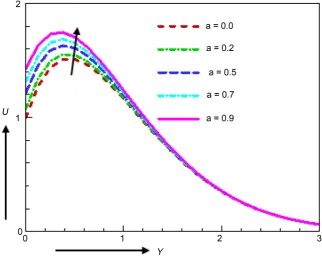
[image:14.595.217.537.433.703.2]α = π/3 and l = 2. All graphs therefore correspond to these unless specifically in-dicated on the appropriate graph. The numerical solutions for the fluid velocity, temperature, concentration, skin-friction, Nusselt number and Sherwood num-ber are presented graphically in Figures 2-24.
Figure 2 delineates the effect of angle of inclination φ on fluid flow. Velocity decreases with the increasing values of inclination angle because the magnitude of the buoyancy force decreases with an increase in the inclination angle. Patt-naik et al. [27] are computed the same result.
DOI: 10.4236/wjm.2017.78019 225 World Journal of Mechanics
Figure 3. Velocity profile for various values of a.
Figure 4. Velocity profile for various values of Gr, Gm, Da and Fs.
DOI: 10.4236/wjm.2017.78019 226 World Journal of Mechanics
Figure 5. Velocity profile for various values of ε.
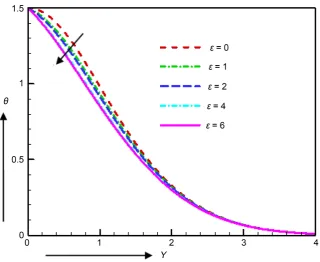
Figure 6. Temperature profile for various values of ε.
The effect of a velocity profile for different values of Grashof number Gr, mass
Grashof number Gm, Darcy number Da and Forchheimer number Fs are depicted
[image:16.595.210.531.367.629.2]DOI: 10.4236/wjm.2017.78019 227 World Journal of Mechanics
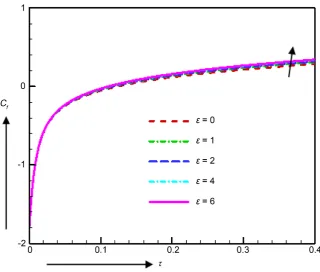
Figure 7. Skin friction for various values of ε.
Figure 8. Nusselt number for various values of ε.
DOI: 10.4236/wjm.2017.78019 228 World Journal of Mechanics
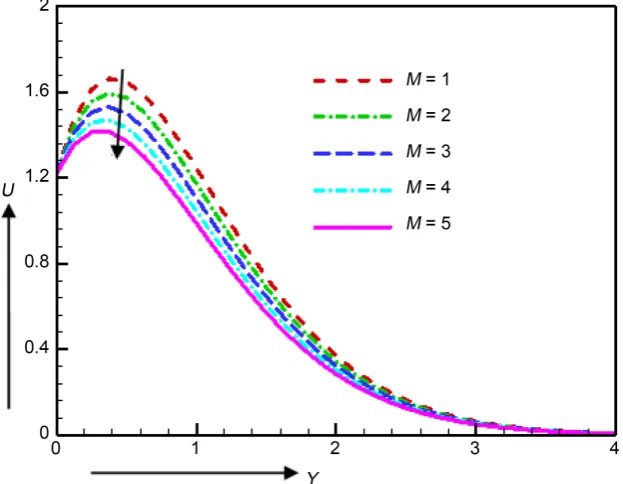
Figure 9. Velocity profile for various values of M.
Figure 10. Temperature profile for various values of M.
the ratio of the concentration buoyancy force to the viscous hydrodynamic force. The porosity of the medium increases due to the presence of Darcy number Da,
thus fluid flows rapidly. Forchheimer number Fs represents the inertial drag,
DOI: 10.4236/wjm.2017.78019 229 World Journal of Mechanics
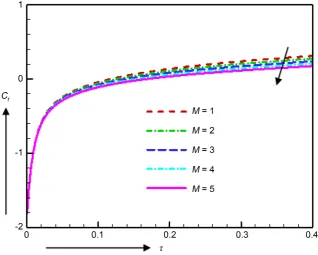
Figure 11. Skin friction for various values of M.
Figure 12. Nusselt number for various values of M.
of thermal buoyancy force, species buoyancy force and Darcy number while it decreases with the increase of Forchheimer number.
DOI: 10.4236/wjm.2017.78019 230 World Journal of Mechanics
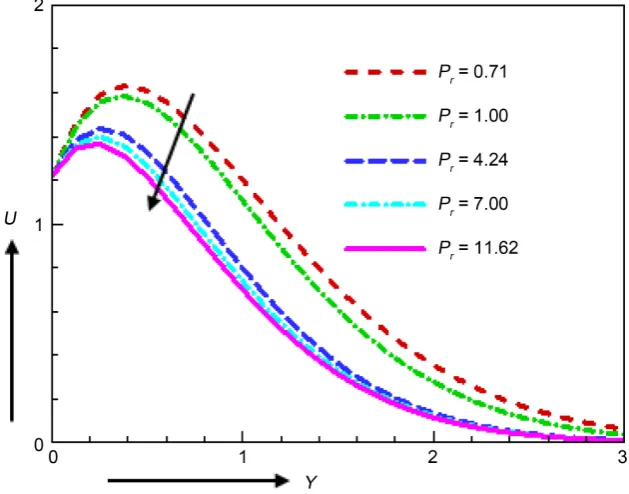
Figure 13. Velocity profile for various values of Pr.
Figure 14. Temperature profile for various values of Pr.
DOI: 10.4236/wjm.2017.78019 231 World Journal of Mechanics
Figure 15. Nusselt number for various values of Pr.
Figure 16. Temperature profile for various values of Du.
[image:21.595.213.533.357.614.2]DOI: 10.4236/wjm.2017.78019 232 World Journal of Mechanics
Figure 17. Temperature profile for various values of R, Q and Ec.
Figure 18. Velocity profile for various values of Q1.
DOI: 10.4236/wjm.2017.78019 233 World Journal of Mechanics
Figure 19. Temperature profile for various values of Q1.
Figure 20. Concentration profile for various values of Q1.
in the rate of heat transfer.
DOI: 10.4236/wjm.2017.78019 234 World Journal of Mechanics
Figure 21. Nusselt number for various values of Q1.
Figure 22. Sherwood number for various values of Q1.
DOI: 10.4236/wjm.2017.78019 235 World Journal of Mechanics
Figure 23. Concentration profile for various values of Sc, Sr and Kc.
Figure 24. Concentration profile for various values of l.
[image:25.595.215.528.353.599.2]DOI: 10.4236/wjm.2017.78019 236 World Journal of Mechanics point Y = 0.5.
Figures 13-15 exhibit the effect of Prandtl number on velocity, temperature and Nusselt number. It is observed that higher values of Prandtl number de-crease the velocity and temperature at all points of the flow domain. Due to the increase in Prandtl number Pr leads to the downfall of fluid temperature that means the temperature difference between the fluid and the plate rises and the associated heat transfer rate increases.
The influence of Dufour number Du number on temperature profile is
deli-neated in Figure 16. The energy flux generated by concentration gradient re- presents the Dufour Effect. From Figure 16, it is clearly seen that temperature increase owing to the increase of Dufour number Du.
The impacts of radiation parameter R, heat source parameter Q and Eckert number Ec on temperature are depicted in Figure 17. Thermal boundary layer
thickness increases with the increase in thermal radiation parameter R. It is no-ticed that an increase in heat generation parameter increases the thermal boun-dary layer thickness. This is owing to the fact that heat source can add more heat to the plate which increases its temperature. The Eckert number enunciates the ratio of the kinetic energy in the flow and the enthalpy. The positive Eckert number corresponds to the cooling plate i.e., the fluid can take heat from the plate. The thermal buoyancy force increases with the increase of radiation para-meter R, heat source parameter Q and Eckert number Ec that means the rate of
heat difference between the plate and the fluid decreases.
The effect of radiation absorption parameter Q1 on velocity, temperature,
concentration, Nusselt number and Sherwood number is illustrated in Figures 18-22. At the position of Y = 0.5 the values of velocity are recorded as 1.65010, 1.69753, 1.74318, 1.78711 and 1.82938 for radiation absorption parameter Q1 =
1, 2, 3, 4 and 5 respectively. From Figure 18 it is clearly observed that the max-imum velocity increases by 4.828% for the change of radiation absorption para-meter Q1 from 4 to 5 which happen at same point Y = 0.5. The temperatures are
computed as 0.9352, 1.04030, 1.14076, 1.23672 and 1.32832 at Y = 1.0 for radia-tion absorpradia-tion parameter Q1= 1, 2, 3, 4 and 5 respectively and the maximum
temperature increases by 10.51%. In Figure 20 the concentration increases by 2.977%, 2.847%, 2.723% and 2.601% as the changes of radiation absorption pa-rameter Q1 as follows 1 to 2, 2 to 3, 3 to 4 and 4 to 5 which occur at Y = 0.75. The
coefficients of Nusselt number decrease due to the increase of radiation absorp-tion parameter. At the time τ = 0.397 the coefficients of Nusselt number are rec-orded as 0.04451, −0.02754, −0.09647, −0.16243 and −0.22556 for radiation ab-sorption parameter Q1= 1, 2, 3, 4 and 5 respectively. Here we saw that the
Nus-selt number decreases with the increasing values of radiation absorption para-meter Q1. This result is similar with Vedavathi et al. [12], Prakash et al. [13] and
Umamaheswar et al. [14].
DOI: 10.4236/wjm.2017.78019 237 World Journal of Mechanics rise of Schmidt number Sc means a decrease of molecular diffusivity, which
re-sults in a decrease of the species boundary layer. The mass flux generated by temperature gradient is designate as the Soret effect. The concentration profile increases with the increasing vales of Soret number Sr. An increase in the
chem-ical reaction parameter Kc leads to the downfall of the concentration.
The effect of higher order chemical reaction l on concentration profile is de-limitated in Figure 24. From the Figure 24, it is seen that the concentration in-creases with increase of the order of chemical reaction l. The similar result is shown by Alam and Ahammad [32].
[image:27.595.247.496.255.451.2]The effect of electrical conductivity parameter ε on the improvement of streamlines and isotherms are presented in Figure 25 and Figure 26. Velocity
Figure 25. Streamlines for ε = 0 (red solid line) and ε = 0.75 (black dashed line).
[image:27.595.249.497.501.693.2]DOI: 10.4236/wjm.2017.78019 238 World Journal of Mechanics boundary layer increases and thermal boundary layer decreases owing to the in-crease of electrical conductivity parameter ε. Figure 27 and Figure 28 delimitate the significant effect of radiation absorption parameter Q1 on streamlines and
[image:28.595.214.529.150.405.2]isotherms.
Figure 27. Streamlines for Q1= 0 (red solid line) and Q1= 0.75 (black dashed line).
[image:28.595.215.528.449.705.2]DOI: 10.4236/wjm.2017.78019 239 World Journal of Mechanics
6. Conclusions
The study that we have carried out considered the effects of higher order chemi-cal reaction, variable electrichemi-cal conductivity on high-speed MHD past an expo-nential accelerated inclined plate. In our investigation, we have been analyzed stability criterion to make this experiment effortful. We have considered the chemical reaction as second order. Also, we have taken Pr= 0.71 and Sc= 0.66 in
our computations. From the above investigation the following assumptions may be drawn:
• Due to the increase of inclination angle φ velocity decreases. • Velocity increases owing to the increase of acceleration parameter a. • In the presence of high speed MHD the temperature profile increases.
• Electrical conductivity parameter ε leads to an increase in velocity and skin friction whereas temperature and Nusselt number decreases.
• An increase in the Prandtl number Pr implies decrease in the velocity and temperature and increase in the Nusselt number.
• Owing to increase the radiation absorption parameter Q1 velocity, tempera-ture and Sherwood number increase but the temperatempera-ture of the fluid de-creases.
• The Schmidt number Sc is inversely proportional to the concentration which leads to a decrease in the concentration profiles.
The concentration profile increases with the increasing values of order of chemical reaction l.
References
[1] Shercliff, J.A. (1965) A Textbook of Magnetohydrodynamics. Pergamon Press, London.
[2] Ferraro, V.C.A. and Plumpton, C. (1966) An Introduction to Magneto Fluid Me-chanics. Clarendon Press, Oxford.
[3] Jeffrey, A. (1966) Magnetohydrodynamics. Oliver and Boyd, Edinburgh.
[4] Pop, I. and Ingham, D.B. (2001) Convective Heat Transfer. Pergamon Press, Lon-don.
[5] Finston, M. (1956) Free Convection past a Vertical Plate. Journal of Applied Ma-thematical Physics, 7, 527-529. https://doi.org/10.1007/BF01601181
[6] Forchheimer, P. (1901) Wasserbewegung durch Boden. 45th Edition, Zeitschrift des
Vereins deutscher Ingenieure, Düsseldorf.
[7] Wooding, R. (1957) Steady State Free Thermal Convection of Liquid in a Saturated Permeable Medium. Journal of Fluid Mechanics, 2, 273-285.
https://doi.org/10.1017/S0022112057000129
[8] Brickmam, H.C. (1947) A Calculation of the Viscous Force Exerted by a Flowing Fluid on a Dense Swarm of Particles. Applied Sciences Research, 1, 27-34.
[9] Brickman, H.C. (1947) On the Permeability of Media Consisting of Closely Packed Porous Particles. Applied Sciences Research, 1, 81-86.
https://doi.org/10.1007/BF02120318
DOI: 10.4236/wjm.2017.78019 240 World Journal of Mechanics Convective, Dissipative Boundary Layer Flow past a Porous Vertical Surface in the Presence of Thermal Radiation, Chemical Reaction and Constant Suction. Ain Shams Engineering Journal, 5, 1361-1369. https://doi.org/10.1016/j.asej.2014.07.005 [11] Mondal, R.K., Hossain, M.A., Rana, B.M.J. and Ahmmed, S.F. (2015) Radiation and
Chemical Reaction Effects on Free Convection and Mass Transfer Flow of Dissipa-tive Fluid past an Infinite Vertical Plate through a Porous Medium. Elixir Interna-tional Journal, 84, 523-530.
[12] Vedavathi, N., Ramakrishna, K. and Reddy, K.J. (2014) Radiation and Mass Trans-fer Effects on Unsteady MHD Convective Flow past an Infinite Vertical Plate with Dufour and Soret Effects. Ain Shams Engineering Journal, 6, 363-371.
https://doi.org/10.1016/j.asej.2014.09.009
[13] Prakash, J., Prasad, P.D., Kumar, R.V.M.S.S.K. and Varma, S.V.K. (2016) Diffu-sion-Thermo Effects on MHD Free Convective Radiative and Chemically Reactive Boundary Layer Flow through a Porous Medium over a Vertical Plate. Journal of Computational and Applied Research in Mechanical Engineering, 5, 111-126. [14] Umamaheswar, M., Raju, M.C., Varma, S.V.K. and Gireeshkumar, J. (2016)
Nu-merical Investigation of MHD Free Convection Flow of a Non-Newtonian Fluid past an Impulsively Started Vertical Plate in the Presence of Thermal Diffusion and Radiation Absorption. Alexandria Engineering Journal, 55, 2005-2014.
https://doi.org/10.1016/j.aej.2016.07.014
[15] Desale, S.V. and Pradhan, V.H. (2013) Implicit Finite Difference Solution of MHD Boundary Layer Heat Transfer over a Moving Plate. IOSR Journal of Mathematics, 9, 18-23.
[16] Mishra, S.R. and Jena, S. (2014) Numerical Solution of Boundary Layer MHD Flow with Viscous Dissipation. The Scientific World Journal, 2014, 1-5.
https://doi.org/10.1155/2014/756498
[17] Haque, M.M. and Sarder, U.K. (2015) Thermal Diffusion Effect on Convective Heat and Mass Transfer of High Speed MHD Flow over a Stretching Sheet. Journal of Scientific Research & Reports, 8, 1-14. https://doi.org/10.9734/JSRR/2015/18075 [18] Einstein, A. (1906) Eineneue Bestinunung der Molekul dimension. Annals of
Phys-ics, 19, 286-306.
[19] Gebhar, B. (1962) Effects of Viscous Dissipation in Natural Convection. Journal of Fluid Mechanics, 14, 225-232. https://doi.org/10.1017/S0022112062001196
[20] Kishore, P.M., Rajesh, V. and Verma, S.V.K. (2010) Effects of Heat Transfer and Viscous Dissipation on MHD Free Convection Flow past an Exponentially Accele-rated Vertical Plate with Variable Temperature. Journal of Naval Architecture and Marine Engineering, 7, 101-110.
[21] Sakiadis, B.C. (1961) Boundary-Layer Behavior on Continuous Solid Surfaces, AIChE Journal, 7, 26-28.
[22] Abd El-Naby, M.A., Elbarbary, E.M.E. and Abdelazem, N.Y. (2012) Finite Differ-ence Solution of Radiation Effects on MHD Unsteady Free-Convection Flow over Vertical Plate with Variablesurface Temperature. Journal of Applied Mathematics, 2, 65-86.
[23] Rajput, U.S. and Kumar, S. (2012) Radiation Effects on MHD Flow past an Impul-sively Started Vertical Plate with Variable Heat and Mass Transfer. International Journal of Applied Mathematics and Mechanics, 8, 66-85.
DOI: 10.4236/wjm.2017.78019 241 World Journal of Mechanics [25] Javaherdeh, K., Nejad, MM. and Moslemi, M. (2015) Natural Convection Heat and Mass Transfer in MHD Fluid Flow past a Moving Vertical Plate with Variable Sur-face Temperature and Concentration in a Porous Medium. Engineering Science and Technology, an International Journal, 18, 423-431.
[26] Pattnaik, J.R., Dash, G.C. and Singh, S. (2017) Radiation and Mass Transfer Effects on MHD Flow through Porous Medium past an Exponentially Accelerated Inclined Plate with Variable Temperature. Ain Shams Engineering Journal, 8, 67-75. https://doi.org/10.1016/j.asej.2015.08.014
[27] Shrama, P.R. and Singh, G. (2010)Steady MHD Natural Convection Flow with Va-riable Electrical Conductivity and Heat Generation along an Isothermal Vertical Plate. Tamkang Journal of Science and Engineering, 13, 235-242.
[28] Chakraborty, S. and Medhi, N. (2016) MHD Convective Flow along a Vertical Iso-thermal Plate under Variable Electrical Conductivity and Heat Generation in Por-ous Medium. International Journal of Current Research, 8, 30374-30379.
[29] Sharma, S. and Deka, R.K. (2012) Chemical Reaction Effects on MHD Mixed Con-vection Flow of Water at Maximum Density past a Vertical Plate under Variable Temperature. IOSR Journal of Applied Physics, 1, 1-7.
[30] Sharma, B.K., Yadav, K., Mishra, N.K. and Chaudhary, R.C. (2012) Soret and Du-four Effects on Unsteady MHD Mixed Convection Flow past a Radiative Vertical Porous Plate Embedded in a Porous Medium with Chemical Reaction. Applied Mathematics, 3, 717-723. https://doi.org/10.4236/am.2012.37105
[31] Alam, M.S. and Ahammad, M.U. (2011) Effects of Variable Chemical Reaction and Variable Electric Conductivity on Free Convective Heat and Mass Transfer Flow along an Inclined Stretching Sheet with Variable Heat and Mass Fluxes under the Influence of Dufour and Soret Effects. Nonlinear Analysis: Modelling and Control, 16, 1-16.
[32] Kumar, B.R., Sivaraj, R. and Benazir, J. (2015) Chemically Reacting MHD Free Convective Flow over a Vertical Cone with Variable Electric Conductivity. Interna-tional Journal of Pure and Applied Mathematics, 5, 821-828.
Submit or recommend next manuscript to SCIRP and we will provide best service for you:
Accepting pre-submission inquiries through Email, Facebook, LinkedIn, Twitter, etc. A wide selection of journals (inclusive of 9 subjects, more than 200 journals)
Providing 24-hour high-quality service User-friendly online submission system Fair and swift peer-review system
Efficient typesetting and proofreading procedure
Display of the result of downloads and visits, as well as the number of cited articles Maximum dissemination of your research work