Using Domain-specific and Collaborative Resources for Term Translation
Mihael Arcan, Paul Buitelaar
Unit for Natural Language Processing Digital Enterprise Research Institute
Galway, Ireland
Christian Federmann
Language Technology Lab German Research Center for AI
Saarbr¨ucken, Germany [email protected]
Abstract
In this article we investigate the translation of terms from English into German and vice versa in the isolation of an ontology vocab-ulary. For this study we built new domain-specific resources from the translation search engine Linguee and from the online encyclo-pedia Wikiencyclo-pedia. We learned that a domain-specific resource produces better results than a bigger, but more general one. The first find-ing of our research is that the vocabulary and the structure of the parallel corpus are impor-tant. By integrating the multilingual knowl-edge base Wikipedia, we further improved the translation wrt. the domain-specific resources, whereby some translation evaluation metrics outperformed the results of Google Translate. This finding leads us to the conclusion that a hybrid translation system, a combination of bilingual terminological resources and statis-tical machine translation can help to improve translation of domain-specific terms.
1 Introduction
Our research on translation of ontology vocabularies is motivated by the challenge of translating domain-specific terms with restricted or no additional textual context that in other cases can be used for transla-tion improvement. For our experiment we started by translating financial terms with baseline systems trained on the EuroParl (Koehn, 2005) corpus and the JRC-Acquis (Steinberger et al., 2006) corpus. Although both resources contain a large amount of parallel data, the translations were not satisfying. To improve the translations of the financial ontology vocabulary we built a new parallel resource, which
was generated using Linguee1, an online translation query service. With this data, we could train a small system, which produced better translations than the baseline model using only general resources.
Since the manual development of terminological resources is a time intensive and expensive task, we used Wikipedia as a background knowledge base and examined articles, tagged with domain-specific categories. With this extracted domain-specific data we built a specialised English-German lexicon to store translations of domain-specific terms. These terms were then used in a pre-processing method in the decoding approach. This approach incorporates the work by Aggarwal et al. (2011), which suggests a sub-term analysis. We split the financial terms into n-grams and search for financial sub-terms in Wikipedia.
The remainder of the paper is organised like this. In Section 2 we describe related work while in Sec-tion 3 the ontology data, the training data that we used in training the language model, and the trans-lation decoder are discussed. Section 4 presents the new resources which were used for improving the term translation. In Section 5 we discuss the results of exploiting the different resources. We conclude with a summary and give an outlook on future work in Section 6.
2 Related Work
Kerremans (2010) presents the issue of terminologi-cal variation in the context of specialised translation on a parallel corpus of biodiversity texts. He shows that a term often cannot be aligned to any term in
1
Seewww.linguee.com
the target language. As a result, he proposes that specialised translation dictionaries should store dif-ferent translation possibilities or term variants.
Weller et al. (2011) describe methods for termi-nology extraction and bilingual term alignment from comparable corpora. In their compound translation task, they are using a dictionary to avoid out-of-domain translation.
Zesch et al. (2008) address issues in accessing the largest collaborative resources: Wikipedia and Wiktionary. They describe several modules and APIs for converting a Wikipedia XML Dump into a more suitable format. Instead of parsing the large Wikipedia XML Dump, they suggest to store the Dump into a database, which significantly increases the performance in retrieval time of queries.
Wikipedia has not only a dense link structure tween articles, it has also inter-language links be-tween articles in different languages, which was the main reason to use this invaluable collaborative re-source. Erdmann et al. (2008) regarded the titles of Wikipedia articles as terminology. They assumed that two articles connected by an Interlanguage link are likely to have the same content and thus an equivalent title.
Vivaldi and Rodriguez (2010) proposed a method-ology for term extraction in the biomedical domain with the help of Wikipedia. As a starting point, they manually select a set of seed words for a domain, which is used to find corresponding nodes in this re-source. For cleaning their collected data, they use thresholds to avoid storing undesirable categories.
M¨uller and Gurevych (2008) use Wikipedia and Wiktionary as knowledge bases to integrate seman-tic knowledge into Information retrieval. Their models, text semantic relatedness (for Wikipedia) and word semantic relatedness (for Wiktionary), are compared to a statistical model implemented in Lucene. In their approach to Bilingual Retrieval, they use the cross-language links in Wikipedia, which improved the retrieval performance in their experiment, especially when the machine translation system generated incorrect translations.
3 Experiments
Our experiment started with an analysis of the terms in the ontology to be translated, which was stored
in RDF2 data model. These terms were used to automatically extract any corresponding Wikipedia Categories, which helped us to define more exactly the domain(s) of the ontology to be translated. The collected Categories were further used to build a domain-specific lexicon to be used for improving term translation. At the same time a new parallel corpus was built, which was also generated with the help of the ontology terms. This new data was then used to pre-process the input data for the decoder and to build a specialised training model which yielded to a translation improvement.
In this section, several types of data will be presented and furthermore the translation decoder, which has to access this data to build the training models. Section 3.1 gives an overview of the data that was used in translation. In Sections 3.2 and 3.3 we describe the data that is used to train the translation and language model. We used differ-ent parallel corpora, JRC-Acquis, EuroParl and a domain-specific corpus built from Linguee. In Sec-tion 3.4, we discuss a domain-specific lexicon, ex-tracted from Wikipedia. In the last Section 3.5 we describe the phrase-based machine translation de-coder Moses that we used for our experiments.
3.1 xEBR Dataset
For the translation dataset a financial ontology de-veloped by the XBRL European Business Registers3 (xEBR) Working Group was used. This financial ontology is a framework for describing financial ac-counting and profile information of business entities across Europe, see also Declerck et al. (2010). The ontology holds 263 concepts and is partially trans-lated into German, Dutch, Spanish, French and Ital-ian. The terms in each language are aligned via the SKOS4 Exact Match mechanism to the xEBR core taxonomy. In this partially translated taxon-omy, we identified 63 English financial terms and their German equivalents, which were used as refer-ence translations in evaluating the different experi-ment steps.
The xEBR financial terms are not really terms from a linguistic point of view, but they are used in financial or accounting reports as unique
finan-2RDF: Resource Description Framework 3
XBRL: eXtensible Business Reporting Language
4
Length Count Examples
11 1 Taxes Remuneration And Social Security Payable After More Than One Year 10 2 Amounts Owed To Credit Institutions After
More Than One Year, Variation In Stocks Of Finished Goods And Work In Progress . . .
[image:3.612.80.293.61.159.2]2 57 Net Turnover, Liquid Assets, . . . 1 10 Assets, Capital, Equity, . . .
Table 1: Examples of xEBR terms
cial expressions or tags to organize and retrieve au-tomatically reported information. Therefore it is im-portant to translate these financial terms exactly.
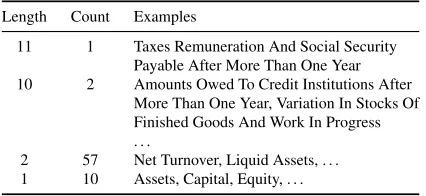
Table 1 illustrates the structure of xEBR terms. It is obvious that they are not comparable to gen-eral language, but instead are more like headlines in newspapers, which are often short, very informative and written in a telegraphic style. xEBR terms are often only noun phrases without determiners. The length of the financial terms varies, e.g. the longest financial term considered for translation has a length of 11 tokens, while others may consist of 1 or 2.
3.2 General Resources: EuroParl and JRC-Acquis
As a baseline, the largest available parallel corpora were used: EuroParl and the JRC-Acquis parallel corpus. The EuroParl parallel corpus holds the pro-ceedings of the European Parliament in 11 European languages. The JRC-Acquis corpus is available in almost all EU official languages (except Irish) and is a collection of legislative texts written between 1950 and today.
Although research work proved, that a training model built by using a general resource cannot be used to translate domain-specific terms (Wu et al., 2008), we decided to train a baseline model on these resources to illustrate any improvement steps from a general resource to specialised domain resources.
3.3 Domain Resource: Linguee
Linguee is a combination of a dictionary and a search engine, which indexes around 100 Million bilingual texts on words and expressions. Linguee search results show example sentences that depict how the searched expression has been translated in context.
In contrast to translation engines like Google Translate and Bing Translator, which give you the
most probable translation of a source text, every en-try in the Linguee database has been translated by humans. The bilingual dataset was gathered from the web, particularly from multilingual websites of companies, organisations or universities. Other sources include EU documents and patent specifica-tions.
The language pairs available for query-ing are English↔German, English↔Spanish, English↔French and English↔Portuguese.
Since Linguee includes EU documents, they also use parallel sentences from EuroParl and JRC-Acquis. We investigated the proportion of sentences returned by Linguee which are contained in Eu-roParl or JRC-Acquis. The outcome is that the num-ber of sentences is very low, where 131 sentences (0.54%) are gathered from JRC-Acquis corpus and 466 (1.92%) from EuroParl.
3.4 Collaborative Resource: Wikipedia
Wikipedia is a multilingual, freely available ency-clopedia that was built by a collaborative effort of voluntary contributors. All combined Wikipedias hold approximately 20 million articles or more than 8 billion words in more than 280 languages. With these facts it is the largest collection of freely avail-able knowledge5.
With the heavily interlinked information base, Wikipedia forms a rich lexical and semantic re-source. Besides a large amount of articles, it also holds a hierarchy of Categories that Wikipedia Articles are tagged with. It includes knowledge about named entities, domain-specific terms and word senses. Furthermore, the redirect system of Wikipedia articles can be used as a dictionary for synonyms, spelling variations and abbreviations.
3.5 Translation System: Moses
For generating translations from English into Ger-man and vice versa, the statistical translation toolkit Moses (Koehn et al., 2007) was used to build the training model and for decoding. For this approach, a phrase-based approach was taken instead of a tree based model. Further, we aimed at improving the translations only on the surface level, and therefore no part-of-speech information was taken into ac-count. Word and phrase alignments were built with
5
the GIZA++ toolkit (Och and Ney, 2003), whereby the 5-gram language model was built by SRILM (Stolcke, 2002).
4 Domain-specific Resource Generation
In this section, two different types of data and the approach of building them will be presented. Sec-tion 4.1 gives an overview of generating a paral-lel resource from Linguee, which was used in gen-erating a new domain-specific training model. In Section 4.2 a detailed description is given how we extracted terms from Wikipedia for generating a domain-specific lexicon.
4.1 Domain-specific parallel corpus generation
To build a new training model that is specialised on our xEBR ontology, we used the Linguee search en-gine. This resource can be queried on single words and on word expressions with or without quotation marks. We stored the HTML output of the Linguee queries on our financial terms and parsed these files to extract plain parallel text. From this, we built a fi-nancial parallel corpus with 13,289 translation pairs, including single words, multi-word expressions and sentences. The English part of the parallel resource contained 410,649 tokens, the German part 347,246.
4.2 Domain-specific lexicon generation
To improve translation based on the domain-specific parallel corpus, we built a cross-lingual terminolog-ical lexicon extracted from Wikipedia. From the Wikipedia Articles we used different information units, i.e. the Title of a Wikipedia Article, the Cat-egory (or Categories) of the Title and the internal Interwiki
Interlanguage links of the Title. The concept of Interwiki links can be used to make links to other Wikipedia Articles in the same language or to an-other Wikipedia language i.e. Interlanguage links.
In our first approach, we used Wikipedia to de-termine the domain (or several domains) of the on-tology. This approach (a) is to understand as the identification of the domain through the vocabulary of the ontology. For this approach, the financial terms, which were extracted from the ontology, were used to query the Wikipedia knowledge base6. The
6
For the Wikipedia Query we used the Wikipedia XML
Collected Wikipedia Categories
Frequency Name
8 Generally Accepted Accounting Principles
4 Debt
[image:4.612.334.517.61.154.2]4 Accounting terminology . . . 1 Political science terms 1 Physical punishments
Table 2: Collected Wikipedia Categories based on the ex-tracted financial terms
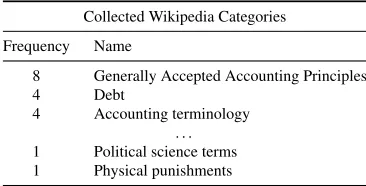
Wikipedia Article was considered for further exami-nation, if its Title is equivalent to our financial terms. In this first step, 7 terms of our ontology were iden-tified in the Wikipedia knowledge base. With this step, we collected the Categories of these Titles, which was the main goal of this approach. In a sec-ond round, we split all financial terms into all pos-sible n-grams and repeated the query again to find additional Categories based on the split n-grams. Ta-ble 2 shows the collected Categories of the first ap-proach and how often they appeared in respect to the extracted financial terms.
After storing all Categories, only such Categories were considered, which frequency had a value more than the calculated arithmetic mean of all frequen-cies (> 3.15). For the calculation of the arithmetic mean only Categories were considered, which had a frequency more than 1, since 2,262 of 3,615 col-lected Categories (62.6%) had a frequency equals 1. With this threshold we avoided extraction of a vo-cabulary that is not related to the ontology. Without this threshold, out-of-domain Categories would be stored, which would extend the lexicon with vocab-ulary that would not benefit the ontology translation, e.g.Physical punishments, which was access by the financial termStocks.
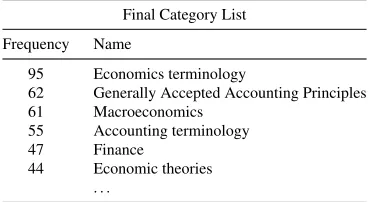
In the next step, we further extended the list of Categories collected previously by use of full and split terms. This was done by storing new Categories based on the Wikipedia Interwiki links of each Arti-cle which was tagged with a Category from Table 2. For example, we collected all Categories wherewith the Article Balance sheet7 is tagged and the Cate-gories of the 106 Interwiki links of the Article Bal-ance sheet. The frequencies of these Categories were summed up for all Interwiki links. Finally a
dump;enwiki-20120104-pages-articles.xml
7
Final Category List
Frequency Name
95 Economics terminology
62 Generally Accepted Accounting Principles 61 Macroeconomics
55 Accounting terminology 47 Finance
[image:5.612.93.278.62.163.2]44 Economic theories . . .
Table 3: Most frequent Categories based on the xEBR terms and their Interwiki links
new Category was added to the final Category list, if the new Category frequency exceeds the arithmetic mean threshold (>18.40).
The final Category list contained 33 financial Wikipedia Categories (Table 3), which was in the next step used for financial term extraction.
With the final list of Categories, we started an investigation of all Wikipedia articles tagged with these financial Categories. Each Wikipedia Title was considered as a useful domain-specific term and was stored in our lexicon if a German title in the Wikipedia knowledge base also existed. As an example, we examined the Category Account-ing terminology and stored the English Wikipedia Title Balance sheet with the German equivalent Wikipedia TitleBilanz.
At the end of the lexicon generation we examined 5228 Wikipedia Articles, which were tagged with one or more financial Categories. From this set of Articles we were able to generate a terminological lexicon with 3228 English-German entities.
5 Evaluation
Tables 4 to 5 illustrate the final results for our exper-iments on translating xEBR ontology terms, using the NIST (Doddington, 2002), BLEU (Papineni et al., 2002), and Meteor (Lavie and Agarwal, 2005) algorithms. To further study any translation im-provements of our experiment, we also used Google Translate8 in translating 63 financial xEBR terms (cf. Section 3.1) from English into German and from German into English.
5.1 Interpretation of Evaluation Metrics
In our experiments translation models built from a general resource performed worst. These
re-8
Translations were generated on February 2012.
Scoring Metric
Source # correct BLEU NIST Meteor
Google Translate 18 0.264 4.382 0.369
JRC-Acquis 12 0.167 3.598 0.323
EuroParl 4 0.113 2.630 0.326
Linguee 25 0.347 4.567 0.408
Lexical substitution 4 0.006 0.223 0.233
[image:5.612.321.532.185.279.2]Linguee+Wiki 25 0.324 4.744 0.432
Table 4: Evaluation scores for German term translations
Scoring Metric
Source # correct BLEU NIST Meteor
Google Translate 21 0.452 4.830 0.641
JRC-Acquis 9 0.127 2.458 0.480
EuroParl 5 0.021 1.307 0.412
Linguee 15 0.364 3.938 0.631
Lexical substitution 4 0.006 0.243 0.260
Linguee+Wiki 22 0.348 3.993 0.644
Table 5: Evaluation scores for English term translations
sults show that building resources from general lan-guage does not improve the translation of terms. The Linguee financial corpus, which is built from 13,289 sentences and holds 304K English and Ger-man 250K words, however demonstrates the ben-efit of domain-specific resources. Its size is less than two percent of that of the JRC-Acquis cor-pus (1,131,922 sentences, 21M English words, 19M German words), but evaluation scores are more than double than those for JRC-Acquis. This is clear evi-dence that such a resource benefits the translation of terms in a specific domain.
The models produced by the Linguee search en-gine are generating better translations than those produced by general resources. This approach out-performs Google Translate translations from Ger-man into English for all used evaluation metrics.
The table further shows results for our approach in using extracted Wikipedia terms as an example-based approach. For this we used the terms extracted from Wikipedia and exchanged English terms with German translations and vice versa. The evaluation metrics are very low in this case; only for Correct Translation we generate four positive findings.
combination of highly specialised resources gives the best results in our experiment. Translating fi-nancial terms into German, we get more Correct Translations as well as the Meteor metric shows better results compared to Google Translate. For translations into English, all used evaluation metrics show better results than those of Google Translate. As a final observation, we learned that translations made by domain-specific resources are on the same quality level, either if we translate from English into German or vice versa. In comparison, we see that Google Translate has a larger discrepancy when translating into German or English respectively. Our research showed that translations from English into German built by specialised resources were slightly better, which goes along with Google Translate that also produces better translations into German.
5.2 Manual Evaluation of Translation Quality
In addition to the automatic evaluation with BLEU, NIST, and Meteor scores, we have also undertaken a manual evaluation campaign to assess the transla-tion quality of the different systems. In this sectransla-tion, we will a) describe the annotation setup and task presented to the human annotators, b) report on the translation quality achieved by the different systems, and c) present inter-annotator agreement scores that allow to judge the reliability of the human rankings.
5.2.1 Annotation Setup
In order to manually assess the translation quality of the different systems under investigation, we de-signed a simple classification scheme consisting of three distinct classes:
1. Acceptable (A): terms classified as acceptable are either fully identical to the reference term or semantically equivalent;
2. Can easily be fixed (C): terms in this class require some minor correction (such as fixing of typos, removal of punctuation, etc.) but are nearly acceptable. The general semantics of the reference term are correctly conveyed to the reader.
3. None of both (N): the translation of the term does not match the intended semantics or it is plain wrong. Items in this class are considered severe errors which cannot easily be fixed and hence should be avoided wherever possible.
Classes
System A C N
[image:6.612.358.494.62.144.2]Linguee+Wiki 58% 27% 15% Google Translate 55% 31% 14% Linguee 51% 37% 12% JRC-Acquis 32% 28% 40% EuroParl 5% 25% 70%
Table 6: Results from the manual evaluation into German
Classes
System A C N
[image:6.612.358.496.174.257.2]Linguee+Wiki 56% 32% 12% Linguee 56% 31% 13% Google Translate 39% 40% 21% JRC-Acquis 39% 31% 30% EuroParl 15% 30% 55%
Table 7: Results from the manual evaluation into English
5.2.2 Annotation Data
We setup ten evaluation tasks, five for transla-tions into English, five for translatransla-tions into German. Each of these sets was comprised of 63 term transla-tions and the corresponding reference. Every set was given to at least three human annotators who then classified the observed translation output according to the classification scheme described above. The human annotators included both domain experts and lay users without knowledge of the terms domain.
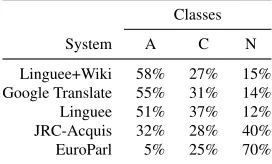
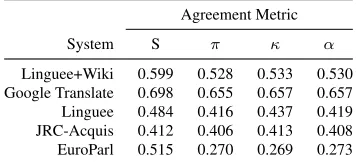
In total, we collected 2,520 classification items from six annotators. Tables 6, 7 show the results from the manual evaluation for term translations into German and English, respectively. We report the distribution of classes per evaluation task which are displayed inbest-to-worstorder.
In order to better be able to interpret these rank-ings, we computed the inter-annotator agreement be-tween human annotators. We report scores gener-ated with the following agreement metrics:
• S (Bennet et al., 1954);
• π(averaged across annotators)(Scott, 1955);
• κ(Fleiss and others, 1971);
• α(Krippendorff, 1980).
Tables 8, 9 present the aforementioned metrics scores for German and English term translations.
Agreement Metric
System S π κ α
[image:7.612.96.274.62.143.2]Linguee+Wiki 0.599 0.528 0.533 0.530 Google Translate 0.698 0.655 0.657 0.657 Linguee 0.484 0.416 0.437 0.419 JRC-Acquis 0.412 0.406 0.413 0.408 EuroParl 0.515 0.270 0.269 0.273
Table 8: Annotator agreement scores for German
Agreement Metric
System S π κ α
[image:7.612.96.275.178.261.2]Linguee+Wiki 0.532 0.452 0.457 0.454 Linguee 0.599 0.537 0.540 0.539 Google Translate 0.480 0.460 0.465 0.463 JRC-Acquis 0.363 0.359 0.366 0.360 EuroParl 0.552 0.493 0.499 0.495
Table 9: Annotator agreement scores for English
observed inter-annotator agreement, we expect the reported ranking results to be meaningful. Our Linguee+Wiki system performs best for both trans-lation directions while out-of-domain systems such as JRC-Acquis and EuroParl perform badly.
5.3 Manual error analysis
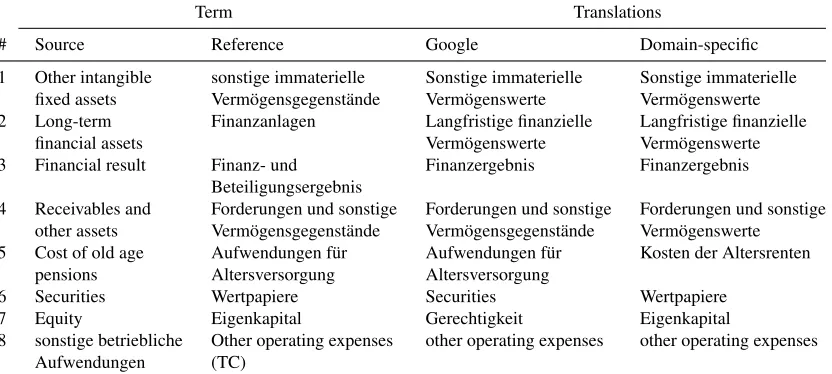
Table 10 provides a manual analysis of the provided translations from Google Translate and the com-bined Linguee and Wikipedia Lexicon approach. Example Ex. 1 shows the results for [Other intan-gible] fixed assets. Since both translating systems translate it the same, namelyVerm¨ogenswerte, they could be considered as term variants.
A similar example is [Receivables and other] as-sets in Ex. 4. Google Translate translates the segmentassetintoVerm¨ogensgegenst¨ande, whereby the domain-specific approach translates it into Verm¨ogenswerte. These examples prove the re-search by Kerremans (2010) that one term does not necessarily have only one translation on the target side. As term variants can further be considered Aufwendungen and Kosten, which were translated fromCosts[of old age pensions] (Ex. 5).
In contrast, the German term in [sonstige be-triebliche]Aufwendungen(Ex. 8) is according to the xEBR translated into [Other operating] expenses, which was translated correctly by both systems.
A deeper terminological analysis has to be done in the translation of the English term [Cost of] old age pensions(Ex. 5). In general it can be translated
into Altersversorgung (provided by Google Trans-late and xEBR) or Altersrente (generated by the domain-specific model). Doing a compound anal-ysis, the translation of [Alters]versorgungissupply ormaintenance. On the other side, the translation of [Alters]rente is pension, which has a stronger con-nection to the financial term in this domain.
Ex. 6 shows an improvement of domain spe-cific translation model in comparison to a general resource. Both general resources translated Securi-tiesasSicherheiten, which is correct but not in the fi-nancial domain. The domain-specific trained model translates the ambiguous term correctly, namely Wertpapiere. Google Translate generates the same term as on the source site, Securities. Further, the termEquity(Ex. 7) is translated by Google Translate asGerechtigkeit, the domain-specific model trans-lates it as Eigenkapital, which is the correct trans-lation. Finally, Ex. 2 and Ex. 3 open the issue of accurateness of the references for translation evalu-ation. The translations of these terms are correct if we consider the source language. On the other hand, if we compare them with the proposed references, they are not the same. In Ex. 2 they are truncated or extended in Ex. 3, which opens up problems in translation evaluation.
5.4 Discussion
Our approach shows the differences between im-proving translations with different resources. It was shown to be necessary to use additional language resources, i.e. specialised parallel corpora and if available, specialised lexica with appropriate trans-lations. Nevertheless, to move further in this direc-tion, translation of specific terms, more research is required in several areas that we identified in our ex-periment. One is the quality of the translation model. Because the translation model can only translate terms that are in the training model, it is necessary to use a domain-specific resource. Although we got better results with a smaller resource (if we translate into English), comparing those results with Google Translate, we learned that more effort has to be done in the direction of extending the size and quality of domain-specific resources.
Term Translations
# Source Reference Google Domain-specific
1 Other intangible sonstige immaterielle Sonstige immaterielle Sonstige immaterielle fixed assets Verm¨ogensgegenst¨ande Verm¨ogenswerte Verm¨ogenswerte 2 Long-term Finanzanlagen Langfristige finanzielle Langfristige finanzielle
financial assets Verm¨ogenswerte Verm¨ogenswerte
3 Financial result Finanz- und Finanzergebnis Finanzergebnis Beteiligungsergebnis
4 Receivables and Forderungen und sonstige Forderungen und sonstige Forderungen und sonstige other assets Verm¨ogensgegenst¨ande Verm¨ogensgegenst¨ande Verm¨ogenswerte 5 Cost of old age Aufwendungen f¨ur Aufwendungen f¨ur Kosten der Altersrenten
pensions Altersversorgung Altersversorgung
6 Securities Wertpapiere Securities Wertpapiere
7 Equity Eigenkapital Gerechtigkeit Eigenkapital
[image:8.612.100.516.64.251.2]8 sonstige betriebliche Other operating expenses other operating expenses other operating expenses Aufwendungen (TC)
Table 10: Translations provided by Google Translate and by the domain-specific resource
point where we outperform translations provided by Google Translate. Nevertheless, our experiment showed that the translations into German were bet-ter in regard of Google translate only for the Meteor evaluation system, for BLEU and NIST we did not achieve significant improvements. Also here more work has to be done in domain adaptation in a more sophisticated way to avoid building out-of-domain vocabulary.
6 Conclusion
The approach of building new resources showed a large impact on the translation quality. Therefore, generating specialised resources for different do-mains will be the focus of our future work. On the one hand, building appropriate training models is important, but our experiment also highlighted the importance of additional collaborative resources, like Wikipedia, Wiktionary, and DBpedia. Besides extracting Wikipedia Articles with their multilin-gual equivalents, as shown in Section 4.2, Wikipedia holds much more information in the articles itself. Therefore exploiting non-parallel resources, shown by Fiˇser et al. (2011), would clearly help the trans-lation system to improve performance. Future work needs to better include the redirect system, which would allow a better understanding of synonymy and spelling variety of terms.
Focusing on translating ontologies, we will try to better exploit the structure of the ontology itself.
Therefore, more work has to be done in the combi-nation of linguistic and semantic information (struc-ture of an ontology) as demonstrated by Aggarwal et al. (2011), which showed first experiments in com-bining semantic, terminological and linguistic infor-mation. They suggest that a deeper semantic analy-sis of terms, i.e. understanding the relations between terms and analysing sub-terms needs to be consid-ered. Another source of useful information may be found in using existing translations for improving the translation of other related terms in the ontology.
Acknowledgments
This work has been funded under the Seventh Framework Programme for Research and Techno-logical Development of the European Commission through the T4ME contract (grant agreement no.: 249119) and in part by the European Union under Grant No. 248458 for the Monnet project as well as by the Science Foundation Ireland under Grant No. SFI/08/CE/I1380 (Lion-2). The authors would like to thank Susan-Marie Thomas, Tobias Wunner, Ni-tish Aggarwal and Derek De Brandt for their help with the manual evaluation. We are grateful to the anonymous reviewers for their valuable feedback.
References
information. InThe Sixth International Workshop on Ontology Matching collocated with the 10th Interna-tional Semantic Web Conference (ISWC’11).
E. M. Bennet, R. Alpert, and A. C. Goldstein. 1954. Communications through limited response question-ing.Public Opinion Quarterly, 18:303–308.
Thierry Declerck, Hans-Ulrich Krieger, Susan M. Thomas, Paul Buitelaar, Sean O’Riain, Tobias Wun-ner, Gilles Maguet, John McCrae, Dennis Spohr, and Elena Montiel-Ponsoda. 2010. Ontology-based mul-tilingual access to financial reports for sharing busi-ness knowledge across europe. InInternal Financial Control Assessment Applying Multilingual Ontology Framework.
George Doddington. 2002. Automatic evaluation of ma-chine translation quality using n-gram co-occurrence statistics. In Proceedings of the second interna-tional conference on Human Language Technology Research, HLT ’02, pages 138–145.
M. Erdmann, K. Nakayama, T. Hara, and S. Nishio. 2008. An approach for extracting bilingual terminol-ogy from wikipedia. Lecture Notes in Computer Sci-ence, (4947):380–392. Springer.
Darja Fiˇser, ˇSpela Vintar, Nikola Ljubeˇsi´c, and Senja Pol-lak. 2011. Building and using comparable corpora for domain-specific bilingual lexicon extraction. In Pro-ceedings of the 4th Workshop on Building and Using Comparable Corpora: Comparable Corpora and the Web, BUCC ’11, pages 19–26.
J.L. Fleiss et al. 1971. Measuring nominal scale agree-ment among many raters. Psychological Bulletin, 76(5):378–382.
Koen Kerremans. 2010. A comparative study of termino-logical variation in specialised translation. In Recon-ceptualizing LSP Online proceedings of the XVII Eu-ropean LSP Symposium 2009, pages 1–14.
Philipp Koehn, Hieu Hoang, Alexandra Birch, Chris Callison-Burch, Marcello Federico, Nicola Bertoldi, Brooke Cowan, Wade Shen, Christine Moran, Richard Zens, Chris Dyer, Ondˇrej Bojar, Alexandra Con-stantin, and Evan Herbst. 2007. Moses: Open Source Toolkit for Statistical Machine Translation. In Pro-ceedings of the 45th Annual Meeting of the ACL, ACL ’07, pages 177–180.
Philipp Koehn. 2005. Europarl: A Parallel Corpus for Statistical Machine Translation. In Conference Proceedings: the tenth Machine Translation Summit, pages 79–86. AAMT.
Klaus Krippendorff. 1980. Content Analysis: An Intro-duction to Methodology. Sage Publications, Inc. J. R. Landis and G. G. Koch. 1977. The measurement of
observer agreement for categorical data. Biometrics, 33(1):159–174.
Alon Lavie and Abhaya Agarwal. 2005. Meteor: An automatic metric for mt evaluation with improved cor-relation with human judgments. InProceedings of the EMNLP 2011 Workshop on Statistical Machine Trans-lation, pages 65–72.
Christof M¨uller and Iryna Gurevych. 2008. Using wikipedia and wiktionary in domain-specific informa-tion retrieval. InWorking Notes for the CLEF 2008 Workshop.
Franz Josef Och and Hermann Ney. 2003. A system-atic comparison of various statistical alignment mod-els. Computational Linguistics, 29.
Kishore Papineni, Salim Roukos, Todd Ward, and Wei-Jing Zhu. 2002. Bleu: a method for automatic eval-uation of machine translation. InProceedings of the 40th Annual Meeting on Association for Computa-tional Linguistics, ACL ’02, pages 311–318.
W. A. Scott. 1955. Reliability of Content Analysis: The Case of Nominal Scale Coding. Public Opinion Quar-terly, 19:321–325.
Ralf Steinberger, Bruno Pouliquen, Anna Widiger, Camelia Ignat, Tomaz Erjavec, Dan Tufis, and Dniel Varga. 2006. The jrc-acquis: A multilingual aligned parallel corpus with 20+ languages. In Proceedings of the 5th International Conference on Language Re-sources and Evaluation (LREC’2006).
Andreas Stolcke. 2002. Srilm-an extensible language modeling toolkit. InProceedings International Con-ference on Spoken Language Processing, pages 257– 286.
Jorge Vivaldi and Horacio Rodriguez. 2010. Using wikipedia for term extraction in the biomedical do-main: first experiences. Procesamiento del Lenguaje Natural, 45:251–254.
Marion Weller, Anita Gojun, Ulrich Heid, B´eatrice Daille, and Rima Harastani. 2011. Simple methods for dealing with term variation and term alignment. InProceedings of the 9th International Conference on Terminology and Artificial Intelligence, pages 87–93. Hua Wu, Haifeng Wang, and Chengqing Zong. 2008.
Domain adaptation for statistical machine translation with domain dictionary and monolingual corpora. In
Proceedings of the 22nd International Conference on Computational Linguistics - Volume 1, COLING ’08, pages 993–1000.