Incremental dialogue act understanding
Volha Petukhova
Tilburg Center for Creative Computing Tilburg University, The Netherlands,
Harry Bunt
Tilburg Center for Creative Computing Tilburg University, The Netherlands,
Abstract
This paper presents a machine learning-based approach to the incremental understanding of dia-logue utterances, with a focus on the recognition of their communicative functions. A token-based approach combining the use of local classifiers, which exploit local utterance features, and global classifiers which use the outputs of local classifiers applied to previous and subsequent tokens, is shown to result in excellent dialogue act recognition scores for unsegmented spoken dialogue. This can be seen as a significant step forward towards the development of fully incremental, on-line meth-ods for computing the meaning of utterances in spoken dialogue.
1
Introduction
When reading a sentence in a text, a human language understander obviously does not wait trying to understand what he is reading until he has come to the end of the sentence. Similarly for participants in a spoken conversation. There is overwhelming psycholinguistic evidence that human understanders construct syntactic, semantic, and pragmatic hypotheses on the fly, while receiving the written or spoken input. Dialogue phenomena such as backchannelling (providing feedback while someone else is speak-ing), the completion of a partner utterance, and requests for clarification that overlap the utterance of the main speaker, illustrate this. Evidence from the analysis of nonverbal behaviour in multimodal dialogue lends further support to the claim that human understanding works incrementally, as input is being re-ceived. Dialogue participants start to perform certain body movements and facial expressions that are perceived and interpreted by others as dialogue acts (such as head nods, smiles, frowns) while another participant is speaking, see e.g. Petukhova and Bunt (2009). As another kind of evidence, eye-tracking experiments by Tanenhaus et al. (1995), Sedivy et al. (1999) and Sedivy (2003) showed that definite descriptions are resolved incrementally when the referent is visually accessible.
Traditional models of language understanding for dialogue systems, by contrast, are pipelined, mod-ular, and operate on complete utterances. Typically, such a system has an automatic speech recognition module, a language understanding module responsible for syntactic and semantic analysis, an interpre-tation manager, a dialogue manager, a natural language generation module, and a module for speech synthesis. The output of each module is the input for another. The language understanding module typ-ically performs the following tasks: (1)segmentation: identification of relevant segments in the input, such as sentences;(2)lexical analysis: lexical lookup, possibly supported by morphological processing, and by additional resources such as WordNet, VerbNet, or lexical ontologies; (3)parsing: construction of syntactic interpretations; (4) semantic analysis: computation of propositional, referential, or action-related content; and (5)pragmatic analysis: determination of speaker intentions.
been less successful (see e.g. Haddock (1989); Milward and Cooper (2009)), but work in computational semantics on the design of underspecified representation formalisms has shown that such formalisms, developed originally for the underspecified representation of quantifier scopes, can also be applied in situations where incomplete input information is available (see e.g. Bos (2002); Bunt (2007), Hobbs (1985), Pinkal (1999)) and as such hold a promise for incremental semantic interpretation.
Pragmatic interpretation, in particular the recognition of a speaker’s intentions in incoming dialogue utterances, is another major aspect of language understanding for dialogue systems. Computational modelling of dialogue behaviour in terms of dialogue acts aims to capture speaker intentions in the com-municative functions of dialogue acts, and offers an effective integration with semantic content analysis through the information state update approach (Poesio and Traum (1998)). In this approach, a dialogue act is viewed as having as its main components a communicative function and a semantic content, where the semantic content is the referential, propositional, or action-related information that the dialogue act addresses, and the communicative function defines how an understander’s information state is to be up-dated with that information.
Evaluation of a non-incremental dialogue system and its incremental counterpart reported in Aist et al. (2007) showed that the latter is faster overall than the former due to the incorporation of pragmatic information in early stages of the understanding process. Since users formulate utterances incrementally, partial utterances may be available for a substantial amount of time and may be interpreted by the system. An incremental interpretation strategy may allow the system to respond more quickly, by minimizing the delay between the time the user finishes and the time the utterance is interpreted DeVault and Stone (2003).
This suggests that a dialogue system performance may benefit from reliable partial processing of input. This paper is concerned with the automatic recognition of dialogue acts based on partially available input and shows that in order to arrive at the best output prediction two different classification strategies are needed: (1) local classification that is based on features observed in dialogue behaviour and that can be extracted from the annotated data; and (2) global classification that takes the locally predicted context into account.
This paper is structured as follows. In Section 2 we will outline performed experiments describing the data, tagset, features, algorithms and evaluation metrics that have been used. Section 3 reports on the experimental results, applying a variety of machine learning techniques and feature selection algorithms, to assess the automatic recognition and classification of dialogue acts using simultaneous incremental segmentation and dialogue act classification. In Section 4 we discuss strategies in management and correction of the output of local classifies. Section 5 concludes.
2
Incremental understanding experiments
2.1 Related work
Nakano et al. (Nakano et al. (1999)) proposed a method for the incremental understanding of utterances whose boundaries are not known. TheIncremental Sentence Sequence Search(ISSS) algorithm finds plausible boundaries of utterances, called significant utterances (SUs), which can be a full sentence or a subsentential phrase, such as a noun phrase or a verb phrase. Any phrase that can change the belief state is defined as a SU. In this sense an SU corresponds more or less with what we call a ‘functional segment’, which is defined as a minimal stretch of behaviour that has a communicative function (see Bunt et al. (2010)). ISSS maintains multiple possible belief states, and updates these each time a word hypothesis is input. The ISSS approach does not deal with the multifunctionality of segments, however, and does not allow segments to overlap.
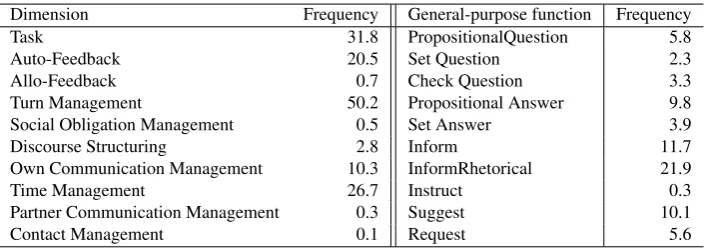
Dimension Frequency General-purpose function Frequency Task 31.8 PropositionalQuestion 5.8 Auto-Feedback 20.5 Set Question 2.3 Allo-Feedback 0.7 Check Question 3.3 Turn Management 50.2 Propositional Answer 9.8 Social Obligation Management 0.5 Set Answer 3.9 Discourse Structuring 2.8 Inform 11.7 Own Communication Management 10.3 InformRhetorical 21.9
Time Management 26.7 Instruct 0.3
Partner Communication Management 0.3 Suggest 10.1
[image:3.595.122.477.69.193.2]Contact Management 0.1 Request 5.6
Table 1: Distribution of functional tags across dimensions and general-purpose functions for the AMI corpus (in %).
or interrupted words). Segmentation and classification of dialogue acts are performed simultaneously in one step. Geertzen (2009) reports on classifier performance on this task for the DIAMOND data1using DIT++
labels. The success scores in terms of F-scores range from 47.7 to 81.7. It was shown that per-forming segmentation and classification together results in better segmentation, but affects the dialogue act classification negatively.
The incremental dialogue act recognition system proposed here takes the token-based approach for building classifiers for the recognition (segmentation and classification) of multiple dialogue acts for each input token, and adopts the ISSS idea for information-state updates based on partial input interpretation.
2.2 Tagset
The data selected for the experiments was annotated with the DIT++
tagset Release 42. The DIT tax-onomy distinguishes 10 dimensions, addressing information about: the domain or task (Task), feedback on communicative behaviour of the speaker (Auto-feedback) or other interlocutors (Allo-feedback), man-aging difficulties in the speaker’s contributions (Own-Communication Management) or those of other interlocutors (Partner Communication Management), the speaker’s need for time to continue the di-alogue (Time Management), establishing and maintaining contact (Contact Management), about who should have the next turn (Turn Management), the way the speaker is planning to structure the dialogue, introducing, changing or closing a topic (Dialogue Structuring), and conditions that trigger dialogue acts by social convention (Social Obligations Management), see Table 1.
For each dimension, at most one communicative function can be assigned, which is either a function that can occur in this dimension alone (adimension-specific(DS) function) or a function that can occur in any dimension (ageneral-purpose(GP) function). Dialogue acts with a DS communicative function are always concerned with a particular type of information, such as a Turn Grabbing act, which is concerned with the allocation of the speaker role, or a Stalling act, which is concerned with the timing of utterance production. GP functions, by contrast, are not specifically related to any dimension in particular, e.g. one can ask a question about any type of semantic content, provide an answer about any type of content, or request the performance of any type of action (such asCould you please close the doororCould you please repeat that). These communicative functions include Question, Answer, Request, Offer, Inform, and many other familiar core speech acts.
The tagset used in these studies contains 38 dimension-specific functions and 44 general-purpose functions. A tag consists either of a pair consisting of a communicative function (CF) and the addressed dimension (D).
1For more information see Geertzen,J., Girard,Y., and Morante,R. 2004. The DIAMOND project. Poster at the 8th
Work-shop on the Semantics and Pragmatics of Dialogue (CATALOG 2004).
2For more information about the tagset and the dimensions that are identified, please visit:http://dit.uvt.nl/or see
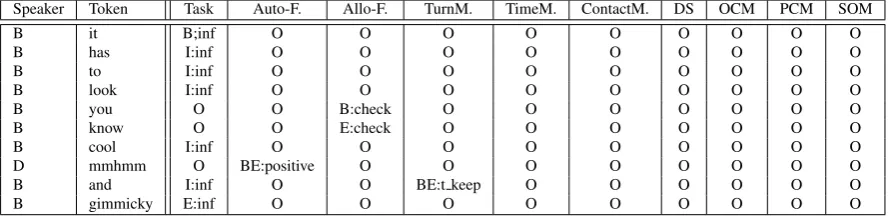
Speaker Token Task Auto-F. Allo-F. TurnM. TimeM. ContactM. DS OCM PCM SOM
B it B;inf O O O O O O O O O
B has I:inf O O O O O O O O O
B to I:inf O O O O O O O O O
B look I:inf O O O O O O O O O
B you O O B:check O O O O O O O
B know O O E:check O O O O O O O
B cool I:inf O O O O O O O O O
D mmhmm O BE:positive O O O O O O O O
B and I:inf O O BE:t keep O O O O O O
[image:4.595.76.522.71.179.2]B gimmicky E:inf O O O O O O O O O
Figure 1:Segment boundaries and dialogue act label encoding in different dimensions.
2.3 Features and data encoding
In the recognition experiments we used data from the AMI meeting corpus3. For training we used three annotated AMI meetings that contain 17,335 tokens forming 3,897 functional segments. The distribution of functional tags across dimensions is given in Table 1.
Features extracted from the data considered here relate todialogue history: functional tags of the 10 previous turns;timing: tokendurationandfloor-transfer offset4computed in milliseconds;prosody: minimum, maximum, mean, and standard deviation for pitch (F0 in Hz), energy (RMS), voicing (fraction of locally unvoiced frames and number of voice breaks) and speaking rate (number of syllables per second)5; andlexical information: token occurrence, bi- and trigram of those tokens. In total, 1,668 features are used for the AMI data.
To be able to identify segment boundaries, we assign to each token its communicative function label and indicate whether a token starts a segment (B), is inside a segment (I), ends a segment (E), is out-side a segment (O), or forms a functional segment on its own (BE). Thus, the class labels consist of a segmentation prefix (IBOE) and a communicative function label, see example in Figure 1.
2.4 Classifiers and evaluation metrics
A wide variety of machine-learning techniques has been used for NLP tasks with various instantiations of feature sets and target class encodings. For dialogue processing, it is still an open issue which techniques are the most suitable for which task. We used two different types of classifiers to test their performance on our dialogue data: a probabilistic one and a rule inducer.
As a probabilistic classifier we usedBayes Nets. This classifier estimates probabilities rather than produce predictions, which is often more useful because this allows us to rank predictions. Bayes Nets estimate the conditional probability distribution on the values of the class attributes given the values of the other attributes.
As a rule induction algorithm we choseRipper(Cohen (1995)). The advantage of a rule inducer is that the regularities discovered in the data are represented as human-readable rules.
The results of all experiments were obtained using 10-fold cross-validation.7 As a baseline it is common practice to use the majority class tag, but for our data sets such a baseline is not very useful because of the relatively low frequencies of the tags in some dimensions. Instead, we use a baseline
3
The A
¯ugmented M¯ulti-party I¯nteraction meeting corpus consists of multimodal task-oriented human-human multi-party dialogues in English, for more information visit (http://www.amiproject.org/
4
Difference between the time that a turn starts and the moment the previous turn ends.
5
These features were computed using the PRAAT tool6. We examined both raw and normalized versions of these features. Speaker-normalized features were obtained by computing z-scores (z = (X-mean)/standard deviation) for the feature, where mean and standard deviation were calculated from all functional segments produced by the same speaker in the dialogues. We also used normalizations by first speaker turn and by previous speaker turn.
7
that is based on a single feature, namely, the tag of the previous dialogue utterance (see Lendvai et al. (2003))).
Several metrics have been proposed for the evaluation of a classifier’s performance: error metrics and performance metrics. The word-based error rate metric, introduced in Ang et al. (2005), measures the percentage of words that were placed in a segment perfectly identical to that in the reference. The dialogue act based metric (DER) was proposed in Zimmermann et al. (2005). In this metric a word is considered to be correctly classified if and only if it has been assigned the correct dialogue act type and it lies in exactly the same segment as the corresponding word of the reference. We will use the combined
DERscerror metric to evaluate joint segmentation (s) and classification (c):
DERsc =
T okens with wrong boundaries and/or f unction class total number of tokens ×100
To assess the quality of classification results, the standard F-score metric is used, which represents the balance between precision and recall.
3
Classification results
Dialogue utterances are often multifunctional, having a function in more than one dimension (see e.g. Bunt (2010)). This makes dialogue act recognition a complex task. Splitting up the output structure may make the task more manageable; for instance, a popular strategy is to split a multi-class learning task into several binary learning tasks. Sometimes, however, learning of multiple classes allows a learning algorithm to exploit the interactions among classes. We will combine these two strategies. We have built in total 64 classifiers for dialogue act recognition for the AMI data. Some of the tasks were defined as binary ones, e.g. the dimension recognition task, others are multi-class learning tasks.
We first trained classifiers to recognize the boundaries of a segment and its communicative functions (joint multi-class learning task) per dimension, see Table 2.
BL BayesNet Ripper Dimensions F1 DERsc F1 DERsc F1 DERsc
[image:5.595.123.475.444.590.2]Task 32.7 51.2 52.1 48.7 66.7 42.6 Auto-Feedback 43.2 84.4 62.7 33.9 60.1 45.6 Allo-Feedback 70.2 59.5 73.7 35.1 71.3 49.1 Turn Management:initial 34.2 95.2 57.0 58.4 54.3 81.3 Turn Management:close 33.3 92.7 54.2 46.9 49.3 87.3 Time Management 43.7 96.5 64.5 46.1 61.4 53.1 Discourse Structuring 41.2 35.1 72.7 19.9 50.2 30.9 Contact Management 59.9 53.2 71.4 49.9 83.3 37.2 Own Communication Management 36.5 87.9 68.3 51.3 58.3 76.8 Partner Communication Management 49.5 59.0 58.5 45.5 51.4 58.7 Social Obligation Management 34.5 47.5 86.5 35.9 83.3 44.3
Table 2: Overview of F-scores andDERscfor the baseline (BL) and the classifiers for joint segmentation and
classification for each DIT++dimension, for the data of the AMI corpus.
insidesegments and are better classified, e.g. the inside-tokens of Set Questions are classified with high precision (83%) and reasonably high recall scores (76%). Still, this is rather worrying, since the correct identification of, in particular, the start of a relevant segment is crucial for future decisions. These obser-vations led us to the conclusion that the search space and the number of initially generated hypotheses for classifiers should be reduced, and we split the classification task in such a way that a classifier needs to learn one particular type of communicative function.
We trained a classifier for each general-purpose and dimension-specific function defined in the DIT++
taxonomy, and observed that this has the effect that the various classifiers perform significantly better. These functions were learned (1) in isolation; (2) as semantically related functions together, e.g. all information-seeking functions (all types of questions) or all information-providing functions (all an-swers and all informs). Both the recognition of communicative functions and that of segment boundaries improves significantly. Table 3 gives an overview of the overall performance (best obtained scores) of the trained classifiers after splitting the learning task.
BL BayesNet Ripper Classification task F1 DERsc F1 DERsc F1 DERsc
General-purpose functions
Propositional Questions 47.0 39.1 94.9 3.9 75.8 23.5 Check Questions 43.8 56.4 68.5 19.6 61.3 33.1 Set Questions 44.8 52.1 74.1 18.6 76.3 17.7 Inform 45.8 39.9 79.8 18.7 66.5 30.5 Inform Rhetorical 37.2 38.9 69.1 13.4 68.7 23.9 Agreement 41.3 79.1 72.1 12.6 71.6 60.2 Propositional Answer 32.0 77.8 66.8 26.1 52.2 53.8 Set Answer 44.3 54.2 77.5 13.2 57.3 44.1 Suggest 45.8 38.4 65.6 17.3 48.8 35.6 Request 45.8 49.3 75.8 14.5 50.3 36.9 Instruct 46.3 49.3 60.5 14.5 46.3 36.9 Dimension-specific functions
[image:6.595.120.477.259.538.2]Auto-Feedback 57.1 23.5 78.8 13.2 66.7 15.5 Allo-Feedback 89.3 4.4 95.1 2.9 94.3 3.9 Turn Management:initial 24.8 21.9 72.8 7.4 46.3 10.7 Turn Management:close 30.7 64.9 62.0 22.5 54.7 39.6 Time management 68.3 32.3 82.4 13.7 92.8 11.4 Discourse Structuring 40.7 13.6 72.6 2.5 74.5 1.7 Contact Management 21.4 48.6 89.2 5.7 92.3 3.6 Own Communication Management 26.7 48.6 78.0 11.6 68.1 20.0 Partner Communication Management 33.4 18.2 77.8 8.5 88.9 6.5 Social Obligation Management 60.0 18.7 88.9 8.3 90.1 5.5
Table 3: Overview of F-scores and DERsc for the baseline (BL) and the classifiers upon joint segmentation
and classification task for each DIT++
communicative function or cluster of functions. (Best scores indicated by numbers in bold face.)
Segments having a general-purpose functions may address any of the ten DIT dimensions. The task of dimension recognition can be approached in two ways. One approach is to learn segment boundaries, communicative function label and dimension in one step (e.g. the class labelB:task;inform). This task is very complicated, however. First, it leads to data which are high dimensional and sparse, which will have a negative influence on the performance of the trained classifiers. Second, in many cases the dimension can be recognized reliably only with some delay; for the first few segment tokens it is often impossible to say what the segment is about. For example:
(1) 1. What do you think who we’re aiming this at? 2. What do you think we are doing next? 3. What do you think Craig?
purpose of Discourse Structuring; and Question 3 elicits feedback.
Another approach is to first recognize segment boundaries and communicative function, and define dimension recognition as a separate classification task.
Tokens SetQuestion Task Auto-F. TurnM. Complex label (BIOE:D;CF) label p label p label p label p label p
what B:setQ 0.85 O 0.71 O 1 O 0.68 O 0.933 you I:setQ 1 task 0.985 O 1 B:give 0.64 O 0.869 guys I:setQ 1 task 0.998 O 1 E:give 0.66 O 0.937 have I:setQ 1 task 0.997 O 1 O 1 I:task;setQ 0.989 already I:setQ 1 task 0.996 O 1 O 0.99 I:task;setQ 0.903 received I:setQ 1 task 0.987 O 1 O 1 I:task;setQ 0.813 um O 0.93 O 0.89 O 1 BE:keep 0.99 O 0.982 in I:setQ 1 task 0.826 O 1 O 0.89 I:task;setQ 0.875 your I:setQ 1 task 0.996 O 1 O 0.99 I:task;setQ 0.948 mails E:setQ 0.99 task 0.987 O 1 O 1 E:task;setQ 0.948
Figure 2: Predictions with indication of confidence scores (highestpclass probability selected) for each token assigned by five trained classifiers simultaneously.
We tested both strategies. The F-scores for the joint learning of complex class labels range from 23.0 (DERsc = 68.3) to 45.3 (DERsc = 63.8). For dimension recognition as a separate learning task
the F-scores are significantly higher, ranging from 70.6 to 97.7. The scores for joint segmentation and function recognition in the latter case are those listed in Table 3. Figure 2 gives an example of predictions made by five classifiers for the inputwhat you guys have already received um in your mails.
4
Managing local classifiers
4.1 Global classification and global search
As shown in the previous section, given a certain input we obtain all possible output predictions (hypothe-ses) from local classifiers. Some predictions are false, but once a local classifier has made a decision it is never revisited. It is therefore important to base the decision on dialogue act labels not only on local features of the input, but to take other parts of the output into account as well. For example, the partial output predicted so far, i.e. the history of previous predictions, may be taken as features for the next classification step, and helps to discover and correct errors. This is known as ‘recurrent sliding window strategy’ (see Dietterich (2002)) when the true values of previous predictions are used as features. This approach suffers from the label bias problem, however, when a classifier overestimates the importance of certain features, and moreover does not apply in a realistic situation, since the true values of previous predictions are not available to a classifier in real time. A solution proposed by Van den Bosch (1997) is to apply adaptive training using thepredictedoutput of previous steps as features.
We trained higher-level classifiers (often referred to as ‘global’) that have, along with features ex-tracted locally from the input data as described above, the partial output predicted so far from all local classifiers. We used five previously predicted class labels, assuming that long distance dependencies may be important, and taking into account that the average length of a functional segment in our data is 4.4 tokens. Table 4 gives an overview of the results of applying these global classifiers. We see that the global classifiers make more accurate predictions than the local classifiers, showing an improvement of about 10% on average. The classifiers still make some incorrect predictions, because the decision is sometimes based on incorrect previous predictions. An optimized global search strategy may lead to further improvements of these results.
Classification task BayesNet Ripper
F1 DERsc F1 DERsc
Task 65.3 14.9 79.1 21.8
Auto-Feedback 72.9 8.1 77.8 7.2 Allo-Feedback 67.7 10.9 74.2 9.5 Turn Management:initial 72.2 11.5 69.5 11.4 Turn Management:close 82.7 5.0 83.0 4.9 Time Management 70.0 3.0 73.5 2.1 Discourse Structuring 72.3 4.9 63.7 3.6 Contact Management 79.1 4.5 84.3 4.6 Own Communication Management 66.0 2.4 68.3 2.3 Partner Communication Management 63.2 7.8 59.5 11.4 Social Obligation Management 88.4 0.9 81.6 1.7
Table 4: Overview of F-scores andDERsc of the global classifiers for the AMI data based on added previous
predictions of local classifiers.
currently produced functional segment). This is particular useful for dialogue act recognition because the recognition of intentions should be based on the system’s understanding of discourse and not just on the interpretation of an isolated utterance. Searching the (partial) output space for the best predictions is not always the best strategy, however, since the highest-ranking predictions are not always correct in a given context. A possible solution to this is to postpone the prediction until some (or all) future predictions have been made for the rest of the segment. For training, the classifier then uses not only previous predictions as additional features, but also some or all future predictions of local classifiers (till the end of the current segment or to the beginning of the next segment, depending on what is recognized). This forces the classifier to not immediately select the highest-ranking predictions, but to also consider lower-ranking predictions that could be better in the context of the rest of the sequence.
Classification task BayesNet Ripper
F1 DERsc F1 DERsc
Task 82.6 9.5 86.1 8.3
[image:8.595.155.443.69.217.2]Auto-Feedback 81.9 1.9 95.1 0.6 Allo-Feedback 96.3 0.6 95.7 0.5 Turn Management:initial 85.7 1.5 81.5 1.6 Turn Management:close 90.9 3.8 91.2 3.6 Time management 90.4 2.4 93.4 1.7 Discourse Structuring 82.1 1.7 78.3 1.8 Contact Management 87.9 1.2 94.3 0.6 Own Communication Management 78.4 2.2 81.6 2.0 Partner Communication Management 71.8 2.4 70.0 4.6 Social Obligation Management 98.6 0.4 98.6 0.5
Table 5:Overview of F-scores andDERscof global classifiers for the AMI data per DIT
++
dimension.
The results show the importance of optimal global classification for finding the best output prediction. We performed similar experiments on the English MapTask data8and obtained comparable results, where F-scores on the global classification task range from 66.7 for Partner Communication Management and Discourse Structuring to 79.7 for Task and 91.2 for Allo-Feedback. For the MapTask corpus the performance of human annotators on segmentation and classification has been assessed; standard kappa scores reported in Bunt et al. (2007) range between 0.92 and 1.00, indicating near perfect agreement between two expert annotators9.
8For more information about the MapTask corpus seehttp://www.hcrc.ed.ac.uk/maptask/ 9
Note, however, that a slightly simplified version of the DIT++
5
Conclusions and future research
The incremental construction of input interpretation hypotheses is useful in a language understanding system, since it has the effect that the understanding of a relevant input segment is already nearly ready when the last token of the segment is received; when a dialogue act is viewed semantically as a recipe for updating an information state, this means that the specification of the update operation is almost ready at that moment, thus allowing an instantaneous response from the system. It may even happen that the con-fidence score of a partially processed input segment is that high, that the system may decide to go forward and update its information state without waiting until the end of the segment, and prepare or produce a response based on that update. Of course, full incremental understanding of dialogue utterances includes not only the recognition of communicative functions, but also that of semantic content. However, many dialogue acts have no or only marginal semantic content, such as turn-taking acts, backchannels (m-hm) and other feedback acts (okay), time management acts (Just a moment), apologies and thankings and other social obligation management acts, and in general dialogue acts with a dimension-specific func-tion; for these acts the proposed strategy can work well without semantic content analysis, and will increase the system’s interactivity significantly. Moreover, given that the average length of a functional segment in our data is no more than 4.4 tokens, the semantic content of such a segment tends not to be very complex, and its construction therefore does not seem to require very sophisticated computational semantic methods, applied either in an incremental fashion (see e.g. Aist et al. (2007) and DeVault and Stone (2003)) or to a complete segment.
Interactivity is however not the sole motivation for incremental interpretation. The integration of pragmatic information obtained from the dialogue act recognition module, as proposed here, at early processing stage can be beneficially used by the incremental semantic parser (but also syntactic parser module). For instance, information about the communicative function of the incoming segment at early processing stage can defuse a number of ambiguous interpretations, e.g. used for the resolution of many anaphoric expressions. A challenge for future work is to integrate the incremental recognition of communicative functions with incremental syntactic and semantic parsing, and to exploit the interaction of syntactic, semantic and pragmatic hypotheses in order to understand incoming dialogue segments incrementally in an optimally efficient manner.
Acknowledgments
This research was conducted within the project ’Multidimensional Dialogue Modelling’, sponsored by the Netherlands Organ-isation for Scientific Research (NWO), under grant reference 017.003.090. We are also very thankful to anonymous reviewers for their valuable comments.
References
Aist, G., J. Allen, E. Campana, C. Gomez Gallo, S. Stoness, M. Swift, and M. K. Tanenhaus (2007). Incremental understanding in human-computer dialogue and experimental evidence for advantages over nonincremental methods. InProceedings of the 11th Workshop on the Semantics and Pragmatics of Dialogue, Trento, Italy, pp. 149–154.
Ang, J., Y. Liu, and E. Shriberg (2005). Automatic dialog act segmentation and classification in multiparty meet-ings. InProceedings of the ICASSP, Volume vol. 1, Philadelphia, USA, pp. 10611064.
Bos, J. (2002). Underspecification and resolution in discourse semantics. PhD Thesis. Saarbr¨ucken: Saarland University.
Bunt, H. (2007). Semantic underspecification: which techniques for what purpose? InComputing Meaning, Vol. 3, pp. 55–85. Dordrecht: Springer.
Bunt, H. (2009). The DIT++ taxonomy for functional dialogue markup. In Proceedings of the AAMAS 2009 Workshop ‘Towards a Standard Markup Language for Embodied Dialogue Acts’ (EDAML 2009), Budapest.
Bunt, H., J. Alexandersson, J. Carletta, J.-W. Choe, A. Fang, K. Hasida, K. Lee, V. Petukhova, A. Popescu-Belis, L. Romary, C. Soria, and D. Traum (2010).Language resource management – Semantic annotation framework – Part 2: Dialogue acts. ISO DIS 24617-2. Geneva: ISO Central Secretariat.
Bunt, H., V. Petukhova, and A. Schiffrin (2007). Lirics deliverable d4.4. multilingual test suites for semantically annotated data. Available athttp://lirics.loria.fr.
Cohen, W. (1995). Fast effective rule induction. InProceedings of the 12th International Conference on Machine Learning (ICML’95), pp. 115–123.
DeVault, D. and M. Stone (2003). Domain inference in incremental interpretation. InProceedings of the Workshop on Inference in Computational Semantics, INRIA Lorraine, Nancy, France.
Dietterich, T. (2002). Machine learning for sequential data: a review. InProceedings of the Joint IAPR Interna-tional Workshop on Structural, Syntactic, and Statistical Pattern Recognition, pp. 15–30.
Geertzen, J. (2009). Dialogue act recognition and prediction: exploration in computational dialogue modelling. The Netherlands: Tilburg University.
Geertzen, J., V. Petukhova, and H. Bunt (2007, September). A multidimensional approach to utterance segmenta-tion and dialogue act classificasegmenta-tion. InProceedings of the 8th SIGdial Workshop on Discourse and Dialogue, Antwerp, Belgium, pp. 140–149. Association for Computational Linguistics.
Haddock, N. (1989). Computational models of incremental semantic interpretation. Language and Cognitive Processes Vol. 14 (3), SI337–SI380.
Hobbs, J. (1985). Ontological promiscuity. InProceedings 23rd Annual Meeting of the ACL, Chicago, pp. 61–69.
Lendvai, P., v. d. A. Bosch, and E. Krahmer (2003). Machine learning for shallow interpretation of user utter-ances in spoken dialogue systems. InProceedings of EACL-03 Workshop on Dialogue Systems: interaction, adaptation and styles of management, Budapest.
Lendvai, P. and J. Geertzen (2007). Token-based chunking of turn-internal dialogue act sequences. InProceedings of the 8th SIGdial Workshop on Discourse and Dialogue, Antwerp, Belgium, pp. 174–181.
Milward, D. and R. Cooper (2009). Incremental interpretation: applications, theory, and relationship to dynamic semantics. InProceedings COLING 2009, Kyoto, Japan, pp. 748–754.
Nakano, M., N. Miyazaki, J. Hirasawa, K. Dohsaka, and T. Kawabata (1999). Understanding unsegmented user ut-terances in real-time spoken dialogue systems. InProceedings of the 37th Annual Conference of the Association of Computational Linguistics, ACL, pp. 200–207.
Petukhova, V. and H. Bunt (2009). Who’s next? speaker-selection mechanisms in multiparty dialogue. In Pro-ceedings of the Workshop on the Semantics and Pragmatics of Dialogue, Stockholm,, pp. 19–26.
Pinkal, M. (1999). On semantic underspecification. InComputing Meaning, Vol. 1, pp. 33–56. Dordrecht: Kluwer.
Poesio, M. and D. Traum (1998). Towards an Axiomatization of Dialogue Acts. InProceedings of the Twente Workshop on the Formal Semantics and Pragmatics of Dialogue, Twente, pp. 309–347.
Sedivy, J. (2003). Pragmatic versus form-based accounts of referential contrast: Evidence for effects of informa-tivity expectations.Journal of Psycolinguistic Research 32(1), 3–23.
Sedivy, J., M. Tanenhaus, C. Chambers, and G. Carlson (1999). Achieving incremental semantic interpretation through contextual representation.Cognition 71, 109–147.
Tanenhaus, M., M. Spivey-Knowlton, K. Eberhard, and J. Sedivy (1995). Intergration of visual and linguistic information in spoken language comprehension.Science 268, 1632–1634.
Tomita, M. (1986).Efficient parsing for natural language. Dordrecht: Kluwer.
Van den Bosch, A. (1997). Learning to pronounce written words: A study in inductive language learning. PhD thesis. The Netherlands: Maastricht University.