Automatically Extracting Word Relationships
as Templates for Pun Generation
Bryan Anthony Hong
and
Ethel Ong
College of Computer StudiesDe La Salle University Manila, 1004 Philippines
[email protected], [email protected]
Abstract
Computational models can be built to capture the syntactic structures and semantic patterns of human punning riddles. This model is then used as rules by a computer to generate its own puns. This paper presents T-PEG, a sys-tem that utilizes phonetic and semantic lin-guistic resources to automatically extract word relationships in puns and store the knowledge in template form. Given a set of training ex-amples, it is able to extract 69.2% usable tem-plates, resulting in computer-generated puns that received an average score of 2.13 as com-pared to 2.70 for human-generated puns from user feedback.
1
Introduction
Previous works in computational humor have shown that by analyzing the syntax and semantics of how humans combine words to produce puns, computational models can be built to capture the linguistic aspects involved in this creative word-play. The model is then used in the design of com-puter systems that can generate puns which are almost at par with those of human-generated puns, as the case of the Joke Analysis and Production Engine or JAPE (Binsted et al, 1997) system.
The computational model used by the JAPE (Binsted, 1996) system is in the form of schemas and templates with rules describing the linguistic structures of human puns. The use of templates in NLP tasks is not new. Information extraction sys-tems (Muslea, 1999) have used templates as rules for extracting relevant information from large, un-structured text. Text generation systems use
tem-plates as linguistic patterns with variables (or slots) that can be filled in to generate syntactically cor-rect and coherent text for their human readers.
One common characteristic among these NLP systems was that the templates were constructed manually. This is a tedious and time-consuming task. Because of this, several researches in exam-ple-based machine translation systems, such as those in (Cicekli and Güvenir, 2003) and in (Go et al, 2007), have worked on automatically extracting templates from training examples. The learned templates are bilingual pairs of patterns with corre-sponding words and phrases replaced with vari-ables. Each template is a complete sentence to preserve the syntax and word order in the source text, regardless of the variance in the sentence structures of the source and target languages (Nunez et al, 2008).
The motivation for T-PEG (Template-Based Pun Extractor and Generator) is to build a model of human-generated puns through the automatic iden-tification, extraction and representation of the word relationships in a template, and then using these templates as patterns for the computer to generate its own puns. T-PEG does not maintain its own lexical resources, but instead relies on publicly available lexicons, in order to perform these tasks. The linguistic aspects of puns and the resources utilized by T-PEG are presented in Section 2.
Sections 3 and 4 discuss the algorithms for ex-tracting templates and generating puns, respec-tively. The tests conducted and the analysis of the results on the learned templates and generated puns follow in Section 5, to show the limitations of T-PEG’s approach and the level of humor in the gen-erated puns. The paper concludes with a summary of what T-PEG has been able to accomplish.
2
Linguistic Resources
Ritchie (2005) defines a pun as “a humorous writ-ten or spoken text which relies crucially on pho-netic similarity for its humorous effect”. Puns can be based on inexact matches between words (Bin-sted and Ritchie, 2001), where tactics include me-tathesis (e.g., throw stones and stow thrones) and substitution of a phonetically similar segment (e.g., glass and grass).
In T-PEG, punning riddles are considered to be a class of jokes that use wordplay, specifically pronunciation, spelling, and possible semantic similarities and differences between words (Hong and Ong, 2008). Only puns using the question - answer format as shown in example (1) from (Bin-sted, 1996) are considered. Compound words are also included, underlined in example (2) from (Webb, 1978).
(1) What do you call a beloved mammal? A dear deer.
(2) What do barbers study? Short-cuts.
The automatic tasks of analyzing human-generated puns in order to build a formal model of the word relationships present in the puns require the use of a number of linguistic resources. These same set of resources are used for later generation. STANDUP (Manurung et al, 2008), for example, uses “a database of word definitions, sounds and syntax to generate simple play-on-words jokes, or puns, on a chosen subject”. Aside from using WordNet (2006) as its lexical resource, STANDUP maintains its own lexical database of phonetic similarity ratings for pairs of words and phrases.
Various works have already emphasized that puns can be generated by distorting a word in the source pun into a similar-sounding pun, e.g., (Ritchie, 2005 and Manurung et al, 2008). This notion of phonetic similarity can be extended fur-ther by allowing puns containing words that sound similar to be generated, as shown in example (3), which was generated by T-PEG following the structure of (1).
(3) What do you call an overall absence? A whole hole.
The Unisyn English Pronunciation lexicon (Fitt, 2002) was utilized for this purpose. The dictionary contains about 70,000 entries with phonetic tran-scriptions and is used by T-PEG to find the pro-nunciation of individual words and to locate
similar sounding words for a given word. Because Unisyn also provides support in checking for spell-ing regularity, it is also used by T-PEG to check if a given word does exist, particularly when a com-pound word is split into its constituent syllables and determining if these individual syllables are valid words, such as the constituents “short” and “cuts” for the compound word “shortcuts” in (2).
The wordplay in punning riddles is not based on phonetic similarity alone, but may also involve the semantic links among words that make up the pun. These semantic relationships must also be identi-fied and captured in the template, such that the generated puns are not only syntactically well-formed (due to the nature of templates) but also have consistent semantics with the source human pun, as shown in example (4) from (Binsted, 1996) and T-PEG’s counterpart in example (5).
(4) How is a car like an elephant? They both have trunks.
(5) How is a person like an elephant? They both have memory.
Two resources are utilized for this purpose. WordNet (2006) is used to find the synonym of a given word, while ConceptNet (Liu and Singh, 2004) is used to determine the semantic relation-ships of words.
ConceptNet is a large-scale common sense knowledge base with about 1.6 million assertions. It focuses on contextual common sense reasoning, which can be used by a computer to understand concepts and situating these concepts on previous knowledge.
Relationship Types Examples
IsA IsA headache pain
IsA deer mammal
PartOf PartOf window pane
PartOf car trunk PropertyOf PropertyOf pancake flat
PropertyOf ghost dead
MadeOf MadeOf snowman snow
CapableOf CapableOf sun burn
CapableOf animal eat
LocationOf LocationOf money bank
CanDo CanDo ball bounce
ConceptuallyRelatedTo ConceptuallyRelatedTo
wedding bride forest animal
The concepts can be classified into three general classes – noun phrases, attributes, and activity phrases, and are connected by edges to form an ontology. Binary relationship types defined by the Open Mind Commonsense (OMCS) Project (Liu and Singh, 2004) are used to relate two concepts together, examples of which are shown in Table 1.
3
Extracting Punning Templates
The structural regularities of puns are captured in T-PEG with the use of templates. A template is the combined notion of schemas and templates in (Binsted, 2006), and it contains the relationship between the words (lexemes) in a pun as well as its syntactical structure. The template constrains the set of words that can be used to fill-in the slots dur-ing the generation phase; it also preserves the syn-tactical structure of the source pun, to enable the generated puns to follow the same syntax.
3.1 Templates in T-Peg
A template in T-PEG is composed of multiple parts. The first component is the source punning riddle, where variables replaced the keywords in the pun and also serve as slots that can be filled during the pun generation phase.
Variables can be one of three types. A regular variable is a basic keyword in the source pun whose part-of-speech tag is a noun, a verb, or an adjective. Variables in the question-part of the pun are represented with Xn while Yn represent vari-ables in the answer-part (where n denotes the lexi-cal sequence of the word in the sentence starting at index 0).
A similar-sound variable represents a word that has the same pronunciation as the regular variable, for example, deer and dear. A compound-word variable contains two regular or similar-sound variables that combine to form a word, for example sun and burn combine to form the word sunburn. A colon (:) is used to connect the variables com-prising a compound variable, for example, X1:X2.
Word relationships may exist among the vari-ables in a pun. These word relationships comprise the second component of a template and are repre-sented <var1> <relationship type> <var2>.
There are four types of binary word relation-ships captured by T-PEG. SynonymOf relation-ships specify that two variables are synonymous
with each other, as derived from WordNet (2006). Compound-word (or IsAWord) relationships spec-ify that one variable combined with a second vari-able should form a word. Unisyn (Fiit, 2002) is used to check that the individual constituents as well as the combined word are valid. SoundsLike relationships specify that two variables have the same pronunciation as derived from Unisyn. Se-mantic relationships show the relationships of two variables derived from ConceptNet (Liu and Singh, 2004), and can be any one of the relation-ship types presented in Table 1.
3.2 Learning Algorithm
Template learning begins from a given corpus of training examples that is preprocessed by the tag-ger and the stemmer. The tagged puns undergo valid word selection to identify keywords (noun, verb, or adjective) as candidate variables. The can-didate variables are then paired with each other to identify any word relationships that may exist be-tween them. The word relationships are determined by the phonetic checker, the synonym checker, and the semantic analyzer. Only those candidate vari-ables with at least one word relationship with an-other candidate variable will be retained as final variables in the learned template.
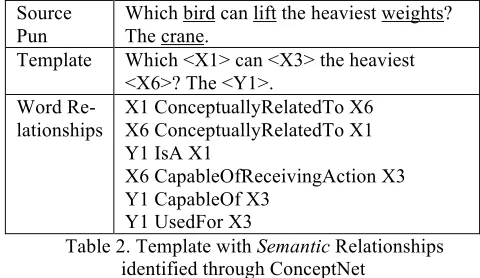
Table 2 presents the template for “Which bird can lift the heaviest weights? The crane.” (Webb, 1978). Keywords are underlined. All of the ex-tracted word relationships in Table 2 were derived from ConceptNet. Notice that i) some word pairs may have one or more word relationships, for ex-ample, “crane” and “lift”; while ii) some candidate keywords may not have any relationships, i.e, the adjective “heaviest”, thus it is not replaced with a variable in the resulting template. This second condition will be explored further in Section 5.
Source Pun
Which bird can lift the heaviest weights? The crane.
Template Which <X1> can <X3> the heaviest <X6>? The <Y1>.
Word Re-lationships
X1 ConceptuallyRelatedTo X6 X6 ConceptuallyRelatedTo X1 Y1 IsA X1
X6 CapableOfReceivingAction X3 Y1 CapableOf X3
[image:3.612.305.545.567.706.2]Y1 UsedFor X3
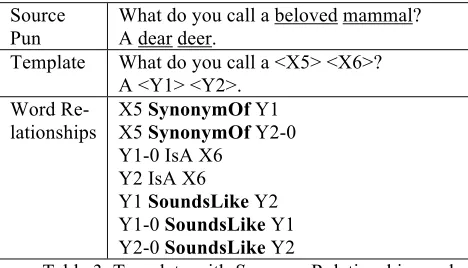
Table 3 presents another template from the pun “What do you call a beloved mammal? A dear deer.” (Binsted, 1996), with the SynonymOf relationship derived from WordNet, the IsA relationship from ConceptNet, and the SoundsLike relationship from Unisyn. Notice the “-0” suffix in variables Y1 and Y2. “<var>-0” is used to repre-sent a word that is phonetically similar to <var>.
Source Pun
What do you call a beloved mammal? A dear deer.
Template What do you call a <X5> <X6>? A <Y1> <Y2>.
Word Re-lationships
X5 SynonymOf Y1
X5 SynonymOf Y2-0
Y1-0 IsA X6 Y2 IsA X6
Y1 SoundsLike Y2
[image:4.612.67.301.179.313.2]Y1-0 SoundsLike Y1 Y2-0 SoundsLike Y2
Table 3. Template with Synonym Relationships and
Sounds-Like Relationships
A constituent word in a compound word (identi-fied through the presence of a dash “-”) may also contain additional word relationships. Thus, in “What kind of fruit fixes taps? A plum-ber.” (Bin-sted, 1996), T-PEG learns the template shown in Table 4. The compound word relationship ex-tracted is Y1 IsAWord Y2 (plum IsAWord ber). Y1 (plum), which is a constituent of the compound word, has a relationship with another word in the pun, X3 (fruit).
Source Pun
What kind of fruit fixes taps? A plum-ber.
Template What kind of <X3> <X4> taps? A <Y1>:<Y2>.
Word Re-lationships
Y1 IsA X3
Y1 IsAWord Y2
Y1:Y2 CapableOf X4
Table 4. Template with Compound Word
The last phase of the learning algorithm in-volves template usability check to determine if the extracted template has any missing link. A tem-plate is usable if all of the word relationships form a connected graph. If the graph contains unreach-able node/s (that is, it has missing edges), the tem-plate cannot be used in the pun generation phase since not all of the variables will be filled with possible words.
Consider a template with four variables named X3, X4, Y1 and Y2. The word relationships X3-X4, X4-Y1 and Y1-Y2 form a connected graph as shown in Figure 1(a). However, if only X3-X4 and Y1-Y2 relationships are available as shown in Figure 1(b), there is a missing edge such that if variable X3 has an initial possible word and is the starting point for generation, a corresponding word for variable X4 can be derived through the X3-X4 edge, but no words can be derived for variables Y1 and Y2.
[image:4.612.314.531.202.314.2](a) Connected Graph (b) Graph with Missing Edge Figure 1. Graphs for Word Relationships
This condition is exemplified in Table 5, where two disjoint subgraphs are created as a result of the missing “house-wall” and “wall-wal” relationships. Further discussion on this is found in Section 5.
Source Pun
What nuts can you use to build a house? Wal-nuts. (Binsted, 1996)
Template What <X1> can you use to <X6> a <X8>? <Y0>-<Y1>.
Word Re-lationships
X8 CapableOfReceivingAction X6 X1 SoundsLike Y1
Y0 IsAWord Y1 Y0:Y1 IsA X1 Missing
Relations
Y0-0 PartOf X8 Y0-0 SoundsLike Y0
Table 5. Template with Missing Word Relationships where Y0-0 is the word “wall”
4
Generating Puns from Templates
T-PEG uses two approaches of populating the variables – forward recursion and backward recur-sion. Forward recursion involves traversing the graph by moving from one node (variable in a template) to the next and following the edges of relationships. Consider the template in Table 6.
Human
Joke How is a window like a headache? They are both panes. (Binsted, 1996) Template How is a <X3> like a <X6>?
They are both <Y3>. Word
Re-lationships
Y3-0 SoundsLike Y3
X3 ConceptuallyRelatedTo Y3 Y3 ConceptuallyRelatedTo X3 Y3 PartOf X3
X6 ConceptallyRelatedTo Y3-0 X6 IsA Y3-0
[image:5.612.67.304.151.289.2]Y3-0 ConceptuallyRelatedTo X6 Table 6. Sample Template for Pun Generation
Given the keyword “garbage”, one possible se-quence of activities to locate words and populate the variables in this template is as follows:
a. “garbage” is tried on variable X6.
b. X6 has three word relationships all of which are with Y3-0, so it is used to find possible words for Y3-0. ConceptNet returns an “IsA” relationship with the word “waste”.
c. Y3-0 has only one word relationship and this is with Y3. Unisyn returns the phonetically similar word “waist”.
d. Y3 has two possible relationships with X3, and ConceptNet satisfies the “PartOf” rela-tionship with the word “trunk”.
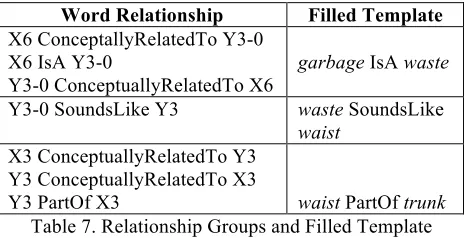
Since two variables may have more than one word relationships connecting them, relationship grouping is also performed. A word relationship group is said to be satisfied if at least one of the word relationships in the group is satisfied. Table 7 shows the relationship grouping and the word rela-tionship that was satisfied in each group for the template in Table 6.
Word Relationship Filled Template
X6 ConceptallyRelatedTo Y3-0 X6 IsA Y3-0
Y3-0 ConceptuallyRelatedTo X6
garbage IsA waste
Y3-0 SoundsLike Y3 waste SoundsLike
waist
X3 ConceptuallyRelatedTo Y3 Y3 ConceptuallyRelatedTo X3
Y3 PartOf X3 waist PartOf trunk Table 7. Relationship Groups and Filled Template
The filled template is passed to the surface real-izer, LanguageTool (Naber, 2007), to fix gram-matical errors, before displaying the resulting pun “How is a trunk like a garbage? They are both waists.” to the user.
[image:5.612.382.481.211.294.2]The forward recursion approach may lead to a situation in which a variable has been filled with two different sets of words. This usually occurs when the graph contains a cycle, as shown in Fig-ure 2.
Figure 2. Graph with Cycle
Assume the process of populating the template begins at X0. The following edges and resulting set of possible words are retrieved in sequence:
a. X0-X1 (Words retrieved for X1 A, B) b. X1-X2 (Words retrieved for X2 D, E, F) c. X2-X3 (Words retrieved for X3 G, H) d. X3-X1 (Words retrieved for X1 B, C) When the forward recursion algorithm reaches X3 in step (d), a second set of possible words for X1 is generated. Since the two sets of words for X1 do not match, the algorithm gets the intersection of (A, B) and (B, C) and assigns this to X1 (in this case, the word “B” is assigned to X1). Backward recursion has to be performed starting from step (b) using the new set of words so that other vari-ables with relationships to X1 will also be checked for possible changes in their values.
5
Test Results
Various tests were conducted to validate the com-pleteness of the word relationships in the learned template, the correctness of the generation algo-rithm, and the quality of the generated puns.
5.1 Evaluating the Learned Templates
[image:5.612.68.302.587.706.2]pun, the size of the corpus is not a factor in deter-mining the quality of the generated jokes.
Of the 39 resulting templates, only 27 (69.2%) are usable. The unusable templates contain missing word relationships that are caused by two factors. Unisyn contains entries only for valid words and not for syllables. Thus, in (6), the relationship be-tween “house” and “wall” is missing in the learned template shown in Table 5 because “wal” is not found in Unisyn to produce “wall”. In (7), Con-ceptNet is unable to determine the relationship be-tween “infantry” and “army”.
(6) What nuts can you use to build a house? Wal-nuts. (Binsted, 1996)
(7) What part of the army could a baby join? The infant-ry. (Webb, 1978)
The generation algorithm relies heavily on the presence of correct word relationships. 10 of the 27 usable templates were selected for manual evalua-tion by a linguist to determine the completeness of the extracted word relationships. A template is said to be complete if it is able to capture the essential word relationships in a pun. The evaluation criteria are based on the number of incorrect relationships as identified by the linguist, and includes missing relationship, extra relationship, or incorrect word pairing. A scoring system from 1 to 5 is used, where 5 means there are no incorrect relationship, 4 means there is one incorrect relationship, and so on.
The learning algorithm received an average score of 4.0 out of 5, due to missing word relation-ships in some of the templates. Again, these were caused by limitations of the resources. For exam-ple, in (8), the linguist noted that no relationship between “heaviest” and “weight” (i.e., PropertyOf heavy weight) is included in the learned template presented in Table 2.
(8) What bird can lift the heaviest weights? The crane. (Webb, 1978)
(9) What kind of fruit fixes taps? The plum-ber. (Binsted, 1996)
In (9), the linguist identified a missing relation-ship between “tap” and “plumber”, which is not extracted by the template shown in Table 4.
The linguist also noted that the constituents of a compound word do not always form valid words, such as “ber” in plum-ber of pun (9), and “wal” in wal-nuts of pun (6). This type of templates were
considered to contain incorrect relationships, and they may cause problems during generation be-cause similar sounding words could not be found for the constituent of the compound word that is not a valid word.
5.2 Evaluating the Generation Algorithm
The generation algorithm was evaluated on two aspects. In the first test, a keyword from each of the source puns was used as input to T-PEG to de-termine if it can generate back the training corpus. From the 27 usable templates, 20 (74.07%) of the source puns were generated back. Regeneration failed in cases where a word in the source pun has multiple POS tags, as the case in (10), where “cut” is tagged as a noun during learning, but verb dur-ing generation. In the learndur-ing phase, taggdur-ing is done at the sentence level, as opposed to a single-word tagging in the generation phase.
(10) What do barbers study? Short-cuts. (Webb, 1978)
Since a keyword is tried on each variable with the same POS tag in the template, the linguistic resources provided the generation algorithm with a large set of possible words. Consider again the pun in (10), using its template and given the keyword “farmer” as an example, the system generated 122 possible puns, some of which are listed in Table 8. Notice that only a couple of these seemed plausible puns, i.e., #3 and #7.
1. What do farmers study? Egg - plant. 2. What do farmers study? Power - plant. 3. What do farmers study? Trans - plant. 4. What do farmers study? Battle - ground. 5. What do farmers study? Play - ground. 6. What do farmers study? Battle - field. 7. What do farmers study? Gar - field.
Table 8. Excerpt of the Generated Puns Using “farmer” as Keyword
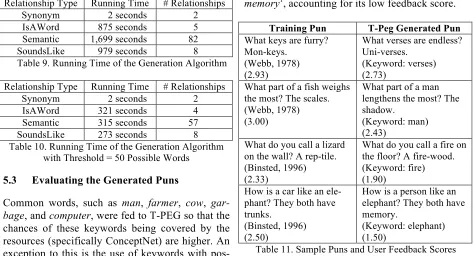
In order to find out how this affects the overall performance of the system, the execution times in locating words for the different types of word rela-tionships were measured for the set of 20 regener-ated human puns. Table 9 shows the summary for the running time and the number of word relation-ships extracted for each relationship type.
number of possible words to be generated was set to 50, resulting in a shorter running time as de-picted in Table 10. A negative outcome of using a threshold value is that only 16 (instead of 20) hu-man puns were regenerated. The other four cases failed because the threshold became restrictive and filtered out the words that should be generated.
Relationship Type Running Time # Relationships
Synonym 2 seconds 2
IsAWord 875 seconds 5
Semantic 1,699 seconds 82
SoundsLike 979 seconds 8
Table 9. Running Time of the Generation Algorithm
Relationship Type Running Time # Relationships
Synonym 2 seconds 2
IsAWord 321 seconds 4
Semantic 315 seconds 57
SoundsLike 273 seconds 8
Table 10. Running Time of the Generation Algorithm with Threshold = 50 Possible Words
5.3 Evaluating the Generated Puns
Common words, such as man, farmer, cow, gar-bage, and computer, were fed to T-PEG so that the chances of these keywords being covered by the resources (specifically ConceptNet) are higher. An exception to this is the use of keywords with pos-sible homonyms (i.e., whole and hole) to increase the possibility of generating puns with SoundsLike relationships.
As previously stated, the linguistic resources provided the generation algorithm with various words that generated a large set of puns. The pro-ponents manually went through this set, identifying which of the output seemed humorous, resulting in the subjective selection of eight puns that were then forwarded for user feedback.
User feedback was gathered from 40 people to compare if the puns of T-PEG are as funny as their source human puns. 15 puns (7 pairs of human-T-PEG puns, with the last pair containing 1 human and 2 T-PEG puns) were rated from a scale of 0 to 5, with 5 being the funniest. This rating system was based on the joke judging process used in (Binsted, 1996), where 0 means it is not a joke, 1 is a pathetic joke, 2 is a “not-so-bad” joke, 3 means average, 4 is quite funny, and 5 is really funny.
T-PEG puns received an average score of 2.13 while the corresponding source puns received an
average score of 2.70. Table 11 shows the scores of four pairs of punning riddles that were evalu-ated, with the input keyword used in generating the T-PEG puns enclosed in parentheses. Pun evalua-tion is very subjective and depends on the prior knowledge of the reader. Most of the users in-volved in the survey, for example, did not under-stand the relationship between elephant and memory1, accounting for its low feedback score.
Training Pun T-Peg Generated Pun
What keys are furry? Mon-keys.
(Webb, 1978) (2.93)
What verses are endless? Uni-verses.
(Keyword: verses) (2.73)
What part of a fish weighs the most? The scales. (Webb, 1978) (3.00)
What part of a man lengthens the most? The shadow.
(Keyword: man) (2.43)
What do you call a lizard on the wall? A rep-tile. (Binsted, 1996) (2.33)
What do you call a fire on the floor? A fire-wood. (Keyword: fire) (1.90)
How is a car like an ele-phant? They both have trunks.
(Binsted, 1996) (2.50)
How is a person like an elephant? They both have memory.
[image:7.612.69.543.171.427.2](Keyword: elephant) (1.50)
Table 11. Sample Puns and User Feedback Scores
Although the generated puns of T-PEG did not receive scores that are as high as the puns in the training corpus, with an average difference rating of 0.57, this work is able to show that the available linguistic resources can be used to train computers to extract word relationships in human puns and to use these learned templates to automatically gener-ate their own puns.
6
Conclusions
Puns have syntactic structures and semantic pat-terns that can be analyzed and represented in com-putational models. T-PEG has shown that these computational models or templates can be auto-matically extracted from training examples of hu-man puns with the use of available linguistic resources. The word relationships extracted are
1 Elephant characters in children’s stories are usually
synonyms, is-a-word, sounds-like, and semantic relationships. User feedback further showed that the resulting puns are of a standard comparable to their source puns.
A template is learned for each new joke fed to the T-PEG system. However, the quantity of the learned templates does not necessarily improve the quality of the generated puns. Future work for T-PEG involves exploring template refinement or merging, where a newly learned template may up-date previously learned templates to improve their quality.
T-PEG is also heavily reliant on the presence of word relationships from linguistic resources. This limitation can be addressed by adding some form of manual intervention to address the missing word relationships caused by limitations of the external resources, thereby increasing the number of usable templates. A different tagger that returns multiple tags may also be explored to consider all possible tags in both the learning and the generation phases. The manual process employed by the propo-nents in identifying which of the generated puns are indeed humorous is very time-consuming and subjective. Automatic humor recognition, similar to the works of Mihalcea and Pulman (2007), may be considered for future work.
The template-learning algorithm of T-PEG can be applied in other NLP systems where the extrac-tion of word relaextrac-tionships can be explored further as a means of teaching vocabulary and related con-cepts to young readers.
References
Kim Binsted. 1996. Machine Humour: An Implemented Model of Puns. PhD Thesis, University of Edinburgh, Scotland.
Kim Binsted, Anton Nijholt, Oliviero Stock, and Carlo Strapparava. 2006. Computational Humor. IEEE In-telligent Systems, 21(2):59-69.
Kim Binsted and Graeme Ritchie. 1997. Computational Rules for Punning Riddles. HUMOR, the Interna-tional Journal of Humor Research, 10(1):25-76. Kim Binsted, Helen Pain, and Graeme Ritchie. 1997.
Children's Evaluation of Computer-Generated Puns.
Pragmatics and Cognition, 5(2):309-358.
Iyas Cicekli, and H. Atay Güvenir. 2003. Learning Translation Templates from Bilingual Translation Examples. Recent Advances in Example-Based Ma-chine Translation, pp. 255-286, Kluwer Publishers. Susan Fitt 2002, Unisyn Lexicon Release. Available:
http://www.cstr.ed.ac.uk/projects/unisyn/.
Kathleen Go, Manimin Morga, Vince Andrew Nunez, Francis Veto, and Ethel Ong. 2007. Extracting and Using Translation Templates in an Example-Based Machine Translation System. Journal of Research in Science, Computing, and Engineering, 4(3):17-29. Bryan Anthony Hong and Ethel Ong. 2008. Generating
Punning Riddles from Examples. Proceedings of the Second International Symposium on Universal Com-munication, 347-352, Osaka, Japan.
Hugo Liu, and Push Singh, 2004. ConceptNet — A Practical Commonsense Reasoning Tool-Kit. BT Technology Journal, 22(4):211-226, Springer Neth-erlands.
Ruli Manurung, Graeme Ritchie, Helen Pain, and An-nalu Waller. 2008. Adding Phonetic Similarity Data to a Lexical Database. Applied Artificial Intelligence, Kluwer Academic Publishers, Netherlands.
Rada Mihalcea and Stephen Pulman. 2007. Characteriz-ing Humour: An Exploration of Features in Humor-ous Texts. Computational Linguistics and Intelligent Text Processing, Lecture Notes in Computer Science, Vol. 4394, 337-347, Springer Berlin.
Ion Muslea. 1999. Extraction Patterns for Information Extraction Tasks: A Survey. Proceedings AAAI-99 Workshop on Machine Learning for Information Ex-traction, American Association for Artificial In-telligence.
Daniel Naber. 2003. A Rule-Based Style and Grammar Checker.
Vince Andrew Nunez, Bryan Anthony Hong, and Ethel Ong. 2008. Automatically Extracting Templates from Examples for NLP Tasks. Proceedings of the 22nd Pacific Asia Conference on Language, Information and Computation,452-459, Cebu, Philippines. Graeme Ritchie. 2005. Computational Mechanisms for
Pun Generation. Proceedings of the 10th European Natural Language Generation Workshop, 125-132. Aberdeen.
Graeme Ritchie, Ruli Manurung, Helen Pain, Annalu Waller, and D. O’Mara. 2006. The STANDUP Inter-active Riddle Builder. IEEE Intelligent Systems
21(2):67-69.
K. Webb, The Crack-a-Joke Book, Puffin Books, Lon-don, England, 1978.