NE Tagging for Urdu based on Bootstrap POS Learning
Smruthi Mukund Rohini K. Srihari
Dept. of Computer Science and Engineering Dept. of Computer Science and Engineering University at Buffalo, SUNY University at Buffalo, SUNY
Amherst, NY, USA Amherst, NY, USA
[email protected] [email protected]
Abstract
Part of Speech (POS) tagging and Named Ent-ity (NE) tagging have become important com-ponents of effective text analysis. In this paper, we propose a bootstrapped model that involves four levels of text processing for Ur-du. We show that increasing the training data for POS learning by applying bootstrapping techniques improves NE tagging results. Our model overcomes the limitation imposed by the availability of limited ground truth data required for training a learning model. Both our POS tagging and NE tagging models are based on the Conditional Random Field (CRF) learning approach. To further enhance the performance, grammar rules and lexicon lookups are applied on the final output to cor-rect any spurious tag assignments. We also propose a model for word boundary segmen-tation where a bigram HMM model is trained for character transitions among all positions in each word. The generated words are further processed using a probabilistic language mod-el. All models use a hybrid approach that combines statistical models with hand crafted grammar rules.
1 Introduction
The work here is motivated by a desire to under-stand human sentiment and social behavior through analysis of verbal communication. Newspapers reflect the collective sentiments and emotions of the people and in turn the society to which they cater to. Not only do they portray an event that has taken place as is, but they also reveal details about
the intensity of fear, imagination, happiness and other emotions that people express in relation to that event. Newspaper write ups, when analyzed over these factors - emotions, reactions and beha-vior - can give a broader perspective on the culture, beliefs and the extent to which the people in the region are tolerant towards other religions. Our final goal is to automate this kind of behavioral analysis on newspaper articles for the Urdu lan-guage. Annotated corpus that tag six basic human emotions, “happy”, “fear”, “sad”, “surprise”, “an-ger” and “disgust”, based on the code book devel-oped using the MPQA standards as guideline, is currently being developed. Articles from two lead-ing Urdu newswires, BBC Urdu1 and Jung Daily2 form our corpus.
In order to achieve our goal, it was required to generate the basic tools needed for efficient text analysis. This includes NE tagging and its precur-sor, POS tagging. However, Urdu, despite being spoken by over 100 million people, (Gordon, 2005) is still a less privileged language when it comes to the availability of resources on the inter-net. Developing tools for a language with limited resources is a challenge, but necessary, as the vo-lume of Urdu text on the internet is rising. Huda (2001) shows that Urdu has now gained impor-tance on the web, making it the right time to tackle these issues.
It is useful to first examine some basic proper-ties of Urdu and how they affect the cascade of NLP steps in text analysis. Urdu has the nastaleeq and nasq style of writing that is similar to Arabic
1
http://www.bbc.co.uk/urdu/
2 http://www.jang.net/urdu/
and flows from right to left (Ahmad et al., 2001). It also adopts some of its vocabulary from Arabic. However, the grammar and semantics of the lan-guage is similar to Hindi and this makes it very different from Arabic. For effective text analysis, a thorough syntactic and semantic understanding of the language is required. Detailed grammatical analysis provided by Platts (1909) and Schmidt (1999) can be used for this purpose. The first step in the information retrieval pipeline is tokeniza-tion. Unlike English, where the word delimiter is mostly a space, Urdu is more complex. There are space insertion as well as space deletion problems. This makes tokenization a difficult task. The word segmentation model that we propose here com-bines the statistical approach that considers bigram transition of characters based on their positions in a word and morphological rules with lexicon loo-kups.
POS tagging comes next in the NLP text analy-sis pipeline. The accuracy of the tagging model varies, depending on the tagsets used and the do-main of the ground truth data. There are two do-main tagsets designed for Urdu, the CRULP tagset3 and the U1-tagset (Hardie 2003). The U1-tagset, re-leased as a part of EMILLE4 corpus, is based on the EAGLES standards (Leech and Wilson 1999). We decided to use the standards proposed by CRULP for the following reasons.
1. The tagset, though not as detailed as the one proposed in U1-tagset, covers all the basic requirements needed to achieve our final goal.
2. The tagged corpus provided by CRULP is newswire material, similar to our final corpus.
A person, when asked to identify an NE tagged word in a sentence would typically try to first find the word associated with a proper noun or a noun, and then assign a suitable NE tag based on the con-text. A similar approach is used in our model, where the learning happens on the data that is POS tagged as well as NE tagged. Features are learnt from the POS tags as well as the NE tags. The final output of our complete model returns the POS tags
3
http://www.crulp.org/Downloads/ling_resources/parallelcorpu s/Urdu POS Tagset.pdf
4 http://www.emille.lancs.ac.uk/
and NE tags associated with each word. Since we have limited data for training both the POS as well as the NE models, we propose a technique called bootstrapping that helps in maximizing the learn-ing for efficient tagglearn-ing.
The remainder of the paper is organized as fol-lows. Section 2 discusses the resources assimilated for the work followed by tokenization and word segmentation in Section 3. Section 4 gives a de-tailed explanation of our model starting with a brief introduction of the learning approach used. Rules used for POS tagging and NE tagging are mentioned in subsections of Section 4. Section 5 presents the results and Section 6 concludes the paper. In each section, wherever relevant, previous work and drawbacks are presented.
2 Resources
Based on the style of writing for Urdu, different encoding standards have been proposed. Urdu Zabta Takthi - the national standard code page for Urdu and Unicode - international standard for mul-tilingual characters are the two proposed and wide-ly used encoding standards. BBC Urdu and Jung Daily are both encoded with Unicode standards and are good sources of data. The availability of online resources for Urdu is not as extensive as other Asian languages like Chinese and Hindi. However, Hussain (2008) has done a good job in assimilating most of the resources available on the internet. The lexicon provided as a part of the EMILLE (2003) data set for Urdu has about 200,000 words. CRL5 has released a lexicon of 8000 words as a part of their Urdu data collection. They also provide an NE tagged data set mostly used for morphological analysis. The lexicon in-cludes POS information as well. CRULP6 has also provided a lexicon of 149,466 words that contains places, organizations and names of people. As part of the Urdu morphological analyzer provided by Humayoun (2007), a lexicon of about 4,500 unique words is made available. There are a few Urdu-English dictionaries available online and the first online dictionary, compiled by Siddiqi (2008), provides about 24,000 words with their meanings in English.
Getting all the resources into one single compi-lation is a challenge. These resources were brought
5
http://crl.nmsu.edu/Resources/lang_res/urdu.html
together and suitably compiled into a format that can be easily processed by Semantex (Srihari, 2008), a text extraction platform provided by Janya Inc7. Lists of places, organizations and names of famous personalities in Pakistan were also com-piled using the Urdu-Wikipedia8 and NationalMas-ter9. A list of most common names in Pakistan was composed by retrieving data from the various name databases available on the internet.
The word segmentation model uses the Urdu corpus released by CRULP as the training data. This dataset is well segmented. POS tagging model uses data provided by CRULP and NE tagging model uses data provided by CRL.
3 Word Segmentation and Tokenization
Urdu is a language that has both the space inser-tion and space deleinser-tion problems. The Urdu word segmentation problem as mentioned by Durrani (2007) is triggered by its orthographic rules and confusions about the definition of a word. Durrani summarizes effectively, all the problems associated with Urdu word segmentation. Of all the different techniques explored to achieve this objective, tra-ditional techniques like longest and maximum matching depend mostly on the availability of a lexicon that holds all the morphological forms of a word. Such a lexicon is difficult to obtain. It is shown by Theeramunkong et al., (2001), that for a Thai segmentation system, the efficiency drops considerably (from 97% to 82%) making this ap-proach highly lexicon dependent.
Statistical based techniques have applied proba-bilistic models to solve the problem of word seg-mentation. Bigram and trigram models are most commonly employed. Using feature based tech-niques for POS tagging is also very common. These techniques overcome the limitations of sta-tistical models by considering the context around the word for specific words and collocations. There are other models that generate segments by consi-dering word level collation as well as syllable level collocation.
However, for a language like Urdu, a model that is purely statistical will fail to yield good segmen-tation results. A mixed model that considers the morphological as well as semantic features of the
7 http://www.janyainc.com/ 8
http://ur.wikipedia.com/wiki/
9 http://www.nationmaster.com/index.php
language facilitates better performance as shown by Durrani (2007) where the word segmentation model uses a lexicon for proper nouns and a statis-tical model that trains over the n-gram probability of morphemes. Maximum matching technique is used to generate word boundaries of the ortho-graphic words that are formed and these are later verified using the POS information. The segments thus generated are ranked and the best ones are accepted. Statistical models that consider character based, syllable based and word based probabilities have shown to perform reasonably well. The Thai segmentation problem was solved by Pornprasert-kul (1994) using the character based approach. In our model, we use a combination of character based statistical approach and grammar rules with lexicon lookups to generate word boundaries.
Urdu segmentation problem can be looked at as an issue of inserting spaces between characters. All letters in Urdu, with a few exceptions, have three forms - initial, medial and final. (We do not con-sider the detached form for word formation). Words are written by joining the letters together and based on the position of the letter in the word, suitable forms are applied. This property of word formation is the crux of our model. The bigram probability of occurrences of each of these charac-ters, based on their positions, is obtained by train-ing over a properly segmented traintrain-ing set. For unknown characters, unknown character models for all the three position of occurrences are also trained. The probability of word occurrence is noted. Along with this, a lexicon rich enough to hold all possible common words is maintained. However, this lexicon does not contain proper nouns. A new incoming sentence that is not seg-mented correctly is taken and suitable word boun-daries are generated by using a combination of morphological rules, lexicon lookups, bigram word probabilities and bigram HMM character model. The following probabilities are estimated and max-imized at character level using the Viterbi algo-rithm. The following are the calculated probabilities:
(ii)
P
(
ch
k(final)|
ch
k−1(initial))
- is theproba-bility of character k being in final form given character k-1 is in initial form. (iii)
P
(
ch
k(final)|
ch
k−1(medial))
- is theproba-bility of character k being in final form given character k-1 is in medial form. (iv)
P
(
ch
k(medial)|
ch
k−1(medial))
- is the proba-bility of character k being in medial form given character k-1 is in medial form.(v)
P
(
ch
k(initial)|
ch
k−1(final))
- is the proba-bility of character k being in initial form given character k-1 is in final form.Each word thus formed successfully is then veri-fied for morphological correctness. If the word is not valid morphologically, then the window is moved back over 3 characters and at every step the validity of occurrence of the word is noted. Simi-larly, the window is moved 3 characters ahead and the validity of the word is verified. All words formed successfully are taken and further processed using a language model that considers the bigram occurrence for each word. The un-known word probability is considered here as well. The word with maximum probability is taken as valid in the given context.
Let <w1w2w3 > be the word formed by the moving window. Then, the word selected, ws, is given by
(vi)
=
) ( | ) (
) ( | ) (
) ( | ) ( max
3 2 1
prev prev prev
s
w P w P
w P w P
w P w P
w
where wprev is the previous word.
It is also noted that the number of times a transi-tion happens from a syllable set with consonants to a syllable set with vowels, in a word, is no longer than four in most cases as noted below. This factor is also considered for terminating the Viterbi algo-rithm for each word.
Ir | aad | ah - three transitions
Some of the morphological rules considered while deciding the word boundaries are given be-low. Word boundary is formed when
1. The word ends with ''ں” - un Gunna 2. The character transitions over to digits 3. Punctuations marks are encountered ('-' is
also included)
4. No two 'ye' - choti ye come back to back 5. No characters occur in detached form
un-less they are initials or abbreviations fol-lowed by a period
6. If current character is 'alif' and the pre-vious character is 'ee' - bari ye then the word boundary occurs after 'alif'
Some of the drawbacks seen in this model are mainly on account of improper identification of proper nouns. If a proper noun is not well seg-mented, the error propagates through the sentence and typically the next two or three words fail to get segmented correctly. Also, in Urdu, some words can be written in more than one ways. This mostly depends on the diacritics and ambiguity between bari and choti 'ye'. The training data as well as the test data were not normalized before training. The model shows a precision of 83%. We realized that the efficiency of this model can be improved if phoneme level transitions were taken into consid-eration. Training has to be increased over more proper nouns and a lexicon for proper nouns loo-kup has to be maintained. Diacritics that are typi-cally used for beautification should be removed. Words across the documents need to be normalized to one accepted format to assure uniqueness. This involves considerable amount of work and hence, in order to prevent the propagation of error into the NLP text analysis pipeline, we decided to test our subsequent models using pre-segmented data, in-dependent of our word segmentation model.
4 Learning Approaches
A Conditional Random Field (CRF), is an undi-rected graphical model used for sequential learn-ing. The tasks of POS tagging and NE tagging are both sequential learning tasks and hence this learn-ing approach is a reasonable choice. What follows is a brief outline about CRF. Interested readers are referred to Lafferty et al., (2001), for more infor-mation on CRF.
A linear chain CRF defines a single log-linear probabilistic distribution over the possible tag se-quences yfor a sentence x
∑∑
= = −
= T
t K
k
t t t k
kf t y y x
x Z x y p
1 1
1, )
, , ( exp
) ( 1 ) |
(
λ
where fk(t, yt, yt-1, xt) is typically a binary function indicating the presence of feature k, λk is the weight
of the feature, and Z(x) is a normalization function.
∑ ∑∑
= =
−
=
y T
t K
k
t t t k
k
f
t
y
y
x
x
Z
1 1
1
,
)
,
,
(
exp
)
(
λ
This modeling allows us to define features on states (the POS/NE tags) and edges (pairs of adja-cent POS/NE tags) combined with observations (eg. words and POS tags for NE estimation). The weights of the features are determined such that they maximize the conditional log-likelihood of the training data:
(
)
∑
==
i
i i
x
y
p
L
(
θ
)
1log
θ(
()|
())
.For the actual implementation, CRF++10, an open source tool that uses the CRF learning algo-rithm is used. The L-BFGS algoalgo-rithm11 is used for optimization.
4.2 %E Tagging using POS information
POS tagging is a precursor for all text analysis tasks. Assigning POS tags to words without any ambiguity depends on contextual information and extracting this information is a challenge. For a language like English, several techniques have been proposed that can be broadly classified into statistical, rule based and hybrid approaches (Ek-bal, 2007). The general consensus is that ap-proaches like MEMM and HMM, that work well for Hindi, would work well for Urdu as well, since Urdu is grammatically similar to Hindi (Platts, 1909). However, the linguistic and morphological rules used in the post processing steps differ from Hindi because of Urdu’s borrowed vocabulary and
10
http://crfpp.sourceforge.net/
11 http://www.mcs.anl.gov/index.php
style of writing from Arabic. Also, the requirement for such models to work well is the availability of large training data.
Building NE recognizers for languages like Ur-du is difficult as there are no concepts like capitali-zation of characters. Also, most names of people have specific meanings associated with them and can easily be found in a dictionary with different associated meanings. Various learning approaches have been proposed for this task, HMM based learning approach (Bikel et al., 1999), Maximum Entropy Approach (Borthwick, 1999) and CRF approach (McCallum, 2003) are the most popular. Ashish et al., (2009) show an SVM based approach also works well for such tasks. To overcome the problem of limited data availability, we present a method to increase the amount of training data that is available, by using a technique called bootstrap-ping.
We do not have a training corpus that is manual-ly tagged for both POS and NE. Our training data consists of two different datasets. The dataset used for POS tagging is provided by CRULP and is tagged using their tagset. The dataset used for NE tagging is provided by CRL as a part of their Urdu resource package. The CRL tagset consists of
LOCATION, PERSON, ORGANIZATION, DATE
and TIME tags. We use only the first three tags in
this work.
Our aim is to achieve effective POS tagging and NE tagging by maximizing the use of the available training data. The CRULP dataset (which we call datasetPOS) is a corpus of 150,000 words that are only POS tagged and the CRL dataset (which we call datasetNE) is a corpus of 50,000 words that are only NE tagged. First, we trained a CRF model on datasetNE that uses only the NE information to per-form NE recognition. This one stage model was not effective due to the sparseness of the NE tags in the dataset. The model requires more data while training. The obvious and frequently tried ap-proach (Thamar, 2004) is to use the POS informa-tion.
as the NE information, to perform effective NE tagging.
Figure 1. Two stage model for NE tagging using POS information
However, although the accuracy of NE tagging improved over the one stage model, there was scope for further improvement. It is obvious that all the NE tagged words should have the proper noun (NNP) POS tag associated. But, when POS tags were generated for the NE tagged ground truth data in datasetNE, most of the words were either tagged as adjectives (JJ) or common nouns (NN). Most tags that come after case markers (CM) were adjectives (JJ) in the training data. Very few ac-counted for proper nouns after case markers. This adversely affected the NE tagger output. It was also noticed that the POS tagger tagged most of the proper nouns (NNP) as common nouns (NN) be-cause of the sparseness of the proper noun tag in the POS ground truth data set datasetPOS. This ob-servation made us look to bootstrapping techniques for effective learning.
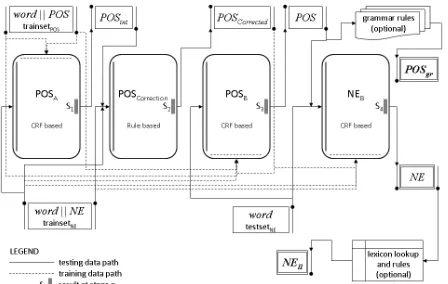
We propose a four stage model as shown in Fig-ure 2, for NE tagging. Three of the stages are trained using the CRF learning approach and one stage uses a rule based approach. All four stages are trained using unigram features on tags and words and bigram features on tags. The POS tagged dataset, datasetPOS, consists of words and associated POS tags and the NE tagged dataset, datasetNE, consists of words and associated NE tags. We divide both datasets into training and test-ing partitions. datasetPOS is divided into trainsetPOS and testsetPOS and datasetNE is divided into train-setNE and testsetNE.
Figure 2. Four stage model for NE tagging using POS information with bootstrapping
In the model shown in Figure 2, POSA stage is a CRF based stage that is trained using trainsetPOS. Once trained, the POSA stage takes as input a sen-tence and generates the associated POS tag for each word in that sentence.
In order to increase the NNP tag associations to improve NE tagging, we generate POS tags for the NE training data in trainsetNE using the POSA stage. The POS tags generated at the POSA stage are called POSint. The POScorrection stage takes as input trainsetNE along with its associated POS tags, POSint. At this stage, correction rules - that change the POS tags of NE associated words to proper noun (NNP), assign Case Markers (CM) before and after the NE tags and verify proper tagging of Cardinals (CD) - are applied. The corrected POS tags are called POScorrected. A consolidated POS training set consisting of entries from both train-setPOS and trainsetNE (with POScorrected generated as output from the POScorrection stage) is used to train the CRF based POSB stage. This stage is the final POS tagging stage. Test data consisting of sen-tences (words) from testsetNE is sent as input to stage POSB and the output generated at stage POSB is the POS tag associated with each input word of a sentence. The NEB stage is a CRF based NE tagger that is trained on a dataset consisting of word and associated NE tags from trainsetNE and associated POS tags from POScorrected. This stage learns from the POS information and the NE information pro-vided in the training data. Once trained, the NEB stage takes as input words from testsetNE and asso-ciated POS tags (obtained at stage POSB) and ge-nerates NE tags.
[image:6.612.314.538.65.207.2] [image:6.612.76.293.105.258.2]“jour-nalistic” or “news writing” style12. The articles are objective and follow a Subject-Object-Verb struc-ture. Related information is usually presented with-in close sentence proximity. This makes it possible to hand-craft grammar rules for the discovery of NE tags with fine granularity. The final POS tagged and NE tagged data generated as outputs at stage POSB and stage NEB respectively of the four stage model, are processed using rules and lexicon lookups to further improve the overall tagging ac-curacy of the model. Rules used are mostly domain specific. The rules were applied to the model using Semantex.
4.3 Rules for POS Tagging
1. Our model tags all the Question Words (QW) like ‘ايک’ - kya as pronoun (PR). All such occurrences are assigned QW tag. 2. If the word is ‘ايک’ – kya and the previous
tag is an adjective (JJ) and the next tag is a phrase marker (PM) then assign a light verb tag (VBL) else assign a verb (VB) tag to the word.
3. It was observed that there were spurious instances of proper nouns getting tagged as nouns. In order to correct this error, if a word ends with any of the characters shown below, and the word was tagged as a noun, then the tag on the word was changed to a proper noun.
’%’, ’ا’, ’ے’, ’()’, ’*+’,
’,-’, ’.و’, ’0*- ’, ’ﭧﮨ’
4. All valid cardinals were tagged as nouns or proper nouns by the model. This was re-solved by looking for a digit in the string.
4.4 Rules for %E Tagging
1. Words like “ٹروک” (court), “ورويب” (bu-reau), “جوف” (army) etc. are looked up. If there are any nouns or proper nouns above these within a window of two, then the tag on this word is ORGANIZATION.
2. Words like “ميظنت” (organization), “یمرآ” are marked ORGANIZATION if the pre-vious word is a proper noun.
3. Lexicon look up for names of places is per-formed and the POS tag of the next word that is found is checked. If this tag is a
12 http://en.wikipedia.org/wiki/News_writing
Case Marker (CM) with a feminine gend-er, like “ےک” (main) or “ںيم”, then the word is marked with a LOCATION tag. 4. If a proper noun that is selected ends with
a suffix “pur”, “bad, “dad” and has the same constraint as mentioned in rule 3, then the LOCATION tag is assigned to it as well.
5 Results
The NE tagging performance, for both the two stage model and the four stage model, are eva-luated using Precision (P), Recall (R) and F-Score (FS) metrics, the equations for which are given below.
(vii)
NEs tagged of
No.
NEs tagged correctly of
No. P=
(viii)
set in test NEs of no. Total
NEs tagged of
No. R=
(ix)
P R
RP FS
+ = 2
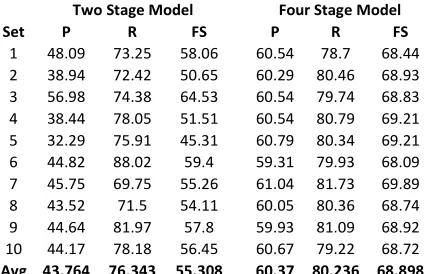
We performed a 10 fold cross validation test to determine the performance of the model. The data-set is divided into 10 subdata-sets of approximately equal size. One subset is withheld for testing and the remaining 9 subsets are used for training. This process is repeated for all 10 subsets and an aver-age result is computed. The 10 fold validation test for NE tagging was performed for both the two stage as well as the four stage models.
Set P R FS P R FS
1 48.09 73.25 58.06 60.54 78.7 68.44
2 38.94 72.42 50.65 60.29 80.46 68.93
3 56.98 74.38 64.53 60.54 79.74 68.83
4 38.44 78.05 51.51 60.54 80.79 69.21
5 32.29 75.91 45.31 60.79 80.34 69.21
6 44.82 88.02 59.4 59.31 79.93 68.09
7 45.75 69.75 55.26 61.04 81.73 69.89
8 43.52 71.5 54.11 60.05 80.36 68.74
9 44.64 81.97 57.8 59.93 81.09 68.92
10 44.17 78.18 56.45 60.67 79.22 68.72
Avg 43.764 76.343 55.308 60.37 80.236 68.898 Four Stage Model Two Stage Model
Table 1. NE tagging results for the two stage and four stage models
[image:7.612.320.532.500.637.2]average F-Score being 55.31% for the two stage model and 68.89% for the four stage model.
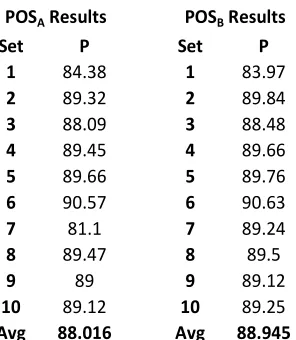
Table 2 shows the POS tagging results for stages POSA and POSB. The POSB stage performs margi-nally better than the POSA stage.
Set P Set P
1 84.38 1 83.97 2 89.32 2 89.84 3 88.09 3 88.48 4 89.45 4 89.66 5 89.66 5 89.76 6 90.57 6 90.63 7 81.1 7 89.24 8 89.47 8 89.5
9 89 9 89.12
10 89.12 10 89.25 Avg 88.016 Avg 88.945
POSB Results
POSA Results
Table 2. POS tagging results for the two stage (POSA)
and four stage (POSB) models
Although for POS tagging, the improvement is not very significant between the two models, tags like light verbs (VBLI), auxiliary verbs (AUXA and AUXT), adjectives (JJ), demonstratives (DM) and nouns (NN, NNC, NNCM, NNCR) get tagged with higher accuracy in the four stage model as shown in Table 3. This improvement becomes evi-dent in the NE test set. Unfortunately, since this data has no associated POS tagged ground truth, the results cannot be quantified. The trainsetPOS training data had very few instances of proper nouns (NNP) occurring after case markers (CM) and so most of the proper nouns were getting tagged as either adjectives (JJ) or common nouns (NN). After providing more training data to stage POSB, the model could effectively learn proper nouns. Spurious tagging of adjectives (JJ) and common nouns (NN) reduced while more proper nouns (NNP, NNPC) were tagged accurately and this allowed the NE stage to apply its learning effi-ciently to the NE test set thereby improving the NE tagging results.
The two stage model tagged 238 NE tagged words as proper nouns out of 403 NE words. The four stage model tagged 340 NE tagged words as proper nouns out of 403 NE words. The four stage model shows an improvement of 25.3% over the two stage model. The results reported for NE and
POS tagging models are without considering rules or lexicon lookups.
Tag FS Tag FS
AUXA 0.801 AUXA 0.816 AUXT 0.872 AUXT 0.898 DM 0.48 DM 0.521 JJ 0.751 JJ 0.765 NN 0.85 NN 0.858 NNC 0.537 NNC 0.549 NNCM 0.909 NNCM 0.923 NNCR 0.496 NNCR 0.51
RB 0.785 RB 0.834 VBLI 0.67 VBLI 0.693 VBT 0.553 VBT 0.586
POSA Output POSB Output
Table 3. POS tagging results for stages POSA and POSB
In order to further improve the POS tagged re-sults and NE tagged rere-sults, the rules mentioned in sections 4.3 and 4.4 and lexicon lookups were ap-plied. Table 4 shows the result for NE tagging with an overall F-Score of 74.67%
Tag P R FS LOCATION 0.78 0.793 0.786
ORGANIZATION 0.775 0.731 0.752
PERSON 0.894 0.595 0.714
[image:8.612.113.261.142.312.2]NEA Output
Table 4. NE tagging results after applying rules for test results in Table 1
6. Conclusion and Future Work
This work was undertaken as a precursor to achieve our final objective as discussed in Section 1. The basic idea here is to increase the size of the available training data, by using bootstrapping, so as to maximize learning for NE tagging. The pro-posed four stage model shows an F-Score of 68.9% for NE tagging which is much higher than that ob-tained by the simple two stage model.
[image:8.612.328.527.375.428.2]References
Raymond G. Gordon Jr. (ed.). 2005. Ethnologue: Lan-guages of the World, Fifteenth edition. Dallas, TX.: SIL International
Kashif Huda. 2001. An Overview of Urdu on the Web. Annual of Urdu Studies Vol 20.
Zaheer Ahmad, Jehanzeb Khan Orakzai, Inam Shamsh-er, Awais Adnan. 2007. Urdu astaleeq Character Recognition. Proceedings of World Academy of Science, Engineering and Technology. Volume 26, ISSN 2070-3740.
John T. Platts. 1967. A grammar of the Hindustani or Urdu language. Munshiram Manoharlal Delhi. R. L. Schmidt. 1999. Urdu: an essential grammar.
London: Routledge.
Sarmad Hussain. 2008. Resources for Urdu Language Processing. The 6th Workshop on Asian Language Resources.
P. Baker, A. Hardie, T. McEnery, B.D. Jayaram. 2003.
Corpus Data for South Asian Language Processing. Proceedings of the 10th Annual Workshop for South Asian Language Processing, EACL.
M. Humayoun, H. Hammarstrm, A. Ranta. 2007. Urdu Morphology, Orthography and Lexicon Extraction.
CAASL-2: The Second Workshop on Computational Approaches to Arabic Script-based Languages, LSA 2007 Linguistic Institute, Stanford University. Waseem Siddiqi, Shahab Alam. 2008. Online
Urdu-English and Urdu-English-Urdu dictionary.
N. Durrani. 2007. Typology of Word and Automatic Word Segmentation in Urdu Text Corpus. National University of Computer and Emerging Sciences, La-hore, Pakistan.
T. Theeramunkong, S. Usanavasin. 2001. on-Dictionary Based Thai Word Segmentation Using decision trees. In proceedings of the First Interna-tional Conference on Human Language Technology Research, San Diego, California, USA.
A. Pornprasertkul. 1994. Thai Syntactic Analysis. Ph.D Thesis, Asian Institute of Technology.
Ismat Javed. 1981.ئن ودرا دعاوق. Taraqqi Urdu Bureau, New Delhi.
Abdul M. Haq. 1987.ودرا فرص و وحن. Amjuman-e-Taraqqi Urdu (Hindi).
Hassan Sajjad. 2007. Statistical Part of Speech Tagger for Urdu. National University of Computer and Emerging Sciences, Lahore, Pakistan.
John D. Lafferty, Andrew McCallum, Fernando C.N. Pereira. 2001. Conditional Random Fields: Probabi-listicModels for Segmenting and Labeling Sequence Data. Proceedings of the Eighteenth International Conference on Machine Learning, pp. 282-289. John Chen. 2006. How to use Sequence Tagger.
Seman-tex Documentation, Janya Inc.
Bikel, D.M., Schwartz, R.L., Weischedel, R.M.1999.
An Algorithm that Learns What’s in a ame. Ma-chine Learning 34(1-3), pp. 211–231.
Borthwick, A. 1999. Maximum Entropy Approach to amed Entity Recognition. PhD thesis, New York University.
McCallum, A., Li, W. 2003. Early results for amed Entity Recognition with Conditional Random Fields, Feature Induction and Web-enhanced Lexicons. In Proceedings of CoNLL.
A. Hardie. 2003. Developing a tagset for automated part-of-speech tagging in Urdu. Department of Lin-guistics and Modern English Language, University of Lancaster.
Leech, G and Wilson, A. 1999. Standards for tagsets. Edited version of EAGLES Recommendations for the Morphosyntactic Annotation of Corpora. In van Hal-teren, H (ed.) Syntactic wordclass tagging. Dor-drecht: Kluwer Academic Publishers.
Awaghad Ashish Krishnarao, Himanshu Gahlot, Amit Srinet and D. S. Kushwaha. 2009. A Comparative Study of amed Entity Recognition for Hindi Using Sequential Learning Algorithms. In IEEE Interna-tional Advance Computing Conference (IACC '09), Thapar University, India. March 6-7.
Thamar Solario. 2004. Improvement of amed Entity Tagging by Machine Learning, Technical Report CCC-04-004, Coordinacin de Ciencias Computatio-nales.
Ekbal, A. and Bandyopadhyay, S. 2007. A Hidden Markov Model Based amed Entity Recognition Sys-tem: Bengali and Hindi as Case Studies. Springer LNCS, Vol. 4815, pp. 545.