Automatic Treebank-Based Acquisition of Arabic LFG Dependency
Structures
Lamia Tounsi Mohammed Attia
NCLT, School of Computing, Dublin City University, Ireland
{lamia.tounsi, mattia, josef}@computing.dcu.ie
Josef van Genabith
Abstract
A number of papers have reported on meth-ods for the automatic acquisition of large-scale, probabilistic LFG-based grammatical resources from treebanks for English (Cahill and al., 2002), (Cahill and al., 2004), German (Cahill and al., 2003), Chinese (Burke, 2004), (Guo and al., 2007), Spanish (O’Donovan, 2004), (Chrupala and van Genabith, 2006) and French (Schluter and van Genabith, 2008). Here, we extend the LFG grammar acquisition approach to Arabic and the Penn Arabic Treebank (ATB) (Maamouri and Bies, 2004), adapting and extending the methodol-ogy of (Cahill and al., 2004) originally developed for English. Arabic is challenging because of its morphological richness and syntactic complexity. Currently 98% of ATB trees (without FRAG and X) produce a covering and connected f-structure. We conduct a qualitative evaluation of our annota-tion against a gold standard and achieve an f-score of 95%.
1 Introduction
Treebank-based statistical parsers tend to achieve greater coverage and robustness compared to ap-proaches using handcrafted grammars. However, they are criticised for being too shallow to mark important syntactic and semantic dependencies needed for meaning-sensitive applications (Ka-plan, 2004). To treat this deficiency, a number of researchers have concentrated on enriching shallow parsers with deep dependency informa-tion. (Cahill and al., 2002), (Cahill and al., 2004) outlined an approach which exploits information encoded in the Penn-II Treebank (PTB) trees to automatically annotate each node in each tree with LFG f-structure equations representing deep predicate-argument structure relations. From this LFG annotated treebank, large-scale unification grammar resources were automatically extracted
and used in parsing (Cahill and al., 2008) and generation (Cahill and van Genabith, 2006). This approach was subsequently extended to other languages including German (Cahill and al., 2003), Chinese (Burke, 2004), (Guo and al., 2007), Spanish (O’Donovan, 2004), (Chrupala and van Genabith, 2006) and French (Schluter and van Genabith, 2008).
Arabic is a semitic language and is well-known for its morphological richness and syntactic complexity. In this paper we describe the porting of the LFG annotation methodology to Arabic in order to induce LFG f-structures from the Penn Arabic Treebank (ATB) (Bies, 2003), (Maamouri and Bies, 2004). We evaluate both the coverage and quality of the automatic f-structure annotation of the ATB. Ultimately, our goal is to use the f-structure annotated ATB to derive wide-coverage resources for parsing and generating unrestricted Arabic text. In this paper we concentrate on the annotation algorithm.
The paper first provides a brief overview of Lexical Functional Grammar, and the Penn Arabic Treebank (ATB). The next section presents the architecture of the f-structure annotation algorithm for the acquisition of f-structures from the Arabic treebank. The last section provides an evaluation of the quality and coverage of the annotation algorithm.
1.1 Lexical Functional Grammar
Lexical-Functional Grammar (LFG) (Kaplan and Bresnan, 1982); (Bresnan, 2001), (Falk, 2001) 2001, (Sells, 1985) is a constraint-based theory of grammar. LFG rejects concepts of configura-tionality and movement familiar from generative grammar, and provides a non-derivational alterna-tive of parallel structures of which phrase structure trees are only one component.
knowledge representation: c(onstituent)-structure, which is represented by (f-structure annotated) phrase structure trees; and f(unctional)-structure, represented by a matrix of attribute-value pairs. While c-structure accounts for language-specific lexical idiosyncrasies, syntactic surface config-urations and word order variations, f-structure provides a more abstract level of representation (grammatical functions/ labeled dependencies), abstracting from some cross-linguistic syntactic differences. Languages may differ typologically as regards surface structural representations, but may still encode similar syntactic functions (such as, subject, object, adjunct, etc.). For a recent overview on LFG-based analyses of Arabic see (Attia, 2008) who presents a hand-crafted Arabic LFG parser using the XLE (Xerox Linguistics En-vironment).
1.2 The Penn Arabic Treebank (ATB)
The Penn Arabic Treebank project started in 2001 with the aim of describing written Modern Standard Arabic newswire. The Treebank consists of 23611 sentences (Bies, 2003), (Maamouri and Bies, 2004) .
Arabic is a subject pro-drop language: a null category (pro) is allowed in the subject position of a finite clause if the agreement features on the verb are rich enough to enable content to be recovered (Baptista, 1995), (Chomsky, 1981). This is represented in the ATB annotation by an empty node after the verb marked with a -SBJ functional tag. The ATB annotation, following the Penn-II Treebank, utilises the concept of empty nodes and traces to mark long distance dependencies, as in relative clauses and questions. The default word order in Arabic is VSO. When the subject precedes the verb (SVO), the con-struction is considered as topicalized. Modern Standard Arabic also allows VOS word order under certain conditions, e.g. when the object is a pronoun. The ATB annotation scheme involves 24 basic POS-tags (497 different tags with mor-phological information ), 22 phrasal tags, and 20 individual functional tags (52 different combined tags).
The relatively free word order of Arabic means that phrase structural position is not an indicator of grammatical function, a feature of English which was heavily exploited in the automatic LFG annotation of the Penn-II Treebank (Cahill and
al., 2002). Instead, in the ATB functional tags are used to mark the subject as well as the object. The syntactic annotation style of the ATB follows, as much as possible, the methodologies and bracketing guidelines already used for the English Penn-II Treebank. For example, in the Penn English Treebank (PTB) (Marcus, 1994), small clauses are considered sentences composed of a subject and a predicate, without traces for an omitted verb or any sort of control relationship, as in example (1) for the sentence ”I consider Kris a fool”.
(1) (S (NP-SBJ I) (VP consider
(S (NP-SBJ Kris) (NP-PRD a fool))))
The team working on the ATB found this approach very convenient for copula construc-tions in Arabic, which are mainly verbless (Maamouri and Bies, 2004). Therefore they used a similar analysis without assuming a deleted copula verb or control relationship, as in (2).
(2) (S (NP-SBJAl-mas>alatu
éËAÖÏ@
) (ADJ-PRDbasiyTatuNé¢J.
))é¢J. éËAÖÏ@
Al-mas>alatu basiyTatuN
the-question simple ‘The question is simple.’
2 Architecture of the Arabic Automatic Annotation Algorithm
The annotation algorithm for Arabic is based on and substantially revises the methodology used for English.
For English, f-structure annotation is very much driven by configurational information: e.g. the leftmost NP sister of a VP is likely to be a direct object and hence annotated↑OBJ=↓. This infor-mation is captured in the format of left-right anno-tation matrices, which specify annoanno-tations for left or right sisters relative to a local head.
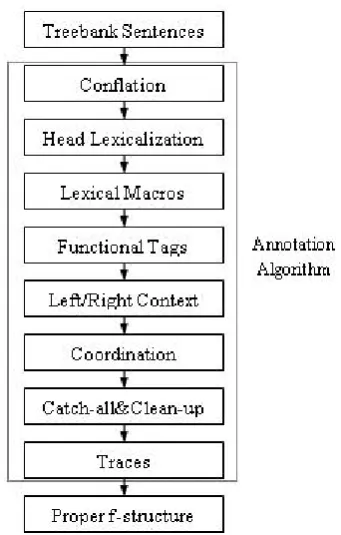
(Figure 1), where left-right annotation matrices play a much smaller role than for English. The annotation algorithm recursively traverses trees in the ATB. It exploits ATB morpho-syntactic fea-tures, ATB functional tags, and (some) configura-tional information in the local subtrees.
We first mask (conflate) some of the complex morphological information available in the pre-terminal nodes to be able to state generalisations for some of the annotation components. We then head-lexicalise ATB trees identifying local heads. Lexical macros exploit the full morphological an-notations available in the ATB and map them to corresponding f-structure equations. We then ex-ploit ATB functional tags mapping them to SUBJ, OBJ, OBL, OBJ2, TOPIC and ADJUNCT etc. grammatical functions. The remaining functions (COMP, XCOMP, SPEC etc.) as well as some cases of SUBJ, OBJ, OBL, OBJ2, TOPIC and AD-JUNCT, which could not be identified by ATB tags, are treated in terms of left-right context anno-tation matrices. Coordination is treated in a sepa-rate component to keep the other components sim-ple. Catch-all & Clean-Up corrects overgenerali-sations in the previous modules and uses defaults for remaining unannotated nodes. Finally, non-local dependencies are handled by a Traces com-ponent.
The next sub-sections describe the main modules of the annotation algorithm.
2.1 Conflation
ATB preterminals are very fine-grained, encod-ing extensive morpho-syntactic details in addi-tion to POS informaaddi-tion. For example, the word
[image:3.595.336.507.66.334.2]® J
sanaqifu‘[we will] stand’ is tagged as (FUT+IV1P+IV+IVSUFF MOOD:I) denoting an imperfective (I) verb (V) in the future tense (FUT), and is first person (1) plural (P) with indicative mood (IVSUFF MOOD:I). In total there are over 460 preterminal types in the treebank. This level of fine-grainedness is an important issue for the annotation as we cannot state grammatical func-tion (dependency) generalizafunc-tions about heads and left and right contexts for such a large tag set. To deal with this problem, for some of the annotation algorithm components we masked the morpho-syntactic details in preterminals, thereby conflat-ing them into more generic POS tags. For exam-ple, the above-mentioned tag will be conflated as VERB.Figure 1: Architecture of the Arabic annotation al-gorithm
2.2 Lexical Macros
Lexical macros, by contrast, utilise the de-tailed morpho-syntactic information encoded in the preterminal nodes of the Penn Arabic Tree-bank trees and provide the required functional an-notations accordingly. These tags usually include information related to person, number, gender, definiteness, case, tense, aspect, mood, etc. Table 1 lists common tags for nouns and verbs and shows the LFG functional annotation assigned to each tag.
2.3 Functional Tags
In addition to monadic POS categories, the ATB treebank contains a set of labels (called functional tags or functional labels) associated with func-tional information, such as -SBJ for ‘subject’ and -OBJ for ‘object’. The functional tags module translates these functional labels into LFG func-tional equations, e.g. -OBJ is assigned the anno-tation ↑OBJ=↓. An f-structure equation look-up table assigns default f-structure equations to each functional label in the ATB (Table 2).
Tag Annotation Nouns
MASC ↑GEND = masc (masculine) FEM ↑GEND = fem (feminine) SG ↑NUM = sg (singular) DU ↑NUM = dual PL ↑NUM = pl (plural) ACC ↑CASE = acc (accusative) NOM ↑CASE = nom (nominative) GEN ↑CASE = gen (genitive)
Verbs 1 ↑PERS = 1 2 ↑PERS = 2 3 ↑PERS = 3
S ↑NUM = sg
[image:4.595.104.258.63.253.2]D ↑NUM = dual P ↑NUM = pl F ↑GEND = masc M ↑GEND = fem
Table 1: Morpho-syntactic tags and their functional anno-tations
Functional Label Annotation -SBJ (subject) ↑SUBJ =↓ -OBJ (object) ↑OBJ =↓ -DTV (dative), ↑OBJ2 =↓ -BNF (Benefactive)
-TPC (topicalized) ↑TOPIC=↓ -CLR (clearly related) ↑OBL =↓ -LOC (locative),
-MNR (manner),
-DIR (direction), ↓∈↑ADJUNCT -TMP (temporal),
-ADV (adverbial) -PRP (purpose),
Table 2:Functional tags used in the ATP Treebank and their default annotations
correspond to the open complement grammatical function XCOMP in LFG and the ATB tag -PRD is associated with the annotation in (4) in order to produce the f-structure in Figure 3. The resulting analysis includes a main predicator ‘null be’ and specifies the control relationship through a func-tional equation stating that the main subject is co-indexed with the subject of the XCOMP.
(3)
éKPðQå é KYêË@
Al-hudonapu Daruwriy˜apN
the-truce necessary ‘The truce is necessary.’
(4)↑PRED = ’null be’
↑XCOMP =↓ ↑SUBJ=↓SUBJ
S NP-SBJ
N Alhudonapu
[image:4.595.330.501.169.337.2]NP-PRD N DaruwriyapN
Figure 2: C-structure for example (3)
2 6 6 6 6 6 6 6 6 6 6 6 6 6 6 6 6 6 6 6 6 6 6 6 6 4
PRED ‘null be
D
SUBJ , XCOMP
E
’
SUBJ
2 6 6 6 6 6 4
PRED ‘Al-hudonapu’ NUM sg
GEND fem
DEF +
CASE nom
3 7 7 7 7 7 5
1
XCOMP
2 6 6 6 6 6 6 6 6 4
PRED ‘Daruwriy˜apN’ NUM sg
GEND fem
DEF
-CASE nom SUBJ
h i
1
3 7 7 7 7 7 7 7 7 5
[image:4.595.99.264.315.451.2]3 7 7 7 7 7 7 7 7 7 7 7 7 7 7 7 7 7 7 7 7 7 7 7 7 5
Figure 3:F-structure for example (3)
2.4 Left-Right Context Rules
The left-right context annotation module is based on a tripartite division of local subtrees into a left-hand-side context (LHS) followed by a head (H) followed by a right-hand-side context (RHS). We developed our own head finding, or head lexical-ization, rules based on a variety of heuristics and manual inspection of the PS rules.
Initially, we extracted 45785 Phrase Structure (PS) rules from the treebank. The reason for the rela-tively large number of PS rules is the fine-grained nature of the tags encoding morphological infor-mation for pre-terminal nodes. When we conflate pre-terminals containing morphological informa-tion to basic POS tags, the set of PS rules is re-duced to 9731.
the left and right context of a rule’s head and state generalisations about the functional annotation of constituents to the left and right of the local head.
Consider sentence (5), where an NP is expanded as NP NP ADJP. The first NP is considered the head and is given the annotation↑=↓. The second NP and the ADJP are located to the left (Arabic reading) of the head (LHS). The left-right context matrix for NP constituents analyses these phrases as adjuncts and assigns them the annotation↓ ∈ ↑
ADJUNCT.
(5)
éJËñm. 'B@ áKPAJ¢Ë@ éJªÔg.
jamoEiy˜apu Al-Tay˜Ariyna Al->anoguwliy˜apu
society the-pilot the-Angolian ’Angolian Pilot Society‘
The left-right annotation matrices also cover other non-subcategorisable functions (such as XADJUNCT, SPEC, etc.) as well as constituents with subcategorisable grammatical functions (SUBJ, OBJ, OBL, COMP, etc.) which are not identified via ATB functional tags (and hence left unannotated by the Functional Tags component)
2.5 Coordination
Treebanks tend to encode co-ordination in a rather flat manner. In the LFG framework coordinated constituents are treated as sets. The phrase structure functional annotations for creating a set function for such constituents is given in (6) where the f-structures of the two coordinated NPs on the right-hand side are members of the set valued f-structure of the NP on the left-hand side.
(6) NP→NP CONJ NP
↑∈↓ ↑∈↓
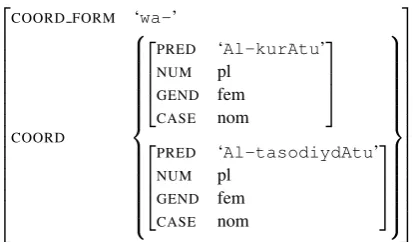
To keep the other modules simple and perspicuous coordination is treated in the annotation algorithm as a separate component. The coordination mod-ule localizes the coordinating conjunct, marks it as head and adds the coordinated elements to the f-structure set representation of the coordination
↓∈↑COORD. Figure 2.5 shows the f-structure for the NP in sentence (7).
(7)
H@YKYË@ð H@QºË@
Al-kurAtu wa-Al-tasodiydAtu
the-balls and-the-scores
2 6 6 6 6 6 6 6 6 6 6 6 6 6 6 6 6 4
COORD FORM ‘wa-’
COORD
8 > > > > > > > > > > > > > < > > > > > > > > > > > > > : 2 6 6 4
PRED ‘Al-kurAtu’ NUM pl
GEND fem CASE nom
3 7 7 5
2 6 6 4
PRED ‘Al-tasodiydAtu’ NUM pl
GEND fem CASE nom
[image:5.595.313.520.60.181.2]3 7 7 5 9 > > > > > > > > > > > > > = > > > > > > > > > > > > > ; 3 7 7 7 7 7 7 7 7 7 7 7 7 7 7 7 7 5
Figure 4: An Arabic coordination example
2.6 Catch-All and Clean-Up
The previous components of the annotation algo-rithm give concise statements of linguistic gen-eralisations, but sometimes they overgeneralise. Such overgeneralisations are detected and cor-rected by the Catch-All and Clean-Up component of the algorithm.
For example, the mutiword expression
à@ B@
’illaA ’anna ‘but’ is annotated in the tree-bank as two subsequent subordinating con-junctions: (SUB CONJ ’illaA) (SUB CONJ
’anna). In the f-structure annotation this leads to a conflict as to which lexical item should occupy the value of the SUBORD FORM feature. The Catch-All and Clean-Up component sidelines the problem by moving the second part of the MWE to an adjunct position.
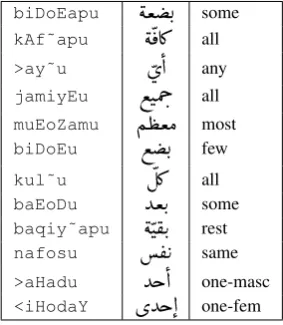
Another example is provided by quantifiers. In Arabic, quantifiers have the same syntactic struc-ture as the construct state (similar to the genitive construction in English as inthe boys’ book), so that sentences (8) and (9) are syntactically equiv-alent. The word ‘students’ is in the second part of the construct state in both phrases, but it is a mod-ifier in the first and a head in the second. There-fore, a list of quantifiers (Table 3) is used in the Catch-All and Clean-Up module, so that they are identified and properly annotated according to cer-tain context conditions.
The Catch-All and Clean-Up module also pro-vides default annotations for nodes that remain unannotated by the previous components.
(8)
H.C
¢Ë@ I.J»
kutubu Al-Tul˜abi
(9)
H.C
¢Ë@ ªK.
baEoDu Al-Tul˜abi
some the-students ‘some students’
biDoEapu
éª .
somekAf˜apu
é ¯A¿
all>ay˜u
ø
@
anyjamiyEu
©JÔg.
allmuEoZamu
Ñ ¢ªÓ
mostbiDoEu
© .
fewkul˜u
É¿
allbaEoDu
YªK.
somebaqiy˜apu
éJ®K.
restnafosu
® K
same>aHadu
Yg@
one-masc [image:6.595.306.540.65.198.2]<iHodaY
øYg@
one-femTable 3: List of Arabic quantifiers
2.7 Traces
The f-structure generated prior to the Traces module is called a proto-f-structure (i.e. a partial representation), as it is not complete with respect to long-distance dependency resolution. In order to produce proper f-structures, long-distance dependencies such as topicalisation and wh-movement must be captured. In our annotation algorithm we exploit trace information in the ATB treebank and translate long-distance dependencies into cooresponding reentrancies at the f-structure level using coindexation.
Figure 5 gives the ATB tree for the phrase in (10) containing a trace. The trace is used to capture A-movement, and the indices on the WHNP-2 and NP-SBJ-2 indicate that these constituents are related.
[image:6.595.110.252.142.305.2]In the annotation algorithm we assign the equa-tion ↑SUBJ = ↑TOPICREL to the empty node to indicate that the relative pronoun ‘which’ is interpreted as the subject of the verb ‘threaten’. This annotation produces the proper f-structure in Figure 6.
(10)
ÐCË@ X YîE ø Y
Ë@ JªË@
Al-Eunofu Al˜a*iy yuhad˜idu Al-salAma
violence which threatens peace
Once every node in a tree is annotated with f-structure equations, the equations are then passed
[image:6.595.308.532.263.453.2]NP NP N Al-Eunofu SBAR WHNP-2 Ala*iy S V yuhadidu NP-SBJ-2 * NP-OBJ Al-salAma
Figure 5: C-structure with a long-distance depen-dency 2 6 6 6 6 6 6 6 6 6 6 6 6 6 6 6 6 6 6 6 6 6 6 6 6 6 6 6 6 6 4
PRED ‘Al-Eunofu’
DEF + CASE genitive RELMOD 2 6 6 6 6 6 6 6 6 6 6 6 6 6 6 6 6 6 6 6 6 6 4 TOPICREL 2 6 4 PRED pro
PRON FORM ‘Al˜a*iy’ PRON TYPE relative
3 7 51
PRED ‘yuhad˜idu’ ASPECT imperfect MOOD indicative SUBJ h i 1 OBJ 2 6 4 DEF + CASE accusative PRED ‘Al-salAma’
3 7 5 3 7 7 7 7 7 7 7 7 7 7 7 7 7 7 7 7 7 7 7 7 7 5 3 7 7 7 7 7 7 7 7 7 7 7 7 7 7 7 7 7 7 7 7 7 7 7 7 7 7 7 7 7 5
Figure 6: Proper f-structure with long-distance de-pendencies captured
to a constraint solver. Ideally one f-structure rep-resentation is produced for each sentence. If there are conflicts in the structure equations, no f-structure is produced.
3 Evaluation
We conduct two types of evaluation: quantitative and qualitative evaluation.
wide-coverage syntactic and lexical resources. In the quantitative evaluation experiment, the an-notation algorithm achieves good coverage for 19 273 ATB sentences (remaining after removing trees with FRAG and X - labeled constituents); 98% of trees produce a complete and connected f-structure (no fragments) and 2% of trees do not produce an f-structure because of feature-value clashes.
For the qualitative evaluation, we use the eval-uation methodology of (Crouch and al., 2002) and (Riezler, 2002) in order to calculate preci-sion and recall on descriptions of f-structures. In this methodology, each f-structure is rep-resented as a set of triples of the form: relation(argument1,argument2). For example the
triples num(riHol+At+i, pl), case(riHol+At+i, genitive), gender(riHol+At+i, fem) encode that the number of the word riHol+At+i
HCgP
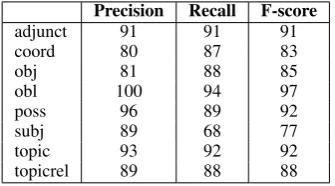
‘jour-neys’ is plural; its case is genitive; and its gen-der is feminine. The triple subj(ta+bolug+u: to reach,HarAr+ap+a: temperature) indicates that the subject of the verb to reach is temperature. The results of the evaluation of the quality of the an-notation against the DCU 250 gold standard are presented in Table 4. We achieve an f-score of 95%. In comparison, the f-scores for French, Eng-lish and Chinese languages are 95%-96%. Table 5 presents the results by selected grammatical func-tions. [image:7.595.98.266.555.648.2]Precision Recall F-score Results 95.49 94.43 94.96
Table 4: Evaluation of the automatically produced f-structures against gold standard (all features).
Precision Recall F-score
adjunct 91 91 91
coord 80 87 83
obj 81 88 85
obl 100 94 97
poss 96 89 92
subj 89 68 77
topic 93 92 92
topicrel 89 88 88
Table 5: Evaluation of the automatically pro-duced f-structures against gold standard by se-lected grammatical functions.
4 Conclusion
In this paper, we have shown how the methodol-ogy for automatically annotating treebanks with
LFG f-structure equations originally developed for English has been successfully adapted to Arabic. Arabic is known for its rich morphology and syn-tactic flexibility which allows SVO, VSO, VOS word orders. We exploit the rich morphological information in the annotation algorithm by utilis-ing the morphological tags to add information to the f-structures. We also use ATB functional tags to specify default syntactic functions, e.g. -SBJ (subject) and -OBJ (object), provide left-right an-notation matrices for the remaining constituents, treat coordination and represent non-local depen-dencies. The evaluation measured coverage as well as the quality of the automatic annotation al-gorithm. 98% of ATB trees (without FRAG and X) produce a complete and connected f-structure. When evaluated against a gold standard of 250 manually constructed f-structures, the algorithm scores an f-measure of 95%. The work presented in this paper is the first step in automatically ac-quiring deep resources for wide coverage parsing and generation for Arabic.
Acknowledgments
This research was supported by Science Founda-tion Ireland Grant 04/IN/I527.
References
Y. Al-Raheb, A. Akrout, J. van Genabith, J. Dichy. 2006.DCU 250 Arabic Dependency Bank: An LFG Gold Standard Resource for the Arabic Penn Tree-bank The Challenge of Arabic for NLP/MT at the British Computer Society, UK, pp. 105–116.
M. Attia. 2008. Handling Arabic Morphological and Syntactic Ambiguity within the LFG Framework with a View to Machine Translation. Ph.D. Thesis. The University of Manchester, Manchester, UK.
M. Baptista. 1995. On the Nature of Pro-drop in Capeverdean Creole. Harvard Working Papers in Linguistics, 5:3-17.
A. Bies and M. Maamouri. 2003. Penn
Arabic Treebank Guidelines URL: http://www.ircs.upenn.edu/arabic/Jan03release/guidelines-TB-1-28-03.pdf.
J. Bresnan. 2001. Lexical-Functional Syntax. Black-well Publishers, Oxford, UK.
M. Burke, O. Lam, R. Chan, A. Cahill, R. ODonovan, A. Bodomo, J. van Genabith, and A. Way. 2004.
M. Burke. 2006. Automatic Treebank Annotation for the Acquisition of LFG Resources. Ph.D. thesis, School of Computing, Dublin City University, Ire-land.
A. Cahill, M. McCarthy, J. van Genabith, A. Way. 2002. Automatic Annotation of the Penn Tree-bank with LFG F-Structure Information. LREC Workshop on Linguistic Knowledge Acquisition and Representation: Bootstrapping Annotated Language Data, Spain, pp. 8-15.
A. Cahill, M. Forst, M. McCarthy, R. ODonovan, C. Rohrer, J. van Genabith and A. Way. 2003.
Treebank-Based Multilingual Unification Grammar Development. The 15th Workshop on Ideas and Strategies for Multilingual Grammar Development, at the 15th European Summer School in Logic, Lan-guage and Information, Vienna, Austria, pp. 17–24.
A. Cahill, M. Burke, R. ODonovan, J. van Genabith, A. Way. 2004. Long-Distance Dependency Res-olution in Automatically Acquired Wide-Coverage PCFG-Based LFG Approximations. 42nd Meeting of the Association for Computational Linguistics, Barcelona, Spain pp. 319-326.
A. Cahill, J. van Genabith. 2006.Robust PCFG-Based Generation using Automatically Acquired LFG Ap-proximations. ACL 2006, Sydney, Australia, pages 1033-1040.
A. Cahill, M. Burke, R. O’Donovan, S. Riezler, J. van Genabith, A. Way. 2008. Wide-Coverage Deep Sta-tistical Parsing using Automatic Dependency Struc-ture Annotation. Computational Linguistics, Vol. 34, No. 1, pages 81-124.
N. Chomsky. 1981. Lectures on Government and Binding. Dordrecht: Foris.
G. Chrupala and J. van Genabith. 2006. Improving Treebank-Based Automatic LFG Induction for Span-ish. In Proceedings of the LFG06 Conference.
R. Crouch, R. M. Kaplan, T. H. King, S. Riezler. 2002.
Comparison of Evaluation Metrics for a Broad Cov-erage Parser LREC Workshop: Beyond PARSE-VAL Towards Improved Evaluation Measures for Parsing Systems, Spain, pp. 67-74.
M. Dalrymple. 2002. Lexical Functional Grammar. Syntax and Semantics, Volume 34, Academic Press, San Diego, CA/London, U.K.
Y. Falk. 2001. Lexical-Functional Grammar: An Introduction to Parallel Constraint-Based Syntax.
Stanford, Calif.: CSLI Publications.
A. Frank, L. Sadler, J. van Genabith, A. Way. 2003.
From Treebank Resources to LFG F-Structurese. A. Abeille editor Treebanks: Building and Using Syntactically Annotated Corpora, Kluwer Academic Publishers, Dordrecht/Boston/London,The Nether-landsm pp. 367-389.
Y. Guo, J. van Genabith, H. Wang. 2007. Acquisition of Wide-Coverage, Robust, Probabilistic Lexical-Functional Grammar Resources for Chinese. Pro-ceedings of the 12th International Lexical Func-tional Grammar Conference, USA, pp. 214–232.
R. Kaplan and J. Bresnan. 1982. Lexical Functional Grammar: a Formal System for Grammatical Rep-resentation, in J. Bresnan (ed.). The Mental Rep-resentation of Grammatical Relations, MIT Press, Cambridge, MA, pp. 173-281.
R. M. Kaplan, S. Riezler, T. H. King, J. T. Maxwell, A. Vasserman, and R. Crouch. 2004. Speed and Accuracy in Shallow and Deep Stochastic Parsing.
In The Human Language Technology Conference of the North American Chapter of the Association for Computational Linguistics (HLT-NAACL 2004), Boston, MA, pp. 97–104.
M. Maamouri and A. Bies. 2004. Developing an Arabic Treebank: Methods, Guidelines, Procedures, and Tools Workshop on Computational Approaches to Arabic Script-based Languages, COLING 2004, Geneva, 2004.
M. Marcus, G. Kim, M. Marcinkiewicz, R. MacIn-tyre, A. Bies, M. Ferguson, K. Katz and B. Schas-berger 1994. The Penn Treebank: Annotating Pred-icate Argument Structure. In Proceedings of the Human Language Technology Workshop. San Fran-cisco, CA.
R. O’Donovan, M. Burke, A. Cahill, J. van Genabith, and A. Way. 2004. Large-Scale Induction and Evaluation of Lexical Resources from the Penn-II Treebank. The 42nd Annual Meeting of the As-sociation for Computational Linguistics, Barcelona, Spain, pp. 368–375.
R. O’Donovan, A. Cahill, J. van Genabith, and A. Way. 2005. Automatic Acquisition of Spanish LFG Re-sources from the CAST3LB Treebank. The Tenth International Conference on LFG, Bergen, Norway, pp. 334–352.
S. Riezler, King, T., Kaplan, R., Crouch, R., Maxwell, J. T., and Johnson, M. 2002. Parsing theWall Street Journal using a Lexical-Functional Grammar and Discriminative Estimation Techniques. The 40th Annual Conference of the Association for Compu-tational Linguistics (ACL-02), Philadelphia, PA, pp. 271–278.
P. Sells 1985. Lectures on Contemporary Syntactic Theories. CSLI Lecture Notes. Stanford, CA: CSLI.
N. Schluter and J. van Genabith 2008. Treebank-Based Acquisition of LFG Parsing Resources for French.