Computing the Most Probable String with a Probabilistic Finite State
Machine
Colin de la Higuera Universit´e de Nantes, CNRS, LINA, UMR6241,
F-44000, France
Jose Oncina
Dep. de Lenguajes y Sistemas Inform´aticos, Universidad de Alicante,
Alicante, Spain
Abstract
The problem of finding the consensus / most probable string for a distribution generated by a probabilistic finite automaton or a hidden Markov model arises in a number of natural language processing tasks: it has to be solved in several transducer related tasks like opti-mal decoding in speech, or finding the most probable translation of an input sentence. We provide an algorithm which solves these prob-lems in time polynomial in the inverse of the probability of the most probable string, which in practise makes the computation tractable in many cases. We also show that this exact com-putation compares favourably with the tradi-tional Viterbi computation.
1 Introduction
Probabilistic finite state machines are used to de-fine distributions over sets of strings, to model lan-guages, help with decoding or for translation tasks. These machines come under various names, with different characteristics: probabilistic (generating) finite state automata, weighted machines, hidden Markov models (HMMs) or finite state transducers... An important and common problem in all the set-tings is that of computing the most probable event generated by the machine, possibly under a con-straint over the input string or the length. The typ-ical way of handling this question is by using the Viterbi algorithm, which extracts the most probable path/parse given the requirements.
If in certain cases finding the most probable parse is what is seeked, in others this is computed under the generally accepted belief that the computation
of the most probable string, also called the consen-sus string, is untractable and that the Viterbi score is an acceptable approximation. But the probability of the string is obtained by summing over the dif-ferent parses, so there is no strong reason that the string with the most probable parse is also the most probable one.
The problem of finding the most probable string was addressed by a number of authors, in computational linguistics, pattern recognition and bio-informatics [Sima’an, 2002, Goodman, 1998, Casacuberta and de la Higuera, 1999, 2000, Lyngsø and Pedersen, 2002]: the problem was proved to be N P-hard; the associated decision problem is N P -complete in limited cases only, because the most probable string can be exponentially long in the number of states of the finite state machine (a con-struction can be found in [de la Higuera and Oncina, 2013]). As a corollary, finding the most probable translation (or decoding) of some input string, when given a finite state transducer, is intractable: the set of possible transductions, with their conditional probabilities can be represented as a PFA.
this will usually be achieved by computing the most probable path instead.
In the before mentioned results the weight of each individual transition is between 0 and 1 and the score can be interpreted as a probability. An interesting variant, in the framework of multiplicity automata or of accepting probabilistic finite automata (also called Rabin automata), is the question, known as the cut-point emptiness problem, of the existence of a string whose weight is above a specific threshold; this problem is known to be undecidable [Blondel and Canterini, 2003].
In a recent analysis, de la Higuera and Oncina [2013] solved an associated decision problem: is there a string whose probability is above a given threshold? The condition required is that we are given an upper bound to the length of the most probable string and a lower bound to its probability. These encouraging results do not provide the means to actually compute the consensus string.
In this paper we provide three main results. The first (Section 3) relates the probability of a string with its length; as a corollary, given any fraction
p, either all strings have probability less thanp, or there is a string whose probability is at least pand is of length at most (n+1)p 2 wheren is the number of states of the corresponding PFA. The second re-sult (Section 4) is an algorithm that can effectively compute the consensus string in time polynomial in the inverse of the probability of this string. Our third result (Section 5) is experimental: we show that our algorithm works well, and also that in highly am-biguous settings, the traditional approach, in which the Viterbi score is used to return the string with the most probable parse, will return sub-optimal results.
2 Definitions and notations
2.1 Languages and distributions
Let[n]denote the set{1, . . . , n} for each n ∈ N.
An alphabet Σ is a finite non-empty set of sym-bols called letters. A string w over Σ is a finite sequence w = a1. . . an of letters. Letters will be
indicated by a, b, c, . . ., and strings by u, v, . . . , z. Let|w|denote the length ofw. In this case we have |w| =|a1. . . an|=n. The empty string is denoted
byλ.
We denote by Σ⋆ the set of all strings and by
Σ≤nthe set of those of length at mostn. When de-composing a string into sub-strings, we will write
w=w1. . . wnwhere∀i∈[n]wi ∈Σ⋆.
A probabilistic languageDis a probability distri-bution overΣ⋆. The probability of a stringx ∈ Σ⋆
under the distribution Dis denoted asP rD(x) and must verifyPx∈Σ⋆P rD(x) = 1. IfLis a language
(thus a set of strings, included inΣ⋆), andDa
dis-tribution overΣ⋆,P rD(L) =Px∈LP rD(x). If the distribution is modelled by some syntactic machine M, the probability of x according to the probability distribution defined byMis denoted by
P rM(x). The distribution modelled by a machine Mwill be denoted by DM and simplified to D if the context is not ambiguous.
2.2 Probabilistic finite automata
Probabilistic finite automata (PFA) are generative devices for which there are a number of possible def-initions [Paz, 1971, Vidal et al., 2005]. In the sequel we will useλ-free PFA: these do not have empty (λ) transitions: this restriction is without loss of gen-erality, as algorithms [Mohri, 2002, de la Higuera, 2010] exist allowing to transform, in polynomial time, more general PFAinto PFArespecting the fol-lowing definition:
Definition 1. Aλ-free Probabilistic Finite
Automa-ton (PFA) is a tupleA=hΣ, Q, S, F, δi, where:
- Σis the alphabet;
- Q={q1,. . . ,q|Q|}is a finite set of states;
- S :Q→R∩[0,1](initial probabilities);
- F :Q→R∩[0,1](final probabilities);
- δ : Q×Σ×Q → R∩[0,1]is the complete
transition function; δ(q, a, q′) = 0can be in-terpreted as “no transition fromqtoq′labelled witha”.
S,δandF are functions such that:
X
q∈Q
S(q) = 1, (1)
and∀q ∈Q,
F(q) + X
a∈Σ, q′∈Q
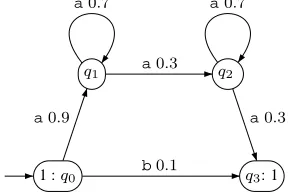
1 :q0
q1 q2
q3: 1
a0.9
b0.1 a0.7
a0.3
a0.7
[image:3.612.114.259.27.123.2]a0.3
Figure 1: Graphical representation of a PFA.
An example of a PFAis shown in Fig. 1.
Given x∈Σ⋆, ΠA(x) is the set of all paths ac-cepting x: an accepting x-path is a sequence π = qi0a1qi1a2. . . anqin wherex = a1· · ·an, ai ∈ Σ,
and∀j∈[n]such thatδ(qij−1, aj, qij)6= 0.
The probability of the path π is defined as
P rM(π) =S(qi0)·
Q
j∈[n]δ(qij−1, aj, qij)·F(qin)
and the probability of the string x is obtained by summing over the probabilities of all the paths in
ΠA(x). An effective computation can be done by means of the Forward (or Backward) algorithm [Vi-dal et al., 2005].
We denote by|A|the size ofAas one more than the number of its states. Therefore, forAas repre-sented in Figure 1, we have|A|= 5.
We do not recall here the definitions for hidden Markov models. It is known that one can transform an HMM into a PFA and vice-versa in polynomial
time [Vidal et al., 2005].
2.3 The problem
The goal is to find the most probable string in a prob-abilistic language. This string is also named the
con-sensus string.
Name: Consensus string (CS)
Instance: A probabilistic machineM
Question: Find x ∈ Σ⋆ such that ∀y ∈ Σ⋆ P rM(x)≥P rM(y).
For example, for the PFAfrom Figure 1, the con-sensus string isaaaaa. Note that the string having the most probable single parse isb.
2.4 Associated decision problem
In [de la Higuera and Oncina, 2013] the following decision problem is studied:
Name: Bounded most probable string (BMPS)
Instance: Aλ-free PFA A, an integerp≥0, an
in-tegerb
Question: Is there in Σ≤b a string x such that P rA(x)> p?
BMPSis known to beN P-hard [Casacuberta and de la Higuera, 2000]. De la Higuera and Oncina [2013] present a construction proving that the most probable string can be of exponential length: this makes the bound issue crucial in order to hope to solve CS. The proposed algorithm takes p and b
as arguments and solves BMPSin time complexity
O(b|Σ|·|pQ|2). It is assumed that all arithmetic opera-tions are in constant time.
The construction relies on the following sim-ple properties, which ensure that only a reasonable amount of incomparable prefixes have to be scruti-nized.
Property 1. ∀u∈Σ⋆,P rA(uΣ⋆)≥P rA(u).
Property 2. If X is a set of strings such that (1)
∀u∈X, P rA(uΣ⋆)> pand (2) no string inXis a prefix of another different string inX, then|X|< 1p.
3 Probable strings are short
Is there a relation between the lengths of the strings and their probabilities? In other words, can we show that a string of probability at leastpmust be reason-ably short? If so, thebparameter is not required: one can compute the consensus string without having to guess the boundb. Let us prove the following:
Proposition 1. LetAbe aλ-free PFA withnstates andwa string.
Then|w| ≤ P r(n+1)A(w2).
As a corollary,
Corollary 1. LetAbe aλ-free PFAwithnstates. If there is a string with probability at leastp, its length is at mostb= (n+1)p 2.
Proof. Let w be a string of length len and
P rA(w) = p. A path is a sequence π =
qi0a1qi1a2. . . alenqilen, withai ∈Σ.
LetΠjA(w)be the subset ofΠA(w)of all pathsπ
for which stateqj is the most used state inπ.
If, for some pathπ, there are several valuesjsuch thatqjis the most used state inπ, we arbitrarily add πto theΠjA(w)which has the smallest indexj.
P rA(ΠjA(w))≥ np. Note that in any path inΠjA(w)
stateqj appears at least lenn+1 times. Consider any
of these paths π in ΠjA(w). Let k be the small-est integer such thatqik = qj (ie the first time we
visit state qj in pathπ is after having read the first kcharacters ofw). Then for each valuek′such that
qik′ =qj, we can shorten the pathπby removing the
cycle betweenqik andqik′ and obtain in each case a
path for a new string, and the probability of this path is at least that ofπ.
We have therefore at least lenn+1 −1 such alter-native paths forπ.
We call Alt(π, j)the set of alternative paths forπ
andqj. Hence|Alt(π, j)| ≥ lenn+1 −1.
And therefore
P rA(Alt(π, j))≥
len+ 1
n −1
P rA(π).
We now want to sum this quantity over the dif-ferentπ inΠjA(w). Note that there could be a diffi-culty with the fact that two different paths may share an identical alternative that would be counted twice. The following lemma (proved later) tells us that this is not a problem.
Lemma 1. Let π and π′ be two different paths in ΠjA(w), and π′′ be a path belonging both to
Alt(π, j) and to Alt(π′, j). Then P rA(π′′) ≥ P rA(π) +P rA(π′).
Therefore, we can sum and
X
π∈ΠjA(w)
P rA(Alt(π, j))≥
len+ 1
n −1
p n.
The left hand side represents a mass of probabil-ities distributed byAto other strings thanw. Sum-ming with the probability ofw, we obtain:
len+ 1
n −1
· p
n+p ≤ 1 (len+ 1−n)·p+pn2 ≤ n2
(len+ 1−n)≤ n
2(1−p)
p
len≤ n
2(1−p)
p +n−1
It follows thatlen≤ (n+1)p 2.
Proof of the lemma. π′′ =πj andπ′′ =πj′′.
Neces-sarily we havej=j′. Now qi1
kwkqi1k+1wk+1. . . wk+tqi1k+t and
qi2
kwkqi2k+1wk+1. . . wk+tqi2k+t are the two
frag-ments of the paths that have been removed from
π and π′. These are necessarily different, but might coincide in part. Leth be the first index for which they are different, ie∀z < h, qi1
z = qi2z and
qi1
h 6=qi2h.
We have:
P(qi1
h−1, wh, qi1h) +P(qih2−1, wh, qi2h)≤1and the
result follows.
We use Proposition 1 to associate with a given stringwan upper bound over the probability of any string havingwas a prefix:
Definition 2. The Potential ProbabilityPPof a pre-fix stringwis
PP(w) = min(P rA(wΣ⋆),|A| 2
|w|)
PP(w)is also an upper bound on the probability of any string havingwas a prefix:
Property 3. ∀u∈Σ⋆ P rA(wu)≤ PP(w)
Indeed,P rA(wu)≤P rA(wΣ⋆)and, because of
Proposition 1,P rA(wu)≤ ||A|wu2| ≤ |A||w|2.
This means that we can decide, for a given prefix
w, and a probability to be improved, ifwis viable, ie if the best string havingwas a prefix can be better than the proposed probability. Furtermore, given a PFAAand a prefixw, computingPP(w)is simple.
4 Solving the consensus string problem
Algorithm 1 is given a PFA Aand returns the most probable string. The bounds obtained in the previ-ous section allow us to explore the viable prefixes, check if the corresponding string improves our cur-rent candidate, add an extra letter to the viable prefix and add this new prefix to a priority queue.
Data: a PFAA
Result:w, the most probable string
1 Current P rob= 0; 2 Q= [λ];
3 Continue=true;
4 while not(Empty(Q))andContinuedo
5 w=Pop(Q);
6 ifPP(w)> Current P robthen 7 p=P rA(w);
8 ifp > Current P robthen
9 Current P rob=p;
10 Current Best=w;
11 foreach a∈Σdo
12 ifPP(wa)> Current P robthen
13 Insert(wa,PP(wa),Q)
14 else
15 Continue=false;
16 returnCurrent Best
Algorithm 1: Finding the Consensus String
Analysis: Let popt be the probability of the
con-sensus string. Let Viable be the set of all stringsw
such thatPP(w)≥popt.
• Fact 1. Letwbe the first element of Q at some iteration. IfPP(w) < popt, every other
ele-ment of Q will also have smallerPP and the algorithm will halt. It follows that until the con-sensus string is found, the first elementwis in
Viable.
• Fact 2. Ifw∈Viable,PP(w)≥popt, therefore
|A|2
|w| ≥poptso|w| ≤ |A|
2
popt.
• Fact 3. There are at most p1
opt pairwise incomparable prefixes in Viable. Indeed, all elements of Viable have PP(w) = min(P rA(wΣ⋆),|A|2
|w|) ≥ popt so also have P rA(wΣ⋆) ≥ popt and by Property 2 we are
done.
• Fact 4. There are at most p1
opt · |A|2
popt different prefixes in Viable, as a consequence of facts 2 and 3.
• Fact 5. At every iteration of the main loop at
most|Σ|new elements are added to the priority queue.
• Fact 6. Therefore, since only the first elements
of the priority queue will cause (at most |Σ|) insertions, and these (fact 1) are necesarily vi-able, the total number of insertions is bounded by|Σ| ·|A|popt2 · 1
popt.
The time complexity of the algorithm is propor-tional to the number of insertions in the queue and is computed as follows:
• |Q|is at most |Σp|·|A|2 2
opt ;
• Insertion of an element into Q is in
Olog|Σp|·|A|2 2
opt
.
5 Experiments
From the theoretical analysis it appears that the new algorithm will be able to compute the consensus string. The goal of the experiments is therefore to show how the algorithm scales up: there are domains in natural language processing where the probabili-ties are very small, and the alphabets very large. In others this is not the case. How well does the algo-rithm adapt to small probabilities? A second line of experiments consists in measuring the quality of the most probable parse for the consensus string. This could obviously not be measured up to now (because of the lack of an algorithm for the most probable string). Finding out how far (both in value and in rank) the string returned by the Viterbi algorithm is from the consensus string is of interest.
5.1 Further experiments
A more extensive experimentation may consist in building a collection of random PFA, in the line of
what has been done in HMM/PFA learning compe-titions, for instance [Verwer et al., 2012]. A con-nected graph is built, the arcs are transformed into transitions by adding labels and weights. A normal-isation phase takes place so as to end up with a dis-tribution of probabilities.
Actually, the same will happen when testing on more realistic data: a language model built fromn -grams will often have as most probable string the empty string.
An extensive experimentation should also com-pare this algorithm with alternative techniques which have been introduced:
A first extension of the Viterbi approximation is called crunching [May and Knight, 2006]: instead of just computing for a string the probability of the best path, with a bit more effort, the value associated to a string is the sum of the probabilities of thenbest paths.
Another approach is variational decoding [Li et al., 2009]: in this method and alternatives like Minimum Risk Decoding, a best approximation by
n-grams of the distribution is used, and the most probable string is taken as the one which maximizes the probability with respect to this approximation. These techniques are shown to give better results than the Viterbi decoding, but are not able to cope with long distance dependencies.
Coarse-to-fine parsing [Charniak et al., 2006] is
a strategy that reduces the complexity of the search involved in finding the best parse. It defines a se-quence of increasingly more complex Probabilistic Context-Free grammars (PCFG), and uses the parse forest produced by one PCFGto prune the search of the next more complex PCFG.
5.2 A tighter bound on the complexity
The complexity of the algorithm can be measured by counting the number of insertions into the prior-ity queue. This number has been upper-bounded by |Σ| · |A|p22
opt . But it is of interest to get a better and tighter bound. In order to have a difficult set of test PFAs we built a family of models for which the con-sensus string has a parametrized length and where an exponentially large set of strings has the same length and slightly lower probabilities than the consensus string.
In order to achieve that, the states are organised in levels, and at each level there is a fixed number of states (multiplicity). One of the states of the first level is chosen as initial state. All the states have an ending probability of zero except for one unique state of the last level; there is a transition from each
0.0 0.0 >0.0
[image:6.612.335.507.52.176.2]0.0 0.0 0.0
Figure 2: The topology of an automaton with 3 levels and multiplicity 2
state of levelnto all states of leveln+ 1but also to all the states of levelk≤n.
An example of this structure, with 3 levels and multiplicity 2 is represented in Fig. 2. The shortest string with non-null probability will be of lengthn− 1wherenis the number of levels.
A collection of random PFAwas built with vocab-ulary size varying from 2 to 6, number of levels from 3 to 5, and the multiplicity from 2 to 3. 16 different PFAwere generated for each vocabulary size, num-ber of levels and multiplicity. Therefore, a total of 480 automata were built. From those 16 were dis-carded because the low probability of the consensus string made it impossible to deal with the size of the priority queue. 464 automata were therefore consid-ered for the experiments.
In the first set of experiments the goal was to test how strong is the theoretical bound on the number of insertions in the priority queue.
Fig. 3 plots the inverse of the probability of the consensus string versus the number of insertions in the priority queue. The bound from Section 4 is
|Q| ≤ |Σ| · |A|
2
p2opt
Our data indicates that
|Q| ≤ 1
p2opt ≤
|Σ| · |A|2 p2opt
Furthermore, p2
1e+00 1e+02 1e+04 1e+06 1e+08 1e+10 1e+12 1e+14 1e+16
1e+00 1e+01 1e+02 1e+03 1e+04 1e+05 1e+06 1e+07 1e+08
in
se
rt
io
n
s
1
popt
Checking priority queue bound
automata
2/popt
1/p2
[image:7.612.85.308.39.197.2]opt
Figure 3: Number of insertions made in the priority queue
0 % 20 % 40 % 60 % 80 % 100 %
1e-08 1e-07 1e-06 1e-05 1e-04 1e-03 1e-02 1e-01 1e+00
R
el
at
iv
e
er
ro
r
Consensus string probability
Consensus string vs. most probable path discrepancy
Most probable path
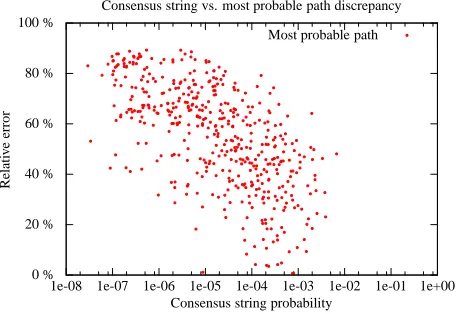
Figure 4: Most probable path accuracy
5.3 How good is the Viterbi approximation?
In the literature the string with the most probable path is often used as an approximation to the consen-sus string. Using the same automata, we attempted to measure the distance between the probability of the string returned by the Viterbi algorithm, which computes the most probable parse, and the probabil-ity of the consensus string.
For each automaton, we have measured the proba-bility of the most probable string (popt) and the
prob-ability of the most probable path (pp).
In63%of the464 PFA the consensus string and
the string with the most probable path were differ-ent, and in no case does the probability of the con-sensus string coincide with the probability of the most probable path.
Figure 4 shows the relative error when using the probability of the most probable path instead of the probability of the consensus string. In other words we measure and plot popt−pp
popt . It can be observed that the relative error can be very large and increases as the probability of the consensus string decreases. Furthermore, we ran an experiment to compute the rank of the string with most probable path, when or-dered by the actual probability. Over the proposed benchmark, the average rank is 9.2 and the maxi-mum is277.
6 Conclusion
The algorithm provided in this work allows to com-pute the most probable string with its exact probabil-ity. Experimentally it works well in settings where the number of paths involved in the sums leading to the computation of the probability is large: in arti-ficial experiments, it allowed to show that the best string for the Viterbi score could be outranked by more that 10 alternative strings.
Further experiments in natural language process-ing tasks are still required in order to understand in which particular settings the algorithm can be of use. In preliminary language modelling tasks two diffi-culties arose: the most probable string is going to be extremely short and of little interest. Further-more, language models use very large alphabets, so the most probable string of length 10 will typically have a probability of the order of10−30. In our ex-periments the algorithm was capable of dealing with figures of the order of 10−6. But the difference is clearly impossible to deal with.
The proposed algorithm can be used in cases where the number of possible translations and paths may be very large, but where at least one string (or translation) has a reasonable probability. Other future research directions concern in lifting the λ-freeness condition by taking into acount λ -transitions on the fly: in many cases, the transforma-tion is cumbersome. Extending this work to proba-bilistic context-free grammars is also an issue.
Acknowledgement
[image:7.612.83.311.246.403.2]anonymous reviewer who pointed out a certain num-ber of alternative heuristics that should be compared more extensively.
The first author acknowledges partial support by the R´egion des Pays de la Loire. The second au-thor thanks the Spanish CICyT for partial support of this work through projects TIN2009-14205-C04-C1, and the program CONSOLIDER INGENIO 2010 (CSD2007-00018).
References
V. D. Blondel and V. Canterini. Undecidable prob-lems for probabilistic automata of fixed dimen-sion. Theory of Computer Systems, 36(3):231– 245, 2003.
F. Casacuberta and C. de la Higuera. Optimal lin-guistic decoding is a difficult computational prob-lem. Pattern Recognition Letters, 20(8):813–821, 1999.
F. Casacuberta and C. de la Higuera. Computational complexity of problems on probabilistic gram-mars and transducers. In A. L. de Oliveira, editor,
Grammatical Inference: Algorithms and Applica-tions, Proceedings of ICGI ’00, volume 1891 of
LNAI, pages 15–24. Springer-Verlag, 2000.
F. Casacuberta and E. Vidal. Machine translation with inferred stochastic finite-state transducers.
Computational Linguistics, 30(2):205–225, 2004.
E. Charniak, M. Johnson, M. Elsner, J. L. Auster-weil, D. Ellis, I. Haxton, C. Hill, R. Shrivaths, J. Moore, M. Pozar, and T. Vu. Multilevel coarse-to-fine PCFG parsing. In Proceedings of HLT -NAACL2006. The Association for Computer
Lin-guistics, 2006.
C. de la Higuera. Grammatical inference: learning
automata and grammars. Cambridge University
Press, 2010.
C. de la Higuera and J. Oncina. The most probable string: an algorithmic study. Journal of Logic and
Computation, doi: 10.1093/logcom/exs049, 2013.
J. T. Goodman. Parsing Inside–Out. PhD thesis, Harvard University, 1998.
P. Koehn. Statistical Machine Translation. Cam-bridge University Press, 2010.
Z. Li, J. Eisner, and S. Khudanpur. Variational de-coding for statistical machine translation. In
Pro-ceedings of ACL/IJCNLP 2009, pages 593–601.
The Association for Computer Linguistics, 2009.
R. B. Lyngsø and C. N. S. Pedersen. The consen-sus string problem and the complexity of compar-ing hidden Markov models. Journal of Computcompar-ing
and System Science, 65(3):545–569, 2002.
C. Manning and H. Sch¨utze. Foundations of
Statis-tical Natural Language Processing. MIT Press,
1999.
J. May and K. Knight. A better n-best list: Practical determinization of weighted finite tree automata. In Proceedings of HLT-NAACL 2006. The
Asso-ciation for Computer Linguistics, 2006.
M. Mohri. Generic removal and input e-normalization algorithms for weighted transduc-ers. International Journal on Foundations of Computer Science, 13(1):129–143, 2002.
A. Paz. Introduction to probabilistic automata. Aca-demic Press, New York, 1971.
K. Sima’an. Computational complexity of proba-bilistic disambiguation: NP-completeness results for language and speech processing. Grammars, 5(2):125–151, 2002.
S. Verwer, R. Eyraud, and C. de la Higuera. Results of the pautomac probabilistic automaton learn-ing competition. In Journal of Machine Learnlearn-ing
Research - Proceedings Track, volume 21, pages
243–248, 2012.
E. Vidal, F. Thollard, C. de la Higuera, F. Casacu-berta, and R. C. Carrasco. Probabilistic finite state automata – part I and II. Pattern Analysis and