A System for the Simplification of Numerical Expressions at Different Levels
of Understandability
Susana Bautista, Raquel Herv´as, Pablo Gerv´as
Universidad Complutense de Madrid Prof. Jos´e Garc´ıa Santesmases
Madrid, Spain
{subautis,raquelhb}@fdi.ucm.es [email protected]
Richard Power, Sandra Williams Department of Computing,
The Open University Milton Keynes, MK76AA, UK [email protected] [email protected]
Abstract
The purpose of this paper is to motivate and describe a system that simplifies numerical expression in texts, along with an evaluation study in which experts in numeracy and liter-acy assessed the outputs of this system. We have worked with a collection of newspaper articles with a significant number of numerical expressions. The results are discussed in com-parison to conclusions obtained from a prior empirical survey.
1 Introduction
A surprisingly large number of people have limited access to information because of poor literacy. The most recent surveys of literacy in the United King-dom reveal that 7 million adults in England can-not locate the reference page for plumbers if given the Yellow Pages alphabetical index. This means that one in five adults has less literacy than the ex-pected literacy in an 11-year-old child (Jama and Dugdale, 2010; Williams et al., 2003a; Christina and Jonathan, 2010). Additionally, almost 24 million adults in the U.K. have insufficient numeracy skills to perform simple everyday tasks such as paying household bills and understanding wage slips. They would be unable to achieve grade C in the GCSE maths examination for 16-year-old school children (Williams et al., 2003a).
“The Standard Rules on the Equalization of Op-portunities for Persons with Disabilities” by United Nations (1994) state that all public information ser-vices and documents should be accessible in such a way that they could be easily understood. If we
focus on numerical information, nowadays, a large percentage of information expressed in daily news or reports comes in the form of numerical expres-sions (economic statistics, demography data, etc) but many people have problems understanding the more complex expressions. In the text simplification process, different tasks are carried out: replacing difficult words, splitting sentences, etc., and the sim-plification of numerical expressions is one of them.
A possible approach to solve this important social problem of making numerical information accessi-ble is to rewrite difficult numerical expressions using alternative wordings that are easier to understand. For example, the original sentence, “25.9% scored A grades” could be rewritten by “Around 26% scored A grades”. In our study we define a “numerical ex-pression” as a phrase that presents a quantity, some-times modified by a numerical hedge as in these ex-amples: ‘less than a quarter’ or ‘about 98%’. Such an approach would require a set of rewriting strate-gies yielding expressions that are linguistically cor-rect, easier to understand than the original, and as close as possible to the original meaning. Some loss of precision could have positive advantages for nu-merate people as well as less nunu-merate. In rewrit-ing, hedges play also an important role. For exam-ple, ‘50.9%’ could be rewritten as ‘about a half’ us-ing the hedge ‘about’. In this kind of simplification, hedges indicate that the original number has been approximated and, in some cases, also the direction of the approximation.
This paper presents a system developed for auto-mated simplification of numerical expressions. Ex-perts in simplification tasks are asked to validate the
simplifications done automatically. The system is evaluated and the results are discussed against con-clusions obtained from previous empirical survey.
2 Previous work
Text simplification, a relative new task in Natural Language Processing, has been directed mainly at syntactic constructions and lexical choices that some readers find difficult, such as long sentences, pas-sives, coordinate and subordinate clauses, abstract words, low frequency words, and abbreviations.
The rule-based paradigm has been used in the implementation of some systems for text simpli-fication, each one focusing on a variety of read-ers (with poor literacy, aphasia, etc) (Chandrasekar et al., 1996; Siddharthan, 2003; Jr. et al., 2009; Bautista et al., 2009).
The transformation of texts into easy-to-read ver-sions can also be phrased as a translation problem between two different subsets of language: the orig-inal and the easy-to-read version. Corpus-based sys-tems can learn from corpora the simplification oper-ations and also the required degree of simplification for a given task (Daelemans et al., 2004; Petersen and Ostendorf, 2007; Gasperin et al., 2009).
A variety of simplification techniques have been used, substituting common words for uncommon words (Devlin and Tait, 1998), activating passive sentences and resolving references (Canning, 2000), reducing multiple-clause sentences to single-clause sentences (Chandrasekar and Srinivas, 1997; Can-ning, 2000; Siddharthan, 2002) and making appro-priate choices at the discourse level (Williams et al., 2003b). Khan et at. (2008) studied the tradeoff be-tween brevity and clarity in the context of generat-ing referrgenerat-ing expressions. Other researchers have fo-cused on the generation of readable texts for readers with low basic skills (Williams and Reiter, 2005), and for teaching foreign languages (Petersen and Ostendorf, 2007).
Previous work on numerical expressions has stud-ied the treatment of numerical information in differ-ent areas like health (Peters et al., 2007), forecast (Dieckmann et al., 2009), representation of proba-bilistic information (Bisantz et al., 2005) or vague information (Mishra et al., 2011). In the NUM-GEN project (Williams and Power, 2009), a corpus
of numerical expressions was collected and a for-mal model for planning specifications for propor-tions (numbers between 0 and 1) was developed. The underlying theory and the design of the work-ing program are described in (Power and Williams, 2012).
3 Experimental identification of
simplification strategies for numerical information
In order to analyze different simplification strategies for numerical expressions, first we have to study the mathematical complexity of the expressions. Ex-pressions can be classified and a level of difficulty can be assigned. A study about the simplification strategies selected by experts to simplify numerical expressions expressed as decimal percentages in a corpus was carried out in Bautista et al. (2011b). Other important aspect of the simplification task is the use of hedges to simplify numerical expressions in the text. A study was performed in Bautista et al. (2011a) to analyze the use of hedges in the sim-plification process. This study was done with ex-perts in simplification tasks. A set of sentences with numerical expressions were presented and they had to rewrite the numerical expressions following some rules. Several hypotheses were expressed and an-alyzed to understand experts’ preferences on sim-plification strategies and use of hedges to simplify numerical expressions in the text. The main conclu-sions from the study were:
Conclusion 1: When experts choose expressions for readers with low numeracy, they tend to prefer round or common values to precise values. For ex-ample, halves, thirds and quarters are usually pre-ferred to eighths or similar, and expressions likeN in 10orN in 100are chosen instead ofN in 36.
Conclusion 2: The value of the original propor-tion influences the choice of simplificapropor-tion strategies (fractions, ratios, percentages). With values in the central range (say 0.2 to 0.8 in a 0.0 to 1.0 scale) and values at the extreme ranges (say 0.0-0.2 and 0.8-1.0) favoring different strategies.
4 A system for adapting numerical expressions
In this first prototype, only numerical expressions defined as percentages are adapted. From an in-put text, the percentage numerical expressions are detected, a target level of difficulty is chosen and the simplified version of the text is generated by re-placing the original numerical expression with the adapted expression.
4.1 Numerical expression
A numerical expression consists of: (1) a numerical value, a quantity which may be expressed with dig-its or with words; (2) an optional unit accompanying the quantity (euro, miles, . . . ); and (3) an optional numerical hedge modifier (around, less than, . . . ). Some examples of numerical expressions used in our experiments are: ‘more than a quarter’, ‘around 98.2%’, ‘just over 25 per cent’ or ‘less than 100 kilo-metres’.
4.2 Levels of difficulty
The Mathematics Curriculum of the Qualifications and Curriculum Authority (1999) describes a num-ber of teaching levels and we assume that concepts to be taught at lower levels will be simpler than ones taught at higher levels. Following this idea a Scale of Mathematic Concepts is defined to identify the dif-ferent levels of difficulty to understand mathematic concepts. The scale defined from less to greater dif-ficulty is: numerical expression in numbers (600), words (six), fractions (1/4), ratios (1 in 4), percent-ages (25%) and decimal percentages (33.8%).
From the Scale of Mathematic Concepts defined, different levels of difficulty are considered in our system. There are three different levels (from eas-iest to hardest):
1. Fractions Level: each percentage in the text is adapted using fractions as mathematical form for the quantity, and sometimes a hedge is used.
2. Percentages without decimals Level (PWD): the system rounds the original percentage with decimals and uses hedges if they are needed.
3. Percentages with decimals Level: This is the most difficult level where no adaptation is per-formed.
The system operates only on numerical expres-sions at the highest levels of the scale (the most dif-ficult levels), that is, numerical expression given in percentages or decimal percentages, adapting them to other levels of less difficulty. So, the user can select the level to which adapt the original numeri-cal expression from the text. Using the interface of the system, the level of difficulty is chosen by the fi-nal user and the numerical expressions from the text with higher level of difficulty than the level chosen are adapted following the rules defined.
4.3 Set of strategies
A set of strategies is defined so they can be applied to adapt the original numerical expression. The quan-tity of the expression is replaced with another ex-pression and sometimes numerical hedges are added to create the simplified numerical expression.
The use of hedges to simplify numerical expres-sion can be influenced by three parameters. The first is the type of simplification depending on the math-ematical knowledge of the final user. The second is the simplification strategy for the choice of the final mathematical form. And the last is the loss of preci-sion that occurs when the exprespreci-sion is simplified.
Out of the European Guidelines for the Produc-tion of Easy-to-Read InformaProduc-tion for People with Learning Disability (Freyhoff et al., 1998), only one involves the treatment of numbers: “Be careful with numbers. If you use small numbers, always use the number and not the word”. For example, if the texts says ‘four’, the system adapts it by ‘4’ following this European Guideline. This strategy is applied by the system at all levels.
There are other strategies to adapt numerical ex-pressions in the form of percentage to other levels of difficulty: (1) replace decimal percentages with centages without decimals; (2) replace decimal per-centages with ratios; (3) replace perper-centages with ra-tios; (4) replace decimal percentages with fractions; (5) replace percentages with fractions; (6) replace ratios with fractions; (7) replace numerical expres-sions in words with numerical expresexpres-sions in digits. At each level of difficulty, a subset of the strate-gies is applied to simplify the numerical expression. For the Fractions Level the strategies 4, 5 and 7 are used. For the Percentages with decimals Level
level, Percentages without decimals Level only the last strategy, number 7, is used.
4.4 System operation
The system takes as input the original text. The user of the system has to choose the level of difficulty. A set of numerical expressions are selected and a set of transformations is applied to adapt them, generat-ing as output of the system a text with the numerical expressions simplified at the chosen level.
The system works through several phases to adapt the numerical expressions in the input text. Some of them are internal working phases (2, 4 and 5). The rest of them (1, 3 and 6) are phases where the user of the system plays a role. The phases considered in the system are:
1. Input text: an original text is selected to adapt its numerical expressions.
2. Mark Numerical Expressions: the numerical expressions that can be adapted are marked.
3. Choose the level of difficulty: the user chooses the desired level of difficulty for the numerical expressions in the text.
4. Adapt the numerical expression from the text: each numerical expression is adapted if the level of the numerical expression is higher than the level of difficulty chosen.
5. Replace numerical expression in the text: adapted numerical expressions replace the orig-inals in the text.
6. Output text: the final adapted version of the text is presented to the user.
The next subsections presents how the system acts in each phase and what kind of tools are used to achieve the final text.
4.4.1 Phase 1: Input text
In this first phase, a plain text is chosen as input to the system to adapt its numerical expressions. Using a Graphical User Interface (GUI) in Java, the user can upload an original text.
4.4.2 Phase 2: Mark numerical expressions
For the text chosen, the system executes the Nu-merical Expression Parser1. Using this parser the numerical quantities are annotated with their type (cardinal, fraction, percentage, decimal percentage, etc.), their format (words, digits), their value (Vg), their units, and hedging phrases, such as ‘more than’. The input to the program is the plain text file and the output is the text with sentences and numer-ical expressions annotated in XML format. In the following code we can see how a numerical quantity is annotated in the parser.
Overall figures showed the national pass rate soared
<numex hedge=“above” hedge-sem=“greaterthan” type=“percentage” format=“digits” Vg=“0.97”>
above 97%</numex>
The XML file is treated by the system and numer-ical expressions are marked in the original text. So, the user can see which numerical expressions are go-ing to be adapted by the system (in the next phase) depending on the level of difficulty chosen.
4.4.3 Phase 3: Choose the level of difficulty
The user of the system chooses the level of dif-ficulty to adapt the original numerical expressions. There are three levels: fractions, percentages with-out decimalsandpercentages with decimals.
4.4.4 Phase 4: Adapt the Numerical Expressions
After deciding the level of difficulty, the system has to adapt each numerical expression to generate the final version. The process of simplification has two stages: obtaining the candidate and applying the adaptation and hedge choice rules.
From the XML file produced by the parser the fol-lowing information for a numerical expression is ob-tained: (1) if there is or not hedge and the kind of hedge; (2) the type (cardinal, fraction, percentage, decimal percentage) and format (digits or words) of the original numerical expression; (3) the given value (Vg)translated from the original numerical ex-pression value of the text; and (4) the units from the
1
Original
Expression Parser Vmg
Proportion Approx. Program
Vr
More than 28% 0.28 0.28 1/3 0.33
Vg [0...1] Vc [0...1]
[image:5.612.136.485.58.117.2]1/3 30% 28%
Figure 1: Obtaining the candidate for simplification. The original expression is annotated by the parser (Vg), and this value is normalized (Vmg). A candidate substitute value (Vc) is chosen from theproportion approximation program
and normalized (Vr).
original expression (M, ins, grams). For example, if in the text the original numerical expression is a percentage like ‘25.9%’, there is no hedge, the type is ‘decimal percentage’, the format is ‘digits’,Vgis 0.259 and there are no units. In the expression, ‘20 grams’, there is no hedge, the type is ‘cardinal’, the format is ‘digits’,Vgis 20 and the parser annotates the units with ‘g’.
The given value Vg annotated by the parser is transformed into a value between 0 to 1, referred to asmapping given value (Vmg), which represents the proportion under consideration. This value is given as input to theproportion approximation pro-gram (Power and Williams, 2012), which returns a list of candidates for substitution. From this list, the first option is taken ascandidate substitute value (Vc), because the program returns them in decreas-ing order of precision. This means that the most precise candidate at the required level of difficulty is chosen. The program also might return the val-ues “none” and “all” if the input value is close to 0 or 1, respectively. From the Vc we calculate the
rounded value (Vr)corresponding to the normaliza-tion of the candidate value between 0 to 1. For ex-ample, if Fraction levelis chosen, for the original expression “more than 28%” with Vmg=0.28, the system choosesVc=1/3 with Vr=0.33. The whole process can be seen in Figure 1.
An additional level of adaptation is required be-yond simple replacement with the candidate substi-tute value. If the original numerical expressions in the text are difficult to understand, the system must adapt them to the desired level of difficulty. For each numerical expression, the system only applies the adaptation rules if the difficulty level of the numer-ical expression is higher than the level of difficulty chosen by the user. This is captured by a set of three adaptation rules:
• If the type of the numerical expression is ‘car-dinal’ and the format is ‘words’ then the candi-date to be used in the simplification isVg. For example, if the original numerical expression is ‘six’, it will be replaced by ‘6’.
• In a similar way, if the type is ‘fraction’ (the lowest possible level of difficulty) and the for-mat is also ‘words’ then the candidate is ob-tained by applying the proportion approxima-tion program. For example, if the original nu-merical expression is ‘a quarter’, it would be replaced by ‘1/4’.
• If the type is ‘percentages’ or ‘decimal percent-ages’ and the format is ‘digits’ then the can-didate is calculated by theproportion approxi-mation programprovided that the level of dif-ficulty chosen in the GUI was lower than the level of the calculated numerical expression.
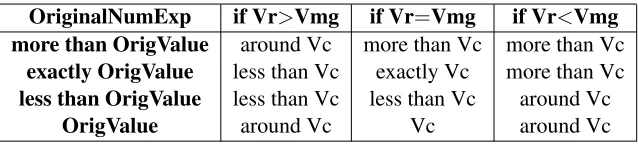
OriginalNumExp if Vr>Vmg if Vr=Vmg if Vr<Vmg more than OrigValue around Vc more than Vc more than Vc
exactly OrigValue less than Vc exactly Vc more than Vc
less than OrigValue less than Vc less than Vc around Vc
[image:6.612.147.466.56.128.2]OrigValue around Vc Vc around Vc
Table 1: Hedge Choice Rules. For each original expression (OrigValue), the normalized values(Vmg, Vr)are used to determinate the hedge chosen for the simplified expression. The final version is composed by the hedge chosen and the candidate value(Vc)
first column of Table 1 (“around”) and the simplified expression is “around 1/3”.
When the user chooses the Fraction Levelin the system, every numerical expression with difficulty level greater than fraction level will be replaced by a numerical expression expressed in fraction form. Depending on the valuesVrandVmg, the appropri-ate hedge will be chosen.
4.4.5 Phase 5: Replace numerical expressions
Once the system has applied its rules, an adapted version is available for each original numerical ex-pression which was more difficult than the target dif-ficulty level. The output text is obtained by replac-ing these difficult expressions with the correspond-ing simplified version.
5 Evaluation of the system
This section presents the evaluation of the system, describing the materials, experiment, participants and results of the evaluation.
5.1 Materials
We selected for the experiment a set of eight can-didate sentences from the NUMGEN corpus, but the number of numerical expressions was larger as some sentences contained more than one proportion ex-pression. In total we had 13 numerical expressions. We selected sentences with as many variations in context, precision and different wordings as possi-ble. The range of proportions values was from points nearly 0.0 to almost 1.0, to give coverage to a wide spread of proportion values. We considered values in the central range (say 0.2 to 0.8) and values at the extreme ranges (say 0.0-0.2 and 0.8-1.0). We also classified as common values the well-known per-centages and fractions like 25%, 50%, 1/4 and 1/2, and as uncommon values the rest like 15% or 6/7.
5.2 Experiment
To evaluate the system a questionnaire was pre-sented to a set of human evaluators. The experi-ment was created and presented on SurveyMonkey2, a commonly-used provider of web surveys. For each original sentence, we presented two possible simpli-fications generated by the system. Participants were asked to use their judgement to decide whether they agreed that the simplified sentences were acceptable for the original sentence. A Likert scale of four val-ues (Strongly Disagree, Disagree, Agree, Strongly Agree) was used to collect the answers.
In the survey only two levels of adaptation from the original sentence were presented. The first op-tion generated by the system was for the Fractions level. The second option generated by the system was for thePercentages without decimals (PWD).
5.3 Participants
The task of simplifying numerical expressions is dif-ficult, so we selected a group of 34 experts made up of primary or secondary school mathematics teach-ers or adult basic numeracy tutors, all native English speakers. This group is well qualified to tackle the task since they are highly numerate and accustomed to talking to people who do not understand mathe-matical concepts very well. We found participants through personal contacts and posts to Internet fo-rums for mathematics teachers and numeracy tutors.
5.4 Results
The answers from the participants were evaluated. In total we collected 377 responses, 191 responses for theFraction leveland 186 responses for the Per-centage without decimals (PWD). Table 2 shows the average from the collected responses, considering 1
2
Level Total average Values Average Values Average
Fraction 2,44 Central 2,87 Common 2,59
Extreme 2,14 Uncommon 1,21
PWD 2,96 Central 3,00 Common 2,80
[image:7.612.132.479.57.129.2]Extreme 2,96 Uncommon 3,22
Table 2: System Evaluation: Fraction Level and Percentages Without Decimals (PWD)
Opinion Fraction PWD Level Level Strongly Disagree 19% 6%
Disagree 27% 15%
Agree 43% 56%
Strongly Agree 11% 23%
Table 3: Opinion of the experts in percentages
to 4 for strongly disagree to strongly agree. In ad-dition, Table 3 shows the distribution in percentages of the opinion of the experts. At theFraction level, there is not too much difference between the average of the answers of the experts that agree with the sys-tem and those that disagree. Most experts are neu-tral. But for the PWD levelthe average shows that most experts agree with the simplification done.
We have also analyzed the answers considering two different criteria from the original numerical ex-pressions: when they are central (20% to 80%) or extreme values (0% to 20% and 80% to 100%), and when the original numerical expressions are com-mon or uncomcom-mon values. In general terms, the ex-perts think that the simplification done by the sys-tem in thePWD levelis better than the simplification done in theFraction level. They disagree specially with the simplification using fractions in two cases. One is the treatment of the extreme values where the system obtains as possible candidates “none” and “all”3. Another case is when uncommon fractions are used to simplify the numerical expression, like for example 9/10. In these two cases the average is lower than the rest of the average achieved.
5.5 Discussion
The system combines syntactic transformations (via the introduction of hedges) and lexical
substitu-3See (Power and Williams, 2012) for a discussion of
appro-priate hedges for values near the extreme points of 0 and 1.
tions (by replacing actual values with substitution candidates and transforming quantities expressed as words into digits) to simplify the original numerical expression. These kinds of transformations are dif-ferent from those used by other systems, which rely only on syntactic transformations or only on lexi-cal substitutions. Rules are purpose-specific and fo-cused on numerical expressions. With this kind of transformations the readability of the text improves in spite of the fact that the resulting syntactic struc-ture of the numerical expression is more compli-cated, due to the possible presence of hedges. For example, for a original numerical expression like ‘25.9%’ the system generates the simplified ‘more than a quarter’ which is easier to understand even though longer and syntactically more complex.
With respect to coverage of different types of nu-merical expressions, this system does not consider
ratiosas a possible simplification strategy because theproportion approximation programdoes not use them as candidates to simplify a proportion. This possibility should be explored in the future.
[image:7.612.92.280.171.256.2]6 Conforming with conclusions of prior surveys
The results presented for the system are evaluated in this section for conformance with the conclusions resulting from the empirical studies described in (Bautista et al., 2011b) and (Bautista et al., 2011a).
With respect to the preference for round or com-mon values in simplification (Conclusion 1), the sys-tem presented conforms to this preference by virtue of the way in which the list of candidate substitu-tions is produced by the program. The candidates re-turned by the program are already restricted to com-mon values of percentages (rounded up) and frac-tions, so the decision to consider as preferred candi-date the one listed first implicitly applies the criteria that leads to this behavior.
With respect to the need to treat differently values in the extreme or central ranges of proportion (Con-clusion 2), the system addresses this need by virtue of the actual set of candidates produced by the pro-gram in each case. For example, if the original ex-pression is a extreme value like ‘0.972’, the program produces a different candidate substitution (‘almost all’) that in the central ranges is not considered.
With respect to restricting the use of hedges to situations where loss of precision is incurred (Con-clusion 3), the hedge choice rules applied by the system (see Table 1) satisfy this restriction. When
Vr=Vmg hedges are included in the simplified ex-pression only if they were already present in the original expression.
In addition, the system rounds up any quantities with decimal positions to the nearest whole num-ber whenever the decimal positions are lost during simplification. This functionality is provided im-plicitly by the program, which presents the rounded up version as the next option immediately follow-ing the alternative which includes the decimal posi-tions. For example, if the input proportion is ‘0.198’, some rounded candidate substitutions are calculated as ‘almost 20%’ or ‘less than 20%’.
Finally, the system follows the European guide-lines for the production of easy to read information in that it automatically replaces numerical quantities expressed in words with the corresponding quantity expressed in digits.
7 Conclusions and future work
The system described in this paper constitutes a first approximation to the task of simplifying numerical expressions in a text to varying degrees of difficulty. The definition of an scale of difficulty of numeri-cal expressions, the identification of rules governing the selection of candidate substitution and the appli-cation of hedges constitute important contributions. The empirical evaluation of the system with human experts results in acceptable rates of agreement. The behavior of the system conforms to the conclusions on simplification strategies as applied by humans re-sulting from previous empirical surveys.
There are different aspects to improve the actual system from the data collected, with a special atten-tion to cases in which the experts disagree. As future work, the syntactic context should be considered to simplify numerical expression, extending the kind of proportion to simplify and treating special cases analyzed in this first version. At the syntactic level, some transformation rules can be implemented from a syntactic analysis. It is important that the meaning of the sentences be preserved regardless of whether part of the sentence is deleted or rewritten by the adaptation rules. In addition, the numerical expres-sion parser and the proportion approximation pro-gram could also be studied in order to evaluate the impact of their errors in the final performance.
Our final aim is to develop an automatic simplifi-cation system in a broader sense, possibly including more complex operations like syntactic transforma-tions of the structure of the input text, or lexical sub-stitution to reduce the complexity of the vocabulary employed in the text. Additionally we hope to de-velop versions of the simplification system for other languages, starting with Spanish. Probably the sim-plification strategies for numbers would be the same but the use of hedge modifiers may be different.
Acknowledgments
References
Susana Bautista, Pablo Gerv´as, and Ignacio Madrid. 2009. Feasibility Analysis for SemiAutomatic Con-version of Text to Improve Readability. In Proceed-ings of The Second International Conference on Infor-mation and Communication Technologies and Acces-sibility, Hammamet, Tunusia, May.
Susana Bautista, Raquel Herv´as, Pablo Gerv´as, Richard Power, and Sandra Williams. 2011a. Experimental identification of the use of hedges in the simplifica-tion of numerical expressions. InProceedings of the Second Workshop on Speech and Language Process-ing for Assistive Technologies, pages 128–136, Edin-burgh, Scotland, UK, July. Association for Computa-tional Linguistics.
Susana Bautista, Raquel Herv´as, Pablo Gerv´as, Richard Power, and Sandra Williams. 2011b. How to Make Numerical Information Accessible: Experimen-tal Identification of Simplification Strategies. In Cam-pos, Pedro and Graham, Nicholas and Jorge, Joaquim and Nunes, Nuno and Palanque, Philippe and Winck-ler, Marco, editor,Human-Computer Interaction IN-TERACT 2011, volume 6946 ofLecture Notes in Com-puter Science, pages 57–64. Springer Berlin / Heidel-berg.
Ann M. Bisantz, Stephanie Schinzing, and Jessica Munch. 2005. Displaying uncertainty: Investigating the effects of display format and specificity. Human Factors: The Journal of the Human Factors and Er-gonomics Society, 47(4):777.
Yvonne Canning. 2000. Cohesive simplification of newspaper text for aphasic readers. In 3rd annual CLUK Doctoral Research Colloquium.
Raman Chandrasekar and Bangalore Srinivas. 1997. Automatic induction of rules for text simplification.
Knowledge-Based Systems, 10.
Raman Chandrasekar, Christine Doran, and Bangalore Srinivas. 1996. Motivations and methods for text simplification. InIn Proceedings of the Sixteenth In-ternational Conference on Computational Linguistics (COLING ’96), pages 1041–1044.
Clark Christina and Douglas Jonathan. 2010. Young people reading and writing today: Whether, what and why. Technical report, London: National Literacy Trust.
Walter Daelemans, Anja Hothker, and Erik Tjong Kim Sang. 2004. Automatic Sentence Simplification for Subtitling in Dutch and English. InProceedings of the 4th Conference on Language Resources and Evalua-tion, pages 1045–1048, Lisbon, Portugal.
Siobhan Devlin and John Tait. 1998. The use of a Psycholinguistic database in the Simplification of Text
for Aphasic Readers. Lecture Notes. Stanford, USA: CSLI.
Nathan Dieckmann, Paul Slovic, and Ellen Peters. 2009. The use of narrative evidence and explicit likelihood by decision makers varying in numeracy. Risk Analy-sis, 29(10).
Geert Freyhoff, Gerhard Hess, Linda Kerr, Elizabeth Menzel, Bror Tronbacke, and Kathy Van Der Veken. 1998. European guidelines for the production of easy-to-read information.
Caroline Gasperin, Lucia Specia, Tiago F. Pereira, and Sandra M. Aluisio. 2009. Learning when to simplify sentences for natural text simplification. In Proceed-ings of the Encontro Nacional de Inteligencia Artificial (ENIA), pages 809–818, Bento Gonalves, Brazil. Deeqa Jama and George Dugdale. 2010. Literacy: State
of the nation. Technical report, National Literacy Trust.
Arnaldo Candido Jr., Erick Maziero, Caroline Gasperin, Thiago A. S. Pardo, Lucia Specia, and Sandra M. Aluisio. 2009. Supporting the Adaptation of Texts for Poor Literacy Readers: a Text Simplification Ed-itor for Brazilian Portuguese. In Proceedings of the NAACL/HLT Workshop on Innovative Use of NLP for Building Educational Applications, pages 34–42, Boulder, Colorado.
Imtiaz Hussain Khan, Kees Deemter, and Graeme Ritchie. 2008. Generation of refering expressions: managing structural ambiguities. In Proceedings of the 22nd International Conference on Computational Linguistics(COLING), pages 433–440, Manchester. Himanshu Mishra, Arul Mishra, and Baba Shiv. 2011.
In praise of vagueness: malleability of vague informa-tion as a performance booster. Psychological Science, 22(6):733–8, April.
Ellen Peters, Judith Hibbard, Paul Slovic, and Nathan Dieckmann. 2007. Numeracy skill and the commu-nication, comprehension, and use of risk-benefit infor-mation. Health Affairs, 26(3):741–748.
Sarah E. Petersen and Mari Ostendorf. 2007. Text Sim-plification for Language Learners: A Corpus Analysis. InProceedings of Workshop on Speech and Language Technology for Education (SLaTE).
Richard Power and Sandra Williams. 2012. Generating numerical approximations. Computational Linguis-tics, 38(1).
Qualification and Curriculum Authority. 1999. Mathe-matics: the National Curriculum for England. Depart-ment for Education and EmployDepart-ment, London. Advaith Siddharthan. 2002. Resolving attachment and
Advaith Siddharthan. 2003.Syntactic Simplification and Text Cohesion. Ph.D. thesis, University of Cambridge. United Nations. 1994. Standard Rules on the Equal-ization of Opportunities for Persons with Disabilities. Technical report.
Sandra Williams and Richard Power. 2009. Precision and mathematical form in first and subsequent men-tions of numerical facts and their relation to document structure. InProc. of the 12th European Workshop on Natural Language Generation, Athens.
Sandra Williams and Ehud Reiter. 2005. Generating readable texts for readers with low basic skills. In
Proceeding of the 10th European Workshop on Natu-ral Language Generation, pages 140–147, Aberdeen, Scotland.
Joel Williams, Sam Clemens, Karin Oleinikova, and Karen Tarvin. 2003a. The Skills for Life survey: A national needs and impact survey of literacy, numer-acy and ICT skills. Technical Report Research Report 490, Department for Education and Skills.
Sandra Williams, Ehud Reiter, and Liesl Osman. 2003b. Experiments with discourse-level choices and read-ability. In In Proceedings of the European Natu-ral Language Generation Workshop (ENLG) and 11th Conference of the European Chapter of the Associa-tion for ComputaAssocia-tional Linguistics (EACL03), pages 127–134.