https://doi.org/10.1177/2059513118816219
Scars, Burns & Healing Volume 4: 1 –15
DOI: 10.1177/2059513118816219 Article reuse guidelines: sagepub.com/journals-permissions © The Author(s) 2018
journals.sagepub.com/home/sbh
Creative Commons Non Commercial CC BY-NC: This article is distributed under the terms of the Creative Commons Attribution-NonCommercial 4.0 License (http://www.creativecommons.org/licenses/by-nc/4.0/) which permits non-commercial use, reproduction and distribution of the work without further permission provided the original work is attributed as specified on the SAGE and Open Access pages (https://us.sagepub.com/en-us/nam/open-access-at-sage).
An evaluation of the impact of
a burn camp on children and
young people’s concerns about
social situations, satisfaction with
appearance and behaviour
Laura Armstrong-James
1, Julia Cadogan
2,
Heidi Williamson
1, Nichola Rumsey
1and Diana Harcourt
1Abstract
Introduction: This evaluation aimed to assess the impact of a burn camp on children and young people’s concerns about social situations, satisfaction with appearance and behaviour.
Methods: Young people completed the Perceived Stigmatisation Questionnaire (PSQ), Social Comfort Questionnaire (SCQ) and Satisfaction with Appearance Scale (SWAP) one month before camp (n=23), on the last day of camp (n=21) and at a three-month follow-up (n=13). Parents completed the Strengths and Difficulties Questionnaire (SDQ) one month before camp (n = 22) and at follow-up (n=12). Parents and young people also completed open-ended questions before camp and at the follow-up.
Results: Results in this evaluation were mixed. While parents’ reported scores on the SDQ were poorer after camp, young people’s reported outcomes on all three measures improved at the end of camp. PSQ and SWAP scores were maintained and improved, respectively, at the follow-up. Qualitative responses were generally consistent with these scores. Significant improvements were found between the scores before camp and at the three-month follow-up for both the SWAP and PSQ. These results indicate that the burn camp may help to improve young people’s satisfaction with their appearance and concerns about social situations. However, there was no comparison group and there was a significant loss of participants at follow-up.
Conclusion: Burn camps may therefore offer a range of psychosocial benefits to young people with burn injuries. This was the first evaluation to demonstrate a positive impact of a burn camp on satisfaction with appearance and concerns about social situations using outcome measures validated with the burns population.
Keywords
Burn camp, psychosocial, young people, support, intervention, parent
1Centre for Appearance Research, Faculty of Health & Applied Science, University of the West of England, Coldharbour Lane, Bristol, UK 2Children’s Burns Research Centre, Bristol Royal Hospital for Children, Upper Maudlin Street, Bristol, UK
Corresponding author:
Laura Armstrong-James, Centre for Appearance Research, Faculty of Health & Applied Science, University of the West of England, Coldharbour Lane, Bristol, UK.
Lay Summary
Burns camps are residential programmes for young people with burn injuries which allow them to meet others who have been through similar experiences, and try out a range of activities in a supportive environment. Previous research has evaluated several aspects of burn camp on young people, including self-esteem, social relationships and emotional/behavioural wellbeing, but has produced conflicting results. This may be because the questionnaires completed by the participants with burn injuries used in these studies were designed for the general population. The current evaluation therefore utilised three questionnaires designed specifically for the burns population with the young people, as well as a generic outcome measure with the parents. Twenty three young people completed questionnaires relating to their feelings about their appearance and social experiences, and twenty two parents completed questionnaires relating to their feelings about their children’s behaviour. Results in this evaluation were mixed. The evaluation indicated that, while parents rated their children’s behaviour as worse following the camp, the young people felt more positively about their appearance and social experiences after camp. As previous research has found that young people can struggle with their appearance and social situations following a burn injury, this evaluation suggests that a burn camp can be of benefit for these issues. However, it should be noted that significantly fewer participants completed the questionnaires at follow-up compared to the initial questionnaire. In addition, this evaluation did not include a comparison group of young people with burn injuries who did not attend burn camp.
Introduction
Burn injuries are associated with a range of psy-chosocial difficulties in children and young
peo-ple aged ⩽ 18 years, such as depression, anxiety,
and worries about appearance and social
situa-tions.1 Burn camps are specialist residential
activ-ity programmes for young people with burn injuries, to allow them to meet others who have been through a similar experience. Although the majority of burn camps do not offer specific chological interventions, they can offer many psy-chosocial benefits such as making new friends and
learning new skills.2 The aim of these camps is to
provide young people with a fun and supportive environment, in which they carry out activities such as caving, zip wire or swimming, designed to help them deal effectively with the challenges of a
burn injury.3 It is thought that helping CYP
(chil-dren and young people) to succeed at physical activities may help them feel better about what their bodies can do, which promotes a more
posi-tive body image and improves self-esteem.4
Previous research has demonstrated remark-able consistency across qualitative studies with young people, parents and staff alike, indicating that they believe the experience of attending camp to be hugely beneficial. For example,
Williams et al.5 conducted focus groups with 52
young people across three burn camps in the USA and found that they provided campers with a sense of acceptance, a greater sense of purpose within life, and increased confidence and self-esteem. Maertens and Ponjaert-Kristoffersen’s
qualitative study6 found that young people,
par-ents and staff reported a number of benefits for the young people attending a camp in Belgium, including new social skills and relationships, increased confidence and a sense of achievement at taking part in activities.
Research employing mixed methods has found similar results from the qualitative elements of
their studies. For example, Gaskell3 collected both
qualitative and quantitative data over a five-year period and found that a UK-based camp helped young people to cope positively with their burns as well as improved their confidence and social skills.
A later study by Gaskell et al.7 collected qualitative
and quantitative data from five European burn camps using self-report questionnaires and Likert scales. Young people and parents referred to the benefits of shared experiences, friendship and increased ability to put the injury in perspective, as well as improved self-confidence, appearance esteem and social skills. As evidenced by these stud-ies, it is clear that results from the qualitative burn camp literature have produced consistent results. However, the findings from the quantitative ele-ments of these mixed methods studies have not replicated those of the qualitative elements and other studies using solely quantitative techniques have also produced inconsistent results.
For example, a review by Maslow and Lobato8
reported that the majority of quantitative research into burn camps used the Rosenberg Self-Esteem
Scale (RSES),9 a generalised measure of
self-esteem. While some research10,11 has not identified
discovered that campers’ self-esteem improved from the beginning to the end of camp, although this effect was relatively minor. The cause of these
conflicting findings remains unclear. Gaskell3
refers to the complex nature of self-esteem and the multifaceted constructs of which it is formed, so it is possible that a single measure of self-esteem may be insufficient to properly evaluate the effects of
camp. Indeed, Rimmer et al.12 suggested that
future research may benefit from implementing alternative measures of self-perception.
Research conducted since Maslow and
Lobato’s8 review has taken additional psychosocial
constructs into account. For example, Bakker
et al.2 examined the relationship between camp,
self-esteem and satisfaction with appearance at three time points: three weeks pre-camp, then one week and 16 weeks after camp. They also used the RSES but included a burns-specific measure of sat-isfaction with appearance (a Dutch version of Lawrence et al.’s Satisfaction with Appearance
Scale [SWAP]).13 The study included a
compari-son group of young people who had had a burn injury but who chose not to attend camp. Results did not identify a change in self-esteem for either the camp attendees or comparison group, in either the short or longer term. However, a small improvement in satisfaction with appearance was noted among the campers when comparing the pre- and post-camp measures, although this effect was not maintained at the 16-week follow-up. However, the Dutch version of the SWAP had not been validated before their study and the authors suggested that their results regarding the effect of camp on appearance need replicating.
Tropez-Arceneaux et al.14 utilised a number
of outcome measures at a burn camp in Nicaragua and determined that camp significantly improved levels of anxiety, depression and self-esteem. However, the camp differed from burn camps in previous, and the current, research as it included both educational and applied ‘classroom-type’ activities involving reflection on depression, anx-iety and self-esteem. The authors also identified cultural differences between their camp and the camps studied in previous research in the US. While the results from this study are very positive, they therefore may not be generalisable to other burn camp research.
The lack of significant findings in many of the earlier quantitative studies may be due to the strong focus on self-esteem, despite qualitative evidence that campers experience benefits that
extend beyond this.8 The positive results from
Bakker et al.’s study2 suggest that investigating
additional constructs such as satisfaction with
appearance may provide a more comprehensive
evaluation of camps. Although Gaskell3 examined
constructs other than self-esteem (such as social competence, social worries and satisfaction with appearance), she speculated that a lack of consist-ent findings in her study may be due to the meas-ures used, as generalised measmeas-ures may fail to consider the issues commonly experienced by young people with burn injuries.
Overall, there remains a need for further research implementing measures of a range of psy-chosocial constructs appropriate for the young
burns population. Kent15 recommends that
research should assess the effect of stigmatisation within disfiguring conditions, while Jenkinson
et al.16 suggest that measures designed to assess
constructs such as appearance satisfaction or social confidence should be considered when conduct-ing research into interventions for young people affected by appearance-altering conditions. These suggestions tie in with the previous qualitative find-ings, which have indicated that camp can improve
feelings towards appearance17 and confidence
within social situations.3 Furthermore, parents’
qualitative responses in the aforementioned stud-ies have referred to a wide range of positive out-comes for their children, including a number of emotional, social and behavioural benefits such as increased confidence, improved conduct with other people and a new sense of independence. In summary, there is a need to evaluate a range of psy-chosocial constructs using appropriate quantita-tive measures. However, it is also considered important to include a qualitative element along-side quantitative methods in order to contextualise
results and explain any unexpected findings.18
Based on the aforementioned research, the current evaluation aimed to determine whether attendance at a burn camp led to a quantifiable improvement in appearance satisfaction and social concerns as reported by young people with a burn injury, and parents’ reports of their chil-dren’s general behaviour. Furthermore, the eval-uation set out to use measures deemed more appropriate and specific than the generalised measures used in previous research. The specific research questions were as follows:
1. Does the burn camp impact on young peo-ple’s concerns regarding social situations? 2. Does the burn camp impact on young
peo-ple’s satisfaction with their appearance? 3. Does the burn camp impact on young
people’s behaviour?
Method
Design
This was a mixed-methods evaluation including both quantitative outcome measures and open-ended questions to encourage qualitative
responses. Johnson and Onwuegbuzie19 suggest
there are a number of advantages to using mixed-methods, which can focus on the strengths of qualitative and quantitative techniques, while attempting to minimise the weaknesses. For example, narrative can be used to add depth to statistical findings from a quantitative study, which can in turn add precision to qualitative findings. Corroborating evidence from the two methods can also help to draw a stronger
conclu-sion about a particular research question.20
This evaluation took place at the National Burn Camp, which has been run by the Burn
Camps UK charity21 since 1996. Children and
young people aged 8–17 years from burn clubs around the country are invited to Grafham Water Centre in Cambridgeshire, UK. The camp runs over seven days and is usually attended by around 50 children and 20 volunteers; parents do not attend. Although children arrive at the camp with their individual burn clubs, they are then split into groups according to age, and partici-pate in a morning, afternoon and evening activ-ity each day. Morning and afternoon activities take place at the centre and include kayaking, wall climbing, archery, high ropes and mountain biking. The evening activities usually occur off-site and include trips to a cinema, swimming pool and bowling alley.
Participants
Young people with burn injuries aged 10–17 years who had been invited to attend the UK National Burn Camp and their parents/carers were eligible to take part. All had been treated for a burn and were referred to the camp through their individual burn clubs, located across the country. Decisions about the readiness of each child to attend camp are made on a case-by-case basis by the child’s own burn club. Fifty-one chil-dren attended the camp, 23 (45% of total attend-ees) of whom elected to participate in the evaluation. Twenty-two (43% of total attendees) parents/carers of the young people who partici-pated in the evaluation also took part. Twenty-two of the children had attended a burn camp before (average of four previous camp attend-ances). Participants’ demographic characteristics are outlined in Table 1.
Twenty-three young people and 22 parents completed the first questionnaire pack before camp; 21 (91%) of the children attending camp completed the pack on the last day of camp. The three-month follow-up packs con-taining child and parent measures were returned by 13 young people and 12 parents (57% and 55% of participating young people and parents, respectively).
Quantitative measures
Participants completed the following measures one month before camp, on the last day of camp and three months after camp.
Table 1. The demographic characteristics of the participants.
Demographic characteristic n
Gender of young people 8 boys, 15 girls
Mean age of young people, years (range) 13.7 (10–17)
Ethnicity of young people 15 white, 1 Asian, 3 black, 4 mixed/multiple ethnic groups
Time since injury, years (range) 8.14 (1–15)
Previous camp attendance 22 yes, 1 no
Mean number of previous camp attendances, n (range) 4.10 (1–18)
Gender of parents/carers 2 men, 20 women
Ethnicity of parents/carers 15 white, 2 Asian, 2 black, 2 mixed/multiple ethnic groups
Relationship status of parents/carers 2 single, 15 married/domestic partnership, 1 widowed, 4
divorced
[image:4.595.39.535.75.295.2]Perceived Stigmatisation Questionnaire (PSQ). The PSQ is the first questionnaire designed to mea-sure stigmatising behaviours experienced by those with a visible difference, and was originally
validated with a sample of adult burns patients.22
The PSQ has 21 items and contains three factors (absence of friendly behaviour, confused and staring behaviour, and hostile behaviour), which convey social acceptance, social discomfort and social rejection to the perceiver. Total and sub-scale scores can be calculated. The PSQ has been validated for use within the paediatric burns pop-ulation, demonstrating reliability scores in the
range of 0.81–0.89,23 and is suitable for the full
age range of participants in the current evalua-tion (10–17 years).
The Social Comfort Questionnaire (SCQ). The SCQ
has eight items and aims to measure an individu-al’s perceived violation of privacy and feelings of
social isolation.23 Total scores are in the range of
1–5 on both measures and higher scores indicate higher levels of perceived stigmatisation and social comfort, respectively. The SCQ has been validated for use within the paediatric burns
pop-ulation, demonstrating reliability scores of 0.78,23
and is suitable for the full age range of partici-pants in the current evaluation (10–17 years).
The Satisfaction with Appearance Scale (SWAP). The
SWAP measures subjective satisfaction with appearance and the social–behavioural impact of
burn scars.24 The SWAP has 14 items and has
been validated for use in the burns population24
and used within previous paediatric burns
research.2,25 Total scores are in the range of 0–78,
with higher scores indicating greater dissatisfac-tion with appearance. It has demonstrated a high level of internal consistency (Cronbach’s alpha,
r = 0.87) and test–retest reliability of (r = 0.59).
Strengths and Difficulties Questionnaire (SDQ). The
SDQ is a behavioural screening tool designed for completion by parents of children aged 4–16
years26 which has been used with paediatric burn
patients aged 8–18 years.3 It contains 25 items
divided into five subscales: emotional symptoms; conduct problems; hyperactivity/attention; peer relationship problems; and pro-social behaviour. Each subscale scores 0–10, with higher scores on the first five subscales indicating a higher inci-dence of problem behaviours, and higher scores on the pro-social subscale indicating an increase in behaviours such as sharing or volunteering to help others. Scores from the first four subscales can also be added to calculate a total difficulties
score. Goodman27 found that the SDQ
demon-strated acceptable levels of internal consistency (Cronbach’s alpha 0.73) and test–retest reliabil-ity (0.62).
Open-ended questions. The questionnaire packs
administered one month before camp and at the three-month follow-up also included open-ended questions, to compare young people’s and par-ents’ expectations before the camp with their views afterwards, an approach previously adopted
by Maertens and Ponjaert-Kristoffersen.6
Pre-camp questionnaires asked young people and their parents about their expectations of camp and what, if anything, they were worried about. The three-month follow-up questionnaire asked what the young people had enjoyed about camp, whether they had gained anything from it, what was good about it and what, if anything, they would change.
Data collection
Ethics approval was granted by the first author’s institutional Research Ethics Committee (refer-ence no. HLS/13/06/85). Participants were sent an evaluation pack including an invitation letter, participant information sheet, consent form and a copy of the questionnaire booklet. Participants who wanted to take part in the evaluation were asked to provide written informed consent
(paren-tal consent for those aged < 16 years) and asked
to return the completed questionnaires (baseline data) using a pre-paid envelope. The researcher collected data on the last day of camp in person (at a predetermined time that minimised disrup-tion with camp activities) and data were collected via post for the three-month follow-up.
Results
Data analysis was conducted by the first author (LAJ) and reviewed by another member of the research team (DH). Quantitative data were ana-lysed with SPSS v20 using a Wilcoxon signed ranks test. Content analysis was employed to analyse responses to the open-ended questions – this involves the formation of categories and then quan-tifying the number of times a particular response,
or section of text, falls into that category.28 As the
current evaluation examined the impact of a burn camp on specific psychosocial constructs, it utilised
a pre-set coding approach. Vaismoradi et al.29
involves transcription of responses and a complete immersion in the data. Organising involves group-ing the responses into categories; in this case, the topics outlined in the research questions. The final stage involves the reporting of the results from the first two stages. These stages were all completed by the first author. Reliability was ensured by asking a second member of the research team to review the
codes.30 The number of responses exceeds the
number of participants in those instances where participants gave multiple responses.
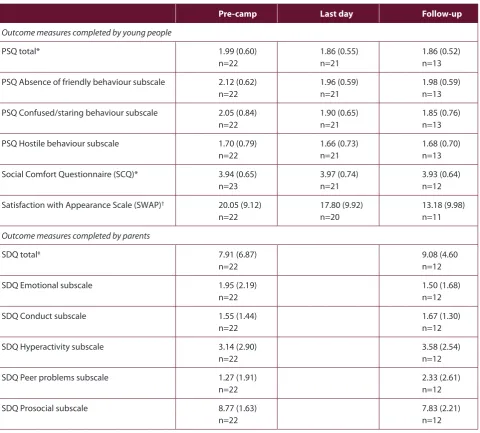
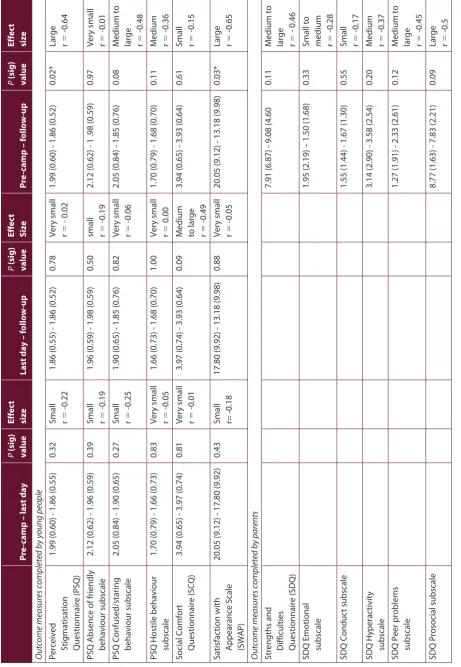
The results in this evaluation were mixed. It should also be noted that no comparison group was included in the evaluation and that there was a sig-nificant loss of participants at follow-up. Therefore, while the results may be indicative of the impact of burn camp, they should be interpreted with cau-tion. A summary of the quantitative results is shown in Tables 2 and 3, and both quantitative and quali-tative responses are discussed below.
Does the burn camp impact on young
people’s concerns regarding social
situations?
PSQ scores are in the range of 1–5, with higher scores indicting higher levels of perceived stigma-tisation. Higher scores on the PSQ as a whole indicated that participants perceived fewer stig-matising behaviours on the last day of camp when compared to pre-camp data; this effect was main-tained at the follow-up (Figure 1). The difference between the PSQ scores before camp and at fol-low-up was statistically significant and
demon-strated a large effect size (P = 0.02, r = -0.64),
indicating it was both statistically and substan-tively significant. In terms of the subscales, partici-pants reported positive changes (an increase in others’ friendly behaviour and less confused/star-ing and hostile behaviour) on the last day of camp compared to pre-camp scores, but an increase in hostile behaviours and less friendly behaviour at the three-month follow-up compared to scores on the last day of camp. None of these effects were statistically significant; however, a medium to large effect size was found between the pre-camp and follow-up scores on the confused/staring subscale, with fewer hostile behaviours reported
at the follow-up (P= 0.084, r = -0.48).
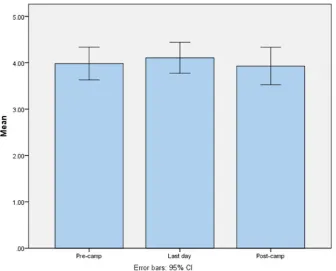
SCQ scores can be in the range of 1–5, with higher scores representing higher levels of social comfort. Participants’ reports of perceived social comfort improved from before camp to end of camp, but had then decreased again by the three-month follow-up (Figure 2). While none of the
differences were found to be statistically signifi-cant, a medium to large effect size was found between the scores on the last day of camp and at the three-month follow-up, with lower levels of
social comfort reported at the follow-up (P =
0.09, r = -0.49).
Before the camp, three young people dis-cussed feeling anxious before their first time at camp, but all agreed that this worry was soon alle-viated: ‘At my first camp I was worried about being lost in the crowd but as soon as I got there I never wanted to leave’ (girl, aged 13 years). The most common aspect of the qualitative responses relating to social issues before the camp tended to be related to making new friends, which was referred to by 15 young people and four parents, while five young people and ten parents talked about the chance to meet other young people who had been through a similar experience: ‘I love spending time with people who understand my feelings and have similar experiences as me’ (girl, aged 13 years). This relates to item 2 on the SCQ: ‘No one can understand me’. Two parents hoped that camp would provide their child with the chance to meet a range of people from differ-ent backgrounds, while one thought it might improve communication skills: ‘Communication with people she does not know, due to soon applying to uni’ (mother of girl, aged 17 years).
At the follow-up, only three young people talked about friendship generally, whereas ten felt that they had benefitted from meeting oth-ers with similar experiences; these responses were also given by four and eight parents, respec-tively. In contrast to these positive outcomes, three young people felt that they had experi-enced negativity from one member of their group: ‘The negative people, being with them and how that affects the rest of the group’ (girl, aged 17 years).
Does the burn camp impact on young
people’s satisfaction with appearance?
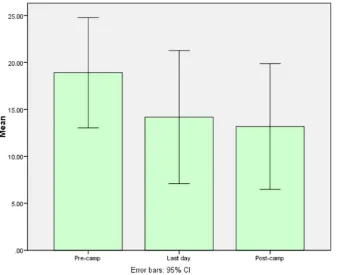
Scores on the SWAP are in the range of 0–84, with higher scores indicating greater dissatisfac-tion with appearance. Participants reported feel-ing more satisfied with their appearance on the last day of camp when compared to the pre-camp measure; this improved again at the follow-up (Figure 3). Only the difference between scores one month before camp and at three-month fol-low-up was found to be statistically significant; furthermore, this result also demonstrated a
a result that is both statistically and substantively significant.
The qualitative data revealed that only one young person referred to appearance before camp, appreciating that they did not anticipate that they would feel embarrassed about their scars while they were there: ‘I love that everyone is in the same situation so there is no need to feel embarrassed about scars’ (girl, aged 16 years).
This can be considered in the context of the first two items on the SWAP: ‘Because of changes in my appearance caused by my burn, I am uncom-fortable in the presence of my friends/strangers’. One parent thought that her daughter would be able to talk to other young people about her scars: ‘Speak to other children about their scars as she did on last camp’ (mother of girl, aged 14 years). Before the camp, two parents hoped that
Table 2. Summary of scores from the Perceived Stigmatisation Questionnaire (PSQ), Social Comfort Questionnaire (SCQ), Satisfaction with Appearance Scale (SWAP) and Strengths and Difficulties Questionnaire (SDQ).
Pre-camp Last day Follow-up
Outcome measures completed by young people
PSQ total* 1.99 (0.60)
n=22
1.86 (0.55) n=21
1.86 (0.52) n=13
PSQ Absence of friendly behaviour subscale 2.12 (0.62) n=22
1.96 (0.59) n=21
1.98 (0.59) n=13
PSQ Confused/staring behaviour subscale 2.05 (0.84) n=22
1.90 (0.65) n=21
1.85 (0.76) n=13
PSQ Hostile behaviour subscale 1.70 (0.79)
n=22
1.66 (0.73) n=21
1.68 (0.70) n=13
Social Comfort Questionnaire (SCQ)* 3.94 (0.65) n=23
3.97 (0.74) n=21
3.93 (0.64) n=12
Satisfaction with Appearance Scale (SWAP)† 20.05 (9.12) n=22
17.80 (9.92) n=20
13.18 (9.98) n=11
Outcome measures completed by parents
SDQ total‡ 7.91 (6.87)
n=22
9.08 (4.60 n=12
SDQ Emotional subscale 1.95 (2.19)
n=22
1.50 (1.68) n=12
SDQ Conduct subscale 1.55 (1.44)
n=22
1.67 (1.30) n=12
SDQ Hyperactivity subscale 3.14 (2.90)
n=22
3.58 (2.54) n=12
SDQ Peer problems subscale 1.27 (1.91)
n=22
2.33 (2.61) n=12
SDQ Prosocial subscale 8.77 (1.63)
n=22
7.83 (2.21) n=12
Values are presented as mean (SD).
*PSQ and SCQ scores are in the range of 1–5 on both measures (higher scores indicate higher levels of perceived stigmatisation and social comfort, respectively).
†SWAP scores are in the range of 0–78 (lower scores indicate greater satisfaction with appearance).
‡SDQ subscales score 0–10 (higher scores on the first four subscales indicating a higher incidence of problem behaviours; higher scores
[image:7.595.67.548.84.517.2]Table 3.
Summar
y of sig
nificanc
e v
alues and eff
ec
ts siz
es bet
w
een the thr
ee time poin
ts
.
Pr
e-camp – last da
y
P
(sig) value
Eff ec t siz e Last da
y – f
ollo
w
-up
P
(sig) value
Eff ec t Siz e Pr
e-camp – f
ollo
w
-up
P
(sig) value
Eff
ec
t
siz
e
Outcome measures completed by young people Perceived Stigmatisation Questionnaire (PSQ)
1.99 (0.60) - 1.86 (0.55)
0.32
Small r =
-0.22
1.86 (0.55) - 1.86 (0.52)
0.78
Very small r =
- 0.02
1.99 (0.60) - 1.86 (0.52)
0.02*
Large r =
-0.64
PSQ Absence of friendly behaviour subscale
2.12 (0.62) - 1.96 (0.59)
0.39
Small r =
-0.19
1.96 (0.59) - 1.98 (0.59)
0.50
small r =
-0.19
2.12 (0.62) - 1 .98 (0.59)
0.97
Very small r =
-0.01
PSQ Confused/staring behaviour subscale
2.05 (0.84) - 1.90 (0.65)
0.27
Small r =
-0.25
1.90 (0.65) - 1.85 (0.76)
0.82
Very small r =
-0.06
2.05 (0.84) - 1.85 (0.76)
0.08
Medium to large r =
-0.48
PSQ Hostile behaviour subscale
1.70 (0.79) - 1.66 (0.73)
0.83
Very small r =
-0.05
1.66 (0.73) - 1.68 (0.70)
1.00
Very small r =
0.00
1.70 (0.79) - 1.68 (0.70)
0.11
Medium r =
-0.36
Social Comfort Questionnaire (SCQ)
3.94 (0.65) - 3.97 (0.74)
0.81
Very small r =
-0.01
3.97 (0.74) - 3.93 (0.64)
0.09
Medium to large r =
-0.49
3.94 (0.65) - 3.93 (0.64)
0.61
Small r =
-0.15
Satisfaction with Appearance Scale (SWAP)
20.05 (9.12) - 17.80 (9.92)
0.43
Small r= -0.18
17.80 (9.92) - 13.18 (9.98)
0.88
Very small r =
-0.05
20.05 (9.12) - 13.18 (9.98)
0.03*
Large r =
-0.65
Outcome measures completed by parents Strengths and Difficulties Questionnaire (SDQ)
7.91 (6.87) - 9.08 (4.60
0.11
Medium to large r =
- 0.46
SDQ Emotional subscale
1.95 (2.19) – 1.50 (1.68)
0.33
Small to medium r =
-0.28
SDQ Conduct subscale
1.55 (1.44) - 1.67 (1.30)
0.55
Small r =
-0.17
SDQ Hyperactivity subscale
3.14 (2.90) - 3.58 (2.54)
0.20
Medium r =
-0.37
SDQ Peer problems subscale
1.27 (1.91) - 2.33 (2.61)
0.12
Medium to large r =
-0.45
SDQ Prosocial subscale
8.77 (1.63) - 7.83 (2.21)
0.09
Large r =
-0.5
Values are presented as mean (SD). *Significant difference at
P
<
their child’s appearance-related confidence would improve, while another hoped it would provide their child with some perspective on their injury: ‘Understand she is not the only one
with a burn scar’ (mother of girl, aged 12 years). While appearance-related confidence and per-spective were not referred to by any young peo-ple before camp, they were considered to be a
Figure 1. Young people’s scores on the Perceived Stigmatisation Questionnaire.
[image:9.595.139.473.59.331.2] [image:9.595.138.475.373.644.2]benefit by three and two young people, respec-tively, at the follow-up: ‘I’m not the only one with scars. Also, people have it much worse than I do’ (girl, aged 17 years).
Does the burn camp impact on young
people’s behaviour?
Total difficulties scores on the SDQ can be in the range of 0–40, with higher scores indicating a higher level of problem behaviours. Overall, par-ents’ scores on the SDQ indicated a higher inci-dence of problem behaviours in terms of the emotional, conduct, hyperactivity and peer prob-lem subscales, and reduced pro-social behaviour at the three-month follow-up compared with the pre-camp scores (Figure 4). Although these effects were not found to be statistically significant, a medium to large effect size was found for the
over-all SDQ (P= 0.11, r = -0.46) and peer problems
(P= 0.12, r = -0.45) subscale scores, while a large
effect size was found on the prosocial subscale (P
= 0.09, r = -0.5). All of the mean scores fell within
the ‘close to average’ range outlined on the SDQ
scoring instructions,31 indicating that these were
not clinically significant problems.
The qualitative responses indicated that one young person and three parents were concerned about behavioural issues before camp: ‘That
people will make me angry and I do something immature’ (girl, aged 11 years). We suggest that this reflects feelings and behaviours that are simi-lar to item 5 on the SDQ: ‘Often has temper tan-trums or hot tempers’. One young person and two parents hoped that camp would help young people to become more accepting of their injury. Confidence in social situations was referred to by 12 parents before camp and nine at the follow-up, and while no young people mentioned this before camp, six thought that their confidence had improved at the follow-up: ‘My confidence has improved so much. I used to be so shy and would have no confidence at all. Since camp my confidence has went right up’ (boy, aged 16 years). Improved confidence relates to item six-teen on the SDQ: ‘Nervous or clingy in new situ-ations, easily loses confidence’. Before camp, two parents felt that camp may help their child become more mature, while another hoped it would help her daughter gain compassion: ‘I hope [she] will gain compassion towards oth-ers’ (mother of girl, aged 13 years). This relates to the first item on the SDQ: ‘Considerate of other people’s feelings’. One parent thought camp may teach her son to be more independ-ent before camp and two parindepend-ents thought increased independence had been a benefit at the follow-up.
[image:10.595.126.464.60.335.2]Does the burn camp offer any additional
benefits to the young people that attend?
Responses to the open-ended questions indi-cated that some young people and parents thought that camp had provided additional ben-efits. Young people tended to focus on having fun and the activities they engaged in, referred to by 18 young people and four parents before camp and 16 young people and three parents at the follow-up. At the follow-up, two parents thought that camp may lead to opportunities to arrange support for both parents and older chil-dren: ‘I think we could have a get-together for the parents or share emails so the parents as well could organise some get-together’ (mother of boy, aged 11 years), while one recognised that young people had the chance to talk to adults with burn care knowledge. One parent also felt that camp had provided a positive from a nega-tive: ‘Continues to provide a positive focus for them after a terrible experience that could have such a negative effect on them’ (mother of boy, aged 13 years).
Discussion
This evaluation explored the impact of a burn camp on young people’s reports of concerns about social situations and satisfaction with
appearance and parents’ reports of their child’s behaviour. The analysis of qualitative data from both the children and parents revealed findings very similar to those reported in previous
research,2,3 referring to the chance to spend time
with other children with burn injuries, gain con-fidence, increase self-esteem, master new skills and learn to accept their scars. While the current evaluation used a generic measure of parent-rated behaviour (the SDQ), it employed three measures of children’s social concerns and satis-faction with appearance that have been devel-oped and tested specifically with those with burn injuries. The SCQ aims to determine young peo-ple’s level of comfort within social situations,
whereas Gaskell’s study3 used the Social Worries
Questionnaire (SWQ),32 which includes similar
items to the SCQ, such as those relating to meet-ing new people or crowded situations. Both Gaskell’s research and the current evaluation failed to find any significant impact of camp on the SWQ or SCQ scores, respectively, suggesting that camp attendance may not impact on young people’s feelings of social comfort, irrespective of the measure used.
Children’s reports of stigmatising behaviours from others, such as staring, name-calling or bul-lying, decreased in frequency from one month before camp to the last day of camp and slightly increased again at the three-month follow-up.
[image:11.595.140.473.60.328.2]These findings suggest that children felt less stig-matised while at camp, and although perceived stigmatisation scores worsened slightly after leav-ing camp, scores at the follow-up were still better than before camp. The confidence gained at camp which was described in the qualitative data may have helped children to become less trou-bled by such behaviours, or to re-evaluate previ-ous misconceptions of others’ behaviours as less stigmatising; this effect appears to have been maintained, to an extent, after camp. Although other quantitative burn camp studies have not examined perceptions of stigmatising behav-iours, participants in Cox et al.’s qualitative
study17 referred specifically to camp as a place
where they knew they would not be stared at or judged on the basis of their appearance.
Young people reported greater satisfaction with their appearance on the last day of camp than one month before camp and again at the three-month follow-up. While it is important to remember that numerous other factors may have had an influence on all results in the three months since leaving camp, these results suggest that the burn camp may have played a part in helping young people to feel more positive and accepting about their appearance, a finding sup-ported by several of the participants’ qualitative responses. When asked how camp had helped them, the majority of responses related to ‘confi-dence’, ‘learning they are not alone’, ‘accept-ance’ and ‘putting the injury into perspective’. Therefore, it is possible that camp challenged young people’s negative thoughts about their appearance, which continued to improve once they returned to everyday life.
These results can be compared to those of
Bakker et al.,2 who used a non-validated Dutch
version of the SWAP and found that satisfaction with appearance improved in the short term (comparing the scores three weeks before camp and one week after camp) but not in the longer term (comparing the scores three weeks before camp and 16 weeks after camp). Bakker et al. did not compare the scores one week and 16 weeks after camp. The differences between Bakker
et al.’s findings2 and those of the current
evalua-tion may relate to the use of the translated
ver-sion. McKenna and Doward33 point out that
translation is just the first stage in creating a ver-sion of a measure in a different language and that full adaptation can only be achieved after a full assessment of psychometric properties. Therefore, until the Dutch version of the SWAP is validated, caution is needed when comparing the results of
Bakker et al.’s study2 and the current evaluation.
Analysis of the SDQ demonstrated that par-ents reported a higher frequency of problem behaviours three months after the camp than they had done one month before camp. A possible interpretation of these findings is that the generic nature of the SDQ means it may not be capturing behaviours which are specifically affected by a burn injury. However, one could also speculate that ‘worsening’ SDQ behavioural scores may be the result of improvements in participant self-con-fidence—a qualitative finding most commonly reported by parents. Changes in confidence may have led to an increase in behaviours rated as problematic by parents. For example, while a par-ent might indicate on the SDQ that their child fights more with other children, a possible inter-pretation is that greater confidence may have increased their willingness to participate in group discussions and argue a point in which they believe to be true; behaviours which are not listed as
spe-cific items on the SDQ. Blakeney et al.34 suggest
that an increase in scores labelled as ‘delinquent’ or ‘externalising’ demonstrates an increase in young people’s assertiveness and expression of feelings, including those which may be construed as negative (e.g. anger). Therefore, the increase of ‘problem’ behaviours may not necessarily be construed as a negative finding; however, it should be interpreted with caution and warrants further research. Furthermore, parents might find it ben-eficial to be presented with a summary of this eval-uation before future burn camps, to inform them of the possible impact camp may have on their children and allow them to make a fully informed decision about whether they consent to their child attending.
It is also notable that all the parents reported pre-camp scores that fell into the ‘close to aver-age’ range outlined by the SDQ scoring
instruc-tions,26 indicating that they considered their
children to exhibit a low incidence of problem behaviours at this point. It is not known whether children displaying a higher incidence of prob-lem behaviours would have benefited any more from camp than those who attended in the
cur-rent evaluation. Similar to Gaskell,3 who
specu-lated whether camp may benefit some children more than others, the sample size in this evalua-tion was too small to compare the scores of young people scoring high or low on each measure.
While behavioural difficulties were not found to be significant in the current evaluation, it is important to be aware that these may be present among young people with burn injuries. Burn injuries are more common in households with a
be defined by a number of factors such as ethnic-ity, large families and single parents, low income and unemployment, illiteracy or low levels of
education.36 A number of these factors have been
identified as risk factors for behavioural prob-lems in the general population, such as children with single parents, parents who do not have a formal education or skilled job, or parents with
substance problems.37
Therefore, it is important to pre-empt these behaviours and consider appropriate ways to intervene if they do arise. The UK’s National
Burn Care Standards38 state that burns services
must have suitably trained health professionals available to support patients with a burn injury and their families. Previous research by
Armstrong-James39 demonstrated that
psycholo-gists within burns services in the UK aimed to conduct psychosocial screening of all inpatients, to identify any difficulties at an early stage. Psychologists in the study also reported that they received outpatient referrals at various stages of the care pathway, which originated from a range of sources including multidisciplinary team (MDT) meetings and other staff, outpatient clin-ics and burn clubs. Families attending the National Burn Camp may therefore already be receiving support from the psychology service in the burn care team and families should engage with these services if difficulties do occur.
The small sample size is a limitation of the current evaluation, which resulted from non-par-ticipation by some attendees and then attrition. No reasons for attrition were reported. This is indicative of the difficulties in recruiting for, and
maintaining interest in, burns research.40 It has
been suggested that the lack of personal contact related to postal questionnaires may contribute
to attrition rates;40 however, this was considered
the most suitable method for the pre-camp and follow-up questionnaires in the current evalua-tion since participants were based across the UK. A comparison group may have added rigour to the evaluation; however, the lack of a compari-son group in previous studies is indicative of the difficulties in using an appropriate comparison group. A process of randomisation was consid-ered for the current evaluation, in which children who had expressed an interest in camp would be randomly allocated into a group which would attend camp and a waiting list control. However, it was decided that such a process would be uneth-ical as it would be denying children the chance to attend the camp, which only runs once a year.
The current evaluation only involved one camp so it is not possible to generalise findings to
others. However, the similarity of the qualitative responses in this evaluation to past research investigating a variety of other camps suggests that generic benefits may be experienced by chil-dren attending a burn camp, irrespective of prac-tical factors, such as its location, staff and the activities on offer. It is also important to note that only one child in the current evaluation had not been to a burn camp before, while the other par-ticipants had, on average, been four times previ-ously. Therefore, it is not known if the benefits of attending camp for the first time are the same as for those who are returning. While the
longitudi-nal nature of Gaskell’s study3 distinguishes it
from other burn camp research, future studies could map responses from individual partici-pants to examine whether cumulative attendance at camp produces any different effects.
It is also important to remember that the sample consisted solely of participants who had chosen to attend the burn camp, and further-more that those most favourably disposed towards camp may have been more likely to volunteer to take part. Since burn camps have been found to improve social difficulties, it is possible that some of the young people who could potentially gain the greatest benefits from going to the burn camp may actually be avoiding it. This suggests that some young people could benefit from addi-tional support before attending camp, and this issue should be explored in future research.
While the current evaluation included a fol-low-up questionnaire to explore young people’s and parents’ views surrounding the benefits of camp, additional research could examine the impact on home and family life after a return from burn camp in more detail. A separate evalu-ation of a family burn camp involved photo-elici-tation interviews, in which several of the participants discussed the lasting impact of the
camp since their return.41
with people who understand my feelings and have similar experiences as me’ or ‘I love that everyone is in the same situation so there is no need to feel embarrassed about scars’ could help to demonstrate the benefits of the burn camp.
In conclusion, the qualitative findings from the current evaluation concur with previous research indicating that the inclusive experience of spending time with other young people who have been through a similar experience is a con-sistent benefit of camp attendance. The quantita-tive findings indicated that, in the short term, camp may indeed improve feelings of social com-fort and body satisfaction, while reducing percep-tions of stigmatising behaviours. While social comfort scores had decreased again at the three-month follow-up, perceived stigmatisation scores were maintained and satisfaction with appear-ance had improved further. Although parents reported a higher incidence of problem behav-iours after camp than before, this may have reflected children’s increased confidence. While it is important not to assume that any observed effects at the follow-up were due to the burn camp alone, these findings do lend support to the importance of using outcome measures which specifically address constructs relevant to those affected by a burn injury rather than generic out-comes intended for use with any young people. Overall, the results from this evaluation indicate that burn camps may provide a number of psy-chosocial benefits to the young people that attend. The strength of this evaluation was that it revealed largely consistent qualitative and quanti-tative results, so it may be considered a step in closing the gap between the two methods of data collection in burn camp research.
Acknowledgements
The authors would like to express their gratitude to Burns Camps UK for supporting this research and to the families who participated in the evaluation.
Declaration of conflicting interests
The authors declared no potential conflicts of interest with respect to the research, authorship, and/or publication of this article. However, the first author (LAJ) attended the burn camp as a volunteer.
Funding
This evaluation was supported by The Children’s Burns Research Centre, which is part of the Burns Collective, a Scar Free Foundation initiative with additional funding from VTCT and the Welsh Assembly. The Centre has core support from the University of Bristol, Cardiff University,
University of the West of England, University of Bath and North Bristol NHS Trust. The views expressed are those of the authors and not necessarily those of the Scar Free Foundation or other funding bodies. The publication of this research was funded by the Katie Piper Foundation.
ORCID iD
Laura Armstrong-James https://orcid.org/0000-0002
-3887-9466
References
1. Bakker A, Maertens KJ, Van Son MJ, et al. Psychological con-sequences of pediatric burns from a child and family perspec-tive: A review of the empirical literature. Clin Psychol Rev 2013; 33(3): 361–371.
2. Bakker A, Van Der Heijden PG, Van Son MJ, et al. Impact of pediatric burn camps on participants’ self-esteem and body image: An empirical study. Burns 2011; 37(8): 1317–1325. 3. Gaskell SL. The challenge of evaluating rehabilitative activity
holidays for burn-injured children: qualitative and quantita-tive outcome data from a burns camp over a five-year period. Dev Neurorehabil 2007; 10(2): 149–160.
4. British Burn Association. Burn Camps. 2018. Available at www. britishburnassociation.org/ [accessed 12 June 2018]. 5. Williams NR, Reeves PM, Cox ER, et al. Creating a social work
link to the burn community: a research team goes to burn camp. Soc Work Health Care 2004; 38(3): 81–103.
6. Maertens K and Ponjaert-Kristoffersen I. The expectations and experiences of children attending burn camps: a qualita-tive study. J Burn Care Res 2008; 29(3): 475–481.
7. Gaskell SL, Cooke S, Lunke M, et al. A Pan-European evalua-tion of residential burns camps for children and young peo-ple. Burns 2010; 36: 511–521.
8. Maslow GR and Lobato D. Summer camps for children with burn injuries: a literature review. J Burn Care Res 2010; 31(5): 740-749. 9. Rosenberg M. Society and the Adolescent Self-Image. Princeton,
NJ: Princeton University Press; 1965
10. Biggs KS, Heinrich JJ, Jekel JF, et al. The burn camp experi-ence: Variables that influence the enhancement of self-esteem. J Burn Care Rehabil 1997; 18: 93–98.
11. Arnoldo BD, Crump D, Burris AM, et al. Self-esteem measure-ment before and after summer burn camp in pediatric burn patients. J Burn Care Res 2006; 27(6) :786–789.
12. Rimmer RB, Fornaciari GM, Foster KN, et al. Impact of a pedi-atric residential burn camp experience on burn survivors’ per-ceptions of self and attitudes regarding the camp community. J Burn Care Res 2007; 28: 334–341.
13. Lawrence JW, Heinberg LJ, Roca R, et al. Development and validation of the Satisfaction with Appearance Scale: Assessing body image among burn-injured patients. Psychological Assessment 1998; 10(1): 64–70.
14. Tropez-Arceneaux LL, Alaniz ATC, Icaza IL, et al. The psycho-logical impact of first burn camp in Nicaragua. J Burn Care Res 2017; 38(1): e1–e7.
15. Kent G. Understanding experiences of people with disfigure-ment: an integration of four models of social and psychologi-cal functioning. Psychology, Health & Medicine 2000; 5: 117–129. 16. Jenkinson E, Williamson H, Byron-Daniel J, et al. Systematic
review: Psychosocial interventions for children and young peo-ple with visible differences resulting from appearance altering conditions, injury, or treatment effects. J Pediatr Psychol 2015; 40(10): 1017–1033.
adolescent campers’ body image. J Burn Care Rehabil 2004; 25(1): 141–147.
18. Bishop FL. Using mixed methods research designs in health psychology: An illustrated discussion from a pragmatist per-spective. Br J Health Psychol 2015; 20: 5–20.
19. Johnson RB and Onwuegbuzie AJ. Mixed methods research: A research paradigm whose time has come. Educational Researcher 2004; 33(14): 14–26.
20. Greene JC and Caracelli VJ. Making paradigmatic sense of mixed methods practice. In: Tashakkori A, Teddlie C, editors. Handbook of Mixed Methods in Social and Behavioral Research. Thousand Oaks, CA: Sage; 2003: 91–110.
21. Burns Camps. 2018. Available at: http://www.burncamps.org. uk/ (accessed 12 June 2018).
22. Lawrence JW, Fauerbach JA, Heinberg LJ, et al. The reliabil-ity and validreliabil-ity of the Perceived Stigmatization Questionnaire (PSQ) and the Social Comfort Questionnaire (SCQ) among an adult burn survivor sample. Psychol Assess 2006; 18(1): 106–111.
23. Lawrence JW, Rosenberg L, Rimmer RB, et al. Perceived stig-matization and social comfort: Validating the constructs and their measurement among pediatric burn survivors. Rehabil Psychol 2010; 55(4): 360–371.
24. Lawrence JW, Heinberg LJ, Roca R, et al. Development and validation of the Satisfaction With Appearance Scale: Assessing body image among burn-injured patients. Psychol Assess 1998; 10(1): 64–70.
25. Pope SJ, Solomons WR, Done DJ, et al. Body image, mood and quality of life in young burn survivors. Burns 2007; 33: 747–755.
26. Goodman R. The Strengths and Difficulties Questionnaire: A research note. J Child Psychol Psychiatry 1997; 38: 581–586. 27. Goodman R. Psychometric properties of the Strengths and
Difficulties Questionnaire (SDQ). J Am Acad Child Adolesc Psychiatry 2001; 40: 1337–1345.
28. Silverman D. Interpreting Qualitative Data. 4th ed. London: SAGE; 2011.
29. Vaismoradi M, Turunen H and Bondas T. Content analysis and thematic analysis: Implications for conducting a quali-tative descriptive study. Nurs Health Sci 2013; 15(3): 398– 405.
30. Coolican H. Research Methods and Statistics in Psychology. 6th ed. Hove, West Sussex: Psychology Press; 2014.
31. SDQ Info. Information for researchers and professionals about the Strengths & Difficulties Questionnaires. 2016. Available at: http://www.sdqinfo.org/ (accessed 12 June 2018).
32. Spence SH. Social Skills Training: Research and Technical Supplement. Cheltenham: NFER Nelson; 1995.
33. McKenna SP and Doward LC. The translation and cultural adaptation of patient-reported outcome measures. Value Health 2005; 8(2): 89–91.
34. Blakeney P, Meyer W, Moore P, et al. Social competence and behavioral problems of pediatric survivors of burns. J Burn Care Rehabil 1993; 14(1): 65–72.
35. Park JO, Do Shin S, et al. Association between socioeconomic status and burn injury severity. Burns 2009; 35(4): 482–490. 36. Edelman LS. Social and economic factors associated with the
risk of burn injury. Burns 2007; 33(8): 958–965.
37. Lanza ST, Rhoades BL, Nix RL, et al. Modeling the interplay of multilevel risk factors for future academic and behavior problems: A person-centered approach. Dev Psychopathol 2010; 22(2): 313–335.
38. National Network for Burn Care. National Burn Care Standards. 2013. Available at: http://www.britishburnassocia-tion.org/downloads/National_Burn_Care_Standards_2013. pdf (accessed 20 June 2018).
39. Armstrong-James L. Psychosocial interventions for young peo-ple with burn injuries and their families. PhD, University of the West of England. 2017. Available at: http://eprints.uwe. ac.uk/30346 (accessed 20 June 2018).
40. McQuaid D, Barton J and Campbell E. Researchers BEWARE! Attrition and nonparticipation at large. J Burn Care Res 2003; 24(4): 203–207.
41. Armstrong-James L, Cadogan J, Williamson H, et al. Using photo-elicitation to explore families’ experiences of burn camp. J Fam Nurs (accepted November 2018).