Different adaptation of IGF-I and its IGFBPs
in dairy cows during a negative energy balance
in early lactation and a negative energy balance
induced by feed restriction in mid-lactation
E.C. Kessler, J.J. Gross, R.M. Bruckmaier
Veterinary Physiology, Vetsuisse Faculty, University of Bern, Bern, Switzerland
ABSTRACT: Control of metabolic pathways is a major task of the somatotropic axis and its constituents. Insulin-like growth-factor binding proteins (IGFBPs) bind IGF-I and -II and act as carriers and regulators of their activities in blood, body fluids and tissues. Over two periods of physiological adaptation, this study investigated the bind-ing pattern of IGF-I to IGFBPs in the plasma of 50 multiparous Holstein dairy cows and identified relationships with the hepatic mRNA abundance of IGFBPs and plasma IGF-I during the lactational negative energy balance (NEB) and during a deliberately induced NEB by feed restriction. Period 1 lasted from week 3 antepartum (a.p.) to week 12 postpartum (p.p.) and period 2, the period of feed restriction, started at around 100 DIM and lasted for three weeks with a control (C) and a restricted group (R). Blood samples and liver biopsies were collected in week 3 a.p., and in weeks 1 and 4 p.p. of period 1 and in weeks 0 and 3 of period 2. For column chromatography of IGFBPs, plasma samples of all animals were pooled by group and time points of sampling. Plasma IGF-I dropped from week 3 a.p. to week 1 p.p. and thereafter increased until week 0 (period 2) and did not change up to week 3 of period 2. The binding of IGF-I to plasma IGFBP-1 and -2 increased in period 1 from week 3 a.p. to week 4 p.p., while at the same time it decreased for IGFBP-3. During period 2, the binding of IGF-I to plasma IGFBP-1 and -2 decreased for both groups, but less for R cows. In C cows, the IGF-I binding to IGFBP-3 in plasma increased from week 0 to week 3 of period 2, whereas R cows showed a slight decrease. In period 1, hepatic mRNA abundance of IGFBP-3 followed the plasma IGFBP-3 binding in contrast to the mRNA abundances of IGFBP-1 and -2. The latter increased from week 3 a.p. to week 1 p.p. and decreased afterwards whereas IGF-I binding to IGFBP-1 and -2 increased. In week 3 of period 2, the binding of IGF-I to IGFBP-1 and -2 and their hepatic mRNA abundance were higher in R cows compared to C cows. Hepatic mRNA abundance of IGF-I was consistently positively cor-related with plasma IGF-I, especially pronounced during the NEBs in week 1 p.p. (period 1) and in week 3 (period 2) in R cows. While no distinct relation between mRNA abundance of IGFBP-1 and plasma IGF-I was evident, the mRNA abundance of IGFBP-2 was inversely related to plasma IGF-I over all experimental time points independ-ent of treatmindepend-ent. The mRNA abundance of IGFBP-3 was particularly correlated with plasma IGF-I during the 2 experimental stages of a NEB. Obviously IGFBP-3, but not IGFBP-1 and -2, binding in plasma closely followed the respective pattern of hepatic mRNA abundance during the entire experimental period. The fact that changes in the different plasma IGFBPs during altering metabolic stages in different stages of lactation do not always strictly follow their mRNA abundance in liver suggests tissues other than the liver flexibly contributing to the IGFBP pool in plasma as well as a partially post-transcriptional regulation of IGFBP synthesis.
Keywords: IGF; IGF-BP; negative energy balance; dairy cow
When initiation and establishment of lactation at the end of pregnancy take place, the metabolic priority is to provide enough nutrients and energy to the mammary gland. Thus, around parturi-tion metabolism changes from an anabolic to a
factors (IGFs), and their binding proteins (IGFBPs) cause a directed nutrient flow towards the mam-mary gland while the nutrient uptake by other pe-ripheral tissues is inhibited.
IGF-I and IGF-II are ca. 7.5 kDa peptides with similar chemical structures (Rinderknecht and Humbel 1978a,b). Since the plasma concentration of IGF-II is not affected as much as the plasma concentration of IGF-I at different stages of lac-tation (Vicini et al. 1991), regulation of the bio-availability of IGF-I is also mediated by IGFBPs. IGF-I is mainly synthesised in the liver, but is also produced in numerous other tissues and organs (Renaville et al. 2002).
The IGFBP family consists of six homologous proteins (Baxter 2000) with variable molecular sizes and characterised by high affinities for IGF-I and IGF-II. The majority of circulating IGFs (ca. 99%) are bound to these proteins while circulat-ing in plasma (Hintz and Liu 1977; McGuire et al. 1992). The IGFBPs have diverse functions in the regulation of the endocrine functions of IGFs such as a role in reducing the plasma clearance of IGFs. This elevates their half-life, inhibits insulin-like ef-fects, and regulates the rate of transport of serum IGFs from the vasculature to extracellular fluids (Zapf et al. 1986; Rajaram et al. 1997).
In dairy cows, the binding pattern of IGF-I to IGFBPs in plasma was studied by Ronge and Blum (1989) during the last one to two weeks of the dry period and during the lactational negative energy balance (NEB) at four weeks postpartum (p.p.). However, until now the binding pattern of IGFs to their binding proteins and relationships among the constituents of the somatotropic axis, including the mRNA abundance of these factors, during a NEB at two different physiological stages of lacta-tion (directly after parturilacta-tion when tremendous changes occur and near 100 days in milk (DIM) without periparturient endocrine adaptations) has not been examined.
The aim of this study was therefore to provide further insights into the adaptation of constituents of the somatotropic axis during the NEB at the on-set of lactation and during a deliberately induced NEB by feed restriction at mid-lactation. Unlike earlier studies, we have investigated relationships between the binding pattern of IGF-I to IGFBPs in plasma as well as IGF-I and mRNA abundance of IGFBPs in the liver. The hypothesis tested was that the binding pattern of IGF-I to its IGFBPs in plasma and the relationships to the hepatic mRNA
abundances of IGFBPs react differently to a NEB during early lactation compared to a deliberately induced NEB at around 100 days in milk.
MATERIAL AND METHODS
Animal trial. Fifty multiparous Holstein dairy
cows were studied during two physiologically dif-ferent periods with a NEB. Period 1 lasted from week 3 a.p. to week 12 p.p. and included the spon-taneous NEB occurring directly after parturition. During period 1, all cows were treated similarly. After 100 DIM (= start of period 2; the week be-fore feed restriction was designated as week 0), cows were separated in two groups: a control group (C cows) and a feed restricted group (R cows). Period 2 lasted three weeks (until week 3 of pe-riod 2) with R cows undergoing a NEB of almost 50% of their requirements induced by feed restric-tion while C cows were fed according to their needs. Details about the animal trial and the feeding regi-men were described previously (Gross et al. 2011a).
Collection of blood and liver samples, analyses of hormones in plasma and hepatic gene
expres-sions. Blood samples and liver biopsies were
col-lected in period 1 (week 3 a.p., week 1 and 4 p.p.) and in period 2 (week 0 and week 3) between 7:30 and 9:00 a.m. before feeding. Blood obtained from the jugular vein was collected in K3EDTA-coated evac-uated tubes (Greiner, Frickenhausen, Germany), immediately cooled on wet ice and centrifuged for 15 min at 2000 × g to harvest plasma. Aliquots of plasma were stored at –20 °C until analysis of IGF-I using a radioimmunoassay in all individual samples as described by Vicari et al. (2008).
Virus Reverse Transcriptase RNase H Minus, Point Mutant (Promega Corp., Madison, WI, USA) using random hexamer primers (Invitrogen, Leek, the Netherlands). Quantitative RT-PCR for determina-tion of the mRNA abundance of IGF-I, IGFBP-1, IGFBP-2, and IGFBP-3 genes was performed on all individual liver samples with a Rotor-Gene 6000 (Corbett Research, Sydney, Australia) equipped with the software version 1.7.40. Ubiquitin (UBQ) and GAPDH were used as housekeeping genes as they were most stably expressed in liver over the course of the experiment. For further details on the methods mentioned above and the used primers see Gross et al. (2011b).
[125I]IGF-I binding to plasma samples and
column chromatography. Sephadex gel filtration was performed in order to separate and to identify IGF-I and IGFBPs by molecular size with larger molecules running faster compared to smaller ones. Because the huge number of plasma samples did not allow gel chromatography on individual sam-ples, the samples of all animals were pooled by group and time points of the experiment.
Chromatography was performed under neutral pH conditions at a pH of 7.4 on a 75 ml column filled with a Sephadex G-200 gel and run at +4 °C with Dulbecco’s Buffer (8 g NaCl, 0.2 g KCl, 0.1 g MgCl2 × 6H2O, 0.2 g NaN3, 1.15 g Na2HPO4 × 2H2O, 0.2 g KH2PO4 dissolved in 1 l double-distilled water at pH 7.4). Two hundred µl of pooled plasma were incubated with 200 µl Dulbecco’s Buffer and 35 µl [125I]IGF-I (ca. 200 000 counts per minute (cpm),
5.85 ng IGF-I) overnight at +4 °C and then passed over the column. Collected fractions (10 drops, 0.5 ml each, resp.) were transferred to a gamma counter (2470 Wizard2 Automatic gamma counter,
PerkinElmer Inc., Waltham, Massachusetts, USA) to measure the radioactivity expressed as cpm. The sum of activities of all collected individual fractions was set to 100% of the total activity per pooled sample measured.
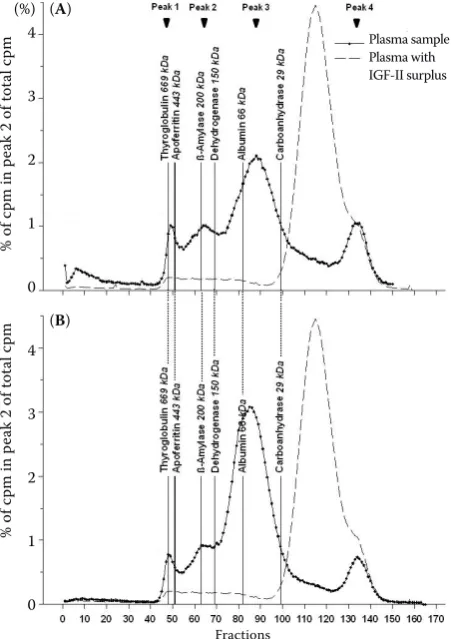
In order to demonstrate the specific bind-ing of IGF-I to the IGFBPs, 200 µl of plasma, 200 µl Dulbecco’s Buffer and 35 µl [125I]IGF-I (ca.
200 000 cpm, 5.85 ng IGF-I) were incubated with 100 µl IGF-II (10 000 ng IGF-II) overnight at +4 °C and then passed over the column (Figure 1). In ad-dition to the excess of supplied IGF-II, IGF-II has a higher affinity to IGFBPs and competes with IGF-I for binding sites of IGFBPs (Rajaram et al. 1997). When incubated with an excess of IGF-II, IGF-I is blocked from IGFBPs and all labelled IGF-Is are
found in the peak of free IGF-I (Figure 1) (Zapf et al. 1989). Thus, the observed binding of IGF-I in the peaks before free IGF-I is very likely due to the binding to IGFBPs (Figure 1).
The separation behaviour of the column was char-acterised with a gel filtration marker kit for pro-teins (Sigma-Aldrich; range of molecular weights from 29 000 up to 700 000 Da) (Figure 1). Carbonic Anhydrase (29 kDa), albumin (66 kDa), alcohol dehydrogenase (150 kDa), β-amylase (200 kDa), apoferritin (443 kDa) and thyroglobulin (669 kDa) were used as standards. From here, the collected fractions containing the different IGFBPs and free IGF-I could be identified by molecular weight and the relative occurrence of [125I]IGF-I in the
differ-ent fractions was calculated as a percdiffer-entage of total
125I-activity (cpm, Figure 1). According to the
[image:3.595.306.532.84.404.2]mo-lecular weights of the IGFBPs and to the literature, the peaks resulting from the column chromatogra-phy could be assigned to different IGFBPs. Peak 2
Figure 1. Sephadex G-200 gel filtration of pooled plasma samples at two different time points (A = week 1 p.p. of period 1; B = week 0 of period 2) incubated with [125I]
IGF-I and of IGF-II given in cpm in % of total cpm. The bars indicate the molecular weights of the standard pro-teins used for the characterisation of the column
(A)
(B)
Plasma sample Plasma with IGF-II surplus
% of c
pm in p
eak 2 of t
ot
al c
pm
% of c
pm in p
eak 2 of t
ot
al c
pm
(%) 4
3
2
1
0
4
3
2
1
0
was associated with IGFBP-3, peak 3 represented IGFBP-1 and -2, and unboundIGF-I was allocated to peak 4.
Besides pooled plasma samples, a subset of in-dividual samples was applied to the Sephadex gel filtration. This may give an idea about the underly-ing variation of the newly created data. However, it must be mentioned that this subset represents only four animals characterised by their distinct deviation from the experimental average in he-patic mRNA abundance of IGF-I and IGFBPs. In peak 2, values ranged from 6.0 to 14.2% and be-tween 56.5 to 63.3% in peak 3. Simultaneously, CT values of mRNA abundances varied from 12.8 to 20.7 (IGFBP-1), from 16.6 to 22.9 (IGFBP-2) and from 8.6 to 12.1 (IGFBP-3). Thus, pooled samples may represent the mean of single samples when considering the concomitant high variation in sin-gle PCR data.
Statistical analysis. Column chromatography for determination of the binding pattern of IGF-I to IGFBPs in plasma was performed with pooled sam-ples representing mean values at the time-points of simultaneous liver biopsies. Therefore, no SEM can be provided for this data and comparisons with IGF-I and the respective mRNA abundance of IGFBPs are based on descriptive statistics only. However, the high specific binding pattern allows gradual changes in column data (pooled samples without giving individual variation) to reflect true means of data approaching closest.
The CORR procedure of SAS (Version 9.2, SAS Institute, Cary, NC, USA) was used to determine Pearson correlation coefficients between IGF-I concentrations in plasma and mRNA abundances of IGFBP-1, -2 and -3 measured in liver.
RESULTS
Endocrine factors of the somatotropic axis, mRNA abundances of IGF-I and IGFBPs them-selves and their role in energy deficient dairy cows, were described in Gross et al. (2011b). Many studies present data only at the stage of gene expression, but the effective distribution and activity take place at the haematological level. In this study it was of main interest to delineate both the changes in the pattern of IGF-I binding to the IGFBPs as well as the interactions between the molecular and hae-matological level of binding proteins and regulating endocrine factors.
Binding pattern of IGF-I to IGFBPs in pooled plasma samples
The binding of IGF-I to binding proteins of peak 2 decreased gradually from week 3 a.p. to week 4 p.p. in period 1 (Figure 2). In period 2, from week 0 to week 3 the binding of IGF-I to binding proteins of peak 2 increased in C cows, while R cows showed a slight decrease.
The binding of IGF-I to binding proteins of peak 3 increased steadily from week 3 a.p. (period 1) to week 0 (period 2) (Figure 2). From week 0 to week 3 in period 2, IGF-I binding to proteins of peak 3 in both groups decreased and was even less in C cows compared to R cows.
Relation between IGF-I plasma concentration and hepatic mRNA abundance of IGF-I and IGFBPs
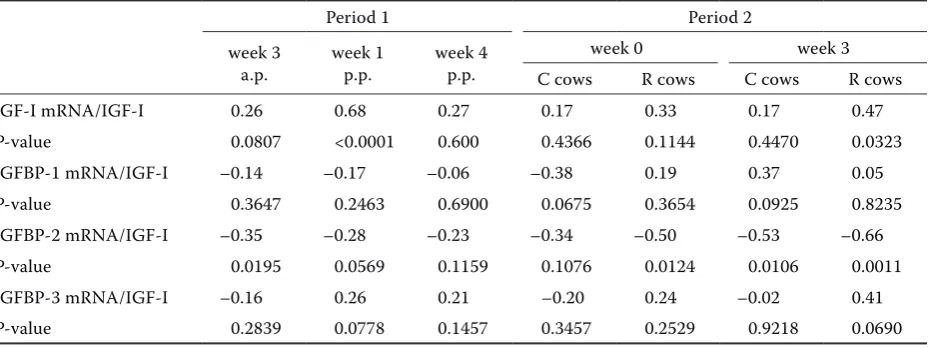
[image:4.595.303.532.387.701.2]The hepatic expression of IGF-I was positively correlated with plasma IGF-I in week 3 a.p., week 1
Figure 2. Binding of [125I]IGF-I to IGFBPs in peak 2
(IGFBP-3) and peak 3 (IGFBP-1 and -2) in % of total cpm at the different time points in period 1 (week 3 a.p. to week 4 p.p.) and period 2 (week 0 and week 3)
week 3 a.p. week 1 p.p. week 4 p.p. week 0 week 3
Period 1 Period 2
both groups control feed-restricted
20 (%)
15
10
5
0 65
60
55
50
45
40
% of c
pm in p
eak 2 of t
ot
al c
pm
% of c
pm in p
eak 2 of t
ot
al c
p.p. and in R cows in week 3 of period 2 (Table 1). The correlations were highest during periods of negative energy balance in week 1 p.p. (period 1) and in R cows in week 3 of period 2 (r = 0.68; P < 0.05 and r = 0.47; P < 0.05). Data on energy balance was shown previously (Gross et al. 2011a).
The IGFBP-1 expression showed no consistent relationship to plasma IGF-I for both groups at any time points (Table 1).
Hepatic mRNA of IGFBP-2 was inversely corre-lated with plasma IGF-I during both experimental periods (Table 1). The correlation of plasma IGF-I with IGFBP-2 mRNA abundance decreased from week 3 a.p. to week 4 p.p. (period 1) and increased in both groups from week 0 to week 3 (period 2).
Hepatic mRNA abundance of IGFBP-3 was cor-related with plasma IGF-I in week 1 in period 1 and in week 3 in R cows (Table 1).
DISCUSSION
The role of the somatotropic axis in growth and de-velopment has been studied since the first postulation of IGFs in the late 1950s (Froesch et al. 1986). Despite its local mode of action on individual cells, the sys-temic mediation of regulatory effects on metabolism is one of the main tasks of the somatotropic axis and its constituents as reviewed by Rajaram et al. (1997).
At the onset of lactation, the mammary gland gains the highest metabolic priority for nutrient flow to support and maintain milk production (Bauman and Currie, 1980; Svennersten-Sjaunja and Olsson 2005). Usually, dairy cows cannot meet their energetic requirements during early lactation
and undergo a negative energy balance (time points week 1 p.p. and week 4 p.p. of period 1 in the present study; Gross et al. 2011a), which becomes positive again in mid lactation (week 0 of period 2 in the present study; Gross et al. 2011a). The required metabolic changes for the adaptation to lactation are mediated, amongst other endocrine systems, by the growth hormone – IGF-axis. According to Boni-Schnetzler et al. (1989) and Fenwick et al. (2008), the liver is the most important source of plasma IGF-I. However, D’Ercole et al. (1984) showed in their study that many extra-hepatic tissues are able to synthesise IGF-I. In the present study, the high-est correlations were found at time points during an obvious NEB, such as in week 1 p.p. (period 1) and in R cows in week 3 (period 2). Thus, the liver is an indisputable source of IGF-I, especially during stages of energy deficiency. It is evident, however, that extra-hepatic tissues may also contribute con-siderably to the IGF-I plasma pool.
[image:5.595.67.532.102.276.2]IGFBPs are carrier proteins in plasma and play a key role in the regulation of circulating IGF bio-availability (Baxter 2000). In the present study, the method of column chromatography was used to investigate the binding pattern of IGF-I to its bind-ing proteins. Since this method is very laborious and time consuming, the considerable numbers of samples were pooled by group and time point for measurement. Pooled samples provide an estima-tion of the closest true mean of individual samples. In the present study, gel chromatography showed four major peaks. Peak 4 was assigned to IGF-I because of different aspects: when labelled IGF-I was passed over the column with only buffer, a peak of free IGF-I was found in the same fractions (data
Table 1.Correlations between mRNA abundances of IGFBP-1, -2 and -3 and plasma IGF-I concentration
Period 1 Period 2
week 3
a.p. week 1 p.p. week 4 p.p.
week 0 week 3
C cows R cows C cows R cows IGF-I mRNA/IGF-I 0.26 0.68 0.27 0.17 0.33 0.17 0.47
P-value 0.0807 <0.0001 0.600 0.4366 0.1144 0.4470 0.0323 IGFBP-1 mRNA/IGF-I –0.14 –0.17 –0.06 –0.38 0.19 0.37 0.05
P-value 0.3647 0.2463 0.6900 0.0675 0.3654 0.0925 0.8235 IGFBP-2 mRNA/IGF-I –0.35 –0.28 –0.23 –0.34 –0.50 –0.53 –0.66
P-value 0.0195 0.0569 0.1159 0.1076 0.0124 0.0106 0.0011 IGFBP-3 mRNA/IGF-I –0.16 0.26 0.21 –0.20 0.24 –0.02 0.41
not shown) as when plasma was incubated with an excess of IGF-II blocking the binding of IGF-I to IGFBPs. Additionally, when IGF-I was incubated with plasma, a peak of unbound IGF-I was found in the fractions which represented peak 4. Peak 3 involved different IGFBPs since six IGFBPs have molecular weights between 29 and 66 kDa (Hwa et al. 1999). The serum concentrations of IGFBP-4, -5 and -6 are quite low and, besides IGFBP-3, IGFBP-1 and -2 are the other major forms of IGFBPs in se-rum (Clemmons 1997). IGFBP-1 and IGFBP-2 form binary complexes with IGF-I of estimated weights of 33 and 45 kDa (Clemmons 1997; Hwa et al. 1999). IGFBP-3 (acid-stable subunit) forms a 150 kDa complex, termed “ternary complex”, with IGF-I and an 80 kDa acid labile subunit (ALS) (Baxter et al. 1989), thus forming peak 2 in the column chro-matography. According to Daughaday et al. (1982), most of the IGF-I in serum is bound to IGFBP-3. However, in the present study, the principal carri-ers of IGF-I in plasma were the IGFBPs in peak 3, IGFBP-1 and -2. The second most abundant IGF-I-carrier was the binding protein in peak 2, IGFBP-3. These results are in agreement with Hossner et al. (1988) and Ronge and Blum (1989). In their column chromatography studies, the most abundant bind-ing of IGF-I to BPs was also detected at molecular weights between 29 and 67 kDa, comparable to our peak 3, including IGFBP-1 and 2. The discrepancy between studies defining the binding capacity of IGFBPs seems to be due to the used methods. More pre-analytical processing steps and the acidic treat-ment of samples in the previous study of Daughaday et al. (1982) may have altered the binding charac-teristics of IGF-I to IGFBPs in plasma compared to the present study, where native plasma was di-rectly incubated with labelled IGF-I and applied to column chromatography. As the preparation of samples and the chromatography protocol in the present study followed Hossner et al. (1988) and Ronge and Blum (1989), IGF-I was mostly bound to IGFBP-1 and -2 located between 29 and 66 kDa.
Since IGFBP-1 and -2 have inhibiting effects on IGF-I (Rajaram et al. 1997), they decrease the bioavailability of IGF-I for the peripheral tissues (Vandehaar et al. 1995). In the present study, the binding affinity of IGF-I for IGFBP-1 and -2 in-creased steadily during the lactational NEB and consequently prevented the insulin-like activities of IGF-I, which might facilitate the glucose uptake from blood by the mammary gland during early lactation when plasma glucose concentration is low
anyway (Gross et al. 2011a). An increasing plasma concentration of IGFBP-2 during the NEB postpar-tum was also demonstrated by Vicini et al. (1991). In contrast, during period 2, both groups showed a decreased binding of IGF-I to IGFBP-1 and -2, although the extent was smaller in R cows. This higher binding of IGF-I to BP-1 and -2 in R cows during the deliberately induced NEB seems to be aimed at restricting the insulin-like activities of IGF-I during this catabolic state (Breier 1999), al-though to a lesser degree than during the lactation-al NEB. The decreased binding of IGF-I to IGFBP-1 and -2 in week 3 in C cows is likely a consequence of a priority shift in metabolism. In mid-lactation, the nutrient supply of the mammary gland is not as highly ranked as in early lactation and thus the inhibitory effect of IGFBP-1 and -2 on IGF-I is no longer needed.
Insulin seems to be an important regulator of IGFBP-1 and -2. When plasma insulin concentra-tions are low during early lactation (Gross et al. 2011b), the binding of IGF-I to IGFBP-1 and -2 increases. These results are in accordance with Clemmons and Underwood (1991), who showed that low plasma insulin increases the IGFBP-1 and -2 plasma concentration. Likewise, in early lacta-tion, during the period of feed restriction in mid-lactation with a lower plasma insulin concentration for R cows (Gross et al. 2011b), the binding of IGF-I to IGFBP-1 and -2 was observed to be increased in R cows compared to C cows. Another hormone involved in the regulation of IGFBP-1 and -2 is GH which was reported to be inversely related to IGFBP-2 plasma concentration (Clemmons 1997). The results of the present study are in agree-ment with this author since the binding of IGF-I to IGFBP-1 and -2 increased from week 1 p.p. to week 0 of period 2 whereas plasma GH decreased (Gross et al. 2011b).
IGFBP-1 and -2 was observed in R cows compared to C cows (Gross et al. 2011b) and the binding of IGF-I to BP1- and -2 was also higher in R cows than in C cows. Thus, in periods of very low NEB, like in week 1 p.p. (period 1) and week 3 (period 2) for R cows, the liver seems to increase the synthesis of IGFBP-1 and -2.
The binding of IGF-I to IGFBP-3 decreased in period 1 from week 3 a.p. to a nadir in week 4 p.p., where the NEB was present. Simultaneously, the IGF-I plasma concentration dropped (Gross et al. 2011a,b). These results are in agreement with Renaville et al. (2000), who observed a decrease in plasma concentrations of IGF-I and IGFBP-3 during feed restriction. This major decrease in IGFBP-3 during the NEB at the onset of lactation might be an attempt to maximise the availability of remaining IGF-I to the tissues (Breier 1999). During period 2, the binding of IGF-I to IGFBP-3 increased in C cows. This change suggests that the insulin-like effects of IGF-I increase in mid lactation since prolonging the half-life of IGF-I in the circulation is a major function of IGFBP-3 (Clemmons 1997). However, in R cows the slight decrease of the bind-ing of IGF-I to IGFBP-3 durbind-ing the deliberately induced NEB can be interpreted as a slight reduc-tion of the insulin-like effects of IGF-I.
An important mechanism for maintaining an adequate reservoir of IGF-I in the circulation is a coordinated regulation of IGF-I and IGFBP-3 (Camacho-Hubner et al. 1991; Clemmons 1997). According to Clemmons et al. (1989), IGF-I is also able to directly elevate the plasma IGFBP-3 concen-tration. In the present study, IGF-I was positively correlated with the hepatic IGFBP-3 mRNA abun-dance only in periods of a NEB. When IGF-I plasma concentration decreased (Gross et al. 2011b), IGF-I bound less to IGFBP-3 and vice versa. Furthermore, the hepatic mRNA abundance of IGFBP-3 and the IGFBP-3 binding pattern in plasma showed a close relationship during the entire experimen-tal period. Hence, IGF-I might be able to directly induce IGFBP-3 only during stages of a negative energy balance. In contrast, IGFBP-2 seems to be suppressed by IGF-I. The hepatic expression of IGFBP-2 was negatively correlated with plasma IGF-I over all time points supporting an inverse regulation of IGFBP-2 by IGF-I.
Aside from IGF-I, GH has also been implicated in the regulation of hepatic IGFBP synthesis. GH acts as a repressor of IGFBP-1 synthesis (Seneviratne et al. 1990) and as a stimulator of IGFBP-3 synthesis (Kelley
et al. 1996). However, in the present study, neither the hepatic expressions of IGFBP-1 and -2, nor the IGFBP-3 mRNA abundance were related to GH.
CONCLUSIONS
In conclusion, clear relationships between he-patic gene expression of IGFBPs and plasma IGF-I concentrations were identified at all time points for IGFBP-2 and during stages of negative energy bal-ance for IGFBP-3. The binding pattern of IGF-I to IGFBP-1, -2 and -3 during the deliberately induced NEB was similar to the binding pattern during the lactational NEB, though to a lesser extent. In contrast to IGFBP-1 and -2, the binding of IGF-I to IGFBP-3 in plasma closely followed the respective hepatic expression pattern during both experimental peri-ods. Furthermore, the hepatic mRNA abundances of IGFBP-1 and -2 were elevated during the lactational NEB in week 1 p.p. and during the NEB induced by feed restriction in week 3 of period 2 in R cows. The fact that changes in plasma IGFBP-1 and -2 do not strictly follow the mRNA abundance in liver suggests that, (a) especially in stages of positive EB, tissues other than the liver contribute to the IGFBP-1 and -2 pool in plasma or (b) post-transcriptional regulation of the hepatic synthesis of IGFBP-1 and -2.
REFERENCES
Bauman DE, Currie WB (1980): Partitioning of nutrients during pregnancy and lactation: A review of mecha-nisms involving homeostasis homeorhesis. Journal of Dairy Science 63, 1514–1529.
Baxter RC (2000): Insulin-like growth factor (IGF)-binding proteins: interactions with IGFs and intrinsic bioactivi-ties. American Journal of Physiology – Endocrinology and Metabolism 278, E967–E976.
Baxter RC, Martin JL, Beniac VA (1989): High molecu-lar weight insulin-like growth factor binding protein complex. Purification and properties of the acid-labile subunit from human serum. Journal of Biological Chemistry 264, 11843–11848.
Boni-Schnetzler M, Binz K, Mary JL, Schmid C, Schwander J, Froesch ER (1989): Regulation of hepatic expression of IGF-I and fetal IGF binding protein mRNA in strep-tozotocin-diabetic rats. FEBS Letters 251, 253–256. Breier BH (1999): Regulation of protein and energy
Camacho-Hubner C, Clemmons DR, D’Ercole AJ (1991): Regulation of insulin-like growth factor (IGF) bind-ing proteins in transgenic mice with altered expression of growth hormone and IGF-I. Endocrinology 129, 1201–1206.
Clemmons DR (1997): Insulin-like growth factor binding proteins and their role in controlling IGF Actions. Cytokine and Growth Factor Reviews 8, 45–62. Clemmons DR, Underwood LE (1991): Nutritional
reg-ulation of IGF-I and IGF binding proteins. Annual Review of Nutrition 11, 393–412.
Clemmons DR, Thissen JP, Maes M, Ketelslegers JM, Underwood LE (1989): Insulin-like growth factor-I (IGF-I) infusion into hypophysectomized or protein-deprived rats induces specific IGF-binding proteins in serum. Endocrinology 125, 2967–2972.
Daughaday WH, Ward AP, Goldberg AC, Trivedi B, Ka-padia M (1982): Characterization of somatomedin binding in human serum by ultracentrifugation and gel filtration. Journal of Clinical Endocrinology and Metabolism 55, 916–921.
D’Ercole AJ, Stiles AD, Underwood LE (1984): Tissue concentrations of somatomedin C: further evidence for multiple sites of synthesis and paracrine or auto-crine mechanisms of action. Proceedings of the Na-tional Academy of Sciences 81, 935–939.
Fenwick MA, Fitzpatrick R, Kenny DA, Diskin MG, Pat-ton J, Murphy JJ, Wathes DC (2008): Interrelationships between negative energy balance (NEB) and IGF reg-ulation in liver of lactating dairy cows. Domestic Animal Endocrinology 34, 31–44.
Froesch ER, Schmid Ch, Zangger I, Schoenle E, Eigen-mann E, Zapf J (1986): Effects of IGF/somatomedins on growth and differentiation of muscle and bone. Journal of Animal Science 63 (Suppl. 2), 57–75. Gross J, van Dorland HA, Bruckmaier RM, Schwarz FJ
(2011a): Performance and metabolic profile of dairy cows during a lactational and deliberately induced negative energy balance with subsequent realimenta-tion. Journal of Dairy Science 94, 1820–1830.
Gross J, van Dorland HA, Schwarz FJ, Bruckmaier RM (2011b): Endocrine changes and liver mRNA abun-dance of somatotropic axis and insulin system con-stituents during negative energy balance at different stages of lactation in dairy cows. Journal of Dairy Sci-ence 94, 3484–3494.
Hintz RL, Liu F (1977): Demonstration of specific plasma protein binding sites for somatomedin. Journal of Clinical Endocrinology and Metabolism 45, 988–995. Hossner KL, Link GA, Yemm RS (1988): Comparison of
insulin-like growth factor 1 serum binding proteins in sheep and cattle: Species differences in size and
en-dogenous binding capacities. Journal of Animal Sci-ence 66, 1401–1408.
Hwa V, Oh Y, Rosenfeld RG (1999): The insulin-like growth factor-binding protein (IGFBP) superfamily. Endocrine Reviews, 20, 761–787.
Kelley KM, Oh Y, Gargosky SE, Gucev Z, Matsumoto T, Hwa V, Ng L, Simpson DM, Rosenfeldt RG (1996): Insulin-like growth factor-binding proteins (IGFBPs) and their regulatory dynamics. International Journal of Biochemistry and Cell Biology 28, 619–637. McGuire MA, Vicini JL, Bauman DE, Veenhuizen JJ
(1992): Insulin-like growth factors and binding pro-teins in ruminants and their nutritional regulation. Journal of Animal Science 70, 2901–2910.
Rajaram S, Baylink,, DJ, Mohan S (1997): Insulin-like growth factor-binding proteins in serum and other biological fluids: Regulation and functions. Endocrine Reviews 18, 801–831.
Renaville R, Van Eaname C, Breier BH, Vleurick L, Ber-tozzi C, Gengler N, Hornick JL, Parmentier I, Istasse L, Haezebroeck V, Massart S, Portetelle D (2000): Feed restriction in young bulls alters the onset of puberty in relationship with plasma insulin-like growth factor-I (factor-IGF-factor-I) and factor-IGF-binding proteins. Domestic Animal Endocrinology 18, 165–176.
Renaville R, Hammadi M, Portetelle D (2002): Role of the somatotropic axis in the mammalian metabolism. Domestic Animal Endocrinology 23, 351–360. Rinderknecht E, Humbel RE (1978a): The amino acid
sequence of human insulin-like growth factor I and its structural homology with proinsulin. Journal of Biological Chemistry 253, 2769–2776.
Rinderknecht E, Humbel RE (1978b): Primary structure of human insulin-like growth factor II. FEBS Letters 89, 283–286.
Ronge H, Blum JW (1989): Insulin-like growth factor I binding proteins in dairy cows, calves and bulls. Acta Endocrinologica (Copenhagen) 121, 153–160. Seneviratne C, Luo JM, Murphy LJ (1990):
Transcrip-tional regulation of rat insulin-like growth factor-binding protein-1 expression by growth hormone. Molecular Endocrinology 4, 1199–1204.
Svennersten-Sjaunja K, Olsson K (2005): Endocrinology of milk production. Domestic Animal Endocrinology 29, 241–258.
Vandehaar MJ, Sharma BK, Fogwell RL (1995): Effect of dietary energy restriction on the expression of insulin-like growth factor-I in liver and corpus luteum of heif-ers. Journal of Dairy Science 78, 832–841.
fre-Corresponding Author:
R. M. Bruckmaier, University of Bern, Vetsuisse Faculty, Veterinary Physiology, Bremgartenstr. 109a, 3012 Bern, Switzerland
E-mail: [email protected]
quency and feeding level in veal calves. Domestic Animal Endocrinology 34, 74–88.
Vicini JL, Buonomo RC, Veenhuizen JJ, Miller MA, Clem-mons DR, Collier RJ (1991): Nutrient balance and stage of lactation affect responses of insulin, insulin-like growth factors I and II, and insulin-like growth factor-binding protein 2 to somatotropin administration in dairy cows. Journal of Nutrition 121, 1656–1664. Zapf J, Hauri C, Waldvogel M, Froesch ER (1986): Acute
metabolic effects and half-lives of intravenously ad-ministered insulin-like growth factors I and II in
nor-mal and hypophysectomized rats. Journal of Clinical Investigation 77, 1768–1778.
Zapf J, Hauri C, Waldvogel M, Futo E, Halser H, Binz K, Guler HP, Schmid C, Froesch ER (1989): Recombinant human insulin-like growth factor I induces its own specific carrier protein in hypophysectomized and diabetic rats. Proceedings of the National Academy of Sciences 86, 3813–3817.
![Figure 2. Binding of [125I]IGF-I to IGFBPs in peak 2 (IGFBP-3) and peak 3 (IGFBP-1 and -2) in % of total cpm at the different time points in period 1 (week 3 a.p](https://thumb-us.123doks.com/thumbv2/123dok_us/565544.556010/4.595.303.532.387.701/figure-binding-igfbps-igfbp-igfbp-different-points-period.webp)