M.A. Hersh and M. Kotecha
USING E-ASSESSMENT TO PROMOTE ENGAGEMENT IN ENGINEERING
MATHEMATICS
Karen Henderson*, Rhys Gwynllyw, Alison Hooper and Aruna Palipana
Department of Engineering Design and Mathematics University of the West of England, Bristol, BS16 1QY
*
Email: [email protected]
Abstract: The number of engineering students at the University of the West of England has increased substantially over the last few years and this has in part led to challenges in the delivery and monitoring of students taking the Engineering Mathematics module. We have used e-Assessment in the form of weekly formative practice tests, summative tests spaced through the year and a January exam under controlled condition to promote engagement in the module. This approach has enabled us to efficiently identify students who were either struggling with the module or disengaging from it and so enabled us to get some such students back on track with the module in a timely manner.
Keywords: e-Assessment, feedback, engagement, engineering mathematics, DEWIS
1. Introduction
Using e-Assessment for formative and summative means has become standard practice in many University mathematics departments (Sangwin, 2013). This is due in part to academics having access to open-source algorithmic e-Assessment systems, such as STACK (Sangwin, 2004), Numbas
(Foster, Perfect and Youd, 2012), DEWIS (Gwynllyw and Henderson, 2009) and Math e.g.(Greenhow and Kamavi, 2012) and also due to the many advantages that e-Assessment affords, such as providing students with instant feedback in a timefficient manner. A fuller review of the benefits of e-Assessment can be found in Bull and McKenna (2003) and Robinson, Hernandez-Martinez and Broughton (2012).
In this paper we report on recent changes we have made to the formative and summative assessment regime of the first year Engineering Mathematics module delivered to approximately 300 students at the University of the West of England, Bristol (UWE). The aim of these changes was to increase student engagement with the material and hence their attainment on the module. Davies et al (2005) highlighted how e-assessment facilitated the regular testing of large numbers of engineering students while driving the student learning. Greenhow and Gill (2008) found that students learn from e-Assessment feedback, using it to perfect their technical knowledge and there is evidence that students find the availability of practice tests to be one of the most useful study resources which supports their learning (McCabe, 2009).
The number of engineering students at UWE has increased substantially over the last few years and this has in part led to challenges in the delivery and monitoring of students taking the Engineering Mathematics module. In addition there is a wide range in background mathematical abilities across the cohort. Some of the students find the material very challenging whilst others think that they have seen it all before. One of the challenges is to keep students engaged with the module. Inglis et al. (2011) found that students who attended lectures and accessed mathematics support facilities achieved better than those who did not. They also reported that e-Assessment based self-assessment provided a way for students to identify their own ability and to stress the need to access mathematics
students who were either struggling with the module and/or disengaging from it and (ii) how to get them back on track with the module in a timely manner.
Two changes were made to the 2014-15 run of the module. Firstly, weekly formative e-Assessment tests were introduced and although the marks did not count towards their final module mark, engagement was monitored. Secondly, the controlled assessment, which contributes 75% towards their final mark, was supplemented by an e-Assessment in January on top of the standard paper-based exam in May. As for previous years, six summative e-Assessments were run though the year, which form part of the coursework and contribute a total of 12.5% towards the final mark. A Matlab assignment contributes the remaining 12.5% towards their final mark.
2. Methodology
2.1 Overview
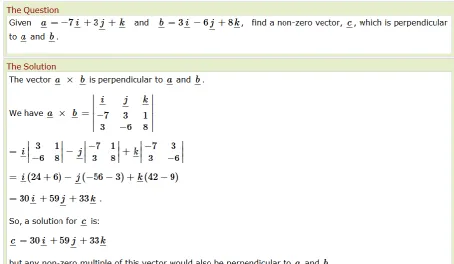
For the Engineering Mathematics module, students receive two hours of lectures, an hour tutorial and, for the first semester only, an hour weekly tuition in Matlab. In addition all students are timetabled for an hour-long peer assisted learning (PAL) session each week in which students receive help and guidance from level 2 PAL tutors with respect to all modules within their programme, not just Engineering Mathematics. Module attendance is not compulsory, but it is monitored in tutorials. E-Assessment has been used on this module as part of the coursework element for many years. We noticed a significant rise in satisfaction and pass rates in 2009/10 when we moved to the DEWIS e-assessment system (Gwynllyw and Henderson, 2009), due in part to the enhanced bespoke feedback offered for each question. An example of an e-Assessment question used for Engineering Mathematics is illustrated in Figure 1 together with the full feedback received.
Figure 1 An example DEWIS question, together with feedback bespoke to the random parameters used in this question. Note that verification marking is used to mark this question, due to there being more than one correct answer.
[image:2.595.68.523.381.645.2]and Mathematics. This algorithmic approach enables the separate solution, marking and feedback algorithms to respond dynamically to a student's input and as such can perform intelligent marking (Gwynllyw and Henderson, 2012). In addition, the DEWIS system is data-lossless, that is, all data relating to every assessment attempt is recorded on the server. This enables the academic to efficiently track how a student or cohort of students has performed on a particular e-Assessment (Walker, Gwynllyw and Henderson, 2015). Implemented for the first time in 2007 the system is now well-established and in 2014/15 within UWE and partner institutions, DEWIS was used for formative and summative tests in more than 50 modules, involving over 100 e-Assessments for approximately 3,000 students.
2.2 Non-controlled conditions
Practice e-Assessments have been available for Engineering Mathematics students since 2009/10, and are designed to help students to prepare for the summative e-Assessments as well as being a valuable learning resource. Typically, there is a summative e-Assessment every three to four weeks and students can attempt these in their own time over an eleven day period, during which the corresponding practice tests are made unavailable.
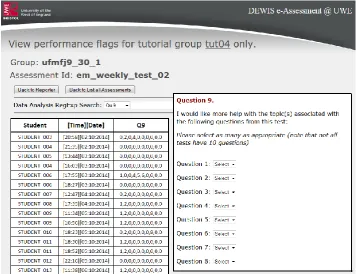
Prior to the 2014/15 academic year access to the practice tests was anonymous. This enabled students to try the questions in a safe space, that is, without academics knowing how an individual student was doing. The drawback to this approach is that it was not possible to identify which students were keeping up with the work, but not attending tutorials and which students were simply not engaging with the module. The deadline of the first summative e-Assessment is not until the sixth week of the semester. James, Krause & Jennings (2010) reported that lack of early engagement is a key factor as to whether a student is at risk of dropping out of university. Therefore a significant change brought in for the 2014/15 academic year is that, although students may still attempt the weekly practice e-Assessments as many times as they like, their attempts are logged against their student ID. Students are made aware of this policy at the start of the module. In this way, we have a record of which students have attempted each practice test and the mark(s) they achieve and thus have a mechanism for identifying early non-engaging students. The additional advantage to the student for trying each test is that the summative e-Assessments comprise a selection of questions taken from the corresponding previous weekly practice tests. Therefore, performing well on the practice tests should guide the student to a good score in the summative e-Assessment.
Figure 2 Tutorial group reporting on DEWIS. Note that only a selection of results is displayed here and student details have been anonymised.
[image:4.595.119.476.174.448.2]In addition the final question on each practice test contained a question asking students to list which questions they felt they needed extra help with and this information was used by tutors to plan their tutorial each week. An example of how this was accessed by academics is shown in Figure 3. Note that in this case Q9 represented this additional question and the performance flags of 1,2,0,0,0,0,0,8 for STUDENT_009 indicated that they requested additional help with Qns 1,2 and 8.
Figure 3 Illustration of the final question (Question 9 here) on each practice test, together with report outcomes for a particular tutorial group. Note that only a selection of results is displayed here and student details have been anonymised.
Each week, after their tutorial, the tutor would email their students who had not attended and not engaged with that week’s practice test. In addition, students who missed or who scored badly in the summative e-Assessments were contacted by student advisors. This approach was designed to try and increase engagement with the module by specifically targeting those students deemed to be at risk of falling behind.
2.3 Controlled conditions
Previously the controlled element of assessment took the form of a single end of module paper-based exam. We felt that, for the 2014/15 academic year, in order to better prepare students for the rigour of an end-of-year examination, running an e-Assessment under controlled conditions in January would be advantageous. The rationale for this, on top of the summative coursework e-Assessments, is that it forces the students to demonstrate their understanding under controlled conditions.
example, converting a complex number from polar to rectangular form as opposed to converting from rectangular to polar form. Both versions were moderated and deemed to be of equal difficulty. In addition, federation colleges ran their own version of the exam at the same time in their own institutions. For each version, the students were accommodated in at least five computer labs and each room contained two invigilators and a member of academic staff involved with the module who could field any possible DEWIS-related or mathematical queries from students.
In order to prevent students outside the room taking the exam, an individual examination key was issued to each computer in each examination room. When instructed to do so, students logged in to DEWIS using their standard UWE username and password and additionally entered their examination key. The computers were set up so that only the DEWIS examination link was available and once students were in the exam, DEWIS displayed a top horizontal bar (as shown in Figure 4) which gave details of the exam version and studentID. This made the invigilation process easier, as any screens not displaying this bar automatically indicated an assessment offence for that student. If a student finished ahead of the two hour time limit, they submitted their answers and were instructed to ask for an invigilator to check their submission before leaving the exam room. This ensured that the exam was completed within the room.
Figure 4 The top horizontal bar was a visual aid in order for invigilators to check that students were only accessing the DEWIS test page.
Although we could have given marks and full feedback instantly to the students when they submitted, we chose to withhold this information for a few days after the end of the e-Assessment. Despite the delay, this still resulted in a much quicker turn around than is usually possible for paper-based exams. These extra days gave us time to review the process and to monitor the results obtained. Although the official submission process was on-line, students were given a paper exam booklet for their workings and these were collected at the end of each exam. Some students were initially sceptical of the fairness of the e-Assessment style January exam, quoting lack of method marks in the marking as being unfair. Part of the review process was to “mark” a selection of the paper copies to check that the online mark received was commensurate with what would have been expected had traditional paper-based marking being employed. Analysis of the sample marking showed that there was very little difference between their online mark and that which would have been awarded had paper-based marking been employed in nearly all cases. Once the review process was finalised, students were able to log back into the appropriate version of the exam and view their submission to get full bespoke feedback for their attempt as well as their mark. This allowed students to gauge their own progress and also enabled tutors to identify under-performing students early enough to address any possible issues in a timely manner. All failing or non-submitting students were invited to a revision session, held early in Semester 2 in which the module team helped individuals to go through questions that they had problems with.
3. Results
[image:5.595.83.514.284.359.2]In Table 2 we show the average exam mark and pass rate for the exams held over the last three academic years. Prior to 2014/15 the controlled element comprised solely a traditional paper-based exam held at the end of the academic year. For the last two years the average pass mark has been approximately 50% and the pass rate disappointingly low. However, there has been a marked increase in both measures this year. A total of 289 of the 306 students still enrolled on the module at the end of March 2015 did the January exam and of these only 45 failed giving a pass rate of 84.5%. This is a significant increase on previous years’ exam performance and now lies within the University’s guideline figures for retention. This is an early indication that our new approaches are having a positive impact, but we will have to wait until the end of this academic year, when the students sit their final exam to make conclusive statements.
Number of submitted attempts Practice tests 2012/13 2013/14 2014/15 1 - 4 (for e-Assessment 1) 695 863 1001 5 - 7 (for e-Assessment 2) 640 518 839 8 - 10 (for e-Assessment 3) 535 390 706
Total: 1870 1771 2546
Average total attempts per
[image:6.595.137.463.209.313.2]student: 7.54 6.24 8.81
Table 1 Comparison of practice test usage, over three consecutive academic years, for the first three summative e-Assessments. Note that the values quoted for 2013/14 and 2014/15 have been averaged over the relevant weekly tests.
Exam and year Number of attempts
Pass rate Average Mark
Summer 2012-13 248 66.6% 49.7
Summer 2013-14 284 62.7% 50.4
[image:6.595.149.452.368.431.2]January 2014-15 289 84.5% 69.1
Table 2 Comparison of exam marks and pass rates, over three consecutive academic years.
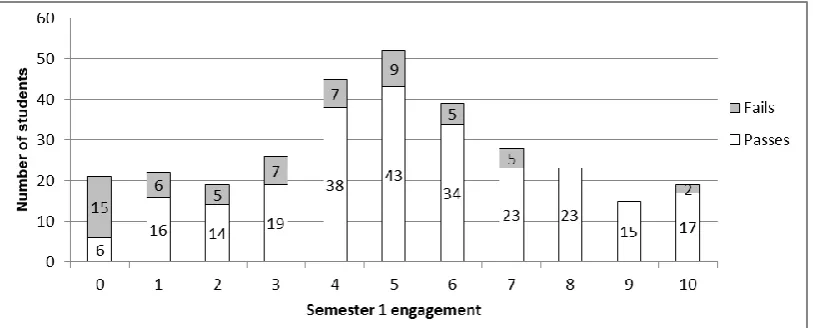
Figure 5 shows the correspondence between the number of weeks that a student engaged with activities in Semester 1, through attending tutorials and/or reaching a threshold mark in that week’s practice test and whether they passed the January exam. Note that data is only presented for a maximum of ten weeks due to not all tutorial attendance information being available. We see that students who engaged less with the module were more likely to fail, or not attempt, the January exam. This is what we have long suspected, but having the tools to more accurately track engagement of each student has enabled us to substantiate this claim.
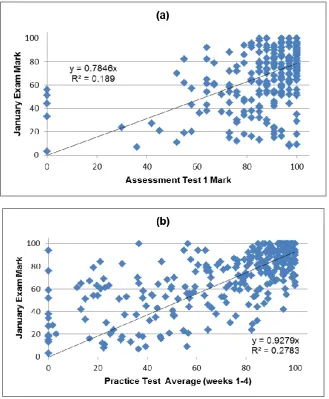
[image:6.595.97.504.555.719.2]In Figure 6 we present scatter plots showing the relation between the January exam mark and (a) the mark for the first summative e-Assessment test and (b) the average practice test mark (averaged over the first four weekly practice tests which contribute to the first summative e-Assessment). The trend line through the origin is drawn on each graph, together with its equation. What we see is that although both graphs show a positive correlation, there is a closer match when considering practice test marks to assessment test marks. Further, there are many instances for which a good coursework mark does not translate into a good exam mark.
Investigating those that failed the January exam more closely we find that 21 of those failing students did not engage with all weekly practice tests 1-4, that is the first four practice tests at the start of the module. In total 63 of the students who took the January exam did not engage with all weekly practice tests 1-4. The average exam mark for these students was 51.6%, significantly lower than the overall exam average of 69.4%, so we conclude that engagement with the practice tests has a positive influence on students’ learning.
Figure 6 Scatter plots showing (a) the January exam mark against the first summative assessment mark; (b) the January exam mark against the practice test mark (averaged over the first four weekly practice tests). The trend line through the origin is plotted in each case.
[image:7.595.134.464.242.642.2]
4. Conclusions and Future Plans
We have found that by monitoring engagement with the weekly practice e-Assessments there has been an increase in the usage of these e-Assessments in the 2014/15 academic year. This is compared to the 2013/14 academic year in which access to these weekly tests was anonymous and the 2012/13 academic year in which the practice tests mirrored the summative e-Assessments. This increase in engagement has led to a significant increase in performance with a larger proportion of students passing the January exam. Assuming that this finding continues throughout the rest of the academic year, we expect that the extra measures put in place will lead to an increase in average marks and pass rates on the module, and thus contributing towards a positive student experience. In addition we have found that students who do not engage in the practice tests have a higher chance of failing or scoring less well in the January exam. This finding should enable us to specifically target such students early on in the year, at a point where interventions are likely to yield positive results.
The January exam gives a good indication to students of their performance so far on the module. Those who are engaged but failing realise that engagement with all the weekly practice tests is a good habit to develop. It seems that practice test results are a better indicator to student performance on the module than the Assessment tests. In 2015/16 we plan to replace the six summative e-Assessments with a mark based on engagement with the practice tests and measure the impact of this change.
References
Bull, J. and McKenna, C. (2003). Blueprint for Computer-Assisted Assessment, Routledge, London. Davis, L.E., Harrison, M.C., Palipana, A.S., Ward, J.P. (2005) Assessment Driven Learning of
Mathematics for Engineering Students, International Journal of Electrical Engineering Education, 42(1): 63-72.
Foster, B., Perfect, C. and Youd, A. (2012). A completely client-side approach to assessment and e-learning of mathematics and statistics, International Journal of e-Assessment 2(2).
Greenhow, M. and Gill, M. (2008). How effective is feedback in computer-aided assessments?
Learning, Media and Technology 33(3): 207-220.
Greenhow, M. and Kamavi, K. (2012). Maths e.g. - a web assessment application for STEM and beyond, Proceedings of the HEA STEM Learning and Teaching Conference.
Gwynllyw, R. and Henderson, K. (2009). DEWIS: a computer aided assessment system for mathematics and statistics, CETL-MSOR 2008 Conference Proceedings, pp. 38-44.
Gwynllyw, R. and Henderson, K. (2012). Intelligent marking in summative e-assessments,
Proceedings of the HEA STEM Learning and Teaching Conference.
Hooper, A. (2012). The use of new technology in module delivery to large, Proceedings of the HEA STEM Learning and Teaching Conference.
Hooper, A., Henderson, K. and Gwynllyw, R. (2014). Using technology in the module delivery of mathematics, CETL-MSOR 2014 Conference.
Inglis, M., Palipana, A.S., Trenholm, S., Ward, J. (2011) Individual differences in students' use of optional learning resources, Journal of Computer Assisted Learning, 27: 490-502.
James, R., Krause, K.-L., and Jennings, C. (2010). The first year experience in Australian universities: Findings from 1994-2009. Melbourne: Centre for the Study of Higher Education, University of Melbourne.
McCabe, M. (2009). The exponential growth of mathematics and technology at the University of Portsmouth, Teaching Mathematics and its Applications 28(4): 222-227.
Robinson, C., Hernandez-Martinez, P. and Broughton, S. (2012). Mathematics lecturers’ practice and perception of computer-aided assessment, in P. Iannone and A. Simpson (eds), Mapping University Mathematics Assessment Practices, University of the East Anglia, pp. 105-117.
Sangwin, C. (2004). Assessing mathematics automatically using computer algebra and the internet,
Teaching Mathematics and its Applications 23(1): 1-14.
Sangwin, C. (2013). Computer Aided Assessment of Mathematics, Oxford University Press.