Conversion of Some Soil Types, Subtypes, and Varieties
between the Taxonomic Classification System of Soils
of the Czech Republic and the World Reference Base
for Soil Resources
Jitka Sládková
Research Institute for Soil and Water Conservation, Prague, Czech Republic
Abstract: The article illustrates the compatibility of the Czech Republic Taxonomic Soil Classification System vali-dated in the CR with the international World Reference Base for Soil Resources. It utilises the archive data on the soil types, subtypes, and varieties from the General survey of agricultural soils in the Czech Republic and soil profiles from new soil survey on the pilot area of Litoměřice district. It indicates the possibilities of the future refinement of both systems.
Keywords: refinement of soil classification systems; soil conversions; TKSP CR, WRB
The World Reference Base for Soil Resources (WRB) had already progressed under the auspices of the International Union of Soil Sciences (IUSS) since the eighties of the last century, and in 1998 it shaped up into a form of the concrete proposal (Deckers 2000; ISSS-ISRIC-FAO 1998; IUSS Working Group WRB 2006, 2007; Nachtergaele et al. 2000). In that year, WRB was adopted as the European Union system for soil correlation. The structure, concepts and definitions of WRB are strongly affected by the Legend of the Soil Map of the World on the scale of 1:5 000 000 (FAO-UNESCO 1974; FAO-UNESCO-ISRIC 1990), which borrowed an approach through the diagnostic horizons and features of Soil Taxonomy of the United States Department of Agriculture.
The Taxonomic Classification System of Soils of the Czech Republic (TKSP CR) connects with previous classification systems (mainly with Mor-phologic-genetic soil classification system of the CSFR – Hraško et al. 1991) and besides WRB is itcompatible with other international standards of soil classification (Soil Taxonomy, Référentiel pé-dologique, Systematik der Böden Deutschland). It includes not only agricultural and forest soils, but also soils of anthropogenic origin. It has arisen for the purpose of easier harmonisation of the Czech map
and database background papers with the sources from other European countries. The system has been constantly applied and further improved during the current innovative soil survey of the CR (Němeček
et al. 2001).
The article briefly introduces the basic principles of both systems used, compares them and facilitates the orientation in WRB. With the help of some soil types, subtypes, and varieties conversions between these systems, it refers to the possibilities of mutual refinement in the framework ofongoing convergence of both systems.
MATERIAL AND METHODS
the background papers from the Research Institute for Soil and Water Conservation, Prague.
The archive data of the General survey of agri-cultural soils from the years 1960–1970 contained the basic material. On the pilot area, the data were also statistically verified and digitised. At the level of the soil types, subtypes, and varieties, the con-versions from the original Genetic-agronomic soil classification into the valid TKSP CR (Sládková 2007) pointed out the need of several refinements of the valid soil classification system, which soil survey of Litoměřice district was also directed to in 2006. The examples of the soil profiles conver-sions between TKSP CR and WRB were completed by laboratory analyses of several soil pits, coming from this soil survey. In term of natural condi-tions in general, the Litoměřice district area is characterised by average annual air temperature 7.0–8.5°C, average annual sum of precipitation 489–617 mm (Němeček et al. 1965), and by vol-canic activity in the geologic past.
In order to describe the methodical approach, the main principles are mentioned of the applied soil classification systems as presented further.
The taxonomic units of WRB are defined by means of the measurable and observable diagnostic horizons, basic soil classification identifiers which are defined by combination of characteristic soil properties, and (or) soil materials.
WRB is represented by: – 32 referential soil groups
– prefixes and suffixes, which define different soil units (allowed qualifiers of the defining terms) In the case of application, more than two quali-fiers can be connected with brackets after the standard defining term (e.g. strongly humic prop-erties and colour). In addition, the defining term of a soil unit can express the depth (from shallow to deep: Epi, Endo, Bathi) and intensity (from slight to strong: Proto, Para, Hypo, Ortho and Hyper) of the features, which are fundamental for the soil cultivation selection. In multi-sequential soil profiles, qualifying terms such as Cumuli or Thapto describe cumulation or burying.
The referential groups of WRB are sorted in the following order: Histosols (HS), Anthrosols (AT), Technosols (TC), Cryosols (CR), Leptosols (LP), Vertisols (VR), Fluvisols (FL), Solonetz (SN), Solonchaks (SC), Gleysols (GL), Andosols (AN), Podzols (PZ), Plinthosols (PT), Nitisols (NT), Ferralsols (FR), Planosols (PL), Stagnosols (ST), Chernozems (CH), Kastanozems (KS), Phaeozems
(PH), Gypsisols (GY), Durisols (DU), Calcisols (CL), Albeluvisols (AB), Alisols (AL), Acrisols (AC), Luvi-sols (LV), LixiLuvi-sols (LX), UmbriLuvi-sols (UM), ArenoLuvi-sols (AR), Cambisols (CM), Regosols (RG).
The Taxonomic Classification System of Soils applied in the Czech Republic (Němeček et al.
2001 and further e.g. Němeček & Kozák 2001; Vokoun et al. 2003) is a hierarchical system, which, in the context with the world development of this area, differentiates the parent materials, diagnostic horizons, and soil properties.
The following taxonomic categories exist:
Referential classes (groups) of soils (15): the main units of the world classification systems.
Soil types (28): basic units of the Czech system, characterised by the presence of certain diagnostic horizon or horizons and/or marked diagnostic features. A name: a noun with ending-zem or other, no-sol.
Subtypes: distinctive modifications of the soil type, expressing the central conception of the type, transitions to other types, marked lithological-genet-ic features (arenlithological-genet-ic, pellithological-genet-ic, etc.), marked debasiflithological-genet-ication, salinisation, sodisation, distinctive hydromorphic and anthropic influences. The name: an adjective placed after the name of the soil type.
Varieties: less distinctive modifications of the soil type, features of forest soils up to 0.25 m. The name: specification of the adjective describing the subtype.
Main soil forms: determined by the type of the parent material and by its lower categories.
Local soil forms: distinguished according to the details of particle size distribution, skeleton content, slope (exposition, inclination, the form of slope).
Ecological phases: distinguished according to humus forms (forest soils)
Degradation phases: degree of the soil deg-radation (mainly errosive wash, accumulation, superimposition), contamination (exceeding the limits of the background values of contaminants), intoxication (surpassing of the critical values of contaminants contents and their mobility for certain transfer path).
RESULTS AND DISCUSSION
WRB is composed on a key approach, whereby the TKSP CR is based on the taxonomic system.
In the case a soil is classified according to WRB, it is necessary to describe the individual soil pro-files, to inspect the whole key until it is possible to identify the referential soil groups by means of the parent material and soil profile properties, and to describe the profiles satisfactorily by the help of prefixes and suffixes. Rather an extensive selection of prefixes and suffixes is significant for accurate soil profile description and for the WRB structure being suitable for future data computer processing. At present, the stated procedure on diagnosing a large number of soil pits is rather time consuming for day by day work.
In TKSP CR, the definition of every referential class of soil and the set and description of lower classification categories are noted in the same place. To be classified in some subcategory under the ap-propriate referential class and to be described more accurately, the soil profile should firstly comply with the characteristics of the referential class. Finally, the possibility of the description is limited. The only data related to the referential class can prevent the application of suitable subcategories.
During the soil classification systems correla-tion and soil profiles conversions between these systems is it necessary to keep permanently in mind that WRB lays stress mainly on the proper-ties of the individual soil profiles, whereby TKSP CR emphasises rather the properties of higher categories, especially the referential classes of soils. It is possible to deduce that extending WRB is simpler compared to TKSP CR. The referential soil group or prefixes and suffixes can be more easily added to a key than, for example, new ref-erential class of soils to TKSP CR, which should be carefully integrated and complexly linked to other categories, because of the strict abiding by mutual exclusivity of individual categories.
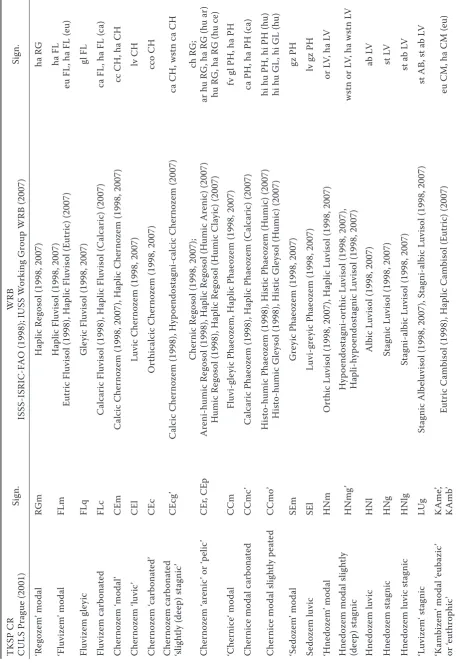
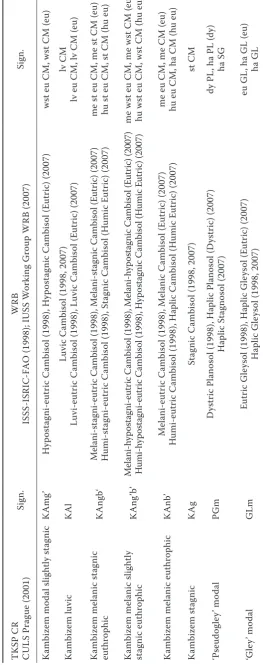
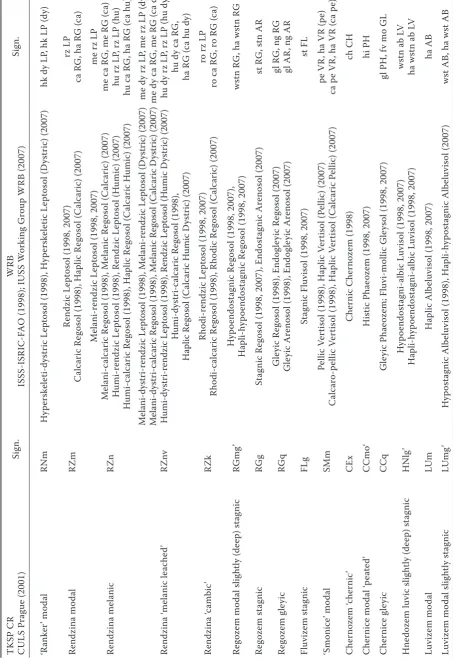
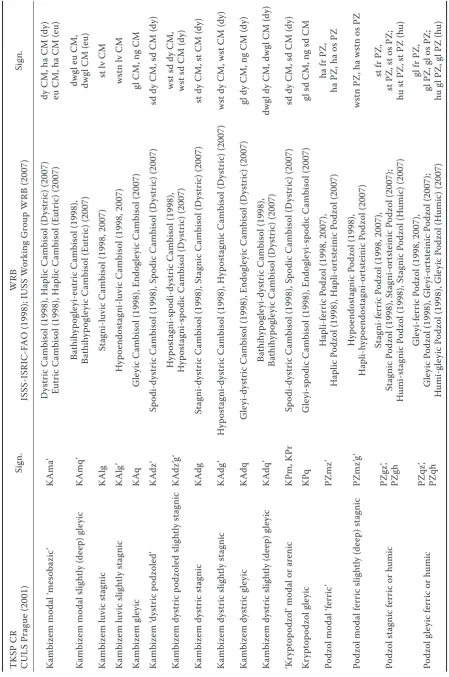
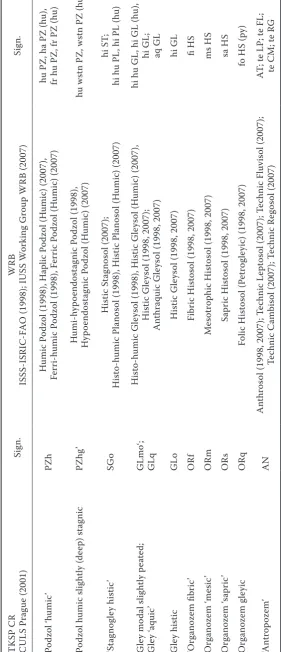
Table 1 contains drafts for the soil types, sub-types, and varieties conversions between TKSP CR (Němeček et al. 2001) and WRB (ISSS-ISRIC-FAO 1998; IUSS Working Group WRB 2006, 2007) in the Litoměřice district. Table 2 shows the conver-sions of the soils in the closest surroundings of the district.
The soils, described in Tables 1 and 2, are classified into these referential soil groups of WRB (arranged according to their order in the key): Histosols, Anthrosols, Leptosols, Vertisols, Fluvisols, Gleys-ols, PodzGleys-ols, PlanosGleys-ols, StagnosGleys-ols, Chernozems,
Phaeozems, Albeluvisols, Luvisols, Arenosols, Cam-bisols, Regosols. Some soil types and subtypes in the Litoměřice district and in surroundings con-form, even without any consideration of the parent materials, to the referential basics of the two WRB soil groups (Luvizem stagnic, Pseudoglej modal, Chernice gleyic, Regozems stagnic, and gleyic and mainly the former Rendzinas profiles, ordered ac-cording to TKSP CR into different soil types).
Strongly anthropogenically influenced soils of Litoměřice district and in the surroundings con-tain only small amounts of artifacts and keep the characteristics of the original referential groups of soils. Therefore, these soils are not classified into the referential group Technosols; only the qualifier Technic is used.
For some soil groups in the WRB system, the supplementation with the following prefixes and suffixes appears as useful:
Histosols– Mesotrophic (ms);
Leptosols– Melanic (me) – so far, there were only Mollic (mo) or Humic (hu) in WRB 1998 and 2007; Arenic/soil pit of Pararendzina cambic arenic in Sládková (2008a);
Fluvisols– Luvic (lv);
Podzols– Ferric (fr) – so far, there were only Ort-steinic (os) in WRB 2007, Humic (hu);
Planosols– Humic (hu) – in WRB 1998 and 2007 it offered from humic horizons only those anhy-dromorphic (molic and umbric), that do not come into question in the case of the Czech soil type ‘Stagnogley’, its some profiles could be included in the referential soil group Planosols;
Phaeozems– Fluvic (fv), Histic (hi), Natric (na) – so far, there were only Sodic (so) in WRB 1998 and 2007, Humic (hu);
Luvisols– Orthic (or);
Cambisols– Luvic (lv), Spodic (sd); Melanic (me) – so far, there were only Mollic (mo) in WRB 1998 or Humic (hu) in WRB 2007; Arenic /soil pit of Kambizem arenic – mentioned below/
Ta
ble 1. S
oil ty
pe
s, subty
pe
s, and v
ar ie tie s c on versions b etwe en TKS P C
R (2001) and W
RB (1998, 2007) in L
itoměř ic e di str ic t TKS P C R C U LS Prag ue (2001) Sig n. WR B ISSS -I SR IC -F A
O (1998); IUSS W
or king Gr oup W RB (2007) Sig n. ‘Re go zem ’ mo dal RG m H aplic Re go
sol (1998, 2007)
ha R G ‘Fluv izem ’ mo dal FL m H aplic Fluv is
ol (1998, 2007)
Eutr
ic Fluv
is
ol (1998), H
aplic Fluv is ol (E utr ic ) (2007) ha FL eu FL
, ha FL (
eu) Fluv izem g le yic FL q Gle yic Fluv is
ol (1998, 2007)
gl FL Fluv izem c arb ona te d FL c C alc ar ic Fluv is
ol (1998), H
aplic Fluv is ol (C alc ar ic ) (2007) ca FL
, ha FL (
ca) C her no zem ‘mo dal ’ C Em C alc ic C her no
zem (1998, 2007), H
aplic C
her
no
zem (1998, 2007)
cc C
H, ha C
H C her no zem ‘luv ic ’ C El Luv ic C her no
zem (1998, 2007)
lv C H C her no zem ‘carb ona te d’ C Ec Or thic alc ic C her no
zem (1998, 2007)
cco C H C her no zem c arb ona te d ‘slig ht ly ( de ep) st ag nic ’ C Ecg ’ C alc ic C her no
zem (1998), H
yp oendo st ag ni-c alc ic C her no zem (2007) ca C H, w stn c a C H C her no zem ‘ar enic ’ or ‘p elic ’ C Er , C Ep C her nic Re go
sol (1998, 2007);
Ar
eni-h
umic Re
go
sol (1998), H
aplic Re go sol (H umic Ar enic ) (2007) H umic Re go
sol (1998), H
aplic Re go sol (H umic C la yic ) (2007) ch R G; ar h u R G
, ha R
G (h
u ar)
hu R
G
, ha R
G (h u c e) ‘C her nic e‘ mo dal C Cm Fluv i-g le yic P hae ozem, H aplic P hae
ozem (1998, 2007)
fv g
l PH, ha PH
C her nic e mo dal c arb ona te d C Cmc ’ C alc ar ic P hae
ozem (1998), H
aplic P hae ozem (C alc ar ic ) (2007)
ca PH, ha PH (
ca) C her nic e mo dal s lig ht ly p ea te d C Cmo ’ Hi st o-h umic P hae
ozem (1998), Hi
stic P hae ozem (H umic ) (2007) Hi st o-h umic Gle ys
ol (1998), Hi
stic Gle ys ol (H umic ) (2007) hi h
u PH, hi PH (h
u)
hi h
u GL
, hi GL (h
u) ‘S edo zem ’ mo dal SE m Gr ey ic P hae
ozem (1998, 2007)
gz PH Se do zem luv ic SE l Luv i-g re yic P hae
ozem (1998, 2007)
lv g z PH ‘Hne do zem ’ mo dal H Nm Or thic L uv is
ol (1998, 2007), H
aplic L
uv
is
ol (1998, 2007)
or L
V, ha L
V Hne do zem mo dal s lig ht ly (de ep) st ag nic H Nmg ’ H yp oe nd os ta gn i-o rt hi c Lu vi so l ( 19 98 , 2 00 7) , H apli-h yp oendo st ag nic L uv is
ol (1998, 2007)
w
stn or L
V, ha w
stn L V Hne do zem luv ic H Nl Albic L uv is
ol (1998, 2007)
ab L V Hne do zem st ag nic H Ng St ag nic L uv is
ol (1998, 2007)
st L V Hne do zem luv ic st ag nic H Nlg St ag ni-albic L uv is
ol (1998, 2007)
st a b L V ‘L uv izem ‘ st ag nic LUg St ag nic Alb eluv is
ol (1998, 2007), S
tag
ni-albic L
uv
is
ol (1998, 2007)
st A
B, st a
b L V ‘Kambi zem ’ mo dal ‘eu baz ic ’ or ‘eut hr ophic ’ K A m e’, K Amb ’ Eutr ic C ambi
sol (1998), H
aplic C ambi sol (E utr ic ) (2007) eu C
M, ha C
M (
TKS P C R C U LS Prag ue (2001) Sig n. WR B ISSS -I SR IC -F A
O (1998); IUSS W
or king Gr oup W RB (2007) Sig n. Kambi zem mo dal s lig ht ly st ag nic K Amg ’ H yp ost ag ni-e utr ic C ambi
sol (1998), H
yp ost ag nic C ambi sol (E utr ic ) (2007) w st e u C M, w st C M ( eu) Kambi zem luv ic K Al Luv ic C ambi
sol (1998, 2007)
Luv
i-e
utr
ic C
ambi
sol (1998), L
uv ic C ambi sol (E utr ic ) (2007) lv C M lv e u C
M, lv C
M ( eu) Kambi zem me lanic st ag nic eut hr ophic K Angb ‘ M el ani-st ag ni-e utr ic C ambi
sol (1998), M
el ani-st ag nic C ambi sol (E utr ic ) (2007) H umi-st ag ni-e utr ic C ambi
sol (1998), S
tag nic C ambi sol (H umic E utr ic ) (2007)
me st e
u C
M, me st C
M (
eu)
hu st e
u C
M, st C
M (h u e u) Kambi zem me lanic s lig ht ly st ag nic e ut hr ophic K Ang ’b ’ M el ani-h yp ost ag ni-e utr ic C ambi
sol (1998), M
el ani-h yp ost ag nic C ambi sol (E utr ic ) (2007) H umi-h yp ost ag ni-e utr ic C ambi
sol (1998), H
yp ost ag nic C ambi sol (H umic E utr ic ) (2007) me w st e u C
M, me w
st C M ( eu) hu w st e u C M, w st C M (h u e u) Kambi zem me lanic e ut hr ophic K Anb ’ M el ani-e utr ic C ambi
sol (1998), M
el anic C ambi sol (E utr ic ) (2007) H umi-e utr ic C ambi
sol (1998), H
aplic C ambi sol (H umic E utr ic ) (2007) me e u C
M, me C
M (
eu)
hu e
u C
M, ha C
M (h u e u) Kambi zem st ag nic K Ag St ag nic C ambi
sol (1998, 2007)
st C M ‘P se udo gle y’ mo dal PGm D ystr ic P lano
sol (1998), H
aplic P lano sol (D ystr ic ) (2007) H aplic S tag no sol (2007) dy PL
, ha PL (
dy) ha S G ‘Gle y’ mo dal GL m Eutr ic Gle ys
ol (1998), H
aplic Gle ys ol (E utr ic ) (2007) H aplic Gle ys
ol (1998, 2007)
eu GL
, ha GL (
eu)
ha GL
[image:5.595.77.341.92.759.2]Ta
ble 1 t
Ta
ble 2. S
oil ty
pe
s, subty
pe
s, and v
ar ie tie s c on versions b etwe en TKS P C
R (2001) and W
RB (1998, 2007) f
or s
oil
s in sur
rounding
s of L
itoměř ic e di str ic t TKS P C R C U LS Prag ue (2001) Sig n. WR B ISSS -I SR IC -F A
O (1998); IUSS W
or king Gr oup W RB (2007) Sig n. ‘R ank er ’ mo dal RNm H yp ers ke le ti-dy str ic L ept os
ol (1998), H
yp ers ke le tic L ept os ol (D ystr ic ) (2007)
hk dy L
P, hk L
P ( dy) Rend zina mo dal RZ m Rend zic L ept os
ol (1998, 2007)
C
alc
ar
ic Re
go
sol (1998), H
aplic Re go sol (C alc ar ic ) (2007) rz L P ca R G
, ha R
G ( ca) Rend zina me lanic RZ n M el ani-r end zic L ept os
ol (1998, 2007)
M el ani-c alc ar ic Re go
sol (1998), M
el anic Re go sol (C alc ar ic ) (2007) H umi-r end zic L ept os
ol (1998), Rend
zic L ept os ol (H umic ) (2007) H umi-c alc ar ic Re go
sol (1998), H
aplic Re go sol (C alc ar ic H umic ) (2007) me r z L P me c a R G
, me R
G ( ca) hu r z L P, r z L P (h u) hu c a R G
, ha R
G ( ca h u) Rend zina ‘me lanic le ac he d’ RZ nv M el ani-dy str i-r end zic L ept os
ol (1998), M
el ani-r end zic L ept os ol (D ystr ic ) (2007) M el ani-dy str i-c alc ar ic Re go
sol (1998), M
el anic Re go sol (C alc ar ic D ystr ic ) (2007) H umi-dy str i-r end zic L ept os
ol (1998), Rend
zic L ept os ol (H umic D ystr ic ) (2007) H um i-d ys tr i-c al ca ric R eg os ol (1 99 8) , H aplic Re go sol (C alc ar ic H umic D ystr ic ) (2007)
me dy r
z L
P, me r
z L
P (
dy)
me dy c
a R
G
, me R
G (
ca dy)
hu dy r
z L
P, r
z L
P (h
u dy)
hu dy c
a R G , ha R G ( ca h u dy) Rend zina ‘cambic ’ RZ k Rho di-r end zic L ept os
ol (1998, 2007)
Rho di-c alc ar ic Re go
sol (1998), R
ho dic Re go sol (C alc ar ic ) (2007) ro r z L P ro c a R G , r o R G ( ca) Re go zem mo dal s lig ht ly ( de ep) st ag nic RGmg ’ H yp oendo st ag nic Re go
sol (1998, 2007),
H apli-h yp oendo st ag nic Re go
sol (1998, 2007)
w
stn R
G
, ha w
stn R G Re go zem st ag nic RG g St ag nic Re go
sol (1998, 2007), Endo
st ag nic Ar eno sol (2007) st R G
, stn A
R Re go zem g le yic RG q Gle yic Re go
sol (1998), Endo
gle yic Re go sol (2007) Gle yic Ar eno
sol (1998), Endo
gle yic Ar eno sol (2007) gl R G
, ng R
G
gl A
R, ng A
R Fluv izem st ag nic FL g St ag nic Fluv is
ol (1998, 2007)
st FL ‘Smonic e’ mo dal SMm Pe llic V er tis
ol (1998), H
aplic V er tis ol (P ellic ) (2007) C alc ar o-pe llic V er tis
ol (1998), H
aplic V er tis ol (C alc ar ic P ellic ) (2007) pe V
R, ha V
R (p
e)
ca p
e V
R, ha V
R ( ca p e) C her no zem ‘cher nic ’ C Ex C her nic C her no zem (1998) ch C H C her nic e mo dal ‘p eat ed ’ C Cmo ‘ Hi stic P hae
ozem (1998, 2007)
hi PH C her nic e g le yic C Cq Gle yic P hae ozem; Fluv i-mollic Gle ys
ol (1998, 2007)
gl PH, f
v mo GL
Hne do zem luv ic s lig ht ly ( de ep) st ag nic H Nlg ’ H yp oendo st ag ni-albic L uv is
ol (1998, 2007)
H apli-h yp oendo st ag ni-albic L uv is
ol (1998, 2007)
w stn a b L V ha w stn a b L V Luv izem mo dal LU m H aplic Alb eluv is
ol (1998, 2007)
ha A B Luv izem mo dal s lig ht ly st ag nic LU m g’ H yp ost ag nic Alb eluv is
ol (1998), H
apli-h yp ost ag nic Alb eluv is ol (2007) w st A
B, ha w
st A
TKS P C R C U LS Prag ue (2001) Sig n. WR B ISSS -I SR IC -F A
O (1998); IUSS W
or king Gr oup W RB (2007) Sig n. Kambi zem mo dal ‘me sob az ic ’ K Ama ’ D ystr ic C ambi
sol (1998), H
aplic C ambi sol (D ystr ic ) (2007) Eutr ic C ambi
sol (1998), H
aplic C ambi sol (E utr ic ) (2007) dy C
M, ha C
M (
dy)
eu C
M, ha C
M ( eu) Kambi zem mo dal s lig ht ly ( de ep) g le yic K Amq’ Ba thih yp og le yi-e utr ic C ambi sol (1998), Ba thih yp og le yic C ambi sol (E utr ic ) (2007) dw gl e u C M, dw gl C M ( eu) Kambi zem luv ic st ag nic K Alg St ag ni-luv ic C ambi
sol (1998, 2007)
st lv C
M Kambi zem luv ic s lig ht ly st ag nic K Alg ’ H yp oendo st ag ni-luv ic C ambi
sol (1998, 2007)
w
stn lv C
M Kambi zem g le yic K Aq Gle yic C ambi
sol (1998), Endo
gle
yic C
ambi
sol (2007)
gl C
M, ng C
M Kambi zem ‘dy str ic p od zole d’ K Ad z‘ Sp odi-dy str ic C ambi
sol (1998), S
po dic C ambi sol (D ystr ic ) (2007)
sd dy C
M, s d C M ( dy) Kambi zem dy str ic p od zole d s lig ht ly st ag nic K A dz ’g‘ H yp os ta gn i-s po di -d ys tr ic C am bi so l ( 19 98 ), H yp ost ag ni-sp odic C ambi sol (D ystr ic ) (2007) w st s
d dy C
M, w st s d C M ( dy) Kambi zem dy str ic st ag nic K Ad g St ag ni-dy str ic C ambi
sol (1998), S
tag nic C ambi sol (D ystr ic ) (2007)
st dy C
M, st C
M ( dy) Kambi zem dy str ic s lig ht ly st ag nic K Ad g’ H yp ost ag ni-dy str ic C ambi
sol (1998), H
yp ost ag nic C ambi sol (D ystr ic ) (2007) w
st dy C
M, w st C M ( dy) Kambi zem dy str ic g le yic K Ad q Gle yi-dy str ic C ambi
sol (1998), Endo
gle yic C ambi sol (D ystr ic ) (2007)
gl dy C
M, ng C
M ( dy) Kambi zem dy str ic s lig ht ly ( de ep) g le yic K A dq’ Ba th ihy po gl ey i-d ys tr ic C am bi so l ( 19 98 ), Ba thih yp og le yic C ambi sol (D ystr ic ) (2007) dw
gl dy C
M, dw gl C M ( dy) ‘Kr ypt op od zol ’ mo
dal or ar
enic K Pm, K Pr Sp odi-dy str ic C ambi
sol (1998), S
po dic C ambi sol (D ystr ic ) (2007)
sd dy C
M, s d C M ( dy) Kr ypt op od zol g le yic K Pq Gle yi-sp odic C ambi
sol (1998), Endo
gle yi-sp odic C ambi sol (2007) gl s d C
M, ng s
d C M Po dzol mo dal ‘fer ric ’ PZ mz ’ H apli-f er ric P od
zol (1998, 2007),
H
aplic P
od
zol (1998), H
apli-or tst einic P od zol (2007) ha f r PZ , ha PZ
, ha o
s PZ Po dzol mo dal f er ric s lig ht ly ( de ep) st ag nic PZ mz ’g’ H yp oe nd os ta gn ic P od zo l ( 19 98 ), H apli-h yp oendo st ag ni-or tst einic P od zol (2007) w stn PZ
, ha w
stn o s PZ Po dzol st ag nic f er
ric or h
umic PZ gz ’, PZ gh St ag ni-f er ric P od
zol (1998, 2007),
St
ag
nic P
od
zol (1998), S
tag ni-or tst einic P od zol (2007); H umi-st ag nic P od
zol (1998), S
tag nic P od zol (H umic ) (2007) st f r PZ , st PZ
, st o
s PZ
;
hu st PZ
, st PZ (h
u) Po dzol g le yic f er
ric or h
umic PZ qz ’, PZ qh Gle yi-f er ric P od
zol (1998, 2007),
Gle
yic P
od
zol (1998), Gle
yi-or tst einic P od zol (2007); H umi-g le yic P od
zol (1998), Gle
yic P od zol (H umic ) (2007) gl f r PZ , gl PZ , g l o s PZ ; hu g l PZ , g
l PZ (h
u)
[image:7.595.81.531.84.762.2]Ta
ble 2 t
TKS
P C
R
C
U
LS Prag
ue (2001)
Sig
n.
WR
B
ISSS
-I
SR
IC
-F
A
O (1998); IUSS W
or
king Gr
oup W
RB (2007)
Sig
n.
Po
dzol
‘h
umic
’
PZ
h
H
umic P
od
zol (1998), H
aplic P
od
zol (H
umic
) (2007),
Fer
ri-h
umic P
od
zol (1998), F
er
ric P
od
zol (H
umic
) (2007)
hu PZ
, ha PZ (h
u),
fr h
u PZ
, f
r PZ (h
u)
Po
dzol h
umic s
lig
ht
ly (
de
ep) st
ag
nic
PZ
hg
’
H
um
i-hy
po
en
do
st
ag
ni
c
Po
dz
ol
(1
99
8)
,
H
yp
oendo
st
ag
nic P
od
zol (H
umic
) (2007)
hu w
stn PZ
, w
stn PZ (h
u)
‘S
tag
no
gle
y hi
stic
’
SG
o
Hi
stic S
tag
no
sol (2007);
Hi
st
o-h
umic P
lano
sol (1998), Hi
stic P
lano
sol (H
umic
) (2007)
hi S
T;
hi h
u PL
, hi PL (h
u)
Gle
y mo
dal s
lig
ht
ly p
ea
te
d;
Gle
y
‘aquic
’
GL
mo
‘;
GL
q
H
is
to
-h
um
ic
G
le
ys
ol
(1
99
8)
, H
is
tic
G
le
ys
ol
(H
um
ic
) (
20
07
),
Hi
stic Gle
ys
ol (1998, 2007);
An
thraquic Gle
ys
ol (1998, 2007)
hi h
u GL
, hi GL (h
u),
hi GL
;
aq GL
Gle
y hi
stic
GL
o
Hi
stic Gle
ys
ol (1998, 2007)
hi GL
‘Or
gano
zem fibr
ic
’
OR
f
Fibr
ic Hi
st
os
ol (1998, 2007)
fi H
S
Or
gano
zem
‘m
es
ic
’
OR
m
M
es
otr
ophic Hi
st
os
ol (1998, 2007)
ms H
S
Or
gano
zem
‘sa
pr
ic
’
OR
s
Sa
pr
ic Hi
st
os
ol (1998, 2007)
sa H
S
Or
gano
zem g
le
yic
ORq
Folic Hi
st
os
ol (P
etr
og
le
yic
) (1998, 2007)
fo H
S (py)
‘An
tr
op
ozem
’
AN
An
thr
os
ol (1998, 2007); T
ec
hnic L
ept
os
ol (2007); T
ec
hnic Fluv
is
ol (2007);
Te
chnic C
ambi
sol (2007); T
ec
hnic Re
go
sol (2007)
AT
; t
e L
P; t
e FL
;
te C
M; t
e R
G
[image:8.595.83.365.99.753.2]Ta
ble 2 t
o b
e c
on
tin
ue
cadastre Levín (Sládková 2007, 2008a). Within the framework of an attempt at TKSP CR refinement, the survey has been focused predominantly on the Rendzina soil type and then on some properties of Chernozems and Kambizems.
TKSP CR
CEc – Chernozem carbonated SN – calcareous marls
WRB
cc CH (gz ce) – Calcic Chernozem (Greyic Clayic) calcareous marl
Soil profile stratigraphy: TKSP CR WRB
1 0–16 cm Apk Ak
2 16–42 cm Ack Ak
3 42–55 cm ACk ACk
4 > 55 cm Ck Ck
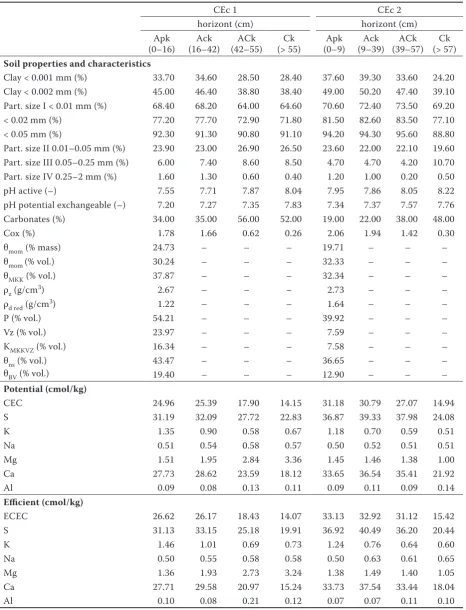
The results of laboratory analyses are described in Table 3.
TKSP CR
CEc – Chernozem carbonated SN – calcareous marls
WRB
cc CH (gz ce) – Calcic Chernozem (Greyic Clayic) calcareous marl
Soil profile stratigraphy: TKSP CR WRB
1 0–9 cm Apk Ak
2 9–39 cm Ack Ak
3 39–57 cm ACk ACk
4 > 57 cm Ck Ck
The results of laboratory analyses are described in Table 3.
TKSP CR
CEc – Chernozem carbonated
SN/SP – double parent material of calcareous marls and loesses
WRB
cc CH (gz) – Calcic Chernozem (Greyic) calcareous marl and loess
Soil profile stratigraphy: TKSP CR WRB
1 0–14 cm Apk Ak
2 14–59 cm Ack Ak
3 59–75 cm ACk A/Ck
4 75–183 cm Ck Ck (calcareous clay) 5 > 183 cm Dk Dk (loess)
The results of laboratory analyses are described in Table 4.
TKSP CR
CEm – Chernozem modal
PSc/SC – double parent material of calcareous sand-stones and carbonated slope desposits
WRB
ha CH – Haplic Chernozem
calcareous sandstone and carbonated slope desposits Soil profile stratigraphy: TKSP CR WRB
1 0–31 cm Ack Ak 2 31–54 cm ACk ACk
3 54–87 cm Ck Ck (calcareous sand) 4 > 1 m Dk Dk (carbonated slope deposit)
The results of laboratory analyses are described in Table 4.
TKSP CR
RGp – ‘Regozem pelic’ SC – marlites
WRB
ha RG (ca eu ce) – Haplic Regosol (Calcaric Eutric Clayic) marlite
Soil profile stratigraphy: TKSP CR WRB
1 0–33 cm Apk’ A
2 > 33 cm Ck Ck
The results of laboratory analyses are given as the pit No. 9 in Table 1 in Sládková (2010). TKSP CR
KAr – Kambizem arenic sŠR – psefitic silitic sediments
WRB
ha CM (eu sl) – Haplic Cambisol (Eutric Siltic) psefitic silitic sediment
Soil profile stratigraphy: TKSP CR WRB
1 0–28 cm Ad A
2 28–35 cm Bv B
3 > 35 cm C C
WRB does not allow prefix/suffix Arenic by the referential soil group Cambisols.
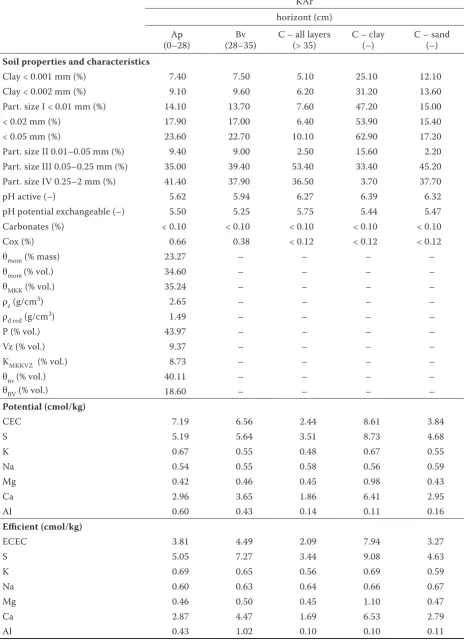
The results of laboratory analyses are described in Table 5.
These soil horizons occur within the scope of the soil profiles mentioned above:
TKSP CR
A – humic horizon
Ack – anhydromorphic chernic humic horizon with the carbonate content of bivalent (2+) cations – carbonated (over 1–3%), event. strongly carbonated (over 3%)
Ak – humic horizon with the carbonate content of cations 2+– carbonated (over 1–3%), event. strongly carbonated (over 3%)
Ap – plough layer (topsoil)
Table 3. Laboratory analysis concerning soil pits of Chernozems carbonated – CEc from the soil survey of Litoměřice district in 2006
CEc 1 CEc 2
horizont (cm) horizont (cm)
Apk
(0–16) (16–42)Ack (42–55)ACk (> 55)Ck (0–9)Apk (9–39)Ack (39–57)ACk (> 57)Ck
Soil properties and characteristics
Clay < 0.001 mm (%) 33.70 34.60 28.50 28.40 37.60 39.30 33.60 24.20
Clay < 0.002 mm (%) 45.00 46.40 38.80 38.40 49.00 50.20 47.40 39.10
Part. size I < 0.01 mm (%) 68.40 68.20 64.00 64.60 70.60 72.40 73.50 69.20
< 0.02 mm (%) 77.20 77.70 72.90 71.80 81.50 82.60 83.50 77.10
< 0.05 mm (%) 92.30 91.30 90.80 91.10 94.20 94.30 95.60 88.80
Part. size II 0.01–0.05 mm (%) 23.90 23.00 26.90 26.50 23.60 22.00 22.10 19.60
Part. size III 0.05–0.25 mm (%) 6.00 7.40 8.60 8.50 4.70 4.70 4.20 10.70
Part. size IV 0.25–2 mm (%) 1.60 1.30 0.60 0.40 1.20 1.00 0.20 0.50
pH active (–) 7.55 7.71 7.87 8.04 7.95 7.86 8.05 8.22
pH potential exchangeable (–) 7.20 7.27 7.35 7.83 7.34 7.37 7.57 7.76
Carbonates (%) 34.00 35.00 56.00 52.00 19.00 22.00 38.00 48.00
Cox (%) 1.78 1.66 0.62 0.26 2.06 1.94 1.42 0.30
θmom (% mass) 24.73 – – – 19.71 – – –
θmom (% vol.) 30.24 – – – 32.33 – – –
θMKK (% vol.) 37.87 – – – 32.34 – – –
ρz (g/cm3) 2.67 – – – 2.73 – – –
ρd red (g/cm3) 1.22 – – – 1.64 – – –
P (% vol.) 54.21 – – – 39.92 – – –
Vz (% vol.) 23.97 – – – 7.59 – – –
KMKKVZ(% vol.) 16.34 – – – 7.58 – – –
θns (% vol.) 43.47 – – – 36.65 – – –
θBV (% vol.) 19.40 – – – 12.90 – – –
Potential (cmol/kg)
CEC 24.96 25.39 17.90 14.15 31.18 30.79 27.07 14.94
S 31.19 32.09 27.72 22.83 36.87 39.33 37.98 24.08
K 1.35 0.90 0.58 0.67 1.18 0.70 0.59 0.51
Na 0.51 0.54 0.58 0.57 0.50 0.52 0.51 0.51
Mg 1.51 1.95 2.84 3.36 1.45 1.46 1.38 1.00
Ca 27.73 28.62 23.59 18.12 33.65 36.54 35.41 21.92
Al 0.09 0.08 0.13 0.11 0.09 0.11 0.09 0.14
Efficient (cmol/kg)
ECEC 26.62 26.17 18.43 14.07 33.13 32.92 31.12 15.42
S 31.13 33.15 25.18 19.91 36.92 40.49 36.20 20.44
K 1.46 1.01 0.69 0.73 1.24 0.76 0.64 0.60
Na 0.50 0.55 0.58 0.58 0.50 0.63 0.61 0.65
Mg 1.36 1.93 2.73 3.24 1.38 1.49 1.40 1.05
Ca 27.71 29.58 20.97 15.24 33.73 37.54 33.44 18.04
Al 0.10 0.08 0.21 0.12 0.07 0.07 0.11 0.10
Table 4. Laboratory analysis concerning soil pits of Chernozem carbonated – CEc and Chernozem modal – CEm from the soil survey in Litoměřice district in 2006
CEc 3 CEm
horizont (cm) horizont (cm)
Apk
(0–14) (14–59)Ack (59–75)ACk (75–183)Ck (0–31)Ack (31–54)ACk (54–87)Ck
Soil properties and characteristics
Clay < 0.001 mm (%) 43.60 33.50 34.70 29.30 19.30 20.30 8.40
Clay < 0.002 mm (%) 51.30 39.70 41.50 36.30 23.10 23.60 10.40
Part. size I < 0.01 mm (%) 73.20 54.90 63.70 56.30 30.60 30.30 14.70
< 0.02 mm (%) 84.30 64.00 79.30 71.90 36.70 36.20 19.10
< 0.05 mm (%) 97.50 74.30 96.90 96.60 45.30 47.30 27.00
Part. size II 0.01–0.05 mm (%) 24.30 19.40 33.20 40.40 14.70 17.10 12.30
Part. size III 0.05–0.25 mm (%) 1.40 24.20 2.50 3.20 22.80 27.00 28.20
Part. size IV 0.25–2 mm (%) 1.10 1.50 0.60 0.20 31.80 25.60 44.80
pH active (–) 7.95 8.02 8.16 8.30 7.50 8.07 8.45
pH potential exchangeable (–) 7.31 7.38 7.64 7.78 7.14 7.60 8.15
Carbonates (%) 11.00 9.00 19.50 26.00 < 0.10 7.20 6.40
Cox (%) 1.86 1.70 1.14 0.18 1.30 0.34 < 0.12
θmom (% mass) 20.91 – – – 26.42 – –
θmom (% vol.) 32.13 – – – 39.48 – –
θMKK (% vol.) 34.87 – – – 39.37 – –
ρz (g/cm) 2.67 – – – 2.63 – –
ρd red (g/cm) 1.54 – – – 1.49 – –
P (% vol.) 42.44 – – – 43.27 – –
Vz (% vol.) 10.31 – – – 3.79 – –
KMKKVZ (% vol.) 7.57 – – – 3.90 – –
θns (% vol.) 40.43 – – – 43.51 – –
θBV (% vol.) 22.40 – – – 22.00 – –
Potential (cmol/kg)
CEC 34.02 29.00 27.46 17.17 18.80 13.59 5.30
S 40.75 38.60 39.59 27.53 19.89 17.97 12.92
K 0.78 0.57 0.54 0.54 1.44 0.84 0.54
Na 0.49 0.46 0.53 0.63 0.58 0.59 0.67
Mg 2.05 2.41 3.32 2.48 1.18 1.26 0.99
Ca 37.32 35.03 35.09 23.80 16.56 15.23 10.65
Al 0.11 0.13 0.11 0.08 0.13 0.05 0.07
Efficient (cmol/kg)
ECEC 38.64 34.79 29.86 18.74 17.05 14.71 5.84
S 40.95 41.24 36.18 25.79 20.31 18.83 10.08
K 0.82 0.63 0.57 0.68 1.52 0.93 0.53
Na 0.61 0.67 0.64 0.68 0.65 0.66 0.65
Mg 2.25 2.55 3.19 2.50 1.10 1.41 0.91
Ca 37.21 37.31 31.71 21.82 16.99 15.76 7.86
Apk’ – plough layer (topsoil) with the carbonate content of cations 2+ – slightly carbonated (carbonates in solum 0. 3–1%)
ACk – intermediate horizon between the humic horizon and the parent material with the carbonate content of cations 2+ – carbonat-ed (over 1–3%), event. strongly carbonatcarbonat-ed (over 3%), with no distinct transition A/Ck – intermediate horizon between the humic
horizon and the parent material with the carbonate content of cations 2+ – ated (over 1–3%), event. strongly carbon-ated (over 3%), with distinct transition Bv – weathered horizon, none, event. less
dis-tinct traces of illuviation; brown cambic (metamorphic) horizon
B/Ck – intermediate horizon between the weathered horizon and the parent material with the carbonate content of cations 2+ – ated (over 1–3%), event. strongly carbon-ated (over 3%), with distinct transition C – parent material
Ck – parent material with a carbonate content of cations 2+ – carbonated (over 1–3%), event. strongly carbonated (over 3%) Dk – seat rock (markedly distinct from the
par-ent material) with the carbonate contpar-ent of cations 2+ – carbonated (over 1–3%), event. strongly carbonated (over 3%)
WRB
A – surface horizon (not distinguished, if organic or organic-mineral)
Ak – surface horizon with the carbonate content of cations 2+
ACk – intermediate horizon between the surface horizon and the parent material with the carbonate content of cations 2+, with not distinct transition
A/C – intermediate horizon between the surface horizon and the parent material, with dis-tinct transition
A/Ck – intermediate horizon between the surface horizon and the parent material with the carbonate content of cations 2+, with distinct transition
B – weathered horizon
B/C – intermediate horizon between the weath-ered horizon and the parent material, with distinct transition
C – parent material
Ck – parent material with the carbonate content of cations 2+
Dk – seat rock with the carbonate content of cati-ons 2+
The conversion accuracy of the soil classifica-tion systems is important for digital mapping. The relatively low punctuality of the WRB system is given by its original use for correlation, not clas-sification of soils. Taking into account the origin from the legend of the overview-scale map, WRB is very suitable to digital maps creation, especially if it is more detailed onwards. As other authors have already mentioned (e.g. Deckers et al. in Eswaran et al. 2003), regardless of the number of qualifiers used, it enables a hierarchical structure and would be an ideal tool for the classification of the soil profiles, characterising the SOTER unit (e.g. Nachtergaele in Eswaran et al. 2003). SOTER (Soil and Terrain Digital Database) is one of the three main EUSIS (European Union Soil Information System) databases.
Under the Czech conditions, WRB is too gen-eral for the maps creation on a detailed scale. The needed maintenance of correlation between TKSP CR and main world referential systems, es-pecially WRB, obstructs in some cases the precise adjustment of TKSP CR to home conditions. This is markedly visible e.g. when studying the TKSP CR referential class Antrosols. The implementa-Antrosols. The implementa-tion of the referential soil group Technosols into WRB in 2006 helped partially the conversions of the TKSP CR referential class to WRB and also reacted on the long-term need for the enlarge-ment of anthropogenic soils. The impleenlarge-mentation of the referential soil group Stagnosols into WRB in the same year facilitated the conversions as well, even though it did not resolve all the present questions in hydromorphic soils classification, and mainly the undesirable overlapping of the referential groups (WRB) or classes (TKSP CR), where hydromorphic soils are classified. Under the Czech conditions, the correlation with WRB has a negative impact also on the accuracy of TKSP CR referential classes Leptosols and Kambisols (also e.g. Sládková 2007, 2008b, 2009). It would be suitable to consider carefully more extensive integration of salinisation signs into TKSP CR (Fluvizems, Chernices).
classifi-Table 5. Laboratory analysis concerning soil pit of Kambizem arenic – KAr from the soil survey in Litoměřice district in 2006
KAr horizont (cm) Ap
(0–28) (28–35)Bv C – all layers (> 35) C – clay (–) C – sand (–)
Soil properties and characteristics
Clay < 0.001 mm (%) 7.40 7.50 5.10 25.10 12.10
Clay < 0.002 mm (%) 9.10 9.60 6.20 31.20 13.60
Part. size I < 0.01 mm (%) 14.10 13.70 7.60 47.20 15.00
< 0.02 mm (%) 17.90 17.00 6.40 53.90 15.40
< 0.05 mm (%) 23.60 22.70 10.10 62.90 17.20
Part. size II 0.01–0.05 mm (%) 9.40 9.00 2.50 15.60 2.20
Part. size III 0.05–0.25 mm (%) 35.00 39.40 53.40 33.40 45.20
Part. size IV 0.25–2 mm (%) 41.40 37.90 36.50 3.70 37.70
pH active (–) 5.62 5.94 6.27 6.39 6.32
pH potential exchangeable (–) 5.50 5.25 5.75 5.44 5.47
Carbonates (%) < 0.10 < 0.10 < 0.10 < 0.10 < 0.10
Cox (%) 0.66 0.38 < 0.12 < 0.12 < 0.12
θmom (% mass) 23.27 – – – –
θmom (% vol.) 34.60 – – – –
θMKK (% vol.) 35.24 – – – –
ρz (g/cm3) 2.65 – – – –
ρd red (g/cm3) 1.49 – – – –
P (% vol.) 43.97 – – – –
Vz (% vol.) 9.37 – – – –
KMKKVZ (% vol.) 8.73 – – – –
θns (% vol.) 40.11 – – – –
θBV (% vol.) 18.60 – – – –
Potential (cmol/kg)
CEC 7.19 6.56 2.44 8.61 3.84
S 5.19 5.64 3.51 8.73 4.68
K 0.67 0.55 0.48 0.67 0.55
Na 0.54 0.55 0.58 0.56 0.59
Mg 0.42 0.46 0.45 0.98 0.43
Ca 2.96 3.65 1.86 6.41 2.95
Al 0.60 0.43 0.14 0.11 0.16
Efficient (cmol/kg)
ECEC 3.81 4.49 2.09 7.94 3.27
S 5.05 7.27 3.44 9.08 4.63
K 0.69 0.65 0.56 0.69 0.59
Na 0.60 0.63 0.64 0.66 0.67
Mg 0.46 0.50 0.45 1.10 0.47
Ca 2.87 4.47 1.69 6.53 2.79
[image:13.595.67.536.120.764.2]cation) will be classified as Regozem (TKSP CR), etc. Whereas by smaller, nevertheless recognizable grade of accumulation or erosive wash also the original soils could be conserved and accordingly classified under the valid system, it is necessary to validate precisely the soil profiles to complete the TKSP CR methodology. WRB uses topsoil classification (FAO 1998), which respects the changes in clas-sification as the result of erosion processes.
References
Deckers J. (2000): World Reference Base for soil re-sources (WRB), IUSS endorsement, world-wide test-ing and validation. Letter to the Editor. Soil Science Society of America Journal, 64: 2187.
FAO (1998): Topsoil Characterization for Sustainable Land Management. Land and Water Development Division, Soil Resources, Management and Conserva-tion Service. FAO, Rome.
FAO-UNESCO (1974): Soil Map of the World 1:5 000 000. Volume 1. Legend. FAO, Rome.
FAO-UNESCO-ISRIC (1990): Revised Legend of the Soil Map of the World. World Soil Resources Report No. 60. FAO, Rome.
Hraško J. et al. (1991): Morphologic-genetic Soil Clas-sification System of the CSFR. VÚPÚ, Bratislava. (in Slovak)
ISSS-ISRIC-FAO (1998): World Reference Base for Soil Resources. ISSS, ISRIC, FAO, Rome.
IUSS Working Group WRB (2006): World Reference Base for Soil Resources. World Soil Resources Report No. 103. ISSS, ISRIC, FAO, Rome.
IUSS Working Group WRB (2007): World Reference Base for Soil Resources 2006. First Update 2007. World Soil Resources Report No. 103. FAO, Rome.
Nachtergaele F.O., Spaargaren O., Deckers J.A., Ahrens B. (2000): New developments in soil clas-sification World Reference Base for Soil Resources. Geoderma, 96: 345–357.
Nachtergaele F.O. (2003): The future of the FAO legend and the FAO/UNESCO soil map of the world. In: Eswaran H., Rice T., Ahrens R., Stewart B.A.
(eds): Soil Classification: A Global Desk Reference. Library of Congress Cataloging-in-Publication Data. CRC Press LLC, Florida, 147–156.
Němeček J. et al. (1965): The Comprehensive Survey of Soils of the ČSSR. The Accompanying New of the Litoměřice District. SPN, Praha. (in Czech)
Němeček J. et al. (1967): Survey of Agricultural Soils of the CSSR. Collected Methodology. Vol. 1. MZV, Praha. (in Czech)
Němeček J., Kozák J. (2001): The Czech taxonomic soil classification system and the harmonization of soil maps. In Micheli E., Nachtergaele F.O., Jones R.J.A., Montanarella L. (eds): Soil Classification 2001. Research Report No. 7. European Soil Bureau, Luxembourg, 47–53.
Němeček J. et al. (2001): Taxonomic Classification Sys-tem of Soils of the Czech Republic. ČZU, Praha. (in Czech)
Sládková J. (2007): SOTER system applied in the Lito- měřice district for the soil conditions assessment. [Ph.D. Thesis.]. ČZU, Praha. (in Czech)
Sládková J. (2008a): Integration of soil information systems. BIS and SOTER perspectives – a review. Soil and Water Research, 3: 183–198.
Sládková J. (2008b): Precision of soil classification systems conversion as prerequisite for archive data elaboration in digital mapping. In: Sobocká, J., Kul-havý J. (eds): Soil in Modern Information Society. Proc. 1st Conf. Czech Soil Science Society and Societas
Pedologica Slovaca. August 20–23, 2007, Rožnov pod Radhoštěm, VÚPOP, Bratislava, 651–657. (in Czech) Sládková J. (2009): An analysis of the Rendzina issue
in the valid Czech Soil Classification System. Soil and Water Research, 4: 66–83.
Sládková J. (2010): Creating GIS on the pilot area of Litoměřice district – from soil survey to internatio-nal information systems. Soil and Water Research, 5: 10–20.
Vokoun J. et al. (2003): Handbook for Survey of Forest Soils. Taxonomic Classification System of Soils of the Czech Republic in Forest Practice. ÚHÚL, Brandýs nad Labem. (in Czech)
Received for publication May 8, 2009 Accepted after corrections September 22, 2010
Corresponding author:
Ing. Jitka Sládková, Ph.D., Český úřad zeměměřičský a katastrální, Sekce centrální databáze katastru nemovitostí, Pod Sídlištěm 9, 182 11 Praha 8-Kobylisy, Česká republika