The award winning Varoom magazine was established in 2006 to address the lack of opportunity for writing and as a vehicle and platform for enquiry within the specialist subject of illustration.
Rick Poynor, in his paper The Missing Critical Link,
suggests that the lack of critical framework for the subject leads to it being marginalised as a discipline, describing Varoom as “a ray of light in this poorly lit area”.
An invitation from the AOI to academic institutions to form strong partnerships through VaroomLab as a catalyst for innovation in illustration in the 21st Century has been instrumental in fostering essential discourse between the practice of illustration and relatively emergent academic research, building upon the success of Varoom magazine in asserting its cultural value.
This unique collaboration between the UK’s professional subject association and representatives from respected academic institutions with critical support from its panel of peer reviewers is testimony to an ambition to cultivate a symbiotic beneficial relationship. The exchange
facilitates both an interrogation and nourishing of the rich complexity of practice, drawing upon and optimising
Received by major institutions internationally, Varoom magazine makes research available to a diverse international audience: design houses including the Nike graphic design studio in the USA, Pentagram, Universities, illustration and design professionals in Europe, the Far East, USA, South America, Russia and the Middle East. Through symposia and publication of papers in this digital format VaroomLab augments this effective mechanism for dissemination, seeking optimum impact.
Issue Two contains selected papers submitted for the Swansea Metropolitan/VaroomLab Spatialising Illustration symposium held at Swansea Metropolitan on 24/25 January 2013. The shortlisted papers were selected into two categories: peer reviewed and non-peer revieved.
Hosted by Swansea Metropolitan, Spatialising Illustration was the second VaroomLab symposium. This two day event explored many ways in which we encounter space and place through illustration. The symposium roamed beyond seeing illustration solely as a commercial discipline and explored it as a visual language inherent in many artistic activities: a medium that evokes ideas and narrative, and one that offers subtle messages about worlds we encounter.
In the true spirit of illustration, academics, practitioners, writers, illustrators and artists came together, all with personal interpretations and meanings about the symposium’s theme. Mitch Miller’s enlightening and vernacular documentary of the daily life of a street through his Dialectograms were celebrated in his paper titled Draw Duke Street, whilst Bella Kerr’s searching paper explored the ‘building’ of a space in words, visually.
All 13 symposium speakers and 4 keynote speakers offered many perspectives and ways in which illustration locates us in the world. The picture book narratives of Nicola Davies and Laura Carlin had an airy, spatial aura that almost left the symposium audience without words.
In thinking of Marilyn Brooke Goffstein’s observation that “all the pictures in a picture book add up to one picture that isn’t even there,” there is an argument illustration, itself, is invisible: that illustration is mindful.
Papers and presentations that took us on journeys from the non-spaces of Luton airport to spaces of the cyber kind; from the commonplace to the bizarre, showed we experience our surroundings in a profusion of ways.
Whether geographically or historically, culturally or psychologically, place is bound to shifting meaning and significance. Illustration has the capacity to lead us to both physical and mindful places: like a symbolic map of society, navigation is by way of interpretation; putting into context - spatialising.
Derek Bainton
Editor of VaroomLab Journal issue 2 Programme Director,
BA Hons Illustration, Swansea Metropolitan University of Wales, Trinity St. Davids
Keynote Speeches
1 Laura Carlin
The Space Between my Work and Myself
2 Chris Aldhous
Architects of the Invisible Idea
9 Nicola Davies
Story Space
10 Simon James
A Place for Picture Books
11 Selected Abstracts
Peer Reviewed Papers
24 Mitch Miller
Illustrating Space as Collaborative, Socially Engaged
Practice: The First Report from the DRAW DUKE
STREET Residency.
41 Nick Dodds
Control of Time and Space in Graphic Narratives
51 Sharon Beeden
Utilising Spatial Positions to Promote Idea Generation
and the Enhancement of Creative Thinking Processes
within Illustration Contexts
68 Rachel Gannon
Being There: Conversational Drawing in a Non- Place
78 Bella Kerr
Word Room
91 Richard Levesley & Marc Bosward
Illustrated Worlds
106 Allan Walker
Alternative Traditions: Flat as a Way of Visualising Space
Presented Papers
125 Paul Edwards & Carole Burns
The Space Between: The Relationship between Image
and Narrative in ‘Imagistic’
139 Geoff Grandfield
Illustration and Narrative as a Spatial Experience –
The Jewel House at the Tower of London
144 Roderick Mills
Illustration for the Internet Space
‘…I think it’s difficult for students when speakers come in, stand on a stage and say, ‘I did this and I did that,’ - failing to mention the five years they spent working in Pizza Hut and dragging round their portfolio. Those years can be just as important as any commercial work.
One of the most difficult pieces of space to form is the gap between my work and myself. And the ability to be honest with it. When you become an illustrator, you’re an artist, but an artist that has to solve a brief.
I spent all my spare time drawing in sketchbooks because that was what I knew. It took me years to come out of them and make them into anything.
So much of studying is the balance between working and then being able to step away – trying to see what’s developing or whether it’s even worth developing…’
The Space Between my Work and Myself
Laura Carlin
Architects Of The Invisible Idea
Chris Aldhous: Creative Director GOODPILOT - Ghost of Gone Birds
We once opened a chain of DIY pop-up art galleries across Europe: London, Paris, Moscow, Milan, Berlin and Amsterdam with a slightly off-brief detour to Singapore. We called it HYPE partly because it gave local up and coming artists the tools to print, project and promote their work to a new, wider audience; to get their name out there - their work noticed. The galleries started off empty- blank walls, blacked out film screens, then the space filled up with digital art and film and we invited the local movers and shakers of the art world to pop along and see the work on show. We also called it HYPE because we’d persuaded Hewlett Packard to pay for the project and we thought the letters HP should appear somewhere. To their credit HP didn’t plaster the galleries with their logo – or even dress any flat surface with their brochures and leaflets – they were just happy for contributing artists to see the HP name on the printers and projectors that they were using to produce their work for the exhibitions. For once, it seemed a fair deal. An open exchange of exposure for endorsement and suddenly the potential for advertising briefs to open up, rather than close down, creative experimentation seemed very real.
We call it ‘strange chemistry’ – that wonderful collision of incongruous ingredients that is guaranteed to yield an unexpected creative outcome. The spirit of experimentation extended to the promotion of the show:
Architects Of The Invisible Idea
Hype artwork
we invited 12 young filmmakers to shoot HYPE films (they simply had to feature the letters H and P in the title so we got ‘Hairy Pooches’ and ‘Hedonistic Penguins’, ‘Help’ and ‘Hair Piece’). We also recruited a wonderful artist called Moose, aka Paul Curtis, to use his clean graffiti technique to inscribe the HYPE logo in the dirt-encrusted pavements and rusting skips of the Shoreditch neighbourhood.
Artists and visitors seemed to like the concept: in just three weeks, HYPE London attracted 1,200 pieces of art and 9,000 visitors. The gallery filled up three times, so we refreshed the hang each week so that there was a reason to return to the show and see a whole new selection of work every Monday.
Hewlett Packard clearly got the attention of the creative community they wanted to open a conversation with, but what did the artists and film-makers get in return? There was the exposure to the 9,000 visitors that made it to the HYPE Gallery – but we also uploaded everybody’s work to a clone of the space online: that unbelievably got over 4 million hits from 140 countries. We made sure that most evenings there was an event that would attract picture editors and commissioners, curators and art buyers to see the work. And the way we managed the press coverage was important; we kept the artists at the
Architects Of The Invisible Idea
We heard back from some of the artists and
photographers who took part: it had raised their profile and they did get more work (additionally every artist was invited back at the end of the HYPE shows to collect their A0-sized exhibited print). More than anything I’d like to think we gave the artists and film-makers the space to create something interesting. When you work for big sprawling multi-national agencies you end up attending way too many pre-production meetings and artist’s briefings where the lights go out in the eyes of all the creative beings sitting around the table - as soon as they realise that the artistic endeavour under discussion has been reduced to simply recreating something that has been researched, story-boarded and neutered to death. A commercials director once confided in me that he had been asked to do a shot for shot copy of another ad – the most depressing aspect of this was that the agency was unknowingly asking him to copy one of his own ads – which he was ashamed to admit was already a copy of someone else’s work. A photocopy of a photocopy. Double jeopardy.
So this is why we set up GOODPILOT six years ago – as a creative experiment to see if we could persuade clients to spend their money in a more meaningful way, to take a leap in the dark and invest their marketing money in communication projects the like of which haven’t been
seen or done before. Like asking Hewlett Packard to fund a series of empty art galleries across Europe, or telling Volvo that we were going to launch their new C30 with a campaign over which none of us would exert any creative control. We started by stopping people on the street and asking for their first reaction to a picture of the new urban hatchback. Negative or positive. Rational evaluation or subjective rant. Words of wisdom or instant rejection. It all got noted down and written up in our book of collected C30 quotes called the Volvo Vox Populi. You see we’d looked at the design of the new car and decided its unexpected lines and features were clearly the result of a Scandinavian designer doing his own thing – essentially producing a product of free will. So we became equally determined to make the marketing similarly uncensored excursion into the unknown – setting up an idea that invisibly withheld the client (and us) from any level of editorial control. So we took our book of C30 quotes and gave it to two dozen artists and filmmakers and told them to take any phrase that appealed as the starting point for a piece of work to enfold the car. Illustrators and graphic artists like Luke Insect and Nomoco gave us gothic landscapes and cloud-filled dreamscapes. Then there was the picnic with giant ants. An underwater Las Vegas dance routine. A German heavy metal video. Greyhounds and exploding grannies. All strange chemistry in full effect. I’m a writer by trade, but I would never have
penned the line ‘it will attract many, many eyes’ to describe the strange beauty of the car – and I would never have scripted the short film that evolved out of that line and turned it into a road trip across a Dali-esque landscape of swivelling eyes.
Architects Of The Invisible Idea
So we work with a lot of charities and NGOs – ActionAid, International Alert, Bollocks to Poverty and Global
Campaign for Education - and when appropriate we bring art into the communication mix. In a way, we’ve been so Tumblr-fied and Instagram-ed that photography has lost a lot of its narrative potency in this sector: the democratic triumph of citizen-journalism has deadened the art of image–making to the point and click of a smartphone.
Architects Of The Invisible Idea
Wonderfully-named, intricately coloured, each one with a particular tragedy to tell; the task of the Ghosts artists was to report back with details of what we had lost in such a compelling fashion that we would be propelled to act to ensure that there were no further additions to the ongoing avian flight into oblivion.Each illustrator, painter, sculptor, musician and poet would help us re-introduce these gone birds into the wilds of the modern imagination. Extinction proved a great levelling field: all art was treated equally. There were no wildlife artists. Or urban artists. Just artists working collectively to resurrect the ghost flocks of lost and forgotten species. Sir Peter Blake hung alongside Cally Higginbottom, a first time exhibitor recently graduated from Liverpool School of Art & Design, the venerable Desmond Morris shared wall space with younger talent like Le Gun and Charming Baker. And every artist was offered the same deal: 50% back on any sale of art – the other 50% split between the project’s running costs and supporting frontline conservation projections chosen in consultation with BirdLife International.
When the show opened, the Ghosts space resonated with the vibrancy of restored bird life; people enthused over spotting species they’d never seen or heard of before – only to then realise that the gallery was no more than an echo-chamber, the Ghosts work a collection of
after-encounter these long gone species. Of course it could have been a funeral march of an experience. Solemn, didactic, hectoring, but instead the contributing artists made it a celebration of bird lives well lived. We were not interested in capturing the musty, dusty remains of an avian mausoleum; we wanted the vim and vigour of life restored. An aviary of optimism, Gone Birds made cat and bullet-proof by the alchemy of art: re-cast in wood and metal, pen and ink, paint and poetry, caught in the first flush of their avian exultancy – flying, preening, hunting… Each show finished with a bang up to date tale of species in jeopardy – and the simple direct action that visitors could take to help haul them back from the edge of extinction.
As the project evolved, so did the artists’ approach to the brief. Each successive exhibition in Liverpool, London, Brighton and Swansea produced wonderful new images for breathing life back into the birds we have lost. For example, Luke Thomas Smith took digital prints of classic bird engravings and layered them with thin sheets of Japanese paper allocating the number of layers in direct relation to the species period of extinction in the wild.
Architects Of The Invisible Idea
Architects Of The Invisible Idea
Ghosts will continue to exhibit throughout the next year in unexpected gallery spaces around the country (we have a coastal lookout tower lined up for next summer), drawing work from as wide a range of artists as possible. The Ghosts book is published by Bloomsbury in October with 50% of our royalties going to frontline conservation projects.
Ghosts. HYPE. C30 – A Product of Free Will. Each time we tried to build a communications idea that liberated the contributing artists from the usual briefing restraints, to create a space that protected their creative talents from editorial interruption. It’s what we feel compelled to do on a day-to-day basis-ideas like art exhibitions in an abandoned swimming pool, artist-in-residences at city
Ghost of Gone Birds artwork by GOODPILOT, 2012
‘Narrative’ or ‘Story’ is a psychological bag - the device we humans have used since we sat around the first fires, to carry information and to pass it to others. Story is an incredibly flexible and robust container - it can hold information about the deepest tides and currents in our nature, the instructions for making a soup or the life history of a polar bear.
Story Space is the place between the exterior world and the interior world of emotion and reflection. In it, boundaries are dissolved, the real and the imagined are combined in unique cocktails of experience, allowing us new insights into the world and our place within it. And the power of the story space that words and pictures create together is immense - a learning environment far too important to be set aside at any stage of our lives.
Story Space
Nicola Davies
A Place for Picture Books
Simon James
For me, I connect illustration to story.
As a child I was influenced by great cartoonists, like Searle, Hoffnung, Addams, Francois, Schultz, Sempe and so on. They all told a rich story of humanity in their drawings. All I had to do was search it out in those beautiful lines.
I am stimulated by ideas, bringing them to life through words as well as pictures. I enjoy how these two mediums can inter-weave, and achieve quite different meanings on the same page. It's the reader who can bring words and pictures together to tell a story. That for me is the intimacy of picturebooks, the reader brings the meaning.
A good picturebook for me, is littered with gaps. The gaps are between the words and pictures, it's these gaps that the active reader has to fill and connect. It can even be done in a way that perhaps the artist didn't intend, that's the freedom found in picturebooks.
During the symposium we discussed how modern technology is influencing how we all read and see illustration, I find I am not particularly stimulated by moving images, or animated illustration for picturebooks. An electronic picturebook seems to regress the reader back to a passive viewer, an onlooker, who can press a
bear that then jumps up in the air with a funny noise, over and over again. However, it contributes nothing to drive the actual telling of the story. Recently, I saw a Beatrix Potter electronic book have 'real' blackberries pouring down the page. Should the subtly of the illustrators craft be reduced to this? I adore the 'still' image where the reader needs to actively find the narrative by looking, and sometimes looking again. 'Poring' over a picture is a desirable feature of illustration for me.
Reduced to it's most basic element, illustration is about drawing for me, a kind of conversation with myself, full of adventure, frustration, surprise and occasional outbursts of laughter. It's also full of lines, gaps, dots, boundaries, shades and spaces. I don't wish to over analyse it, it's simply our first language.
Sharon Beeden
Utilising Spatial Positions to Promote Idea Generation
and the Enhancement of Creative Thinking Processes
within Illustration Contexts
This paper seeks to demonstrate the use of physical spatial areas as a strategy for creative thinking, and the subsequent, resultant creative process.
Adapted from a Neuro-Linguistic Programming, (NLP), strategy devised by Robert Dilts, relating to the working methodology of animator, Walt Disney, this approach when used within the early stages of a live commission or college project brief, focuses on the interrelatedness between three different perceptual states inherent within the creative cognitive process – the Dreamer (the visionary, highly creative state), the Realist (the planning and organisational state), and finally, the Critic state, (the constructive fault-finder and problem-solver).
Selected Abstracts
In recognising that every experience has a structure, by means of decoding the way in which we think and consider the possibilities within a specified context of a brief or goal, in association with the use of designated spaces within the studio, college or work-based environment, this exercise has broad-ranging applications.
Drawing from a range of contemporary examples, the paper will explore the capacity of illustration to generate a virtual world that engages and absorbs its audience. The paper will argue that a sense of place established through non-representational approaches can address the actual, socio-historical world through the interpretation of the constructed world’s diegesis. The paper will also consider how a world is realised across personal and commercial outputs and the interrelationship and interface of authorial and commercial imperatives.
Richard Levesley & Marc Bosward
Illustrated Worlds
The practice of the contemporary illustrator is no longer exclusively defined by the traditional orthodoxies of the commissioner and illustrator relationship. Contemporary Illustration has expanded the parameters of the discipline to include toys, games, animation, collectable objects, fashion and other forms of media and merchandising. This multi-disciplinary and authorial practice is often predicated on the creation of an identifiable, virtual ‘world’ that is manifest across an illustrator’s output, independent of variations in audience, purpose and subject matter. This paper will explore the illustrator’s use of visual language in constructing virtual, illustrated worlds.
Paul Edwards & Carole Burns
The Space Between: The Relationship Between Image
and Narrative in “Imagistic”
For “Imagistic,” eight artists were asked to provide images to eight writers. Some of the images provided a clear narrative hook, a sense of place, a moment in time or an action interrupted. Others were more obscure: through a glass darkly. Each writer was asked to choose an image to respond with a piece of flash fiction, no more than a thousand words - a translation from the language of image into the language of word.
These are some of the aspects of the relationship between image and narrative we wish to explore for “Spatialising Illustration,” looking at the space or hinterland between text and image. By asking writers to respond to pictures ‘Imagistic’ looks at how writing explains the visible world, and images - even when unintended - contain stories. It also raises questions about what an artist intends, and whether that idea emerges from an image as story.
Selected Abstracts
Talking to writers, we will look at how they may draw a narrative hook from a detail or idea in a painting, through the practice of “ekphrasis,” in order both to understand an image as well as to create a new story – to “make it new.” With artists, we will discuss whether there is narrative behind their images, and explore the space between that narrative and the writer’s story.
one panel and the next in the strip sequence. For this reason, graphic narratives offer up tremendous potential for textual analysis: for studying at close quarters issues pertaining to spatial design, visual literacy and the breach between expression and readership. This paper will address the formal and spatial apparatus of the comic book, with reference to selected examples of theorists and practitioners, focusing on i) page composition and spatial orientation, ii) the dynamic between text and image, iii) the utilization of panels as temporal markers and iv) connoting a sense of socio-geographical setting. Nick Dodds
Spatial Poetics: Control of Time and Space in
Graphic Narratives
Deceptively simple on the surface, under close analysis the comic strip page is something of a paradox, a complex and multi-layered structure. For the artist, the formative layout of a graphic narrative is both a conceptual and spatial activity, involving a high degree of reasoning in the selection and placement of any textual and visual elements. In reception, the effectiveness of any narrative depends on the readiness of the reader to recognize, synthesize and decode the linguistic and visual information at hand, in short; to navigate spatial relationships and make meaningful connections between
position of 'Intuition in Action' - Deleuze and Guattari; drawing as an experience that is felt. It is, in action, during the experience of drawing that we think; addressing drawing as thinking not as thought. This is concerned with a space where thinking is presenced not presented - drawing as a tool to extract memories and heighten experience. John Berger states that photography stops time whilst drawing encompasses it. There is a significant urge to stop time, to pause and return to the scene over and over again. However, this urge can be resisted (as is attempted here) and the process of drawing is seen as the intended outcome. This project addresses drawing to encompass; a practice that is both conversational and immersive.
Rachel Gannon
Being There: Conversational Drawing in a Non- ‐Place
This submission proposes the presentation of a practice led project. At the centre of this project is a month long drawing residency (in 2012) at London Luton Airport. These drawings, made in situ at the airport over the busy summer period, document and record the travellers (and airport staff) that pass through this self-contained non-place every day. Marc Augé states, in his analysis of supermodernity, that Airports are concerned with standardisation and are often remembered in very generic terms. This provides an interesting dichotomy as the drawings address a highly personal narrative; seen, imagined and remembered. The stories of these journeys, both dreamt and recorded, emerge from the drawings, creating a palimpsest of both rumour and fact. It is the experience of these transient moments that is documented and displayed in the subsequent exhibition.
The word drawing can be defined as both gesture (verb) and object (noun). This research is concerned with the former; the act of drawing or drawing as process. It does not look at drawing as a distinct discipline or an outcome but as an experience. It takes the phenomenological
Geoff Grandfield
Illustration and Narrative as a Spatial Experience –
the Jewel House at the Tower of London
Specifically I will address the perception and understanding of the visual within a constructed environment and seek to explore examples and possibilities with direct research via my commission for the Jewel House at the Tower of London and my illustration practice. It will include a summary of the working process of originating 16 panels of narrative illustration in association with an architectural design practice and the Historic Royal Palaces. This will explore and detail the issues of originality, expression and content. I will examine the use and effectiveness of coherent visual language (specifically original to a project, not applied from existing sources) and the importance of scale, lighting, the control of pov and expectation.
Selected Abstracts
In particular I will compare the cinematic experience as a static seated event with the dynamism of audience motion. The paper will also explore the international ‘voice’ of image in regard to the Jewel House
Bella Kerr
Word Room
The low ceiling sloped down on three sides, the slant being interrupted on the east by a single square window, swinging outward on hinges and held ajar by a hook in the sill. This was the sole opening for light and air. Walls and ceiling alike were covered with a yellow paper which had once been very ugly, but had faded into inoffensive neutrality. The matting on the floor was worn and scratchy. Against the wall stood an old walnut table, with one leaf up, holding piles of orderly papers. Before it was a cane-backed office chair that turned on a screw.
(Cather 1925: 16)
Perched at the boundaries of domesticity, the spare utility of this study is the location for the essential exchanges of Willa Cather’s novel, The Professor’s House (1925). The text in one way provides a simple drawing of the room, but, like a pocket into which the whole can be folded, the novel’s narrative is tucked within the meanings and patterns of the word’s sounds and shapes.
‘The low ceiling sloped down’ drops as we sound it
Selected Abstracts
curtailing the attic room. Alliteration hisses awkwardness into ‘sloped down on three sides, the slant’, as does ‘interrupted on the east’, throwing up hard ts in words that unsettle. Single, swinging and ajar continue the sense of lop-sidedness, a state of imbalance and indecision, while square window supplies completeness, drawing single to its side, with hinges and hook to anchor the reader in the solid and material world. Sill is sensible enough, as are walls, floor, chair and table (building the room as we read), but its sibilance connects it to the slippery sounds above and offers a threshold, the place of change from interior to exterior. Outward and light and air see and breathe, wide and far, with good reason in the context of the narrative - if lost, all is lost. The piles of orderly papers tell us where we are, the Professor’s study, orderly and office restoring our belief in ‘o’, as an indicator of wholeness, echoing outward and opening in a quiet reverberation across the paragraph. Three words for singularity, ‘single - sole - one’, signal the Professor’s solitary state and anticipate his possible desire to leave life and family.
Mitch Miller
Illustrating Space as Collaborative, Socially Engaged
Practice: The First Report from the DRAW DUKE
STREET Residency
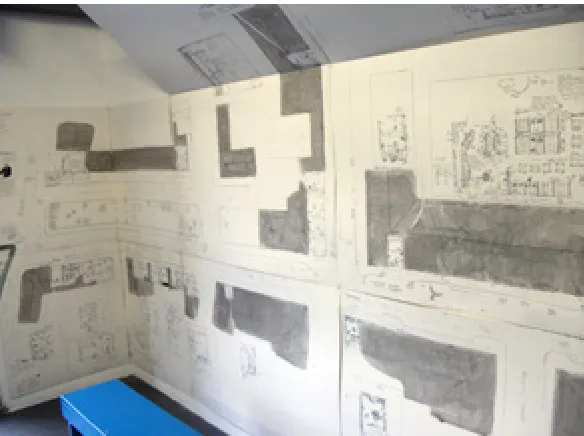
This paper reflects on DRAW DUKE STREET, a residency at Glasgow’s Market Gallery between early October and December 2012. This formed a case study in AHRC-funded PhD research into ‘the dialectogram’ (a word made from adding dialect/dialectic to diagram). Dialectograms are large documentary pen and ink drawings of places/spaces in the city of Glasgow, made on A0 board. They borrow from but do not conform to, the conventions of illustrative journalism, cartography, Psychogeography, architectural drawing, ethnography, oral history and sequential art to understand, and
interpret, urban spaces. The aim of the residency was to draw as much as possible of a stretch of Duke Street in Dennistoun (where the gallery is located), documenting how this shared space is used, perceived and imagined by residents and local businesses. The drawing was created through the efforts of a team of local volunteer researchers who will assist me in gathering information
Selected Abstracts
and interviews, and through operating my workspace (in the gallery itself) as an open ‘surgery’ to gather further insights and ongoing input into the drawing as it develops. The final results were presented in a strip mimicking the shape of Duke Street, pieced together from A0 panels added as they are completed.
This process was carefully recorded and scrutinised through an action research model. Of particular interest were issues of social engagement in illustration,
Roderick Mills
Illustration for the Internet Space
As newspapers and magazines slowly migrate to digital platforms what are the consequences for Illustration? Rather than seeing only the negative, what are the
opportunities offered for images existing within a timeline as they do in the online interface? I would like to suggest that this timeline offers the chance for illustrators to explore sequence and narrative, the corner stones of much Illustration practice, and to offer the reader further insight into the visual language of the Illustrator.
What are the precedents currently being used that
suggest the direction Illustration might take in the future? It is vital that illustrators occupy this area without fear of technology to show what can be achieved and the
Selected Abstracts
possibilities for new areas of commercial enterprise. The digital has to be embraced as surveyed in the 2001 book Pen & Mouse: Commercial Art and Digital Illustration by Angus Hyland and Roanne Bell. Not in the creation of artwork, but in the platforms that we readily receive images these days – invariably on our desktops.
Taking a woman I know I observe and draw…Can you live out a fantasy? Can one rely on film to help to establish an identity, to cope with previous sadness and disappointment?
Space continues to be explored through my process of drawing. The use of space on the drawing page and manipulation of composition are significant. John O’Reilly’s ‘A Phenomenology of the Sketch’ proves a significant context.
‘The sketch as…the unresolved relationship of word and image...as observation, as voyeur.’ (O’Reilly, 2011)1
I have also experimented with collage and creating three-dimensional models of significant spaces in the book from which I make drawings and take photographs from multi-perspectives to evoke and communicate.
Through drawing as a tool for visual thinking, I convey the subtlety of the effects of space.
Chloe Regan
The Set
I am creating an illustrated book that explores space in significant ways. The protagonist of the narrative is based on a friend. She has lived in the same flat for forty years. She moved in with her ex-husband and now lives with her partner of many years. I have never been to the flat but have heard much about it. It is sparse. In fact it is almost empty. She is glamorous, citing film as an inspiration for a way of dressing and urban existence. This is misleading. Her flat and the city act as a film set on which she leads her life. She demonstrates a repetitive nature of rituals informed by the flat and the city, always remaining anonymous.
The protagonist inhabits specific spaces, her flat, and the city. These spaces are both reflective and evocative of her psychological state and inform her patterns of existence. Psychogeography is a relevant context for my narrative; particularly with reference to Walter Benjamin’s ‘Arcade Project’ and Charles Baudelaire’s ‘flâneur’ which both examine human responses to the city and urban alienation.
This study compares the treatment of space in two examples from these cultural traditions and provides insights into the construction of graphic flatness in narrative art. Both artists have created highly versatile surfaces on which to convey representational and
symbolic meaning and there are many similarities relating to the composition of space and depiction of movement. Contrasts also emerge principally in the application of orthographic and other systems for representing space in two dimensions. Although the influences of American Indian and Japanese art on Western art have been well documented, the physical and psychological dramas revealed in these examples identify relevant vocabularies for contemporary picture-making in the graphic arts and it is hoped, the study will enable practitioners to see and ‘read’ these images afresh.
Professor Allan Walker
Alternative Traditions: Flat as a Way of
Visualising Space
Two narrative traditions are analysed in this critical examination of 19th Century images from Japan and the Plains Indians of North America. Although at first glance comparison between such different cultures seems unlikely, both have long histories of making visual chronicles and areas of common ground emerge in their treatment of subject matter and pictorial space.
Plains Indian drawings were traditionally produced as winter accounts of events in the life of the tribe in relation to warfare, hunting, religion and courtship. Following increased contact with soldiers and settlers during the mid-19th Century, the Plains Indians began to use bound ledgers drawing on the military or trading inventories using pencil, ink and watercolour. In Japanese woodblock prints, the influence of European perspective had been absorbed in the 18th Century and the ‘opening up’ of the country during the Meiji Period ushered in a period of frenetic print production using the foreigners as subject matter. Despite this, the contemporary artist Murakami considers that the defining quality of Japanese art and culture is the feeling of flatness.
Mitch Miller is an Illustrator and PhD Student at the School of Design, Glasgow School of Art.
In 2001 he co-founded The Drouth magazine and has published books, essays and articles on a range of cultural and political subjects. Past projects include the web- documentary Boswell in Space (www.
boswellinspace.org), and a period as resident artist at the Red Road Flats Cultural Project. He is currently working with clients such as Glasgow Life, Glasgow Museums and Collective Gallery (Edinburgh) on a number of socially engaged, documentary illustration projects as part of his insane scheme to draw all of Glasgow in dialectogram form.
Mitch Miller
Contact Information
Illustrator and PhD Student at the School of Design, Glasgow School of Art
Illustrating space as collaborative, socially engaged practice:
The first report from the DRAW DUKE STREET residency
The DRAW DUKE STREET Project
A dialectogram is an invented, slightly tongue-in-cheek word combining ‘diagram’ with ‘dialect’ or ‘dialectic’ to describe large, detailed drawings of places in Glasgow. Each of these images sit somewhere between a map, an architectural plan, comic strip and diagram, using techniques from these disciplines to contain and arrange information on their subject within the image. The
drawings use ethnographic methods to collate personal narratives, local knowledge, feelings and imaginings about place, to create a unique social and aesthetic document. The dialectogram bears a slight resemblance to the intricate and beautiful satirical maps of Adam Dant, but the method and style of the former developed with no knowledge of this artist’s work and was initially a gradual, piecemeal response to the difficulties of creating complex documentary drawings of life in the east and north of Glasgow. While Dant successfully subverts and satirises the informational drawing in his work, dialectograms offer a much ‘straighter’ documentary treatment of their subject and also, require sustained engagement with communities to gather the raw materials and shape the final piece. Furthermore, as I will later demonstrate, dialectograms owe much more to the literary and visual culture of Glasgow.
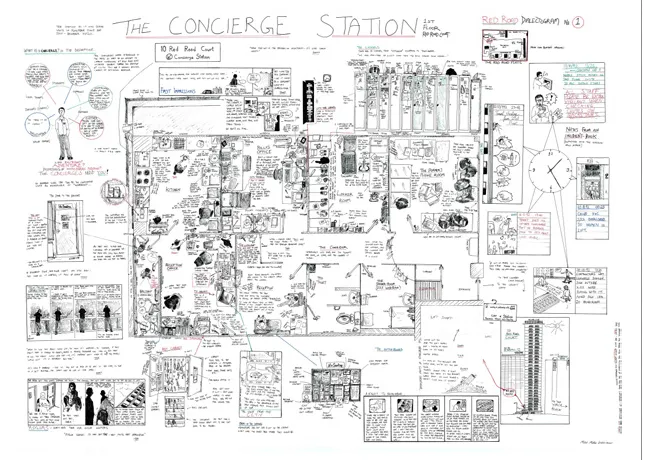
The dialectogram has been used to create documentary illustrations of the Red Road Flats as part of the Red Road Cultural project (now acquired by the People’s Palace Museum), and to record the living arrangements of the travelling showpeople of Glasgow’s East end (Fig. 1, 2). The DRAW DUKE STREET residency (Market Gallery, 30th of October to the 16th of December) was the first of a series of case study dialectograms for my PhD. These case studies centre on locations that are; in deprived and marginal areas; ‘hidden’ from public view or; are in a state of transition.
Illustrating space as collaborative, socially engaged practice: The first report from the DRAW DUKE STREET residency
Illustrating space as collaborative, socially engaged practice: The first report from the DRAW DUKE STREET residency
[image:32.1024.523.960.198.485.2]Illustrating space as collaborative, socially engaged practice: The first report from the DRAW DUKE STREET residency
The residency was designed to incur changes in the practice and the practitioner. In describing these
changes, it seems appropriate to use the first person in this article. I was investigating - and disrupting – how I was used to working, and trying to challenge myself to consider new practices and ways of thinking about them. Among the latter, I wanted to investigate my belief that dialectograms are a ‘socially engaged’ creative practice, a claim I will admit to have undergone little serious self-reflection before I started the PhD project. This case study was a chance to begin to address the question of how dialectograms fitted a “socially engaged” model. In his Living as Form: Socially Engaged Art from 1991-2011, Nato Thomson outlines the development of “socially engaged” art:
In recent years there has been a rapidly growing movement of artists choosing to engage with timely issues by expanding their practice beyond the safe confines of the studio and right into the complexity of the unpredictable public sphere. The work has many names: “relational aesthetics,” “social justice art,” “social practice,” and “community art,” among others. These artists engage in a process that includes careful listening, thoughtful conversations, and
community organizing. (Thomson, 2012: 7-8)
In this case study I wanted to look more closely at how dialectograms may already fit a socially engaged model and explore whether this could – and should – be expanded through greater collaboration. By choosing to work in an open studio in a deprived area of Glasgow, and by making a process of listening and talking to local people as core to the manufacture of these drawings, I already felt I ticked a number of these boxes.
Change would also come through working under pressure. Somewhat paradoxically, my plans were also much more ambitious than previous projects; the drawing would in fact, be eighteen times larger than its usual A0 dimensions, yet engage with a much more diverse and complex space than in previous works. The Market Gallery offered me a place on its programme of studio projects that run on a six-weekly basis throughout the year. This was nowhere near the ten-week residency I had hoped for (previous dialectograms typically took several weeks just to research). Given the proximity to Christmas, I was able to negotiate a seventh week to exhibit the drawing in the gallery, and decided to work within the six-week limit and see what could be achieved. This relatively short time period in which to research, plan and execute the drawing meant that regardless of
whether it was ready, the dialectogram would be hung on the 7th of December. Applying these pressures gave me the opportunity to test my practice and introduce new approaches that could potentially become part of the ‘rules’ of making dialectograms. I framed this process around the ‘emancipatory action research’ cycle defined by Ortrun Zuber-Skerrit (1992) and its goal of effecting radical change within a system or organisation – in this case, the system of practices that had built up around myself. For the purposes of this paper, I would like to explore some of the background to the work, explain why the case study was set up in this way, then through a narrative account of the project, give some attention to the role that ‘spatialising illustration’ played in suggesting changes to my practice.
Ethnography and the Everyday: The theory and practice of the dialectogram
Illustrating space as collaborative, socially engaged practice: The first report from the DRAW DUKE STREET residency
socially engaged practices (Burawoy, 1991: Blomberg et al, 1993). In creative fields product designers have used ethnography to investigate the ‘needs and wants’ of their users, understand how the products are used and shape them accordingly (Wasson 2000). Historically, Illustration has played an important role in anthropological recording and note taking, mainly to create components for the ethnographer’s final synthesis of their studies into an ‘ethnography’ (El Guindi, 2004).
This somewhat subservient relationship with the
ethnographic tradition has changed, as illustrators have begun to use these techniques to create standalone creative works. The ‘artist as ethnographer’ is a trend been noted and problematized by Hal Foster within the fine art tradition, while new research networks such as Artful Encounters brings artists and arts academics together with anthropologists and other social scientists to explore these problems (Foster, 1996, Artful
Encounters, 2013). Limitations of time and space make it impossible to work through all of these problems in this paper; suffice to say that as well as offering new and exciting opportunities to the illustrator, ethnographic technique presents her/him with an additional set of concerns, particularly with regard to ethical practice Some
run by the illustrative journalist Gary Embury. Reportager brings together illustrators who produce works of
illustrated journalism and ethnography in a range of styles and approaches. Embury notes a shared sensibility between dialectograms and Reportager member Olivier Kugler’s travelogues (Embury, 2013: 67). While it fits more definitely within the ‘gonzo’ journalistic tradition, Joe Sacco’s method involves spending long periods of time with communities, often participating in certain activities and taking a very reflexive approach to how he gathers his material, which means his comics journalism is an useful touchstone for ethnographic practices within illustration (Hedges and Sacco, 2012). Ethnography is used very successfully within the socially engaged practice of Julien ‘Seth’ Malland. Malland’s highly participatory street art projects operate as a filter for the skills and abilities of the communities he engages with, and in giving away the autonomy and authority of the creator to them, resembles Nicolas Bourriaud’s notion of presenting new ‘models of action’ to the practitioner who wants to work in the community (Bourriaud, 1998:13). Malland’s recent work enabled villagers in Southeast Asia to apply their own crafts and skills to create murals and demonstrate the value of their own traditions and lifeways (Manco, 2012). This example inspired me to encourage more participation
It should also be noted that dialectograms’ focus on social engagement as both practice and theme has many forerunners within the visual culture of Glasgow itself. The most relevant of these to the visual approach I take would be writer and illustrator Alasdair Gray’s time as Glasgow’s ‘city-recorder’ with the People’s Palace social history museum (Gray, 2010: 173-198), in which he produced new works for the purposes of expanding and enhancing the collections of the museum, and generated these by working closely with local communities and networks. In addition to portraits of notable Glaswegians and painted landscapes of east-end streets due to be redeveloped or demolished, his illustrations incorporated documentary detail through writing notes or included found objects and personal effects onto the images, as shown in this image of the Third Eye Centre. (Fig. 4)
Illustrating space as collaborative, socially engaged practice: The first report from the DRAW DUKE STREET residency
Fig 4: Ken McGrath in his Office at The Third Eye Centre with Secretary Linda Haase and View Through the window behind of Scott Street, Alasdair Gray, 1977
Illustrating space as collaborative, socially engaged practice: The first report from the DRAW DUKE STREET residency
and sees an appreciation of these practices as a
Marxist, regards these as the basis of a new radical and emancipatory politics (de Certeau, 1988).
Again, we can link this to my local context. The
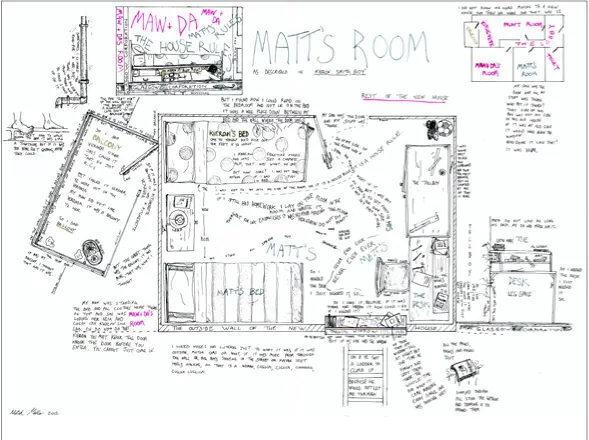
Glaswegian novelist James Kelman “tactically consumes” literary norms in creating his own ‘workerist’ literary style, but takes this further and incorporates it into modus operandi of his alienated, marginalised working class characters (Miller and Rodger, 2012). I first identified this link when I visualised a location from a Kelman novel (Fig. 5). This image that my own practice, could, like Kelman’s, be framed as the tactical consumption of illustrative traditions such as the map, architectural plan, diagram or comic strip, to illustrate environments according to how they themselves, are tactically consumed.
DRAW DUKE STREET as action research: Setting up the case study
[image:36.1024.383.972.197.637.2]Illustrating space as collaborative, socially engaged practice: The first report from the DRAW DUKE STREET residency
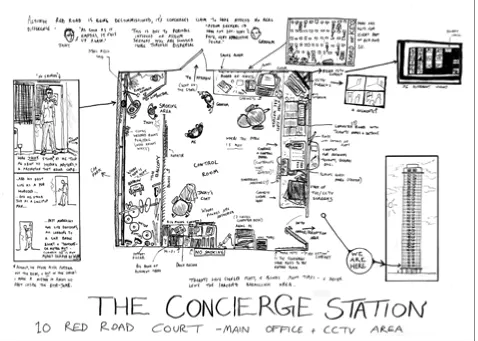
for the participant to request changes and corrections, but to date, none have been willing to suggest any at such a late stage in the process. At earlier stages in the drawing process it is hard to see how the drawing will pan out, while others have been reluctant to see it before it is finished. I have had more luck when showing small, rough sketches during the early stages of the work (Fig. 6a, 7) than showing the participant a latter stage in the actual finished work itself. A past participant in the Red Road Dialectograms, who had seen a drawing in its early stages, but preferred not to see it before it was finished explained why (and how the ‘surprise’ enhanced his experience), while raising important ethical concerns:
It was quite a surprise to see it like that, and everybody likes surprises, so instead of getting told about it […] the way you done it [with the big reveal] wid be better. But I suppose if you’da says speak to the people that are involved, and say look, do ye WANT tae see it? Ask them, get an opinion and say look I’m gonnae be putting this [detail] in you know, before it, you could dae it that way. I suppose you don’t want tae finish it, and then a guy go “look, you cannae put that in, I told you that in confidence” or whatever […] so I suppose it would make sense that way.
(interview with Concierge Station Participant, March 2013)
The problem of encouraging participation is frequently encountered by design ethnographers who find the public are unwilling to make changes, either because they feel unqualified to speak up, or the product looks too finished (Blomberg et al, 1991:140). The other problem, of what is and is not confidential, can be difficult to keep track of when the fieldwork takes place amid the cut and thrust of everyday life, but this comment establishes a general principle of checking at various stages during the process whether a participant want to input on the final form of the drawing, one which I tried to put into practice in this case study. The gallery was used as an open studio where locals could come in to see the work underway and potentially, participate by giving informal interviews.
By putting myself into a publicly accessible space, I hoped it would be easier for the community to take a look without feeling self-conscious or intrusive (as they might if coming into my studio on an arranged visit, or if I was a visitor in their home or workplace). Participation would be further integrated into the project through engaging a team of volunteer researchers to gather information from the shops and public spaces along the street., as I would have no time to do this myself.
I also ensured that informed consent was secured through release forms and applied Meskell and Pels’ principles of ‘embedded ethics’. This involved being strongly connected to the research site and giving preference to my responsibilities to the community I was working with, rather than more traditional models aimed at protecting professional rights (Meskell and Pels, 2005: 3). I made a commitment to stick to the rules I had set for the residency – opening from 10-6pm at set hours, during which I was at their disposal and could be ‘interrupted’ at any time (see below). I took it upon myself to explain, whenever asked, what I was doing and exactly how I would use their contribution (it was helpful to have the ‘target’ walls where the drawing would be hung, and past dialectograms nearby, to give them an idea of what I was trying to accomplish).
Illustrating space as collaborative, socially engaged practice: The first report from the DRAW DUKE STREET residency
[image:38.1024.55.533.199.540.2]Fig. 6: Concierge Prototype, Mitch Miller, 2009
Illustrating space as collaborative, socially engaged practice: The first report from the DRAW DUKE STREET residency
Fig. 8: Detail from Duke Street Dialectogram, Mitch Miller, 2012
DRAW DUKE STREET as Spatialised Illustration
Whereas previous drawings such as the Concierge Station illustrated a microcosmic ‘story world’ within Red Road it was immediately apparent that Draw Duke Street would deal with shared space that contained different modes of use, access and occupation. Consequently, this drawing had to contend with a range of different subjective
relationships people had with the street, what the theorist of space and ‘the practice of everyday life’ de Certeau describes as ‘the ciphered river […] a mobile language of computations and rationalities that belong to no-one’ (de Certeau, 1988: v). To this end, the ‘peeks into’ the interiors of shops that can be seen on the drawing were accompanied by narratives drawn directly onto the street and pavement areas, with comic strips used to capture smaller, imaginative interactions and insights (see Fig 8)
Illustrating space as collaborative, socially engaged practice: The first report from the DRAW DUKE STREET residency
Illustrating space as collaborative, socially engaged practice: The first report from the DRAW DUKE STREET residency
could I, in a Goffman-esque sense make it clear what role I was playing while trying to ‘get inside’ the community, but it embedded an ethic of my being open to scrutiny and on display to the community I set out to study and depict, a principle of public access and partnership articulated by Meskell and Pels (Meskell and Pels 2005: 8). I honoured this principle by making the space more open to, and welcoming of visitors from the street. Some weeks earlier I had participated in a community event at which locals had indicated the breezeblock and white cube aesthetic of the gallery was intimidating and off putting. I set out to offset this as much as possible by rearranging and tidying the space and ensuring it was well heated (it was usually very cold). I provided an urn, beverages and biscuits located next to historical displays and gave much of the gallery over to community services, providing a notice board, a small reading-room and wall space for local artists and poets to hang their work. Some of these works were eventually incorporated into the drawing.
Once enticed through the door, locals were encouraged to ask questions about the project and, if they were interested, record an interview. In these cases it was important to both the ethical and methodological framework I set up, to show that I was available and valued the time they were giving me, and was ready to
do nothing else but listen. I would stop drawing, make tea or coffee for the visitor and either do the interview on the spot, or arrange a better time. As many participants would forget or not be able to come back I made getting an interview a priority over anything else. This helped to create an atmosphere of openness and approachability that was vital if the work was to succeed. In many
respects, it did; of the 30 hours of interviews we recorded over the six weeks, twenty hours came solely from the drop in facility. While very fruitful, the success of the drop-in approach created difficulties in terms of actually producing the drawing. With as many as twenty visitors in a day, work became very slow. Some participants also began to regard me as a friendly ear and began to drop in regularly, beyond the ‘official’ research interaction, a situation that, operating an open studio, could not easily be prevented. This led to an extension of working hours with the studio closed from 6pm, in order to try to make up drawing time. In short, the open approach could not really be reconciled with drawing as easily as it could with the principle of conducting original research interviews. It worked very well in gathering information and informants, but was in many respects, a victim of its own success.
I was however, very much a fixed point in the project; my ability to engage directly with the community was limited to my daily walks to the gallery, my trips out for
lunch, and early morning or evening visits to the political and public spaces of Dennistoun such as meetings with the community council, the local writers group the conservation society and the local library. This met with some success, with the local public library offering access to a number of community groups such as the Bounce and Rhyme playgroup, several of whose members came to be interviewed at the gallery; Dennistoun Community Council is currently looking at ways of financially supporting the dissemination of the drawing; the Conservation group providing archive material and oral histories and the writer’s group contributing poems and personal accounts directly to the drawing itself. Not all of these opportunities for social engagement could be realized at the time, but there is potential for doing so at a prospective phase two of the project.
Illustrating space as collaborative, socially engaged practice: The first report from the DRAW DUKE STREET residency
information; I had never had to explain how I worked to others before. I soon abandoned any concept of the volunteers as ‘proxies’ for my style and sensibility. As the first interviews came in using the very basic questionnaire I had drafted, I realised that I had failed to notice an opportunity to make the most of the volunteers. I began to encourage them to draw upon their own backgrounds, perspectives and practices in carrying out the research, which led to more diverse – and interesting – information coming back.
[image:42.1024.697.972.198.427.2]This outsourcing of my usual tasks went beyond what was originally planned. As the pressure of the final days mounted and I became increasingly desperate, I asked the volunteers to listen to interview recordings and direct me to specific segments and quotes. More than one volunteer would listen to the same interview in case any one of them missed something. I was very reluctant to give this aspect of the work over; in previous projects this process of listening had been a crucial, and rather private aspect of forming my thoughts about what the drawing is going to look like and what it would contain, It felt like giving a major part of myself away and also, like I was abandoning my duties. I accordingly, noted feelings of guilt and unease in my blog (DSD 30 December 2012).
Fig. 10: Eastern corner of Duke Street Dialectogram, photo by Damon Herd, 2012
Nevertheless, the ways in which each researcher’s take on the material differed slightly from the other was in itself interesting and had there been more time, could have led to much more diverse, subtle treatment of the material.
DRAW DUKE STREET as…failure?
A glib conclusion from this case study is that it is not possible to create a drawing of such a large space, of such a large size, in this style, in less than six weeks. Nevertheless, the unique conditions of the residency created a hothouse effect that allowed a great deal to be achieved, very quickly. (Fig. 11, 12). It was in many respects a ‘campaign’ that raised awareness of Duke Street and used its visibility to create the conditions for further work within the community to finish the drawing.
I began with questions over how well engineered my process of social engagement actually was, and whether putting my own methods under pressure could suggest new and ‘emancipatory’ alternatives. I do not have conclusive answers to these at present, but the account indicates that if I can be reconciled, and readied for the additional pressures created by collaboration, these may may indeed exist, and that spatialising the illustration process has played a major role in doing so. As I go on to apply my initial findings in my next case study in Govan, the spatial dimension will be central in establishing the ‘rules’ of the dialectogram as a socially engaged practice. Illustrating space as collaborative, socially engaged practice:
[image:43.1024.56.643.61.363.2]The first report from the DRAW DUKE STREET residency
Fig 11: Panoramic View of Duke Street Dialectogram, photo by Stuart MacMillan, 2012
[image:43.1024.55.347.428.646.2]References/Bibliography
Illustrating space as collaborative, socially engaged practice: The first report from the DRAW DUKE STREET residency
Artful Encounters (Ethnographic research network) http://www.
artfulencounters.nl/ (last accessed 29 March 2013).
Jeanette Blomberg, Jean Giacomi, Andrea Mosher, Pat Swenton-Wall (1993), ‘Ethnographic Field Methods and Their Relation to Design, in Douglas Schuler and Aki Namioka, Participatory Design,
Principles and Practices, New Jersey: Routledge p 123-157
Nicolas Bourriaud, (1998) Relational Aesthetics, Paris: les presses du reel
Michael Burawoy, (1991) Ethnography Unbound: Power and
Resistance in the Modern Metropolis, London:Routledge.
Michel de Certeau, (1988) The Practice of Everyday Life, Los Angeles, U.C.P.
Merlin Coverley, (2010) Psychogeography, London: Pocket Essentials
Fadwa El Guindi, (2004) Visual Anthropology: Essential Method and
Theory. Walnut Creek: Rowman Altamira.
Gary Embury, (2013) “The New Visual Journalism” in Varoom! Lab
online journal issue one, January 2012 pp59-69.
Hal Foster (1996) ‘the Artist as Ethnographer?’ in The Return of the
Real: The Avant-Garde at the End of the Century, Cambridge: MIT
Press.
Erving Goffman, (1959) The Presentation of Self in Everyday Life, London: Pelican.
Alasdair Gray, (2010) A Life in Pictures, Edinburgh: Canongate
Chris Hedges and Joe Sacco (2012), Days of Destruction, Days of Revolt, New York: Nation Books.
Julien Manco, ‘Street Art: Hybrids’, in Varoom! , Issue 19, Autumn 2012, London.
Gerry McCartney et al, (2011) Accounting for Scotland’s Excess
Mortality: Towards a Synthesis, Glasgow: Glasgow Centre for
Population Health.
Lynn Meskell and Peter Pels, (2005) Embedding Ethics: shifting
Boundaries of the Anthropological Profession, London: Berg.
Mitch Miller and Johnny Rodger, (2012) ‘The Writer as Tactician: James Kelman’s Everyday Practice” in Scottish Literary Review Vol. 4
No. 1, 2012. pp151-168
Nato Thomson, (2012) Living As Form: Socially Engaged Art From
1991-2011, New York: Creative Time Books.
Edward Tufte (1990) Envisioning Information, Connecticut: Graphics Press
Ortrun Zuber-Skerritt, (1996), New Directions in Action Research, London: RoutledgeFarmer.
Christina Wasson, C., (2000) ‘Ethnography in the Field of Design’ in Human Organization. 59( 4): p. 377-388
The Duke Street Diaries, (DSD) 31st October – 7th December 2012,
http://drawdukestreet.wordpress.com/ (last accessed 13/12/2012)
(all dialectograms can be viewed at www.dialectograms.co.uk/the-archive)
Fig 1. Red Road Dialectogram No. 1: The Concierge Station (Mitch Miller 2010)
Fig 2: Showman’s Yard in the East End, Pencil and ink on mountboard (Mitch Miller, 2012)
Fig 3: Social Deprivation levels in Duke Street, from Map of
Social Deprivation in Scotland 2012 https://sites.google.com/site/
scotdep2012/ (last accessed 21 January 2013)
Fig 4: Ken McGrath in his Office at The Third Eye Centre with
Secretary Linda Haase and View Through the window behind of Scott Street (Alasdair Gray, 1977)
Fig 5: Matt’s Room as described in Kieron Smith, Boy. (Mitch Miller, 2012)
Fig. 6: Concierge Prototype (Mitch Miller, 2009)
Fig. 7: Detail from The Concierge Station with prototype drawing being shown to participants (Mitch Miller, 2010)
Fig. 8: Detail from Duke Street Dialectogram (Mitch Miller, 2012)
Fig 9a, 9b: Views of Market Gallery, October-November 2012 (Mitch Miller, 2012)
Fig. 10: Eastern corner of Duke Street Dialectogram (photo by Damon Herd, 2012)
Fig 11. Panoramic View of Duke Street Dialectogram, (Stuart MacMillan, 2012)
Fig 12: Detail of Coia’s, from Duke Street Dialectogram (Damon Herd 2012)
Illustrating space as collaborative, socially engaged practice: The first report from the DRAW DUKE STREET residency
Nick Dodds is an illustrator, researcher and senior lecturer in visual culture at the University of Cumbria.
He is currently responsible for teaching contemporary design discourse and narrative theory across a number of course areas including BA Graphic Design, BA Illustration and BA Film and Television Production. Nick has a longstanding passion for comic strips and graphic story telling which feeds directly into his own artwork and academic research. Recently, Nick has worked collaboratively on comic strip themed projects with organisations such as Tullie House, Carlisle (as part of the touring exhibition Cult Fiction: Art and Comics) and Copeland Arts in Whitehaven. The latter involved designing public art installations for Whitehaven Civic Centre. Current projects include a graphic novel called The Collector and writing and performing film soundtracks with the band Pecker. He is the editor and prime mover behind the anthology Bagatelle, a magazine published annually by the University of Cumbria and featuring ‘comic strip tales’.
Nick Dodds
Contact Information
Senior Lecturer in Visual Culture University of Cumbria
Spatial Poetics: Control of Time
and Space in Graphic Narratives
Deceptively simple on the surface, under close analysis the comic strip page is something of a paradox, a complex and multi-layered structure. For the artist, the formative layout of a graphic narrative is both a conceptual and spatial activity, involving a high degree of reasoning in the selection and placement of any textual and visual elements. In reception, the effectiveness of any narrative depends on the readiness of the reader to recognize, synthesize and decode the linguistic and visual information at hand, in short: to navigate spatial relationships and make meaningful connections between one panel and the next in the strip sequence. For this reason, graphic narratives offer up tremendous potential for textual analysis: for studying at close quarters
issues pertaining to spatial design, visual literacy and the breach between expression and readership. This paper will address the formal and spatial apparatus of the printed comic book from a predominately western perspective, with reference to selected American and European theorists and practitioners, focusing on i) page composition and spatial orientation, ii) the dynamic between text and image, iii) the utilization of panels as temporal markers and iv) connoting a sense of socio-geographical setting.
For the purpose of this paper the term ‘graphic narrative’ refers specifically to anthologised print collections
of comic strip stories and one-off graphic novels; as opposed to storyboards, illustrated stories, info-graphics and other published or printed ephemera. Historically, academic study has tended towards framing the comic strip as a narrative form with “limited intellectual accomplishment” (Eisner, 1996:3), often associated with a proto-stage of reading or contextualized within the narrow confines of the superhero set. Thankfully, this attitude no longer prevails. Currently, western comic book scholarship is a vibrant, albeit still emerging field, located in keynote American universities and the Francophone school of semiotic discourse. In Britain, the post-war boom of the printed weekly strip pamphlet (see Sabin, 1996:44-91) may be long past but the ‘graphic novel’, an entire strip narrative in book form, currently appears to be enjoying a healthy flush of visibility and respectability. In the case of the former, a burgeoning information economy, and more specifically, a penchant for screen-based, interactive social narrative and
game-play amongst younger readers in the 7 to 14 age bracket has led to a decline in circulation (witness the decision taken in 2012 by publishers D.C.Thompson, to move the Dandy comic to an online version only). Although difficult to categorize, it can be argued that the audience for the graphic novel is comprised of a different demographic or community of readers: adult, male-centric but not exclusively so, culturally aware with
a visual sensibility that still prizes the physicality of the printed object over the digitized copy. The latest graphical works; often combining lush production values, complex character driven narratives and underscored with diverse sociopolitical themes, are just as likely to be reviewed in the broadsheet press as they are a scholarly journal.
In contemplating the current relevance of the sequential form, there is a further dimension worth touching on here. There are clear parallels between the navigation of the printed artifact or the fragmentary narratives contained between the margins, and the digital sphere, that resonates with a contemporary media-savvy audience. In an age dominated by new media forms and multi-modal ways of experiencing narrative, any discussion of the term ‘reading’ that seeks to equate literacy with text-only formats seems increasingly antiquated. Eisner’s comment on the perceived criticism of the strip format by a (unspecified) literary intelligentsia signals a pedagogical framework that is no longer tenable. According to some, the predominance of the digital has led to a profound re-evaluation of the “balance between word and image” (Harris, 2006:213), shifting the literacy debate away from the purely verbal or alphabetical. In respect to readership, contemporary structural analysis of strip narratives
Spatial Poetics: Control of Time and Space in Graphic Narratives
In part, there are idiosyncratic features associated with the strip medium that may explain previous academic resistance. It is, undeniably, easier to paraphrase a cinematic sequence or a passage in a novel than it is to describe the surface ‘clunkiness’ of a page of graphic fiction, largely because the viewing or reading experience is plurivectorial. The reader is constantly traversing and rewinding across the page, from panel to panel, to retrieve the information necessary to propel the story onwards. Deviation from the prescribed route laid out by the author is also a common occurrence; the direction of eye movement can be erratic, often moving ahead in a sequence or arresting on a choice aesthetic detail. Seasoned comic book artists are aware of these anomalies and will either design around or incorporate