Utilising a systematic knowledge management based system to optimise project management operations in oil and gas organisation
Journal of Information Technology and People
Ochieng, E.G. 1, Ovbagbedia,O.O. 2, Abdulai, R. 3, Matipa, W. 4, Zuofa, T. 5, Ruan, X.6 and Oledinma,
A7
1, 7Cranfield School of Management, Innovation and Process Management, Cranfield University
Cranfield, Bedford, MK43 0AL,UK
2,3,4 School of the Built Environment, Liverpool John Moores University, Byrom Street, Liverpool, L3 3AF, UK
5 Faculty of Engineering and Computing, Coventry University, Coventry, CV1 5FB, UK, 6Bristol Business School, University of the West of England, Bristol, BS16 1QY, UK
Corresponding author
Dr. Edward Ochieng: PhD, PGCertHELT, MSc, BSc (Hons), FHEA Phone: +44 01234 751122 extn. 3123
Email: [email protected]
Edward is a Senior Lecturer in Programme and Project Management at Cranfield University, UK. Edward’s research is focused on heavy engineering project management. He has extensive experience and knowledge relating to organisational challenges and solution development for managing large capital and heavy engineering projects. Edward has published 3 books, 28 book chapters and over 75 refereed papers in refereed journals and conferences. He has supervised 9 PhD students to successful completion and over 150 MSc/MBA industrial projects by research. He has also acted as an internal and external examiner of more than 10 PhD students in different UK universities.
Dr. Oghenemarho Omaruaye Ovbagbedia: BSc (Hons), MSc, PhD Email: [email protected]
Phone: 001 8327458614
I have recently completed my PhD in Project Management at Liverpool John Moores University. My research interests focuses on knowledge management, risk management and people issues.
Dr. Raymond Abdulai: PhD, MPhil, PGCert HE, BSc (Hons) Email: [email protected]
Phone: +44 151 231 25713
Dr Wilfred Matipa: PhD, PGCE, MSc, BSc (Hons)
Email: [email protected]
Phone: +44 0151 231 2860
Wilfred is a Senior Lecturer at Liverpool John Moores University. He holds a (BSc) Degree in Building (with Merit); and a Master of Science (MSc) (with Distinction) in Construction Project Management. His Doctor of Philosophy Degree (PhD) in Civil and Environmental Engineering was obtained from Cork (University College Cork, UCC). Wilfred is a Chartered Builder (MCIOB)with an interest in research related to whole life cost management using information and communication technologies such as building information models (BIM) and computer aided taking-off (CATO).
Dr. Tarila Zuofa: BTech, MSc, PhD Email:
[email protected]
Phone: +44 75321023300
Tarila is a Senior Lecturer at Coventry University. Tari, has extensively carried out industry and academic oriented research in project management, most of which have focused on key issues such as strategic project management, risk and uncertainty management, knowledge management, multicultural team leadership. His PhD research explored a wide range of issues affecting risk management in the oil and gas industry and project management in general. Part of the novelty of the thesis was highlighted in its uniqueness of providing an excellent opportunity for exploring project management practices in developing and developed countries.
Dr. Ximing Ruan: MBA, PhD, MAMP, FHEA Email: [email protected]
Tel: +44 (0)117 32 83182
After working in IT and the construction industry for 10 years, I pursued degrees in Northumbria University at Newcastle upon Tyne, including an MBA from the Business School and a PhD in project management from the Built Environment School. I joined the Business Management department at UWE in 2012 after four year's teaching in Aberdeen, Scotland. I am a full member of APM (Association for Project Management) with both APMP and PQ qualifications.
Dr. Akunna Oledinma: PhD, MSc, BSc Email: [email protected]
Tel: +44 (0) 1234 752260
communities and their governments in Nigeria. Her most recent work involved the development of a food distribution model in Qatar.
Abstract
Purpose: This research examined the efficacy of knowledge management based systems and best practices that could be used to address operational issues in the oil and gas sector.
Design/methodology/approach: Given little was known empirically about the strategies and practices which contribute to improved performance, innovation and continuous improvement in the oil and gas sector qualitative method was used. Semi-structured interviews were used to derive senior managers’ constructs of project delivery efficiency and knowledge management based systems. The interviews were analysed through the use of a qualitative analysis software package NUDIST NVivoTM. Participants were selected using purposive sampling. Validity and reliability were achieved by first assessing the plausibility in terms of already existing knowledge on some of the operational issues raised by participants.
Findings: These were synthesised into a framework capturing seven-well defined stages. All these steps emerged as being related; they are comprised of independent variables. These steps were found to comprise of knowledge management technology approaches, knowledge management people approaches, knowledge management strategies and value enhancing practices.
Research limitations/implications: Although the findings are pertinent to oil and gas organisations, it will be important to conduct follow-up research validating the potential for using the results of this study to establish frameworks for knowledge and information management in different organisations and contexts. This will provide not only data about the validity of the framework in generic terms but will also generate additional data on the application of knowledge management strategy.
Practical implications: As shown in this study, successful knowledge management based systems requires the aligning of business strategy, technology for knowledge management, project management operations with an enterprise-knowledge sharing culture. Such sharing requires managing the behaviour of project personnel such that knowledge transfer becomes part of the organisation’s norm.
Social implications: The implementation of knowledge management based systems requires deliberate planning and action to create the conditions for success and put in place the strategy, leadership, goals, process, skills, systems, issue resolution, and structure to direct and exploit the dynamic nature of project work. The strategies proposed in this research cannot be expected to resolve all knowledge management issues in the oil and gas sector. However, their use defines an approach that is superior to the traditional approaches typically adopted and consequently merits far wider application.
challenges in their future projects. Reflecting on their experiences, the participants confirmed that the proposed knowledge management framework and its seven well-defined stages were central to the effectiveness of knowledge management in oil and gas operations. Although the scope of this research was restricted to projects in Nigeria and the UK, the geographical focus of this research does not invalidate these results with respect to other countries. The fact is that the oil and gas sector globally shares some common fundamental characteristics.
Keywords: Knowledge management systems, Knowledge integration, IT project management, Cross-cultural issues, Knowledge adoption, Decision making, Developing countries.
1.1 Introduction
In the oil and gas sector, project practitioners are beginning to take responsibility for
managing knowledge as a means to create value on projects, but still the sector has
continued to face several performance challenges. One common performance challenge in
the sector is that there is too much data and not enough information (Feblowitz and Vesset,
2013). The digital oilfield, the price and performance improvements in the sensor
technologies, and the availability of broadband networks have maximised the volume, variety
and velocity of data in the energy sector (Feblowitz and Vesset, 2013). Recently, Abel et al.
(2015) showed that most of the data relevant for geological interpretation of oil reservoirs
entails visual data that have no formal denomination and are learnt through an implicit
process during training and field experience. The process of standardising and implementing
a knowledge management based system can be particularly difficult for oil and gas
companies, which has often viewed key business-exploration, upstream and downstream
production, refining as distinctly different (Ochieng et al. 2016). Creating a standardised
knowledge management model, which entails people and technology approaches, can be
challenging (Secchi and Camuffo, 2016; Siemieniuch and Sinclair, 2004). To successfully
implement a knowledge management based system, key stakeholders from the core areas
mentioned above must come together and participate in designing a knowledge
management system that is broad enough to capture all of the assets. Having a well
standardised knowledge management based system linked to various business and project
functions allows centralised knowledge and oversight, while giving flexibility in
implementation. Within the context of this study, a knowledge management based system is
defined as an information data base designed to assist the sharing and integration of project
data. It is worth noting that a knowledge management based system may be less automated
in that they may require human activity in their operation (Ochieng et al. 2016). For many oil
efficiency requires cultural transformation within the strategic, operational and project levels
of the organisation (Wagner and Majchrzak, 2006). As established from the reviewed
literature, the UK oil and gas sector is no exception when it comes to the gaps and
shortcomings experienced as a result of efficiency related challenges of knowledge
management and project delivery (De Wit 1986; Lang 1990; Oil and Gas UK 2015). With an
estimated circa 65,000 jobs lost in the UKCS (United Kingdom Continental Shelf) from the
beginning of 2014 to the third quarter of 2015, reduced activity levels and threats to the
sustainability of this key industry in the UK, mainly due to the significant reduction of the
commodity prices. There has never been such an aggressive demand and urgent need for
meaningful knowledge management based systems and efficiency improvement initiatives in
the UK Oil and Gas industry (OGER, 2015). It is worth emphasising that, the oil and gas
industry in the UK as a whole has made significant strides in how they operate and individual
companies have shared best practices to ensure the advancement of the sector (OGER,
2015).
In contrast, the oil and gas industry in developing countries like Nigeria has been under
pressure to evolve into a sector that is constantly changing to fit the needs of the broader
context in which the operations are executed (IIedare 2007). Attitudes towards working have
changed dramatically in recent years and there is currently much more emphasis on the
application of innovative knowledge based systems. As oil and gas organisations in Nigeria
define more of their activities as projects, the demand for innovative solutions grows, and
there is increasing interest in reforming the project delivery process (Ekemena, 2011; Nwafor
and Salau, 2009; Rabiu 2009). Based on this demand, this research focussed on examining
the extent to which knowledge management people approaches and technology approaches
could contribute to adding value in the delivery of oil and gas projects. The growing
difficulties associated with accessing and leveraging technical knowledge have roots in the
several ongoing trends, including demographics (Oyejide and Adewuyi, 2011; Rabiu, 2009;
Chen and McQueen, 2010). For instance, about half of senior project management
practitioners are expected to retire over the next fifteen years (Nwafor and Salau, 2009).
This exodus can be viewed as a recruiting and training challenge, but it is also a tacit
knowledge management challenge. The challenge for oil and gas companies operating in
Nigeria is how to ensure that the remaining project management practitioners and the
incoming generation of project management practitioners have access to the data they
require, so they can avoid repeating lessons already learned. Accessing that data is
time-consuming and tedious because traditional knowledge management systems are ill-suited.
Local oil and gas organisations are finding it impossible to capture the value of information
Adewuyi 2011). Ultimately, without a solution to the knowledge management challenge,
senior project management practitioners will continue to waste valuable time and resources,
to their companies’ revenues and profits. Hence, this research aimed to:
Examine knowledge management challenges and propose an integrated framework
for managing knowledge repositories in oil and gas projects.
Contribute empirically to the development and advancement of project delivery in the
oil and gas sector by proposing a knowledge management framework. The
researchers, deviated from previous studies by embedding a systematic knowledge
management platform which includes knowledge management technology
approaches, knowledge management people approaches, value enhancing practices
and strategies and practices.
Build on previous works specifically done by Leavitt (2002) and Grant (2013).
There is a review of knowledge management, evolution of oil and gas and perspectives of
knowledge management in the next section.
1.2 Conceptual framing of knowledge management
Knowledge has been progressively considered the most important asset of organisations.
Asrar-ul-Haq et al. (2016) referred to it as lifeblood of organisations and it has also been
identified as a fundamental element required for the survival of organisations in dynamic and
competitive times. Irrespective of the significant role knowledge plays within organisations, it
is much more difficult to define because numerous possible interpretations are associated
with the term. Theorising knowledge can be traced to antiquated studies (Ryle 1949; Polanyi
1967; Burrell and Morgan’s 1979). However, more recently Karlinsky-Shichor and Zviran
(2016) defined it as familiarity, awareness or understanding of someone or something, such
as facts, information, descriptions, or skills, which is acquired through experience or
education by perceiving, discovering, or learning. As established from the reviewed
literature, several authors including (Shujahat et al. 2017; Karlinsky-Shichor and Zviran
2016; Geisler and Wickramasinghe 2015) have addressed the issue of emergence and key
factors behind the increased interest in and application of knowledge management systems.
Interestingly, these authors more or less identify the similar factors (Asrar-ul-Haq et al. 2016;
Dalkir, 2011). One key feature identified in the literature is the substantial increase in
international commerce and globalisation of businesses (Dalkir, 2011). Products
manufactured in one organisation or countries are now assembled from multiple sources
worldwide while in the past there were limited product alternatives. This trend has resulted in
been the move towards leaner organisations and the challenge of delivering better, quicker
and in time products and services (Geisler and Wickramasinghe 2015; Dalkir, 2011). The
last feature relates to the constant need for highly skilled manpower, the increased turnover
of employees and workforce mobility (Dalkir 2011).
As illustrated above, the discipline of knowledge management has equally emerged in both
academic research and in practice over the years (Lang 2001; Leseure and Brookes, 2004).
Although there are a lot of different definitions of knowledge management, it can be said to
improve organisational performance by allowing individuals to identify, take, share and apply
their collective knowledge to make optimum decisions (Bjorkman et al. 2004; Gold et al.
2001; Nissen, 2005). An organisation must have “up-to-date” technology in order to develop
globally, especially in the multinational business environment of today (Wagner and
Majchrzak, 2006; Durcikova and Gray, 2009). However, to achieve bottom-line success,
attention must be paid to the other issues. Experience in many organisations has shown that
no more than one third of the knowledge management budget should be devoted to
knowledge management technology (O’Dell et al., 2000; Bittner and Leimeister 2014)). One
of the main success factors for knowledge management is to develop an understanding of
the existing connections and mechanisms of sharing and then develop ways to allow people
to improve on the already existing process (Gilbert et al., 2002). According to Bixler (2002),
implementing a knowledge management based system can be complex and dynamic, no
matter how well planned and developed the organisation is, as it involves people and other
organisational factors.
A lot of interest has been placed on knowledge in organisations and the idea has been
recognised as a source of competitive advantage, this has been acknowledged by many
authors such as Cao et al. (2013); Garavan et al. (2007). It was Nonaka (1991) who said that
in an economy where the only certainty is uncertainty, the one sure source of lasting
competitive advantage is knowledge. In turn, when discussing knowledge management, it is
necessary to make the following assumptions regarding knowledge: ‘knowledge is worth managing, organisations benefits from managing knowledge can be managed’ (Stewart et
al. 2000; Mehta and Bharadwaj, 2015). Thus, Love et al. (2005) claimed that effective
knowledge management based system could be considered as an instrument in a project
environment for reducing project time, increasing product quality and to avoid making the
same blunder. While all organisations may have a given knowledge repository within their
organisation, they may be unaware of these resources as well as how to control them
and ideas to sustain and leverage these resources. These type of ideas and activities are
known as knowledge management. Karlinsky-Shichor and Zviran (2016) defined knowledge
management as the practice of selectively applying knowledge from previous experiences of
decision making to current and future decision making activities with the express purpose of
improving the effectiveness of an organisation Knowledge management involves data mining
and some method of operation to pass information to users (Amrit and Ephraim, 2005; Uday
et al. 2006) and it is usually accomplished using a holistically combination of behavioural and
organizational concepts as well as information management.
In recent times, the oil and gas industry has taken advantage of knowledge management
(KM) developments (Leavitt, 2002; Grant, 2013) and the IT revolution (Wei 2009). So far,
the industry has experienced swift transformations, throughout the rapid advance of
technology, an extension of offshore drilling, numerous acquisitions, the growing reliance on
foreign oil sources, and a focus on environmental issues, knowledge management initiatives
have played a part in making operations more efficient and effective (Grant, 2013).
Knowledge management is a key aspect of organisation capability that is critical in deploying
best available resources (Rabiu, 2009). It is noteworthy, that every individual, society or
organisation needs knowledge to be able to make real and sustained progress over time.
Knowledge management teams provide support through technology and knowledge transfer,
as well as asset management when an oil and gas organisation is faced with new
technology, outsourcing, new partnerships, and government regulation (Ko and Dennis
2011; Li et al. 2012; Robert et al. 2008). When business issues involve capacity
management, cost reduction, and the environment, knowledge management plays a part
through forecasting/scheduling and process and technique innovation (Liu et al. 2010; Lyles
and Salk, 2007; Jarvanpaa and Majchrzak, 2010).
According to Ichijo and Kohlbacher (2007) the success of a company in the twenty-first
century will be determined by the extent to which its leaders can develop intellectual capital
through knowledge creation and knowledge-sharing on a global basis. The importance of
knowledge in economics, business and management has been recognised for quite some
time. However, substantial attention to knowledge and its management as a source of
organisational efficiency and competitive advantage is a recent phenomenon (Hung et al.
2015; Chen and McQueen, 2010). Recently, a lot of research emphasis has been place on
knowledge management in other parts of the world (Pawloski and Bick, 2012). Taking into
consideration the existing state-of-the-art in knowledge management and organisational
theory, there is evidence that a number of local oil and gas organisations in Nigeria involved
(Ekemena, 2011; Nwafor and Salau, 2009) while others have experienced very limited
support from their knowledge institutions (Jegede et al. 2012).
1.3 Evolution of oil and gas: Knowledge management viewpoint
Oil and gas operations are so complex and multi-dimensional that major heavy engineering
projects in many developing countries are often performed as joint ventures with firms from
developed nations (Reid et al. 2001). According to Clark and Ip (1999), trans-global
economic developments offer an opportunity to introduce products utilising up-to-date
knowledge in a cost-effective manner. In any oil and gas project, it is essential for the senior
project management practitioners to apply innovative knowledge management solutions
(Reid et al. 2001; Corso et al. 2001). According to Abdul-Aziz and Lee (2002), the oil and
gas industry has taken advantage of knowledge management developments for more than a
decade. In that time the industry, has gone through rapid changes and so many mergers that
a one worded petroleum company name now seems like an oddity. As established from the
reviewed literature (Leavitt, 2002), throughout the rapid advance of technology, an extension
of offshore drilling, numerous acquisitions, the growing reliance on foreign oil sources, and a
focus on environmental issues, knowledge management initiatives have played a part in
making operations more effective and efficient in developed and developing countries
(Gallupe 2001; Meier, 2010). Enhancing knowledge-based management systems remains
an aspiration with the oil and gas industry.
As suggested by Abdul-Aziz and Lee (2002), when oil and gas companies have been faced
with new technology, outsourcing, new partnerships, and government regulations, their
knowledge management teams have provided support through technology and knowledge
transfer, as well as asset management. When business issues involved capacity
management, cost reduction, and the environment, knowledge management played a part
through forecasting/scheduling and process and technique innovation (Reid et al. 2001). In
addition, knowledge management initiatives have expanded to address point-of-sale
technology adoption and procedure effectiveness. As established in this research,
knowledge management is not a novel concept but an existing knowledge management
infrastructure has been found to be a cost-effective means of addressing new and/or
increasingly operational issues in the oil and gas sector, including: retaining valuable
knowledge during a period of work force aging/diminishing and increasing efficiency through
According to Rabiu (2009), the global oil and gas sector has been a catalyst to the economic
advancement of many nations in the last four decades. Globally, a number of oil producing
countries are grappling with key global energy challenges which include providing access to
modern energy at optimum cost. As suggested by Rabiu (2009), the industry, particularly the
upstream sector in Nigeria has been growing. There is therefore a need to integrate
optimally extant capability (i.e. people and technology) for business profitability and
long-term sustainability of the society in Nigeria (Rabiu 2009). Recent evidence suggests that
(Al-Busaidi and Olfman 2017; Bridge and Wood 2005; Furner et al. 2009; Kasimu et al. 2012;
Oyejide and Adewuyi 2011; Rabiu 2009), knowledge management is a key aspect of
organisation capability that is critical in deploying best available resources. For instance,
Rabiu (2009) found that the globalisation of the knowledge-based economy will increase
knowledge management requirements in strategic alignment with the organisation
objectives. As noted by Rabiu (2009), oil and gas organisations in Nigeria have committed
more time and resources to leverage the value of knowledge management practice for their
organisations. There is, however, a lot more work to be done to make the right impact.
Additionally, there is a need for increased research efforts in understanding influential factors
that enhance knowledge management practices in the Nigerian oil and gas industry. There is
mounting evidence and opinion indicating that knowledge management-based systems have
played a part in making oil and gas operations more efficient and effective. According to
Mckenna et al. (2006), areas of concern in the oil and gas sector include knowledge
management, supply chain, sourcing, project planning, commissioning and engineering.
Given the uniqueness of knowledge management-based systems this study presents a
balance between the experiences of senior project management practitioners from a
developed and a developing country. The outcome is an integrated knowledge management
framework that should be of benefit to senior project management practitioners in Nigeria
and to a broad range of professionals delivering oil and gas projects. Oyejide and Adewuyi
(2011), showed that the dearth of linkages between the oil sector and other sectors of the
Nigerian economy is a critical developmental problem. Oyejide and Adewuyi (2011)
suggested that one reason why there are no linkages in the oil sector is the capital intensive
nature of oil sector activities and scarcity of capital as well as local expertise. Thus, despite
several government development initiatives including promotion of indigenous ownership,
articulation of local content policy, local content remains insignificant (Kasimu et al. 2012;
Oyejide and Adewuyi 2011; Rabiu 2009. This problem has contributed to crisis in the
2011). As demonstrated by Rabiu (2009), the key challenges particularly in the Nigerian oil
and gas sector are as follows:
Commitment and alignment-securing commitment by top management to deploy
knowledge management tools is a challenge;
Technology-the level of internet penetration and impact are some challenges in
managing knowledge management in many oil and gas organisations in Nigeria;
Return on investment-measuring the value of knowledge management to the
organisation is not considered a priority but could significantly improve resource
commitment and confidence level. Many organisations in Nigeria avoid measuring
impact and effectiveness because it is not an easy task and not exact science;
Development of knowledge management professionals-learning and development (and
organisation design) professionals who manage the process must be provided skills
building opportunities;
Engagement (interaction) culture-the engagement culture, whether it is open or closed,
friendly or hostile, willing or unwilling to learn (i.e. learning organisation) will influence
progress with knowledge management deployment.
As established from the reviewed literature, a vast literature related to oil and gas project
delivery are invariably written based upon Western practices (Reid et al. 2001), and all too
often assume that best practice is the Western Way. However, senior project management
practitioners in developing countries need to be fully aware of the environment within which
they operate to ensure the project way of working is efficient and effective. The need for
senior project management practitioners in the Nigeria to successfully incorporate
knowledge management based systems is a critical success. Research on knowledge
management based systems in fraternity Nigeria is limited (Zuofa and Ochieng 2015).
Limited attention has been given by the oil and gas research community about the necessity
to take account of enhancing knowledge management practices in Nigeria. Hence, the
research scope was thus expanded to include practitioners from the UK oil and gas sector.
1.4 Perspectives of knowledge management in the oil and gas sector
Oil and gas organisations have always managed their knowledge in some form. They have
always relied on the expertise of key members of staff. Thus, knowledge management is not
entirely new to the industry. What is new is the application of the terminology and the
increased awareness that knowledge should be management in a more structured manner.
competition; big data analytics; company size; geographical spread; and employee turnover
(Carrillo, 2004, Rovik, 2016). Mertins et al. (2001) highlighted knowledge management’s
ability to improve organisational goals and therefore its close connection to business
processes. They considered knowledge management: provides an understanding of
markets, customers, develops visions and strategies, develops products and services,
improves marketing and sales, improves the production and distribution of and products
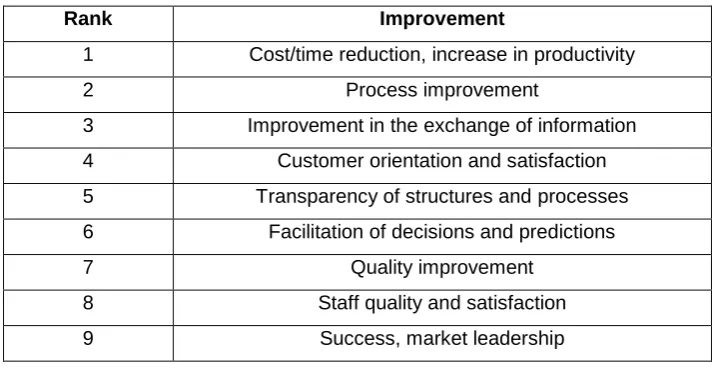
and/or services. In addition, as illustrated in Table 1, Carrillo identified the top ten
[image:12.595.127.485.260.444.2]improvements achieved through knowledge management.
Table 1: Improvements through knowledge management
Rank Improvement
1 Cost/time reduction, increase in productivity
2 Process improvement
3 Improvement in the exchange of information
4 Customer orientation and satisfaction
5 Transparency of structures and processes
6 Facilitation of decisions and predictions
7 Quality improvement
8 Staff quality and satisfaction
9 Success, market leadership
Source: Carrillo 2004
The increasing size and the geographical spread of oil and gas organisations have led to
large, international organisations that make it difficult to source expertise quickly or indeed
know what expertise is available within the organisation (Ochieng et al. 2013). The high
turnover of employees means that there is a need to provide clients with confidence that the
organisation is competent in specific areas of work (Kopman and Gupta, 2014; Burstein and
Linger, 2003). To facilitate knowledge sharing in an organisation, it has to focus towards
human resource policies, information policies, group dynamics, departmental cooperation
and organisational incentive structure and any other relevant activities according to the
nature of the process involved (Ramanigopal, 2012).
In the oil and gas sector, knowledge management can be thought of as either a framework
or an approach, which will enable the development of a set of practices to collect and share
knowledge. In balancing information culture and technological culture, there are three major
to utilise and share the information effectively and efficiently towards the betterment of the
organisation, where the oil and gas industry cannot be an exception. McKenna et al. (2006)
noted that the oil and gas upstream industries operate based on the strength of their natural
resources, infrastructure, processing facility and technology, human resources and the most
important, energy products that the market demands. If one of the factors fluctuates, it
affects the industry operations, planning and production. By nature everything is not
exceptional, there are strengths and weakness, resources without capital, knowledge without
management, skilled people without organisation, willingness to do but lack of technology,
strength in execution but with no quality, no core know how, success with no sustainability,
vision with no decision making, and so on and so forth (Ramanigopal, 2012). To be
successful, it is important to make use of the best available resources. Everyone could be a
master in their own domain but to be a master of all in a particular capital venture, one needs
to understand all available data collectively as teams and groups by analysing, sharing
experience, knowhow and knowledge.
In the current global context, oil and gas organisations in Nigeria are in need of knowledge
management implementation as a key strategy to handle the global competition and to
improve their competence to meet the challenges in their business irrespective of the size of
the organisation (Kasimu et al. 2012; Oyejide and Adewuyi 2009; Rabiu 2009). Knowledge
and data management has become the most essential key strategy for the upstream oil and
gas sector (Feblowitz and Vesset, 2013; Carbonera et al. 2015). From the reviewed
literature, it has been established that organisations in the oil and gas sector were early
users of knowledge management, and have provided the way in terms of knowledge
management implementation (McKenna et al., 2006).
The energy sector incorporates a huge variety of organisations, from oil and gas majors, to
conventional, renewable and nuclear power companies, to specialist drilling, mining firms
and all allied industries (McKenna et al., 2006). It is an industry dominated by a number of
huge multinational organisations, each of which must contend with the difficulties and
challenges of maintaining a geographically dispersed workforce, operations, and functioning
according to clearly defined operational procedures (OGER 2012; 2013). At the same time,
they must cope with external pressures relating to deregulation, growing environmental
concerns and strict health and safety guidelines (Ramanigopal, 2012). It is therefore not
surprising that some of the world’s biggest energy organisations were early pioneers of the
principles and working practices of knowledge management and, indeed, still lead the way
on a global scale. That said, most energy companies are still to realise the full potential of
management and its fruitfulness, and knowledge management represents a powerful means
for these firms to deal with the challenges that lie ahead and growing endlessly according to
the techno and social changes (McKenna et al., 2006; Ramanigopal, 2012; Ko and Dennis
2011; Robert et al. 2008).
A centralised knowledge management system helps companies hasten their effort to backfill
their technical capability gap (Corso et al. 2001; Reid et al. 2001). This also helps to
recognise and anticipate problems and avoid these problems across multiple projects.
Knowledge management includes on the job mentoring, structured training, and the
establishment of institutional mechanisms to capture and disseminate information relevant to
project teams (Rovik, 2016). Oil and gas organisations in Nigeria have always managed
knowledge in one form or another, usually by relying on the expertise of one key member or
another. This shows that knowledge management is not an entirely new concept in the
Nigerian oil and gas industry, but there is the need to create an awareness of the
terminology and to develop a structure that enables proper knowledge management
implementation. Oil and gas organisations in Nigeria, are facing a lot of operational
challenges, in handling data required to operate as well as to execute in their business
activities (Oyejide and Adewuyi 2009; Rabiu 2009; Shell, 2014). As recommended by
Jegede et al. (2013), seamless data and technology transfers can be realised by
encouraging local contractors, multinational organisations and government to form consortia
in order to ensure that proper training is available and taken up by prospective members of
the workforce and potential entrepreneurs. However, to achieve this, both knowledge
management and effective knowledge management systems play a critical role in the
success of such collaborative networks. This is because information sharing and knowledge
assets are crucial in the ever-changing and competitive oil and gas industry market. Lessons
learned systems are crucial for delivering performance improvement in the risky and
expensive world of the international and offshore major projects.
Discussion forums, have become more and more vital for connecting people in communities
of practice, and these can usefully be supplemented by real-time collaboration technologies
(Nissen 2005; Wagner and Majchrzak 2006). The major benefit that knowledge management
has given oil organisations so far is protecting the base. The objective is on reducing capital
and operating costs, increasing utilisation and up time, and improving market positioning to
compete in the global market. Knowledge is captured and shared about topics such as
increasing success in finding oil fields, reducing maintenance down-time in oil refineries, and
become more and more popular (Ochieng 2009; Ochieng et al. 2013; Zuofa and Ochieng
2015; Ovbagbedia and Ochieng, 2015). Economic conditions remain tough due to cut throat
competition, globalisation, strategic operations against competition both local and global
level (Ochieng et al. 2016). Web Portal has become the most essential tool in the energy
sector. Organisations in energy sectors operating at international level started developing
and applying required portals to keep a transferable database of reservoir engineering
techniques.
From the reviewed literature a number of broad conclusions were drawn. These conclusions
gave a suitable context to the research aim. Enabling oil organisations in Nigeria to capture,
share and apply the collective experience and know-how of their project teams was seen as
fundamental in this study. Consequently, there has been a wave of enthusiasm and activity
centred on knowledge management. To make progress, issues of technology, processes,
people and content was explored. Growing global operations in oil and gas organisations is
leading knowledge and content management challenges. Oil and gas organisations in
Nigeria are being forced to rethink and redesign their knowledge management strategies so
as to be responsive to evolving market dynamics, such as technological innovations,
(mobility, wireless communication and geographic information systems). There is little doubt
that knowledge management has contributed substantially to the companies’ success in
dealing with challenges of the past decade. As shown in the reviewed literature, oil
companies in the West (for instance UK) have already taken steps to facilitate knowledge
management initiatives (Edwards, 2008). However, despite the amount of resources
invested in these systems and the inherent value of knowledge capital, traditional knowledge
management initiatives have failed to facilitate access to this reservoir of knowledge assets.
Traditional knowledge management initiatives have failed primarily because of (Gartner,
2013; Hart et al., 2013):
1. Current emphasis on mining instead of using knowledge - there is limited discussion on
facilitating the sharing and re-using of knowledge output that ensues which resides in
different systems, locations and disparate formats to generate the radically better
outcomes.
2. Knowledge management systems currently function as operational tools - as a result of
being used primarily to store, retrieve and extract data and information, knowledge
management has been relegated to an operational rather than asset management
for non-structured data—although it has the ability to generate radically greater returns
when used as a knowledge-sharing and re-utilisation tool.
3. Current focus on accessing explicit knowledge but not tacit knowledge - while knowledge
management systems provide avenues for employees to access explicit knowledge, it
has limited success in helping employees find and access tacit knowledge. This is mainly
because the link between talent management and knowledge management has yet to be
fully established. The next section details the research method and symposium of key
findings drawn from the participants. This is followed by a discussion, conclusion and
recommendations.
1.5 Method
A literature review was performed to determine what is known about the specific research
problem of knowledge management based systems in Nigeria and the UK. The review was
conducted into a variety of project management disciplines. From the foundation of the
review, a research problem was defined (strategies and practices that could be used to
address knowledge management issues and enhance project delivery in Nigeria), thus
determining the direction of the fieldwork. This procedure is in line with the purpose of
literature control, as defined by May (2002), who indicated that literature should assist the
researcher in planning the narratives for the actual research.It also enabled a fair evaluation
of the research topic through a trustworthy, rigorous and auditable process. The literature
review for this study defined some of the possible causes of knowledge management
complexity that were involved in oil and gas projects. Through the literature, this study
defined qualities of responsive management that are conducive to minimising knowledge
management complexity within a project environment. More specifically, this research
attempted to pinpoint knowledge management strategies necessary to enhance project
delivery in Nigeria.
Considering the aim and objectives of this research and given little was known empirically
about the strategies and practices which contribute to improved performance, innovation and
continuous improvement in the oil and gas sector qualitative method was used. The
literature search revealed that there were already external factors, which influenced the
implementation of knowledge management strategies on oil and gas projects in Nigeria
(Ekemena, 2011; Nwafor and Salau, 2009). These factors were assumed as integral to
everything, which took place in the projects but rather than attempting to make the
individuals involved in oil and gas project delivery. This opened up the possibility of
developing a clear understanding of strategies and practices that could be used to address
knowledge management issues and enhance knowledge management based systems in the
Nigerian oil and gas industry.
A preliminary pilot study was carried out with experienced project managers in Nigeria and
UK. The purpose of the pilot study was to assess clarity of questions, timing, and suitability
of the respondents for the study and to establish its reliability and validity. The interview
schedule included closed and open questions. The purpose was to obtain rich data about
attitudes, opinions, and experiences of people involved with oil and gas projects. The
interviews were solely conducted by the researchers. Adopting a semi-structured
questionnaire with topics as opposed provided maximum flexibility during the interviews.
The major strengths of the semi-structured interviews were found in its usefulness for
understanding the meaning and context of the phenomena of knowledge management and
the particular operations and processes that make up these phenomena with the oil and gas
industry. Specifically, probe questions were used to understand what the participants were
saying; exploratory questions were designed to ensure that participants gave as full an
answer as possible. This study considered knowledge management based systems across a
variety of organisations and project environments. The use of a series of semi structured
interviews allowed the researchers to elaborate points, which were unclear to participants. It
also enabled the researchers to clarify meaning of questions and provided the opportunity to
introduce the research topic and motivate the respondents to provide honest answers.
Additionally, it provided the opportunity to explore some issues and allowed the researchers
to classify (or at least) clarify the responses to such questions into useful categories during
the course of the interviews. The semi-structured interviews were used to derive senior
managers’ constructs of project delivery efficiency and knowledge management based systems. The method employed helped to evaluate senior managers’ attitudes and
perceptions as well as to refine and improve the development of the framework.
In total, twenty-six interviews were carried out with senior managers: thirteen in Nigeria and
thirteen in the UK. Questions were asked to elicit knowledge management based systems
implementation on oil and gas projects. At the start of each interview carried out in this
study, participants were advised to read and to sign a statement of consent. The statement
of consent briefly highlighted the purpose of the research project, and then explained that
the interviews would take the form of a structured discussion. The consent form also assured
advantages that emerged after the interview process is that the sample size used for this
research allowed the researcher’s to focus on social issues in different types of projects.
This was particularly important because the research subject is in a research area of which
there was little available data in Nigeria and UK. The following is a summary profile of the
twenty-six managers involved in this study [see Table 2]; for the purpose of confidentiality,
the researcher’s used alphabetical letters to represent names of participants.
Table 2: Summary profile of participants involved in this study
Participants Country Sector Current Job
Numbers of years worked in
sector Number of years managed projects Role and Responsibility
A UK Energy Project Manager 29
17 Managing projects
B UK Energy Project Leader 18 7 Planning
C UK Energy Project Manager 27 15 Managing projects
D UK Energy
Chief Project
Manager 19
10 Managing projects
E UK Energy Project Manager 12 5 Planning
F UK Energy
Junior Project
Manager 10
4 Managing projects
G Nigeria Energy
Chief Project
Manager 14
6 Managing projects
H Nigeria Energy Project Engineer 20
10 Co-ordination of project work I UK Energy Project Engineer 15 7 Managing projects J UK Energy Project Manager 20 10 Managing projects
K UK Energy
Junior Project
Manager 15
6 Co-ordination of resources/technical
assessment L Nigeria Energy Project Manager 20 11 Managing projects M Nigeria Energy Project Leader 14
3 Co-ordination of work N Nigeria Energy Project Engineer 17 5 Managing projects O Nigeria Energy Project Engineer 15 6 Managing projects P Nigeria Energy Project Leader 11
5 Co-ordination of work Q Nigeria Energy Project Engineer 19 9 Managing projects R UK Energy Project Engineer 20 11 Managing projects S UK Energy Project Manager 23 9 Managing projects T Nigeria Energy Project Manager 25 11 Managing projects U Nigeria Energy Project Manager 15 11 Managing projects
Denzin and Lincoln, (1998) noted that interviewee variety is essential to the profundity and
richness of data obtained in qualitative research. The aim of this was to explore expert views
from successful project directors, project managers, and project engineers on knowledge
advantage of this sample was that each participant had worked on projects in developing
countries. The participants worked in various types of organisation formations and project
arrangements. All participants were considered to have practical understanding of
knowledge management based systems and their views were considered those of
knowledgeable practitioners. Participants were selected using purposive sampling as the
process involves obtaining all possible cases that fit particular criteria and selects cases with
specific purpose in mind (Neuman, 2006). Usunier (1998) stated that where researchers
want to compare across cultural contexts, they need to use concepts and research
instruments that are understood in similar ways. In all cross-cultural studies, as in this study,
the researcher’s made sure that the same data collection procedures did not result in biased
findings. The search for equivalence was the most important methodological aspect in this
research. In order to define a sampling procedure for this research, the researcher’s
selected a method, which was based on several national or cultural samples, each being
fully representative of the populations of the country. The sample was designed to obtain
Nigerian and UK participants with the requirement of having experienced positive impact of
knowledge management based systems on oil and gas projects. The second requirement for
selection was that participants had successful managed complex project teams, and the
third requirement was that participants had worked on complex oil and gas projects. As the
research participants had not been randomly selected no claim can be made of achieving
representation of the wider oil and gas industry. This research instead achieved an in-depth
insight into knowledge management systems within the oil and gas industry by interviewing
participants’ with in-depth project management experience. Interviewing various oil and gas
professionals allowed the researchers to analyse and cross-compare all interview
responses.
The organisations were selected from a diverse oil and gas sector to ensure that a variety of
project environments would be examined. Interviewing more than one project leader in an
organisation allowed more information about their actual practice (and opinions) to be
obtained. In order to investigate the factors that influenced knowledge management based
systems it was necessary to have a range of organisations in terms of projects managed.
The organisations that were selected, where twenty-six of the participants interviewed,
operated in the energy and petrochemical sector. The selected organisations were well
balanced in terms of oil and gas projects managed. In general terms, there was a link
between the existence of project work and the type of projects undertaken. To ensure that
gatekeepers included company directors in Nigeria and the UK. Between them, these
individuals allowed access to their senior project management personnel.
In any qualitative research, data analysis becomes an ongoing process; meaning that the
researcher has to make thoughtful, informed decisions throughout the data collection
procedure Bryman (2004). According to Lewis and Ritchie (2003), the thread of analysis is
woven through the interview process, when the researcher starts to record ‘personal comments’ beside the narrative data. During the analysis, broad themes and patterns are
looked for, rather than narrow, precise variables of qualitative research (Bryman, 2004). As
possible topics become evident, the researcher may try to verify the research area during
the interviews. For this research, data was not a distinct stage of the study. Formally, it
started to take shape in analytic notes; informally it was embodied in thoughts, ideas,
hunches, and emergent concepts and continued into the writing up process. Even though
the data analysis phase was placed after the fieldwork phase, the data analysis phase was
an ongoing process of fieldwork itself, rather than as a final stage in a linear model.
Qualitative researchers (Bryman, 2004; Denzin and Lincoln, 1998; Huberman and Miles,
2002; Silverman, 2001) stress the continuous interconnection of fieldwork and interpretation.
Bryman (2014) addressed it as a spherical sequence, whereby the researcher’s original
theoretical position is continuously altered or refocused by the fieldwork in a dynamic
dialectical method.
All interviews were recorded and transcribed verbatim and they were then analysed through
the use of a qualitative analysis software package NUDIST NVivoTM. During the analysis,
broad themes and patterns were looked for, rather than narrow, precisely variables of
qualitative research. One of the primary functions of this software that emerged was the
ability to add memos to sections of the data, as thoughts and connections were made during
all phases of the data analysis. It enabled the researcher’s to sort through the data and at
the same time allowed exploration for patterns and recurring phenomena. This allowed the
researcher’s to compare, contrast, and synthesise. Data was then first coded, searched
according to codes and the underlying themes and patterns revealed. Initial and subsequent
impressions and thoughts were recorded in detail emphasizing the organic nature of this
method for data analysis. As the data analysis progressed, further details were obtained,
with sections of data intensively analysed. At this stage, the researcher’s had already
generated some categories through the ongoing theoretical reflections and applied these for
cases, a particular section would fall into more than one category, but this seemed to
indicate the interlinking of themes rather than a fault in coding.
As the analysis progressed, the researcher’s developed working categories that explained
knowledge management complexity on project teams. Following the construction of a
category, the next component of the process was the presentation of the data in a narrative
form supported by evidence from the statements recorded during the interview phase and
making theoretical references as necessary. The generation of themes was an ongoing and
development process, garnered in part by the application of a large number of codes. Four
main parent codes (or clusters) provided meaningful categories. These included: knowledge
management technology approaches (KMTA), knowledge management people approaches
(KMPA), knowledge management strategies and value enhancing practices.
As illustrated above, there was a logical progression to the order of the parent codes. This
was an attempt to ensure that the main objectives of the research were met. Once this
phase was complete, the researchers took each topic in turn and inserted the relevant
interview extracts. Validity and reliability were achieved by first assessing the plausibility in
terms of already existing knowledge on some of the knowledge management issues raised
by participants. The verification took place after the interpretation of data; this involved
presenting the framework to the main participants of this study in Nigeria and the UK. This
was achieved through workshops and group discussions. These workshops enabled the
framework to be continuously adjusted and refined. The main purpose of this process was to
ensure that the framework that was developed was not influenced by the researcher’s own
interpretation and thus distanced from the reality in question. The validation took place after
the verification process; this involved presenting the proposed model to a different group of
managers who were not involved with the study. This was achieved through a focus group.
In general, verification and validation was carried out to achieve the following objectives,
which follow on from the key objectives of the research, to: present all information compiled
throughout both the preliminary and main study stages, ensure that the proposed framework
fulfils the requirements of oil and gas organisations, validate the applicability of the proposed
framework in real life situations and achieve an agreement on framework requirements to
ensure generic applicability.
Rigour was achieved by focusing on verification and validation; this included the
sampling, data analysis and thinking practically. Fitzgerald and Howcroft (1998) considered
the existence of relativist and realist ontological positions, where at one extreme there is the
relativist position, which holds the belief of the existence of multiple realities as subjective
constructions of the mind where the perception of reality is directed by socially transmitted
teams and can vary according to language and culture. In this reality, concepts such as right
and wrong, goodness and badness, truth and falsehood cannot be absolutes as they can
change from culture to culture and situation to situation. At the other extreme there is the
realist ontological position, which is based upon the belief that the external world comprises
of pre-existing hard and tangible structures. These structures exist independently of an
individual’s cognition and ability to acquire knowledge, which is a practical position
unconcerned with an abstract or idealistic view of life. At the ontological level, this research
is common with many other studies and is based upon the realist position. However, this
research takes the form of critical realism, which is a philosophy of science that prioritises
ontology over epistemology in the sense that, for critical realists, the way the world is should
guide the way knowledge of it can be obtained. Critical realism was derived mainly from the
work of Bhaskar (1998) and developed by Fleetwood and Ackroyd (2004) and Reed (2005)
for organisational and management studies. The interpretivist epistemological position,
which advocates the absence of a universal truth, places more emphasis on the realism of
context and is considered critical to apply a scientific model to social study. The
understanding and perspective of and interpretation by the researcher of research findings
become the point of reference. As such, it is not possible for the researcher to be strictly
neutral when adopting an interpretivist epistemological position in research. For example,
researchers become totally involved in their research, and their values and beliefs likewise
become the driving force in interpreting research findings (Bryman, 2008; Fitzgerald and
Howcroft, 1998).
Moreover, when researchers adopt an interpretive approach they start their research with
the assumptions that access to reality is only through social constructions such as language,
consciousness and shared meanings. Researchers have to try and understand phenomena
through the meanings that people place on them because interpretive research focuses on
the holistic complexity of decision-making as situations evolve rather than placing
pre-ordained definitions upon dependant and independent variables (Easterby-Smith et al.,
2008; Remenyi et al., 1998). From a philosophical viewpoint, at the ontological level, this
research adopted the realist position because the number of ways Nigerian oil and gas
project managers’ work on oil and gas major-projects varied considerably. Moreover, this
research also considered that the investigation should be conducted in a practical rather
strategies in the oil and gas sector. At the epistemological level, this research adopted the
interpretivist position because the nature of the research problem was focused on examining
the extent to which knowledge management strategies contribute to adding value in oil and
gas projects in Nigeria. The second epistemological level was linked to proposing solutions
to knowledge-based management challenges in the Nigerian oil and gas industry. Moreover,
Seymour et al. (1997) emphasized that the interpretive approach is valuable for identifying
problems in the oil and gas sector because it can recognise the differing viewpoints of
various people in the industry. In this study, interpretivism was associated with the
philosophical position of idealism, and was used to examine diverse people and technology
approaches. The adoption of interpretivisim, allowed the researchers to examine culturally
differences in organisations in a great level of depth.
1.6 Findings and framework development
This section focuses on the findings, verification and validation of the framework. The
framework delineates the key variables that influence knowledge management technologies
and people approaches and highlights how knowledge management strategies and value
enhancing practices can be managed and implemented. The framework was developed from
the key variables identified from the qualitative analysis. As suggested by the participants, it
guarantees the correct functioning and enhances creativity and innovation. The
implementation of knowledge management based systems is likely to depend on the
establishment of a number of identifiable knowledge management technologies and people
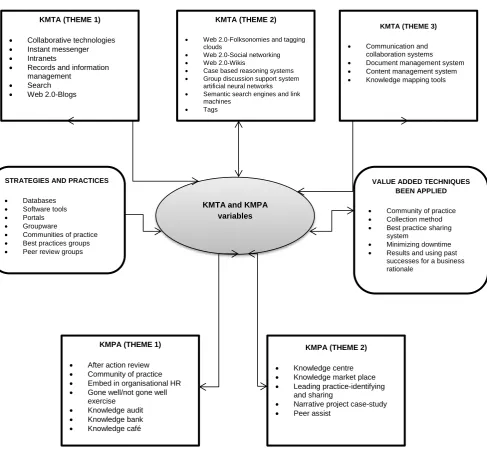
approaches practices. As illustrated in Figure 1, these were found to fall within the following
categories: KMTA (Theme1), KMTA (Theme2), KMTA (Theme3), KMPA (Theme1) and
Figure 1: Knowledge management technology and people approaches variables Conclusions from the qualitative findings indicated that knowledge management based
systems represents a powerful means for oil and gas organisations to deal with project
challenges. It was also established that enabling organisations to capture, share and apply
the collective experience and expertise of their practitioners is seen as fundamental to
competing in the global knowledge economy. Participants further suggested that oil and gas
organisations embrace good enough technology to make progress, especially in the
transitional business environment of today. In enhancing the above, there was a need to
propose a framework that would: highlight key knowledge management technology
approaches, highlight knowledge management people approaches and knowledge
KMTA and KMPA variables
KMTA (THEME 1)
Collaborative technologies
Instant messenger
Intranets
Records and information management
Search
Web 2.0-Blogs
KMTA (THEME 2) Web 2.0-Folksonomies and tagging
clouds
Web 2.0-Social networking
Web 2.0-Wikis
Case based reasoning systems
Group discussion support system artificial neural networks
Semantic search engines and link machines
Tags
KMTA (THEME 3)
Communication and collaboration systems Document management system Content management system Knowledge mapping tools
KMPA (THEME 1)
After action review
Community of practice
Embed in organisational HR
Gone well/not gone well exercise
Knowledge audit
Knowledge bank
Knowledge café
KMPA (THEME 2)
Knowledge centre
Knowledge market place
Leading practice-identifying and sharing
Narrative project case-study
Peer assist
STRATEGIES AND PRACTICES
Databases Software tools Portals Groupware
Communities of practice Best practices groups Peer review groups
VALUE ADDED TECHNIQUES BEEN APPLIED
Community of practice Collection method Best practice sharing
system
Minimizing downtime Results and using past
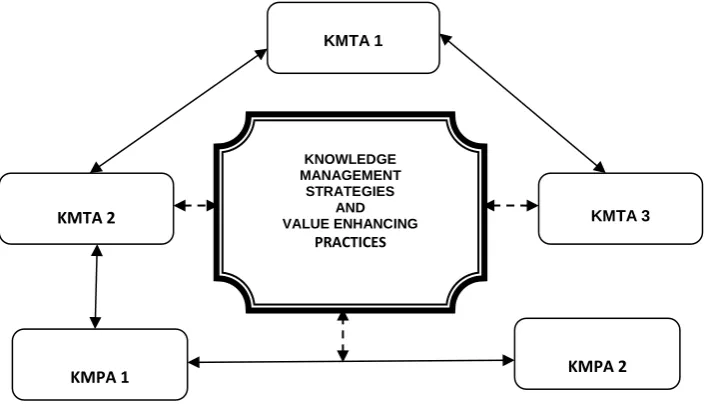
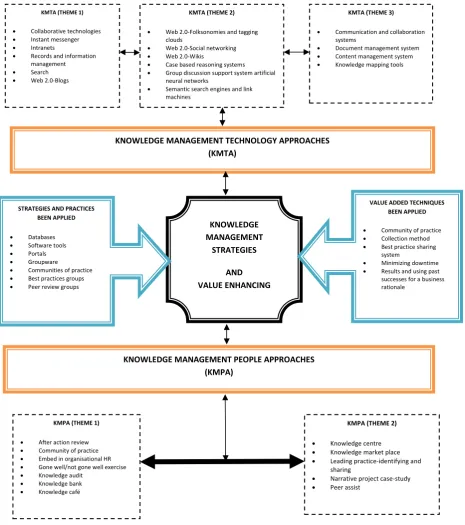
management strategies and value enhancing practices. Figure 2 summarises the main
[image:25.595.129.482.130.334.2]components of the framework that emerged from this study.
Figure 2: Framework components
The findings show that a framework for knowledge management implementation in oil and
gas projects needs to draw together: knowledge management technology approaches,
knowledge management people approaches and knowledge management strategies and
value enhancing practices. The analysis carried out allowed the researchers to take a step
further and propose a more detailed framework (see Figure: 2). The results showed that oil
and gas organisations must ensure their project teams have access to a library of technical
data that comprises of knowledge management technology, people approaches and value
enhancing practices.
1.7 Framework verification results
The results of the two focus groups suggested that there must be an evident commitment
from senior project management practitioners. This applies at strategic level, operational
level and project level. The participants suggested that without guidance from the top, there
is a danger of the project team developing their own working culture within the project
environment. There was recognition by the participants that in order to build a knowledge
sharing culture, senior managers need to ensure that there is a robust
knowledge-management platform. As indicated by both sets of participants, the growing difficulties with
accessing and leveraging technical project knowledge have roots in several ongoing trends,
including demographics. As suggested by the participants about half of Nigerian and UK
project engineers are expected to retire over the next coming years. Participants further
KMTA 1
KMTA 3
KMTA 2
KMPA 2 KMPA 1
KNOWLEDGE MANAGEMENT
STRATEGIES AND VALUE ENHANCING