Decentralized Traceable Attribute-Based Signatures
Ali El Kaafarani1, Essam Ghadafi2, and Dalia Khader3
1
University of Bath, UK 2 University of Bristol, UK 3
Interdisciplinary Centre for Security, Reliability and Trust (SnT) , Luxembourg
Abstract. Attribute-based signatures allow a signer owning a set of attributes to anonymously sign a message w.r.t. some signing policy. A recipient of the signature is convinced that a signer with a set of attributes satisfying the signing policy has indeed produced the signature without learning the identity of the signer or which set of attributes was used in the signing.
Traceable attribute-based signatures add anonymity revocation mechanisms to attribute-based signatures whereby a special tracing authority equipped with a secret key is capable of revealing the identity of the signer. Such a feature is important in settings where accountability and abuse prevention are required.
In this work, we first provide a formal security model for traceable attribute-based signatures. Our focus is on the more practical case where attribute management is distributed among different authorities rather than relying on a single central authority. By specializing our model to the single attribute authority setting, we overcome some of the shortcomings of the existing model for the same setting.
Our second contribution is a generic construction for the primitive which achieves a strong notion of security. Namely, it achieves CCA anonymity and its security is w.r.t. adaptive adversaries. Moreover, our framework per-mits expressive signing polices. Finally, we provide some instantiations of the primitive whose security reduces to falsifiable intractability assumptions and without relying on idealized assumptions.
Keywords. Attribute-based signatures, security definitions, standard model.
1 Introduction
Attribute-based cryptography has emerged as an important research topic in recent years. It offers a ver-satile solution for designing role-based cryptosystems. In such systems, users are assigned attributes, and private operations (e.g. decryption/signing) are associated with security policies. Only users possessing at-tributes satisfying the policy in question can perform such operations. The first proposals of attribute-based cryptosystems were: an encryption scheme by Goyal et al. [22] (inspired by Sahai and Waters [41]) and a signature scheme by Maji et al. [35].
In traditional digital signature schemes, the recipient of a signature is convinced that a particular signer has indeed authenticated the message in question. In Attribute-Based Signatures (ABS) [35, 36], messages are signed w.r.t. a signing policy expressed as a predicate. Thus, the recipient is convinced that someone with a set of attributes satisfying the signing predicate has indeed authenticated the message without learning the identity of the signer or learning how the predicate was satisfied (i.e. which set of attributes was used in the signing).
There are many applications of attribute-based signatures such as attribute-based messaging, e.g. [8], trust negotiation, e.g. [15], and leaking secrets. Refer to [36] for more details and comparison with related notions such as mesh signatures [10] and anonymous credentials [11].
Traceable Attribute-Based Signatures (TABS) [13] extend standard attribute-based signatures by adding an anonymity revocation mechanism which allows a tracing authority to recover the identity of the signer if needed. This added feature is very important in scenarios where accountability and abuse prevention are required.
Related Work.Variants of attribute-based signatures exist in the literature each supporting policies that dif-fer in their expressiveness. Those can be categorized into three main types of policies: non-monotonic poli-cies, e.g. [38], monotonic polipoli-cies, e.g. [36], and threshold-based polipoli-cies, e.g. [33, 42, 32, 26, 18]. Schemes with more expressive policies are more interesting since they cover a larger scale of potential applications. Nevertheless, their current state–of–the–art instantiations are less efficient. The size of the signatures in ex-isting instantiations of those supporting “monotonic” and “non-monotonic” policies, in the best case, are linearly dependent on the number of attributes in the policy [36, 38]. While the works of [26, 18] yield constant-size signatures, they only support threshold policies.
Early proposals of attribute-based signatures considered the case of multiple attribute authorities where each authority is responsible for a sub–universe of attributes [35, 38]. However, the multi–authority case still had the problem of relying on the existence of a central trusted authority. Moreover, in some cases, the security (unforgeability) of the whole system is compromised if the central authority is corrupted. Okamoto and Takashima [39] recently proposed the first decentralized construction.
Traceability in attribute-based signatures was first addressed by Khader [29] who proposed the notion of attribute-based group signatures. In this notion, only the anonymity of the identity of the signer is pre-served, whereas the attributes used are not hidden. This is an undesirable property for many applications. Later, Khader et al. [30] proposed a traceable attribute-based signature scheme that relies on the verifier to decide the policy and thus requiring interaction in the signing protocol. Even though this can be useful in certain applications (see [30] for details), such interaction is prohibitive for many applications. A more recent construction by Escala et al. [13] adds the traceability feature (it was called revocation by the authors) to standard ABS schemes. The proposed scheme in [13] is in the inefficient composite-order groups setting and was originally proven in the Random Oracle Model (ROM) [4]. Although the authors described how the reliance on random oracles could be removed, this was done informally and without a concrete construction or a full security proof. In addition, their construction relies on a central attribute authority which could be a bottleneck when the number of members of the system increases.
Our Contribution. Our first contribution is a formal security model for traceable attribute-based signatures. Our focus is on the more interesting setting where there are multiple attribute authorities. We refer to this setting as Decentralized Traceable Attribute-Based Signatures (DTABS). By restricting the number of at-tribute authorities to one, we get a new model which addresses some of the shortcomings of the previous model for the same setting [13]. Our model can, in some sense, be viewed as an extension of the model of [39] where we allow signatures to be traced and allow for dynamic corruption of attribute authorities.
Our second contribution is a generic construction for DTABS. Our construction meets strong security re-quirements and permits expressive signing policies. Namely, it is CCA-anonymous under full-key exposure attacks, and its unforgeability is w.r.t. adaptively chosen messages and signing policies.
Finally, we present example instantiations of the generic construction and provide the first provably secure construction not relying on idealized assumptions. The security of all our instantiations rely on in-tractability assumptions which are falsifiable [37].
Notation. A functionν(.) :N→R+is negligible incif for every polynomialp(.)and all sufficiently large values ofc, it holds thatν(c)< p(1c). Given a probability distributionS, we denote byy ←Sthe operation of selecting an element according toS. If A is a probabilistic machine, we denote byA(x1, . . . , xn) the output distribution ofAon inputs(x1, . . . , xn). By PPT we mean running in probabilistic polynomial time in the relevant security parameter.
2 Preliminaries
In this section we provide some preliminary definitions.
2.1 Bilinear Groups
A bilinear group is a tuple P := (G1,G2,GT, p, G,G, e˜ ) where G1,G2 andGT are groups of a prime orderp andGandG˜ generate G1 andG2, respectively. The functioneis a non-degenerate bilinear map
G1×G2 −→ GT. We will use multiplicative notation for all the groups although usually G1 andG2 are
chosen to be additive groups. We letG×1 :=G1\ {1G1}andG
×
2 :=G2\ {1G2}. For clarity, elements from
G2will be accented with˜.
Following [19], we categorize prime-order bilinear groups into three main types:
• Type-1: This is the symmetric pairing setting in whichG
1 =G2.
• Type-2:G16=G2but there is an efficiently computable isomorphismψ:G2 −→G1.
• Type-3: G1 6= G2 but there is no efficiently computable isomorphism between the groups in either direction.
We assume that there is an algorithmBGrpSetupthat takes as input a security parameterλand a type
tp∈ {1,2,3}and outputs a description of bilinear groups of Type-tp.
2.2 Complexity Assumptions
We will use the following assumptions from the literature:
DDH. For a groupG := hGiof a prime orderp, given(G, Ga, Gb, C) ∈ G4 fora, b ← Zp, it is hard to decide whether or notC=Gab.
SXDH. The Decisional Diffie-Hellman (DDH) assumption holds in both groupsG1andG2.
DLIN[9]. For a groupG := hGiof a prime orderp, given the tuple(Ga, Gb, Gra, Gsb, Gt)for unknown a, b, r, s, t∈Zp, it is hard to tell whethert=r+sortis random.
q-SDH[7]. For a group G := hGi of a prime orderp, given(G, Gx, . . . , Gxq)for x ← Zp, it is hard to output a pair(c, Gx+1c)∈Z
p×Gfor an arbitraryc∈Zp\{−x}.
WFCDH[16]. In symmetric bilinear groups, given(G, Ga, Gb) ∈G3 fora, b←
Zp, it is hard to output a tuple(Gr, Gra, Grb, Grab)∈G×4for an arbitraryr∈Zp.
AWFCDH[16]. In asymmetric bilinear groups, given(G, Ga,G˜) ∈ G12 ×
G2 fora ← Zp, it is hard to output a tuple(Gb, Gab,G˜b,G˜ab)∈G×12×G×22for an arbitraryb∈Zp.
q-ADHSDH[16]. In asymmetric bilinear groups4, given(G, F, K, Gx,G,˜ G˜x)∈G41×G22forx←Zp, and
q−1tuples(Wi := (K·Gui)
1
x+vi, U
i := Gui,U˜i := ˜Gui, Vi := Fvi,V˜i := ˜Gvi)iq−=11 forui, vi ← Zp, it is hard to output a new tuple(W∗, U∗,U˜∗, V∗,V˜∗)of this form.
4
2.3 Span Programs
For a fieldFand a variable setA={a1, . . . , an}, a monotone span program [27] is define by aα×βmatrix Z(overF) along with a labeling mapρwhich associates each row inZwith an elementai ∈A.
The span program accepts a setγ iff1 ∈ Span(Zγ), whereZγ is the sub-matrix ofZcontaining only rows with labelsai ∈γ. In other words, the span program only accepts the setγ if there exists a vectors s.t.sZγ = [1,0, . . . ,0].
3 Syntax of Decentralized Traceable Attribute-Based Signatures
The parties involved in a DTABS scheme are:κattribute authorities each with a unique identityaidand a pair of secret/verification keys(aaskaid,aavkaid); a tracing authorityTwhich possesses a secret tracing key
tkthat can be used to trace the identity of the signer of a given signature; a set of signers each with a unique identitysidand a set of attributesA ⊆A, whereAis the universe of all possible attributes. An attribute can be uniquely identified by concatenating the identity of the managing attribute authority with the name of the attribute itself. A DTABS scheme is a tuple of polynomial-time algorithms
DTABS:= (Setup,AuthSetup,KeyGen,Sign,Verify,Trace,Judge)·
The syntax of the algorithms is defined below; where to aid notation all algorithms bar (Setup and
AuthSetup) are assumed to take as implicit input the public parametersppoutput by algorithmSetup.
• Setup(1λ)is run by some trusted third party. It takes as input a security parameter1λand outputs public parametersppand the tracing keytk. We assume thatppcontains the attribute universeA.
• AuthSetup(pp,aid) used by attribute authorityAuth
aid to generate its key pair(aaskaid,aavkaid). The attribute authority publishes its public verification keyaavkaid.
• KeyGen(aaskaid,sid, a)takes as input an attribute authority’s secret keyaaskaid, a signer’s identitysid and an attributea∈Athat signersidpossesses and generates a secret keysksid,afor attributeafor the signer. The keysksid,a is given tosid. The attribute authority may locally maintain a list of signers for which it ran theKeyGenalgorithm.
• Sign({aavk
aid(a)}a∈A,{sksid,a}a∈A, m, Ψ)signersidwho possesses a set of attributesA ⊆Auses this algorithm to produce a signature on m w.r.t. the signing policy Ψ whereΨ(A) = 1. The algorithm takes as input an ordered list of attribute authorities’ verification keys{aavkaid(a)}a∈A, an ordered list of attributes’ secret keys{sksid,a}a∈A, a messagemand a signing predicateΨ, and outputs a signature σ. Hereaid(a)denotes the identity of the attribute authority managing attributea∈A.
• Verify({aavk
aid(a)}a∈Ψ, m, σ, Ψ)is a deterministic algorithm which takes as input an ordered list of at-tribute authorities’ verification keys{aavkaid(a)}a∈Ψ, a messagem, a signatureσand a signing predicate Ψ, and outputs1ifσis valid onmw.r.t. the signing predicateΨ or0otherwise.
• Trace(tk, m, σ, Ψ)is a deterministic algorithm which takes as inputT’s keytk, a message m, a signature σ and a signing predicateΨ, and outputs the identitysidof the signer plus a proofπ attesting to this claim. If the algorithm is unable to trace the signature to a signer, it returns the special symbol⊥. Note that if the tracing authority additionally gets a read-only access to the local registration tables maintained by the attribute authorities (whose identities can be inferred from the signing policyΨ), then the tracing authority could additionally check whether or notsidhas run theKeyGenalgorithm.
• Judge({aavk
AddS(sid,A)
• If∃a∈ As.t.(sid, a)∈HSLThen Return⊥. • For eacha∈ ADo
◦ Ifaid(a)∈/HALThen
∗ Ifaid(a)∈CALThen Return⊥.
∗ AddA(aid(a)). ◦ Ifaask
aid(a)=⊥Then Return⊥. ◦ sksid,a←KeyGen(aask
aid(a),sid, a). • HSL:=HSL∪ {(sid, a)}
a∈A.
AddA(aid)
• Ifaid∈HAL∪CALThen Return⊥. • (aask
aid,aavkaid)←AuthSetup(pp,aid).
• HAL:=HAL∪ {aid}.
Sign(sid,A, m, Ψ)
• If∃a∈ As.t.(sid, a)∈/HSLThen Return⊥. • IfΨ(A)6= 1or∃a∈ As.t.sk
sid,a=⊥Then Return⊥.
• σ←Sign({aavk
aid(a)}a∈A,{sksid,a}a∈A, m, Ψ).
• SL:=SL∪ {(sid,A, m, σ, Ψ)}. • Returnσ.
Trace(m, σ, Ψ)
• IfVerify({aavk
aid(a)}a∈Ψ, m, σ, Ψ) = 0Then Return⊥.
• If(m, σ, Ψ)∈CLThen Return⊥. • ReturnTrace(tk, m, σ, Ψ).
CHb((sid0,A0),(sid1,A1), m, Ψ) • IfΨ(A
0)6= 1orΨ(A1)6= 1Then Return⊥. • For i=0 To 1 Do
◦ For eacha∈ Ais.t.(sidi, a)∈/HSLDO
∗ IfAddS(sidi, a) =⊥Then Return⊥.
◦ If∃a∈ Ais.t.sksid
i,a=⊥Then Return⊥. • σ←Sign({aavk
aid(a)}a∈Ab,{sksidb,a}a∈Ab, m, Ψ). • CL:=CL∪ {(m, σ, Ψ)}.
• Returnσ.
RevealA(aid)
• Ifaid∈/HAL\(CAL∪BAL)Then Return⊥.
• BAL:=BAL∪ {aid}.
• Returnaaskaid.
CrptA(aid,vk)
• Ifaid∈HAL∪CALThen Return⊥.
• CAL:=CAL∪ {aid}.
RevealS(sid,A)
• If∃a∈ As.t.(sid, a)∈/HSL\BSLThen Return⊥. • BSL:=BSL∪ {(sid, a)}
a∈A.
• Return{sk
[image:5.612.103.526.74.368.2]sid,a}a∈A.
Fig. 1.Oracles used in the security games for DTABS
4 Security of Decentralized Traceble Attribute-Based Signatures
The security properties required from a DTABS scheme are: correctness, anonymity, full unforgeability, and traceability. In defining those requirements we use a set of experiments in which the adversary has access to a set of oracles. The following global lists are maintained:HSLis a list of honest signers’ attributes and has entries of the form(sid, a);HALis a list of honest attribute authorities; BSLis a list of bad signers’ attributes whose secret keys have been revealed to the adversary with entries of the form(sid, a);BALis a list of bad attribute authorities whose secret keys have been learned by the adversary;CALis a list of corrupt attribute authorities whose keys have been chosen by the adversary;SLis a list of signatures obtained from theSignoracle;CL is a list of challenge signatures obtained from the challenge oracle and is used only in the anonymity game.
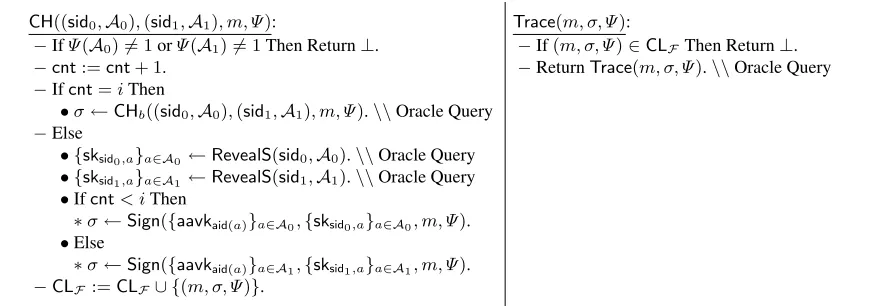
The details of the following oracles are given in Fig. 1.
• AddS(sid,A)is used to add honest attributesA ⊆ Afor signersid. It can be called multiple times to add more attributes.
• AddA(aid)is used to add an honest attribute authority with identityaid.
• CrptA(aid,vk)is used to create a corrupt attribute authority whose secret key is chosen by the adversary. • RevealS(sid,A)is used to obtain the secret keys{sk
sid,a}a∈Acorresponding to the subset of attributes A ⊆Aowned by signersid. It can be called multiple times.
• RevealA(aid)is used to obtain the secret keyaask
aidof the honest attribute authorityaid. • Sign(sid,A, m, Ψ)is used to obtain a signatureσon messagemby signersidusing{sk
Experiment:ExpCorr
DTABS,F(λ)
• (pp,tk)←Setup(1λ). • HSL:=∅.
• (sid,A, m, Ψ)← F(pp:AddS(·,·),AddA(·)). • IfΨ(A)6= 1orA 6⊆AThen Return0.
• If∃a∈ As.t.(sid, a)∈/HSLorsksid,a=⊥oraid(a)∈/HALThen Return0. • σ←Sign({aavk
aid(a)}a∈A,{sksid,a}a∈A, m, Ψ).
• IfVerify({aavk
aid(a)}a∈Ψ, m, σ, Ψ) = 0Then Return1.
• (sid0, π)←Trace(tk, m, σ, Ψ). • Ifsid06=sidThen Return1. • IfJudge({aavk
aid(a)}a∈Ψ, m, σ, Ψ,sid, π) = 0Then Return1.
• Return0.
Experiment:ExpAnon-DTABSb,F(λ)
• (pp,tk)←Setup(1λ).
• CAL,HSL,HAL,BSL,BAL,CL:=∅.
• b∗← F(pp:AddS(·,·),AddA(·),CrptA(·,·),RevealS(·,·),RevealA(·),CHb((·,·),(·,·),·,·),Trace(·,·,·)). • Returnb∗.
Experiment:ExpF-UnforgeDTABS,F(λ)
• (pp,tk)←Setup(1λ).
• CAL,HSL,HAL,BSL,BAL,SL:=∅.
• (m∗, σ∗, Ψ∗,sid∗, π∗)← F(pp,tk:AddS(·,·),AddA(·),CrptA(·,·),RevealS(·,·),RevealA(·),Sign(·,·,·,·)). • IfVerify({aavk
aid(a)}a∈Ψ∗, m∗, σ∗, Ψ∗) = 0Then Return 0. • IfJudge({aavk
aid(a)}a∈Ψ∗, m∗, σ∗, Ψ∗,sid∗, π∗) = 0Then Return0. • LetA
sid∗be the set of attributes owned bysid∗and managed by dishonest (i.e.∈CAL∪BAL) attribute authorities. • If∃As.t.{(sid∗, a)}
a∈A⊆BSLandΨ∗(A ∪ Asid∗) = 1Then Return 0. • If∃(sid∗,·, m∗, σ∗, Ψ∗)∈SLThen Return 0.
• Return 1.
Experiment:ExpTrace
DTABS,F(λ)
• (pp,tk)←Setup(1λ).
• CAL,HSL,HAL,BSL,BAL,SL:=∅.
• (m∗, σ∗, Ψ∗)← F(pp,tk:AddS(·,·),AddA(·),RevealS(·,·),Sign(·,·,·,·)). • IfVerify({aavk
aid(a)}a∈Ψ∗, m∗, σ∗, Ψ∗) = 0Then Return 0. • (sid∗, π)←Trace(tk, m∗, σ∗, Ψ∗).
• Ifsid∗=⊥Then Return 1. • IfJudge({aavk
aid(a)}a∈Ψ∗, m∗, σ∗, Ψ∗,sid∗, π) = 0Then Return1. • If(sid,·)∈HSLThen Return0.
[image:6.612.72.534.69.533.2]• Return 1.
Fig. 2.Security experiments for decentralized traceable attribute-based signatures
• CH
b((sid0,A0),(sid1,A1), m, Ψ)is a left-right oracle for defining anonymity and is only called once.
The adversary sends a couple of identities(sid0,A0),(sid1,A1), a messagemand a signing policyΨ.
IfΨ(A0) =Ψ(A1) = 1, the oracle returns a signature onmusing{sksidb,a}a∈Abforb← {0,1}. • Trace(m, σ, Ψ)allows the adversary to ask for signatures to be traced.
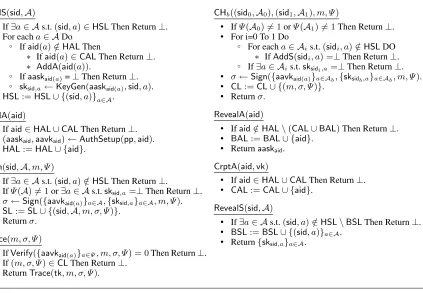
The security requirements are defined by the games in Fig. 2.
Anonymity. This requires that a signature reveals neither the identity of the signer nor the set of attributes used in the signing. This is a stronger notion than what is used in other settings, e.g. [29, 33], which only require that the identity of the signer remains anonymous. Thus, our definition ensures that a signature does not reveal more information other than what can be already inferred from the signing predicate itself.
In the game, the adversary chooses a message, a signing policy and two signers with two, possibly different, sets of attributes with the condition that both sets have to satisfy the signing policy. The adversary gets a signature by either signer and wins if it correctly guesses the signer.
Our model provides the adversary with strong capabilities, for instance, it can fully corrupt the attribute authorities and can ask for signers’ secret keys to be revealed including the two signers it chooses for the challenge (and thus capturing full-key exposure attacks). Note that since the adversary can sign on behalf of any signer, it is redundant to provide the adversary with a sign oracle. The only restriction we impose on the adversary is that it may not query theTraceoracle on the challenge signature.
In CPA-anonymity [9], the adversary is not given access to theTraceoracle. On the contrary, in CCA-anonymity [5], the adversary can askTracequeries at any stage of the game on any signature except the challenge signature. One can also consider a weaker non-adaptive variant of CCA-anonymity where the adversary can only askTracequeries before it sees the challenge signature.
WLOG and in order to simplify the security proofs, we only allow the adversary a single call to the challenge oracle. We show in Appendix A that this is sufficient by showing a reduction from any adversary with a polynomial number of calls to the challenge oracle to one with a single call via a hybrid argument.
Also, our definition captures unlinkability because the adversary has access to all signers’ secret keys and hence can produce signatures on behalf of any signer.
Formally, a DTABSscheme is anonymous if for allλ ∈ N, all PPT adversariesF have a negligible advantageAdvAnonDTABS,F(λ) :=
Pr[ExpAnon-0DTABS,F(λ) = 1]−Pr[ExpAnon-1DTABS,F(λ) = 1] .
Full Unforgeability. This requirement captures unforgeability scenarios where the forgery opens to a par-ticular signer. It ensures that even if signers collude and combine their attributes together, they cannot forge a signature that opens to a signer whose attributes do not satisfy the signing predicate. It also covers non-frameability and ensures that even if signers collude, they cannot frame a user who did not produce the signature.
Unlike the single attribute authority setting, here we allow the adversary to adaptively create corrupt attribute authorities and learn some of the honest authorities’ secret keys as long as there is at least a single honest attribute authority managing one of the attributes required for satisfying the policy used in the forgery. In addition, we allow the adversary to fully corrupt the tracing authority.
Our definition is adaptive and allows the adversary to adaptively choose the predicate and the message on which it wants to produce the forgery rather than having to select the predicate at the start of the game. Also, note that we consider the stronger form of unforgeability, i.e. (strong unforgeability) where the adversary wins even if it manages to produce a new signature on a message/predicate pair that was queried to the sign oracle. We refer to this stronger definition asStrong Full Unforgeabilityand use the abbreviation SFU for short. The definition can, in a straightforward manner, be adapted to work for the weaker variant used in, e.g. [5, 36, 13], by requiring that the forgery is not on a message/predicate pair that was queried to the sign oracle. For the latter variant which we refer to asWeak Full Unforgeability(WFU), we just need to replace the check∃(sid∗,·, m∗, Ψ∗, σ∗)∈SLby the check∃(sid∗,·, m∗, Ψ∗,·)∈SL.
Formally, aDTABSscheme is fully unforgeable if for allλ∈N, all PPT adversariesFhave a negligible advantageAdvF-UnforgeDTABS,F(λ) := Pr[ExpF-UnforgeDTABS,F(λ) = 1].
untraceable. In the game, the adversary is allowed to corrupt the tracing authority and ask for the signing keys of any signer to be revealed. However, unlike in the full unforgeability game, we require that all the attribute authorities are honest as knowing a secret key of any attribute authority makes it easy to create signatures by dummy signers which are thus untraceable.
Formally, a DTABS scheme is traceable if for all λ ∈ N, all PPT adversaries F have a negligible advantageAdvTraceDTABS,F(λ) := Pr[ExpTraceDTABS,F(λ) = 1].
4.1 Comparison with Escala et al. Model [13] for the Single Attribute Authority Setting
Specializing our model to the single attribute authority setting, we get a stronger model than the one in [13]. In particular, our model avoids some of the shortcomings inherent to [13] which we now explain. When defining non-frameability in [13], the sign oracle used by [13] does not consider the identity of the signer and hence it does not capture the following scenario: The adversary asks for two different signerssid1with
attributesA1andsid2with attributesA2to be added. It then asks for a signature on the messagemw.r.t. the
signing policyΨ by signersid1 (whereΨ(A1) = 1), and outputs as its forgery a signatureσ∗ on the same
messagemw.r.t. the same signing policyΨ but the signature opens tosid2(assume here thatΨ(A2) = 1).
Therefore, we believe that in this context, where traceability is required, it is important that the identity of the signer is taken into account when answering signing queries. Otherwise, some of the unforgeabil-ity scenarios are not captured. This is, of course, different from standard attribute-based signatures where traceability is not required and thus there is no way for the adversary to learn who produced a particular signature.
In addition, our full unforgeability definition protects against a fully corrupt tracing authority which is stronger than the non-frameability definition in [13] which only considers a partially but not fully corrupt tracing authority.
5 Building Blocks
In this section we present the building blocks that we use in our constructions.
5.1 Tagged Signature Scheme
We define here a new variant of a signature scheme which we call a Tagged Signature (TS) scheme5. A tagged signature scheme for a message spaceMTSand a tag spaceTTSis a tuple of algorithms
TS:= ([Setup],KeyGen,Sign,Verify) .
• Setup(1λ) this optional algorithm takes as input a security parameter and outputs common public pa-rametersparamwhich is an implicit input to the rest of algorithms.
• KeyGen({param|1λ})takes as input either public parameters (if the scheme requires a setup) or just the security parameter (if no setup is required) and outputs a pair of secret/verification keys(sk,vk). • Sign(sk, τ, m)takes as input a secret keysk, a tag τ ∈ T
TS and a messagem ∈ MTS, and outputs a signatureσ.
• Verify(vk, τ, m, σ)outputs 1 ifσis a signature onτ andmw.r.t. the verification keyvk.
The security of a tagged signature scheme is similar to that of a traditional digital signature and consists of correctness and unforgeability:
5
• Correctness: Requires that for all m ∈ M
TS, τ ∈ TTS and (sk,vk) output by KeyGen, we have
Verify(vk, τ, m,Sign(sk, τ, m)) = 1.
• (Existential) Unforgeability: Unforgeability under adaptive chosen-message-tag attack requires that any PPT adversaryF that is given a sign oracleSign(sk,·,·)has a negligible advantage in winning the following game:
◦ A key pair(sk,vk)is generated andvkis sent toF. ◦ Fmakes a polynomial number of queries toSign(sk,·,·).
◦ Eventually, F halts by outputting a tuple (σ∗, τ∗, m∗) and wins if σ∗ is valid on (τ∗, m∗) and
(τ∗, m∗)was never queried toSign.
We note here that any signature scheme that can sign a pair of messages can be used as a tagged signature scheme. However, to allow for generality and explicitly distinguish the tag space from the message space (and hence care for the case where they might be distinct), we define this notion. Note that one can always use a collision-resistant hash function to map the tag into the message space.
Defining this as a new notion also serves to simplify the description of our constructions and security proofs. In particular, later in the constructions we need to hide the tag, whereas the message remains public and hence just signing the hash of the combination of the tag and the message using a standard digital signature would be problematic.
Instantiation. To construct a tagged signature, we use a variant of the automorphic scheme from [16] which was given in [17]. The original scheme given in [17] was given in the asymmetric setting. For simplicity, the variant we give here is in the symmetric setting. The tag space of the tagged signature scheme are Diffie– Hellman tuples DH where DH := {(Ga, G0a) ∈ G2|a ∈
Zp}, whereas the message space is Zp. The scheme is unforgeable under theq-ADHSDH and WFCDH assumptions in the symmetric setting (and the q-ADHSDH and AWFCDH assumptions in the asymmetric setting) (cf. Section 2.2). Our tagged signature construction is as follows:
• TS.Setup(1λ): LetP := (G,G
T, p, G, e)be the description of Type-1 bilinear groups. ChooseF, K, T, G0, L←Gand returnparam:= (P, F, K, T, L, G0).
• TS.KeyGen(param): Choosex←Z
pand set(X, X0) := (Gx, G0x). Setsk:=xandvk:= (X, X0). • TS.Sign(sk,(τ, τ0), m): Reject if(τ, τ0)∈ DH/ (i.e.e(τ, G0)6=e(G, τ0)). Otherwise, chooseu, v←Z
p
and computeσ:=U :=Gu, U0 :=G0u, V :=Fv, V0:=G0v, W := (K·Tu·τ ·Lm)x+1v
.
• TS.Verify(vk,(τ, τ0), m, σ): Check thate(U, G0) =e(G, U0),e(V, G0) =e(F, V0), ande(W, X0·V0) = e(T, U0)e(K·τ ·Lm, G0), and output1or0accordingly.
5.2 The Full Boneh-Boyen (FBB) Signature Scheme
In [7], the authors gave a signature scheme that is secure under the q-SDH assumption (cf. Section 2.2). The signature scheme can be instantiated in both the symmetric and asymmetric bilinear group settings. Let P := (G,GT, p, G, e)be the description of a bilinear group. The scheme is as follows; where to aid notation all algorithms barKeyGenare assumed to take as implicit inputP:
• KeyGen(P): Choosex, y←Z
pand set(X, Y) := (Gx, Gy). Setsk:= (x, y)andvk:= (X, Y). • Sign(sk, m): To signm∈ Z
p, chooser ← Zpsuch thatx+r·y+m 6= 0and compute the signature σ :=Gx+r·1y+m.
5.3 Strongly Unforgeable One-Time Signatures
A digital signature scheme is calledone-time signatureif in the unforgeability game, the adversary is re-stricted to a single signing query.Strong Unforgeabilityas opposed to weak unforgeability requires that the adversary cannot even forge a new signature on a message that she obtained a signature on from the sign-ing oracle. In this paper, we will instantiate the one-time signature ussign-ing the Full Boneh-Boyen signature scheme from Section 5.2.
5.4 Simulation-Sound Non-Interactive Zero-Knowledge Proofs
Let R be an efficiently computable relation. For pairs (x, w) ∈ R, we call x the statement and w the witness. We define the languageLas all the statementsxinR. A Simulation-Sound Non-Interactive Zero-Knowledge (SS-NIZK) proof system forRis defined by a tuple of algorithms
(Setup,Prove,Verify,Extract,SimSetup,SimProve) .
Setuptakes as input a security parameter1λand outputs a common reference stringcrsand an extraction key xkwhich allows for witness extraction. Prove takes as input (crs, x, w) and outputs a proof π that
(x, w)∈ R.Verifytakes as input(crs, x, π)and outputs1if the proof is valid, or0otherwise.Extracttakes as input(crs,xk, x, π)and outputs a witness.SimSetuptakes as input a security parameter1λand outputs a simulated reference stringcrsSimand a trapdoor keytrthat allows for proof simulation.SimProvetakes as
input (crsSim,tr, x)and outputs a simulated proofπSimwithout a witness.
We require: completeness, soundness, zero-knowledge and simulation-soundness which are all formally defined in Appendix B.
Groth-Sahai Proofs. Groth-Sahai (GS) proofs [25] are efficient non-interactive proofs in the Common Reference String (CRS) model. The GS system can be instantiated under different intractability assumptions with the SXDH-based instantiation being the most efficient [21].
The language for the system has the form
L:={statement| ∃witness:E1(statement,witness), . . . , En(statement,witness)hold},
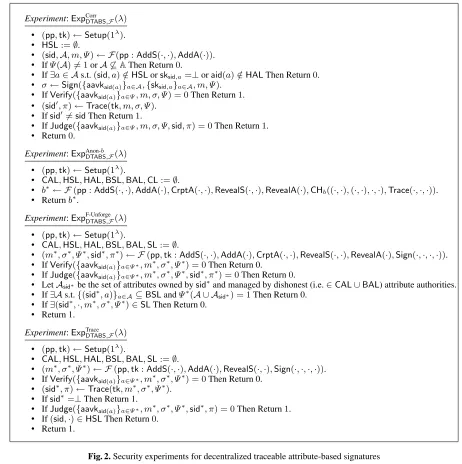
where Ei(statement,·) is one of the types of equation summarized in Fig. 3, where X1, . . . , Xm, Y1,
. . . , Yn ∈ G, x1, . . . , xm, y1, . . . , yn ∈ Zp are secret variables (hence underlined), whereas Ai, T ∈ G, ai, bi, ki,j, t∈Zp,tT ∈GT are public constants. Note that in the asymmetric setting, there are two types of MSM equations depending on which group the elements belong to.
While one can fully extract parts of the witness which are group elements from Groth-Sahai proofs, we can only extract a one-way function of exponents as fully extracting an exponent element of the witness requires solving discrete logarithms. Also, for the proof to be zero-knowledge, all the equations have to have a trivial right-hand side. In particular, in the PPE case, we can only obtain zero-knowledge if eithertT = 1 or one knowsP1, . . . , PkandQ1, . . . , Qksuch thattT =Qki=1e(Pi, Qi).
The proof system has perfect completeness, perfect soundness, composable witness-indistinguishabilit-y/zero-knowledge. Note that the original proof system in [25] is not simulation-sound. We refer to [25] for the formal definitions and details of the instantiations.
• Pairing Product Equation (PPE):
n
Q
i=1
e(Ai, Yi)· m Q i=1 n Q j=1
e(Xi, Yj)ki,j=tT·
• Multi-Scalar Multiplication Equation (MSME):
n
Q
i=1
Ayii m
Q
i=1
Xibi m Q i=1 n Q j=1
Xiki,jyj =T·
• Quadratic Equation (QE) inZp:
n
P
i=1
aiyi+ m
P
i=1
xibi+ m P i=1 n P j=1
[image:11.612.114.502.66.280.2]xiyj=t·
Fig. 3.Types of equations one can use Groth-Sahai proofs for
Experiment:ExpIND-CCA-b
PKE,F (λ):
• (pk,sk)←KeyGen(1λ). • (m0, m1,st
find)← Ffind(pk:Dec(sk,·)), where|m0|=|m1|. • C
b←Enc(pk, mb).
• b∗← Fguess`stfind, Cb:DecCb(sk,·)´, whereDecCbreturns⊥if queried onC
b.
• Returnb∗.
Fig. 4.IND–CCA security game for PKE
5.5 Public-Key Encryption
A Public-Key Encryption (PKE) scheme is a tuple of polynomial-time algorithms
PKE:= (KeyGen,Enc,Dec),
where the algorithms are defined as follows:
• KeyGen(1λ): Takes a security parameter1λand outputs a public keypkand a secret keysk. • Enc(pk, m): Takes as input the public keypkand a messagem, and outputs a ciphertextC. • Dec(sk, C): Takes as input the secret keyskand a ciphertextC, and outputs a messagem.
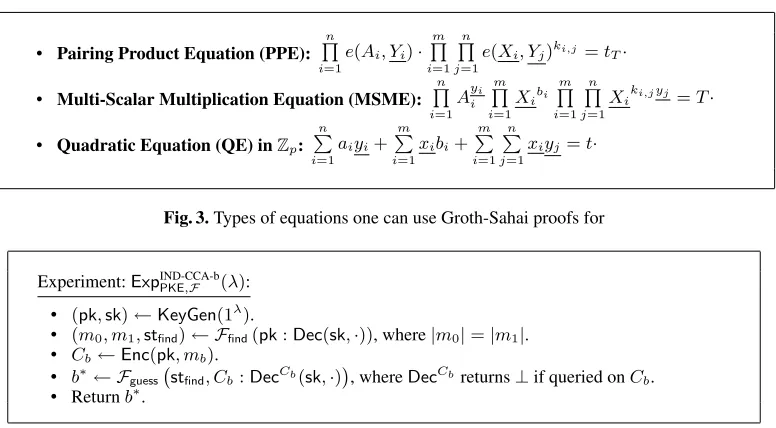
Besides the usual correctness requirement, we require that the scheme is indistinguishable against adap-tive chosen-ciphertext attacks (IND-CCA), which is defined by the game in Fig. 4.
We say that an encryption scheme is IND-CCA secure if for allλ∈N, all polynomial-time adversaries Fhave a negligible advantage
AdvIND-CCAPKE,F (λ) :=
Pr[ExpIND-CCA-0PKE,F (λ) = 1]−Pr[ExpIND-CCA-1PKE,F (λ) = 1]
5.6 Tag-Based Encryption
A Tag-based Public-Key Encryption (TPKE) scheme [34] is similar to a public-key encryption scheme with the only difference being that bothEncandDecalgorithms take as an additional input a tagt.
More formally, a TPKE scheme for a message space MTPKE and a tag space TTPKE is a tuple of polynomial-time algorithms
TPKE:= (KeyGen,Enc,Dec[,IsValid]),
where the algorithms are defined as follows:
[image:11.612.120.503.72.158.2]Experiment:ExpST-WIND-CCA-b
TPKE,F (λ):
• (t∗,stinit)← Finit`1λ´. • (pk,sk)←KeyGen(1λ). • (m
0, m1,stfind)← Ffind
“
stinit,pk:Dect
∗
(sk,·,·)”, where|m0|=|m1|. • C
tbe,b←Enc(pk, t∗, mb).
• b∗← F
guess
“
stfind, Ctbe,b:Dect
∗
(sk,·,·)”, whereDect∗returns⊥if queried ont∗.
[image:12.612.96.523.62.342.2]• Returnb∗.
Fig. 5.ST-WIND-CCA security game for TPKE
• TPKE.KeyGen(1λ)
◦ (G, p)←GrpSetup(1λ). ◦ K, L←G;f, h←Zp. ◦ F :=Gf,H:=Gh.
◦ pk:= (G, F, H, K, L);sk:= (f, h). • TPKE.Enc(pk, t, M)
◦ r
1, r2←Zp.
◦ C
1:=Fr1;C2:=Hr2;C3:=Gr1+r2·M. ◦ C
4:= (Gt·K)r1;C5:= (Gt·L)r2. ◦ C
tbe:= (C1, C2, C3, C4, C5).
• TPKE.Dec(sk, t, C
tbe)
◦ IfTPKE.IsValid(pk, t, C
tbe) = 0Then return⊥
◦ ParseC
tbeas(C1, C2, C3, C4, C5). ◦ M:=C
3·C
−1/f
1 C
−1/h
2 . • TPKE.IsValid(pk, t, C
tbe)
◦ ParseC
tbeas(C1, C2, C3, C4, C5). ◦ Ife(F, C
4)6=e(C1, Gt·K)Or
e(H, C5)6=e(C2, Gt·L)Then Return 0. ◦ Else Return 1.
Fig. 6.The tag-based encryption by Kiltz [31]
• Enc(pk, t, m): Takes as input the public key pk, a tagt ∈ T
TPKE and a messagem ∈ MTPKE, and outputs a ciphertextCtbe.
• Dec(sk, t, C
tbe): Takes as input the secret keysk, a tagt∈ TTPKE and a ciphertextCtbe, and outputs a
messagemor the reject symbol⊥. • IsValid(pk, t, C
tbe): This is an optional algorithm and is used to check whether a ciphertext is valid under
the tagtw.r.t. the pubic keypk. It returns1or0accordingly.
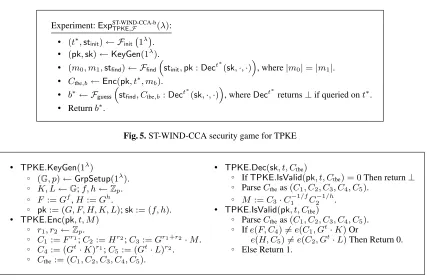
Besides the usual correctness requirement, we require selective-tag weak indistinguishability against adaptive chosen-ciphertext attacks (ST-WIND-CCA), which is defined by the game in Fig. 5.
We say the scheme is ST-WIND-CCA secure if for allλ∈N, all polynomial-time adversariesFhave a negligible advantage
AdvST-WIND-CCATPKE,F (λ) :=Pr[ExpST-WIND-CCA-0TPKE,F (λ) = 1]−Pr[ExpST-WIND-CCA-1TPKE,F (λ) = 1]
Kiltz [31] showed how to combine a ST-WIND-CCA secure TPKE scheme with a strongly unforgeable one-time signature scheme to obtain an IND-CCA2 secure PKE scheme. In the transformation the one-time signature verification key is used as a tag for the TPKE scheme and then the tag-based ciphertext Ctbe is
signed with the one-time signature secret signing key.
Instantiation of ST-WIND-CCA Tag-Based Encryption. We use the selective-tag weakly secure CCA tag-based encryption scheme by Kiltz [31] which is secure under the DLIN assumption. The scheme is in Fig. 6.
in both groups. However, the security of this variant requires that the message space is polynomial in the security parameter so that we can efficiently search when decrypting.
6 A Generic Construction for Decentralized Traceable Attribute-Based Signatures
In this section, we present our generic construction for decentralized traceable attribute-based signatures.
Overview of the construction. The tools we use in our generic construction are two NIZK proof systems
NIZK1andNIZK2, an IND-CCA2 secure public-key encryption schemePKE, an existentially unforgeable
tagged signature schemeTS, and an existentially unforgeable digital signature schemeDSwith a message spaceMDS. In addition, we need a collision-resistant hash functionH:{0,1}∗ → MDS.
We require that theNIZK1 proof system, which will be used in the signing, is simulation-sound [40]
and a proof of knowledge [12]. In fact, it is sufficient for it to be only one-time simulation-sound (see Appendix B). On the contrary, it suffices that NIZK2 is a zero-knowledge proof system, i.e. we require
neither simulation-soundness nor knowledge extractability fromNIZK2.
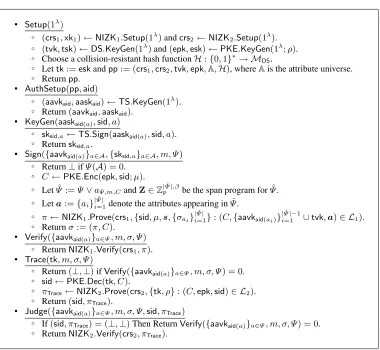
TheSetupalgorithm generates two separate common reference stringscrs1 andcrs2for the NIZK
sys-temsNIZK1andNIZK2, respectively. It also generates a key pair(tvk,tsk)for the digital signature scheme DS, and an encryption/decryption key pair(epk,esk)for the encryption schemePKE. The public parameters of the system is set topp:= (crs1,crs2,tvk,epk,A,H), whereAis the universe of attributes. The tracing authority’s key is set totk:=esk.
When a new attribute authority joins the system, it creates a secret/verification key pair(aaskaid,aavkaid) for the tagged signature scheme TS. To generate a signing key for attribute a ∈ A for signer sid, the managing attribute authority signs the signer identitysid(used as tag) along with the attributeausing her secret tagged signature signing key. The resulting signature is used as the secret key for that attribute by signersid.
To sign a message m w.r.t. a signing policyΨ, the signer first encrypts her identity sidusing the en-cryption scheme PKE(and some randomness µ) to obtain a ciphertext C. She then computes, using the NIZK systemNIZK1, a proofπ that she encrypted her identity correctly and that she either has a digital
signature on the hash of the combination of the signing predicate, the message and the ciphertext containing her identity, i.e.H(Ψ, m, C), that verifies w.r.t. the verification keytvk or that she owns enough attributes to satisfy the original signing predicateΨin the form of tagged signatures on her identity and the attributes. For ease of composition and following [36], we refer toH(Ψ, m, C)as pseudo-attributes and denote them byaΨ,m,C. Note here that including the ciphertext as part of the encoding of the pseudo-attribute does not affect the signature size.
The extended predicateΨˆis proved via a span program (see Section 2.3) represented by the matrixZ: the
signer proves that she knows a secret vectors∈Z|pΨ|ˆ s.t.sZ= [1,0, . . . ,0]. She also needs to show that she possesses a valid (tagged) signature on each attribute in the signing predicate for which the corresponding element in s is non-zero or a valid signature that verifies w.r.t tvk in the case of a pseudo-attribute. For attributes appearing in the policy that the signer does not own, she chooses random signatures.
Note that the hiding property of the NIZK1 system ensures that the proof π does not reveal how the
modified predicateΨˆwas satisfied, i.e. whether the signer has a special signature on the pseudo-attribute or she owns enough attributes to satisfy the original predicateΨ. The signature is then set toσ := (π, C). To verify the signature, one just needs to verify the proofπ.
• Setup(1λ)
◦ (crs1,xk1)←NIZK1.Setup(1λ)andcrs2 ←NIZK2.Setup(1λ). ◦ (tvk,tsk)←DS.KeyGen(1λ)and(epk,esk)←PKE.KeyGen(1λ;ρ). ◦ Choose a collision-resistant hash functionH:{0,1}∗→ MDS. ◦ Lettk:=eskandpp:= (crs
1,crs2,tvk,epk,A,H), whereAis the attribute universe. ◦ Returnpp.
• AuthSetup(pp,aid) ◦ (aavk
aid,aaskaid)←TS.KeyGen(1λ).
◦ Return(aavk
aid,aaskaid).
• KeyGen(aask
aid(a),sid, a) ◦ sksid,a←TS.Sign(aask
aid(a),sid, a). ◦ Returnsksid,a.
• Sign({aavk
aid(a)}a∈A,{sksid,a}a∈A, m, Ψ)
◦ Return⊥ifΨ(A) = 0. ◦ C←PKE.Enc(epk,sid;µ). ◦ LetΨˆ:=Ψ∨a
Ψ,m,CandZ∈Z|
ˆ
Ψ|,β
p be the span program forΨˆ.
◦ Leta:={ai}|Ψˆ|
i=1denote the attributes appearing inΨˆ. ◦ π←NIZK
1.Prove(crs1,{sid, µ,s,{σai}
|Ψˆ|
i=1}: (C,{aavkaid(ai)}
|Ψˆ|−1
i=1 ∪tvk,a)∈ L1). ◦ Returnσ:= (π, C).
• Verify({aavk
aid(a)}a∈Ψ, m, σ, Ψ)
◦ ReturnNIZK1.Verify(crs1, π). • Trace(tk, m, σ, Ψ)
◦ Return(⊥,⊥)ifVerify({aavk
aid(a)}a∈Ψ, m, σ, Ψ) = 0.
◦ sid←PKE.Dec(tk, C). ◦ π
Trace←NIZK2.Prove(crs2,{tk, ρ}: (C,epk,sid)∈ L2). ◦ Return(sid, π
Trace).
• Judge({aavk
aid(a)}a∈Ψ, m, σ, Ψ,sid, πTrace)
◦ If(sid, π
Trace) = (⊥,⊥)Then ReturnVerify({aavkaid(a)}a∈Ψ, m, σ, Ψ) = 0.
◦ ReturnNIZK2.Verify(crs2, π
[image:14.612.117.497.63.413.2]Trace).
Fig. 7.The generic construction for DTABS
of any signer without knowing their secret keys by simply encrypting their identity and producing a signa-ture on the pseudo-attribute associated with the message and the signing predicate. Note that even in the unlikely case that any of the pseudo-attributes happened to collide with a real attribute, this is not a problem since signatures associated with pseudo-attributes must verify w.r.t.tvkwhich is different from all attribute authorities’ keys.
To trace a signature, the tracing authority just decrypts the ciphertextCto recover the signer’s identity. It then produces a proofπTraceusing the NIZK systemNIZK2to prove that the decryption was done correctly.
To verify the tracing correctness, the judge just needs to verify the validity of the NIZK proofπTrace. The details of the construction are in Fig. 7, whereas the languages associated with the NIZK proofs used in the construction are as follows, where for clarity we underline the elements of the witness:
L1:
n
(C,vk:={aavkaid(ai)}
|Ψ|−ˆ 1
i=1 ∪tvk,a:={ai}
|Ψ|ˆ
i=1),(sid, µ,s,σ :={σai}
|Ψ|ˆ i=1)
:
sZ= [1,0, . . . ,0]
|Ψ|−ˆ 1
^
i=1
ifsi6= 0⇒TS.Verify(vki,sid, ai, σai) = 1
∧ ifs|Ψˆ|6= 0⇒DS.Verify(tvk, aΨ,m,C, σa|Ψˆ|) = 1
The witness consists of a signer identitysid, the randomness µused in encryptingsid, a vector s ∈ Z|
ˆ
Ψ| p ,
and signatures {σai} |Ψ|ˆ
i=1 s.t. the span program Zverifies w.r.t. tosand for every non-zero element si for i ∈ {1, . . .|s| −1}, the tagged signatureσai on sid(as a tag) and the attributeai (as a message) verifies w.r.t. the corresponding attribute authority verification key, and ifs|s|6= 0, the signatureσ|Ψ|ˆ, i.e. the one on
the special pseudo-attribute verifies w.r.t. the verification keytvk.
L2:
n
(C,epk,sid),(tk, ρ):PKE.KeyGen(1λ;ρ) = (epk,tk) ∧ PKE.Dec(tk, C) =sid
o ·
The witness consists of the tracing key, i.e. the decryption key forPKE, and the randomnessρ(if any) used in the key generation ofPKEs.t. the encryption/decryption key pair is correct and the ciphertextCdecrypts tosid.
Note that if we encrypted the whole witness of π (rather than just the signer identity) then we could drop the requirement forNIZK1 to be a proof of knowledge. The reason why we cannot afford to do this is
two-fold: first, since the decryption key is used as a tracing key and signers do not have their own personal key pairs, this would mean that a dishonest tracing authority will be able to forge on behalf of an honest signer once it has opened a signature by them. Second, since in both the full unforgeability and traceability experiments, the adversary has access to the tracing key, it would mean that we can no longer sign using pseudo-attributes since the adversary will be able to learn what witness we used in producing a signature.
Also, note that for the construction to satisfy the stronger variant of full unforgeability (i.e. SFU) rather than WFU, NIZK1 must additionally be strongly non-malleable in the sense that it is infeasible for the
adversary to even output a new proof for a statement that it received a proof for. In particular, as noted by [23] if the proof system is simulation-sound extractable [23] then it is non-malleable.
Theorem 1. The construction in Fig. 7 is a secure decentralized traceable attribute-based signature if the building blocks are secure w.r.t. their security requirements.
The full proof of this theorem can be found in Appendix C.
We note here that instantiations of all the tools we require for the generic construction exist in the literature in both the random oracle and the standard models. In particular, we note that in the random oracle model we can instantiate the proof systems required using the Fiat–Shamir heuristics [14]. Our focus is, however, on constructions which do not rely on idealized assumptions. Before we proceed we note here that the size of the signature in [13], which requires random oracles and is over the inefficient composite-order bilinear groups, isG|Ψ|ˆ+β+7. Note that the size of the group order of composite-order groups is about 10 times that of their prime-order counterparts at the same security level.
In order to improve the efficiency in the standard model, we present a construction in the next section that slightly deviates from the generic framework.
7 Constructions in the Standard Model
In order to get more efficient constructions in the standard model, we slightly deviate from the generic framework by dropping the requirement thatNIZK1 is simulation-sound. In particular, in our instantiations
we will use the Groth-Sahai proof system (which is the only efficient non-interactive proof system not relying on random oracles) to instantiate bothNIZK1 andNIZK2 systems. Note that Groth-Sahai proofs
• Setup(1λ)
◦ (crs1,xk1)←NIZK1.Setup(1λ)and(crs2,xk2)←NIZK2.Setup(1λ). ◦ (tvk,tsk)←DS.KeyGen(1λ)and(epk,esk)←TPKE.KeyGen(1λ;ρ). ◦ Choose collision-resistant hash functionsH:{0,1}∗→ M
DSandHˆ:{0,1}∗→ TTPKE.
◦ Lettk:=eskandpp:= (crs1,crs2,tvk,epk,A,H,Hˆ), whereAis the attribute universe. ◦ Returnpp.
• AuthSetup(pp,aid) ◦ (aavk
aid,aaskaid)←TS.KeyGen(1λ).
◦ Return(aavk
aid,aaskaid).
• KeyGen(aask
aid(a),sid, a) ◦ sk
sid,a←TS.Sign(aaskaid(a),sid, a). ◦ Returnsk
sid,a.
• Sign({aavk
aid(a)}a∈A,{sksid,a}a∈A, m, Ψ)
◦ Return⊥ifΨ(A) = 0.
◦ (otsvk,otssk)←OTS.KeyGen(1λ). ◦ C
tbe←TPKE.Enc(epk,Hˆ(otsvk),sid;µ).
◦ LetΨˆ:=Ψ∨a
Ψ,m,Ctbe,Hˆ(otsvk)andZ∈Z |Ψˆ|,β
p be the span program forΨˆ.
◦ Leta:={a
i} |Ψˆ|
i=1denote the attributes appearing inΨˆ. ◦ π←NIZK1.Prove(crs1,{sid, µ,s,{σa
i}
|Ψˆ|
i=1}: ( ˆH(otsvk), Ctbe,{aavkaid(ai)}
|Ψˆ|−1
i=1 ∪tvk,a)∈ L
0
1). ◦ σots←OTS.Sign(otssk,(π, Ctbe,otsvk)).
◦ Returnσ:= (σots, π, Ctbe,otsvk). • Verify({aavk
aid(a)}a∈Ψ, m, σ, Ψ)
◦ Parseσas(σ
ots, π, Ctbe,otsvk).
◦ Return 1 if all the following verify; otherwise, return 0:
∗ OTS.Verify(otsvk,(π, Ctbe,otsvk), σots)= 1. ∗ NIZK1.Verify(crs1, π)= 1.
∗ TPKE.IsValid(epk,Hˆ(otsvk), Ctbe)= 1.
• Trace(tk, m, σ, Ψ)
◦ Return(⊥,⊥)ifVerify({aavk
aid(a)}a∈Ψ, m, σ, Ψ) = 0.
◦ sid←TPKE.Dec(tk,Hˆ(otsvk), C
tbe).
◦ πTrace←NIZK2.Prove(crs2,{tk, ρ}: ( ˆH(otsvk), Ctbe,epk,sid)∈ L0 2). ◦ Return(sid, π
Trace).
• Judge({aavk
aid(a)}a∈Ψ, m, σ, Ψ,sid, πTrace)
◦ If(sid, π
Trace) = (⊥,⊥)Then ReturnVerify({aavkaid(a)}a∈Ψ, m, σ, Ψ) = 0.
◦ ReturnNIZK
[image:16.612.93.518.70.492.2]2.Verify(crs2, πTrace).
Fig. 8.Details of the second construction
not a problem in our case as we never need to be able to efficiently extract the exponent components of the witness.
We will start by describing the idea of the construction generically and then present the exact instantia-tions later. To eliminate the need forNIZK1to be simulation-sound, we apply a trick similar to that used by
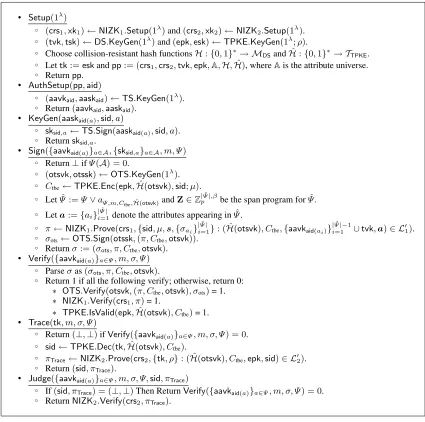
Groth in [24] where we sign the final signature with a strongly unforgeable one-time signature schemeOTS. We require thatOTSis strongly existentially unforgeable against adaptive chosen-message attack. We use the corresponding one-time verification key as a tag for a selective-tag weakly IND-CCA (i.e. ST-WIND-CCA secure) tag-based encryption schemeTPKEwith which we encrypt the user’s identitysid. The rest of the tools are the same as in the generic construction in Section 6.
verification key as a part of the pseudo-attribute, i.e. the pseudo-attribute now is(Ψ, m, Ctbe,Hˆ(otsvk)),
which we will denote by aΨ,m,C
tbe,Hˆ(otsvk). The one-time signature serves to prevent the adversary from
transforming a signature that it received into another valid signature as it now must be able to forge a one-time signature in order to succeed. Moreover, the one-one-time signature gives us the added bonus of realizing the stronger variant of full unforgeability.
The general idea of this construction is given in Fig. 8, whereas the languages associated with the NIZK proofs used in the construction are as follows, where again the elements of the witness are underlined:
• LanguageL0
1is defined as
L01 :n ( ˆH(otsvk), Ctbe,vk:={aavkaid(ai)}
|Ψ|−ˆ 1
i=1 ∪tvk,a:={ai} |Ψ|ˆ
i=1),(sid, µ,s,σ:={σai} |Ψ|ˆ
i=1)
:
sZ= [1,0, . . . ,0]
|Ψ|−ˆ 1
^
i=1
ifsi 6= 0⇒TS.Verify(vki,sid, ai, σai) = 1
∧ ifs|Ψ|ˆ 6= 0⇒DS.Verify(tvk, aΨ,m,Ctbe,Hˆ(otsvk), σa|Ψˆ|) = 1
∧ TPKE.Enc(epk,Hˆ(otsvk),sid;µ) =Ctbe
o ·
• LanguageL0
2is defined as
L02 :
n
( ˆH(otsvk), Ctbe,epk,sid),(tk, ρ)
:TPKE.KeyGen(1λ;ρ) = (epk,tk)
∧ TPKE.Dec(tk,Hˆ(otsvk), Ctbe) =sid
o ·
We provide a proof for the following Theorem in Appendix D.
Theorem 2. The construction in Fig. 8 is a secure decentralized traceable attribute-based signature if the building blocks are secure w.r.t. their security requirements.
7.1 An Instantiation in Symmetric Groups
We use the instantiation of the tagged signature scheme from Section 5.1 and instantiate the digital signature
DS used for pseudo-attributes with the full Boneh-Boyen signature scheme (cf. Section 5.2) both in the symmetric setting. Thus, we assume a collision-resistant hash functionH:{0,1}∗ →
Zp. Note that we need not hide the integer componentrof the full Boneh-Boyen signature when provingπas such a signature can only be generated by the simulator running the security game and hencerdoes not reveal any information about the attributes involved or the identity of the signer. In other words, in both the real signature and the simulated signature cases,ris chosen uniformly at random.
[image:17.612.74.539.181.370.2]We use the selective-tag weakly IND-CCA tag-based encryption scheme by Kiltz [31] as illustrated in Fig. 6 to instantiateTPKEand instantiate the one-time signature with the full Boneh-Boyen signature in the symmetric setting.
We now give the specific details of the proofs invloved. LetZ∈ Z|
ˆ
Ψ|,β
p be the span program forΨˆ := Ψ∨aΨ,m,C
tbe,Hˆ(otsvk). To sign, we need the following proofs:
• To prove thatsZ= [1,0, . . . ,0], we need to prove the following linear equations:
|Ψˆ| X
i=1
(siZi,1) = 1
|Ψ|ˆ
X
i=1
![Fig. 6 to instantiateWe use the selective-tag weakly IND-CCA tag-based encryption scheme by Kiltz [31] as illustrated in T P K Eand instantiate the one-time signature with the full Boneh-Boyen signature in thesymmetric setting.ˆ ˆ](https://thumb-us.123doks.com/thumbv2/123dok_us/630476.563991/17.612.74.539.181.370/instantiatewe-selective-encryption-illustrated-instantiate-signature-signature-thesymmetric.webp)