Methods to Generate the Yearly
Shutdown-Schedule of a Basic Oxygen Steel Plant
1 Date and Place:
August 2013, Velsen-Noord
Author: Michiel Bel
Supervisors:
Dr. Ir. J.M.J. Schutten, Universiteit Twente Dr. Ir. M.R.K. Mes, Universiteit Twente R. Broers, Tata Steel
Commissioned by:
2
Management Summary
Tata Steel’s Basic Oxygen Steel Plant in IJmuiden converts pig iron into sheets of steel, which requires several installations. These installations all require different maintenance jobs, which are specified in the SAP system where the job’s cycle time, duration, priority, start date, etc. are stored. Currently, Tata Steel bases the Yearly Shutdown-Schedule (YSS) too much on the maintenance needs of installations, instead of on the jobs that have to be performed on these installations. Furthermore, Tata Steel generates the YSS based on manual processes, without a formal methodology. Hence, the research question of this research is:
Method
In the literature, our problem is called the ‘Maintenance Scheduling Problem’ (MSP) and the problem is solved in the literature by applying a local search heuristic, because the problem is too complex to be solved to optimality. Our MSP is even more complex, mainly due to the high amount of possible routes through the Basic Oxygen Steel Plant. In order to create a transparent and subjective method to generate a YSS, we formulated the MSP as a Mixed-Integer Program, which includes the restrictions on shutting down an installation. The method contains four ranked objectives, in which a lower ranked objective can never by improved at the cost of a higher ranked objective:
1. Minimize the overflow of pig iron (deregulating the Blast-Furnaces and dumping at Harsco). 2. Minimize working in overtime (during the weekends and on working days before 7am and
after 3pm).
3. Minimize deviating from the job’s cycle time. 4. Maximize the spreading of jobs.
In order to solve the MSP, we applied a Simulated Annealing (SA) heuristic that uses four runs to subsequently optimize each objective.
Results
The analysis of the results of our four-run SA approach clearly shows the correctness of the approach with respect to clustering jobs in order to minimize the overflow: our approach causes a decrease in the objective value of 89% with respect to the initial schedule, as Table 1 shows. In Table 1, the ‘initial’ column shows the values of the four objectives if every job is scheduled at its start date in SAP.
Table 1 - Results of our SA approach
Initial After SA Decrease
Objective 653,066.4 74,291 -89%
Overflow 651,066.4 72,067 -89%
Overtime 2,000 2,155 +8 %
Deviation (/1000) 0 69,662 - %
Spread (/1000) 5.03 4.149 -18%
3 Additionally, we applied two Iterative Improvement approaches, a one-run SA approach, and a combined approach to the same MSP. From this analysis, we conclude that both our four-run SA and the one-run SA outperform the Iterative Improvement approaches and the combined approach. Although it did not out- or underperform the method in the small experiment that we performed, we expect our four-run SA approach to outperform the one-run SA approach on the long run, because the one-run SA approach finds a bad local optimum relatively quickly.
Furthermore, the analysis shows that not all rules of thumb that Tata Steel currently applies to generate the YSS remain valid from an overflow point of view, whereas we are unable to conclude on the validity of the rules of thumb from any other point of view, such as safety. Although not all of these rules of thumb remain valid, the current YSS seems to outperform our YSS. However, 55% of the jobs do not fit to the shutdowns in the YSS as Tata Steel generated it. This is mainly due to our usage of tight bounds on the allowed deviation from the cycle time: we expect that our approach outperforms the current manual approach if it is based on the same restrictions.
Conclusions and Recommendations
As mentioned in the previous section, the currently applied restrictions differ from the restrictions as we applied them, which is mainly due to the incorrectness or unavailability of the job’s duration, the priority, and cycle time. We propose determining the correct parameters for every job in SAP, such that the YSS is based on these data, which improves the objectivity of the restrictions and the trust in the output. Furthermore, we recommend clustering jobs in order to decrease the runtime of the SA approach. Especially clustering the jobs on the casting installations decreases the problem size without decreasing the quality of the method and the YSS.
Finally, the main advantages of our method over the current method to generate the YSS are mainly due to the scheduling of jobs instead of installations (as Tata Steel currently does) and due to the computerized approach instead of a manual approach. The main advantages are:
Sections have more insight in and a better overview of the maintenance to perform during the year.
The method to generate the YSS is neither based on experience, nor a manual process.
Less additional maintenance jobs appear during the year, because the schedule includes every job. This leads to less rescheduling and more time to prepare a shutdown.
The method takes four objectives into account for each and every job.
The consequences of rescheduling can be analyzed quickly and comprehensively.
4
Preface
By means of this report, I finish my master Industrial Engineering and Management at the University of Twente. This report contains my research towards an improved method to generate the yearly shutdown-schedule at the Basic Oxygen Steel Plant of Tata Steel IJmuiden. This master assignment offered me the opportunity to work on both maintenance concepts and complex schedules within a plant with an impressive production process, which is part of a chain of complex and interesting processes at the Tata Steel IJmuiden site.
For providing me this opportunity, the offered supervision, and shown interest from the initial contact until handing in this report, I would like to thank Tata Steel. I would especially thank my Tata Steel-supervisor Randy Broers for providing me with useful feedback and introducing me in a complex plant and system. I enjoyed using the workplace next to you.
Furthermore, I would like to thank Marco Schutten and Martijn Mes, my supervisors from the University of Twente. The useful feedback that I received while carrying out my research was full of clear content and often helped me obtaining new insights in my research. Especially the different and complementary types of feedback helped me obtaining these.
I would like to thank my parents for their interest in this assignment and for their financial support during my studies. Finally, I would like to thank Sandra for moving to Enschede during her studies, to join me during my years in Enschede.
5
Table of Contents
1. Introduction ... 6
1.1 Background and Motive ... 6
1.2 Core Problem and Research Questions ... 8
1.3 Approach and Outline ... 10
2. Current Situation ... 11
2.1 Flows through the Plant ... 12
2.2 Process of Generating and Applying the Yearly Shutdown-Schedule ... 15
2.3 Complications ... 17
2.4 Cycle Time Defined ... 19
2.5 Restrictions to Scheduling Maintenance ... 20
3. Literature Review ... 23
3.1 Position in the Literature ... 23
3.2 Approaches to Comparable Problems ... 26
3.3 Options to Improve the Process ... 26
3.4 Concluding Remarks ... 31
4. Model of the Maintenance Scheduling Problem at Tata Steel ... 32
4.1 Evaluation of the Modeling Techniques ... 32
4.2 Mathematical Model of the Maintenance Scheduling Problem ... 32
4.3 Implementing the Local Search Technique ... 38
4.4 Concluding Remarks ... 44
5. Analysis and Discussion of the Results ... 45
5.1 Initial Solution... 45
5.2 Performance of Simulated Annealing ... 45
5.3 The Generated YSS ... 56
5.4 Computation Time ... 63
5.5 Summarizing the Results ... 65
6. Conclusions and Recommendations ... 66
6.1 Conclusions ... 66
6.2 Further Research ... 69
Bibliography ... 72
Appendices ... 77
A Translation of Terms ... 77
B Maps the Basic Oxygen Steel Plant and the IJmuiden Site... 79
6
1.
Introduction
This research focusses on the scheduling of installation shutdowns to perform maintenance at Tata Steel’s Basic Oxygen Steel Plant 21 in IJmuiden. Figure 1 shows a part of the Tata Steel IJmuiden site, and Appendix B contains a map of both the IJmuiden site and the Basic Oxygen Steel Plant. Tata Steel IJmuiden employs approximately 9,000 people, of which 1,000 are employed by the Basic Oxygen Steel Plant. The Basic Oxygen Steel Plant converts liquid iron – produced by two blast furnaces – into sheets of steel, which are further processed by the Direct Sheet Plant and the Hot Strip Mill. Section 1.1 explains the motive and importance of this research for both Tata Steel and the scientific research; Section 1.2 derives the research question and this chapter finishes with the outline of this research in Section 1.3.
1.1
Background and Motive
Every manufacturing organization faces the breakdowns of machines at unexpected and unwanted moments. All these organizations use some kind of approach to perform maintenance, based on the balance between costs, time, and safety. Maintenance is often seen as a cost function only, instead of a way to save money and time during breakdowns and for a company such as Tata Steel – with a continuous process and expensive installations – the call for maintenance often comes at an inopportune moment. Still, maintenance is more and more accepted as needed to increase the total amount of output and the output’s quality, and Tata Steel recognizes that the planning of maintenance should be improved. Figure 2 shows a simplified flowchart of the continuous process, in which some installations are more critical to the flow than other installations. Currently, the yearly process of planning the shutdown of an installation aims to attain a high flow through the plant, by scheduling the shutdowns of these installations in a finely tuned way. Note that we add more installations to this flow in Chapter 2.
1 Appendix A contains a translation of several terms from English to Dutch
7 The relevance of this research for Tata Steel is especially in acquiring new insights in maintenance scheduling as well as in a method to schedule maintenance. This research is also relevant to other organizations, because every organization with a continuous process that does not have the possibility to change the flow of goods via spare machines needs to cut the flow by shutdowns, in order to maintain the installations. All these organizations can use new insights in the process and methods of developing a shutdown schedule. Next to the relevance to organizations, this research’s relevance to science lies in the fact that maintenance scheduling is mostly researched in the power generating industry, where simpler flows are considered. Dekker (1996) recognizes an increasing trend from the late 1980s to the early 1990s of research in the field of maintenance optimization and since that time, more and more literature has become available on the maintenance scheduling topic, although its focus remains on the power generating industry. Furthermore, the relevance to science lies in the fact that maintenance scheduling is not highlighted in basic scheduling books, such as Pinedo (2009), while there is a clear link between maintenance and scheduling. He does discuss the differences between manufacturing and service industries and from that discussion we conclude that maintenance is somewhere in between these two types of industries and should be dealt with on the interface of manufacturing and services, making maintenance planning and scheduling an even more interesting topic. So, maintenance becomes an important research topic in the scientific literature, and Tata Steel improves its maintenance policy and process, to attain high uptime and more output.
8
1.2
Core Problem and Research Questions
To perform planned maintenance at the Basic Oxygen Steel Plant, several installations need to be taken out of service. Every installation has several maintenance jobs attached to it (lubricating, replacement of parts, etc.) and these jobs all have a cycle time2, which is defined by a maintenance engineer. These cycle times are combined to schedule the shutdown of an installation and these shutdowns are combined to a yearly shutdown-schedule (YSS), which shows the moments of a shutdown.
The shutdown moments are set such that the flow through the plant is guaranteed and every installation is maintained. Actually, the most important aim is to guarantee a flow through the plant that is high enough to process the pig iron processed by the Blast-Furnaces. The scheduling is based on human knowledge about restrictions with respect to taking different installations together out of service and these are not clear to everybody, such that convincing others about its correctness is hard. Moreover, the scheduling is based on rules of thumb that have proven their usability in the past, but it is unclear whether each of these rules is needed to set up the schedule. Still, most of these rules are based on cycle times through the plant. The scheduling process of setting up a shutdown schedule for the installations in the Basic Oxygen Steel Plant repeats itself every year and the YSS needs to be revised several times before it is accepted and frozen. Another disadvantage of the unclear process and the rescheduling before freezing the YSS, is the decreasing trust in the developed YSS. Part of the process is the method of deducting the YSS from the different maintenance needs, which currently holds that the different installation engineers define the installation cycle time, without really basing this on the cycle times of maintenance jobs that are stored in SAP. Therefore, this process is too much based on experience and human knowledge. That is why Tata Steel recognizes a possibility to increase the clarity and understandability of the YSS. Finally, because of the manual approach to define and combine the cycle times of installations, we question the correctness of the resulting schedule.
So far, we have mentioned several problems in the current process of generating the YSS: the process is based on human knowledge, the method is based on a manual approach, the process is unclear and incomprehensible, rescheduling is required, and the outcome has a questionable quality. While the process basically covers three steps – the determination of the cycle times, the generation of the schedule, and the implementation of the schedule – we only focus on the generation itself, because most problems appear there (rules of thumb, outcome, manual approach). Although the focus is on the method to generate the schedule, we do recognize the importance of the other two steps. Now, the main problem with respect to maintenance scheduling at the Basic Oxygen Steel Plant is:
To improve the method, a manual process should be prevented, the trust and understandability should be higher, and the outcome should not be questionable anymore. So, a model should be developed that clarifies the restrictions, such that the trust in the correctness of the YSS increases.
2
The cycle time of maintenance is the time between two identical and subsequent maintenance jobs. In practice, this time varies between two bounds (e.g., a cycle time of 10 weeks means that the job should be repeated after at least 9 and at most 11 weeks).
9 Hence, the model should have high face validity (or logical validity), which means that the process seems logical. So, if the process is composed of understandable steps and restrictions, the YSS (the result of the process) should be intuitively understandable. Notice that high face validity only means that the process looks like it obtains good solutions, rather than that it finds good solutions. Recall that we only focus on the method of generating a YSS, so we improve the method of generating a YSS given the cycle times and maintenance needs of installations, while leaving out the process of determining these values (e.g., determining the cycle times, determining the maintenance needs, changing the way of approaching the YSS).
Furthermore, the main task of maintenance management is to guarantee availability (Moghaddam, 2008), which equals – for this research – guaranteeing the flow of steel through the plant or making sure that all iron produced by the Blast-Furnaces, is processed by the Basic Oxygen Steel Plant. While there are hardly any buffers in the plant, the iron is only processed if the cycle time through the different areas of the plant is at most the Blast-Furnaces’ cycle time. Section 2.4 elaborates on this topic. In addition to that main task of guaranteeing availability, maintenance management should guarantee some repeatability and predictability of maintenance moments, such that scheduling is possible and everybody expects the shutdown of an installation. So, in order to make sure that a new method is accepted, the capacity of the Basic Oxygen Steel Plant should be high enough to process the iron supplied by the Blast-Furnaces, while the maintenance cycles are repeating.
Both the problem and the explanation above lead to the following research question:
In order to answer this question, we first need to have a better insight in the current process of developing the YSS, which results in the first sub-question:
1. How is the yearly shutdown-schedule currently developed at the Basic Oxygen Steel Plant? a. What are the current steps to generate the YSS?
b. What are the restrictions of the YSS? c. How should the cycle time be defined?
Based on the first question, we are able to position this research in the literature and we are able to derive useful insights for this research from that literature. So, our second sub-question is:
2. How should this research be positioned in the literature? a. How is the problem described in the literature?
b. What can we learn from the literature to improve the current method of scheduling maintenance at the Basic Oxygen Steel Plant?
c. Which methods are applied in the literature?
10 After answering these questions, we can develop a new method to generate the YSS:
3. What is the most suitable option to improve the current method of scheduling shutdowns, taking into account the method’s clarity and understandability, such that the flow is guaranteed and the restrictions are met?
a. What option discussed in the literature suits best to our problem? b. How can we adapt that option to make it fit to our problem? c. How should this option be implemented?
Finally, we have to reflect on the selected method and evaluate the results:
4. What are the results of applying the selected method? a. What is the improvement in the flow?
b. What is the improvement in clarity and understandability?
c. How bad/well is the current method (i.e., are the rules of thumb useful)?
1.3
Approach and Outline
11
2.
Current Situation
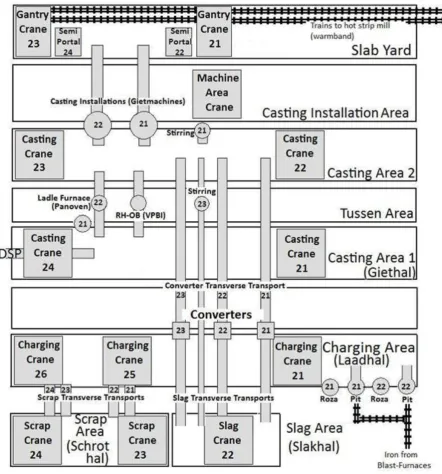
[image:12.595.75.518.183.658.2]This chapter explains the current situation – with respect to planned maintenance – at the Basic Oxygen Steel Plant. This chapter comprises a part on the flows of steel through the plant and a part on the developing of the yearly shutdown-schedule (YSS). We explain the current flow of iron, scrap, steel, and slag through the Basic Oxygen Steel Plant in Section 2.1, before we explain the current process of developing the YSS in Section 2.2. Section 2.3 explains the complications in the current process, and Section 2.4 and Section 2.5 clarifies the terms: cycle time and restrictions.
Figure 3 - Simplified lay-out of the Basic Oxygen Steel Plant
12
2.1
Flows through the Plant
The Tata Steel IJmuiden site is made up of several separate plants that together manufacture sheets and roles of steel (Appendix B.1 contains a map of the site). The relevant plants for this research are the two Blast-Furnaces, (especially) the Basic Oxygen Steel Plant, and – although less relevant – the Direct Sheet Plant and the Hot Strip Mill. The Blast-Furnaces produce pig iron (liquid iron), which is transported by hot metal cars to the Basic Oxygen Steel Plant. As the name implies, this steel plant converts the iron into steel: either sheets or roles. Finally, the sheets and roles are transported to the Direct Sheet Plant (DSP) and the Hot Strip Mill respectively, where they are prepared for the customer and further operations, such as galvanizing and cold rolling. This research’s focus is on the maintenance scheduling of the Basic Oxygen Steel Plant, which is influenced by the supply of iron of the predecessors (Blast-Furnaces) and the capacity and the demand for steel of the succeeding DSP, because the DSP is directly attached to the Basic Oxygen Steel Plant, whereas the Hot Strip Mill has the possibility to store the sheets of steel before handling these. The only way to buffer between the Blast-Furnaces and the Basic Oxygen Steel Plant, is by means of filling the hot metal cars, but this type of buffering is obviously limited.
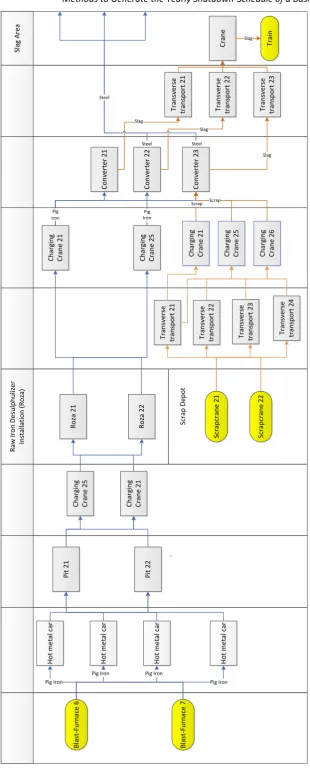
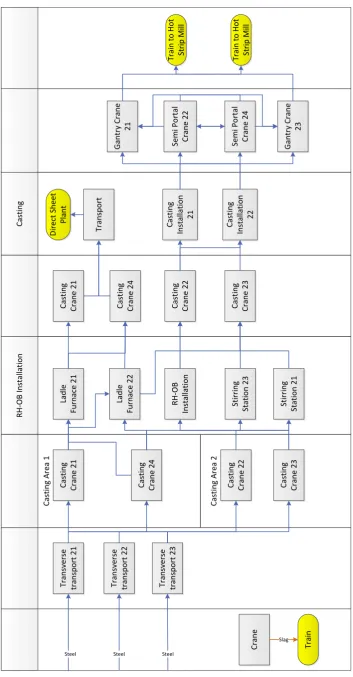
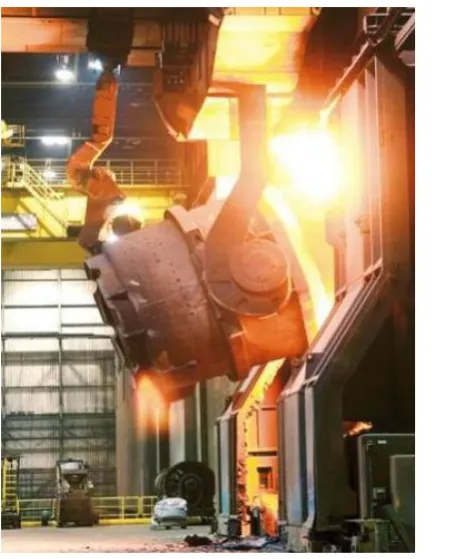
Figure 3 contains a simplified map of the Basic Oxygen Steel Plant and only shows the installations that we consider in this research. Recall that Appendix B.2 contains a more detailed map of the plant and that hot metal cars (Figure 4) transport pig iron to the pits. From Figure 3, we derive Figure 5 that contains the flows through the plant from the Blast-Furnaces, via the hot metal cars and the Basic Oxygen Steel Plant to the DSP and train to the Hot Strip Mill. As mentioned before, the shutdown of a Blast-Furnace means that the supply of pig iron decreases and installations are out of supply. On the other hand, shutting down an installation while both Blast-Furnaces produce pig iron, may lead to the need to deregulate the Blast-Furnaces to lower the amount of iron processed by the Blast-Furnaces and so the amount of iron to be processed by the Basic Oxygen Steel Plant. Whether or not deregulation of the Blast-Furnaces is required depends on the impact of shutting down that installation on the capacity of the Basic Oxygen Steel Plant, because there may be the possibility to use another flow (e.g., Converter 21 instead of Converter 22) and pig iron may be dumped and reused as scrap. Figure 6 and Figure 7 show the charging of respectively pig iron and scrap into the Converter by a Loading Crane.
13 Figure 5a - Flow through the Basic Oxygen Steel Plant
14 C as ti n g R H -O B In st al la ti o n Sl ag A re a Sl ab tr ac k C as ti n g Tr an sv er se tr an sp o rt C as ti n g A re a C as ti n g A re a Sl ab A re a La d le Fu rn ac e 2 1 La d le Fu rn ac e 2 2 C as ti n g In st al la ti o n 2 1 C as ti n g In st al la ti o n 2 2 Se m i P o rt al C ra n e 2 2 Se m i P o rt al C ra n e 2 4 C as ti n g C ra n e 2 1 C as ti n g C ra n e 2 4 C as ti n g C ra n e 2 2 C as ti n g C ra n e 2 3 C as ti n g A re a 1 C as ti n g A re a 2 R H -O B In st al la ti o n St ir ri n g St at io n 2 3 St ir ri n g St at io n 2 1 C as ti n g C ra n e 2 1 C as ti n g C ra n e 2 4 C as ti n g C ra n e 2 2 C as ti n g C ra n e 2 3 G an tr y C ra n e 2 1 G an tr y C ra n e 2 3 C ra n e Tr ai n Slag Tr an sv er se tr an sp o rt 2 1 Tr an sv er se tr an sp o rt 2 2 Tr an sv er se tr an sp o rt 2 3 Steel Steel D ir ec t Sh ee t P la n t Tr an sp o rt Tr ai n t o H o t St ri p M ill Tr ai n t o H o t St ri p M ill Steel
15 Finally, a shutdown of one of the cranes pictured in Figure 3 may mean that an installation is locked out of possible supply and may also lead to locking another crane. For example, the shutdown of Charging Crane 25 in the Charging Area means that the crane is put as far as possible to the left side of the picture. Now, Charging Crane 26 cannot be used because it is isolated and for the same reason Scrap Transverse Transports 22, 23, and 24 cannot be used either. Consequently, Charging Crane 21 should take the pig iron ladle from the Pits to the Rozas and further to the Converters, but also put scrap from Scrap Transverse Transport 21 into a converter, which obviously has its impact on the cycle time in the Charging Area. In practice, some routes shown in the figure are not used for practical reasons and we return to that point in Section 2.5. Notice that Figure 5 shows both the Charging Area and the Casting Area two times, meaning that these cranes have more tasks. For example, the Charging Cranes charge pig iron into the converters, but also charge scrap into the same converter.
2.2
Process of Generating and Applying the Yearly Shutdown-Schedule
In the current situation, Tata Steel develops the YSS for the next fiscal year (April to March) between May and October and bases it solely on planned maintenance. The development can be divided into four phases, which Figure 8 depicts. During Phase 1, the installation engineers belonging to the section3 that manages the installation define the maintenance needs of the different installations and store these needs and the corresponding cycle times in PO-plans4 in SAP. As a reminder for the job, SAP shows a pop-up of the PO-plan a preset number of weeks before the maintenance has to be performed.
3 The ‘Basic Oxygen Steel Plant 2’ is made up of 5 sections that are all responsible for a set of installations.
4
[image:16.595.77.302.396.676.2]PO-plan stands for the Dutch term ‘periodiek onderhoud’-plan, which means ‘periodical maintenance’-plan, and is a function in SAP. These plans are used to store maintenance jobs and its corresponding cycle times. PO-plans pop-up a preset number of weeks before the maintenance is actually performed.
16 During the determination of the cycle times of the installations, the engineers assume that their maintenance suits best in the schedule if the plant is down: they know that one of the Blast-Furnaces is down every ten weeks, and assign a cycle time of ten weeks to their installation. Despite of their good intentions, to keep the shutdown controllable, there should be the least maintenance as possible during a shutdown, so only the maintenance that really requires a shutdown should be scheduled during a shutdown (Blok et al., 2012). Presently, Tata Steel tries to make the engineers aware of the need to define their needs from a maintenance point of view, meaning that they really define the maintenance needs of the installation. Besides planned maintenance, installations need to be shut down due to additional needs, called projects. These projects are also proposed during Phase 1. Hereafter, the maintenance schedulers combine these needs to cluster jobs and to schedule shutdowns, such that production is the highest possible: they should add the production point of view, rather than the installation engineer, who adapts the cycle time of the installation to the cycle time of the Blast-Furnaces in the current method.
Current process of the determination of the yearly shutdown-schedule
Section Maintenance planners Several departments
P h as e 4 – a d d n ew jo b s (d ai ly ) P h as e 1 – d ef in e in p u t fo r ye ar ly sh u td o w n -s ch ed u le ( d ai ly p ro ce ss ) P h as e 2 – cr ea te in it ia l v er si o n o f ye ar ly s h u td o w n -s ch ed u le ( ye ar ly ) P h as e 3 – f in al iz e th e sc h ed u le (y ea rl y)
Define cycle time of each maintenance
job
Combine the Cycle Times of the installations
Combine drafts of different sections
Propose usage dependent jobs during
the year
Add the additional tasks to the schedule
Additional maintenance requirements Add additional requirements Define maintenance jobs for every installation Define projects needing maintenance Draft shutdown schedule Rough draft shutdown schedule Final shutdown schedule PO plans in SAP
[image:17.595.74.535.297.711.2]Define cycle time of each installation
17 Currently, the defined jobs and their cycle times are stored in SAP, but to generate the YSS during Phase 2, these PO-plans are hardly used and the process is mostly based on discussions and consultation with the responsible sections and installation engineers, after which the needs are combined with the needs of the Blast-Furnaces and the Direct Sheet Plant (DSP). During the development, several restrictions appear, especially due to the continuous production of steel, meaning that the production speed of the Blast-Furnaces should be adjusted if certain installations in the process are shut down too long, which may result from an uncertain duration of the maintenance job. Because an overflow of steel is unwanted, the uncertain jobs are scheduled with more slack. This makes the whole YSS-procedure a deterministic process: the amount of shutdowns, the time windows, etc. Furthermore, to take care of the restrictions to the flow, Tata Steel uses rules of thumb instead of scientific and objective measures. Note that some shutdowns of installations do not affect the flow of steel, because the plant has some buffers – such as ladles – in which transport takes place and iron and steel can flow on different routes through the plant. Still, these shutdowns are scheduled in the YSS.
The resulting YSS contains two axes: the horizontal axis contains the different installations in the plant and the vertical axis contains the time in weeks. The YSS gives per installation, the day and time to be down – Figure 9 shows a simplified view. Note that the current schedule contains 41 installations and 52 weeks, which are divided in days. In order to add the production view to the maintenance jobs, the schedulers search for ways to cluster different maintenance jobs, such that no crane or installation is unreachable without being maintained, so no crane is
unreachable while it is available for production. In Phase 3, the different sections propose adaptions to the schedule and the planner changes the schedule. The process remains in that cycle of adapting and proposing adaptions until the schedule fits best to the needs of the sections, such that after Phase 3 the YSS is finished and the shutdowns of the plant are scheduled. Finally, in Phase 4, additional maintenance jobs are defined and added to the schedule, which is done throughout the year. These jobs vary from unexpected shutdowns, to additional maintenance requirements of an installation.
After scheduling the shutdowns (i.e., after Phase 4), the actual jobs to be performed during a shutdown still have to be determined. As mentioned before, the different maintenance jobs are stored in PO-plans and pop up a few weeks before the maintenance has to be performed and based on the pop-up and the YSS, the section sets a date and time for the task, depending on the availability of personnel, materials, and time (as scheduled in the YSS). Notice that not every job exactly fits in the YSS, because jobs have different theoretical cycle times, but are combined by the planners.
2.3
Complications
This section clarifies the link between Chapter 1 and 2 by shortly concluding on Section 2.1 and Section 2.2.
18 about the schedule’s restrictions, such as rules of thumb. Due to this manual method, Tata Steel is not sure about the performance of the current method with respect to total flow, but Tata Steel is also not sure about the correctness of the rules of thumb. A negative side-effect of the manual method is the difficulty to adapt the schedule when new information is present and it makes it hard to convince others about the schedule. Besides these topics, the engineers who define the cycle times during Phase 1 do not define the cycle times from a maintenance point of view, but rather from a production point of view. This process should be the other way around: the engineers define the optimal maintenance cycle times of jobs and the schedulers compose the YSS based on these optimal cycle times. By defining the cycle times from a maintenance point of view, the installation engineers only focus on the availability of their installation and the requirements of their jobs, whereas the shutdown manager adapts these cycle times such that the jobs fit in the schedule. So, the shutdown manager adds the production point of view based on the cycle times defined by the installation engineers, such that the YSS guarantees the highest availability of the whole plant, given certain restrictions (safety, supervising workforce, etc.).
The scope of this research does not include this problem of determining the cycle times (i.e., Phase 1), because the current, non-optimal cycle times can be used as input for the process of generating a YSS and besides that, Tata Steel is dealing with a better determination of the maintenance needs by means of implementing new software based on Failure Mode, Effects, and Criticality Analysis (FMECA). Although we do not focus on defining the cycle times of jobs, we do use the cycle times of installations as input. We obtain the maintenance jobs and the corresponding cycle times by generating all PO-plans in SAP, to obtain every job that has to be performed during the upcoming year. Hence, we link Phase 1 to Phase 2 by using Phase 1’s output as input for Phase 2. By generating these PO-plans, we already circumvent one ‘human knowledge’-problem, because the current cycles in the YSS are based on discussions with the different sections instead of on the cycle times that are defined for the jobs. Furthermore, we initially leave out Phase 4 of this research because of time restrictions, but we aim to recommend on the implementation and addition of Phase 4 to the method we deliver, because robustness of the YSS makes sure that rescheduling is prevented as much as possible, which leads to an increase in trust and the willingness to accept the schedule. Figure 10 shows a brief summary of the current situation: cycle times of different jobs are available (Phase 1), the jobs are combined, and the YSS is generated. In this research, we focus on the generation of the YSS (Phase 2 and Phase 3 of Figure 8), hence the frame in Figure 10: we develop a method to generate the YSS, given the cycle times of maintenance jobs.
We cannot set a target on the output of the process, because there is no benchmark value available, so the current performance is not comparable. Besides that, the current method does not necessarily cover every job; neither necessarily uses the correct cycle time.
Yearly Shutdown-Schedule
Input Process Output
Generating the Yearly Shutdown Schedule
Combining cycle times to schedule shutdowns Cycle times per
maintenance job
19
2.4
Cycle Time Defined
The previous sections already briefly indicated that, when the Basic Oxygen Steel Plant cannot handle all the iron produced by the Blast-Furnaces, either the Blast-Furnaces have to be deregulated or pig iron has be dumped. This section elaborates on the in- and decrease of the cycle time of the Basic Oxygen Steel Plant due to planned maintenance, such that it is clearer how the Blast-Furnaces and the Basic Oxygen Steel Plant influence each other. Again, this section only considers the cycle time due to planned maintenance, so it does not include deviations due to corrective maintenance. Furthermore, it only considers the theoretical cycle time, as if all other factors are not restrictive: plenty of steel, enough demand, etc.
[image:20.595.75.519.450.749.2]Recall that there is a small capacity to buffer pig iron (in hot metal cars) between the Blast-Furnaces and the Basic Oxygen Steel Plant. So, in order to process all iron produced by the Blast-Furnaces at a certain moment, the capacity of the Basic Oxygen Steel Plant should be at least the output of the Blast-Furnaces minus the available capacity of the buffer. The Basic Oxygen Steel Plant is made up of several areas (see Figure 3 for the different areas and Figure 11 for a view in one of these areas) that all have their own capacity, but these areas can only produce what the successor can handle or the predecessor supplies, due to the continuous process and the – for a yearly schedule – negligible buffers between the areas. Moreover, only the capacity of the bottleneck area influences the amount of iron that the Basic Oxygen Steel Plant can handle. Here we assume that it is not possible to use the non-bottleneck installations as a small buffer (work in process), such that the installation that is maintained can be fully occupied when it is taken into service again (when it is taken into service the bottleneck shifts to another installation, such that it is not fully occupied). Due to this assumption, the simplicity of the model increases, while it does not influence the representativeness much, because an installation needs some time to be back on full operational capacity after maintenance.
20 Now, the cycle time in the bottleneck area depends on the shutdown of (a set of) installations in that area. For example, if Charging Crane 21 is down, the cycle time of a load in the Charging Area is 25 minutes instead of 18 minutes. This means that the cycle time of the same amount of iron at the Blast-Furnaces may not be less than 25 minutes, if the buffer has reached its capacity. Because Tata Steel has data about the cycle time in an area if a certain set of installations is taken out of service, we define the bottleneck cycle time as the maximum cycle time through an area,
resulting from shutting down combination ( ).
Note that an installation may be present in more than one combination and that the formula only searches for the highest cycle time without indicating which combination leads to the highest cycle time, although it can be found in a recursive manner. Finally, we recognize that maintenance scheduling is not just about maintaining the capacity of installations and that other aspects such as costs and manpower, need to be considered as well. We assume that costs are closely related to reductions in the capacity and that the cycle times determined by the installation engineers are among others based on costs of maintenance.
2.5
Restrictions to Scheduling Maintenance
The current process of scheduling maintenance is subject to several constraining dependencies between installations (the combinations of Section 2.4). This section states and explains the different constraints that Tata Steel currently applies to the scheduling process in Section 2.5.1. These restrictions focus on organizational requirements. Then, Section 2.5.2 discusses the currently used rules of thumb to generate the YSS.
2.5.1 Currently Applied Restrictions
To schedule the shutdowns, several organizational requirements have to be met. These organizational restrictions are:
1. During an installation shutdown, only the jobs that really require the shutdown of that installation should be performed. Other jobs should be performed during production, in order to keep the jobs during the shutdown manageable.
2. Plant shutdowns are preferred outside holiday periods and outside the winter period, because of weather restrictions, such as frost.
3. If maintenance is started it should be finished without interruption. So, if an installation is shut down for maintenance, it is not allowed to take it back into service without finishing the job. Furthermore, most jobs that last longer than 8 hours are performed during several days between 7:00 and 15:00. This means that jobs with a duration of twelve hours take one full day and a day from 07:00 till 11:00, so the installation is down for more than one day. There
{ }
Formula 2.1
is the bottleneck cycle time of one load,
is the index of a combination. = 1… ,
is the cycle time if combination c is down,
21 are jobs, on the other hand, that should be finished quicker (require more hours per day) if they affect the flow too much. A distinction between jobs should be made here.
4. The Basic Oxygen Steel Plant should adapt its shutdown schedule to the amount of pig iron produced by the Blast-Furnaces. If one of the Blast-Furnaces is shut down (every 10 weeks), the Basic Oxygen Steel Plant receives less iron and is partly down too. If the Blast-Furnace that is still up produces more iron than the Basic Oxygen Steel Plant can handle, the buffer increases. The schedule should take care of this finite buffer: pig iron is storable in a pre-specified amount of hot metal cars. If this finite buffer is fully occupied, pig iron can be dumped at Harsco (company on the IJmuiden site), where the iron solidifies. Hereafter the solid iron can be reused as scrap, which obviously has a lower value than the liquid iron as it left the Blast-Furnaces, because it not desulfurized and has to become liquid again. The final option is to deregulate the Blast-Furnaces, which is highly unwanted and only scheduled in the YSS if one maintenance task takes a long time, such that it cannot be prevented.
5. The converters are maintained based on the number of loads they processed, instead of on a number of weeks, so the cycle times may differ when the loads per period differ. After a certain amount of loads on a converter, that particular converter is maintained during 2 x 168 hours (two weeks). The amount of loads is uncertain and a converter may require maintenance because of a breakdown, so indicating when the converter should be maintained is subject to uncertainty and Tata Steel does not include the converters in the YSS. Furthermore, if the steam-system is down, Converter 21 and Converter 22 are also down and finally, all three converters are down if the secondary dust exhausting system is down. The secondary dust exhausting system is scheduled in the YSS.
6. There is no restriction on the maintenance of Scrap Cranes, as long as a mobile spare scrap crane is available. This availability is to be determined at the operational level and is not relevant for this research. So, we assume that one of the two Scrap Cranes can always be maintained. On the other hand, if Charging Crane 25 is maintained and still scrap has to be added to the converter, Scrap Transverse Transport 21 needs to be in use. The flowchart in Figure 3 and Figure 5 nicely show the logic behind that: Charging Crane 21 can only reach Scrap Transverse Transport 21, meaning that if Charging Crane 25 is out of service while still scrap has to be added to the converters, Scrap Transverse Transport 21 needs to be in use. Furthermore, if Charging Crane 26 is maintained above Scrap Transverse Transports 23 and 24, then Scrap Transverse Transports 21 and 22 should be available.
2.5.2 Rules of Thumb
22 Charging Related
Taking more than one installation in the Charging Area out of service at the same time is not allowed, unless the whole plant is down. An exception is that Charging Crane 25 and Charging Crane 26 may be down together, especially because taking Charging Crane 25 out of service, leads to the unreachability of Charging Crane 26. Furthermore, during plant shutdowns, there should be at least two Charging Cranes, one Roza, and one Pit available after 8 hours of downtime, such that production can continue.
Loads without scrap can only be produced for 10 hours. Production of loads without scrap happens when both Charging Crane 26 and Charging Crane 25 are out of service. Recall that the shutdown of Charging Crane 25 leads to the unreachability of Charging Crane 26. This rule of thumb is based on a buffer overflow after 10 hours.
Slag Related
To transport slag away from the converters, either the Slag Area or Casting Area 1 should be used. The Slag Area consists of three transverse transports and a Slag Crane. These can be taken out of service as long as Casting Area 1 is available, so as long as either Casting Crane 21 or Casting Crane 24 is available. This rule is derived from Figure 5, which indicates the disruption of the flow.
Scrap Related
If Charging Crane 25 is maintained and still scrap has to be added to the converter, Scrap Transverse Transport 21 needs to be in use. The flowchart in Figure 5 shows the logic behind that: Charging Crane 21 can only reach Scrap Transverse Transport 21, meaning that if Charging Crane 25 is out of service while still scrap has to be added to the converter, Scrap Transverse Transport 21 needs to be in use. Furthermore, if Charging Crane 26 is maintained above the Scrap Transverse Transports 23 and 24, then Scrap Transverse Transports 21 and 22 should be available.
Converter Related
Besides the restriction mentioned in Section 2.5.1, there are no rules of thumb for the converters.
Casting Areas
23
3.
Literature Review
This chapter answers question 2 How should this research be positioned in the literature?, by first giving a general overview of the literature in Section 3.1. Section 3.2 explains why existing exact methods and heuristics do not fit to the problem that Tata Steel faces, although these suit to seemingly comparable problems. Section 3.3 explains how the previous research models and solves comparable maintenance scheduling problems and Section 3.4 contains some concluding remarks on the literature review.
3.1
Position in the Literature
The process we consider in this research distinguishes itself by being a continuous process without buffers (the only buffers are outside the Basic Oxygen Steel Plant and are relatively small, compared to the production speed). Continuous processes are distinguished from other types of processes by high volume and low variety in the production process (Slack et al., 2007). The lack of buffers in the continuous process at organizations such as Tata Steel is what makes the topic of maintenance scheduling difficult and this difficulty makes it an appreciated subject of research as it turns out in the upcoming paragraphs.
A major part of the literature on maintenance comprises terms such as ‘availability’ (Sherbrooke, 2004), ‘mean time to repair’ (Sherbrooke, 2004), ‘failure statistics’ (Aven and Jensen, 1999), and ‘corrective and preventive maintenance’ (Gertsbakh, 2005). These concepts influence the length of a maintenance cycle calculated by the engineers of every installation and although this influences the YSS, the determination is outside the scope of this research. Still, this determination is interesting and it may be important to search for possibilities to in- or decrease the cycle time, because as Van Dijkhuizen and Van Harten (1997) and Gits (1992) state, changing the cycle time may lead to a better clustering of maintenance jobs. A better clustering makes that the total costs decrease, because installations can be maintained in parallel, which leads to lower set-up costs. Considering our research, clustering maintenance jobs is especially relevant if a whole branch of the flow of steel is unreachable, after shutting down one installation, because all these installations can be maintained and clustered.
24 for example fuzzy integer programming. So, the literature discusses deterministic as well as stochastic maintenance scheduling problems.
Previous research classifies our problem as a ‘Maintenance Scheduling Problem’, and we add the term ‘deterministic’ to that formulation, because the literature belonging to that term does not explicitly focus on deterministic problems, but on both stochastic and deterministic problems. For the Maintenance Scheduling Problem, there is an exhaustive base of literature available that focusses especially on power systems, as mentioned by Kralj and Petrovic (1995). Since that time the subject of maintenance scheduling is still especially researched in the electric power utilities. We highlight the relevant and important literature on the power generating units in this paragraph. One of the researches is performed by Huang et al. (1992), who use fuzzy dynamic programming to solve a generator Maintenance Scheduling Problem at the Taiwan Power Company. Another example of maintenance scheduling in power systems can be found in Volkanovski et al. (2008), who schedule maintenance for generating units of a Macedonian power system by minimizing the loss of load expectation. Such an objective is comparable to ours, because we aim to minimize the loss of pig iron. Besides Volkanoviski et al. and Huang et al., Chattopadhyay et al. (1995) research the maintenance of generating units, but they combine this with the production schedule, which makes the approach a more integrated one. Berrichi et al. (2010) also combine the scheduling of production and maintenance, in order to obtain an integrated schedule. These approaches are less applicable to our problem, because both the maintenance and the production schedule are not that detailed a year in advance. Kralj and Petrović (1988) performed a review of papers published between 1973 and 1988 that focus on the optimization techniques used in preventive maintenance scheduling for energy supplying organizations. Although the authors focus on the energy supply, the insights they summarize (objectives, constraints) are interesting and comparable to other industries. El-Sharkh and El-Keib (2003) apply an evolutionary programming-based technique to the problem of maintenance scheduling of power generation and transmission systems, by means of a search method that finds local optima and an additional method to move from an infeasible solution to a feasible solution. They define the Maintenance Scheduling Problem as “determining the optimal starting time for each preventive maintenance outage in a weekly period for one year in advance, while satisfying the system constraints and maintaining system reliability”, which more or less corresponds to the problem central in our research. Mohanta et al. (2007) uses a combination of genetic algorithms and simulated annealing to schedule maintenance at a power plant by developing a model that is applicable to other power-intensive industries, but the focus is much on the power industry and may not be extendable to the steel manufacturing industry.
25 short-term preventive maintenance in their model. This corresponds to Phase 4 in this research and their approach is interesting for the Basic Oxygen Steel Plant if Tata Steel decides to extend the static YSS to a more dynamic YSS with a rolling horizon that includes medium-term scheduling. Escudero (1981) develops a mixed integer linear program that is applicable to a broad range of Maintenance Scheduling Problems, because of his broad definitions of variables. A negative side-effect of this broad definition is the low direct usability, but a positive effect is the fact that it is applicable as a first way of thinking. With respect to maintenance scheduling, the most comparable industry that the literature discusses is the railway industry, which deals with several flows and a rather continuous process (continuous enough to restrict maintenance durations) and both small routine jobs and larger projects have to be performed. Umiliacchi et al. (2011) research the requirements to implement predictive maintenance to the railway system, ranging from trains to the infrastructure. Their approach is rather theoretical and based on the linking of different installation states, but their ideas about the rather new view of maintenance – predictive maintenance – are worth mentioning here, because predictive maintenance may be of use for Tata Steel. Peng et al. (2011) also focus on the railroad track maintenance problem, but especially emphasize on the personnel constraints. Such constraints are not useful for our problem, but their heuristic approach to solve the problem shows the simplicity to quickly find a solution. This heuristic is based on clustering jobs and the probability that the cluster violates a mutually exclusive constraint. These clusters are scheduled first. Budai et al. (2004) discuss other heuristics for solving the Maintenance Scheduling Problem for the Dutch railway system. Alkhamis and Yellen (1995) use Integer Programming to solve the Maintenance Scheduling Problem at a refinery in Kuwait, which is part of an interesting and highly comparable industry because of the continuous process, storable goods, and dependent installations. However, their problem is less complex, because they have fewer flows and fewer dependencies among the different installations. Still, their setting is comparable to ours and they also recognize that it is impossible to know the quality of the current schedule: “Also with manual methods it is impossible to know how well the maintenance schedule is and how far we are from the optimal schedule” (Alkhamis and Yellen, 1995, p544).
26 allowed to postpone certain jobs to the next year if it suits better in the schedule. Obviously, such a rolling horizon has a positive impact on the solution instead of a negative impact in Lima’s case.
None of the above mentioned authors focuses on minimizing the impact on the successors of the process, on the total flow of the plant, or on the flow through different areas. We do focus on these aspects and the reason for this apparently non-conventional objective is, as mentioned before, the fact that the Basic Oxygen Steel Plant has different flows through the plant, whereas the energy generating plants do not have such flows. Besides that, in a continuous process such as Tata Steel’s process, maximizing the flow equals maximizing availability, uptime, output, and revenues. Some researches aim to the same output of the model as the YSS we propose to develop, for example Saraiva et al. (2011), who schedule maintenance for a year discretized in weeks. However, their objective is to minimize the costs for a generating plant, which is a slightly different objective.
We conclude that finding an optimal solution with respect to any objective is almost impossible, but near-optimal solutions are attainable. This conclusion is based on the fact that most authors used a local search heuristic to find a near-optimal solution to their problem, because the problem was too complex to solve to optimality, whereas our problem is even more complex than most of these problems. Section 3.3 returns to this topic and discusses the literature that applies local search heuristics. Furthermore, this research contains more complexity than previously performed research. Still, we understand that the deterministic aspect in this research reduces the complexity and possibly leads to an easier achievable optimum. Whether or not we are able to find an optimal solution to this deterministic problem depends on the definition of the objective and the set of restrictions. Finally, the literature only contains problems without pre-specified cycle times, whereas we have to deal with those cycles specified by maintenance engineers. This decreases the model’s mathematical complexity, but increases the difficulty of combining maintenance jobs based on time-windows.
3.2
Approaches to Comparable Problems
This section discusses problems that seem to be comparable to the Maintenance Scheduling Problem and for which there are methods to quickly find a good or optimal solution. At first sight, the Maintenance Scheduling Problem looks comparable to the project scheduling problem, which is a scheduling problem with precedence constraints where multiple resources are required, while the make-span has to be minimized. In our problem, the make-span does not have to be minimized, which makes the problem quite different from the project scheduling problem, so techniques to solve the project scheduling problem do not apply to our problem. Nevertheless, the scheduling during a shutdown is comparable or even equal to a project scheduling problem and the heuristics may be applicable after Phase 4 in Figure 8 on page 16, during the operational level scheduling of the shutdown where multiple jobs have to be performed as quick as possible, hence aiming to minimize the make-span. Furthermore, the problem seems comparable to the flow-shop problem and the job-shop problem (Pinedo, 2009), which are special cases of the project scheduling problem and are consequently applicable after Phase 4, but are not applicable to our problem.
3.3
Options to Improve the Process
27 solved by computers, in contrast with Tata Steel’s current manual method. The need for computers to schedule maintenance is already set forth in Christiaanse and Palmer (1971), who state that automated techniques increase system reliability, reduce cost, allow planners to reschedule quickly, and require less manpower to set up the schedule. Especially for more complex Maintenance Scheduling Problems, manually developed schedules do perform worse on these aspects. Computers probably do not find the optimum either, but the probability of finding a good solution with a computer model is higher and automated planning methods save a lot of time for the human planners. First, Section 3.3.1 discusses techniques to model the Maintenance Scheduling Problem as they appear in the literature and Section 3.3.2 discusses search techniques to obtain good solutions based on these models. Table 2 shows the different techniques that Section 3.3.1 and 3.3.2 discuss. More techniques appear in the literature (e.g., Ant Colony Optimization), but those are comparable to or even derived from these techniques and in our view too complex to be applied to our problem.
Table 2 - Overview of the methods used by different authors
3.3.1 Problem Formulations
This section discusses the main formulations to model the Maintenance Scheduling Problem that appear in the literature. For every problem formulation in Table 2, this section briefly explains the characteristics and the way previous research applies the type of formulation. Section 3.3.2 explains techniques to solve the models, such as the ones that this section discusses.
A Linear Programming (LP) formulation is a mathematical modeling technique that assumes no dependencies among decision variables5, hence the techniques is called linear. If the variables are allowed to have fractional values, the model is called an LP and if the variables should be integers, the model is called an Integer LP (ILP). The major advantage of an LP is the existence of efficient techniques to find an optimal solution, which is harder for ILPs. However, the literature on the Maintenance Scheduling Problem does not widely describe LPs to model the Maintenance Scheduling Problem as Table 2 indicates, probably because a job either starts or does not start (variable is 0 or 1 - ILP), and it cannot start for 70% (variable is 0.7 - LP). Chattopadhyay (1998), on
5
Decision Variable: “The variables whose values are under our control and influence the performance of the system” (Winston, 2004, p2). So, in our case this may be the variable that indicates when a job is started, which actually is the decision to be taken and changed by the computer.
Type Method Authors
Problem Formulations
Linear Programming Formulations
Escudero (1981); Chattopadhyay (1998).
(Mixed) Integer Programming Formulations
Dopazo and Merill (1975); Alkhamis and Yellen (1995); Fetanat and Shafipour (2011); Dahal and Chakpitak (2007); Satoh and Nara (1991); Lima (2011); Escudero (1981); Muckstadt and Wilson (1968); Chattopadhyay, et al. (1995).
Search Techniques
Genetic Algorithm
Burke and Smith (2000); Volkonovski (2007); Mohanta (2007); Dahal et al. (1999); Baskar (2003); Wang and Hanschin (2000); Dahal and Chakpitak (2007); Huang (1998).
Simulated Annealing
Satoh and Nara (1991); Mohanta (2007); Saraiva et al. (2011); Dahal and Chakpitak (2007).
28 the other hand, states that an LP formulation simplifies the method of finding an exact moment (e.g., after 9.7 days) to start maintenance instead of during a specific period (at day 10). Escudero (1981) models the Maintenance Scheduling Problem with integer variables, but solves the problem as if the variables are continuous, so he relaxes the problem. As mentioned before, the LP that is left can be solved quickly and the solution obtained from that relaxation is a lower bound to the solution of the actual problem.
29
3.3.2 Search Techniques
If the models that Section 3.3.1 discusses are too complex to solve to optimality within reasonable time, search heuristics or other heuristics can be used to find an acceptable solution within the given time range. For example, the constraints of a linear programming formulation are – as its name implies – linear and it is rather easy to find the best solution, because the problem has an easily analyzable solution space. On the other hand, more complex problems have more complex solution spaces and require more complex solving methods. Figure 12 shows an example of such a solution space, where the horizontal axes show the decision variables and the vertical axis shows the solution value. Notice that the solution values are the highest at the top of the hills. In case of a maximization problem, every top of a hill is a local optimum and the highest top is the global optimum. The methods that this section discusses are all based on hill climbing with the addition that they are able to step to other hills, so the methods all start with an initial solution from which they search for better neighboring solutions (hill climbing) or solutions on other hills:
local and global search respectively. Besides the need for an initial solution, there is the need for a
method to generate neighboring solutions and the need for a procedure to accept these neighbors. Clearly, if the heuristic only accepts neighbors with a higher solution, the probability of moving to another hill is lower than in case it also accepts neighbors with a lower solution value. So far, the fundamentals of the local search techniques are clear and the remainder of this section discusses three techniques that use a different way to generate neighbors and have their own procedure to accept neighbors. These heuristics are the main heuristics to solve the Maintenance Scheduling Problem, according to our literature review.
Genetic Algorithm
[image:30.595.72.541.187.497.2]Holland developed the Genetic Algorithm (GA) approach in the mid-sixties and based GAs on natural evolution and survival of the fittest (Coley, 2003). In case of maximizing the solution value, the fittest solutions are the solutions at the top of the hills. GA searches for the fittest solutions, by creating so called parents and offspring in regions that seems to be near the top of a hill. The process is, like the other search algorithms, on creating new solutions from the available solutions: creating offspring by matching good parents. This matching based on the fittest parents is called selection and combining the parents to create offspring is called crossover. In addition, there is way to create new solutions by changing variables without crossover, which is called mutation and is meant to step to other local optima in order to search for the global optimum. Finally, GA creates a new generation and deletes generations with the least fit. The process starts over again as long as it does not exceed a preset number of generations to be created and as long as it does not attain a preset solution value. For a more detailed discussion on Genetic Algorithms, we refer to Coley (2003) and Holland (1992).
30 Baskar et al. (2003) apply GA to the Maintenance Scheduling Problem, but they only use it for small instances and they adapt the approach to make it suitable to their problem. Wang and Hanschin (2000) also apply and adapt the GA to suit to their Maintenance Scheduling Problem, such that the storage space and decoding time decrease. Due to these decreases, the computation time becomes shorter, which may be of use for our research.
Tabu Search
This explanation on Tabu Search (TS) is based on Hertz et al. (2003) and Glover et al. (1993). TS uses a memory (the tabu list), not only to compare the values of the current objective and best objective, but also to compare the values of variables and objectives of earlier steps. Every step in searching for a new solution starts with evaluating all neighboring solutions (change the variables), followed by choosing the best of these solutions that is not on the tabu list. Instead of complete solutions, the tabu list may also contain characteristics of solutions that are not allowed. Several mechanisms can be chosen to make the algorithm stop, for example if every neighboring solution is on the tabu list or a certain time window has passed. Of course, there are many approaches to this broad explanation of tabu search.
The literature does not discuss many approaches to the Maintenance Scheduling Problem that solely uses TS, because usually researchers combine it with other approaches. Burke and Smith (2000) for example apply a memetic approach (to start a genetic algorithm with good initial solutions) that employs TS in order to improve the found schedule. They state that this method is applicable to large-scale problems, whereas other models, such as the model of Satoh and Nara (1991) are solely applicable to small-scale problems. On the other hand, El-Amin et al. (2000) apply only TS to solve a MILP of the Maintenance Scheduling Problem in the power industry. Their conclusion is that the TS approach is good and promising for further usage based on a comparison with an enumeration method, but they do not compare it with other search techniques. Gopalakrishnan et al. (2001) also add a tabu search heuristic to previously performed research and decrease the optimality gap from 2.26% to 0.60%. Again, they do not compare their results with the results of other search heuristics.
Simulated Annealing
We discuss Simulated Annealing (SA) more extensively than TS and GA, because Chapter 4 concludes that this is the most suitable approach to our problem. Kirkpatrick et al. (1983) developed the SA method and based it on the Metropolis algorithm (Metropolis et al., 1953). The latter method shows that natural systems can be used to search for rather good solutions. They take N imaginary particles, put them in a random structure and calculate the energy of the whole system. Then they rearrange one particle, again calculate the energy of the system, and compare it with the energy before the change. If this energy is lower, the algorithm accepts the new structure, otherwise a new change is proposed based on the previous structure (with the lowest energy).
31 its solution value and less on a random probability, until the temperature is low enough to make the search algorithm a local search where it only accepts improvements. Kirkpatrick et al. (1983) conclude that performing SA to a problem requires four aspects:
1) A concise description of a configuration of the system.
2) A random generator of "moves" or rearrangements of the elements in a configuration. 3) A quantitative objective function containing the trade-offs that have to be made.
4) An annealing schedule of the temperatures and length of times for which the system is to be evolved.
For a much more elaborated overview of SA with explanations of different cooling schedules we refer to Aarts et al. (1997).
The literature widely describes the use of SA to solve the Maintenance Scheduling Problem, for example Mohanta et al. (2007) use a combination of a GA and SA to solve the Maintenance Scheduling Problem. They distinguish between a stochastic and deterministic objective, where obviously the deterministic function is most comparable to our situation. Satoh and Nara (1991) research the Maintenance Scheduling Problem for thermal generator maintenance and formulate the problem as a mixed integer linear programming (MILP) model, which they solve by using SA. They use penalty functions on some tight restrictions in order to make sure that a feasible solution will be found, while the deviation from the initial model is the smallest possible. Finally, Saraiva et al. (2011) formulate the generator Maintenance Scheduling Problem as a mixed-integer problem and use SA to solve it. They conclude that SA performs very well with a short computation time, but they do not compare their results with the results attained by enumeration or other search methods.